

National Advisory Committee for Aeronautics

Encyclopedia
The National Advisory Committee for Aeronautics (NACA) was a U.S.
federal agency founded on March 3, 1915 to undertake, promote, and institutionalize aeronautical research. On October 1, 1958 the agency was dissolved, and its assets and personnel transferred to the newly created National Aeronautics and Space Administration
(NASA). NACA was pronounced as individual letters, rather than as an acronym.
NACA research and development
produced the NACA duct
, a type of air intake used in modern automotive applications, the NACA cowling
and several series of NACA airfoil
s which are still used in aircraft manufacturing.
 NACA began as an emergency measure during World War I
to promote industry/academic/government coordination on war-related projects. It was modeled on similar national agencies found in Europe. Such agencies were the French “L’Etablissement Central de l’Aérostation Militaire” in Meudon
(now Office National d'Etudes et de Recherches Aerospatiales
), the German “Aerodynamical Laboratory of the University of Göttingen
” and the Russian “Aerodynamic Institute of Koutchino”. However, the most influential agency upon which the NACA was based was the British “Advisory Committee for Aeronautics
”.
In December 1912, President William Howard Taft
had appointed a National Aerodynamical Laboratory Commission chaired by Robert S. Woodward, president of the Carnegie Institution of Washington. Legislation was introduced in both houses of Congress early in January 1913 to approve the commission, but when it came to a vote, the legislation was defeated.
Charles D. Walcott – secretary of the Smithsonian Institution
from 1907 to 1927 – took up the effort, and in January 1915, Senator Benjamin R. Tillman, and House Representative Ernest W. Roberts
, introduced identical resolutions recommending the creation of an advisory committee as outlined by Walcott. The purpose of the committee was "to supervise and direct the scientific study of the problems of flight with a view to their practical solution, and to determine the problems which should be experimentally attacked and to discuss their solution and their application to practical questions." Assistant Secretary of the Navy
Franklin D. Roosevelt
wrote that he "heartily [endorsed] the principle" on which the legislation was based. Walcott then suggested the tactic of adding the resolution to the Naval Appropriations Bill.
According to one source, "The enabling legislation for the NACA slipped through almost unnoticed as a rider attached to the Naval Appropriation Bill, on 3 March 1915." The committee of 12 people, all unpaid, were allocated a budget of $5,000 per year.
President Woodrow Wilson
signed it into law the same day, thus formally creating the Advisory Committee for Aeronautics, as it was called in the legislation, on the last day of the 63rd Congress.
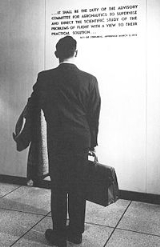
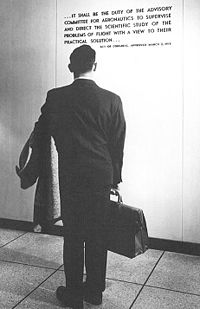
The act of Congress creating NACA, approved March 3, 1915, reads, "...It shall be the duty of the advisory committee for aeronautics to supervise and direct the scientific study of the problems of flight with a view to their practical solution...."
 On January 29, 1920, President Wilson appointed pioneering flier and aviation engineer Orville Wright to NACA's board. By the early 1920s, it had adopted a new and more ambitious mission: to promote military and civilian aviation through applied research that looked beyond current needs. NACA researchers pursued this mission through the agency's impressive collection of in-house wind tunnels, engine test stands, and flight test facilities. Commercial and military clients were also permitted to use NACA facilities on a contract basis.
Facilities
In 1922, NACA had 100 employees. By 1938, it had 426. In addition to formal assignments, staff were encouraged to pursue unauthorized "bootleg" research, provided that it was not too exotic. The result was a long string of fundamental breakthroughs, including "NACA engine cowl
" (1930s), the "NACA airfoil
" series (1940s), and the "area rule
" for supersonic aircraft (1950s). On the other hand, NACA's 1941 refusal to increase airspeed in their wind tunnels set Lockheed
back a year in their quest to solve the problem of compressibility in the P-38
.
The full-size 30 foot Langley wind tunnel operated at no more than 100 miles per hour (44.7 m/s) and the recent 7 foot tunnels at Moffett could only reach 250 mph (111.8 m/s). These were speeds Lockheed engineers considered useless for their purposes. Gen. 'Hap' Arnold
took up the matter and overruled NACA objections to higher air speeds. NACA built a handful of new high-speed wind tunnels, and Mach 0.75 (570 mph, 920 km/h) was reached at Moffett's 16 feet (4.9 m) wind tunnel late in 1942.
NACA claims credit for having the first aircraft to break the sound barrier (although the aircraft, the Bell X-1
, was controlled by the Air Force and flew with an Air Force pilot when it broke the sound barrier). They also claim credit for the first aircraft (X-15) that eventually flew to the "edge of space". NACA airfoils are still used on modern aircraft, up to the state of the art F-22 Raptor
jet fighter.
On September 30, 1946, five NACA engineers, headed by Walter C. Williams, arrived at Muroc Army Airfield (now Edwards AFB) from Langley Aeronautical Laboratory, VA, to prepare for X-1
supersonic
research flights in joint NACA-Army Air Forces program.
In 1951, Richard Whitcomb
determined the transonic area rule
that explained the physical rationale for transonic flow over an aircraft. This concept is now used in designing all transonic and supersonic aircraft.
The NACA experience provided a powerful model for World War II
research, the postwar government laboratories, and NACA's successor: the National Aeronautics and Space Administration.
 On 21 November 1957, Hugh Dryden
, NACA’s director, established the Special Committee on Space Technology.
The committee, also called the Stever Committee after its chairman, Guyford Stever
, was a special steering committee that was formed with the mandate to coordinate various branches of the Federal government, private companies as well as universities within the United States with NACA's objectives and also harness their expertise in order to develop a space program.
Remarkably, Hendrik Wade Bode
, the man who helped develop automatic radar-controlled artillery that brought down the Nazi
V-1 flying bomb
s over London
during World War II
, was actually serving in the same committee and sitting at the same table as Wernher von Braun who was head of the team which developed the V-2, the other weapon that terrorized London.
On March 5, 1958, James Killian
, who chaired the President's Science Advisory Committee
, wrote a memorandum to the President Dwight D. Eisenhower
. Titled, "Organization for Civil Space Programs," it encouraged the President to sanction the creation of NASA. He wrote that a civil space program should be based on a "strengthened and redesignated" NACA, indicating that NACA was a "going Federal research agency" with 7,500 employees and $300 million worth of facilities, which could expand its research program "with a minimum of delay."
in 1958, the NACA was abolished, and its research centers – Ames Research Center, Lewis Research Center, and Langley Aeronautical Laboratory – were incorporated within the new space and aeronautics agency along with some elements of the U.S. Army and U.S. Navy. In 1967, Congress directed NASA to form an Aerospace Safety Advisory Panel (ASAP) to advise the NASA Administrator on safety issues and hazards in NASA's aerospace programs. In addition, there were the Space Program Advisory Council and the Research and Technology Advisory Council.
In 1977, these were all combined to form the NASA Advisory Council (NAC) which is the successor to the National Advisory Committee for Aeronautics.
was formally dedicated at Langley on June 11, 1920. It was the first of many now-famous NACA and NASA wind tunnels. Although this specific wind tunnel was not unique or advanced, it enabled NACA engineers and scientists to develop and test new and advanced concepts in aerodynamics
and to improve future wind tunnel design.
United States
The United States of America is a federal constitutional republic comprising fifty states and a federal district...
federal agency founded on March 3, 1915 to undertake, promote, and institutionalize aeronautical research. On October 1, 1958 the agency was dissolved, and its assets and personnel transferred to the newly created National Aeronautics and Space Administration
NASA
The National Aeronautics and Space Administration is the agency of the United States government that is responsible for the nation's civilian space program and for aeronautics and aerospace research...
(NASA). NACA was pronounced as individual letters, rather than as an acronym.
NACA research and development
Research and development
The phrase research and development , according to the Organization for Economic Co-operation and Development, refers to "creative work undertaken on a systematic basis in order to increase the stock of knowledge, including knowledge of man, culture and society, and the use of this stock of...
produced the NACA duct
NACA duct
A NACA duct also sometimes called a NACA scoop or NACA Inlet, is a common form of low-drag air inlet design, originally developed by the U.S. National Advisory Committee for Aeronautics , the precursor to NASA, in 1945....
, a type of air intake used in modern automotive applications, the NACA cowling
NACA cowling
The NACA cowling is a type of aerodynamic fairing used to streamline radial engines for use on airplanes and developed by the National Advisory Committee for Aeronautics in 1927...
and several series of NACA airfoil
NACA airfoil
The NACA airfoils are airfoil shapes for aircraft wings developed by the National Advisory Committee for Aeronautics . The shape of the NACA airfoils is described using a series of digits following the word "NACA." The parameters in the numerical code can be entered into equations to precisely...
s which are still used in aircraft manufacturing.
Origins
World War I
World War I , which was predominantly called the World War or the Great War from its occurrence until 1939, and the First World War or World War I thereafter, was a major war centred in Europe that began on 28 July 1914 and lasted until 11 November 1918...
to promote industry/academic/government coordination on war-related projects. It was modeled on similar national agencies found in Europe. Such agencies were the French “L’Etablissement Central de l’Aérostation Militaire” in Meudon
Meudon
Meudon is a municipality in the southwestern suburbs of Paris, France. It is in the département of Hauts-de-Seine. It is located from the center of Paris.-Geography:...
(now Office National d'Etudes et de Recherches Aerospatiales
Office National d'Etudes et de Recherches Aerospatiales
Office National d'Études et de Recherches Aérospatiales or Onera is the French aerospace research center. It is a public establishment with industrial and commercial operations, and carries out application-oriented research to support enhanced innovation and competitiveness in the aerospace and...
), the German “Aerodynamical Laboratory of the University of Göttingen
Göttingen
Göttingen is a university town in Lower Saxony, Germany. It is the capital of the district of Göttingen. The Leine river runs through the town. In 2006 the population was 129,686.-General information:...
” and the Russian “Aerodynamic Institute of Koutchino”. However, the most influential agency upon which the NACA was based was the British “Advisory Committee for Aeronautics
Advisory Committee for Aeronautics
The Advisory Committee for Aeronautics was a United Kingdom agency founded on April 30, 1909 to undertake, promote, and institutionalize aeronautical research...
”.
In December 1912, President William Howard Taft
William Howard Taft
William Howard Taft was the 27th President of the United States and later the tenth Chief Justice of the United States...
had appointed a National Aerodynamical Laboratory Commission chaired by Robert S. Woodward, president of the Carnegie Institution of Washington. Legislation was introduced in both houses of Congress early in January 1913 to approve the commission, but when it came to a vote, the legislation was defeated.
Charles D. Walcott – secretary of the Smithsonian Institution
Smithsonian Institution
The Smithsonian Institution is an educational and research institute and associated museum complex, administered and funded by the government of the United States and by funds from its endowment, contributions, and profits from its retail operations, concessions, licensing activities, and magazines...
from 1907 to 1927 – took up the effort, and in January 1915, Senator Benjamin R. Tillman, and House Representative Ernest W. Roberts
Ernest W. Roberts
Ernest William Roberts was a U.S. Representative from Massachusetts.Born in East Madison, Maine, Roberts attended the public schools in Chelsea, Massachusetts....
, introduced identical resolutions recommending the creation of an advisory committee as outlined by Walcott. The purpose of the committee was "to supervise and direct the scientific study of the problems of flight with a view to their practical solution, and to determine the problems which should be experimentally attacked and to discuss their solution and their application to practical questions." Assistant Secretary of the Navy
Assistant Secretary of the Navy
Assistant Secretary of the Navy is the title given to certain civilian senior officials in the United States Department of the Navy....
Franklin D. Roosevelt
Franklin D. Roosevelt
Franklin Delano Roosevelt , also known by his initials, FDR, was the 32nd President of the United States and a central figure in world events during the mid-20th century, leading the United States during a time of worldwide economic crisis and world war...
wrote that he "heartily [endorsed] the principle" on which the legislation was based. Walcott then suggested the tactic of adding the resolution to the Naval Appropriations Bill.
According to one source, "The enabling legislation for the NACA slipped through almost unnoticed as a rider attached to the Naval Appropriation Bill, on 3 March 1915." The committee of 12 people, all unpaid, were allocated a budget of $5,000 per year.
President Woodrow Wilson
Woodrow Wilson
Thomas Woodrow Wilson was the 28th President of the United States, from 1913 to 1921. A leader of the Progressive Movement, he served as President of Princeton University from 1902 to 1910, and then as the Governor of New Jersey from 1911 to 1913...
signed it into law the same day, thus formally creating the Advisory Committee for Aeronautics, as it was called in the legislation, on the last day of the 63rd Congress.
The act of Congress creating NACA, approved March 3, 1915, reads, "...It shall be the duty of the advisory committee for aeronautics to supervise and direct the scientific study of the problems of flight with a view to their practical solution...."
Research at NACA
Facilities
- Langley Memorial Aeronautical Laboratory (Hampton, VirginiaHampton, VirginiaHampton is an independent city that is not part of any county in Southeast Virginia. Its population is 137,436. As one of the seven major cities that compose the Hampton Roads metropolitan area, it is on the southeastern end of the Virginia Peninsula. Located on the Hampton Roads Beltway, it hosts...
) - Ames Aeronautical Laboratory (Moffett Field)
- Aircraft Engine Research Laboratory (Lewis Research Center)
- Muroc Flight Test Unit (Edwards Air Force BaseEdwards Air Force BaseEdwards Air Force Base is a United States Air Force base located on the border of Kern County, Los Angeles County, and San Bernardino County, California, in the Antelope Valley. It is southwest of the central business district of North Edwards, California and due east of Rosamond.It is named in...
)
In 1922, NACA had 100 employees. By 1938, it had 426. In addition to formal assignments, staff were encouraged to pursue unauthorized "bootleg" research, provided that it was not too exotic. The result was a long string of fundamental breakthroughs, including "NACA engine cowl
NACA cowling
The NACA cowling is a type of aerodynamic fairing used to streamline radial engines for use on airplanes and developed by the National Advisory Committee for Aeronautics in 1927...
" (1930s), the "NACA airfoil
NACA airfoil
The NACA airfoils are airfoil shapes for aircraft wings developed by the National Advisory Committee for Aeronautics . The shape of the NACA airfoils is described using a series of digits following the word "NACA." The parameters in the numerical code can be entered into equations to precisely...
" series (1940s), and the "area rule
Area rule
The Whitcomb area rule, also called the transonic area rule, is a design technique used to reduce an aircraft's drag at transonic and supersonic speeds, particularly between Mach 0.75 and 1.2....
" for supersonic aircraft (1950s). On the other hand, NACA's 1941 refusal to increase airspeed in their wind tunnels set Lockheed
Lockheed Corporation
The Lockheed Corporation was an American aerospace company. Lockheed was founded in 1912 and later merged with Martin Marietta to form Lockheed Martin in 1995.-Origins:...
back a year in their quest to solve the problem of compressibility in the P-38
P-38 Lightning
The Lockheed P-38 Lightning was a World War II American fighter aircraft built by Lockheed. Developed to a United States Army Air Corps requirement, the P-38 had distinctive twin booms and a single, central nacelle containing the cockpit and armament...
.
The full-size 30 foot Langley wind tunnel operated at no more than 100 miles per hour (44.7 m/s) and the recent 7 foot tunnels at Moffett could only reach 250 mph (111.8 m/s). These were speeds Lockheed engineers considered useless for their purposes. Gen. 'Hap' Arnold
Henry H. Arnold
Henry Harley "Hap" Arnold was an American general officer holding the grades of General of the Army and later General of the Air Force. Arnold was an aviation pioneer, Chief of the Air Corps , Commanding General of the U.S...
took up the matter and overruled NACA objections to higher air speeds. NACA built a handful of new high-speed wind tunnels, and Mach 0.75 (570 mph, 920 km/h) was reached at Moffett's 16 feet (4.9 m) wind tunnel late in 1942.
NACA claims credit for having the first aircraft to break the sound barrier (although the aircraft, the Bell X-1
Bell X-1
The Bell X-1, originally designated XS-1, was a joint NACA-U.S. Army/US Air Force supersonic research project built by Bell Aircraft. Conceived in 1944 and designed and built over 1945, it eventually reached nearly 1,000 mph in 1948...
, was controlled by the Air Force and flew with an Air Force pilot when it broke the sound barrier). They also claim credit for the first aircraft (X-15) that eventually flew to the "edge of space". NACA airfoils are still used on modern aircraft, up to the state of the art F-22 Raptor
F-22 Raptor
The Lockheed Martin/Boeing F-22 Raptor is a single-seat, twin-engine fifth-generation supermaneuverable fighter aircraft that uses stealth technology. It was designed primarily as an air superiority fighter, but has additional capabilities that include ground attack, electronic warfare, and signals...
jet fighter.
On September 30, 1946, five NACA engineers, headed by Walter C. Williams, arrived at Muroc Army Airfield (now Edwards AFB) from Langley Aeronautical Laboratory, VA, to prepare for X-1
Bell X-1
The Bell X-1, originally designated XS-1, was a joint NACA-U.S. Army/US Air Force supersonic research project built by Bell Aircraft. Conceived in 1944 and designed and built over 1945, it eventually reached nearly 1,000 mph in 1948...
supersonic
Supersonic
Supersonic speed is a rate of travel of an object that exceeds the speed of sound . For objects traveling in dry air of a temperature of 20 °C this speed is approximately 343 m/s, 1,125 ft/s, 768 mph or 1,235 km/h. Speeds greater than five times the speed of sound are often...
research flights in joint NACA-Army Air Forces program.
In 1951, Richard Whitcomb
Richard Whitcomb
Richard T. Whitcomb , was an American aeronautical engineer noted for his significant contributions to the science of aerodynamics....
determined the transonic area rule
Area rule
The Whitcomb area rule, also called the transonic area rule, is a design technique used to reduce an aircraft's drag at transonic and supersonic speeds, particularly between Mach 0.75 and 1.2....
that explained the physical rationale for transonic flow over an aircraft. This concept is now used in designing all transonic and supersonic aircraft.
The NACA experience provided a powerful model for World War II
World War II
World War II, or the Second World War , was a global conflict lasting from 1939 to 1945, involving most of the world's nations—including all of the great powers—eventually forming two opposing military alliances: the Allies and the Axis...
research, the postwar government laboratories, and NACA's successor: the National Aeronautics and Space Administration.
Special Committee on Space Technology
Hugh Latimer Dryden
Hugh Latimer Dryden was an aeronautical scientist and civil servant. He served as NASA Deputy Administrator from August 19, 1958 until his death.-Biography:...
, NACA’s director, established the Special Committee on Space Technology.
The committee, also called the Stever Committee after its chairman, Guyford Stever
Guyford Stever
Horton Guyford Stever was an American administrator, physicist, educator, and engineer.-Biography:Stever was raised in Corning, New York, principally by his maternal grandmother. He played football in high school...
, was a special steering committee that was formed with the mandate to coordinate various branches of the Federal government, private companies as well as universities within the United States with NACA's objectives and also harness their expertise in order to develop a space program.
Remarkably, Hendrik Wade Bode
Hendrik Wade Bode
Hendrik Wade Bode , was an American engineer, researcher, inventor, author and scientist], of Dutch ancestry. As a pioneer of modern control theory and electronic telecommunications he revolutionized both the content and methodology of his chosen fields of research.He made important contributions...
, the man who helped develop automatic radar-controlled artillery that brought down the Nazi
Nazism
Nazism, the common short form name of National Socialism was the ideology and practice of the Nazi Party and of Nazi Germany...
V-1 flying bomb
V-1 flying bomb
The V-1 flying bomb, also known as the Buzz Bomb or Doodlebug, was an early pulse-jet-powered predecessor of the cruise missile....
s over London
London
London is the capital city of :England and the :United Kingdom, the largest metropolitan area in the United Kingdom, and the largest urban zone in the European Union by most measures. Located on the River Thames, London has been a major settlement for two millennia, its history going back to its...
during World War II
World War II
World War II, or the Second World War , was a global conflict lasting from 1939 to 1945, involving most of the world's nations—including all of the great powers—eventually forming two opposing military alliances: the Allies and the Axis...
, was actually serving in the same committee and sitting at the same table as Wernher von Braun who was head of the team which developed the V-2, the other weapon that terrorized London.
Transformation into NASA
On January 14, 1958, Dryden published "A National Research Program for Space Technology," which stated:On March 5, 1958, James Killian
James Rhyne Killian
Dr. James Rhyne Killian, Jr. was the 10th president of the Massachusetts Institute of Technology, from 1948 until 1959.-Career:...
, who chaired the President's Science Advisory Committee
President's Science Advisory Committee
In 1951 President of the United States Harry S. Truman established the Science Advisory Committee as part of the Office of Defense Mobilization . As a direct response to the launches of the Soviet artificial satellites, Sputnik 1 and Sputnik 2, on October 4 and November 3, 1957, the Science...
, wrote a memorandum to the President Dwight D. Eisenhower
Dwight D. Eisenhower
Dwight David "Ike" Eisenhower was the 34th President of the United States, from 1953 until 1961. He was a five-star general in the United States Army...
. Titled, "Organization for Civil Space Programs," it encouraged the President to sanction the creation of NASA. He wrote that a civil space program should be based on a "strengthened and redesignated" NACA, indicating that NACA was a "going Federal research agency" with 7,500 employees and $300 million worth of facilities, which could expand its research program "with a minimum of delay."
NASA Advisory Council
With the creation of NASANASA
The National Aeronautics and Space Administration is the agency of the United States government that is responsible for the nation's civilian space program and for aeronautics and aerospace research...
in 1958, the NACA was abolished, and its research centers – Ames Research Center, Lewis Research Center, and Langley Aeronautical Laboratory – were incorporated within the new space and aeronautics agency along with some elements of the U.S. Army and U.S. Navy. In 1967, Congress directed NASA to form an Aerospace Safety Advisory Panel (ASAP) to advise the NASA Administrator on safety issues and hazards in NASA's aerospace programs. In addition, there were the Space Program Advisory Council and the Research and Technology Advisory Council.
In 1977, these were all combined to form the NASA Advisory Council (NAC) which is the successor to the National Advisory Committee for Aeronautics.
NACA wind tunnels
NACA's first Wind tunnelWind tunnel
A wind tunnel is a research tool used in aerodynamic research to study the effects of air moving past solid objects.-Theory of operation:Wind tunnels were first proposed as a means of studying vehicles in free flight...
was formally dedicated at Langley on June 11, 1920. It was the first of many now-famous NACA and NASA wind tunnels. Although this specific wind tunnel was not unique or advanced, it enabled NACA engineers and scientists to develop and test new and advanced concepts in aerodynamics
Aerodynamics
Aerodynamics is a branch of dynamics concerned with studying the motion of air, particularly when it interacts with a moving object. Aerodynamics is a subfield of fluid dynamics and gas dynamics, with much theory shared between them. Aerodynamics is often used synonymously with gas dynamics, with...
and to improve future wind tunnel design.
- 5ft Atmospheric wind tunnel (1920)
- Variable Density TunnelVariable Density TunnelThe Variable Density Tunnel was a wind tunnel at NASA's Langley Research Center. It is a National Historic Landmark. It was the world's first variable density wind tunnel that allowed accurate testing with small-scale models...
(1922) - Propeller research tunnel (1927)
- 11in high speed wind tunnel (1928)
- 5ft vertical wind tunnel (1929)
- 7x10ft atmospheric wind tunnel (1930)
- Full Scale 30- by 60-Foot TunnelFull Scale 30- by 60-Foot TunnelThe Full-Scale Tunnel was a wind tunnel at NASA's Langley Research Center. It is a National Historic Landmark....
(1931)
NACA chairmen
- George P. Scriven (United States ArmyUnited States ArmyThe United States Army is the main branch of the United States Armed Forces responsible for land-based military operations. It is the largest and oldest established branch of the U.S. military, and is one of seven U.S. uniformed services...
) (1915–1916) - William F. DurandWilliam F. DurandWilliam F. Durand was a United States naval officer and pioneer mechanical engineer. He contributed significantly to the development of aircraft propellers...
(Stanford UniversityStanford UniversityThe Leland Stanford Junior University, commonly referred to as Stanford University or Stanford, is a private research university on an campus located near Palo Alto, California. It is situated in the northwestern Santa Clara Valley on the San Francisco Peninsula, approximately northwest of San...
) (1916–1918) - John R. Freeman (consultantConsultantA consultant is a professional who provides professional or expert advice in a particular area such as management, accountancy, the environment, entertainment, technology, law , human resources, marketing, emergency management, food production, medicine, finance, life management, economics, public...
) (1918–1919) - Charles Doolittle WalcottCharles Doolittle WalcottCharles Doolittle Walcott was an American invertebrate paleontologist. He became known for his discovery in 1909 of well-preserved fossils in the Burgess Shale of British Columbia, Canada.-Early life:...
(Smithsonian InstitutionSmithsonian InstitutionThe Smithsonian Institution is an educational and research institute and associated museum complex, administered and funded by the government of the United States and by funds from its endowment, contributions, and profits from its retail operations, concessions, licensing activities, and magazines...
) (1920–1927) - Joseph Sweetman AmesJoseph Sweetman AmesJoseph Sweetman Ames was a physics professor at Johns Hopkins University, provost of the university from 1926 until 1929, and university president from 1929 until 1935.He was born at Manchester, Vermont...
(Johns Hopkins UniversityJohns Hopkins UniversityThe Johns Hopkins University, commonly referred to as Johns Hopkins, JHU, or simply Hopkins, is a private research university based in Baltimore, Maryland, United States...
) (1927–1939) - Vannevar BushVannevar BushVannevar Bush was an American engineer and science administrator known for his work on analog computing, his political role in the development of the atomic bomb as a primary organizer of the Manhattan Project, the founding of Raytheon, and the idea of the memex, an adjustable microfilm viewer...
(Carnegie Institution) (1940–1941) - Jerome C. Hunsaker (NavyUnited States NavyThe United States Navy is the naval warfare service branch of the United States Armed Forces and one of the seven uniformed services of the United States. The U.S. Navy is the largest in the world; its battle fleet tonnage is greater than that of the next 13 largest navies combined. The U.S...
, MIT) (1941–1956) - James H. Doolittle (Shell Oil) (1957–1958)
Members of Special Committee on Space Technology
As of their meeting on 26 May 1958, committee members, starting clockwise from the left of the above picture:| Committee member | Title |
|---|---|
| Edward R. Sharp | Director of the Lewis Flight Propulsion Laboratory Glenn Research Center NASA John H. Glenn Research Center at Lewis Field is a NASA center, located within the cities of Brook Park, Cleveland and Fairview Park, Ohio between Cleveland Hopkins International Airport and the Cleveland Metroparks's Rocky River Reservation, and has other subsidiary facilities in Ohio... |
| Colonel Norman C Appold | Assistant to the Deputy Commander for Weapons Systems, Air Research and Development Command: US Air Force |
| Abraham Hyatt | Research and Analysis Officer Bureau of Aeronautics, Department of the Navy |
| Hendrik Wade Bode Hendrik Wade Bode Hendrik Wade Bode , was an American engineer, researcher, inventor, author and scientist], of Dutch ancestry. As a pioneer of modern control theory and electronic telecommunications he revolutionized both the content and methodology of his chosen fields of research.He made important contributions... |
Director of Research Physical Sciences, Bell Telephone Laboratories |
| W Randolph Lovelace II | Lovelace Foundation for Medication Education and Research |
| S. K Hoffman | General Manager, Rocketdyne Division, North American Aviation North American Aviation North American Aviation was a major US aerospace manufacturer, responsible for a number of historic aircraft, including the T-6 Texan trainer, the P-51 Mustang fighter, the B-25 Mitchell bomber, the F-86 Sabre jet fighter, the X-15 rocket plane, and the XB-70, as well as Apollo Command and Service... |
| Milton U Clauser | Director, Aeronautical Research Laboratory, The Ramo-Wooldridge Corporation |
| H. Julian Allen Harry Julian Allen Harry Julian Allen , also known as Harvey Allen, was an aeronautical engineer and a Director of the NASA Ames Research Center, most noted for his "Blunt Body Theory" of re-entry aerodynamics which permitted successful recovery of orbiting spacecraft. His technique is still used to this... |
Chief, High Speed Flight Research, NACA Ames |
| Robert R. Gilruth | Assistant Director, NACA Langley |
| J. R. Dempsey | Manager. Convair-Astronautics Convair Convair was an American aircraft manufacturing company which later expanded into rockets and spacecraft. The company was formed in 1943 by the merger of Vultee Aircraft and Consolidated Aircraft, and went on to produce a number of pioneering aircraft, such as the Convair B-36 bomber, and the F-102... (Division of General Dynamics General Dynamics General Dynamics Corporation is a U.S. defense conglomerate formed by mergers and divestitures, and as of 2008 it is the fifth largest defense contractor in the world. Its headquarters are in West Falls Church , unincorporated Fairfax County, Virginia, in the Falls Church area.The company has... ) |
| Carl B. Palmer | Secretary to Committee, NACA Headquarters |
| H. Guyford Stever Guyford Stever Horton Guyford Stever was an American administrator, physicist, educator, and engineer.-Biography:Stever was raised in Corning, New York, principally by his maternal grandmother. He played football in high school... |
Chairman, Associate Dean of Engineering, Massachusetts Institute of Technology Massachusetts Institute of Technology The Massachusetts Institute of Technology is a private research university located in Cambridge, Massachusetts. MIT has five schools and one college, containing a total of 32 academic departments, with a strong emphasis on scientific and technological education and research.Founded in 1861 in... |
| Hugh L. Dryden Hugh Latimer Dryden Hugh Latimer Dryden was an aeronautical scientist and civil servant. He served as NASA Deputy Administrator from August 19, 1958 until his death.-Biography:... |
(ex officio), Director, NACA |
| Dale R. Corson Dale R. Corson Dale R. Corson was the eighth president of Cornell University. Born in Pittsburg, Kansas, in 1914, Corson received a B.A. degree from the College of Emporia in 1934, his M.A. degree from the University of Kansas in 1935, and his Ph.D... |
Department of Physics, Cornell University Cornell University Cornell University is an Ivy League university located in Ithaca, New York, United States. It is a private land-grant university, receiving annual funding from the State of New York for certain educational missions... |
| Abe Silverstein Abe Silverstein Abraham "Abe" Silverstein was an American engineer who played an important part in the United States space program. He was a longtime manager at the National Aeronautics and Space Administration and its predecessor, the National Advisory Committee for Aeronautics... |
Associate Director, NACA Lewis |
| Wernher von Braun Wernher von Braun Wernher Magnus Maximilian, Freiherr von Braun was a German rocket scientist, aerospace engineer, space architect, and one of the leading figures in the development of rocket technology in Nazi Germany during World War II and in the United States after that.A former member of the Nazi party,... |
Director, Development Operations Division, Army Ballistic Missile Agency Army Ballistic Missile Agency The Army Ballistic Missile Agency was the agency formed to develop the US Army's first intermediate range ballistic missile. It was established at Redstone Arsenal on February 1, 1956 and commanded by Major General John B... |
Further reading
- John Henry, et al. Orders of Magnitude: A History of the NACA and NASA, 1915-1990.
- Alex Roland. Model Research: The National Advisory Committee for Aeronautics, 1915-1958.
- James Hansen. Engineer in Charge: A History of the Langley Aeronautical Laboratory, 1917-1958.
- Michael H. Gorn, Expanding the envelope – Flight Research at NACA and NASA.
External links
- The NASA Technical Reports Server provides access to a collection of 14,469 NACA documents dating from 1917.
- U.S. Centennial of Flight Commission – The National Advisory Committee for Aeronautics (NACA)
- More information on NACA airfoil series
- From Engineering Science to Big Science – The NACA and NASA Collier Trophy Research Project Winners, Edited by Pamela E. Mack