

Mithra

Encyclopedia
Mithra is the Zoroastrian
divinity
(yazata
) of covenant and oath
. In addition to being the divinity of contracts, Mithra is also a judicial figure, an all-seeing protector of Truth
, and the guardian of cattle, the harvest and of The Waters
.
The term Mithra is from the Avestan language
. In Middle Iranian languages (Middle Persian
, Parthian
etc.), Mithra became Mehr, Myhr etc., from which New Persian and Armenian
Mihr ultimately derive.
common noun mitra
, the Avestan common noun miθra derives from proto-Indo-Iranian *mitra
, from the root mi- "to bind", with the "tool suffix" -tra- "causing to." Thus, etymologically mitra/miθra means "that which causes binding", preserved in the Avestan word for "covenant, contract, oath".
scriptures as, "Mithra of wide pastures, of the thousand ears, and of the myriad eyes,"(Yasna 1:3), "the lofty, and the everlasting...the province ruler,"(Yasna 1:11), "the Yazad (divinity) of the spoken name"(Yasna 3:5), and "the holy,"(Yasna 3:13)
The Khorda Avesta (Book of Common Prayer) also refer to Mithra in the Litany to the Sun, "Homage to Mithra of wide cattle pastures,"(Khwarshed Niyayesh 5), "Whose word is true, who is of the assembly,Who has a thousand ears, the well-shaped one,Who has ten thousand eyes, the exalted one,Who has wide knowledge, the helpful one,Who sleeps not, the ever wakeful.We sacrifice to Mithra, The lord of all countries,Whom Ahura Mazda created the most glorious, Of the supernatural yazads. So may there come to us for aid, Both Mithra and Ahura, the two exalted ones,"(Khwarshed Niyayesh 6-7), "I shall sacrifice to his mace, well aimed against the skulls of the Daevas,"(Khwarshed Niyayesh 15). Some recent theories have claimed Mithra represents the sun itself, but the Khorda Avesta refers to the sun as a separate entity as well as the moon with which the sun has "the best of friendships,"(Khwarshed Niyayesh 15)
Like most other divinities, Mithra is not mentioned by name in the Gathas
, the oldest texts of Zoroastrianism and generally attributed to Zoroaster
himself. Mithra also does not appear by name in the Yasna Haptanghaiti
, a seven-verse section of the Yasna
liturgy that is linguistically as old as the Gathas. The lack of Mithra's presence in these texts was once a cause of some consternation amongst Iranists. An often repeated speculation of the first half of the 20th century was that the lack of any mention (i.e. Zoroaster's silence) of Mithra in these texts implied that Zoroaster had rejected Mithra. This ex silencio
speculation is no longer followed. Building on that speculation was another series of speculations that postulated that the reason why Zoroaster did not mention Mithra was because the latter was the supreme god of a bloodthirsty group of daeva
-worshipers that Zoroaster condemned. However, "no satisfactory evidence has yet been adduced to show that, before Zoroaster, the concept of a supreme god existed among the Iranians, or that among them Mithra – or any other divinity – ever enjoyed a separate cult of his or her own outside either their ancient or their Zoroastrian pantheons."
As a member of the ahuric triad
, a feature that only Ahura Mazda
and Ahura Berezaiti (Apam Napat
) also have, Mithra is an exalted figure. As the divinity of contract, Mithra is undeceivable, infallible, eternally watchful, and never-resting. Mithra is additionally the protector of cattle, and his stock epithet is "of wide pastures." He is guardian of the waters
and ensures that those pastures receive enough of it.
Together with Rashnu
"Justice" and Sraosha
"Obedience", Mithra is one of the three judges at the Chinvat bridge
, the "bridge of separation" that all souls must cross. Unlike Sraosha, Mithra is not however a psychopomp
. Should the good thoughts, words and deeds outweigh the bad, Sraosha alone conveys the soul across the bridge.
The Avestan hymn to Mithra (Yasht 10) is the longest, and one of the best preserved, of the Yasht
s.
 In the Zoroastrian calendar
, the sixteenth day of the month and the seventh month of the year are dedicated to, and under the protection of, Mithra. (The Iranian civil calendar
of 1925 adopted Zoroastrian month-names, and as such also has the seventh month of the year named 'Mihr'). The position of the sixteenth day and seventh month reflects the Mithra's rank in the hierarchy of the divinities; the sixteenth day and seventh month are respectively the first day of the second half of the month and the first month of the second half of the year. The day on which the day-name and month-name dedications intersect is (like all other such intersections) dedicated to the divinity of that day/month, and is celebrated with a Jashan (from Avestan Yasna, "worship") in honor of that divinity. In the case of Mithra this was Jashan-e Mihragan, or just Mihragan in short.
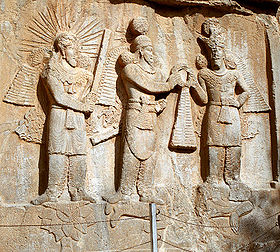
While Mithra is not the divinity of the Sun in Zoroastrian scripture (or in Indian scripture either), this being the role of Hvare.khshaeta
(literally "radiant Sun", whence also Middle Persian
Khorshed for the Sun), in Zoroastrian/Iranian tradition, Mithra became the divinity of the Sun. How, when or why this occurred is uncertain, but is commonly attributed to a conflation with Babylonian Shamash
, who – in addition to being a Sun god – was a judicial figure like Mithra. In the Hellenistic era
(i.e. in Seleucid
and Parthian
times), Mithra also seems to have been conflated with Apollo
, who – like Mithra – was an all-seeing divinity of the truth.
Royal names incorporating Mithra's (e.g. "Mithradates") appear in the dynasties of Parthia, Armenia, and in Anatolia, in Pontus and Cappadocia.
used the name of Mithra current in their time (Mihryazd, q.e. Mithra-yazata) for two different Manichaean angels.
German academic Werner Sundermann has asserted that the Manicheans adopted the name Mithra to designate one of their own deities. Sundermann determined that the Zoroastrian Mithra, which in Middle Persian
is Mihr (in Russian "Mir" = world), is not a variant of the Parthian and Sogdian
Mytr or Mytrg; though sharing linguistic roots with the name Mithra, those names denote Maitreya
.
In Parthian and Sogdian however Mihr was taken as the sun and consequently identified as the Third Messenger. This Third Messenger was the helper and redeemer of mankind, and identified with another Zoroastrian divinity Narisaf. Citing Boyce, Sundermann remarks, "It was among the Parthian Manicheans that Mithra as a sun god surpassed the importance of Narisaf as the common Iranian image of the Third Messenger; among the Parthians the dominance of Mithra was such that his identification with the Third Messenger led to cultic emphasis on the Mithraic traits in the Manichaean god."
Zoroastrianism
Zoroastrianism is a religion and philosophy based on the teachings of prophet Zoroaster and was formerly among the world's largest religions. It was probably founded some time before the 6th century BCE in Greater Iran.In Zoroastrianism, the Creator Ahura Mazda is all good, and no evil...
divinity
Divinity
Divinity and divine are broadly applied but loosely defined terms, used variously within different faiths and belief systems — and even by different individuals within a given faith — to refer to some transcendent or transcendental power or deity, or its attributes or manifestations in...
(yazata
Yazata
Yazata is the Avestan language word for a Zoroastrian concept. The word has a wide range of meanings but generally signifies a divinity...
) of covenant and oath
Oath
An oath is either a statement of fact or a promise calling upon something or someone that the oath maker considers sacred, usually God, as a witness to the binding nature of the promise or the truth of the statement of fact. To swear is to take an oath, to make a solemn vow...
. In addition to being the divinity of contracts, Mithra is also a judicial figure, an all-seeing protector of Truth
Asha
Asha is the Avestan language term for a concept of cardinal importance to Zoroastrian theology and doctrine. In the moral sphere, aša/arta represents what has been called "the decisive confessional concept of Zoroastrianism." ...
, and the guardian of cattle, the harvest and of The Waters
Aban
Apas is the Avestan language term for "the waters", which—in its innumerable aggregate states—is represented by the Apas, the hypostases of the waters....
.
The term Mithra is from the Avestan language
Avestan language
Avestan is an East Iranian language known only from its use as the language of Zoroastrian scripture, i.e. the Avesta, from which it derives its name...
. In Middle Iranian languages (Middle Persian
Middle Persian
Middle Persian , indigenously known as "Pârsig" sometimes referred to as Pahlavi or Pehlevi, is the Middle Iranian language/ethnolect of Southwestern Iran that during Sassanid times became a prestige dialect and so came to be spoken in other regions as well. Middle Persian is classified as a...
, Parthian
Parthian language
The Parthian language, also known as Arsacid Pahlavi and Pahlavanik, is a now-extinct ancient Northwestern Iranian language spoken in Parthia, a region of northeastern ancient Persia during the rule of the Parthian empire....
etc.), Mithra became Mehr, Myhr etc., from which New Persian and Armenian
Armenian language
The Armenian language is an Indo-European language spoken by the Armenian people. It is the official language of the Republic of Armenia as well as in the region of Nagorno-Karabakh. The language is also widely spoken by Armenian communities in the Armenian diaspora...
Mihr ultimately derive.
Etymology
Together with the VedicHistorical Vedic religion
The religion of the Vedic period is a historical predecessor of Hinduism. Its liturgy is reflected in the mantra portion of the four Vedas, which are compiled in Sanskrit. The religious practices centered on a clergy administering rites...
common noun mitra
Mitra (Vedic)
This article is about the Vedic deity Mitra. For other divinities with related names, see the general article Mitra.Mitra is an important divinity of Indic culture, and the patron divinity of honesty, friendship, contracts and meetings...
, the Avestan common noun miθra derives from proto-Indo-Iranian *mitra
Mitra
*Mitra was an important Indo-Iranian divinity. Following the prehistoric cultural split of Indo-Aryan and Iranian cultures, names descended from *mitra were used for the following religious entities:...
, from the root mi- "to bind", with the "tool suffix" -tra- "causing to." Thus, etymologically mitra/miθra means "that which causes binding", preserved in the Avestan word for "covenant, contract, oath".
In scripture
Mithra is described in the Zoroastrian AvestaAvesta
The Avesta is the primary collection of sacred texts of Zoroastrianism, composed in the Avestan language.-Early transmission:The texts of the Avesta — which are all in the Avestan language — were composed over the course of several hundred years. The most important portion, the Gathas,...
scriptures as, "Mithra of wide pastures, of the thousand ears, and of the myriad eyes,"(Yasna 1:3), "the lofty, and the everlasting...the province ruler,"(Yasna 1:11), "the Yazad (divinity) of the spoken name"(Yasna 3:5), and "the holy,"(Yasna 3:13)
The Khorda Avesta (Book of Common Prayer) also refer to Mithra in the Litany to the Sun, "Homage to Mithra of wide cattle pastures,"(Khwarshed Niyayesh 5), "Whose word is true, who is of the assembly,Who has a thousand ears, the well-shaped one,Who has ten thousand eyes, the exalted one,Who has wide knowledge, the helpful one,Who sleeps not, the ever wakeful.We sacrifice to Mithra, The lord of all countries,Whom Ahura Mazda created the most glorious, Of the supernatural yazads. So may there come to us for aid, Both Mithra and Ahura, the two exalted ones,"(Khwarshed Niyayesh 6-7), "I shall sacrifice to his mace, well aimed against the skulls of the Daevas,"(Khwarshed Niyayesh 15). Some recent theories have claimed Mithra represents the sun itself, but the Khorda Avesta refers to the sun as a separate entity as well as the moon with which the sun has "the best of friendships,"(Khwarshed Niyayesh 15)
Like most other divinities, Mithra is not mentioned by name in the Gathas
Gathas
The Gathas are 17 hymns believed to have been composed by Zarathusthra himself. They are the most sacred texts of the Zoroastrian faith.-Structure and organization:...
, the oldest texts of Zoroastrianism and generally attributed to Zoroaster
Zoroaster
Zoroaster , also known as Zarathustra , was a prophet and the founder of Zoroastrianism who was either born in North Western or Eastern Iran. He is credited with the authorship of the Yasna Haptanghaiti as well as the Gathas, hymns which are at the liturgical core of Zoroastrianism...
himself. Mithra also does not appear by name in the Yasna Haptanghaiti
Yasna Haptanghaiti
The Yasna Haptanghaiti , Avestan for "Worship in Seven Chapters," is a set of 7 hymns within the greater Yasna collection, that is, within the primary liturgical texts of the Zoroastrian Avesta.-Age and importance:...
, a seven-verse section of the Yasna
Yasna
Yasna is the name of the primary liturgical collection of texts of the Avesta as well as the name of the principal Zoroastrian act of worship at which those verses are recited. The Yasna, or Izeshne, is primarily the name of the ceremony in which the entire book is recited and appropriate...
liturgy that is linguistically as old as the Gathas. The lack of Mithra's presence in these texts was once a cause of some consternation amongst Iranists. An often repeated speculation of the first half of the 20th century was that the lack of any mention (i.e. Zoroaster's silence) of Mithra in these texts implied that Zoroaster had rejected Mithra. This ex silencio
Argument from silence
The argument from silence is generally a conclusion based on silence of opponent, failing to give evidence. In the field of classical studies, it often refers to the deduction from the lack of references to a subject in the available writings of an author to the conclusion that he was ignorant of it...
speculation is no longer followed. Building on that speculation was another series of speculations that postulated that the reason why Zoroaster did not mention Mithra was because the latter was the supreme god of a bloodthirsty group of daeva
Daeva
Daeva in Avestan language meaning "a being of shining light", is a term for a particular sort of supernatural entity with disagreeable characteristics. Equivalents in Iranian languages include Pashto dêw , Baluchi dêw , Persian dīv , Kurdish dêw...
-worshipers that Zoroaster condemned. However, "no satisfactory evidence has yet been adduced to show that, before Zoroaster, the concept of a supreme god existed among the Iranians, or that among them Mithra – or any other divinity – ever enjoyed a separate cult of his or her own outside either their ancient or their Zoroastrian pantheons."
As a member of the ahuric triad
Ahura
Ahura is an Avestan language designation for a particular class of Zoroastrian divinities.-Etymology:Avestan ahura derives from Indo-Iranian *asura, also attested in an Indian context as RigVedic asura...
, a feature that only Ahura Mazda
Ahura Mazda
Ahura Mazdā is the Avestan name for a divinity of the Old Iranian religion who was proclaimed the uncreated God by Zoroaster, the founder of Zoroastrianism...
and Ahura Berezaiti (Apam Napat
Burz
Burz is the middle Persian name for the Indo-Iranian divinity of waters. Burz is also known as Ahura Berezant in the texts of the Avesta, and also as Apam Napat in Avestan and Vedic Sanskrit...
) also have, Mithra is an exalted figure. As the divinity of contract, Mithra is undeceivable, infallible, eternally watchful, and never-resting. Mithra is additionally the protector of cattle, and his stock epithet is "of wide pastures." He is guardian of the waters
Aban
Apas is the Avestan language term for "the waters", which—in its innumerable aggregate states—is represented by the Apas, the hypostases of the waters....
and ensures that those pastures receive enough of it.
Together with Rashnu
Rashnu
Rashnu is the Avestan language name of the Zoroastrian yazata of justice. Together with Mithra and Sraosha, Rashnu is one of the three judges who pass judgment on the souls of people after death...
"Justice" and Sraosha
Sraosha
Sraosha is the Avestan language name of the Zoroastrian divinity of "Obedience" or "Observance", which is also the literal meaning of her name....
"Obedience", Mithra is one of the three judges at the Chinvat bridge
Chinvat bridge
The Chinvat Bridge in Zoroastrianism is the bridge which separates the world of the living from the world of the dead. All souls must cross the bridge upon death....
, the "bridge of separation" that all souls must cross. Unlike Sraosha, Mithra is not however a psychopomp
Psychopomp
Psychopomps are creatures, spirits, angels, or deities in many religions whose responsibility is to escort newly deceased souls to the afterlife. Their role is not to judge the deceased, but simply provide safe passage...
. Should the good thoughts, words and deeds outweigh the bad, Sraosha alone conveys the soul across the bridge.
The Avestan hymn to Mithra (Yasht 10) is the longest, and one of the best preserved, of the Yasht
Yasht
The s are a collection of twenty-one hymns in Younger Avestan. Each of these hymns invokes a specific Zoroastrian divinity or concept. Yasht chapter and verse pointers are traditionally abbreviated as Yt....
s.
In tradition
Zoroastrian calendar
This article treats of the reckoning of days, months and years in the calendar used by adherents of the Zoroastrian faith. Zoroastrian religious festivals are discussed elsewhere, but have a fixed relationship to Nawruz, the New Year festival, whose timing is discussed below...
, the sixteenth day of the month and the seventh month of the year are dedicated to, and under the protection of, Mithra. (The Iranian civil calendar
Iranian calendar
The Iranian calendars or sometimes called Persian calendars are a succession of calendars invented or used for over two millennia in Greater Iran...
of 1925 adopted Zoroastrian month-names, and as such also has the seventh month of the year named 'Mihr'). The position of the sixteenth day and seventh month reflects the Mithra's rank in the hierarchy of the divinities; the sixteenth day and seventh month are respectively the first day of the second half of the month and the first month of the second half of the year. The day on which the day-name and month-name dedications intersect is (like all other such intersections) dedicated to the divinity of that day/month, and is celebrated with a Jashan (from Avestan Yasna, "worship") in honor of that divinity. In the case of Mithra this was Jashan-e Mihragan, or just Mihragan in short.
While Mithra is not the divinity of the Sun in Zoroastrian scripture (or in Indian scripture either), this being the role of Hvare.khshaeta
Hvare-khshaeta
Hvare.khshaeta is the Avestan language name of the Zoroastrian divinity of the "Radiant Sun."Avestan Hvare khshaeta is a compound in which hvar "Sun" has khshaeta "radiant" as a stock epithet. Avestan hvar derives from the Indo-Iranian root *svar "to shine," from which Vedic Sanskrit Surya - again...
(literally "radiant Sun", whence also Middle Persian
Middle Persian
Middle Persian , indigenously known as "Pârsig" sometimes referred to as Pahlavi or Pehlevi, is the Middle Iranian language/ethnolect of Southwestern Iran that during Sassanid times became a prestige dialect and so came to be spoken in other regions as well. Middle Persian is classified as a...
Khorshed for the Sun), in Zoroastrian/Iranian tradition, Mithra became the divinity of the Sun. How, when or why this occurred is uncertain, but is commonly attributed to a conflation with Babylonian Shamash
Shamash
Shamash was a native Mesopotamian deity and the sun god in the Akkadian, Assyrian and Babylonian pantheons. Shamash was the god of justice in Babylonia and Assyria, corresponding to Sumerian Utu...
, who – in addition to being a Sun god – was a judicial figure like Mithra. In the Hellenistic era
Hellenistic civilization
Hellenistic civilization represents the zenith of Greek influence in the ancient world from 323 BCE to about 146 BCE...
(i.e. in Seleucid
Seleucid Empire
The Seleucid Empire was a Greek-Macedonian state that was created out of the eastern conquests of Alexander the Great. At the height of its power, it included central Anatolia, the Levant, Mesopotamia, Persia, today's Turkmenistan, Pamir and parts of Pakistan.The Seleucid Empire was a major centre...
and Parthian
Parthian Empire
The Parthian Empire , also known as the Arsacid Empire , was a major Iranian political and cultural power in ancient Persia...
times), Mithra also seems to have been conflated with Apollo
Apollo
Apollo is one of the most important and complex of the Olympian deities in Greek and Roman mythology...
, who – like Mithra – was an all-seeing divinity of the truth.
Royal names incorporating Mithra's (e.g. "Mithradates") appear in the dynasties of Parthia, Armenia, and in Anatolia, in Pontus and Cappadocia.
In Manichaeism
Persian and Parthian-speaking ManichaeansManichaeism
Manichaeism in Modern Persian Āyin e Māni; ) was one of the major Iranian Gnostic religions, originating in Sassanid Persia.Although most of the original writings of the founding prophet Mani have been lost, numerous translations and fragmentary texts have survived...
used the name of Mithra current in their time (Mihryazd, q.e. Mithra-yazata) for two different Manichaean angels.
- The first, called Mihryazd by the Persians, was the "The Living Spirit" (Aramaic ), a savior-figure who rescues the "First Man" from the demonic Darkness into which he had plunged.
- The second, known as Mihr or Mihr yazd among the Parthians, is "The Messenger" (Aramaic īzgaddā), likewise a savior figure, but one concerned with setting up the structures to liberate the Light lost when the First Man had been defeated.
German academic Werner Sundermann has asserted that the Manicheans adopted the name Mithra to designate one of their own deities. Sundermann determined that the Zoroastrian Mithra, which in Middle Persian
Middle Persian
Middle Persian , indigenously known as "Pârsig" sometimes referred to as Pahlavi or Pehlevi, is the Middle Iranian language/ethnolect of Southwestern Iran that during Sassanid times became a prestige dialect and so came to be spoken in other regions as well. Middle Persian is classified as a...
is Mihr (in Russian "Mir" = world), is not a variant of the Parthian and Sogdian
Sogdian language
The Sogdian language is a Middle Iranian language that was spoken in Sogdiana , located in modern day Uzbekistan and Tajikistan ....
Mytr or Mytrg; though sharing linguistic roots with the name Mithra, those names denote Maitreya
Maitreya
Maitreya , Metteyya , or Jampa , is foretold as a future Buddha of this world in Buddhist eschatology. In some Buddhist literature, such as the Amitabha Sutra and the Lotus Sutra, he or she is referred to as Ajita Bodhisattva.Maitreya is a bodhisattva who in the Buddhist tradition is to appear on...
.
In Parthian and Sogdian however Mihr was taken as the sun and consequently identified as the Third Messenger. This Third Messenger was the helper and redeemer of mankind, and identified with another Zoroastrian divinity Narisaf. Citing Boyce, Sundermann remarks, "It was among the Parthian Manicheans that Mithra as a sun god surpassed the importance of Narisaf as the common Iranian image of the Third Messenger; among the Parthians the dominance of Mithra was such that his identification with the Third Messenger led to cultic emphasis on the Mithraic traits in the Manichaean god."