

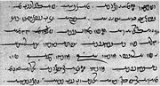
Yasna

Encyclopedia
Yasna is the name of the primary liturgical collection of texts of the Avesta
as well as the name of the principal Zoroastrian
act of worship at which those verses are recited. The Yasna, or Izeshne, is primarily the name of the ceremony in which the entire book is recited and appropriate liturgical actions performed. In its normal form, this ceremony can only be performed in the morning.
A well-trained priest is able to recite the entire Yasna in about two hours. (Stausberg, 2004:337,n131) With extensions, it takes about an hour longer. Yasna chapter and verse pointers are traditionally abbreviated with Y.
, the "offering to waters". The Yasna ceremony may be extended by recitation of the Visperad
and Vendidad
.
As the name of the service, the term Yasna is linguistically (but not functionally) cognate with Vedic
Yajna
. Unlike Vedic Yajna, Zoroastrian Yasna has "to do with water rather than fire" (Drower, 1944:78; Boyce, 1975:147-191)
Avesta
The Avesta is the primary collection of sacred texts of Zoroastrianism, composed in the Avestan language.-Early transmission:The texts of the Avesta — which are all in the Avestan language — were composed over the course of several hundred years. The most important portion, the Gathas,...
as well as the name of the principal Zoroastrian
Zoroastrianism
Zoroastrianism is a religion and philosophy based on the teachings of prophet Zoroaster and was formerly among the world's largest religions. It was probably founded some time before the 6th century BCE in Greater Iran.In Zoroastrianism, the Creator Ahura Mazda is all good, and no evil...
act of worship at which those verses are recited. The Yasna, or Izeshne, is primarily the name of the ceremony in which the entire book is recited and appropriate liturgical actions performed. In its normal form, this ceremony can only be performed in the morning.
A well-trained priest is able to recite the entire Yasna in about two hours. (Stausberg, 2004:337,n131) With extensions, it takes about an hour longer. Yasna chapter and verse pointers are traditionally abbreviated with Y.
The service
The Yasna service, that is, the recitation of the Yasna texts, culminates in the Ab-ZohrAb-Zohr
The Ab-Zohr is the culminating rite of the greater Yasna service, the principal Zoroastrian act of worship that accompanies the recitation of the Yasna liturgy....
, the "offering to waters". The Yasna ceremony may be extended by recitation of the Visperad
Visperad
Visperad or Visprad is either a particular Zoroastrian religious ceremony, or the name given to a passage collection within the greater Avesta compendium of texts....
and Vendidad
Vendidad
The Vendidad or Videvdat is a collection of texts within the greater compendium of the Avesta. However, unlike the other texts of the Avesta, the Vendidad is an ecclesiastical code, not a liturgical manual.-Name:...
.
As the name of the service, the term Yasna is linguistically (but not functionally) cognate with Vedic
Historical Vedic religion
The religion of the Vedic period is a historical predecessor of Hinduism. Its liturgy is reflected in the mantra portion of the four Vedas, which are compiled in Sanskrit. The religious practices centered on a clergy administering rites...
Yajna
Yajna
In Hinduism, yajna is a ritual of sacrifice derived from the practice of Vedic times. It is performed to please the gods or to attain certain wishes...
. Unlike Vedic Yajna, Zoroastrian Yasna has "to do with water rather than fire" (Drower, 1944:78; Boyce, 1975:147-191)
The liturgy
 Kushti Kushti is the sacred girdle worn by Zoroastrians around their waists. Along with the Sedreh, the Kushti is part of the ritual dress of the Zoroastrians.... the sacred girdle worn around the waist - represent the 72 chapters of the Yasna. The collection includes the 17 chapters of the Gathas Gathas The Gathas are 17 hymns believed to have been composed by Zarathusthra himself. They are the most sacred texts of the Zoroastrian faith.-Structure and organization:... , the oldest and most sacred texts of the Zoroastrian canon. Some sections of the Yasna occur more than once. For instance, Yasna 5 is repeated as Yasna 37, and Yasna 63 consists of passages from Yasna 15.2, 66.2 and 38.3. The ability to recite the Yasna from memory is one of the prerequisites for Zoroastrian priesthood. |
Content and organization
- Yasna 1 opens with the praise of Ahura MazdaAhura MazdaAhura Mazdā is the Avestan name for a divinity of the Old Iranian religion who was proclaimed the uncreated God by Zoroaster, the founder of Zoroastrianism...
, enumerating his divine titles as the Creator, "radiant, glorious, the greatest, the best, the most beautiful, the most firm, the most wise, of the most perfect form, the highest in righteousness, possessed of great joy, æssshat, fashioner, nourisher, and the Most Holy Spirit." (Dhalla, 1936:155). Yasna 1 then enumerates the divinities, inviting them to the service. - Yasna 2, the Barsom Yasht, presents libation and the barsom (a bundle of 23 twigs bound together, symbolizing sanctity) to the invited divinities. Yasna 2-4 complement Yasna 1. Most verses in Yasna 2-3 begin with the formula ayese yeshti …, "by means of this sacrifice, I call …", followed by the name of the divinity being invoked.
- Yasna 3-8 known collectively as the Sarosh dron, presents other offerings (zaothra). Yasna 3 draws the attention of the divinities invoked in Yasna 1, and in Yasna 4, the offerings are consecrated to the divinities. Yasna 5 is repeated in Yasna 37. Yasna 6 is almost identical to the first 10 verses of Yasna 17.
- Yasna 9-11 is the Hom Yasht, a collection of eulogies to the HaomaHaomaHaoma is the Avestan language name of a plant and its divinity, both of which play a role in Zoroastrian doctrine and in later Persian culture and mythology. The Middle Persian form of the name is hōm, which continues to be the name in Modern Persian and other living Iranian languages.Sacred haoma...
plant and its divinity.
- Yasna 12 constitutes the Fravarane, the Zoroastrian creed and declaration of faith. It is in "Artificial" Gathic Avestan, that is, it is stylistically and linguistically aligned with the language of the GathasGathasThe Gathas are 17 hymns believed to have been composed by Zarathusthra himself. They are the most sacred texts of the Zoroastrian faith.-Structure and organization:...
, but imperfectly. The last strophe of verse 7 as well as all of verses 8 and 9 are incorporated into the Kusti ritual.
- Yasna 13-18 are comparable to Yasna 1-8 in that they too are a collection of invocations to the divinities. Chapters 14-18 serve as an introduction to the Staota Yesniia of Yasna 19-59. The first 10 verses of Yasna 17, "to the fires, waters, plants", is almost identical to Yasna 6.
- Yasna 19-21, the Bhagan Yasht, are commentaries on the three 'high prayers' of Yasna 28-53.
- Yasna 22-26 is another set of invocations to the divinities.
- Yasna 27 has the prayers referred to by Yasna 19-21. These are:
- The Ahuna VairyaAhuna VairyaAhuna Vairya is the Avestan language name of the most sacred of the Gathic hymns of the Avesta, the revered texts of Zoroastrianism....
invocation (also known as the Yatha Ahu Vairyo), the most sacred of all Zoroastrian prayers. - The Ashem VohuAshem VohuAshem Vohu is one of two very important prayers in Zoroastrianism. The Ashem Vohu, after the Ahunavar is considered one of the basic, yet meaningful and powerful mantras in the religion. It is also at the end of most of the prayers in the Khordeh Avesta, except a certain few, most notably the...
- The Yenghe hatam
- The Ahuna Vairya
- Yasna 28-53 include the (linguistically) oldest texts of the Zoroastrian canon. 17 of the 26 chapters make up the GathasGathasThe Gathas are 17 hymns believed to have been composed by Zarathusthra himself. They are the most sacred texts of the Zoroastrian faith.-Structure and organization:...
, the most sacred hymns of Zoroastrianism and thought to have been composed by ZoroasterZoroasterZoroaster , also known as Zarathustra , was a prophet and the founder of Zoroastrianism who was either born in North Western or Eastern Iran. He is credited with the authorship of the Yasna Haptanghaiti as well as the Gathas, hymns which are at the liturgical core of Zoroastrianism...
himself. The Gathas are in verse. These are structurally interrupted by a) the Yasna Haptanghaiti ("seven-chapter Yasna", #35-41), which is as old as the Gathas but in prose, b) two short chapters (#42 and #52) that are not as old as the Gathas and Yasna Haptanghaiti.- Yasna 28-34: Ahunavaiti GathaGathasThe Gathas are 17 hymns believed to have been composed by Zarathusthra himself. They are the most sacred texts of the Zoroastrian faith.-Structure and organization:...
- Yasna 35-41: Yasna HaptanghaitiYasna HaptanghaitiThe Yasna Haptanghaiti , Avestan for "Worship in Seven Chapters," is a set of 7 hymns within the greater Yasna collection, that is, within the primary liturgical texts of the Zoroastrian Avesta.-Age and importance:...
, the "seven-chapter Yasna", also in Gathic Avestan but in prose. - Yasna 42: a 4 verse chapter invoking the elements.
- Yasna 43-46: Ushtavait GathaGathasThe Gathas are 17 hymns believed to have been composed by Zarathusthra himself. They are the most sacred texts of the Zoroastrian faith.-Structure and organization:...
- Yasna 47-50: Spenta Mainyu GathaGathasThe Gathas are 17 hymns believed to have been composed by Zarathusthra himself. They are the most sacred texts of the Zoroastrian faith.-Structure and organization:...
- Yasna 51: Vohu Khshathra GathaGathasThe Gathas are 17 hymns believed to have been composed by Zarathusthra himself. They are the most sacred texts of the Zoroastrian faith.-Structure and organization:...
- Yasna 52: an 8 verse hymn to AshiAshiRav Ashi was a celebrated Jewish religious scholar, a Babylonian amora, who reestablished the academy at Sura and was first editor of the Babylonian Talmud...
. Verses 52.5 - 52.8, in Younger Avestan, are a duplicate of Yasna 8.5 - 8.8. - Yasna 53: Vahishto Ishti GathaGathasThe Gathas are 17 hymns believed to have been composed by Zarathusthra himself. They are the most sacred texts of the Zoroastrian faith.-Structure and organization:...
- Yasna 28-34: Ahunavaiti Gatha
- Yasna 54 has the text of the a airiiema ishiioAiryaman ishyaThe airyaman ishya is Zoroastrianism's fourth of the four Gathic Avestan invocations.-Name:The prayer is named after its opening words, ā airyə̄mā išyō. In present-day Zoroastrian usage, the airyama of these opening words are considered to be an invocation of the divinity Airyaman, the yazata of...
, a prayer referred to in Yasna 27.
- Yasna 55 is a praise to the Gathas and the Staota Yesniia.
- Yasna 56 is again an invocation to the divinities, appealing for their attention.
- Yasna 57 is the Sarosh Yasht, the hymn to the divinity of religious discipline. It is closely related to, and appears to have sections borrowed from Yasht 10, the hymn to MithraMithraMithra is the Zoroastrian divinity of covenant and oath. In addition to being the divinity of contracts, Mithra is also a judicial figure, an all-seeing protector of Truth, and the guardian of cattle, the harvest and of The Waters....
. - Yasna 58 is again a "hidden" Yasht, here to the genius of prayer (cf. Dahman).
- Yasna 59 is a repetition of the sections from Yasna 17 and 26.
- Yasna 60 is blessing upon the house of the ashavanAshavanAvestan ashavan is a Zoroastrian theological term. It literally means "possessing aša", hence "possessing truth" or "possessing righteousness", but has further implications:...
('just' or 'true' man). Yasna 60.2-7 constitute the Dahma Afriti invocation, also known as the Afrinagan Dahman. - Yasna 61 praises the anti-demonic powers imbued in the Afrinagan Dahman, Yenghe hatam and the three principal prayers of Yasna 27.
- Yasna 62 constitutes the AtakshAtarAtar is the Zoroastrian concept of holy fire, sometimes described in abstract terms as "burning and unburning fire" or "visible and invisible fire" ....
Nyashes, prayers to fire and its divinity. - Yasna 63-69 constitute the prayers that accompany the Ab-ZohrAb-ZohrThe Ab-Zohr is the culminating rite of the greater Yasna service, the principal Zoroastrian act of worship that accompanies the recitation of the Yasna liturgy....
, "offering to water". - Yasna 70-72 are again a set of invocations to the divinities.
External links
- Translations of the Yasna liturgy now in the public domain:
- Complete YASNA
- at avesta.org (organized by chapter).
- at sacred-texts.com (plain text).