


Mendelian inheritance

Encyclopedia
Mendelian inheritance is a scientific description of how hereditary
characteristics are passed from parent organisms to their offspring; it underlies much of genetics
. This theoretical framework was initially derived from the work of Gregor Johann Mendel published in 1865 and 1866 which was re-discovered in 1900; it was initially very controversial. When Mendel's theories were integrated with the chromosome theory of inheritance by Thomas Hunt Morgan
in 1915, they became the core of classical genetics
.
Priest
/monk conducting hybridization experiments in garden peas (Pisum sativum). Between 1856 and 1863, he cultivated and tested some 29,000 pea plants. From these experiments he deduced two generalizations which later became known as Mendel's Principles of Heredity or Mendelian inheritance. He described these principles in a two part paper, Experiments on Plant Hybridization
that he read to the Natural History Society of Brno
on February 8 and March 8, 1865, and which was published in 1866.
Mendel's conclusions were largely ignored. Although they were not completely unknown to biologists of the time, they were not seen as generally applicable, even by Mendel himself, who thought they only applied to certain categories of species or traits. A major block to understanding their significance was the importance attached by 19th century biologists to the apparent blending of inherited traits in the overall appearance of the progeny, now known to be due to multigene interactions, in contrast to the organ-specific binary characters studied by Mendel. In 1900, however, his work was "re-discovered" by three European scientists, Hugo de Vries
, Carl Correns
, and Erich von Tschermak
. The exact nature of the "re-discovery" has been somewhat debated: De Vries published first on the subject, mentioning Mendel in a footnote, while Correns pointed out Mendel's priority after having read De Vries's paper and realizing that he himself did not have priority. De Vries may not have acknowledged truthfully how much of his knowledge of the laws came from his own work, or came only after reading Mendel's paper. Later scholars have accused Von Tschermak of not truly understanding the results at all.
Regardless, the "re-discovery" made Mendelism an important but controversial theory. Its most vigorous promoter in Europe was William Bateson
, who coined the term "genetics
" and "allele
" to describe many of its tenets. The model of heredity was highly contested by other biologists because it implied that heredity was discontinuous, in opposition to the apparently continuous variation observable for many traits. Many biologists also dismissed the theory because they were not sure it would apply to all species. However later work by biologists and statisticians such as R.A. Fisher showed that if multiple Mendelian factors were involved in the expression of an individual trait, they could produce the diverse results observed. Thomas Hunt Morgan
and his assistants later integrated the theoretical model of Mendel with the chromosome theory of inheritance, in which the chromosome
s of cell
s were thought to hold the actual hereditary material, and create what is now known as classical genetics
, which was extremely successful and cemented Mendel's place in history.
Mendel's findings allowed other scientists to predict the expression of traits on the basis of mathematical probabilities. A large contribution to Mendel's success can be traced to his decision to start his crosses only with plants he demonstrated were true-breeding. He also only measured absolute (binary) characteristics, such as color, shape, and position of the offspring, rather than quantitative characteristics. He expressed his results numerically and subjected them to statistical analysis. His method of data analysis and his large sample size
gave credibility to his data. He also had the foresight to follow several successive generations (f2, f3) of his pea plants and record their variations. Finally, he performed "test crosses" (back-crossing descendants of the initial hybridization to the initial true-breeding lines) to reveal the presence and proportion of recessive characters. Without his hard work and careful attention to procedure and detail, Mendel's work could not have had the impact it made on the world of genetics.
Mendel stated that each individual has two factors for each trait, one from each parent. The two factors may or may not contain the same information. If the two factors are identical, the individual is called homozygous for the trait. If the two factors have different information, the individual is called heterozygous. The alternative forms of a factor are called alleles. The genotype of an individual is made up of the many alleles it possesses. An individual's physical appearance, or phenotype, is determined by its alleles as well as by its environment. An individual possesses two alleles for each trait; one allele is given by the female parent and the other by the male parent. They are passed on when an individual matures and produces gametes: egg and sperm. When gametes form, the paired alleles separate randomly so that each gamete receives a copy of one of the two alleles. The presence of an allele doesn't promise that the trait will be expressed in the individual that possesses it. In heterozygous individuals the only allele that is expressed is the dominant. The recessive allele is present but its expression is hidden.
Mendel summarized his findings in two laws; the Law of Segregation and the Law of Independent Assortment.
s for any particular trait and that each parent passes a randomly selected copy (allele) of only one of these to its offspring. The offspring then receives its own pair of alleles for that trait. Whichever of the two alleles in the offspring is dominant determines how the offspring expresses that trait (e.g. the color of a plant, the color of an animal's fur, the color of a person's eyes).
More precisely the law states that when any individual produces gametes
, the copies of a gene
separate so that each gamete receives only one copy (allele). A gamete will receive one allele
or the other. The direct proof of this was later found following the observation of meiosis
by two independent scientists, the German botanist, Oscar Hertwig in 1876, and the Belgian zoologist, Edouard Van Beneden
in 1883. In meiosis, the paternal and maternal chromosomes get separated and the alleles with the traits of a character are segregated into two different gametes.
OR
The two coexisting alleles of an individual for each trait segregate (separate) during gamete formation so that each gamete gets only one of the two alleles. Alleles again unite at random fertilization of gametes.
to each other.
Independent assortment occurs during meiosis I in eukaryotic organisms, specifically anaphase I of meiosis, to produce a gamete with a mixture of the organism's maternal and paternal chromosomes. Along with chromosomal crossover
, this process aids in increasing genetic diversity by producing novel genetic combinations.
Of the 46 chromosomes in a normal diploid human cell, half are maternally-derived (from the mother's egg
) and half are paternally-derived (from the father's sperm
). This occurs as sexual reproduction
involves the fusion of two haploid gametes (the egg and sperm) to produce a new organism having the full complement of chromosomes. During gametogenesis
—the production of new gametes by an adult—the normal complement of 46 chromosomes needs to be halved to 23 to ensure that the resulting haploid gamete can join with another gamete to produce a diploid organism. An error in the number of chromosomes, such as those caused by a diploid gamete joining with a haploid gamete, is termed aneuploidy
.
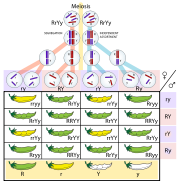
In independent assortment the chromosomes that end randomly sorted from all possible combinations of maternal and paternal chromosomes. Because gametes end up with a random mix instead of a pre-defined "set" from either parent, gametes are therefore considered assorted independently. As such, the gamete
can end up with any combination of paternal or maternal chromosomes. Any of the possible combinations of gametes formed from maternal and paternal chromosomes will occur with equal frequency. For human gametes, with 23 pairs of chromosomes, the number of possibilities is 223 or 8,388,608 possible combinations. The gametes will normally end up with 23 chromosomes, but the origin of any particular one will be randomly selected from paternal or maternal chromosomes. This contributes to the genetic variability of progeny.
 The reason for these laws is found in the nature of the cell nucleus
. It is made up of several chromosome
s carrying the genetic traits
. In a normal cell, each of these chromosomes has two parts, the chromatid
s. A reproductive cell, which is created in a process called meiosis
, usually contains only one of those chromatids of each chromosome. By merging two of these cells (usually one male and one female), the full set is restored and the genes are mixed. The resulting cell becomes a new embryo
. The fact that this new life has half the genes of each parent (23 from mother, 23 from father for total of 46 in the case of humans) is one reason for the Mendelian laws. The second most important reason is the varying dominance of different genes, causing some traits to appear unevenly instead of averaging out (whereby dominant doesn't mean more likely to reproduce—recessive genes can become the most common, too).
There are several advantages of this method (sexual reproduction) over reproduction without genetic exchange:
and shows a simple Mendelian inheritance pattern. In such cases, a mutation in a single gene can cause a disease that is inherited according to Mendel's laws. Examples include sickle-cell anemia, Tay-Sachs disease
, cystic fibrosis
and xeroderma pigmentosa. A disease controlled by a single gene contrasts with a multi-factorial disease, like arthritis
, which is affected by several loci (and the environment) as well as those diseases inherited in a non-Mendelian
fashion. The Mendelian Inheritance in Man
database is a catalog of, among other things, genes in which Mendelian traits cause disease.
Heredity
Heredity is the passing of traits to offspring . This is the process by which an offspring cell or organism acquires or becomes predisposed to the characteristics of its parent cell or organism. Through heredity, variations exhibited by individuals can accumulate and cause some species to evolve...
characteristics are passed from parent organisms to their offspring; it underlies much of genetics
Genetics
Genetics , a discipline of biology, is the science of genes, heredity, and variation in living organisms....
. This theoretical framework was initially derived from the work of Gregor Johann Mendel published in 1865 and 1866 which was re-discovered in 1900; it was initially very controversial. When Mendel's theories were integrated with the chromosome theory of inheritance by Thomas Hunt Morgan
Thomas Hunt Morgan
Thomas Hunt Morgan was an American evolutionary biologist, geneticist and embryologist and science author who won the Nobel Prize in Physiology or Medicine in 1933 for discoveries relating the role the chromosome plays in heredity.Morgan received his PhD from Johns Hopkins University in zoology...
in 1915, they became the core of classical genetics
Classical genetics
Classical genetics consists of the technique and methodologies of genetics that predate the advent of molecular biology. A key discovery of classical genetics in eukaryotes was genetic linkage...
.
History
The laws of inheritance were derived by Gregor Mendel, a 19th century AustrianAustrians
Austrians are a nation and ethnic group, consisting of the population of the Republic of Austria and its historical predecessor states who share a common Austrian culture and Austrian descent....
Priest
Priest
A priest is a person authorized to perform the sacred rites of a religion, especially as a mediatory agent between humans and deities. They also have the authority or power to administer religious rites; in particular, rites of sacrifice to, and propitiation of, a deity or deities...
/monk conducting hybridization experiments in garden peas (Pisum sativum). Between 1856 and 1863, he cultivated and tested some 29,000 pea plants. From these experiments he deduced two generalizations which later became known as Mendel's Principles of Heredity or Mendelian inheritance. He described these principles in a two part paper, Experiments on Plant Hybridization
Experiments on Plant Hybridization
Written in 1865 by Gregor Mendel, Experiments on Plant Hybridization was the result after years spent studying genetic traits in pea plants. Mendel read his paper to the Natural History Society of Brünn on February 8 and March 8, 1865...
that he read to the Natural History Society of Brno
Brno
Brno by population and area is the second largest city in the Czech Republic, the largest Moravian city, and the historical capital city of the Margraviate of Moravia. Brno is the administrative centre of the South Moravian Region where it forms a separate district Brno-City District...
on February 8 and March 8, 1865, and which was published in 1866.
Mendel's conclusions were largely ignored. Although they were not completely unknown to biologists of the time, they were not seen as generally applicable, even by Mendel himself, who thought they only applied to certain categories of species or traits. A major block to understanding their significance was the importance attached by 19th century biologists to the apparent blending of inherited traits in the overall appearance of the progeny, now known to be due to multigene interactions, in contrast to the organ-specific binary characters studied by Mendel. In 1900, however, his work was "re-discovered" by three European scientists, Hugo de Vries
Hugo de Vries
Hugo Marie de Vries ForMemRS was a Dutch botanist and one of the first geneticists. He is known chiefly for suggesting the concept of genes, rediscovering the laws of heredity in the 1890s while unaware of Gregor Mendel's work, for introducing the term "mutation", and for developing a mutation...
, Carl Correns
Carl Correns
Carl Erich Correns was a German botanist and geneticist, who is notable primarily for his independent discovery of the principles of heredity, and for his rediscovery of Gregor Mendel's earlier paper on that subject, which he achieved simultaneously but independently of the botanists Erich...
, and Erich von Tschermak
Erich von Tschermak
Erich von Tschermak-Seysenegg was an Austrian agronomist who developed several new disease-resistant crops, including wheat-rye and oat hybrids. He was a son of the Moravia-born mineralogist Gustav Tschermak von Seysenegg...
. The exact nature of the "re-discovery" has been somewhat debated: De Vries published first on the subject, mentioning Mendel in a footnote, while Correns pointed out Mendel's priority after having read De Vries's paper and realizing that he himself did not have priority. De Vries may not have acknowledged truthfully how much of his knowledge of the laws came from his own work, or came only after reading Mendel's paper. Later scholars have accused Von Tschermak of not truly understanding the results at all.
Regardless, the "re-discovery" made Mendelism an important but controversial theory. Its most vigorous promoter in Europe was William Bateson
William Bateson
William Bateson was an English geneticist and a Fellow of St. John's College, Cambridge...
, who coined the term "genetics
Genetics
Genetics , a discipline of biology, is the science of genes, heredity, and variation in living organisms....
" and "allele
Allele
An allele is one of two or more forms of a gene or a genetic locus . "Allel" is an abbreviation of allelomorph. Sometimes, different alleles can result in different observable phenotypic traits, such as different pigmentation...
" to describe many of its tenets. The model of heredity was highly contested by other biologists because it implied that heredity was discontinuous, in opposition to the apparently continuous variation observable for many traits. Many biologists also dismissed the theory because they were not sure it would apply to all species. However later work by biologists and statisticians such as R.A. Fisher showed that if multiple Mendelian factors were involved in the expression of an individual trait, they could produce the diverse results observed. Thomas Hunt Morgan
Thomas Hunt Morgan
Thomas Hunt Morgan was an American evolutionary biologist, geneticist and embryologist and science author who won the Nobel Prize in Physiology or Medicine in 1933 for discoveries relating the role the chromosome plays in heredity.Morgan received his PhD from Johns Hopkins University in zoology...
and his assistants later integrated the theoretical model of Mendel with the chromosome theory of inheritance, in which the chromosome
Chromosome
A chromosome is an organized structure of DNA and protein found in cells. It is a single piece of coiled DNA containing many genes, regulatory elements and other nucleotide sequences. Chromosomes also contain DNA-bound proteins, which serve to package the DNA and control its functions.Chromosomes...
s of cell
Cell (biology)
The cell is the basic structural and functional unit of all known living organisms. It is the smallest unit of life that is classified as a living thing, and is often called the building block of life. The Alberts text discusses how the "cellular building blocks" move to shape developing embryos....
s were thought to hold the actual hereditary material, and create what is now known as classical genetics
Classical genetics
Classical genetics consists of the technique and methodologies of genetics that predate the advent of molecular biology. A key discovery of classical genetics in eukaryotes was genetic linkage...
, which was extremely successful and cemented Mendel's place in history.
Mendel's findings allowed other scientists to predict the expression of traits on the basis of mathematical probabilities. A large contribution to Mendel's success can be traced to his decision to start his crosses only with plants he demonstrated were true-breeding. He also only measured absolute (binary) characteristics, such as color, shape, and position of the offspring, rather than quantitative characteristics. He expressed his results numerically and subjected them to statistical analysis. His method of data analysis and his large sample size
Sample size
Sample size determination is the act of choosing the number of observations to include in a statistical sample. The sample size is an important feature of any empirical study in which the goal is to make inferences about a population from a sample...
gave credibility to his data. He also had the foresight to follow several successive generations (f2, f3) of his pea plants and record their variations. Finally, he performed "test crosses" (back-crossing descendants of the initial hybridization to the initial true-breeding lines) to reveal the presence and proportion of recessive characters. Without his hard work and careful attention to procedure and detail, Mendel's work could not have had the impact it made on the world of genetics.
Mendel's Laws
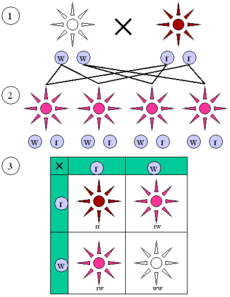
Mendel discovered that when crossing white flower and purple flower plants, the result is not a blend. Rather than being a mix of the two, the offspring was purple flowered. He then conceived the idea of heredity units, which he called "factors", one of which is a recessive characteristic and the other dominant. Mendel said that factors, later called genes, normally occur in pairs in ordinary body cells, yet segregate during the formation of sex cells. Each member of the pair becomes part of the separate sex cell. The dominant gene, such as the purple flower in Mendel's plants, will hide the recessive gene, the white flower. After Mendel self-fertilized the F1 generation and obtained the 3:1 ratio, he correctly theorized that genes can be paired in three different ways for each trait: AA, aa, and Aa. The capital "A" represents the dominant factor and lowercase "a" represents the recessive. (The last combination listed above, Aa, will occur roughly twice as often as each of the other two, as it can be made in two different ways, Aa or aA.)Mendel stated that each individual has two factors for each trait, one from each parent. The two factors may or may not contain the same information. If the two factors are identical, the individual is called homozygous for the trait. If the two factors have different information, the individual is called heterozygous. The alternative forms of a factor are called alleles. The genotype of an individual is made up of the many alleles it possesses. An individual's physical appearance, or phenotype, is determined by its alleles as well as by its environment. An individual possesses two alleles for each trait; one allele is given by the female parent and the other by the male parent. They are passed on when an individual matures and produces gametes: egg and sperm. When gametes form, the paired alleles separate randomly so that each gamete receives a copy of one of the two alleles. The presence of an allele doesn't promise that the trait will be expressed in the individual that possesses it. In heterozygous individuals the only allele that is expressed is the dominant. The recessive allele is present but its expression is hidden.
Mendel summarized his findings in two laws; the Law of Segregation and the Law of Independent Assortment.
Law of Segregation (The "First Law")
The Law of Segregation states that every individual possesses a pair of alleleAllele
An allele is one of two or more forms of a gene or a genetic locus . "Allel" is an abbreviation of allelomorph. Sometimes, different alleles can result in different observable phenotypic traits, such as different pigmentation...
s for any particular trait and that each parent passes a randomly selected copy (allele) of only one of these to its offspring. The offspring then receives its own pair of alleles for that trait. Whichever of the two alleles in the offspring is dominant determines how the offspring expresses that trait (e.g. the color of a plant, the color of an animal's fur, the color of a person's eyes).
More precisely the law states that when any individual produces gametes
Gamete
A gamete is a cell that fuses with another cell during fertilization in organisms that reproduce sexually...
, the copies of a gene
Gene
A gene is a molecular unit of heredity of a living organism. It is a name given to some stretches of DNA and RNA that code for a type of protein or for an RNA chain that has a function in the organism. Living beings depend on genes, as they specify all proteins and functional RNA chains...
separate so that each gamete receives only one copy (allele). A gamete will receive one allele
Allele
An allele is one of two or more forms of a gene or a genetic locus . "Allel" is an abbreviation of allelomorph. Sometimes, different alleles can result in different observable phenotypic traits, such as different pigmentation...
or the other. The direct proof of this was later found following the observation of meiosis
Meiosis
Meiosis is a special type of cell division necessary for sexual reproduction. The cells produced by meiosis are gametes or spores. The animals' gametes are called sperm and egg cells....
by two independent scientists, the German botanist, Oscar Hertwig in 1876, and the Belgian zoologist, Edouard Van Beneden
Edouard Van Beneden
Edouard Joseph Marie Van Beneden , son of Pierre-Joseph Van Beneden, was a Belgian embryologist, cytologist and marine biologist. He was professor of zoology at the University of Liège. He contributed to cytogenetics by his works on the roundworm Ascaris...
in 1883. In meiosis, the paternal and maternal chromosomes get separated and the alleles with the traits of a character are segregated into two different gametes.
OR
The two coexisting alleles of an individual for each trait segregate (separate) during gamete formation so that each gamete gets only one of the two alleles. Alleles again unite at random fertilization of gametes.
Law of Independent Assortment (The "Second Law")
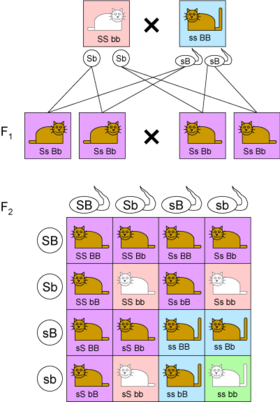
The Law of Independent Assortment, also known as "Inheritance Law" states that separate genes for separate traits are passed independently of one another from parents to offspring. That is, the biological selection of a particular gene in the gene pair for one trait to be passed to the offspring has nothing to do with the selection of the gene for any other trait. More precisely the law states that alleles of different genes assort independently of one another during gamete formation. While Mendel's experiments with mixing one trait always resulted in a 3:1 ratio (Fig. 1) between dominant and recessive phenotypes, his experiments with mixing two traits (dihybrid cross) showed 9:3:3:1 ratios (Fig. 2). But the 9:3:3:1 table shows that each of the two genes are independently inherited with a 3:1 phenotypic ratio. Mendel concluded that different traits are inherited independently of each other, so that there is no relation, for example, between a cat's color and tail length. This is actually only true for genes that are not linkedGenetic linkage
Genetic linkage is the tendency of certain loci or alleles to be inherited together. Genetic loci that are physically close to one another on the same chromosome tend to stay together during meiosis, and are thus genetically linked.-Background:...
to each other.
Independent assortment occurs during meiosis I in eukaryotic organisms, specifically anaphase I of meiosis, to produce a gamete with a mixture of the organism's maternal and paternal chromosomes. Along with chromosomal crossover
Chromosomal crossover
Chromosomal crossover is an exchange of genetic material between homologous chromosomes. It is one of the final phases of genetic recombination, which occurs during prophase I of meiosis in a process called synapsis. Synapsis begins before the synaptonemal complex develops, and is not completed...
, this process aids in increasing genetic diversity by producing novel genetic combinations.
Of the 46 chromosomes in a normal diploid human cell, half are maternally-derived (from the mother's egg
Ovum
An ovum is a haploid female reproductive cell or gamete. Both animals and embryophytes have ova. The term ovule is used for the young ovum of an animal, as well as the plant structure that carries the female gametophyte and egg cell and develops into a seed after fertilization...
) and half are paternally-derived (from the father's sperm
Spermatozoon
A spermatozoon is a motile sperm cell, or moving form of the haploid cell that is the male gamete. A spermatozoon joins an ovum to form a zygote...
). This occurs as sexual reproduction
Sexual reproduction
Sexual reproduction is the creation of a new organism by combining the genetic material of two organisms. There are two main processes during sexual reproduction; they are: meiosis, involving the halving of the number of chromosomes; and fertilization, involving the fusion of two gametes and the...
involves the fusion of two haploid gametes (the egg and sperm) to produce a new organism having the full complement of chromosomes. During gametogenesis
Gametogenesis
Gametogenesis is a biological process by which diploid or haploid precursor cells undergo cell division and differentiation to form mature haploid gametes. Depending on the biological life cycle of the organism, gametogenesis occurs by meiotic division of diploid gametocytes into various gametes,...
—the production of new gametes by an adult—the normal complement of 46 chromosomes needs to be halved to 23 to ensure that the resulting haploid gamete can join with another gamete to produce a diploid organism. An error in the number of chromosomes, such as those caused by a diploid gamete joining with a haploid gamete, is termed aneuploidy
Aneuploidy
Aneuploidy is an abnormal number of chromosomes, and is a type of chromosome abnormality. An extra or missing chromosome is a common cause of genetic disorders . Some cancer cells also have abnormal numbers of chromosomes. Aneuploidy occurs during cell division when the chromosomes do not separate...
.
In independent assortment the chromosomes that end randomly sorted from all possible combinations of maternal and paternal chromosomes. Because gametes end up with a random mix instead of a pre-defined "set" from either parent, gametes are therefore considered assorted independently. As such, the gamete
Gamete
A gamete is a cell that fuses with another cell during fertilization in organisms that reproduce sexually...
can end up with any combination of paternal or maternal chromosomes. Any of the possible combinations of gametes formed from maternal and paternal chromosomes will occur with equal frequency. For human gametes, with 23 pairs of chromosomes, the number of possibilities is 223 or 8,388,608 possible combinations. The gametes will normally end up with 23 chromosomes, but the origin of any particular one will be randomly selected from paternal or maternal chromosomes. This contributes to the genetic variability of progeny.
 |
 |
Background
Cell nucleus
In cell biology, the nucleus is a membrane-enclosed organelle found in eukaryotic cells. It contains most of the cell's genetic material, organized as multiple long linear DNA molecules in complex with a large variety of proteins, such as histones, to form chromosomes. The genes within these...
. It is made up of several chromosome
Chromosome
A chromosome is an organized structure of DNA and protein found in cells. It is a single piece of coiled DNA containing many genes, regulatory elements and other nucleotide sequences. Chromosomes also contain DNA-bound proteins, which serve to package the DNA and control its functions.Chromosomes...
s carrying the genetic traits
Trait (biology)
A trait is a distinct variant of a phenotypic character of an organism that may be inherited, environmentally determined or be a combination of the two...
. In a normal cell, each of these chromosomes has two parts, the chromatid
Chromatid
A chromatid is one of the two identical copies of DNA making up a duplicated chromosome, which are joined at their centromeres, for the process of cell division . They are called sister chromatids so long as they are joined by the centromeres...
s. A reproductive cell, which is created in a process called meiosis
Meiosis
Meiosis is a special type of cell division necessary for sexual reproduction. The cells produced by meiosis are gametes or spores. The animals' gametes are called sperm and egg cells....
, usually contains only one of those chromatids of each chromosome. By merging two of these cells (usually one male and one female), the full set is restored and the genes are mixed. The resulting cell becomes a new embryo
Embryo
An embryo is a multicellular diploid eukaryote in its earliest stage of development, from the time of first cell division until birth, hatching, or germination...
. The fact that this new life has half the genes of each parent (23 from mother, 23 from father for total of 46 in the case of humans) is one reason for the Mendelian laws. The second most important reason is the varying dominance of different genes, causing some traits to appear unevenly instead of averaging out (whereby dominant doesn't mean more likely to reproduce—recessive genes can become the most common, too).
There are several advantages of this method (sexual reproduction) over reproduction without genetic exchange:
- Instead of nearly identical copies of an organism, a broad range of offspring develops, allowing more different abilities and evolutionEvolutionEvolution is any change across successive generations in the heritable characteristics of biological populations. Evolutionary processes give rise to diversity at every level of biological organisation, including species, individual organisms and molecules such as DNA and proteins.Life on Earth...
ary strategies. - There are usually some errors in every cell nucleus. Copying the genes usually adds more of them. By distributing them randomly over different chromosomes and mixing the genes, such errors will be distributed unevenly over the different children. Some of them will therefore have only very few such problems. This helps reduce problems with copying errors somewhat.
- Genes can spread faster from one part of a population to another. This is for instance useful if there's a temporary isolation of two groups. New genes developing in each of the populations don't get reduced to half when one side replaces the other, they mix and form a population with the advantages of both sides.
- Sometimes, a mutation can have positive side effects. For example, sickle cell anemia is a mutation that can cause the benefit of malariaMalariaMalaria is a mosquito-borne infectious disease of humans and other animals caused by eukaryotic protists of the genus Plasmodium. The disease results from the multiplication of Plasmodium parasites within red blood cells, causing symptoms that typically include fever and headache, in severe cases...
resistance. The mechanism behind the Mendelian laws can make it possible for some offspring to carry the advantages without the disadvantages until further mutationMutationIn molecular biology and genetics, mutations are changes in a genomic sequence: the DNA sequence of a cell's genome or the DNA or RNA sequence of a virus. They can be defined as sudden and spontaneous changes in the cell. Mutations are caused by radiation, viruses, transposons and mutagenic...
s solve the problems.
Mendelian trait
A Mendelian trait is one that is controlled by a single locusLocus (genetics)
In the fields of genetics and genetic computation, a locus is the specific location of a gene or DNA sequence on a chromosome. A variant of the DNA sequence at a given locus is called an allele. The ordered list of loci known for a particular genome is called a genetic map...
and shows a simple Mendelian inheritance pattern. In such cases, a mutation in a single gene can cause a disease that is inherited according to Mendel's laws. Examples include sickle-cell anemia, Tay-Sachs disease
Tay-Sachs disease
Tay–Sachs disease is an autosomal recessive genetic disorder...
, cystic fibrosis
Cystic fibrosis
Cystic fibrosis is a recessive genetic disease affecting most critically the lungs, and also the pancreas, liver, and intestine...
and xeroderma pigmentosa. A disease controlled by a single gene contrasts with a multi-factorial disease, like arthritis
Arthritis
Arthritis is a form of joint disorder that involves inflammation of one or more joints....
, which is affected by several loci (and the environment) as well as those diseases inherited in a non-Mendelian
Non-mendelian inheritance
Non-Mendelian inheritance is a general term that refers to any pattern of inheritance in which traits do not segregate in accordance with Mendel’s laws. These laws describe the inheritance of traits linked to single genes on chromosomes in the nucleus. In Mendelian inheritance, each parent...
fashion. The Mendelian Inheritance in Man
Mendelian Inheritance in Man
Online Mendelian Inheritance in Man is a database that catalogues all the known diseases with a genetic component, and—when possible—links them to the relevant genes in the human genome and provides references for further research and tools for genomic analysis of a catalogued gene. OMIM is one...
database is a catalog of, among other things, genes in which Mendelian traits cause disease.
See also
- Dominance relationshipDominance relationshipDominance in genetics is a relationship between two variant forms of a single gene, in which one allele masks the effect of the other in influencing some trait. In the simplest case, if a gene exists in two allelic forms , three combinations of alleles are possible: AA, AB, and BB...
- HeritabilityHeritabilityThe Heritability of a population is the proportion of observable differences between individuals that is due to genetic differences. Factors including genetics, environment and random chance can all contribute to the variation between individuals in their observable characteristics...
- List of Mendelian traits in humans
- Gregor MendelGregor MendelGregor Johann Mendel was an Austrian scientist and Augustinian friar who gained posthumous fame as the founder of the new science of genetics. Mendel demonstrated that the inheritance of certain traits in pea plants follows particular patterns, now referred to as the laws of Mendelian inheritance...
- Mendelian diseases (monogenic disease)
- Mendelian errorMendelian errorA Mendelian error in the genetic analysis of a species, describes an allele in an individual which could not have been received from either of its biological parents by Mendelian inheritance. Inheritance is defined by a set of related individuals who have the same or similar phenotypes for a locus...
- Non-Mendelian inheritanceNon-mendelian inheritanceNon-Mendelian inheritance is a general term that refers to any pattern of inheritance in which traits do not segregate in accordance with Mendel’s laws. These laws describe the inheritance of traits linked to single genes on chromosomes in the nucleus. In Mendelian inheritance, each parent...
- Particulate inheritance
- Punnett squarePunnett squareThe Punnett square is a diagram that is used to predict an outcome of a particular cross or breeding experiment. It is named after Reginald C. Punnett, who devised the approach, and is used by biologists to determine the probability of an offspring's having a particular genotype...