

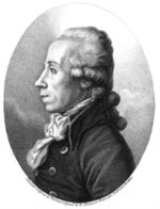
Martin Heinrich Klaproth

Encyclopedia
Martin Heinrich Klaproth (1 December 1743 – 1 January 1817) was a German chemist
.
Klaproth was born in Wernigerode
. During a large portion of his life he followed the profession of an apothecary
. After acting as assistant in pharmacies at Quedlinburg
, Hanover
, Berlin
and Danzig successively he came to Berlin on the death of Valentin Rose the Elder
in 1771 as manager of his business, and in 1780 he started an establishment on his own account in the same city, where from 1782 he was pharmaceutical assessor of the Ober-Collegium Medicum. In 1787 he was appointed lecturer in chemistry
to the Prussia
n Royal Artillery, and when the university
was founded in 1810 he was selected to be the professor of chemistry. He died in Berlin on New Year's Day
in 1817. Klaproth was the leading chemist of his time in Germany.
An exact and conscientious worker, he did much to improve and systematize the processes of analytical chemistry
and mineralogy
, and his appreciation of the value of quantitative methods led him to become one of the earliest adherents of the Lavoisierian doctrines outside France. Klaproth found the element titanium
in the ore rutile
in 1791, believing it to be a new discovery, however, William Gregor
is credited with the discovery of titanium
, having found the metal in a different ore, (ilmenite
), before Klaproth, although in the same year. He was the first to discover uranium
while studying the mineral pitchblende. In addition, he discovered zirconium
, and to characterize uranium and zirconium as distinct elements
, though he did not obtain any of them in the pure metal
lic state; and he elucidated the composition of numerous substances till then imperfectly known, including compounds of the then newly recognized elements: tellurium, strontium
, cerium
and chromium
.
His papers, over 200 in number, were collected by himself in Beiträge zur chemischen Kenntnis der Mineralkörper (5 vols., 1795–1810) and Chemische Abhandlungen gemischten Inhalts (1815). He also published a Chemisches Wörterbuch (1807–1810), and edited a revised edition of F. A. C. Gren
’s Handbuch der Chemie (1806).
Klaproth was elected a foreign member of the Royal Swedish Academy of Sciences
in 1804.
The crater Klaproth
on the Moon
is named after him.
His son Julius
was a famous orientalist
.
Chemist
A chemist is a scientist trained in the study of chemistry. Chemists study the composition of matter and its properties such as density and acidity. Chemists carefully describe the properties they study in terms of quantities, with detail on the level of molecules and their component atoms...
.
Klaproth was born in Wernigerode
Wernigerode
Wernigerode is a town in the district of Harz, Saxony-Anhalt, Germany. Until 2007, it was the capital of the district of Wernigerode. Its population was 35,500 in 1999....
. During a large portion of his life he followed the profession of an apothecary
Apothecary
Apothecary is a historical name for a medical professional who formulates and dispenses materia medica to physicians, surgeons and patients — a role now served by a pharmacist and some caregivers....
. After acting as assistant in pharmacies at Quedlinburg
Quedlinburg
Quedlinburg is a town located north of the Harz mountains, in the district of Harz in the west of Saxony-Anhalt, Germany. In 1994 the medieval court and the old town was set on the UNESCO world heritage list....
, Hanover
Hanover
Hanover or Hannover, on the river Leine, is the capital of the federal state of Lower Saxony , Germany and was once by personal union the family seat of the Hanoverian Kings of Great Britain, under their title as the dukes of Brunswick-Lüneburg...
, Berlin
Berlin
Berlin is the capital city of Germany and is one of the 16 states of Germany. With a population of 3.45 million people, Berlin is Germany's largest city. It is the second most populous city proper and the seventh most populous urban area in the European Union...
and Danzig successively he came to Berlin on the death of Valentin Rose the Elder
Valentin Rose the Elder
Valentin Rose the Elder was a German pharmacist and chemist who was a native of Neuruppin. He is remembered for creation of a fusible alloy known as Rose metal, which is composed of lead, bismuth and tin....
in 1771 as manager of his business, and in 1780 he started an establishment on his own account in the same city, where from 1782 he was pharmaceutical assessor of the Ober-Collegium Medicum. In 1787 he was appointed lecturer in chemistry
Chemistry
Chemistry is the science of matter, especially its chemical reactions, but also its composition, structure and properties. Chemistry is concerned with atoms and their interactions with other atoms, and particularly with the properties of chemical bonds....
to the Prussia
Prussia
Prussia was a German kingdom and historic state originating out of the Duchy of Prussia and the Margraviate of Brandenburg. For centuries, the House of Hohenzollern ruled Prussia, successfully expanding its size by way of an unusually well-organized and effective army. Prussia shaped the history...
n Royal Artillery, and when the university
Humboldt University of Berlin
The Humboldt University of Berlin is Berlin's oldest university, founded in 1810 as the University of Berlin by the liberal Prussian educational reformer and linguist Wilhelm von Humboldt, whose university model has strongly influenced other European and Western universities...
was founded in 1810 he was selected to be the professor of chemistry. He died in Berlin on New Year's Day
New Year's Day
New Year's Day is observed on January 1, the first day of the year on the modern Gregorian calendar as well as the Julian calendar used in ancient Rome...
in 1817. Klaproth was the leading chemist of his time in Germany.
An exact and conscientious worker, he did much to improve and systematize the processes of analytical chemistry
Analytical chemistry
Analytical chemistry is the study of the separation, identification, and quantification of the chemical components of natural and artificial materials. Qualitative analysis gives an indication of the identity of the chemical species in the sample and quantitative analysis determines the amount of...
and mineralogy
Mineralogy
Mineralogy is the study of chemistry, crystal structure, and physical properties of minerals. Specific studies within mineralogy include the processes of mineral origin and formation, classification of minerals, their geographical distribution, as well as their utilization.-History:Early writing...
, and his appreciation of the value of quantitative methods led him to become one of the earliest adherents of the Lavoisierian doctrines outside France. Klaproth found the element titanium
Titanium
Titanium is a chemical element with the symbol Ti and atomic number 22. It has a low density and is a strong, lustrous, corrosion-resistant transition metal with a silver color....
in the ore rutile
Rutile
Rutile is a mineral composed primarily of titanium dioxide, TiO2.Rutile is the most common natural form of TiO2. Two rarer polymorphs of TiO2 are known:...
in 1791, believing it to be a new discovery, however, William Gregor
William Gregor
William Gregor was the British clergyman and mineralogist who discovered the elemental metal titanium.-Early years:...
is credited with the discovery of titanium
Titanium
Titanium is a chemical element with the symbol Ti and atomic number 22. It has a low density and is a strong, lustrous, corrosion-resistant transition metal with a silver color....
, having found the metal in a different ore, (ilmenite
Ilmenite
Ilmenite is a weakly magnetic titanium-iron oxide mineral which is iron-black or steel-gray. It is a crystalline iron titanium oxide . It crystallizes in the trigonal system, and it has the same crystal structure as corundum and hematite....
), before Klaproth, although in the same year. He was the first to discover uranium
Uranium
Uranium is a silvery-white metallic chemical element in the actinide series of the periodic table, with atomic number 92. It is assigned the chemical symbol U. A uranium atom has 92 protons and 92 electrons, of which 6 are valence electrons...
while studying the mineral pitchblende. In addition, he discovered zirconium
Zirconium
Zirconium is a chemical element with the symbol Zr and atomic number 40. The name of zirconium is taken from the mineral zircon. Its atomic mass is 91.224. It is a lustrous, grey-white, strong transition metal that resembles titanium...
, and to characterize uranium and zirconium as distinct elements
Chemical element
A chemical element is a pure chemical substance consisting of one type of atom distinguished by its atomic number, which is the number of protons in its nucleus. Familiar examples of elements include carbon, oxygen, aluminum, iron, copper, gold, mercury, and lead.As of November 2011, 118 elements...
, though he did not obtain any of them in the pure metal
Metal
A metal , is an element, compound, or alloy that is a good conductor of both electricity and heat. Metals are usually malleable and shiny, that is they reflect most of incident light...
lic state; and he elucidated the composition of numerous substances till then imperfectly known, including compounds of the then newly recognized elements: tellurium, strontium
Strontium
Strontium is a chemical element with the symbol Sr and the atomic number 38. An alkaline earth metal, strontium is a soft silver-white or yellowish metallic element that is highly reactive chemically. The metal turns yellow when exposed to air. It occurs naturally in the minerals celestine and...
, cerium
Cerium
Cerium is a chemical element with the symbol Ce and atomic number 58. It is a soft, silvery, ductile metal which easily oxidizes in air. Cerium was named after the dwarf planet . Cerium is the most abundant of the rare earth elements, making up about 0.0046% of the Earth's crust by weight...
and chromium
Chromium
Chromium is a chemical element which has the symbol Cr and atomic number 24. It is the first element in Group 6. It is a steely-gray, lustrous, hard metal that takes a high polish and has a high melting point. It is also odorless, tasteless, and malleable...
.
His papers, over 200 in number, were collected by himself in Beiträge zur chemischen Kenntnis der Mineralkörper (5 vols., 1795–1810) and Chemische Abhandlungen gemischten Inhalts (1815). He also published a Chemisches Wörterbuch (1807–1810), and edited a revised edition of F. A. C. Gren
Friedrich Albrecht Carl Gren
Friedrich Albrecht Carl Gren was a German chemist who was a native of Bernburg. He began his career working in a pharmacy in Bernburg, and later worked as a pharmacist in Offenbach am Main and Erfurt...
’s Handbuch der Chemie (1806).
Klaproth was elected a foreign member of the Royal Swedish Academy of Sciences
Royal Swedish Academy of Sciences
The Royal Swedish Academy of Sciences or Kungliga Vetenskapsakademien is one of the Royal Academies of Sweden. The Academy is an independent, non-governmental scientific organization which acts to promote the sciences, primarily the natural sciences and mathematics.The Academy was founded on 2...
in 1804.
The crater Klaproth
Klaproth (crater)
Klaproth is an old lunar crater that lies in the rugged southern highlands of the Moon's near side. Due to its location, this crater appears significantly foreshortened when viewed from the Earth...
on the Moon
Moon
The Moon is Earth's only known natural satellite,There are a number of near-Earth asteroids including 3753 Cruithne that are co-orbital with Earth: their orbits bring them close to Earth for periods of time but then alter in the long term . These are quasi-satellites and not true moons. For more...
is named after him.
His son Julius
Julius Klaproth
Julius Heinrich Klaproth , German linguist, historian, ethnographer, author, Orientalist and explorer. As a scholar, he is credited along with Jean-Pierre Abel-Rémusat, with being instrumental in turning East Asian Studies into scientific disciplines with critical methods.-Chronology:Klaproth was...
was a famous orientalist
Oriental studies
Oriental studies is the academic field of study that embraces Near Eastern and Far Eastern societies and cultures, languages, peoples, history and archaeology; in recent years the subject has often been turned into the newer terms of Asian studies and Middle Eastern studies...
.