


Mao suit

Encyclopedia

China
Chinese civilization may refer to:* China for more general discussion of the country.* Chinese culture* Greater China, the transnational community of ethnic Chinese.* History of China* Sinosphere, the area historically affected by Chinese culture...
as the Zhongshan suit (after Sun Yat-Sen
Sun Yat-sen
Sun Yat-sen was a Chinese doctor, revolutionary and political leader. As the foremost pioneer of Nationalist China, Sun is frequently referred to as the "Father of the Nation" , a view agreed upon by both the People's Republic of China and the Republic of China...
), and known in the West as the Mao suit (after Mao Zedong
Mao Zedong
Mao Zedong, also transliterated as Mao Tse-tung , and commonly referred to as Chairman Mao , was a Chinese Communist revolutionary, guerrilla warfare strategist, Marxist political philosopher, and leader of the Chinese Revolution...
). Sun Zhongshan (better known as Sun Yat-sen
Sun Yat-sen
Sun Yat-sen was a Chinese doctor, revolutionary and political leader. As the foremost pioneer of Nationalist China, Sun is frequently referred to as the "Father of the Nation" , a view agreed upon by both the People's Republic of China and the Republic of China...
) introduced the style shortly after the founding of the Republic of China
Republic of China
The Republic of China , commonly known as Taiwan , is a unitary sovereign state located in East Asia. Originally based in mainland China, the Republic of China currently governs the island of Taiwan , which forms over 99% of its current territory, as well as Penghu, Kinmen, Matsu and other minor...
as a form of national dress although with a distinctly political and later governmental implication.
After the end of the Chinese Civil War
Chinese Civil War
The Chinese Civil War was a civil war fought between the Kuomintang , the governing party of the Republic of China, and the Communist Party of China , for the control of China which eventually led to China's division into two Chinas, Republic of China and People's Republic of...
and the establishment of the People's Republic of China
People's Republic of China
China , officially the People's Republic of China , is the most populous country in the world, with over 1.3 billion citizens. Located in East Asia, the country covers approximately 9.6 million square kilometres...
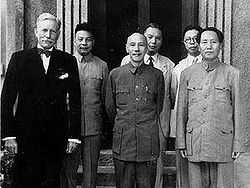
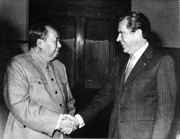
in 1949, the suit became widely worn by males and government leaders as a symbol of proletarian unity and an Eastern counterpart to the Western business suit. The name "Mao suit" comes from Chinese leader Mao Zedong's affinity for wearing them in public, thus tying the garment closely to him and Chinese communism in general in the Western imagination. Although they fell into disuse in the 1990s amid increasing Western influences, they are still worn on occasion by Chinese leaders during important state ceremonies and functions.
Origins
When the Republic was founded in 1912, the style of dress worn in China was based on ManchuManchu
The Manchu people or Man are an ethnic minority of China who originated in Manchuria . During their rise in the 17th century, with the help of the Ming dynasty rebels , they came to power in China and founded the Qing Dynasty, which ruled China until the Xinhai Revolution of 1911, which...
dress (qipao
Qipao
The cheongsam is a body-hugging one-piece Chinese dress for women; the male version is the changshan. It is known in Mandarin Chinese as the qípáo Wade-Giles ch'i-p'ao, and is also known in English as a mandarin gown...
and changshan
Changshan
In traditional Chinese dress, a changshan is the male equivalent of the women's cheongsam . It is also known as a changpao or dagua ....
), which had been imposed by the Qing Dynasty
Qing Dynasty
The Qing Dynasty was the last dynasty of China, ruling from 1644 to 1912 with a brief, abortive restoration in 1917. It was preceded by the Ming Dynasty and followed by the Republic of China....
as a form of social control. The majority-Han Chinese
Han Chinese
Han Chinese are an ethnic group native to China and are the largest single ethnic group in the world.Han Chinese constitute about 92% of the population of the People's Republic of China , 98% of the population of the Republic of China , 78% of the population of Singapore, and about 20% of the...
revolutionaries who overthrew the Qing were fueled by failure of the Qing to defend China against western imperialists and the low standing of the Qing in terms of technology and science compared to the West. Even before the founding of the Republic, older forms of Chinese dress were becoming unpopular among the elite and led to the development of Chinese dress which combined the changshan and the Western hat to form a new dress. The Zhongshan suit is similar development which combined Western and Eastern fashions.
The Zhongshan suit was an attempt to cater to contemporary sensibilities without adopting Western styles wholesale. Dr. Sun Yat-sen
Sun Yat-sen
Sun Yat-sen was a Chinese doctor, revolutionary and political leader. As the foremost pioneer of Nationalist China, Sun is frequently referred to as the "Father of the Nation" , a view agreed upon by both the People's Republic of China and the Republic of China...
was personally involved, providing inputs based on his life experience in Japan
Japan
Japan is an island nation in East Asia. Located in the Pacific Ocean, it lies to the east of the Sea of Japan, China, North Korea, South Korea and Russia, stretching from the Sea of Okhotsk in the north to the East China Sea and Taiwan in the south...
: the Japanese cadet
Cadet
A cadet is a trainee to become an officer in the military, often a person who is a junior trainee. The term comes from the term "cadet" for younger sons of a noble family.- Military context :...
uniform became a basis of Zhongshan suit. There were other modifications as well: instead of the three hidden pockets in Western suits, the Zhongshan suit had four outside pockets to adhere to Chinese concepts of balance and symmetry; an inside pocket was also available. Over time, minor stylistic changes developed. The suit originally had seven buttons, later reduced to five.
After repeated attempts to win support and recognition from Western countries failed, the Nationalist Party government in Canton led by Dr. Sun gained help (advisers and critically vital small arms) from Soviet Russia, which viewed it as a likely revolutionary ally against Western interests in the Far East; Chinese nationalism at the time (of treaty ports and extraterritoriality discriminations) was naturally heavily infected with resentment against the West. As a result of this geopolitical alignment, Dr. Sun agreed to permit the nascent Chinese Communist Party to join the Nationalist Party—as individual members—not as a party-party union, combination or alliance. As a result, early Communist Party members adopted the attire as a mark of joining the Nationalist Party. Ironically, from that practice during an attenuated political marriage of convenience which would soon be divorced in blood (in 1927), Asian Marxist movements and governments henceforth would all consider this attire as a standard of political coloration, and it would continue to be appropriate dress for both sides of the bitter Chinese civil wars lasting decades.
After Sun Yat-sen
Sun Yat-sen
Sun Yat-sen was a Chinese doctor, revolutionary and political leader. As the foremost pioneer of Nationalist China, Sun is frequently referred to as the "Father of the Nation" , a view agreed upon by both the People's Republic of China and the Republic of China...
's death in 1925, popular mythology assigned a revolutionary and patriotic significance to the Zhongshan suit. The four pockets were said to represent the Four Virtues cited in the classic Guanzi: Propriety, Justice, Honesty, and Shame. The five center-front buttons were said to represent the five Yuans (branches of government) cited in the constitution of the Republic of China
Constitution of the Republic of China
The Constitution of the Republic of China is the fundamental law of the Republic of China . Drafted by the Kuomintang as part of its third stage of national development , it established a centralized Republic with five branches of government...
and the three cuff-buttons to symbolize Sun Yat-sen's Three Principles of the People
Three Principles of the People
The Three Principles of the People, also translated as Three People's Principles, or collectively San-min Doctrine, is a political philosophy developed by Sun Yat-sen as part of a philosophy to make China a free, prosperous, and powerful nation...
: Nationalism, Democracy, and People's Livelihood.
Historical development
National Revolutionary Army
The National Revolutionary Army , pre-1928 sometimes shortened to 革命軍 or Revolutionary Army and between 1928-1947 as 國軍 or National Army was the Military Arm of the Kuomintang from 1925 until 1947, as well as the national army of the Republic of China during the KMT's period of party rule...
army uniforms leading up through the Second Sino-Japanese War
Second Sino-Japanese War
The Second Sino-Japanese War was a military conflict fought primarily between the Republic of China and the Empire of Japan. From 1937 to 1941, China fought Japan with some economic help from Germany , the Soviet Union and the United States...
, although during the 1930s, as German military advice and assistance to the National Government waxed, the formal military uniform in the professional elements and ranks essentially became that of Weimar
Weimar
Weimar is a city in Germany famous for its cultural heritage. It is located in the federal state of Thuringia , north of the Thüringer Wald, east of Erfurt, and southwest of Halle and Leipzig. Its current population is approximately 65,000. The oldest record of the city dates from the year 899...
and then Nazi Germany (including the famous helmet
Stahlhelm
Stahlhelm is German for "steel helmet". The Imperial German Army began to replace the traditional boiled-leather Pickelhaube with the Stahlhelm during World War I in 1916...
).
After the establishment of the People's Republic of China
People's Republic of China
China , officially the People's Republic of China , is the most populous country in the world, with over 1.3 billion citizens. Located in East Asia, the country covers approximately 9.6 million square kilometres...
, and especially during the long initial period marked by intensive Maoist indoctrination and mass oppression through waves of purges and campaigns and "criticism/struggle" culminating with the Great Proletarian Cultural Revolution from 1965-76 when Mao himself died, the suit became widely worn by the entire male population, formally as a symbol of proletarian unity, but in fact as a form of personal—and virtually camouflage—coloration; it was, of course, regularly worn by Communist Party
Communist Party of China
The Communist Party of China , also known as the Chinese Communist Party , is the founding and ruling political party of the People's Republic of China...
cadres until the 1990s when it was largely replaced by the Western business suit.
The Mao suit remained the standard formal dress for the first and second generations of PRC leaders
Generations of Chinese leadership
Because both the Communist Party of China and the People's Liberation Army promote according to seniority, it is possible to discern distinct generations of Chinese leadership...
such as Deng Xiaoping
Deng Xiaoping
Deng Xiaoping was a Chinese politician, statesman, and diplomat. As leader of the Communist Party of China, Deng was a reformer who led China towards a market economy...
. During the 1990s, it began to be worn with decreasing frequency by leaders of Jiang Zemin
Jiang Zemin
Jiang Zemin is a former Chinese politician, who served as General Secretary of the Communist Party of China from 1989 to 2002, as President of the People's Republic of China from 1993 to 2003, and as Chairman of the Central Military Commission from 1989 to 2005...
's generation as more and more Chinese politians and began wearing traditional Western-style suits with neckties. Jiang wore it only on special occasions, such as to state dinners, but this practice was almost totally discontinued by his successor Hu Jintao
Hu Jintao
Hu Jintao is the current Paramount Leader of the People's Republic of China. He has held the titles of General Secretary of the Communist Party of China since 2002, President of the People's Republic of China since 2003, and Chairman of the Central Military Commission since 2004, succeeding Jiang...
. By the early part of the 21st century, the Mao suit is rarely worn even on formal occasions. The military-green version of the suit is more often worn, usually by civilian party
Communist Party of China
The Communist Party of China , also known as the Chinese Communist Party , is the founding and ruling political party of the People's Republic of China...
officials wishing to demonstrate control over – or camaraderie with – the military
People's Liberation Army
The People's Liberation Army is the unified military organization of all land, sea, strategic missile and air forces of the People's Republic of China. The PLA was established on August 1, 1927 — celebrated annually as "PLA Day" — as the military arm of the Communist Party of China...
in their capacity as officials of the Central Military Commission
Central Military Commission
A Central Military Commission or National Defense Commission is an organisation typical of Communist one-party states, responsible for supervising the nation's armed forces....
. In Taiwan
Taiwan
Taiwan , also known, especially in the past, as Formosa , is the largest island of the same-named island group of East Asia in the western Pacific Ocean and located off the southeastern coast of mainland China. The island forms over 99% of the current territory of the Republic of China following...
, the Zhongshan suit was seldom seen after the 1970s. Moreover, given the subtropical weather much of the year in Taiwan, for a time a modified version became at least semi-standard which dropped the high-collar buttoned up original constriction in favor of a Western style open dress shirt collar, unbuttoned.
Today among the Chinese people, the Mao suit has been largely abandoned by the younger generation in urban areas, but is still regarded as formal attire by many old people. It is also prevalent among Chinese peasants as casual dress.
See also
- Nehru jacketNehru jacketThe Nehru jacket is a hip-length tailored coat for men or women, created in India in the 1940s. The jacket essentially blends the collar of the achkan, historically the royal court dress of Indian nobles, with the Western suit jacket...
- Gakuran
- Mandarin collarMandarin collarA mandarin collar is a short unfolded stand-up collar style on a shirt or jacket. Mandarin collars start at the neckline and typically rise vertically two to five centimeters. The style originated from Western interpretation of dresses worn by Mandarins in Imperial China.The length along a...