


M90 motorway

Encyclopedia
The M90 is a motorway in Scotland
. It runs from Inverkeithing
, at the north end of the Forth Road Bridge
, to Perth
, passing Dunfermline
, Cowdenbeath
and Kinross
on the way. It is the most northerly motorway in the UK
; the northernmost point being a spur into the western suburbs of Perth at Broxden.
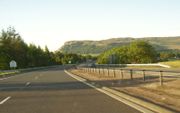 The M90's arguably most substantial engineering feature is the Friarton Bridge
in Perth, a tall concrete pillared structure which traverses the River Tay
. The bridge carries eastbound traffic from Broxden towards Dundee and along the Firth of Tay.
The road constitutes most of the southerly part of the crucial A90 corridor from Edinburgh
, through Perth, Dundee
and Aberdeen
to Peterhead
along Scotland's North Sea
coast.
The M90 is considered one of the UK's most sub-standard motorways of significant distance. Junctions 1 and 2 share a tiny common sliproad, forcing a conflict between entering and leaving traffic at the junction with the A823(M)
. It lacks hard shoulders for an 8 miles (12.9 km) section. In this section there are emergency lay-bys at 1/4 mi intervals instead. The M90 also has one of the tightest corners on the UK motorway network, for which some traffic is forced to slow down. The corner cuts through the northern side of the Ochil Hills
and has a curve radius of 694.5 m (a minimum of 914 m was standard practice at the time of construction). This corner also coincides with one of the steepest sections of the motorway, for which north-bound Heavy Goods Vehicles (HGVs)
are sign-posted to stay in a low gear and often brake continuously through the turn. South-bound HGVs are normally substantially reduced in speed as they make the incline.
A large part of the northern section of the motorway follows the route of the former railway line linking Perth to Glenfarg
, Kinross
then onwards to the Forth Bridge. It is not obvious when first driving along the road but close inspection of the 1:25,000 scale Ordnance Survey maps of the route illustrates this.
Near to its northern terminus, the motorway splits into two branches. The construction of this three-way interchange required the removal of about 900,000 cubic metres of material, mostly rock. The motorway bends through more than 90 degrees, on a compound curve partly of about 500 m and partly of about 800 m radius. One branch forms part of the western bypass of Perth
, and meets the A9 at its end. The gradient is 4.57% uphill and 5.65% downhill on this section. The slip roads forming this branch merge with shared priority to allow HGVs to maintain momentum on the steep upgrade. The other branch heads in a north-easterly direction, flowing into the A90 at its end. The easternmost branch was formerly the M85 motorway, until the A85 was renumbered as A90.
The M90 forms part of the Euroroute
E15
which runs from Inverness
to Algeciras
, but is not signposted within Scotland.
Scotland
Scotland is a country that is part of the United Kingdom. Occupying the northern third of the island of Great Britain, it shares a border with England to the south and is bounded by the North Sea to the east, the Atlantic Ocean to the north and west, and the North Channel and Irish Sea to the...
. It runs from Inverkeithing
Inverkeithing
Inverkeithing is a town and a royal burgh in Fife, Scotland, located on the Firth of Forth. According to population estimates , the town has a population of 5,265. The port town was given burgh status by King David I of Scotland in the 12th century and is situated about 9 miles north from...
, at the north end of the Forth Road Bridge
Forth Road Bridge
The Forth Road Bridge is a suspension bridge in east central Scotland. The bridge, opened in 1964, spans the Firth of Forth, connecting the capital city Edinburgh, at South Queensferry, to Fife, at North Queensferry...
, to Perth
Perth, Scotland
Perth is a town and former city and royal burgh in central Scotland. Located on the banks of the River Tay, it is the administrative centre of Perth and Kinross council area and the historic county town of Perthshire...
, passing Dunfermline
Dunfermline
Dunfermline is a town and former Royal Burgh in Fife, Scotland, on high ground from the northern shore of the Firth of Forth. According to a 2008 estimate, Dunfermline has a population of 46,430, making it the second-biggest settlement in Fife. Part of the town's name comes from the Gaelic word...
, Cowdenbeath
Cowdenbeath
Cowdenbeath is a town and burgh in west Fife, Scotland. It is 5 miles north-east of Dunfermline and 18 miles north of the capital, Edinburgh. The town grew up around the extensive coalfields of the area and became a Police Burgh in 1890...
and Kinross
Kinross
Kinross is a burgh in Perth and Kinross, Scotland. It was formerly the county town of Kinross-shire.Kinross is a fairly small town, with some attractive buildings...
on the way. It is the most northerly motorway in the UK
United Kingdom
The United Kingdom of Great Britain and Northern IrelandIn the United Kingdom and Dependencies, other languages have been officially recognised as legitimate autochthonous languages under the European Charter for Regional or Minority Languages...
; the northernmost point being a spur into the western suburbs of Perth at Broxden.
Friarton Bridge
The Friarton Bridge is a light weight concrete road bridge across the Firth of Tay on the southeastern outskirts of Perth, Scotland, approximately 20 miles upstream of the Tay Road Bridge...
in Perth, a tall concrete pillared structure which traverses the River Tay
River Tay
The River Tay is the longest river in Scotland and the seventh-longest in the United Kingdom. The Tay originates in western Scotland on the slopes of Ben Lui , then flows easterly across the Highlands, through Loch Dochhart, Loch Lubhair and Loch Tay, then continues east through Strathtay , in...
. The bridge carries eastbound traffic from Broxden towards Dundee and along the Firth of Tay.
The road constitutes most of the southerly part of the crucial A90 corridor from Edinburgh
Edinburgh
Edinburgh is the capital city of Scotland, the second largest city in Scotland, and the eighth most populous in the United Kingdom. The City of Edinburgh Council governs one of Scotland's 32 local government council areas. The council area includes urban Edinburgh and a rural area...
, through Perth, Dundee
Dundee
Dundee is the fourth-largest city in Scotland and the 39th most populous settlement in the United Kingdom. It lies within the eastern central Lowlands on the north bank of the Firth of Tay, which feeds into the North Sea...
and Aberdeen
Aberdeen
Aberdeen is Scotland's third most populous city, one of Scotland's 32 local government council areas and the United Kingdom's 25th most populous city, with an official population estimate of ....
to Peterhead
Peterhead
Peterhead is a town in Aberdeenshire, Scotland. It is Aberdeenshire's biggest settlement , with a population of 17,947 at the 2001 Census and estimated to have fallen to 17,330 by 2006....
along Scotland's North Sea
North Sea
In the southwest, beyond the Straits of Dover, the North Sea becomes the English Channel connecting to the Atlantic Ocean. In the east, it connects to the Baltic Sea via the Skagerrak and Kattegat, narrow straits that separate Denmark from Norway and Sweden respectively...
coast.
The M90 is considered one of the UK's most sub-standard motorways of significant distance. Junctions 1 and 2 share a tiny common sliproad, forcing a conflict between entering and leaving traffic at the junction with the A823(M)
A823(M) motorway
The A823 is a motorway in Fife, Scotland. It is a 1 mile spur from the M90 into Dunfermline. It is the highest numbered Ax motorway in the UK. The road provides a fast route for traffic from Dunfermline to the Forth Road Bridge...
. It lacks hard shoulders for an 8 miles (12.9 km) section. In this section there are emergency lay-bys at 1/4 mi intervals instead. The M90 also has one of the tightest corners on the UK motorway network, for which some traffic is forced to slow down. The corner cuts through the northern side of the Ochil Hills
Ochil Hills
The Ochil Hills is a range of hills in Scotland north of the Forth valley bordered by the towns of Stirling, Alloa, Kinross and Perth. The only major roads crossing the hills pass through Glen Devon/Glen Eagles and Glenfarg, the latter now largely replaced except for local traffic by the M90...
and has a curve radius of 694.5 m (a minimum of 914 m was standard practice at the time of construction). This corner also coincides with one of the steepest sections of the motorway, for which north-bound Heavy Goods Vehicles (HGVs)
Large Goods Vehicle
A large goods vehicle , is the European Union term for any truck with a gross combination mass of over...
are sign-posted to stay in a low gear and often brake continuously through the turn. South-bound HGVs are normally substantially reduced in speed as they make the incline.
A large part of the northern section of the motorway follows the route of the former railway line linking Perth to Glenfarg
Glenfarg
Glenfarg is a small village in the Ochil Hills in the county of Perth and Kinross, central Scotland. The village benefited from a station on the Perth to Kinross railway line until the line's closure in 1964. The North British Railway experienced problems because of the landscape, which required 2...
, Kinross
Kinross
Kinross is a burgh in Perth and Kinross, Scotland. It was formerly the county town of Kinross-shire.Kinross is a fairly small town, with some attractive buildings...
then onwards to the Forth Bridge. It is not obvious when first driving along the road but close inspection of the 1:25,000 scale Ordnance Survey maps of the route illustrates this.
Near to its northern terminus, the motorway splits into two branches. The construction of this three-way interchange required the removal of about 900,000 cubic metres of material, mostly rock. The motorway bends through more than 90 degrees, on a compound curve partly of about 500 m and partly of about 800 m radius. One branch forms part of the western bypass of Perth
Perth, Scotland
Perth is a town and former city and royal burgh in central Scotland. Located on the banks of the River Tay, it is the administrative centre of Perth and Kinross council area and the historic county town of Perthshire...
, and meets the A9 at its end. The gradient is 4.57% uphill and 5.65% downhill on this section. The slip roads forming this branch merge with shared priority to allow HGVs to maintain momentum on the steep upgrade. The other branch heads in a north-easterly direction, flowing into the A90 at its end. The easternmost branch was formerly the M85 motorway, until the A85 was renumbered as A90.
The M90 forms part of the Euroroute
International E-road network
The international E-road network is a numbering system for roads in Europe developed by the United Nations Economic Commission for Europe . The network is numbered from E 1 up and its roads cross national borders...
E15
European route E15
The European route E 15 is part of the United Nations international E-road network. It is a north-south "reference road", running from Inverness, Scotland south through England and France to Algeciras, Spain...
which runs from Inverness
Inverness
Inverness is a city in the Scottish Highlands. It is the administrative centre for the Highland council area, and is regarded as the capital of the Highlands of Scotland...
to Algeciras
Algeciras
Algeciras is a port city in the south of Spain, and is the largest city on the Bay of Gibraltar . Port of Algeciras is one of the largest ports in Europe and in the world in three categories: container,...
, but is not signposted within Scotland.
Junctions
| M90 Motorway | ||
| Northbound exits | Junction | Southbound exits |
| Road continues as A90 to Dundee, Aberdeen and Forfar | J11 | Perth A85, Inverness Inverness Inverness is a city in the Scottish Highlands. It is the administrative centre for the Highland council area, and is regarded as the capital of the Highlands of Scotland... A9 Non-motorway traffic |
| Perth, Crieff Crieff Crieff is a market town in Perth and Kinross, Scotland. It lies on the A85 road between Perth and Crianlarich and also lies on the A822 between Greenloaning and Aberfeldy. The A822 joins onto the A823 which leads to Dunfermline.... A85 |
Start of Motorway | |
| Perth, Stirling Stirling Stirling is a city and former ancient burgh in Scotland, and is at the heart of the wider Stirling council area. The city is clustered around a large fortress and medieval old-town beside the River Forth... , Glasgow Glasgow Glasgow is the largest city in Scotland and third most populous in the United Kingdom. The city is situated on the River Clyde in the country's west central lowlands... (A9) |
J10 | Perth, Stirling, Pitlochry Pitlochry Pitlochry , is a burgh in the council area of Perth and Kinross, Scotland, lying on the River Tummel. Its population according to the 2001 census was 2,564.... (A9) |
| Bridge of Earn Bridge of Earn Bridge of Earn is a small town in Perthshire, Scotland.Often referred to simply as 'The Brig' by its inhabitants... , Aberargie Aberargie Aberargie is a village in the Scottish region of Perth and Kinross.... A912 |
J9 | Bridge of Earn, Aberargie A912 |
| Cupar Cupar Cupar is a town and former royal burgh in Fife, Scotland. The town is situated between Dundee and the New Town of Glenrothes.According to a recent population estimate , Cupar had a population around 8,980 making the town the ninth largest settlement in Fife.-History:The town is believed to have... , St Andrews St Andrews St Andrews is a university town and former royal burgh on the east coast of Fife in Scotland. The town is named after Saint Andrew the Apostle.St Andrews has a population of 16,680, making this the fifth largest settlement in Fife.... A91 |
J8 | No exit |
| No exit | J7 | Stirling A91 Milnathort A911 |
| Kinross Kinross Kinross is a burgh in Perth and Kinross, Scotland. It was formerly the county town of Kinross-shire.Kinross is a fairly small town, with some attractive buildings... , Milnathort Milnathort Milnathort is a small village in the Perth & Kinross region of central Scotland.The smaller neighbour of nearby Kinross, Milnathort has a small population of roughly 1000 people. It is situated amidst picturesque countryside at the foot of the Ochil Hills, and near the north shore of Loch Leven... A977 A977 road The A977 is an A road in Scotland, connecting Kincardine Bridge in Fife to Kinross.-Route:The A977 runs between the M90 junction 6 and a roundabout at the southern end of the Kincardine Bridge.-Places along the route:... Kinross services Kinross services Kinross services is a motorway service station near Kinross, Scotland. The service station is located next to the M90 motorway and is accessed using motorway junction 6 in both the northbound and southbound directions... |
J6 | Kinross, Crook of Devon Crook of Devon Crook of Devon is a village within the parish of Fossoway in Perthshire. It is located about 6 miles southwest of Kinross on the A977. Until relatively recently the official name of the village was Fossoway but this has been usurped by the widely used nickname "crook of devon"... A977 Kinross services |
| Cleish, Crook of Devon B9097 | J5 | Cleish, Ballingry Ballingry Ballingry is a small town, in Fife, close to the border with Perth and Kinross, north of Lochgelly. It has an estimated population of 5,740 . The once separate villages of Ballingry, Lochore, Crosshill, and Glencraig are now somewhat joined together as the part of the Benarty area... B9097 |
| Kelty Kelty Kelty is located in Fife, Scotland. Kelty is a former coal mining village in the heart of the old mining heartlands of Fife. It is situated on the Fife/Kinross-shire boundary with a population of around 6,000 residents This was nearer to 9,000 when the mining industry was still operational in... , Ballingry A909 |
J4 | Kelty, Lochgelly Lochgelly Lochgelly is a town in Fife, Scotland. It is located between Lochs Ore and Gelly to the north-west and south-east respectively. It is separated from Cowdenbeath by the village of Lumphinnans. According to the 2007 population estimate, the town has a population of 6,834.-History:From the 1830s... A909 |
| Dunfermline A907 | J3 | Dunfermline A907, Kirkcaldy Kirkcaldy Kirkcaldy is a town and former royal burgh in Fife, on the east coast of Scotland. The town lies on a shallow bay on the northern shore of the Firth of Forth; SSE of Glenrothes, ENE of Dunfermline, WSW of Dundee and NNE of Edinburgh... , Glenrothes Glenrothes Glenrothes is a large town situated in the heart of Fife, in east-central Scotland. It is located approximately from both Edinburgh, which lies to the south and Dundee to the north. The town had an estimated population of 38,750 in 2008, making Glenrothes the third largest settlement in Fife... A92 |
| Kirkcaldy, Glenrothes A92 A92 road The A92 is a major road in Fife and Angus, Scotland. It runs from Dunfermline to Stonehaven.Starting at its junction with the M90 motorway near Dunfermline, it runs north east past Cowdenbeath, Lochgelly, Kirkcaldy, Glenrothes, Ladybank and Newport-on-Tay... |
J2A | No exit |
| Dunfermline, Rosyth Rosyth Rosyth is a town located on the Firth of Forth, three miles south of the centre of Dunfermline. According to an estimate taken in 2008, the town has a population of 12,790.... A823 (M) A823(M) motorway The A823 is a motorway in Fife, Scotland. It is a 1 mile spur from the M90 into Dunfermline. It is the highest numbered Ax motorway in the UK. The road provides a fast route for traffic from Dunfermline to the Forth Road Bridge... |
J2 | Dunfermline, Rosyth A823(M) |
| Start of Motorway | J1 | Inverkeithing A921 A921 road The A921 road is a road that connects Kirkcaldy with the M90 motorway.... Kincardine Kincardine Kincardine or Kincardine-on-Forth is a small town located on the north shore of the Firth of Forth, in Fife, Scotland. The town was given the status of a Burgh of barony in 1663. It was at one time a reasonably prosperous minor port... , Glasgow Glasgow Glasgow is the largest city in Scotland and third most populous in the United Kingdom. The city is situated on the River Clyde in the country's west central lowlands... A985 |
| Inverkeithing A921 Kincardine, Glasgow A985 Non-motorway traffic |
Road continues as A90 to Edinburgh Edinburgh Edinburgh is the capital city of Scotland, the second largest city in Scotland, and the eighth most populous in the United Kingdom. The City of Edinburgh Council governs one of Scotland's 32 local government council areas. The council area includes urban Edinburgh and a rural area... , M9, M8 to Glasgow Glasgow Glasgow is the largest city in Scotland and third most populous in the United Kingdom. The city is situated on the River Clyde in the country's west central lowlands... , Edinburgh Airport Edinburgh Airport Edinburgh Airport is located at Turnhouse in the City of Edinburgh, Scotland, and was the busiest airport in Scotland in 2010, handling just under 8.6 million passengers in that year. It was also the sixth busiest airport in the UK by passengers and the fifth busiest by aircraft movements... , Livingston |
|