

Meuse-Rhenish

Encyclopedia
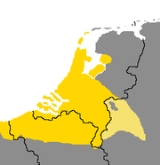
Meuse-Rhenish or Rheinmaasländisch is a modern term that geographically refers to the literature written in mediæval times in the greater Meuse-Rhine area. This area stretches in the northern triangle roughly between the rivers Meuse (in Belgium and the Netherlands) and Rhine (in Germany). It also applies to the Low Franconian dialects that have been spoken in that area in continuation from mediæval times up to now.
It includes varieties of South Guelderish
(Zuid-Gelders) and Limburgish in the Belgian and Dutch provinces of Limburg, and their German counterparts Low Rhenish (German: Niederrheinisch) including East Bergish
in German Northern Rhineland
. This group can be called Meuse-Rhenish (German: Rheinmaasländisch, Dutch: Maas-Rijnlands, and French: francique rhéno-mosan). Although some dialects of this group are spoken within the language area where German is the standard, they actually are Low Franconian in character, do stand on a shorter distance to Dutch than to High German, and could therefore also be called Dutch (see also Dutch dialects
). With regard to this German part only, Meuse-Rhenish equals the total of Low Rhenish vernaculars.
in the west of Germany.
Low Franconian is a language or dialect group that has developed in the lower parts of the Frankish Empire
, northwest of the Benrath line
. From this group both the Dutch
and later the Afrikaans
standard languages have arisen. The differences between Low Rhenish and Low Saxon are smaller than between Low Rhenish and High German. Yet, Low Rhenish does not belong to Low German
, but to Low Franconian. Therefore it could properly be called German Dutch. Indeed, Deutschniederländisch was the official term under the Prussian Reign of the 19th century.
 Today, Low Franconian dialects are spoken mainly in regions to the west of the rivers Rhine and IJssel
in the Netherlands
, in the Dutch speaking part of Belgium
, but also in Germany in the Lower Rhine
area. Only the latter have traditionally been called Low Rhenish, but they can be regarded as the German extension or counterpart of the Limburgish regiolects
in the Netherlands and Belgium, and of Zuid-Gelders (South Guelderish) in the Netherlands.
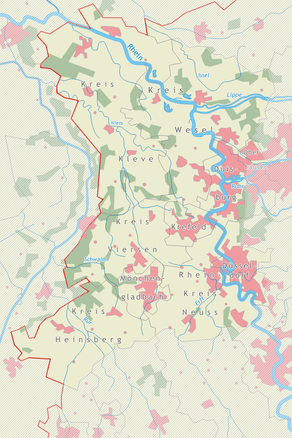
Low Rhenish differs strongly from High German. The more to the north it approaches the Netherlands, the more it sounds like Dutch. As it crosses the Dutch-German as well as the Dutch-Belgian borders, it becomes a part of the language landscape in three neighbouring countries. In two of them Dutch is the standard language. In Germany, important towns on the Lower Rhine and in the Rhine-Ruhr area, including parts of the Düsseldorf Region, are part of it, among them Kleve
, Xanten
, Wesel
, Moers
, Essen
, Duisburg
, Düsseldorf
, Oberhausen
and Wuppertal
. This language area stretches towards the southwest along cities such as Neuss
, Krefeld
and Mönchengladbach
, and the Heinsberg
district, where it is called Limburgish, crosses the German-Dutch border into the Dutch province of Limburg
, passing cities east of the Meuse
river (in both Dutch and German called Maas) such as Venlo
, Roermond
and Sittard
, and then again crosses the Meuse
between the Dutch and Belgian provinces of Limburg, encompassing the cities of Maastricht
(NL) and Hasselt
(B). Thus a mainly political-geographic (not linguistical) division can be made into western (Dutch) South Guelderish and Limburgish at the west side, and eastern (German) Low Rhenish and South East Low Franconian at the east side of the border. The eastmost varieties of the latter, east of the Rhine from Düsseldorf to Wuppertal, are referred to as Low Bergish
.
Limburgish is recognised as a regional language
in the Netherlands. As such, it receives moderate protection under chapter 2 of the European Charter for Regional or Minority Languages. The area in which Limburgish is spoken roughly fits within a wide circle from Venlo
(NL) to Düsseldorf
(D) to Aachen
(D) to Maastricht
(NL) to Hasselt
(B) and back to Venlo. In Germany, it is common to consider the Limburgish varieties as belonging to the Low Franconian language varieties; in the Netherlands and Belgium, however, all these varieties are traditionally considered to be West Central German
, part of High German. This difference is caused by a difference in definition: linguists of the Low Countries define a High German variety as one that has taken part in any of the first three phases of the High German consonant shift
.
In German sources, the dialects linguistically counting as Limburgish spoken east of the river Rhine are often called "Bergish
" (after the former Duchy of Berg). West of the river Rhine they are called "Low Rhenish", "Limburgish" or "Ripuarian". Limburgish is not recognised by the German government as an official language. Low Rhenish is considered as a group of dialects in Germany. Together all these varieties belong to a greater continuum; this superordinating group is called Meuse-Rhenish. These insights are rather new among dialectologists on both sides of the national Dutch-German border.
German population in the Meuse-Rhine area are used to let the geographic 'Lower Rhine' area begin approximately with the Benrath line, coincidentally. They do mostly not think of the Ripuarian speaking area as Low Rhenish, which includes the South Bergish
or Upper Bergish area east of the Rhine, south of the Wupper
, north of the Sieg
.
(1543–1789), though politically more fragmented. The former predominantly Dutch speaking duchies of Guelders
and Limburg
lay in the heart of this linguistic landscape, but eastward the former duchies of Cleves (entirely), Jülich
, and Berg
partially, also fit in.
The northwestern part of this triangular area came under the influence of the Dutch standard language, especially since the founding of the United Kingdom of the Netherlands
in 1815. The southeastern part became a part of the Kingdom of Prussia
at the same time, and from then it was subject to High German language domination. At the dialectal level however, mutual understanding is still possible far beyond both sides of the national borders.
The close relation between Limburgish of Belgium and the Netherlands and Low Bergish
is paralleled with that between Zuid-Gelders and Kleverlandish-East Bergish
, which are even more clearly belonging to Low Franconian. By including Zuid-Gelders-Kleverlandish-East Bergish in this continuum, we are enlarging the territory and turn the wide circle of Limburgish into a triangle with its top along the line Arnhem
- Kleve
- Wesel
- Duisburg
- Wuppertal
(along the Rhine-IJssel
Line). The Diest
- Nijmegen Line is its western border, the Benrath line
(from Eupen
to Wuppertal
) is a major part of the southeastern one.
Within the Dutch speaking area, the Western continuance of Low Rhenish is divided into Limburgish and Zuid-Gelders. Together they belong to the greater triangle-shaped Meuse
-Rhine area, a large group of southeastern Low Franconian dialects, including areas in Belgium, the Netherlands and the German Northern Rhineland
.
, Bocholtz and Vaals
in the Netherlands
, Aachen
in Germany
and Raeren
and Eynatten
in Belgium
. In Germany
it is mostly considered as a form of Ripuarian
, instead of Limburgish. According to a contemporary vision, all varieties in a wider half circle some 20 km around Aachen, including 2/3 of Dutch South Limburg and also the so-called Low Dietsch
area between Voeren and Eupen
in Belgium, can be taken as a group of its own, which recently has been named Limburgish of the Three Countries Area (Dutch: Drielandenlimburgs, German: Dreiländerplatt), referring to the place where the Netherlands, Belgium and Germany meet. This variety still possesses interesting syntactic idiosyncrasies, probably dating from the period in which the old Duchy of Limburg
existed. In Belgium, the south-eastern boundary between Meuse-Rhenish or (French) francique rhéno-mosan and Ripuarian is formed by the Low Dietsch
language area.
If only tonality is to be taken as to define this variety, it stretches several dozen kilometers into Germany
. In Germany, the consensus is to class it as belonging to High German
varieties. But this is a little over-simplified. In order to include them properly, a more encompassing concept is needed. The combination of Meuse-Rhenish and Ripuarian
, including their overlapping transitional zones of Southeast Limburgish and Low Dietsch
, will do.
It includes varieties of South Guelderish
South Guelderish
South Guelderish refers to a group of dialects of the Dutch language which are spoken along the Nederrijn in the Netherlands and around the city of Cleves in Germany...
(Zuid-Gelders) and Limburgish in the Belgian and Dutch provinces of Limburg, and their German counterparts Low Rhenish (German: Niederrheinisch) including East Bergish
East Bergish
East Bergish is a group of dialects of the Bergisches Land Region in West Germany. It combines features the of Westphalian group, Limburgish, and the South Guelderish or Cleverlands group, it is usually seen as part of the latter. South Guelderish covers much of the Lower Rhine area in Germany and...
in German Northern Rhineland
Rhineland
Historically, the Rhinelands refers to a loosely-defined region embracing the land on either bank of the River Rhine in central Europe....
. This group can be called Meuse-Rhenish (German: Rheinmaasländisch, Dutch: Maas-Rijnlands, and French: francique rhéno-mosan). Although some dialects of this group are spoken within the language area where German is the standard, they actually are Low Franconian in character, do stand on a shorter distance to Dutch than to High German, and could therefore also be called Dutch (see also Dutch dialects
Dutch dialects
Dutch dialects are primarily the dialects that are both cognate with the Dutch language and are spoken in the same language area as the Dutch standard language. Dutch dialects are remarkably diverse and are found in the Netherlands and northern Belgium....
). With regard to this German part only, Meuse-Rhenish equals the total of Low Rhenish vernaculars.
Low Rhenish and Limburgish
Low Rhenish is the collective name in German for the regional Low Franconian language varieties spoken alongside the so-called Lower RhineLower Rhine
The Lower Rhine flows from Bonn, Germany, to the North Sea at Hoek van Holland, Netherlands.Almost immediately after entering the Netherlands, the Rhine splits into many branches. The main branch is called the Waal which flows from Nijmegen to meet the river Meuse; after which it is called Merwede...
in the west of Germany.
Low Franconian is a language or dialect group that has developed in the lower parts of the Frankish Empire
Frankish Empire
Francia or Frankia, later also called the Frankish Empire , Frankish Kingdom , Frankish Realm or occasionally Frankland, was the territory inhabited and ruled by the Franks from the 3rd to the 10th century...
, northwest of the Benrath line
Benrath line
In German linguistics, the Benrath line is the maken-machen isogloss: dialects north of the line have the original in maken , while those to the south have...
. From this group both the Dutch
Dutch language
Dutch is a West Germanic language and the native language of the majority of the population of the Netherlands, Belgium, and Suriname, the three member states of the Dutch Language Union. Most speakers live in the European Union, where it is a first language for about 23 million and a second...
and later the Afrikaans
Afrikaans
Afrikaans is a West Germanic language, spoken natively in South Africa and Namibia. It is a daughter language of Dutch, originating in its 17th century dialects, collectively referred to as Cape Dutch .Afrikaans is a daughter language of Dutch; see , , , , , .Afrikaans was historically called Cape...
standard languages have arisen. The differences between Low Rhenish and Low Saxon are smaller than between Low Rhenish and High German. Yet, Low Rhenish does not belong to Low German
Low German
Low German or Low Saxon is an Ingvaeonic West Germanic language spoken mainly in northern Germany and the eastern part of the Netherlands...
, but to Low Franconian. Therefore it could properly be called German Dutch. Indeed, Deutschniederländisch was the official term under the Prussian Reign of the 19th century.
IJssel
River IJssel , sometimes called Gelderse IJssel to avoid confusion with its Hollandse IJssel namesake in the west of the Netherlands, is a branch of the Rhine in the Dutch provinces of Gelderland and Overijssel...
in the Netherlands
Netherlands
The Netherlands is a constituent country of the Kingdom of the Netherlands, located mainly in North-West Europe and with several islands in the Caribbean. Mainland Netherlands borders the North Sea to the north and west, Belgium to the south, and Germany to the east, and shares maritime borders...
, in the Dutch speaking part of Belgium
Belgium
Belgium , officially the Kingdom of Belgium, is a federal state in Western Europe. It is a founding member of the European Union and hosts the EU's headquarters, and those of several other major international organisations such as NATO.Belgium is also a member of, or affiliated to, many...
, but also in Germany in the Lower Rhine
Lower Rhine
The Lower Rhine flows from Bonn, Germany, to the North Sea at Hoek van Holland, Netherlands.Almost immediately after entering the Netherlands, the Rhine splits into many branches. The main branch is called the Waal which flows from Nijmegen to meet the river Meuse; after which it is called Merwede...
area. Only the latter have traditionally been called Low Rhenish, but they can be regarded as the German extension or counterpart of the Limburgish regiolects
Dialectology
Dialectology is the scientific study of linguistic dialect, a sub-field of sociolinguistics. It studies variations in language based primarily on geographic distribution and their associated features...
in the Netherlands and Belgium, and of Zuid-Gelders (South Guelderish) in the Netherlands.
Low Rhenish differs strongly from High German. The more to the north it approaches the Netherlands, the more it sounds like Dutch. As it crosses the Dutch-German as well as the Dutch-Belgian borders, it becomes a part of the language landscape in three neighbouring countries. In two of them Dutch is the standard language. In Germany, important towns on the Lower Rhine and in the Rhine-Ruhr area, including parts of the Düsseldorf Region, are part of it, among them Kleve
Kleve
Kleve , is a town in the Lower Rhine region of northwestern Germany near the Dutch border and the River Rhine. From the 11th century onwards, Kleve was capital of a county and later a duchy...
, Xanten
Xanten
Xanten is a historic town in the North Rhine-Westphalia state of Germany, located in the district of Wesel.Xanten is known for the Archaeological Park or archaeological open air museum , its medieval picturesque city centre with Xanten Cathedral and many museums, its large man-made lake for...
, Wesel
Wesel
Wesel is a city in North Rhine-Westphalia, Germany. It is the capital of the Wesel district.-Division of the town:Suburbs of Wesel include Lackhausen, Obrighoven, Ginderich, Feldmark,Fusternberg, Büderich, Flüren and Blumenkamp.-History:...
, Moers
Moers
Moers is a German city on the left bank of the Rhine. Moers belongs to the district of Wesel...
, Essen
Essen
- Origin of the name :In German-speaking countries, the name of the city Essen often causes confusion as to its origins, because it is commonly known as the German infinitive of the verb for the act of eating, and/or the German noun for food. Although scholars still dispute the interpretation of...
, Duisburg
Duisburg
- History :A legend recorded by Johannes Aventinus holds that Duisburg, was built by the eponymous Tuisto, mythical progenitor of Germans, ca. 2395 BC...
, Düsseldorf
Düsseldorf
Düsseldorf is the capital city of the German state of North Rhine-Westphalia and centre of the Rhine-Ruhr metropolitan region.Düsseldorf is an important international business and financial centre and renowned for its fashion and trade fairs. Located centrally within the European Megalopolis, the...
, Oberhausen
Oberhausen
Oberhausen is a city on the river Emscher in the Ruhr Area, Germany, located between Duisburg and Essen . The city hosts the International Short Film Festival Oberhausen and its Gasometer Oberhausen is an anchor point of the European Route of Industrial Heritage. It is also well known for the...
and Wuppertal
Wuppertal
Wuppertal is a city in North Rhine-Westphalia, Germany. It is located in and around the Wupper river valley, and is situated east of the city of Düsseldorf and south of the Ruhr area. With a population of approximately 350,000, it is the largest city in the Bergisches Land...
. This language area stretches towards the southwest along cities such as Neuss
Neuss
Neuss is a city in North Rhine-Westphalia, Germany. It is located on the west bank of the Rhine opposite Düsseldorf. Neuss is the largest city within the Rhein-Kreis Neuss district and owes its prosperity to its location at the crossing of historic and modern trade routes. It is primarily known...
, Krefeld
Krefeld
Krefeld , also known as Crefeld until 1929, is a city in North Rhine-Westphalia, Germany. It is located northwest of Düsseldorf, its centre lying just a few kilometres to the west of the River Rhine; the borough of Uerdingen is situated directly on the Rhine...
and Mönchengladbach
Mönchengladbach
Mönchengladbach , formerly known as Münchengladbach, is a city in North Rhine-Westphalia, Germany. It is located west of the Rhine half way between Düsseldorf and the Dutch border....
, and the Heinsberg
Heinsberg
Heinsberg is the capital of the district Heinsberg in North Rhine-Westphalia, Germany. It is situated near the border with the Netherlands, on the river Wurm, approx...
district, where it is called Limburgish, crosses the German-Dutch border into the Dutch province of Limburg
Limburg (Netherlands)
Limburg is the southernmost of the twelve provinces of the Netherlands. It is located in the southeastern part of the country and bordered by the province of Gelderland to the north, Germany to the east, Belgium to the south and part of the west, andthe Dutch province of North Brabant partly to...
, passing cities east of the Meuse
Meuse
Meuse is a department in northeast France, named after the River Meuse.-History:Meuse is one of the original 83 departments created during the French Revolution on March 4, 1790...
river (in both Dutch and German called Maas) such as Venlo
Venlo
Venlo is a municipality and a city in the southeastern Netherlands, next to the German border. It is situated in the province of Limburg.In 2001, the municipalities of Belfeld and Tegelen were merged into the municipality of Venlo. Tegelen was originally part of the Duchy of Jülich centuries ago,...
, Roermond
Roermond
Roermond is a city, a municipality, and a diocese in the southeastern part of the Netherlands.The city of Roermond is a historically important town, on the lower Roer at the east bank of the Meuse river. It received city rights in 1231...
and Sittard
Sittard
Sittard is a city in the Dutch province of Limburg, which is the southernmost province of the Netherlands.On the east Sittard borders on Germany . It has some 48,400 inhabitants . Sittard is part of the municipality of Sittard-Geleen...
, and then again crosses the Meuse
Meuse
Meuse is a department in northeast France, named after the River Meuse.-History:Meuse is one of the original 83 departments created during the French Revolution on March 4, 1790...
between the Dutch and Belgian provinces of Limburg, encompassing the cities of Maastricht
Maastricht
Maastricht is situated on both sides of the Meuse river in the south-eastern part of the Netherlands, on the Belgian border and near the German border...
(NL) and Hasselt
Hasselt
Hasselt is a Belgian city and municipality, and capital of the Flemish province of Limburg...
(B). Thus a mainly political-geographic (not linguistical) division can be made into western (Dutch) South Guelderish and Limburgish at the west side, and eastern (German) Low Rhenish and South East Low Franconian at the east side of the border. The eastmost varieties of the latter, east of the Rhine from Düsseldorf to Wuppertal, are referred to as Low Bergish
Low Bergish
Low Bergish, or Western Bergish, is a group of local languages of the Bergisches Land Region east of the Rhine in West Germany. It is part of the Limburgish language group, which extends far beyond the rivers Rhine and Maas into the Netherlands and Belgium. They are also part of the East Limburgish...
.
Limburgish is recognised as a regional language
Regional language
A regional language is a language spoken in an area of a nation state, whether it be a small area, a federal state or province, or some wider area....
in the Netherlands. As such, it receives moderate protection under chapter 2 of the European Charter for Regional or Minority Languages. The area in which Limburgish is spoken roughly fits within a wide circle from Venlo
Venlo
Venlo is a municipality and a city in the southeastern Netherlands, next to the German border. It is situated in the province of Limburg.In 2001, the municipalities of Belfeld and Tegelen were merged into the municipality of Venlo. Tegelen was originally part of the Duchy of Jülich centuries ago,...
(NL) to Düsseldorf
Düsseldorf
Düsseldorf is the capital city of the German state of North Rhine-Westphalia and centre of the Rhine-Ruhr metropolitan region.Düsseldorf is an important international business and financial centre and renowned for its fashion and trade fairs. Located centrally within the European Megalopolis, the...
(D) to Aachen
Aachen
Aachen has historically been a spa town in North Rhine-Westphalia, Germany. Aachen was a favoured residence of Charlemagne, and the place of coronation of the Kings of Germany. Geographically, Aachen is the westernmost town of Germany, located along its borders with Belgium and the Netherlands, ...
(D) to Maastricht
Maastricht
Maastricht is situated on both sides of the Meuse river in the south-eastern part of the Netherlands, on the Belgian border and near the German border...
(NL) to Hasselt
Hasselt
Hasselt is a Belgian city and municipality, and capital of the Flemish province of Limburg...
(B) and back to Venlo. In Germany, it is common to consider the Limburgish varieties as belonging to the Low Franconian language varieties; in the Netherlands and Belgium, however, all these varieties are traditionally considered to be West Central German
West Central German
West Central German belongs to the Central, High German dialect family in the German language. Its dialects are thoroughly Franconian including the following sub-families:* Central Franconian...
, part of High German. This difference is caused by a difference in definition: linguists of the Low Countries define a High German variety as one that has taken part in any of the first three phases of the High German consonant shift
High German consonant shift
In historical linguistics, the High German consonant shift or second Germanic consonant shift is a phonological development that took place in the southern parts of the West Germanic dialect continuum in several phases, probably beginning between the 3rd and 5th centuries AD, and was almost...
.
In German sources, the dialects linguistically counting as Limburgish spoken east of the river Rhine are often called "Bergish
Bergish dialects
Bergish is a term used for the collection of local languages of the Bergisches Land Region East of the Rhine in West Germany. It is more a popular term, rather than one of linguistic relevance. The reason is that, the regions local dialects belong to several quite distinct groups inside the...
" (after the former Duchy of Berg). West of the river Rhine they are called "Low Rhenish", "Limburgish" or "Ripuarian". Limburgish is not recognised by the German government as an official language. Low Rhenish is considered as a group of dialects in Germany. Together all these varieties belong to a greater continuum; this superordinating group is called Meuse-Rhenish. These insights are rather new among dialectologists on both sides of the national Dutch-German border.
German population in the Meuse-Rhine area are used to let the geographic 'Lower Rhine' area begin approximately with the Benrath line, coincidentally. They do mostly not think of the Ripuarian speaking area as Low Rhenish, which includes the South Bergish
South Bergish
South Bergish dialects or Upper Bergish is a term used for the collection of local languages of the Bergisches Land Region East of the Rhine and approximately south of the Wupper and north of the Sieg in West Germany. These dialects are all part of the Ripuarian group and thus are also called...
or Upper Bergish area east of the Rhine, south of the Wupper
Wupper
The Wupper is a right tributary to the Rhine river in the state of North Rhine-Westphalia, Germany. Rising near Marienheide in western Sauerland it runs through the mountainous area of the Bergisches Land Berg County and enters the Rhine at Leverkussen, south of Düsseldorf...
, north of the Sieg
Sieg
The Sieg is a river in North Rhine-Westphalia and Rhineland-Palatinate, Germany named after the Sigambrer. It is a right tributary of the Rhine and 153 kilometres in length....
.
The Meuse-Rhine triangle
This whole region between the Meuse and the Rhine was linguistically and culturally quite coherent during the so-called Early modern periodEarly modern period
In history, the early modern period of modern history follows the late Middle Ages. Although the chronological limits of the period are open to debate, the timeframe spans the period after the late portion of the Middle Ages through the beginning of the Age of Revolutions...
(1543–1789), though politically more fragmented. The former predominantly Dutch speaking duchies of Guelders
Guelders
Guelders or Gueldres is the name of a historical county, later duchy of the Holy Roman Empire, located in the Low Countries.-Geography:...
and Limburg
Duchy of Limburg
The Duchy of Limburg, situated in the Low Countries between the river Meuse and the city of Aachen, was a state of the Holy Roman Empire. Its territory is now divided between the Belgian provinces of Liège and Limburg , the Dutch province of Limburg , and a small part of North Rhine-Westphalia in...
lay in the heart of this linguistic landscape, but eastward the former duchies of Cleves (entirely), Jülich
Jülich
Jülich is a town in the district of Düren, in the federal state of North Rhine-Westphalia, Germany. Jülich is well known as location of a world-famous research centre, the Forschungszentrum Jülich and as shortwave transmission site of Deutsche Welle...
, and Berg
Berg (state)
Berg was a state – originally a county, later a duchy – in the Rhineland of Germany. Its capital was Düsseldorf. It existed from the early 12th to the 19th centuries.-Ascent:...
partially, also fit in.
The northwestern part of this triangular area came under the influence of the Dutch standard language, especially since the founding of the United Kingdom of the Netherlands
United Kingdom of the Netherlands
United Kingdom of the Netherlands is the unofficial name used to refer to Kingdom of the Netherlands during the period after it was first created from part of the First French Empire and before the new kingdom of Belgium split out in 1830...
in 1815. The southeastern part became a part of the Kingdom of Prussia
Kingdom of Prussia
The Kingdom of Prussia was a German kingdom from 1701 to 1918. Until the defeat of Germany in World War I, it comprised almost two-thirds of the area of the German Empire...
at the same time, and from then it was subject to High German language domination. At the dialectal level however, mutual understanding is still possible far beyond both sides of the national borders.
The close relation between Limburgish of Belgium and the Netherlands and Low Bergish
Low Bergish
Low Bergish, or Western Bergish, is a group of local languages of the Bergisches Land Region east of the Rhine in West Germany. It is part of the Limburgish language group, which extends far beyond the rivers Rhine and Maas into the Netherlands and Belgium. They are also part of the East Limburgish...
is paralleled with that between Zuid-Gelders and Kleverlandish-East Bergish
East Bergish
East Bergish is a group of dialects of the Bergisches Land Region in West Germany. It combines features the of Westphalian group, Limburgish, and the South Guelderish or Cleverlands group, it is usually seen as part of the latter. South Guelderish covers much of the Lower Rhine area in Germany and...
, which are even more clearly belonging to Low Franconian. By including Zuid-Gelders-Kleverlandish-East Bergish in this continuum, we are enlarging the territory and turn the wide circle of Limburgish into a triangle with its top along the line Arnhem
Arnhem
Arnhem is a city and municipality, situated in the eastern part of the Netherlands. It is the capital of the province of Gelderland and located near the river Nederrijn as well as near the St. Jansbeek, which was the source of the city's development. Arnhem has 146,095 residents as one of the...
- Kleve
Kleve
Kleve , is a town in the Lower Rhine region of northwestern Germany near the Dutch border and the River Rhine. From the 11th century onwards, Kleve was capital of a county and later a duchy...
- Wesel
Wesel
Wesel is a city in North Rhine-Westphalia, Germany. It is the capital of the Wesel district.-Division of the town:Suburbs of Wesel include Lackhausen, Obrighoven, Ginderich, Feldmark,Fusternberg, Büderich, Flüren and Blumenkamp.-History:...
- Duisburg
Duisburg
- History :A legend recorded by Johannes Aventinus holds that Duisburg, was built by the eponymous Tuisto, mythical progenitor of Germans, ca. 2395 BC...
- Wuppertal
Wuppertal
Wuppertal is a city in North Rhine-Westphalia, Germany. It is located in and around the Wupper river valley, and is situated east of the city of Düsseldorf and south of the Ruhr area. With a population of approximately 350,000, it is the largest city in the Bergisches Land...
(along the Rhine-IJssel
IJssel
River IJssel , sometimes called Gelderse IJssel to avoid confusion with its Hollandse IJssel namesake in the west of the Netherlands, is a branch of the Rhine in the Dutch provinces of Gelderland and Overijssel...
Line). The Diest
Diest
Diest is a city and municipality located in the Belgian province of Flemish Brabant. Situated in the northeast of the Hageland region, Diest neighbours the provinces of Antwerp to its North, and Limburg to the East and is situated around 60km from Brussels. The municipality comprises the city of...
- Nijmegen Line is its western border, the Benrath line
Benrath line
In German linguistics, the Benrath line is the maken-machen isogloss: dialects north of the line have the original in maken , while those to the south have...
(from Eupen
Eupen
Eupen is a municipality in the Belgian province of Liège, from the German border , from the Dutch border and from the "High Fens" nature reserve...
to Wuppertal
Wuppertal
Wuppertal is a city in North Rhine-Westphalia, Germany. It is located in and around the Wupper river valley, and is situated east of the city of Düsseldorf and south of the Ruhr area. With a population of approximately 350,000, it is the largest city in the Bergisches Land...
) is a major part of the southeastern one.
Within the Dutch speaking area, the Western continuance of Low Rhenish is divided into Limburgish and Zuid-Gelders. Together they belong to the greater triangle-shaped Meuse
Meuse
Meuse is a department in northeast France, named after the River Meuse.-History:Meuse is one of the original 83 departments created during the French Revolution on March 4, 1790...
-Rhine area, a large group of southeastern Low Franconian dialects, including areas in Belgium, the Netherlands and the German Northern Rhineland
Rhineland
Historically, the Rhinelands refers to a loosely-defined region embracing the land on either bank of the River Rhine in central Europe....
.
Southeast Limburgish around Aachen
Southeast Limburgish is spoken around KerkradeKerkrade
Kerkrade is a town and a municipality in the southeastern Netherlands.It is the western half of the divided region and de facto city, taken together with the eastern half, the German town of Herzogenrath...
, Bocholtz and Vaals
Vaals
Vaals is a town in the extreme southeastern part of the Dutch province of Limburg, which in its turn finds itself in the southeastern part of the Netherlands....
in the Netherlands
Netherlands
The Netherlands is a constituent country of the Kingdom of the Netherlands, located mainly in North-West Europe and with several islands in the Caribbean. Mainland Netherlands borders the North Sea to the north and west, Belgium to the south, and Germany to the east, and shares maritime borders...
, Aachen
Aachen
Aachen has historically been a spa town in North Rhine-Westphalia, Germany. Aachen was a favoured residence of Charlemagne, and the place of coronation of the Kings of Germany. Geographically, Aachen is the westernmost town of Germany, located along its borders with Belgium and the Netherlands, ...
in Germany
Germany
Germany , officially the Federal Republic of Germany , is a federal parliamentary republic in Europe. The country consists of 16 states while the capital and largest city is Berlin. Germany covers an area of 357,021 km2 and has a largely temperate seasonal climate...
and Raeren
Raeren
Raeren is a municipality located in the Belgian province of Liège. It was part of Germany until the First World War, after which it became part of Belgium. It is one of several towns in Eastern Belgium which still predominantly speak German....
and Eynatten
Eynatten
Eynatten is a village in the Belgian municipality of Raeren into the German-speaking Community of Belgium. Eynatten is on the border to Germany, 6 km south from Aachen. Around half of the population are foreigners, most of them Germans....
in Belgium
Belgium
Belgium , officially the Kingdom of Belgium, is a federal state in Western Europe. It is a founding member of the European Union and hosts the EU's headquarters, and those of several other major international organisations such as NATO.Belgium is also a member of, or affiliated to, many...
. In Germany
Germany
Germany , officially the Federal Republic of Germany , is a federal parliamentary republic in Europe. The country consists of 16 states while the capital and largest city is Berlin. Germany covers an area of 357,021 km2 and has a largely temperate seasonal climate...
it is mostly considered as a form of Ripuarian
Ripuarian
Ripuarian is a German dialect group, part of the West Central German language group....
, instead of Limburgish. According to a contemporary vision, all varieties in a wider half circle some 20 km around Aachen, including 2/3 of Dutch South Limburg and also the so-called Low Dietsch
Low Dietsch
Low Dietsch is a term mainly used within the Flemish terminology for the transitional Limburgish–Ripuarian dialects of a number of towns and villages in the north-east of the Belgian province of Liege, such as Gemmenich, Homburg, Montzen and Welkenraedt....
area between Voeren and Eupen
Eupen
Eupen is a municipality in the Belgian province of Liège, from the German border , from the Dutch border and from the "High Fens" nature reserve...
in Belgium, can be taken as a group of its own, which recently has been named Limburgish of the Three Countries Area (Dutch: Drielandenlimburgs, German: Dreiländerplatt), referring to the place where the Netherlands, Belgium and Germany meet. This variety still possesses interesting syntactic idiosyncrasies, probably dating from the period in which the old Duchy of Limburg
Duchy of Limburg
The Duchy of Limburg, situated in the Low Countries between the river Meuse and the city of Aachen, was a state of the Holy Roman Empire. Its territory is now divided between the Belgian provinces of Liège and Limburg , the Dutch province of Limburg , and a small part of North Rhine-Westphalia in...
existed. In Belgium, the south-eastern boundary between Meuse-Rhenish or (French) francique rhéno-mosan and Ripuarian is formed by the Low Dietsch
Low Dietsch
Low Dietsch is a term mainly used within the Flemish terminology for the transitional Limburgish–Ripuarian dialects of a number of towns and villages in the north-east of the Belgian province of Liege, such as Gemmenich, Homburg, Montzen and Welkenraedt....
language area.
If only tonality is to be taken as to define this variety, it stretches several dozen kilometers into Germany
Germany
Germany , officially the Federal Republic of Germany , is a federal parliamentary republic in Europe. The country consists of 16 states while the capital and largest city is Berlin. Germany covers an area of 357,021 km2 and has a largely temperate seasonal climate...
. In Germany, the consensus is to class it as belonging to High German
High German languages
The High German languages or the High German dialects are any of the varieties of standard German, Luxembourgish and Yiddish, as well as the local German dialects spoken in central and southern Germany, Austria, Liechtenstein, Switzerland, Luxembourg and in neighboring portions of Belgium and the...
varieties. But this is a little over-simplified. In order to include them properly, a more encompassing concept is needed. The combination of Meuse-Rhenish and Ripuarian
Ripuarian
Ripuarian is a German dialect group, part of the West Central German language group....
, including their overlapping transitional zones of Southeast Limburgish and Low Dietsch
Low Dietsch
Low Dietsch is a term mainly used within the Flemish terminology for the transitional Limburgish–Ripuarian dialects of a number of towns and villages in the north-east of the Belgian province of Liege, such as Gemmenich, Homburg, Montzen and Welkenraedt....
, will do.
Classification
- Indo-EuropeanIndo-European languagesThe Indo-European languages are a family of several hundred related languages and dialects, including most major current languages of Europe, the Iranian plateau, and South Asia and also historically predominant in Anatolia...
- GermanicGermanic languagesThe Germanic languages constitute a sub-branch of the Indo-European language family. The common ancestor of all of the languages in this branch is called Proto-Germanic , which was spoken in approximately the mid-1st millennium BC in Iron Age northern Europe...
- West Germanic
- Low Franconian
- Meuse-Rhenish
- Limburgish and Zuid-Gelders / Low Rhenish
- Meuse-Rhenish
- Low Franconian
- West Germanic
- Germanic
Sources
- Ad Welschen 2000-2005: Course Dutch Society and Culture, International School for Humanities and Social Studies ISHSS, Universiteit van Amsterdam
- Georg Cornelissen 2003: Kleine niederrheinische Sprachgeschichte (1300-1900) : eine regionale Sprachgeschichte für das deutsch-niederländische Grenzgebiet zwischen Arnheim und Krefeld [with an introduction in Dutch. Geldern / Venray: Stichting Historie Peel-Maas-Niersgebied, ISBN 90-807292-2-1]
- Michael Elmentaler, Die Schreibsprachgeschichte des Niederrheins. Forschungsprojekt der Uni Duisburg, in: Sprache und Literatur am Niederrhein, Schriftenreihe der Niederrhein-Akademie Bd. 3, 15-34.
- Theodor Frings 1916: Mittelfränkisch-niederfränkische studien I. Das ripuarisch-niederfränkische Übergangsgebiet. II. Zur Geschichte des Niederfränkischenn in: Beiträge zur Geschichte und Sprache der deutschen Literatur 41 (1916), 193-271 en 42, 177-248.
- Irmgard Hantsche 2004: Atlas zur Geschichte des Niederrheins (= Schriftenreihe der Niederrhein-Akademie 4). Bottrop/Essen: Peter Pomp (5e druk). ISBN 3893552006
- Uwe Ludwig, Thomas Schilp (red.) 2004: Mittelalter an Rhein und Maas. Beiträge zur Geschichte des Niederrheins. Dieter Geuenich zum 60. Geburtstag (= Studien zur Geschichte und Kultur Nordwesteuropas 8). Münster/New York/München/Berlin: Waxmann. ISBN 383091380X
- Arend Mihm 1992: Sprache und Geschichte am unteren Niederrhein, in: Jahrbuch des Vereins für niederdeutsche Sprachforschung, 88-122.
- Arend Mihm 2000: Rheinmaasländische Sprachgeschichte von 1500 bis 1650, in: Jürgen Macha, Elmar Neuss, Robert Peters (red.): Rheinisch-Westfälische Sprachgeschichte. Köln enz. (= Niederdeutsche Studien 46), 139-164.
- Helmut Tervooren 2005: Van der Masen tot op den Rijn. Ein Handbuch zur Geschichte der volkssprachlichen mittelalterlichen Literatur im Raum von Rhein und Maas. Geldern: Erich Schmidt. ISBN 3503079580
See also
- Southeast Limburgish
- Bergish dialectsBergish dialectsBergish is a term used for the collection of local languages of the Bergisches Land Region East of the Rhine in West Germany. It is more a popular term, rather than one of linguistic relevance. The reason is that, the regions local dialects belong to several quite distinct groups inside the...
- Limburgish
- South GuelderishSouth GuelderishSouth Guelderish refers to a group of dialects of the Dutch language which are spoken along the Nederrijn in the Netherlands and around the city of Cleves in Germany...
- Low DietschLow DietschLow Dietsch is a term mainly used within the Flemish terminology for the transitional Limburgish–Ripuarian dialects of a number of towns and villages in the north-east of the Belgian province of Liege, such as Gemmenich, Homburg, Montzen and Welkenraedt....
- Zuid-Gelders