

Low Dietsch

Encyclopedia
Low Dietsch is a term mainly used within the Flemish terminology for the transitional Limburgish–Ripuarian dialects of a number of towns and villages in the north-east of the Belgian province of Liege
, such as Gemmenich, Homburg
, Montzen and Welkenraedt
.
This region, lying within the Belgian (Walloon) three frontiers area stretching from Voeren towards Eupen
, crossing Plombières
(Bleiberg), is called the Low Dietsch area . German dialectologists tend to roughly count this variety as Ripuarian Franconian, but more precisely it shows the gradual transition between Low Franconian Limburgish and West Central German
Ripuarian. It belongs to the whole range of Meuse-Rhenish
varieties that make the north-western part of the greater fan-like dialect continuum
called the Rhenish fan . As the most peripheral variety of southern Limburgish, it represents the language of the old Duchy of Limburg
, that had its historic kernel just there.
era.
Historically, this language area stretched from Tongeren to Cologne
, and this Limburgish-Frankish variety itself probably was the mother tongue of Charlemagne
.
Since 1963, it has officially belonged to the Walloon Region
and the French Community of Belgium
, but since 1992, this dialect has been acknowledged as an internal regional language by the Walloon
authority. Linguistically, however, it cannot be a called a walloon
dialect, because of its entirely Germanic, transitional Low Franconian / Middle Low German
nature. It forms the northwestern border of Ripuarian and the southeastern of Meuse-Rhenish or in Belgium.
, Bocholtz and Vaals
in the Netherlands, Aachen
in Germany and Raeren
and Eynatten
in Belgium, also shows the gradual transition from Limburgish towards Ripuarian. It is adjacent to the southeastern border of the Meuse-Rhenish language area, and is related to Southern Meuse-Rhenish
. Limburgish straddles the borderline between Low Franconian and West Central German varieties. They are more-or-less mutually intelligible with the Ripuarian dialects, but show fewer 'High German shifts' (R. Hahn 2001).
Dialects belonging to the Ripuarian group almost always call themselves Platt like Öcher Platt (of Aachen) or Eischwiele Platt (of Eschweiler). The reason behind this is, that most of the far more than hundred Ripuarian dialects are bound to a village or municipality. Usually there are small distinctive differences between neighboring dialects, and increasingly bigger ones between the more distant ones. These are described by a set of isogloss
es called the 'Rhenish fan' (Rheinischer Fächer in linguistics). The way someone talks, even if he is not using Ripuarian, quite often makes it possible to trace him precisely to the village or city quarter where he learned to speak.
According to a contemporary viewpoint, all varieties within a half circle some 15–20 km around Aachen, including two-thirds of Dutch South Limburg and also the Low Dietsch area between Voeren and Eupen
in Belgium, can be considered a group of its own, which recently has been named Limburgish of the Three Countries , referring to the place where the Netherlands, Belgium, and Germany meet (Frins 2005). This variety still possesses interesting syntactic idiosyncrasies, probably dating from the period when the old Duchy of Limburg existed.
Liège (province)
Liège is the easternmost province of Belgium and belongs to the Walloon Region. It is an area of French and German ethnicity. It borders on the Netherlands, Germany, Luxembourg, and in Belgium the provinces of Luxembourg, Namur, Walloon Brabant , and those of Flemish Brabant and Limburg . Its...
, such as Gemmenich, Homburg
Homburg
-In Germany:* Homburg, Saarland, capital of the Saarpfalz district of Saarland* Bad Homburg, town and spa in Hesse* Homburg Forest, a hill range in Lower Saxony* Homburg, a quarter of Triefenstein, Bavaria...
, Montzen and Welkenraedt
Welkenraedt
Welkenraedt is a Walloon municipality located in the province of Liège, Belgium. On January 1, 2006, Welkenraedt had a total population of 9,163. The total area is 24.47 km² which gives a population density of 374 inhabitants per km²....
.
| Language situation in the northeast of the Belgian province of Liège |
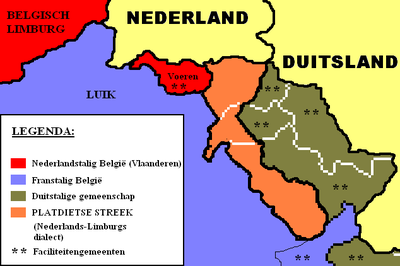 |
This region, lying within the Belgian (Walloon) three frontiers area stretching from Voeren towards Eupen
Eupen
Eupen is a municipality in the Belgian province of Liège, from the German border , from the Dutch border and from the "High Fens" nature reserve...
, crossing Plombières
Plombières
Plombières is a Walloon municipality located in the Belgian province of Liège. On January 1, 2006, Plombières had a total population of 9,672. The total area is 53.17 km² which gives a population density of 182 inhabitants per km². The municipality Plombières consists of the villages...
(Bleiberg), is called the Low Dietsch area . German dialectologists tend to roughly count this variety as Ripuarian Franconian, but more precisely it shows the gradual transition between Low Franconian Limburgish and West Central German
West Central German
West Central German belongs to the Central, High German dialect family in the German language. Its dialects are thoroughly Franconian including the following sub-families:* Central Franconian...
Ripuarian. It belongs to the whole range of Meuse-Rhenish
Meuse-Rhenish
Meuse-Rhenish or Rheinmaasländisch is a modern term that geographically refers to the literature written in mediæval times in the greater Meuse-Rhine area. This area stretches in the northern triangle roughly between the rivers Meuse and Rhine...
varieties that make the north-western part of the greater fan-like dialect continuum
Dialect continuum
A dialect continuum, or dialect area, was defined by Leonard Bloomfield as a range of dialects spoken across some geographical area that differ only slightly between neighboring areas, but as one travels in any direction, these differences accumulate such that speakers from opposite ends of the...
called the Rhenish fan . As the most peripheral variety of southern Limburgish, it represents the language of the old Duchy of Limburg
Duchy of Limburg
The Duchy of Limburg, situated in the Low Countries between the river Meuse and the city of Aachen, was a state of the Holy Roman Empire. Its territory is now divided between the Belgian provinces of Liège and Limburg , the Dutch province of Limburg , and a small part of North Rhine-Westphalia in...
, that had its historic kernel just there.
Carolingian Frankish
In French, the term (Carolingian Frankish) is also used, because of its historic roots, dating back to the CarolingianCarolingian
The Carolingian dynasty was a Frankish noble family with origins in the Arnulfing and Pippinid clans of the 7th century AD. The name "Carolingian", Medieval Latin karolingi, an altered form of an unattested Old High German *karling, kerling The Carolingian dynasty (known variously as the...
era.
Historically, this language area stretched from Tongeren to Cologne
Cologne
Cologne is Germany's fourth-largest city , and is the largest city both in the Germany Federal State of North Rhine-Westphalia and within the Rhine-Ruhr Metropolitan Area, one of the major European metropolitan areas with more than ten million inhabitants.Cologne is located on both sides of the...
, and this Limburgish-Frankish variety itself probably was the mother tongue of Charlemagne
Charlemagne
Charlemagne was King of the Franks from 768 and Emperor of the Romans from 800 to his death in 814. He expanded the Frankish kingdom into an empire that incorporated much of Western and Central Europe. During his reign, he conquered Italy and was crowned by Pope Leo III on 25 December 800...
.
Since 1963, it has officially belonged to the Walloon Region
Walloon Region
The Walloon Region, commonly called Wallonia, is one of the three federal Regions of Belgium, and its capital is Namur. It comprises, as defined by Article 5 of the Constitution of Belgium, the provinces of Walloon Brabant, Hainaut, Liège, Luxembourg and Namur...
and the French Community of Belgium
French Community of Belgium
The French Community of Belgium is one of the three official communities in Belgium along with the Flemish Community and the German speaking Community. Although its name could suggest that it is a community of French citizens in Belgium, it is not...
, but since 1992, this dialect has been acknowledged as an internal regional language by the Walloon
Walloon Region
The Walloon Region, commonly called Wallonia, is one of the three federal Regions of Belgium, and its capital is Namur. It comprises, as defined by Article 5 of the Constitution of Belgium, the provinces of Walloon Brabant, Hainaut, Liège, Luxembourg and Namur...
authority. Linguistically, however, it cannot be a called a walloon
Walloon language
Walloon is a Romance language which was spoken as a primary language in large portions of the Walloon Region of Belgium and some villages of Northern France until the middle of the 20th century. It belongs to the langue d'oïl language family, whose most prominent member is the French language...
dialect, because of its entirely Germanic, transitional Low Franconian / Middle Low German
Middle Low German
Middle Low German is a language that is the descendant of Old Saxon and is the ancestor of modern Low German. It served as the international lingua franca of the Hanseatic League...
nature. It forms the northwestern border of Ripuarian and the southeastern of Meuse-Rhenish or in Belgium.
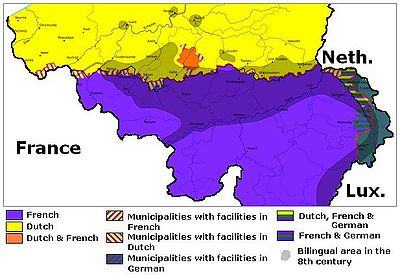
| Language situation in Belgium |
 |
Southeast Limburgish
Southeast Limburgish , as spoken around KerkradeKerkrade
Kerkrade is a town and a municipality in the southeastern Netherlands.It is the western half of the divided region and de facto city, taken together with the eastern half, the German town of Herzogenrath...
, Bocholtz and Vaals
Vaals
Vaals is a town in the extreme southeastern part of the Dutch province of Limburg, which in its turn finds itself in the southeastern part of the Netherlands....
in the Netherlands, Aachen
Aachen
Aachen has historically been a spa town in North Rhine-Westphalia, Germany. Aachen was a favoured residence of Charlemagne, and the place of coronation of the Kings of Germany. Geographically, Aachen is the westernmost town of Germany, located along its borders with Belgium and the Netherlands, ...
in Germany and Raeren
Raeren
Raeren is a municipality located in the Belgian province of Liège. It was part of Germany until the First World War, after which it became part of Belgium. It is one of several towns in Eastern Belgium which still predominantly speak German....
and Eynatten
Eynatten
Eynatten is a village in the Belgian municipality of Raeren into the German-speaking Community of Belgium. Eynatten is on the border to Germany, 6 km south from Aachen. Around half of the population are foreigners, most of them Germans....
in Belgium, also shows the gradual transition from Limburgish towards Ripuarian. It is adjacent to the southeastern border of the Meuse-Rhenish language area, and is related to Southern Meuse-Rhenish
Southern Meuse-Rhenish
Southeast Limburgish, also to be defined as Southern Meuse-Rhenish, is a subdivision of what recently has been named Meuse-Rhenish. Both terms denote a rather compact grouping of Low Franconian varieties, spoken in the Limburg and Lower Rhineland regions, near the common Dutch/Flemish and...
. Limburgish straddles the borderline between Low Franconian and West Central German varieties. They are more-or-less mutually intelligible with the Ripuarian dialects, but show fewer 'High German shifts' (R. Hahn 2001).
Dialects belonging to the Ripuarian group almost always call themselves Platt like Öcher Platt (of Aachen) or Eischwiele Platt (of Eschweiler). The reason behind this is, that most of the far more than hundred Ripuarian dialects are bound to a village or municipality. Usually there are small distinctive differences between neighboring dialects, and increasingly bigger ones between the more distant ones. These are described by a set of isogloss
Isogloss
An isogloss—also called a heterogloss —is the geographical boundary of a certain linguistic feature, such as the pronunciation of a vowel, the meaning of a word, or use of some syntactic feature...
es called the 'Rhenish fan' (Rheinischer Fächer in linguistics). The way someone talks, even if he is not using Ripuarian, quite often makes it possible to trace him precisely to the village or city quarter where he learned to speak.
According to a contemporary viewpoint, all varieties within a half circle some 15–20 km around Aachen, including two-thirds of Dutch South Limburg and also the Low Dietsch area between Voeren and Eupen
Eupen
Eupen is a municipality in the Belgian province of Liège, from the German border , from the Dutch border and from the "High Fens" nature reserve...
in Belgium, can be considered a group of its own, which recently has been named Limburgish of the Three Countries , referring to the place where the Netherlands, Belgium, and Germany meet (Frins 2005). This variety still possesses interesting syntactic idiosyncrasies, probably dating from the period when the old Duchy of Limburg existed.
Classification
- Indo-EuropeanIndo-European languagesThe Indo-European languages are a family of several hundred related languages and dialects, including most major current languages of Europe, the Iranian plateau, and South Asia and also historically predominant in Anatolia...
- GermanicGermanic languagesThe Germanic languages constitute a sub-branch of the Indo-European language family. The common ancestor of all of the languages in this branch is called Proto-Germanic , which was spoken in approximately the mid-1st millennium BC in Iron Age northern Europe...
- West Germanic
- Low Franconian / Middle Low GermanMiddle Low GermanMiddle Low German is a language that is the descendant of Old Saxon and is the ancestor of modern Low German. It served as the international lingua franca of the Hanseatic League...
- LimburgishLimburgish languageLimburgish, also called Limburgian or Limburgic is a group of East Low Franconian language varieties spoken in the Limburg and Rhineland regions, near the common Dutch / Belgian / German border...
–Ripuarian / Low Dietsch
- Limburgish
- Low Franconian / Middle Low German
- West Germanic
- Germanic
See also
- Southern Meuse-RhenishSouthern Meuse-RhenishSoutheast Limburgish, also to be defined as Southern Meuse-Rhenish, is a subdivision of what recently has been named Meuse-Rhenish. Both terms denote a rather compact grouping of Low Franconian varieties, spoken in the Limburg and Lower Rhineland regions, near the common Dutch/Flemish and...
- Ripuarian language
- Thiois in the French WikipediaFrench WikipediaThe French Wikipedia is the French language edition of Wikipedia, spelt Wikipédia. This edition was started in March 2001, and has about articles as of , making it the third-largest Wikipedia overall, after the English-language and German-language editions...
- Zuidoost-Limburgs in the Dutch WikipediaDutch WikipediaThe Dutch Wikipedia is the Dutch-language edition of the free online encyclopedia, Wikipedia. As of November 2011, the Dutch Wikipedia is the fourth-largest Wikipedia edition, with over articles.-History:...
- Eupen-MalmedyEupen-MalmedyEupen-Malmedy, or the East Cantons , is a group of cantons in Belgium, composed of the former Prussian districts of Malmedy and Eupen, together with the Neutral Moresnet...
External links
- Belgian Three frontiers area: Trois frontières.
- Projet babel
- Notre patois, notre "Platdutch"
- Dictionnaire du patois de Gemmenich