

Limahuli Garden and Preserve

Encyclopedia
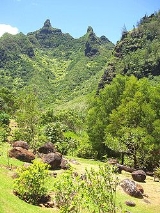
The Limahuli Garden and Preserve (17 acre or 6.9 ha of garden, 985 acre or 398.6 ha of preserve) is a botanical garden
Botanical garden
A botanical garden The terms botanic and botanical, and garden or gardens are used more-or-less interchangeably, although the word botanic is generally reserved for the earlier, more traditional gardens. is a well-tended area displaying a wide range of plants labelled with their botanical names...
and nature preserve on the north shore of Kauai
Kauai
Kauai or Kauai, known as Tauai in the ancient Kaua'i dialect, is geologically the oldest of the main Hawaiian Islands. With an area of , it is the fourth largest of the main islands in the Hawaiian archipelago, and the 21st largest island in the United States. Known also as the "Garden Isle",...
island, Hawaii
Hawaii
Hawaii is the newest of the 50 U.S. states , and is the only U.S. state made up entirely of islands. It is the northernmost island group in Polynesia, occupying most of an archipelago in the central Pacific Ocean, southwest of the continental United States, southeast of Japan, and northeast of...
. It is one of the five gardens of the non-profit National Tropical Botanical Garden
National Tropical Botanical Garden
The National Tropical Botanical Garden is a group that sponors preservation of plants native to the tropics in a network of botanical gardens and preserves.-History:...
.
Description
Limahuli lies within a tropical valley covering three distinct ecological zones.It is inland from the Haʻena State Park
Haʻena State Park
Hāena State Park is a state park located on the north shore of the Hawaiian island of Kauai. It is often referred to as the "end of the road" and marks the end point of the Kuhio Highway. The park provides access to beaches, trails, and several ancient Hawaiian sites, including sea caves estimated...
and Kee beach off of Route 560
Hawaii Route 560
Route 560 or Kaua'i Belt Road-North Shore section, is a ten-mile scenic road on the northern shore of the island of Kauai in Hawaii. The entire belt road is signed as the Kuhio Highway and Hawaii Route 56 was once signed on this route before it was downgraded to become Hawaii Route 560...
(near its western end) at 22°13′13"N 159°34′33"W.
The Makana Mountain
Makana
Makana is a mountain located on northern shore of the island of Kauai, where it rises above Limahuli Valley at .Makana is a Hawaiian language term meaning gift or reward. It is often used as a person's name or as part of a name....
ridge looms behind, and the Limahuli Stream includes an 800 feet (243.8 m) waterfall on its descent from the valley's high end at 3330 feet (1,015 m) to sea level just below the garden. This area is sometimes known as Bali Ha'i
Bali Ha'i
"Bali Ha'i", also spelled "Bali Hai", is a show tune from the 1949 Rodgers and Hammerstein musical South Pacific.-In musical South Pacific:...
, a name used in the 1958 film South Pacific
South Pacific (film)
South Pacific is a 1958 musical romance film adaptation of the Rodgers and Hammerstein musical South Pacific, and based on James A. Michener's Tales of the South Pacific...
which was filmed on location in the area.
The name comes from lima huli which means "turned hand" in the Hawaiian language
Hawaiian language
The Hawaiian language is a Polynesian language that takes its name from Hawaii, the largest island in the tropical North Pacific archipelago where it developed. Hawaiian, along with English, is an official language of the state of Hawaii...
.
The garden contains a wide range of native and Polynesia
Polynesia
Polynesia is a subregion of Oceania, made up of over 1,000 islands scattered over the central and southern Pacific Ocean. The indigenous people who inhabit the islands of Polynesia are termed Polynesians and they share many similar traits including language, culture and beliefs...
n-introduced plants, including kukui (Aleurites moluccana
Candlenut
Aleurites moluccana, the Candlenut, is a flowering tree in the spurge family, Euphorbiaceae, also known as Candleberry, Indian walnut, Kemiri, Varnish tree, Nuez de la India, Buah keras or Kukui nut tree....
), banana
Banana
Banana is the common name for herbaceous plants of the genus Musa and for the fruit they produce. Bananas come in a variety of sizes and colors when ripe, including yellow, purple, and red....
, breadfruit
Breadfruit
Breadfruit is a species of flowering tree in the mulberry family, Moraceae, growing throughout Southeast Asia and most Pacific Ocean islands...
, alula (Brighamia insignis
Brighamia insignis
Brighamia insignis, commonly known as Ōlulu or Alula in Hawaiian, or colloquially as cabbage on a stick, is a critically endangered species of Hawaiian lobelioid in the bellflower family, Campanulaceae. It is native to the islands of Kauai and Niihau...
), Paper Mulberry
Paper Mulberry
The Paper Mulberry is a tree in the family Moraceae, native to eastern Asia. Other names include Dak, Halibun, Kalivon, Kozo, and Tapacloth tree.It is a deciduous tree growing to tall...
(Broussonetia papyrifera), papala (Charpentiera elliptica
Charpentiera elliptica
Pāpala is an endangered species of flowering tree in the pigweed family, Amaranthaceae, that is endemic to the island of Kauai in Hawaii. It inhabits coastal mesic and mixed mesic forests at elevations of ....
), kī (Cordyline fruticosa), tumeric (Curcuma domestica), hāhā (Cyanea hardyi
Cyanea hardyi
Cyanea hardyi, known in Hawaiian as hāhā, is species of flowering plant in the bellflower family, Campanulaceae. This Hawaiian lobelioid is endemic to southern Kauai. It inhabits forested valleys up to an elevation of .-External links:...
), lama (Diospyros sandwicensis
Diospyros sandwicensis
Diospyros sandwicensis is a species of flowering tree in the ebony family, Ebenaceae, that is endemic to Hawaii. Its common name, Lama, also means enlightenment in Hawaiian. Lama is a small to medium-sized tree, with a height of and a trunk diameter of . It can be found in dry, coastal mesic,...
), vegetable fern
Vegetable fern
Vegetable fern is an edible fern found throughout Asia and Oceania. It is probably the most commonly consumed fern . The young fronds are stir-fried as a "vegetable" or used in salads....
(Diplazium esculentum), ginger
Ginger
Ginger is the rhizome of the plant Zingiber officinale, consumed as a delicacy, medicine, or spice. It lends its name to its genus and family . Other notable members of this plant family are turmeric, cardamom, and galangal....
, hau kuahiwi (Hibiscadelphus distans
Hibiscadelphus distans
Hibiscadelphus distans is an extremely rare species of flowering tree in the mallow family, Malvaceae, that is endemic to the island of Kauai in Hawaii. It is known as hau kuahiwi in Hawaiian, which means "upland Hibiscus tiliaceus."...
), hibiscus
Hibiscus
Hibiscus is a genus of flowering plants in the mallow family, Malvaceae. It is quite large, containing several hundred species that are native to warm-temperate, subtropical and tropical regions throughout the world...
including kokio keokeo (Hibiscus waimeae
Hibiscus waimeae
Hibiscus waimeae is a species of flowering plant in the okra family, Malvaceae, that is endemic to the island of Kauai in Hawaii. It is a small gray-barked tree, reaching a height of and a trunk diameter of . The flowers last for a single day, starting out white and fading to pink in the...
), kava
Kava
Kava or kava-kava is a crop of the western Pacific....
, koa (Acacia koa), nehe (Lipochaeta succulenta
Lipochaeta succulenta
Lipochaeta succulenta is a plant endemic to all the main Hawaiian islands except Lanai.L. succulenta is a perennial, clump-forming subshrub up to tall with lax, spreading stems that root at the nodes. Leaves are glossy green, succulent, and long...
), ōhia lehua (Metrosideros polymorpha
Metrosideros polymorpha
The ōhia lehua is a species of flowering evergreen tree in the myrtle family, Myrtaceae, that is endemic to the six largest islands of Hawaii. It is a highly variable tree, being tall in favorable situations, and much smaller when growing in boggy soils or on basalt...
), pokulakalaka (Munroidendron racemosum
Munroidendron racemosum
Munroidendron racemosum , the sole species in the genus Munroidendron, is an extremely rare flowering plant in the ivy family, Araliaceae, that is endemic to the island of Kauai in Hawaii.-Description:...
), kului (Nototrichium divaricatum
Nototrichium divaricatum
Nototrichium divaricatum, also known as Na Pali rockwort or kuluī , is a rare perennial shrub in the pigweed family, Amaranthaceae, that is endemic to the island of Kauai in Hawaii. It can be found in the northwestern part of the island in dry to moist shrublands, where it grows on north-facing...
), hala (Pandanus tectorius
Pandanus tectorius
Pandanus tectorius is a species of Pandanus that is native to Malesia, eastern Australia, and the Pacific Islands. Common names include Thatch Screwpine, Hala , Bacua , and Vacquois ....
), pāpala kēpau (Pisonia wagneriana
Pisonia wagneriana
Pāpala kēpau or Kauai catchbirdtree is a species of flowering tree in the Bougainvillea family, Nyctaginaceae, that is endemic to Kauai in the Hawaiian Islands. It is threatened by habitat loss.-References:...
), plumeria
Plumeria
Plumeria is a genus of flowering plants of the family that includes Dogbane: the Apocynaceae. It contains 7-8 species of mainly deciduous shrubs and small trees...
, loulu (Pritchardia limahuliensis
Pritchardia limahuliensis
Pritchardia limahuliensis is a palm native to Hawaii. It is a rare species, only discovered in 1977 by staff of the National Tropical Botanical Garden in the Limahuli Garden and Preserve, Kauai, Hawaii, where it is now being conserved...
), sugarcane
Sugarcane
Sugarcane refers to any of six to 37 species of tall perennial grasses of the genus Saccharum . Native to the warm temperate to tropical regions of South Asia, they have stout, jointed, fibrous stalks that are rich in sugar, and measure two to six metres tall...
, taro
Taro
Taro is a common name for the corms and tubers of several plants in the family Araceae . Of these, Colocasia esculenta is the most widely cultivated, and is the subject of this article. More specifically, this article describes the 'dasheen' form of taro; another variety is called eddoe.Taro is...
, and iliau (Wilkesia gymnoxiphium
Wilkesia gymnoxiphium
Wilkesia gymnoxiphium , is a species of flowering plant in the sunflower family, Asteraceae, that is endemic to the island of Kauai in Hawaii...
). It also contains taro terraces
Terrace (agriculture)
Terraces are used in farming to cultivate sloped land. Graduated terrace steps are commonly used to farm on hilly or mountainous terrain. Terraced fields decrease erosion and surface runoff, and are effective for growing crops requiring much water, such as rice...
(loi kalo) that date back to early Polynesian arrivals on the island.
In 1997 Limahuli Garden was selected by the American Horticultural Society
American Horticultural Society
The American Horticultural Society is a nonprofit, membership-based organization that promotes excellence in American horticulture. It is headquartered in Alexandria, Virginia....
as the best natural botanical garden in the United States. In 2007, it received the top "Keep It Hawaii" award from the Hawaii Tourism Authority for its support of the Hawaiian culture, protection and development of Hawaiian knowledge by preservation of natural resources through research, hands-on work, and educational opportunities.
Limahuli Garden is open to visitors. An admission fee is charged. The preserve is not open to the public.
The preserve was established with 13 acres (5.3 ha) donated by Juliet Rice Wichman (1901–1987) in 1967 and extended by her grandson Charles "Chipper" Rice Wichman, who were descended from businessman William Hyde Rice
William Hyde Rice
William Hyde Rice was a businessman and politician during the overthrow of the Kingdom of Hawaii. He collected and published legends of Hawaiian mythology.-Life:William Hyde Rice was born at Honolulu, Hawaii on July 23, 1846...
and missionary William Harrison Rice
William Harrison Rice
William Harrison Rice was a missionary teacher from the United States who traveled to the Hawaiian Islands and managed an early sugar plantation.-Life:...
.
See also
- National Tropical Botanical GardenNational Tropical Botanical GardenThe National Tropical Botanical Garden is a group that sponors preservation of plants native to the tropics in a network of botanical gardens and preserves.-History:...
- McBryde GardenMcBryde Gardenis a botanical garden located on the south shore of Kauai, Hawaii. It is one of five gardens of the non-profit National Tropical Botanical Garden .The garden is situated above Lāwai Bay, in a valley transected by the Lāwai Stream...
- Allerton GardenAllerton GardenAllerton Garden , also known as Lāwai-kai, is a botanical garden, originally created by Robert Allerton and John Gregg Allerton, located on the south shore of Kauai, Hawaii. The garden covers an area and is situated beside the Lāwai Bay, in a valley transected by the Lāwai Stream...
- Kahanu GardenKahanu GardenKahanu Garden is a botanical garden located on the Hāna Highway near Hāna, Maui, Hawaii. It is one of five gardens of the non-profit National Tropical Botanical Garden, the others being McBryde, Allerton, and Limahuli Garden and Preserve on Kauai, and The Kampong in Florida.The garden was...
- The KampongThe KampongThe Kampong is an 11-acre tropical garden in the Coconut Grove neighborhood of Miami, Florida United States. It is one of the five gardens of the non-profit National Tropical Botanical Garden , and is open to visitors. An admission fee is charged.-History:The Kampong was bought as their winter...
- List of botanical gardens in the United States