

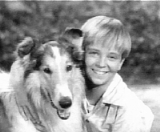
Lassie

Encyclopedia

Eric Knight
Eric Knight was an author who is mainly notable for creating the fictional collie Lassie.Born on 10 April 1897, in Menston in Yorkshire, England, Eric Mowbray Knight was the third of four sons born to Frederic Harrison and Marion Hilda Knight, both Quakers...
in a short story expanded to novel length called Lassie Come-Home. Published in 1940, the novel was filmed by MGM in 1943 as Lassie Come Home
Lassie Come Home
Lassie Come Home is a 1943 MGM film starring Roddy McDowall and canine actor, Pal, in a story about the profound bond between Yorkshire boy Joe Carraclough and his rough collie, Lassie. The film was directed by Fred M. Wilcox from a screenplay by Hugo Butler based upon the 1940 novel Lassie...
with a dog named Pal
Pal (dog actor)
Pal was a Rough Collie actor and the first in a line of such dogs to portray the fictional female collie Lassie in film and television. Pal was born in California in 1940 and eventually brought to the notice of Rudd Weatherwax, a Hollywood animal trainer. In 1943, the dog was chosen to play Lassie...
playing Lassie. Pal then appeared with the stage name "Lassie" in six other MGM feature films through 1951. Pal's owner and trainer Rudd Weatherwax then acquired the Lassie name and trademark from MGM and appeared with Pal (as "Lassie") at rodeos, fairs, and similar events across America in the early 1950s. In 1954, the long-running, Emmy winning television series Lassie debuted, and, over the next 19 years, a succession of Pal's descendants appeared on the series. The "Lassie" character has appeared in radio, television, film, toys, comic books, animated series, juvenile novels, and other media. Pal's descendants continue to play Lassie today.
History
According to writer Nigel Clarke, the original Lassie who inspired so many films and television episodes was a rough-haired crossbreed who saved the life of a sailor during World War IWorld War I
World War I , which was predominantly called the World War or the Great War from its occurrence until 1939, and the First World War or World War I thereafter, was a major war centred in Europe that began on 28 July 1914 and lasted until 11 November 1918...
.
Half collie, Lassie was owned by the landlord of the Pilot Boat, a pub in the port of Lyme Regis. On New Year's Day in 1915, the Royal Navy
Royal Navy
The Royal Navy is the naval warfare service branch of the British Armed Forces. Founded in the 16th century, it is the oldest service branch and is known as the Senior Service...
battleship
Battleship
A battleship is a large armored warship with a main battery consisting of heavy caliber guns. Battleships were larger, better armed and armored than cruisers and destroyers. As the largest armed ships in a fleet, battleships were used to attain command of the sea and represented the apex of a...
was hit by a torpedo from a German submarine off Start Point
Start Point, Devon
Start Point is a promontory in the South Hams district. It is one of the most southerly points in Devon, England, . It marks the southern limit of Start Bay, which extends northwards to the estuary of the River Dart....
in South Devon
South Devon
South Devon is the southern part of the county of Devon, England.South Devon may also refer to*South Devon Area of Outstanding Natural Beauty*South Devon *South Devon College*South Devon cattle, a breed of cattle...
, with the loss of more than 500 men. One of the ship's life rafts, containing many bodies, was blown by gales along the coast and was washed ashore in Dorset
Dorset
Dorset , is a county in South West England on the English Channel coast. The county town is Dorchester which is situated in the south. The Hampshire towns of Bournemouth and Christchurch joined the county with the reorganisation of local government in 1974...
. The bodies were laid out on the table of the local pub. The pub dog, Lassie, began to lick one sailor's feet, and someone noticed the man was reacting to it—so they revived him. The dog had saved the man's life! Hollywood got hold of the story, and so a star was born.
The fictional character of Lassie was created by English American
English American
English Americans are citizens or residents of the United States whose ancestry originates wholly or partly in England....
author Eric Knight
Eric Knight
Eric Knight was an author who is mainly notable for creating the fictional collie Lassie.Born on 10 April 1897, in Menston in Yorkshire, England, Eric Mowbray Knight was the third of four sons born to Frederic Harrison and Marion Hilda Knight, both Quakers...
in Lassie Come-Home, first published as a short story the Saturday Evening Post in 1938 and later as a full-length novel in 1940. Set in the Depression-era
Great Depression
The Great Depression was a severe worldwide economic depression in the decade preceding World War II. The timing of the Great Depression varied across nations, but in most countries it started in about 1929 and lasted until the late 1930s or early 1940s...
England
England
England is a country that is part of the United Kingdom. It shares land borders with Scotland to the north and Wales to the west; the Irish Sea is to the north west, the Celtic Sea to the south west, with the North Sea to the east and the English Channel to the south separating it from continental...
, the novel depicts the lengthy journey a rough collie
Rough Collie
The Rough Collie is a long coated breed of medium to large size dog that in its original form was a type of collie used and bred for herding in Scotland. Originating in the 1800's, it is now well known through the works of author Albert Payson Terhune, and through the Lassie novel, movies, and...
makes to be reunited with her young Yorkshire
Yorkshire
Yorkshire is a historic county of northern England and the largest in the United Kingdom. Because of its great size in comparison to other English counties, functions have been increasingly undertaken over time by its subdivisions, which have also been subject to periodic reform...
master after his family is forced to sell her for money. In 1943, the novel was adapted into a feature film, Lassie Come Home
Lassie Come Home
Lassie Come Home is a 1943 MGM film starring Roddy McDowall and canine actor, Pal, in a story about the profound bond between Yorkshire boy Joe Carraclough and his rough collie, Lassie. The film was directed by Fred M. Wilcox from a screenplay by Hugo Butler based upon the 1940 novel Lassie...
, by Metro-Goldwyn-Mayer
Metro-Goldwyn-Mayer
Metro-Goldwyn-Mayer Inc. is an American media company, involved primarily in the production and distribution of films and television programs. MGM was founded in 1924 when the entertainment entrepreneur Marcus Loew gained control of Metro Pictures, Goldwyn Pictures Corporation and Louis B. Mayer...
(MGM) that starred Roddy McDowall
Roddy McDowall
Roderick Andrew Anthony Jude "Roddy" McDowall was an English actor and photographer. His film roles included Cornelius and Caesar in the Planet of the Apes film series...
and Elizabeth Taylor
Elizabeth Taylor
Dame Elizabeth Rosemond "Liz" Taylor, DBE was a British-American actress. From her early years as a child star with MGM, she became one of the great screen actresses of Hollywood's Golden Age...
. The movie was a hit and enjoyed favorable critical response. MGM followed this with several additional films, including a sequel entitled Son of Lassie
Son of Lassie
Son of Lassie is a 1945 feature film produced by MGM based on characters created by Eric Knight, and starring Peter Lawford, Donald Crisp, June Lockhart and Lassie...
(1945), starring Peter Lawford
Peter Lawford
Peter Sydney Ernest Aylen , better known as Peter Lawford, was an English-American actor.He was a member of the "Rat Pack", and brother-in-law to US President John F. Kennedy, perhaps more noted in later years for his off-screen activities as a celebrity than for his acting...
and June Lockhart
June Lockhart
June Lockhart is an American actress, primarily in 1950s and 1960s television, but with memorable performances on stage and in film too. She is remembered as the mother in two TV series, Lassie and Lost in Space. She also portrayed Dr...
, and Courage of Lassie
Courage of Lassie
Courage of Lassie is a 1946 MGM feature film starring Elizabeth Taylor, Frank Morgan, and dog actor Pal in a story about a collie named Bill and his young companion, Kathie Merrick. When Bill is separated from Kathie following a vehicular accident, he is trained as a war dog, performs heroically,...
with Elizabeth Taylor. A radio series, Lassie Radio Show, was also created, airing until 1949.
Between 1954–1973, the television series, Lassie
Lassie (1954 TV series)
Lassie is an American television series that follows the adventures of a female Rough Collie named Lassie and her companions, human and animal. The show was the creation of producer Robert Maxwell and animal trainer Rudd Weatherwax and was televised from September 12, 1954, to March 24, 1973...
was broadcast in America, with Lassie initially residing on a farm with a young male master. In the eleventh season, she changed to adult forestry workers as her companions, then had the collie on her own for awhile before ending the series with Lassie residing at a ranch for troubled children. The long-running series was the recipient of two Emmy Awards before it was canceled in 1973. A second series followed in the 1980s. In 1997, Canadian
Canada
Canada is a North American country consisting of ten provinces and three territories. Located in the northern part of the continent, it extends from the Atlantic Ocean in the east to the Pacific Ocean in the west, and northward into the Arctic Ocean...
production company Cinar Inc.
Cookie Jar Entertainment
The Cookie Jar Group is an American and Canadian producer of children’s entertainment, consumer products and educational materials...
produced a new Lassie
Lassie (1997 TV series)
Lassie is a Canadian television series which aired from 1997 to 1999 on YTV in Canada and Sunday nights on the Animal Planet network in the United States, as a remake of the original Lassie TV series about a boy and his faithful dog...
television series for the Animal Planet
Animal Planet
Animal Planet is an American cable tv specialty channel that launched on October 1, 1996. It is distributed by Discovery Communications. A high-definition simulcast of the channel launched on September 1, 2007.-History:...
network in the U.S.
United States
The United States of America is a federal constitutional republic comprising fifty states and a federal district...
and YTV in Canada. It ran until 1999.
In 2005, a remake of the original Lassie Come Home movie was produced in the United Kingdom
United Kingdom
The United Kingdom of Great Britain and Northern IrelandIn the United Kingdom and Dependencies, other languages have been officially recognised as legitimate autochthonous languages under the European Charter for Regional or Minority Languages...
. Starring Peter O'Toole
Peter O'Toole
Peter Seamus Lorcan O'Toole is an Irish actor of stage and screen. O'Toole achieved stardom in 1962 playing T. E. Lawrence in Lawrence of Arabia, and then went on to become a highly-honoured film and stage actor. He has been nominated for eight Academy Awards, and holds the record for most...
and Samantha Morton
Samantha Morton
Samantha Jane Morton is an English actress and film director. She began her performing career with guest roles in television shows such as Soldier Soldier and Boon before making her film debut in the 1997 drama film This Is the Sea, playing the character of Hazel Stokes...
, Lassie was released in 2006.
Lassie continues to make personal appearances as well as marketing a line of pet food and a current pet care TV show, Lassie's Pet Vet
Lassie's Pet Vet
Lassie's Pet Vet is a reality television series about the health, lifestyle and community of pets. It is hosted by Jeff Werber and the collie, Lassie. This series is currently seen on WTTW in Chicago, Illinois, and on PBS stations in the United States....
on PBS
Public Broadcasting Service
The Public Broadcasting Service is an American non-profit public broadcasting television network with 354 member TV stations in the United States which hold collective ownership. Its headquarters is in Arlington, Virginia....
stations in the United States. Lassie is one of only three animals (and one of very few fictional characters, such as Mickey Mouse
Mickey Mouse
Mickey Mouse is a cartoon character created in 1928 by Walt Disney and Ub Iwerks at The Walt Disney Studio. Mickey is an anthropomorphic black mouse and typically wears red shorts, large yellow shoes, and white gloves...
and Bugs Bunny
Bugs Bunny
Bugs Bunny is a animated character created in 1938 at Leon Schlesinger Productions, later Warner Bros. Cartoons. Bugs is an anthropomorphic gray rabbit and is famous for his flippant, insouciant personality and his portrayal as a trickster. He has primarily appeared in animated cartoons, most...
) to be awarded a star on the Hollywood Walk of Fame
Hollywood Walk of Fame
The Hollywood Walk of Fame consists of more than 2,400 five-pointed terrazzo and brass stars embedded in the sidewalks along fifteen blocks of Hollywood Boulevard and three blocks of Vine Street in Hollywood, California...
—the others being silent-film stars Rin Tin Tin
Rin Tin Tin
Rin Tin Tin was the name given to a dog adopted from a WWI battlefield that went on to star in twenty-three Hollywood films. The name was subsequently given to several related German Shepherd dogs featured in fictional stories on film, radio and television.-Origins:The first of the line Rin Tin...
and Strongheart
Strongheart
Strongheart was the screen name of Etzel von Oeringen , a German Shepherd that became one of the earliest canine film stars. After being trained in Germany as a police dog, he was brought to the United States by husband and wife filmmakers Laurence Trimble and Jane Murfin, who had previously worked...
. In 2005, the show business journal Variety
Variety (magazine)
Variety is an American weekly entertainment-trade magazine founded in New York City, New York, in 1905 by Sime Silverman. With the rise of the importance of the motion-picture industry, Daily Variety, a daily edition based in Los Angeles, California, was founded by Silverman in 1933. In 1998, the...
named Lassie one of the "100 Icons of the Century"—the only animal star on the list.
Portrayers
Despite the fact the character Lassie is female, all collies to play Lassie in the television series were male because male collies retain a thicker summer coat than females, which "looks better on television." Also, the male is larger and a child actor can play opposite the dog for longer before outgrowing him.The first canine actor to play Lassie was Pal
Pal (dog actor)
Pal was a Rough Collie actor and the first in a line of such dogs to portray the fictional female collie Lassie in film and television. Pal was born in California in 1940 and eventually brought to the notice of Rudd Weatherwax, a Hollywood animal trainer. In 1943, the dog was chosen to play Lassie...
, who appeared in seven MGM films between 1943 and 1951, and the two pilots filmed for the 1954 television series before he was retired. Pal was handled by Frank
Frank Weatherwax
Frank Thrall Weatherwax was an American actor and animal trainer. He is best remembered with his brother Rudd Weatherwax for their famous collie, Pal, the dog who became famous as Lassie in the 1943 Metro-Goldwyn-Mayer film Lassie Come Home.Weatherwax was born in Camp Palomas, New Mexico...
and Rudd Weatherwax
Rudd Weatherwax
Ruddell Bird "Rudd" Weatherwax was an American actor and animal trainer. He and his brother Frank Weatherwax are best remembered for training dogs for motion pictures and television. Frank's collie, Pal, became the original Lassie, handled by Rudd for the 1943 MGM film Lassie Come Home...
, and Frank Inn
Frank Inn
Frank Inn was born as Elias Franklin Freeman, was an American animal trainer. He trained several animals for movies, but was most known for his work with the dogs in the Benji series.-Personal life:...
.
Eight generations of Pal and his descendants portrayed the beloved collie in more than ten movies and two television series, until the late 1990s. Lassie Junior, Spook, Baby, Mire, and Hey Hey played the role of Lassie in the long-running television series.
Hey Hey's son Boy played the collie in the 1978 film The Magic of Lassie
The Magic of Lassie
The Magic of Lassie is a 1978 Wrather Corporation film. It features James Stewart in one of only two musical film roles that he played . Mickey Rooney and Alice Faye also make cameo appearances in the film...
, and Boy's son The Old Man took up the role of Lassie in the 80s series, The New Lassie
The New Lassie
The New Lassie was an American television series which aired in first-run syndication for two seasons beginning in 1989, reviving the beloved "Lassie" collie character who debuted in the 1943 film Lassie Come Home, followed by several more movies and a long-running earlier Lassie television series...
of the late-1980s and early 1990s. During this time Rudd Weatherwax died and his son Robert became the handler of Lassie.
The 1997 Lassie series featured eighth generation Pal descendant, Howard as the titular character in the first season, however midway through the production he was replaced with a non-Pal descended dog due to some disputes with the production company. In response to fan outrage, Hey Hey II, a ninth-generation direct descendant of Pal, owned by Carol Riggins who was employed by Robert Weatherwax, assumed the role for the final thirteen episodes of the show in 1999. Classic Media
Classic Media
Classic Media, LLC, is an American production company and distributor of family programming. It was founded in 2000 by former Marvel Entertainment CEO Eric Ellenbogen and former Broadway Video executive John Engelman in hopes of acquiring mismanaged classic properties and giving exposure to...
acquired the Lassie trademark
Trademark
A trademark, trade mark, or trade-mark is a distinctive sign or indicator used by an individual, business organization, or other legal entity to identify that the products or services to consumers with which the trademark appears originate from a unique source, and to distinguish its products or...
from the Weatherwax family in 2000, and in 2004 Robert Weatherwax's contract to provide a dog ended, at which time neither side pursued a renewal and Mr. Weatherwax retired from film work and began drawing a SAG pension. In the 2005 Lassie film, shot in the UK, three non-Pal bloodline collies were used in the title role by Gary Gero's Birds and Animals UK corporation.
In late 2005, following the shooting of the movie, Classic Media contracted with Carol Riggins, longtime co-trainer of Robert Weatherwax, to supply "Hey Hey II", as the ninth generation Lassie in the Pal bloodline. Robert Weatherwax's website has disputed the use of these collies, claiming that Riggins was violating her dog purchase contract by breeding
Animal husbandry
Animal husbandry is the agricultural practice of breeding and raising livestock.- History :Animal husbandry has been practiced for thousands of years, since the first domestication of animals....
Hey Hey II. but has never taken any legal action of any kind. In the 2006 television series Lassie's Pet Vet, a Pal descendant from the Hey Hey II line appeared with veterinarian Dr. Jeff Werber. In January 2008, Lassie 10, a 10th generation direct genetic descendant of the original Lassie, was introduced. Although this claim was made to a reporter, no paperwork has ever surfaced to prove Mr. Weatherwax's claim and no legal action was ever taken against Ms. Riggins.
Mr. Weatherwax is listed as SAG retired in 2004 and is no longer involved with Lassie in any way.
Film
| Year | Title | Role | Notes |
|---|---|---|---|
| 1943 | Lassie Come Home Lassie Come Home Lassie Come Home is a 1943 MGM film starring Roddy McDowall and canine actor, Pal, in a story about the profound bond between Yorkshire boy Joe Carraclough and his rough collie, Lassie. The film was directed by Fred M. Wilcox from a screenplay by Hugo Butler based upon the 1940 novel Lassie... |
Lassie | Principal role played by Pal |
| 1945 | Son of Lassie Son of Lassie Son of Lassie is a 1945 feature film produced by MGM based on characters created by Eric Knight, and starring Peter Lawford, Donald Crisp, June Lockhart and Lassie... |
Laddie | Principal role played by Pal |
| 1946 | Courage of Lassie Courage of Lassie Courage of Lassie is a 1946 MGM feature film starring Elizabeth Taylor, Frank Morgan, and dog actor Pal in a story about a collie named Bill and his young companion, Kathie Merrick. When Bill is separated from Kathie following a vehicular accident, he is trained as a war dog, performs heroically,... |
Bill | Principal role played by Pal |
| 1948 | Hills of Home Hills of Home (film) Hills of Home is a 1948 Technicolor drama film, the fourth in a series of MGM Lassie films. It starred Edmund Gwenn, Donald Crisp, and Tom Drake.-Plot:... |
Lass | Principal role played by Pal |
| 1949 | The Sun Comes Up The Sun Comes Up The Sun Comes Up is a 1949 MGM Lassie picture.-Plot:Ex-opera singer Helen Lorfield Winter rents a house in the small town of Brushy Gap, in the hills not too far from the Smokies, Blue Ridge, and Atlanta Georgia with her dog, Lassie, after the tragic death of her son. There she befriends Jerry, a... |
Lassie | Principal role played by Pal |
| 1950 | Challenge to Lassie Challenge to Lassie Challenge to Lassie is an American drama directed by Richard Thorpe and released October 31, 1949 by MGM Studios. It was the fifth feature film starring the original Lassie, a collie named Pal and the fourth, and final, Lassie film that Donald Crisp would star in.The movie is based on Eleanor... |
Lassie | Principal role played by Pal |
| 1951 | The Painted Hills The Painted Hills The Painted Hills, also known as Lassie's Adventures in the Goldrush, is a 1951 action film produced by Metro-Goldwyn-Mayer and directed by Harold F. Kress... |
Shep | Principal role played by Pal |
| 1963 | Lassie's Great Adventure | Lassie | Principal role; a compilation of television episodes |
| 1978 | The Magic of Lassie The Magic of Lassie The Magic of Lassie is a 1978 Wrather Corporation film. It features James Stewart in one of only two musical film roles that he played . Mickey Rooney and Alice Faye also make cameo appearances in the film... |
Lassie | Principal role played by Boy |
| 1994 | Lassie Lassie (1994 film) Lassie is a 1994 adventure family film directed by Daniel Petrie and featuring the fictional collie Lassie.-Plot:The Turner family moves from the big city to the rural countryside in Virginia, hoping to start a new life. The move creates problems for everyone, especially 13-year old Matt, who... |
Lassie | Principal role played by Howard |
| 2005 | Lassie Lassie (2005 film) Lassie is a 2005 family-based film directed by Charles Sturridge. When a family hits financial crisis, they have no choice but to sell Lassie... |
Lassie | Principal role played by Mason, a USA farm Bred Collie Action role played by DR Dakota, a USA farm Bred Collie |
Radio
| Year | Title | Role | Notes |
|---|---|---|---|
| 1947–1948 | Lassie Show | Lassie | Principal role; ABC series |
| 1948–1950 | Lassie Show | Lassie | Principal role; NBC series |
Television
| Year | Title | Role | Notes |
|---|---|---|---|
| 1954–1973 | Lassie Lassie (1954 TV series) Lassie is an American television series that follows the adventures of a female Rough Collie named Lassie and her companions, human and animal. The show was the creation of producer Robert Maxwell and animal trainer Rudd Weatherwax and was televised from September 12, 1954, to March 24, 1973... |
Lassie | Principal role |
| 1968 | The Adventures of Neeka | Lassie | Principal role; TV film; a compilation of television episodes |
| 1970 | Peace is Our Profession | Lassie | Principal role; TV film; a compilation of TV episodes |
| 1970 | Well of Love | Lassie | Principal role; TV film, a compilation of TV episodes |
| 1972 | Sound of Joy | Lassie | Principal role; TV film; a compilation of TV episodes |
| 1972 | Lassie and the Spirit of Thunder Mountain | Lassie | Principal role; animated TV film |
| 1972 | Lassie's Rescue Rangers Lassie's Rescue Rangers Lassie's Rescue Rangers is an animated TV show produced by Filmation and featuring Lassie, running from 1973 to 1975. The hour-long pilot, Lassie and the Spirit of Thunder Mountain, was part of The ABC Saturday Superstar Movie.-Overview:... |
Lassie | Principal role; animated series |
| 1989–1991 | The New Lassie The New Lassie The New Lassie was an American television series which aired in first-run syndication for two seasons beginning in 1989, reviving the beloved "Lassie" collie character who debuted in the 1943 film Lassie Come Home, followed by several more movies and a long-running earlier Lassie television series... |
Lassie | Principal role; first-run syndication |
| 1997–1999 | Lassie Lassie (1997 TV series) Lassie is a Canadian television series which aired from 1997 to 1999 on YTV in Canada and Sunday nights on the Animal Planet network in the United States, as a remake of the original Lassie TV series about a boy and his faithful dog... |
Lassie | Principal role |
| 2001 | Whose Line Is It Anyway? Whose Line Is It Anyway? Whose Line Is It Anyway? is a short-form improvisational comedy TV show. Originally a British radio programme, it moved to television in 1988 as a series made for the UK's Channel 4, for a 10 series run... |
Lassie | Cameo Appearance |
| 1996 | Meiken Lassie Meiken Lassie is a Japanese anime series by Nippon Animation.-Themes:* Opening Theme: "Owaranai Monogatari" by Jun Morioka* Ending Theme: "Shōnen no Oka" by Jun Morioka-Episodes:# I'm Not Alone# Disruptive Home Stay# Good-Bye Lassie# Father's Pay Day... |
Lassie | Principal role; animated series |
| Lassie's Pet Vet Lassie's Pet Vet Lassie's Pet Vet is a reality television series about the health, lifestyle and community of pets. It is hosted by Jeff Werber and the collie, Lassie. This series is currently seen on WTTW in Chicago, Illinois, and on PBS stations in the United States.... |
|||