


Lake Peipus

Encyclopedia
Lake Peipus, is the biggest transboundary
lake in Europe
on the border between Estonia
(part of European Union
) and Russia
.
The lake is the fifth largest in Europe after Lake Ladoga
and Lake Onega
in Russia north of St. Petersburg
, Lake Vänern
in Sweden
, and Lake Saimaa in Finland
.
Lake Peipus-Pihkva is a remnant of a bigger body of water which existed in this area during an Ice Age
. It covers 3,555 km2, and has an average depth of 7.1 m, the deepest point being 15 m. The lake has several islands and consists of 3 parts:
The lake is used for fishing and recreation, but suffered from some environmental degradation from Soviet
era agriculture. Some 30 rivers and streams discharge into Lake Peipus. The largest rivers are Emajõgi
and Velikaya River
. The lake is drained by the Narva River
.
In 1242, the lake was the site of the Battle on the Ice between the Teutonic Knights
and Novgorodians under Alexander Nevsky
.
. In the Paleozoic
Era, 300–400 million years ago, the entire territory of the modern Gulf of Finland was covered by a sea. Its modern relief was formed as a result of glacier
activities, the last of which, the Weichselian glaciation, ended about 12,000 years ago.
and are bordered by vast lowland and marsh
es which are flooded in the Spring with the flooding area reaching up to 1000 km2. The west bank of the Pihkva Lake is high and steep; the west bank of Peipus Lake is low and boggy, and the east bank is more sublime. There are sand dunes and hills, covered with pine forests. Along the sandy shores there is a 200–300 m wide stretch of shallow waters.
The relief of the bottom is uniform and flat, gradually rising near the shores and covered with silt
, and in some places with sand. The deepest point of 15.3 m is located in the Teploe Lake, 300 m from the coast.
The lake is well-flowing, with the annual inflow of water equal to about half of the total water volume.
The lake water is fresh, with a low transparency of about 2.5 m due to plankton
and suspended sediment
s caused by the river flow. Water currents are weak (5–9 cm/s); they are induced by the wind and stop when it ceases. However, during the spring flood, there is a constant surface current from south to north.
Because of the shallow depth, the lake quickly warms up and cools down. Water temperature reaches 25–26 °C in July. The lakes freeze in late November – early December and thaws in late April – early May, first lakes Teploe and Pihkva and then lake Peipus.
|+>
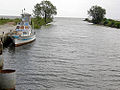
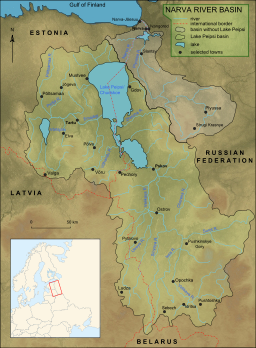
and Emajõgi
, smaller rivers include Zadubka, Cherma, Gdovka, Kuna, Torohovka, Remda, Rovya, Chernaya, Lipenka, Startseva, Borovka, Abija, Obdeh, Piusa
, Võhandu, Kodza, Kargaya, Omedu, Tagajõgi and Alajõgi. The lake is drained by only one river, the Narva into the Baltic Sea
.
The lake contains 29 islands with a total area of 25.8 km2, with 40 more islands located within the delta of the Velikaya River
. The islands are low wetlands, elevated above the lake surface on average by only 1–2 m (maximum 4.5 m) and therefore suffer from floods. The largest islands are Piirissaar
(area 7.39 km2, located in the southern part of Lake Peipus), Kolpino (area 11 km2, in the Pihkva Lake) and Kamenka (area 6 km2). In the center of Pihkva Lake there is a group of Talabski Islands (Belova, Zalita and Talavenets).
, calamus, bulrush
, grass rush
, Lesser Bulrush
and water parsnip
. Floating plants are rare and are of only three types: arrowhead
, yellow water-lily
and water knotweed
. The wetlands of the coastal strip of the lake are important resting and feeding grounds for swans, geese and ducks migrating between the White Sea
and Baltic Sea
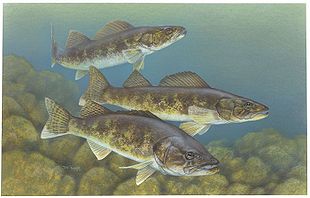
. The lake is home to perch
, pike-perch
, bream
, roaches
, whitefishes
, smelt
and other fish species.
. The water condition of the rivers has improved since 2001–2007, but there is an increase in population of blue-green algae. The main problem of Lake Peipus is its eutrophication
.
|+>

European perch
Carp bream
roach
Pike-perch
(population 1,610), Kallaste
(population 1,260) and Gdov
(population 4,400). The largest city, Pskov
(population 202,000) stands on the Velikaya River
, 10 km from the lake. Ship navigation is well developed and serves fishery, transport of goods and passengers and tourist tours. The picturesque shores of the lake are a popular destination for tourism and recreation at several tourist camps and sanatoriums.
were defeated by the Russian troops from Novgorod led by Alexander Nevsky
. The battle is remarkable in that it was mostly fought on the frozen surface of the lake and is therefore called the Battle on the Ice.
The largest city on the lake, Pskov
, is also one of the oldest cities in Russia, known from at least 903 AD from a record in the Primary Chronicle
of the Laurentian Codex
. Several historical buildings remain in the city, including Mirozhsky Monastery
(1156, which contains famous frescoes of 14–17th centuries), Pskov Kremlin (14–17th centuries) with the five-domed Trinity Cathedral (1682–1699), churches of Ivanovo (until 1243), Snetogorsky monastery (13th century), Church of Basil (1413), Church of Cosmas and Damian (1462), Church of St. George (1494) and others.
Gdov
was founded in 1431 as a fortress and became a city in 1780; the only remains of the historical Gdov Kremlin
are three fortress walls. Kallaste
was founded in the 18th century by the Old Believers
who had fled from the Novgorod area, and there is still a functional Russian Orthodox Old-Rite Church
in the town. Near Kallaste, there is one of the largest surfacings of Devonian
sandstone
with a length of 930 m and a maximum height of 8 m, as well as several caves and one of the largest in Estonia colonies of swallow
s.
|+>
Mirozhsky Monastery
Pskov Kremlin
International waters
The terms international waters or trans-boundary waters apply where any of the following types of bodies of water transcend international boundaries: oceans, large marine ecosystems, enclosed or semi-enclosed regional seas and estuaries, rivers, lakes, groundwater systems , and wetlands.Oceans,...
lake in Europe
Europe
Europe is, by convention, one of the world's seven continents. Comprising the westernmost peninsula of Eurasia, Europe is generally 'divided' from Asia to its east by the watershed divides of the Ural and Caucasus Mountains, the Ural River, the Caspian and Black Seas, and the waterways connecting...
on the border between Estonia
Estonia
Estonia , officially the Republic of Estonia , is a state in the Baltic region of Northern Europe. It is bordered to the north by the Gulf of Finland, to the west by the Baltic Sea, to the south by Latvia , and to the east by Lake Peipsi and the Russian Federation . Across the Baltic Sea lies...
(part of European Union
European Union
The European Union is an economic and political union of 27 independent member states which are located primarily in Europe. The EU traces its origins from the European Coal and Steel Community and the European Economic Community , formed by six countries in 1958...
) and Russia
Russia
Russia or , officially known as both Russia and the Russian Federation , is a country in northern Eurasia. It is a federal semi-presidential republic, comprising 83 federal subjects...
.
The lake is the fifth largest in Europe after Lake Ladoga
Lake Ladoga
Lake Ladoga is a freshwater lake located in the Republic of Karelia and Leningrad Oblast in northwestern Russia, not far from Saint Petersburg. It is the largest lake in Europe, and the 14th largest lake by area in the world.-Geography:...
and Lake Onega
Lake Onega
Lake Onega is a lake in the north-west European part of Russia, located on the territory of Republic of Karelia, Leningrad Oblast and Vologda Oblast. It belongs to the basin of Baltic Sea, Atlantic Ocean, and is the second largest lake in Europe after Lake Ladoga...
in Russia north of St. Petersburg
Saint Petersburg
Saint Petersburg is a city and a federal subject of Russia located on the Neva River at the head of the Gulf of Finland on the Baltic Sea...
, Lake Vänern
Vänern
Vänern is the largest lake in Sweden, the largest lake in the EU and the third largest lake in Europe after Ladoga and Onega in Russia. It is located in the provinces of Västergötland, Dalsland, and Värmland in the southwest of the country.- History :...
in Sweden
Sweden
Sweden , officially the Kingdom of Sweden , is a Nordic country on the Scandinavian Peninsula in Northern Europe. Sweden borders with Norway and Finland and is connected to Denmark by a bridge-tunnel across the Öresund....
, and Lake Saimaa in Finland
Finland
Finland , officially the Republic of Finland, is a Nordic country situated in the Fennoscandian region of Northern Europe. It is bordered by Sweden in the west, Norway in the north and Russia in the east, while Estonia lies to its south across the Gulf of Finland.Around 5.4 million people reside...
.
Lake Peipus-Pihkva is a remnant of a bigger body of water which existed in this area during an Ice Age
Ice age
An ice age or, more precisely, glacial age, is a generic geological period of long-term reduction in the temperature of the Earth's surface and atmosphere, resulting in the presence or expansion of continental ice sheets, polar ice sheets and alpine glaciers...
. It covers 3,555 km2, and has an average depth of 7.1 m, the deepest point being 15 m. The lake has several islands and consists of 3 parts:
- Lake Peipsi/Chudskoe is the northern part of the lake with the area of 2611 km2 (73%).
- Lake Pihkva/Pskovskoe is the southern part of the lake (area 708 km2 or 20%).
- Lake Lämmijärv/Teploe is the sound connecting both parts of the lake (area 236 km2 or 7%).
The lake is used for fishing and recreation, but suffered from some environmental degradation from Soviet
Soviet Union
The Soviet Union , officially the Union of Soviet Socialist Republics , was a constitutionally socialist state that existed in Eurasia between 1922 and 1991....
era agriculture. Some 30 rivers and streams discharge into Lake Peipus. The largest rivers are Emajõgi
Emajõgi
The Emajõgi is a river in Estonia which flows from Lake Võrtsjärv through Tartu County into Lake Peipus, crossing the city of Tartu for 10 km. It has a length of 100 km...
and Velikaya River
Velikaya River
For the Velikaya river in Far East Siberia, see Velikaya River .Velikaya River is located in western Russia . It starts in highlands in the south of Pskov Oblast, flows north through the cities of Opochka, Ostrov, and Pskov into Lake Peipus, which is drained by the Narva River....
. The lake is drained by the Narva River
Narva River
The Narva is a river flowing into the Baltic Sea, the largest river in Estonia. Draining Lake Peipsi, the river forms the border of Estonia and Russia and flows through the towns of Narva/Ivangorod and Narva-Jõesuu into Narva Bay. Though the river is only 77 km long, in terms of volume...
.
In 1242, the lake was the site of the Battle on the Ice between the Teutonic Knights
Teutonic Knights
The Order of Brothers of the German House of Saint Mary in Jerusalem , commonly the Teutonic Order , is a German medieval military order, in modern times a purely religious Catholic order...
and Novgorodians under Alexander Nevsky
Alexander Nevsky
Alexander Nevsky was the Prince of Novgorod and Grand Prince of Vladimir during some of the most trying times in the city's history. Commonly regarded as the key figure of medieval Rus, Alexander was the grandson of Vsevolod the Big Nest and rose to legendary status on account of his military...
.
Formation
The lake is a remnant of a larger body of water which existed in this area during an Ice AgeIce age
An ice age or, more precisely, glacial age, is a generic geological period of long-term reduction in the temperature of the Earth's surface and atmosphere, resulting in the presence or expansion of continental ice sheets, polar ice sheets and alpine glaciers...
. In the Paleozoic
Paleozoic
The Paleozoic era is the earliest of three geologic eras of the Phanerozoic eon, spanning from roughly...
Era, 300–400 million years ago, the entire territory of the modern Gulf of Finland was covered by a sea. Its modern relief was formed as a result of glacier
Glacier
A glacier is a large persistent body of ice that forms where the accumulation of snow exceeds its ablation over many years, often centuries. At least 0.1 km² in area and 50 m thick, but often much larger, a glacier slowly deforms and flows due to stresses induced by its weight...
activities, the last of which, the Weichselian glaciation, ended about 12,000 years ago.
Topography and hydrography
The banks of Lake Peipus have smooth contours and form only one large bay – Raskopelsky Bay. The low shores of the lake mostly consist of peatPeat
Peat is an accumulation of partially decayed vegetation matter or histosol. Peat forms in wetland bogs, moors, muskegs, pocosins, mires, and peat swamp forests. Peat is harvested as an important source of fuel in certain parts of the world...
and are bordered by vast lowland and marsh
Marsh
In geography, a marsh, or morass, is a type of wetland that is subject to frequent or continuous flood. Typically the water is shallow and features grasses, rushes, reeds, typhas, sedges, other herbaceous plants, and moss....
es which are flooded in the Spring with the flooding area reaching up to 1000 km2. The west bank of the Pihkva Lake is high and steep; the west bank of Peipus Lake is low and boggy, and the east bank is more sublime. There are sand dunes and hills, covered with pine forests. Along the sandy shores there is a 200–300 m wide stretch of shallow waters.
The relief of the bottom is uniform and flat, gradually rising near the shores and covered with silt
Silt
Silt is granular material of a size somewhere between sand and clay whose mineral origin is quartz and feldspar. Silt may occur as a soil or as suspended sediment in a surface water body...
, and in some places with sand. The deepest point of 15.3 m is located in the Teploe Lake, 300 m from the coast.
The lake is well-flowing, with the annual inflow of water equal to about half of the total water volume.
The lake water is fresh, with a low transparency of about 2.5 m due to plankton
Plankton
Plankton are any drifting organisms that inhabit the pelagic zone of oceans, seas, or bodies of fresh water. That is, plankton are defined by their ecological niche rather than phylogenetic or taxonomic classification...
and suspended sediment
Sediment
Sediment is naturally occurring material that is broken down by processes of weathering and erosion, and is subsequently transported by the action of fluids such as wind, water, or ice, and/or by the force of gravity acting on the particle itself....
s caused by the river flow. Water currents are weak (5–9 cm/s); they are induced by the wind and stop when it ceases. However, during the spring flood, there is a constant surface current from south to north.
Because of the shallow depth, the lake quickly warms up and cools down. Water temperature reaches 25–26 °C in July. The lakes freeze in late November – early December and thaws in late April – early May, first lakes Teploe and Pihkva and then lake Peipus.
Basin and islands
About 30 rivers flow into the lake. The largest are VelikayaVelikaya River
For the Velikaya river in Far East Siberia, see Velikaya River .Velikaya River is located in western Russia . It starts in highlands in the south of Pskov Oblast, flows north through the cities of Opochka, Ostrov, and Pskov into Lake Peipus, which is drained by the Narva River....
and Emajõgi
Emajõgi
The Emajõgi is a river in Estonia which flows from Lake Võrtsjärv through Tartu County into Lake Peipus, crossing the city of Tartu for 10 km. It has a length of 100 km...
, smaller rivers include Zadubka, Cherma, Gdovka, Kuna, Torohovka, Remda, Rovya, Chernaya, Lipenka, Startseva, Borovka, Abija, Obdeh, Piusa
Piusa River
Piusa is a river in Southeastern Estonia and, for the last 14 km before draining into Lake Pihkva, in Pskov Oblast, Russia. For a 17-km-long section near Pechory Piusa is the border river between Estonia and the Russian Federation....
, Võhandu, Kodza, Kargaya, Omedu, Tagajõgi and Alajõgi. The lake is drained by only one river, the Narva into the Baltic Sea
Baltic Sea
The Baltic Sea is a brackish mediterranean sea located in Northern Europe, from 53°N to 66°N latitude and from 20°E to 26°E longitude. It is bounded by the Scandinavian Peninsula, the mainland of Europe, and the Danish islands. It drains into the Kattegat by way of the Øresund, the Great Belt and...
.
The lake contains 29 islands with a total area of 25.8 km2, with 40 more islands located within the delta of the Velikaya River
Velikaya River
For the Velikaya river in Far East Siberia, see Velikaya River .Velikaya River is located in western Russia . It starts in highlands in the south of Pskov Oblast, flows north through the cities of Opochka, Ostrov, and Pskov into Lake Peipus, which is drained by the Narva River....
. The islands are low wetlands, elevated above the lake surface on average by only 1–2 m (maximum 4.5 m) and therefore suffer from floods. The largest islands are Piirissaar
Piirissaar
Piirissaar is an Estonian island located in Lake Peipus. It belongs to Tartu County as the Piirissaare Parish.Piirissar is the largest island in Lake Peipus with a size of 7.8 km². It is located c. 15 km from the mouth of the Emajõgi river. Piirissaar is located c...
(area 7.39 km2, located in the southern part of Lake Peipus), Kolpino (area 11 km2, in the Pihkva Lake) and Kamenka (area 6 km2). In the center of Pihkva Lake there is a group of Talabski Islands (Belova, Zalita and Talavenets).
Flora and fauna
The lake hosts 54 species of coastal aquatic flora, including caneCane
Cane are either of two genera of tall, perennial grasses with flexible, woody stalks from the family Poaceae that grow throughout the world in wet soils. They are related to and may include species of bamboo. The genus Arundo is native from the Mediterranean region to the Far East. Arundinaria...
, calamus, bulrush
Scirpus
The plant genus Scirpus consists of a large number of aquatic, grass-like species in the family Cyperaceae , many with the common names club-rush or bulrush . Other common names are deergrass or grassweed.The genus has a cosmopolitan distribution, and grows in wetlands and moist soil...
, grass rush
Butomus
Butomus is the sole genus in the monogeneric plant family Butomaceae, containing the single species Butomus umbellatus, also known as flowering rush or grass rush.-Description:...
, Lesser Bulrush
Typha angustifolia
Typha angustifolia L., , is a perennial herbaceous plant of genus Typha. This cattail is an "obligate wetland" species that is commonly found in the northern hemisphere in brackish locations...
and water parsnip
Sium latifolium
The Sium latifolium or Greater Water parsnip or sometimes simply Water parsnip is a plant species of the genus Sium....
. Floating plants are rare and are of only three types: arrowhead
Sagittaria
Sagittaria is a genus of about 30 species of aquatic plants whose members go by a variety of common names, including arrowhead, duck potato, iz-ze-kn, katniss, kuwai , swan potato, tule potato, and wapato...
, yellow water-lily
Nuphar lutea
Nuphar lutea is an aquatic plant of the family Nymphaeaceae, native to temperate regions of Europe, northwest Africa, and western Asia.-Growth:...
and water knotweed
Persicaria amphibia
Persicaria amphibia is a species of flowering plant in the knotweed family known by several common names, including water knotweed, water smartweed, and amphibious bistort. It is native to much of North America and Eurasia, but it is known on most continents as an introduced species and sometimes...
. The wetlands of the coastal strip of the lake are important resting and feeding grounds for swans, geese and ducks migrating between the White Sea
White Sea
The White Sea is a southern inlet of the Barents Sea located on the northwest coast of Russia. It is surrounded by Karelia to the west, the Kola Peninsula to the north, and the Kanin Peninsula to the northeast. The whole of the White Sea is under Russian sovereignty and considered to be part of...
and Baltic Sea
Baltic Sea
The Baltic Sea is a brackish mediterranean sea located in Northern Europe, from 53°N to 66°N latitude and from 20°E to 26°E longitude. It is bounded by the Scandinavian Peninsula, the mainland of Europe, and the Danish islands. It drains into the Kattegat by way of the Øresund, the Great Belt and...
. The lake is home to perch
European perch
The European perch, Perca fluviatilis, is a predatory species of perch found in Europe and Asia. In some areas it is known as the redfin perch or English perch, and it is often known simply as perch. The species is a popular quarry for anglers and has been widely introduced beyond its native area,...
, pike-perch
Sander (genus)
Sander is a genus of fish in the Percidae family. They are also known as "pike-perch" because of their resemblance to fish in the unrelated Esocidae family....
, bream
Carp bream
The common bream, freshwater bream, bream, bronze bream or carp bream, Abramis brama, is a European species of freshwater fish in the family Cyprinidae....
, roaches
Rutilus
Rutilus is a genus of fishes in the family Cyprinidae, commonly called roaches. Locally, the name "roach" without any further qualifiers is also used for particular species, particularly the Common Roach Rutilus (Latin for "shining, red, golden, auburn") is a genus of fishes in the family...
, whitefishes
Coregonus
Coregonus is a diverse genus of fish in the salmon family . The type species is the common whitefish . The Coregonus species are known as whitefishes...
, smelt
European smelt
The Smelt or European smelt is a species of fish in the Osmeridae family.- Shape and appearance :The body of the European smelt is typically 15 to 18 cm long, slender and slightly flattened on either side. Larger fish may reach 30 cm in length. Smelts have a slightly translucent body...
and other fish species.
Ecology
The ecological condition of the lake basin is, in general, satisfactory – water is mostly of grades I and II (clean), and is of grade III in some rivers due to the high content of phosphorusPhosphorus
Phosphorus is the chemical element that has the symbol P and atomic number 15. A multivalent nonmetal of the nitrogen group, phosphorus as a mineral is almost always present in its maximally oxidized state, as inorganic phosphate rocks...
. The water condition of the rivers has improved since 2001–2007, but there is an increase in population of blue-green algae. The main problem of Lake Peipus is its eutrophication
Eutrophication
Eutrophication or more precisely hypertrophication, is the movement of a body of water′s trophic status in the direction of increasing plant biomass, by the addition of artificial or natural substances, such as nitrates and phosphates, through fertilizers or sewage, to an aquatic system...
.
European perch
The European perch, Perca fluviatilis, is a predatory species of perch found in Europe and Asia. In some areas it is known as the redfin perch or English perch, and it is often known simply as perch. The species is a popular quarry for anglers and has been widely introduced beyond its native area,...
Carp bream
The common bream, freshwater bream, bream, bronze bream or carp bream, Abramis brama, is a European species of freshwater fish in the family Cyprinidae....
Rutilus
Rutilus is a genus of fishes in the family Cyprinidae, commonly called roaches. Locally, the name "roach" without any further qualifiers is also used for particular species, particularly the Common Roach Rutilus (Latin for "shining, red, golden, auburn") is a genus of fishes in the family...
Sander (genus)
Sander is a genus of fish in the Percidae family. They are also known as "pike-perch" because of their resemblance to fish in the unrelated Esocidae family....
Economy
The towns standing on the banks are relatively small and include MustveeMustvee
Mustvee is a town and municipality in Estonia. It lies on the shore of Lake Peipus in Jõgeva County. Its population of 1,600 is approximately half Estonian and half Russian. The name of Mustvee was first recorded in 1343 at the time of reign of Livonian order. It became a haven for Russian Old...
(population 1,610), Kallaste
Kallaste
Kallaste is a town and a municipality in Tartu County, Estonia. It is located on the western shore of Lake Peipus. Most of the population are Russians, 15% being Estonians.-History:...
(population 1,260) and Gdov
Gdov
Gdov is a town and the administrative center of Gdovsky District of Pskov Oblast, Russia, situated on the Gdovka River, just from its outflow into Lake Peipus. Population:...
(population 4,400). The largest city, Pskov
Pskov
Pskov is an ancient city and the administrative center of Pskov Oblast, Russia, located in the northwest of Russia about east from the Estonian border, on the Velikaya River. Population: -Early history:...
(population 202,000) stands on the Velikaya River
Velikaya River
For the Velikaya river in Far East Siberia, see Velikaya River .Velikaya River is located in western Russia . It starts in highlands in the south of Pskov Oblast, flows north through the cities of Opochka, Ostrov, and Pskov into Lake Peipus, which is drained by the Narva River....
, 10 km from the lake. Ship navigation is well developed and serves fishery, transport of goods and passengers and tourist tours. The picturesque shores of the lake are a popular destination for tourism and recreation at several tourist camps and sanatoriums.
History
In 1242, the southern part of Lake Peipus hosted a major historical battle where Teutonic KnightsTeutonic Knights
The Order of Brothers of the German House of Saint Mary in Jerusalem , commonly the Teutonic Order , is a German medieval military order, in modern times a purely religious Catholic order...
were defeated by the Russian troops from Novgorod led by Alexander Nevsky
Alexander Nevsky
Alexander Nevsky was the Prince of Novgorod and Grand Prince of Vladimir during some of the most trying times in the city's history. Commonly regarded as the key figure of medieval Rus, Alexander was the grandson of Vsevolod the Big Nest and rose to legendary status on account of his military...
. The battle is remarkable in that it was mostly fought on the frozen surface of the lake and is therefore called the Battle on the Ice.
The largest city on the lake, Pskov
Pskov
Pskov is an ancient city and the administrative center of Pskov Oblast, Russia, located in the northwest of Russia about east from the Estonian border, on the Velikaya River. Population: -Early history:...
, is also one of the oldest cities in Russia, known from at least 903 AD from a record in the Primary Chronicle
Primary Chronicle
The Primary Chronicle , Ruthenian Primary Chronicle or Russian Primary Chronicle, is a history of Kievan Rus' from about 850 to 1110, originally compiled in Kiev about 1113.- Three editions :...
of the Laurentian Codex
Laurentian Codex
Laurentian Codex or Laurentian Chronicle is a collection of chronicles that includes the oldest extant version of the Primary Chronicle and its continuations, mostly relating the events in Northern Russia ....
. Several historical buildings remain in the city, including Mirozhsky Monastery
Mirozhsky Monastery
Mirozhsky Monastery – a 12th-century monastery complex in Pskov, Russia, famous for its frescoes, located in The Christ's Transfiguration Cathedral. The name of the monastery is derived from the name of the Mirozha River, near which it’s situated...
(1156, which contains famous frescoes of 14–17th centuries), Pskov Kremlin (14–17th centuries) with the five-domed Trinity Cathedral (1682–1699), churches of Ivanovo (until 1243), Snetogorsky monastery (13th century), Church of Basil (1413), Church of Cosmas and Damian (1462), Church of St. George (1494) and others.
Gdov
Gdov
Gdov is a town and the administrative center of Gdovsky District of Pskov Oblast, Russia, situated on the Gdovka River, just from its outflow into Lake Peipus. Population:...
was founded in 1431 as a fortress and became a city in 1780; the only remains of the historical Gdov Kremlin
Gdov Kremlin
The Gdov Kremlin is located on a bank of the Gdovka River, overlooking the Russian town of Gdov.- Origin :Gdov was established as an outpost of the Pskov Republic. It occupied a strategically important position, being close to Lake Peipus, separating Livonia and Rus. Located on an important road...
are three fortress walls. Kallaste
Kallaste
Kallaste is a town and a municipality in Tartu County, Estonia. It is located on the western shore of Lake Peipus. Most of the population are Russians, 15% being Estonians.-History:...
was founded in the 18th century by the Old Believers
Old Believers
In the context of Russian Orthodox church history, the Old Believers separated after 1666 from the official Russian Orthodox Church as a protest against church reforms introduced by Patriarch Nikon between 1652–66...
who had fled from the Novgorod area, and there is still a functional Russian Orthodox Old-Rite Church
Russian Orthodox Old-Rite Church
The Russian Orthodox Old-Rite Church is an Eastern Orthodox Church of the Old Believers tradition, born from a schism within the Russian Orthodox Church following the liturgical reforms of Patriarch Nikon in the second half of 17th century...
in the town. Near Kallaste, there is one of the largest surfacings of Devonian
Devonian
The Devonian is a geologic period and system of the Paleozoic Era spanning from the end of the Silurian Period, about 416.0 ± 2.8 Mya , to the beginning of the Carboniferous Period, about 359.2 ± 2.5 Mya...
sandstone
Sandstone
Sandstone is a sedimentary rock composed mainly of sand-sized minerals or rock grains.Most sandstone is composed of quartz and/or feldspar because these are the most common minerals in the Earth's crust. Like sand, sandstone may be any colour, but the most common colours are tan, brown, yellow,...
with a length of 930 m and a maximum height of 8 m, as well as several caves and one of the largest in Estonia colonies of swallow
Swallow
The swallows and martins are a group of passerine birds in the family Hirundinidae which are characterised by their adaptation to aerial feeding...
s.
Mirozhsky Monastery
Mirozhsky Monastery – a 12th-century monastery complex in Pskov, Russia, famous for its frescoes, located in The Christ's Transfiguration Cathedral. The name of the monastery is derived from the name of the Mirozha River, near which it’s situated...
External links
- Peipsi Infokeskus Estonian tourist information website