

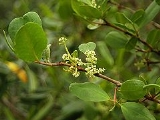
Laguncularia racemosa

Encyclopedia
Laguncularia racemosa is a species of flowering plant
in the leadwood tree
family, Combretaceae
. It is native to the coasts of western Africa
from Senegal
to Cameroon
, the Atlantic
coast of the Americas
from Bermuda
, Florida
, the Bahamas
, Mexico
, the Caribbean
and south to Brazil
; and on the Pacific
coast of the Americas from Mexico to northwestern Peru
, including the Galápagos Islands
.
 It is a mangrove
tree, growing to 12–18 m (39.4–59.1 ft) tall. The bark
is gray-brown or reddish, and rough and fissured. Pneumatophores and/or prop roots may be present, depending on environmental conditions. The leaves
are opposite, elliptical, 12–18 cm (4.7–7.1 in) long and 2.5–5 cm (0.984251968503937–2 in) broad, rounded at both ends, entire, smooth, leathery in texture, slightly fleshy, without visible veins, and yellow-green in color. The petiole
is stout, reddish, 10–13 mm (0.393700787401575–0.511811023622047 in) long, with two small glands near the blade that exude salt
. The white, bell-shaped flower
s are mostly bisexual
and about 5 mm (0.196850393700787 in) long. The fruit
is a reddish-brown drupe
, about 12–20 mm (0.47244094488189–0.78740157480315 in) long, with longitudinal ridges. The single seed is sometimes viviparous.
It grows in coastal areas of bay
s, lagoon
s, and tidal creek
s, typically growing inland of other mangroves, well above the high tide line.
Flowering plant
The flowering plants , also known as Angiospermae or Magnoliophyta, are the most diverse group of land plants. Angiosperms are seed-producing plants like the gymnosperms and can be distinguished from the gymnosperms by a series of synapomorphies...
in the leadwood tree
Combretum imberbe
The semi-deciduous Leadwood tree is found from KwaZulu-Natal Province of South Africa in the south to Tanzania in the north. It normally grows up to 20 metres tall...
family, Combretaceae
Combretaceae
Combretaceae is a family of flowering plants in the order Myrtales. The family includes about 600 species of trees, shrubs, and lianas in 18 genera. The family includes the leadwood tree, Combretum imberbe. Three genera, Conocarpus, Laguncularia and Lumnitzera, grow in mangrove habitats ....
. It is native to the coasts of western Africa
Africa
Africa is the world's second largest and second most populous continent, after Asia. At about 30.2 million km² including adjacent islands, it covers 6% of the Earth's total surface area and 20.4% of the total land area...
from Senegal
Senegal
Senegal , officially the Republic of Senegal , is a country in western Africa. It owes its name to the Sénégal River that borders it to the east and north...
to Cameroon
Cameroon
Cameroon, officially the Republic of Cameroon , is a country in west Central Africa. It is bordered by Nigeria to the west; Chad to the northeast; the Central African Republic to the east; and Equatorial Guinea, Gabon, and the Republic of the Congo to the south. Cameroon's coastline lies on the...
, the Atlantic
Atlantic Ocean
The Atlantic Ocean is the second-largest of the world's oceanic divisions. With a total area of about , it covers approximately 20% of the Earth's surface and about 26% of its water surface area...
coast of the Americas
Americas
The Americas, or America , are lands in the Western hemisphere, also known as the New World. In English, the plural form the Americas is often used to refer to the landmasses of North America and South America with their associated islands and regions, while the singular form America is primarily...
from Bermuda
Bermuda
Bermuda is a British overseas territory in the North Atlantic Ocean. Located off the east coast of the United States, its nearest landmass is Cape Hatteras, North Carolina, about to the west-northwest. It is about south of Halifax, Nova Scotia, Canada, and northeast of Miami, Florida...
, Florida
Florida
Florida is a state in the southeastern United States, located on the nation's Atlantic and Gulf coasts. It is bordered to the west by the Gulf of Mexico, to the north by Alabama and Georgia and to the east by the Atlantic Ocean. With a population of 18,801,310 as measured by the 2010 census, it...
, the Bahamas
The Bahamas
The Bahamas , officially the Commonwealth of the Bahamas, is a nation consisting of 29 islands, 661 cays, and 2,387 islets . It is located in the Atlantic Ocean north of Cuba and Hispaniola , northwest of the Turks and Caicos Islands, and southeast of the United States...
, Mexico
Mexico
The United Mexican States , commonly known as Mexico , is a federal constitutional republic in North America. It is bordered on the north by the United States; on the south and west by the Pacific Ocean; on the southeast by Guatemala, Belize, and the Caribbean Sea; and on the east by the Gulf of...
, the Caribbean
Caribbean
The Caribbean is a crescent-shaped group of islands more than 2,000 miles long separating the Gulf of Mexico and the Caribbean Sea, to the west and south, from the Atlantic Ocean, to the east and north...
and south to Brazil
Brazil
Brazil , officially the Federative Republic of Brazil , is the largest country in South America. It is the world's fifth largest country, both by geographical area and by population with over 192 million people...
; and on the Pacific
Pacific Ocean
The Pacific Ocean is the largest of the Earth's oceanic divisions. It extends from the Arctic in the north to the Southern Ocean in the south, bounded by Asia and Australia in the west, and the Americas in the east.At 165.2 million square kilometres in area, this largest division of the World...
coast of the Americas from Mexico to northwestern Peru
Peru
Peru , officially the Republic of Peru , is a country in western South America. It is bordered on the north by Ecuador and Colombia, on the east by Brazil, on the southeast by Bolivia, on the south by Chile, and on the west by the Pacific Ocean....
, including the Galápagos Islands
Galápagos Islands
The Galápagos Islands are an archipelago of volcanic islands distributed around the equator in the Pacific Ocean, west of continental Ecuador, of which they are a part.The Galápagos Islands and its surrounding waters form an Ecuadorian province, a national park, and a...
.
Mangrove
Mangroves are various kinds of trees up to medium height and shrubs that grow in saline coastal sediment habitats in the tropics and subtropics – mainly between latitudes N and S...
tree, growing to 12–18 m (39.4–59.1 ft) tall. The bark
Bark
Bark is the outermost layers of stems and roots of woody plants. Plants with bark include trees, woody vines and shrubs. Bark refers to all the tissues outside of the vascular cambium and is a nontechnical term. It overlays the wood and consists of the inner bark and the outer bark. The inner...
is gray-brown or reddish, and rough and fissured. Pneumatophores and/or prop roots may be present, depending on environmental conditions. The leaves
Leaf
A leaf is an organ of a vascular plant, as defined in botanical terms, and in particular in plant morphology. Foliage is a mass noun that refers to leaves as a feature of plants....
are opposite, elliptical, 12–18 cm (4.7–7.1 in) long and 2.5–5 cm (0.984251968503937–2 in) broad, rounded at both ends, entire, smooth, leathery in texture, slightly fleshy, without visible veins, and yellow-green in color. The petiole
Petiole (botany)
In botany, the petiole is the stalk attaching the leaf blade to the stem. The petiole usually has the same internal structure as the stem. Outgrowths appearing on each side of the petiole are called stipules. Leaves lacking a petiole are called sessile, or clasping when they partly surround the...
is stout, reddish, 10–13 mm (0.393700787401575–0.511811023622047 in) long, with two small glands near the blade that exude salt
Salt
In chemistry, salts are ionic compounds that result from the neutralization reaction of an acid and a base. They are composed of cations and anions so that the product is electrically neutral...
. The white, bell-shaped flower
Flower
A flower, sometimes known as a bloom or blossom, is the reproductive structure found in flowering plants . The biological function of a flower is to effect reproduction, usually by providing a mechanism for the union of sperm with eggs...
s are mostly bisexual
Plant sexuality
Plant sexuality covers the wide variety of sexual reproduction systems found across the plant kingdom. This article describes morphological aspects of sexual reproduction of plants....
and about 5 mm (0.196850393700787 in) long. The fruit
Fruit
In broad terms, a fruit is a structure of a plant that contains its seeds.The term has different meanings dependent on context. In non-technical usage, such as food preparation, fruit normally means the fleshy seed-associated structures of certain plants that are sweet and edible in the raw state,...
is a reddish-brown drupe
Drupe
In botany, a drupe is a fruit in which an outer fleshy part surrounds a shell of hardened endocarp with a seed inside. These fruits develop from a single carpel, and mostly from flowers with superior ovaries...
, about 12–20 mm (0.47244094488189–0.78740157480315 in) long, with longitudinal ridges. The single seed is sometimes viviparous.
It grows in coastal areas of bay
Headlands and bays
Headlands and bays are two related features of the coastal environment.- Geology and geography :Headlands and bays are often found on the same coastline. A bay is surrounded by land on three sides, whereas a headland is surrounded by water on three sides. Headlands are characterized by high,...
s, lagoon
Lagoon
A lagoon is a body of shallow sea water or brackish water separated from the sea by some form of barrier. The EU's habitat directive defines lagoons as "expanses of shallow coastal salt water, of varying salinity or water volume, wholly or partially separated from the sea by sand banks or shingle,...
s, and tidal creek
Creek (tidal)
A tidal creek, tidal channel, or estuary is the portion of a stream that is affected by ebb and flow of ocean tides, in the case that the subject stream discharges to an ocean, sea or strait. Thus this portion of the stream has variable salinity and electrical conductivity over the tidal cycle...
s, typically growing inland of other mangroves, well above the high tide line.