

Kotelnich

Encyclopedia

Port
A port is a location on a coast or shore containing one or more harbors where ships can dock and transfer people or cargo to or from land....
town in Kirov Oblast
Kirov Oblast
Kirov Oblast is a federal subject of Russia . Its administrative center is the city of Kirov. Population: -History:In the late 19th and early 20th centuries, Vyatka remained a place of exile for opponents of the tsarist regime, including many prominent revolutionary figures.In 1920, a number of...
, Russia
Russia
Russia or , officially known as both Russia and the Russian Federation , is a country in northern Eurasia. It is a federal semi-presidential republic, comprising 83 federal subjects...
, located on the right bank of the Vyatka River
Vyatka River
The Vyatka River is a river in Kirov Oblast and the Republic of Tatarstan in Russia, right tributary of the Kama River. It is 1,314 km in length. The area of its basin is 129,000 km²....
near its confluence
Confluence
Confluence, in geography, describes the meeting of two or more bodies of water.Confluence may also refer to:* Confluence , a property of term rewriting systems...
with the Moloma
Moloma River
Moloma River is a river in Kirov Oblast in Russia, an arm of the Vyatka River. The length of the river is 419 km, the area of its basin is 12,700 km². The Moloma freezes up in early November and stays icebound until late April....
, along the route of the Trans-Siberian Railway
Trans-Siberian Railway
The Trans-Siberian Railway is a network of railways connecting Moscow with the Russian Far East and the Sea of Japan. It is the longest railway in the world...
, 124 kilometres (77.1 mi) southwest of Kirov
Kirov, Russia
Kirov or Kirova is the name of several inhabited localities in Russia.Urban localities*Kirov, Kirov Oblast, a city and the administrative center of Kirov Oblast*Kirov, Kaluga Oblast, a town in Kaluga OblastRural localities...
. Population:
The locality of Koksharov was first mentioned in 1143 as a Mari town. In 1182, it was occupied by Russians
Russians
The Russian people are an East Slavic ethnic group native to Russia, speaking the Russian language and primarily living in Russia and neighboring countries....
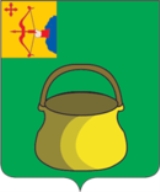
and renamed Kotelnich, from the word kotel (now kotlovina) 'hollow, depression.' Town status was granted to it in 1780.
The strip of the Vyatka's right bank on which Kotelnich stands is a part of a pareiasaur
Pareiasaur
The Pareiasaurs - Family Pareiasauridae - are a clade of medium-sized to large herbivorous anapsid reptiles that flourished during the Permian period....
remains site, one of the largest in the world.
12th to 16th centuries: Foundation and joining the Russian state
Ancient literary monuments and archaeological excavations have demonstrated that the town was founded near the end of the 12th century, at which time it was inhabited by the Maris (Cheremis), according to P. I. Rychkov and N. M. Karamzin. The first documents that prove the city status of Kotelnich date from the middle of the fifteenth century. For a long time the VyatkaVyatka River
The Vyatka River is a river in Kirov Oblast and the Republic of Tatarstan in Russia, right tributary of the Kama River. It is 1,314 km in length. The area of its basin is 129,000 km²....
region was a strong antagonist of Moscow
Grand Duchy of Moscow
The Grand Duchy of Moscow or Grand Principality of Moscow, also known in English simply as Muscovy , was a late medieval Rus' principality centered on Moscow, and the predecessor state of the early modern Tsardom of Russia....
and its attempts to consolidate all the Russian lands, but eventually resistance was broken, and Kotelnich was conquered in 1459 together with many other towns of the region. By 1489 its rebellious population was resettled to distant places and the city itself became an ordinary fortress on the northeastern border of the Grand Duchy of Moscow
Grand Duchy of Moscow
The Grand Duchy of Moscow or Grand Principality of Moscow, also known in English simply as Muscovy , was a late medieval Rus' principality centered on Moscow, and the predecessor state of the early modern Tsardom of Russia....
, helping protect the rich northern lands from ruinous raids by Tatars
Tatars
Tatars are a Turkic speaking ethnic group , numbering roughly 7 million.The majority of Tatars live in the Russian Federation, with a population of around 5.5 million, about 2 million of which in the republic of Tatarstan.Significant minority populations are found in Uzbekistan, Kazakhstan,...
. In 1542 a troop of 4,000 Tatars was defeated near Kotelnich.
In the middle of the 16th century the region was divided into four parts, with Kotelnich as the head of one part. In 1558 the system of vice-regency
Mestnichestvo
In Russian history, Mestnichestvo was a feudal hierarchical system in Russia from the 15th to 17th centuries. Mestnichestvo revolved around a simple principle: the boyar who estimated that his origins were more ancient and his personal services to the tsar more valuable could claim a higher state...
was liquidated and much power was given to local group representative bodies. At the end of the century a Siberian Route
Siberian Route
The Siberian Route , also known as the Moscow Route and Great Route , was a historic route that connected European Russia to Siberia and China. Previously Siberian transport had been mostly by river via Siberian River Routes...
was built that passed through Kotelnich. A listing conducted in 1595 revealed a population of 430 citizens.
17th to 19th century: Beginnings of the fair, complicated growth
The Time of TroublesTime of Troubles
The Time of Troubles was a period of Russian history comprising the years of interregnum between the death of the last Russian Tsar of the Rurik Dynasty, Feodor Ivanovich, in 1598, and the establishment of the Romanov Dynasty in 1613. In 1601-1603, Russia suffered a famine that killed one-third...
was a significant period for the town; it was captured by armed bands that devastated churches, raped women, and turned Kotelnich into a local center of the uprising for the "Tsar Dmitri
False Dmitriy I
False Dmitriy I was the Tsar of Russia from 21 July 1605 until his death on 17 May 1606 under the name of Dimitriy Ioannovich . He is sometimes referred to under the usurped title of Dmitriy II...
". After being liberated in December 1609, Kotelnich fell into decay; it became the smallest town in the Vyatka
Kirov Oblast
Kirov Oblast is a federal subject of Russia . Its administrative center is the city of Kirov. Population: -History:In the late 19th and early 20th centuries, Vyatka remained a place of exile for opponents of the tsarist regime, including many prominent revolutionary figures.In 1920, a number of...
region. During the next forty years its economy was restored, which led to the opening of a large fair called Alekseevskaya, in honour of Tsar Alexei Mikhailovich). In 1654 the population was to be five times more than in 1629 because of an increasing number of new settlers lured by an abundance of unoccupied land, and also due to the colonization activity of monasteries
Monastery
Monastery denotes the building, or complex of buildings, that houses a room reserved for prayer as well as the domestic quarters and workplace of monastics, whether monks or nuns, and whether living in community or alone .Monasteries may vary greatly in size – a small dwelling accommodating only...
. This development was interrupted by a epidemic of mortal ulcers
Peptic ulcer
A peptic ulcer, also known as PUD or peptic ulcer disease, is the most common ulcer of an area of the gastrointestinal tract that is usually acidic and thus extremely painful. It is defined as mucosal erosions equal to or greater than 0.5 cm...
in 1658. Eventually, in 1686, Kotelnich was completely burnt down.
In the 18th century its population and economy grew slowly, restrained by recruit enrollment and money exactions for the building of Saint Petersburg
Saint Petersburg
Saint Petersburg is a city and a federal subject of Russia located on the Neva River at the head of the Gulf of Finland on the Baltic Sea...
and attendant projects. The churches were rebuilt despite the prohibition on stone construction. In the days of Catherine II
Catherine II of Russia
Catherine II, also known as Catherine the Great , Empress of Russia, was born in Stettin, Pomerania, Prussia on as Sophie Friederike Auguste von Anhalt-Zerbst-Dornburg...
, Kotelnich became a center of a district that remains today. It also received an emblem and self-government rights, including elections for a city chief and formation of a local council (duma
Duma
A Duma is any of various representative assemblies in modern Russia and Russian history. The State Duma in the Russian Empire and Russian Federation corresponds to the lower house of the parliament. Simply it is a form of Russian governmental institution, that was formed during the reign of the...
). By 1795 its population was over one thousand people for the first time (448 men and 606 women). Kotelnich began to develop as a connecting link between Perm
Perm
Perm is a city and the administrative center of Perm Krai, Russia, located on the banks of the Kama River, in the European part of Russia near the Ural Mountains. From 1940 to 1957 it was named Molotov ....
, Kazan
Kazan
Kazan is the capital and largest city of the Republic of Tatarstan, Russia. With a population of 1,143,546 , it is the eighth most populous city in Russia. Kazan lies at the confluence of the Volga and Kazanka Rivers in European Russia. In April 2009, the Russian Patent Office granted Kazan the...
, Kostroma
Kostroma
Kostroma is a historic city and the administrative center of Kostroma Oblast, Russia. A part of the Golden Ring of Russian towns, it is located at the confluence of the Volga and Kostroma Rivers...
and Vyatka
Kirov, Kirov Oblast
Kirov , formerly known as Vyatka and Khlynov, is a city in northeastern European Russia, on the Vyatka River, and the administrative center of Kirov Oblast. Population: -History:...
. During this time the first post office, a small public college with 30 pupils, a city hospital for 10 patients, and a private pharmacy were opened.
During the 19th century the fair in Kotelnich acquired considerable interregional significance. In various years it was included in the best ten fairs in Russia due to a great volume of sales. The main products sold in the market were horses and sewing machines. However, the popularity of the fair didn't stimulate internal trade or productive work in Kotelnich. The town earned sufficient money from leasing warehouses and trade spaces. By the end of the century (1897) the population of the town had increased to 4,240 people and the territory to 1.8 km2.
20th century: Revolutions and wars, definitive stagnation
In the 20th century Kotelnich developed as a transport junction. A main railway from Saint Petersburg to Vyatka went through Kotelnich in 1902–1905 when the bridge across the river was built. As a result, the Alekseevskaya fair lost its significant role. The beginning of the century was also marked by the appearance of a water supply, 36 cabmen, oil lamps on the streets, telephone communication, and 22 prostitutes.Workers and soldiers in Kotelnich joined the protest actions during the First World War. Disorder of 6,000 mobilized citizens was suppressed brutally, with 10 people killed and 12 injured. Bolshevik
Bolshevik
The Bolsheviks, originally also Bolshevists , derived from bol'shinstvo, "majority") were a faction of the Marxist Russian Social Democratic Labour Party which split apart from the Menshevik faction at the Second Party Congress in 1903....
power in 1917 came to Kotelnich comparatively late, by armed means. During the civil war
Russian Civil War
The Russian Civil War was a multi-party war that occurred within the former Russian Empire after the Russian provisional government collapsed to the Soviets, under the domination of the Bolshevik party. Soviet forces first assumed power in Petrograd The Russian Civil War (1917–1923) was a...
Kotelnich passed from hand to hand many times. A terrible fire in 1926 destroyed two-thirds of the town and left more than 7,000 people homeless. Kotelnich very nearly became a small rural settlement after that; the local legislative committee was forced to persuade the government of the republic to keep its city status and to rebuild what was destroyed.
In 1926 a fair was conducted for the last time, and most trade businesses were closed. During the next 10 years there were built several small and middle-size industrial enterprises such as building materials factories and sawing and brick plants. The council
Soviet (council)
Soviet was a name used for several Russian political organizations. Examples include the Czar's Council of Ministers, which was called the “Soviet of Ministers”; a workers' local council in late Imperial Russia; and the Supreme Soviet of the Soviet Union....
and Red Army
Red Army
The Workers' and Peasants' Red Army started out as the Soviet Union's revolutionary communist combat groups during the Russian Civil War of 1918-1922. It grew into the national army of the Soviet Union. By the 1930s the Red Army was among the largest armies in history.The "Red Army" name refers to...
deputies were lax in the execution of their functions, which led to frequent changes of local leadership. Kotelnich was often left without electricity because the capacity of the local electric power station was low. Delivery of foodstuffs was reduced, and the death rate grew quickly. Many people refused to work, and 239 were subjected to repression
Great Purge
The Great Purge was a series of campaigns of political repression and persecution in the Soviet Union orchestrated by Joseph Stalin from 1936 to 1938...
for political reasons by 1952 (more than half of them were shot). Kotelnich became a place of exile for many priests.
From July 1941 it was an evacuation point for thousands of people from northwestern Russia. By February 1943 the population of the town had increased to 32,500. There wasn't much space to settle all the evacuees, and many families from the western regions were lodged with local ones. Four evacuation hospitals were organized, and 50,000 fighters recovered there and later returned to the battlefront. In the battles of World War II
World War II
World War II, or the Second World War , was a global conflict lasting from 1939 to 1945, involving most of the world's nations—including all of the great powers—eventually forming two opposing military alliances: the Allies and the Axis...
, 654 natives of Kotelnich perished.
The first postwar years were difficult. A crisis was experienced in production and dwelling. It wasn't until the late sixties that many plants were reconstructed or newly built. The biggest is Micrometer, a ferroconcrete and furniture plant. By the 1980s each citizen had a little more than 13 square meters of dwelling space. Several schools, colleges, and cultural establishments appeared at that time.
Reforms conducted in the end of the century led to a rapid decrease of population, employment, and industrial production. Only one-fifth of the capacity of the local plants was used. The modern Russian economy is based on raw materials, leaving little chance to Kotelnich to grow in any important sphere.