

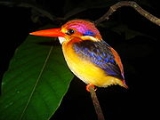
Kingfisher

Encyclopedia
Kingfishers are a group of small to medium sized brightly coloured bird
s in the order Coraciiformes
. They have a cosmopolitan distribution
, with most species being found in the Old World
and Australia
. The group is treated either as a single family
, Alcedinidae, or as a suborder Alcedines containing three families, Alcedinidae (river kingfishers), Halcyonidae (tree kingfisher
s), and Cerylidae (water kingfisher
s). There are roughly 90 species of kingfisher. All have large heads, long, sharp, pointed bills, short legs, and stubby tails. Most species have bright plumage
with little differences between the sexes. Most species are tropical in distribution, and a slight majority are found only in forests. They consume a wide range of prey as well as fish, usually caught by swooping down from a perch. Like other members of their order they nest in cavities, usually tunnels dug into the natural or artificial banks in the ground. A few species, principally insular forms, are threatened with extinction.
of the three families is complex and rather controversial. Although commonly assigned to the order
Coraciiformes
, from this level down confusion sets in.
The kingfishers were traditionally treated as one family, Alcedinidae with three subfamilies, but following the 1990s revolution
in bird taxonomy, the three former subfamilies are now often elevated to familial level. That move was supported by chromosome and DNA-DNA hybridisation studies, but challenged on the grounds that all three groups are monophyletic with respect to the other Coraciiformes
. This leads to them being grouped as the suborder Alcedines.
The tree kingfishers have been previously given the familial name Dacelonidae but Halcyonidae has priority.
The centre of kingfisher diversity is the Australasian region, but the family is not thought to have originated there, instead they evolved in the Northern Hemisphere and invaded the Australasian region a number of times. Fossil
kingfishers have been described from Lower Eocene
rocks in Wyoming
and Middle Eocene rocks in Germany
, around 30-40 million years ago. More recent fossil kingfishers have been described in the Miocene rocks of Australia
(5-25 million years old). Several fossil birds have been erroneously ascribed to the kingfishers, including Halcyornis, from the Lower Eocene rocks in Kent
, which has also been considered a gull
, but is now thought to have been a member of an extinct family.
Amongst the four families the Alcedinidae are basal to the other two families. The few species found in the Americas, all from the family Cerylidae, suggest that the sparse representation in the western hemisphere resulted
from just two original colonising species. The family is a comparatively recent split from the Halcyonidae, diversifying in the Old World as recently as the Miocene or Pliocene.
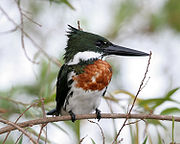 The kingfishers have a cosmopolitan distribution
, occurring throughout the worlds tropics and temperate regions. They are absent from the polar regions and some of the world's driest deserts. A number of species have reached islands groups, particularly those in the south and east Pacific Ocean
. The Old World
tropics and Australasia
are the core area for this group. Europe
and North America
north of Mexico
are very poorly represented with only one common kingfisher (Common Kingfisher and Belted Kingfisher
respectively), and a couple of uncommon or very local species each: (Ringed Kingfisher
and Green Kingfisher
in the southwest USA, Pied Kingfisher
and White-throated Kingfisher
in SE Europe). The six species occurring in the Americas are four closely related green kingfishers in the genus Chloroceryle
and two large crested kingfishers in the genus Megaceryle
. Even tropical South America
has only five species plus wintering
Belted Kingfisher. In comparison, the tiny Africa
n country of The Gambia
has eight resident species in its 120 by 20 mi. (192 by 32 km) area.
Individual species may have massive ranges, like the Common Kingfisher, which ranges from Ireland
across Europe, North Africa and Asia as far as the Solomon Islands
in Australasia, or the Pied Kingfisher
, which has a widespread distribution across Africa and Asia. Other species have much narrower ranges, particularly insular species which are endemic to a single small island. The Kofiau Paradise Kingfisher
is restricted to the tiny island of Kofiau
off New Guinea.
Kingfishers occupy a wide range of habitats. While they are often associated with rivers and lakes, over half the worlds species are found in forests and forested streams. They also occupy a wide range of other habitats. The Red-backed Kingfisher
of Australia lives in the driest deserts, although kingfishers are absent from other dry deserts like the Sahara. Other species live high in mountains, or in open woodland, and a number of species live on tropical coral atolls. Numerous species have adapted to human modified habitats, particularly those adapted to woodlands, and may be found in cultivated and agricultural areas, as well as parks and gardens in towns and cities.
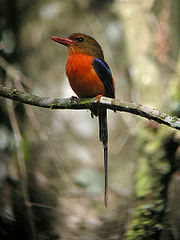 The smallest species of kingfisher is the African Dwarf Kingfisher (Ispidina lecontei), which averages at 10.4 g and 10 cm (4 inches). The largest overall is the Giant Kingfisher
(Megaceryle maxima), at an average of 355 g (13.5 oz) and 45 cm (18 inches). However, the familiar Australia
n kingfisher known as the Laughing Kookaburra
(Dacelo novaeguineae) may be the heaviest species, since large individuals exceeding 450 g (1 lb) are not rare.
The plumage
of most kingfishers is bright, with green and blue being the most common colours. The brightness of the colours is neither the product of iridescence (except in the American kingfishers) or pigments, but is instead caused by the structure of the feathers, which causes scattering of blue light (the Tyndall effect
). In most species there are no differences between the sexes, when there are differences they are quite small (less than 10%).
The kingfishers have a long, dagger-like bill. The bill is usually longer and more compressed in species that hunt fish, and shorter and more broad in species that hunt prey off the ground. The largest and most atypical bill is that of the Shovel-billed Kookaburra
, which is used to dig through the forest floor in search of prey. They generally have short legs, although species that feed on the ground have longer tarsi. Most species have four toes, three of which are forward pointing.
The irises of most species are dark brown. The kingfishers have excellent vision; they are capable of binocular vision and are thought in particular to have good colour vision. They have restricted movement of their eyes within the eye sockets, instead using head movements in order to track prey. In addition they are able to compensate for the refraction of water and reflection when hunting prey underwater, and are able to judge depth underwater accurately. They also have nictitating membranes that cover the eyes when they hit the water in order to protect them; in the Pied Kingfisher
has a bony plate which slides across the eye when the bird hits the water.
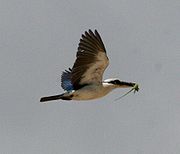 The kingfishers feed on a wide variety of items. They are most famous for hunting and eating fish, and some species do specialise in catching fish, but other species take crustacean
s, frog
s and other amphibian
s, annelid
worms, molluscs, insect
s, spider
s, centipede
s, reptiles (including snakes) and even birds and mammals. Individual species may specialise in a few items or take a wide variety of prey, and for species with large global distributions different populations may have different diets. Woodland and forest kingfishers take mainly insects, particularly grasshoppers, whereas the water kingfishers are more specialised in taking fish. The Red-backed Kingfisher
has been observed hammering into the mud nests of Fairy Martin
s to feed on their nestlings. Kingfishers usually hunt from an exposed perch, when a prey item is observed the kingfisher swoops down to snatch it, then returns to the perch. Kingfishers of all three families beat larger prey on a perch in order to kill the prey and to dislodge or break protective spines and bones. Having beaten the prey it is manipulated and then swallowed. The Shovel-billed Kookaburra
uses its massive wide bill as a shovel in order to dig for worms in soft mud.
, some species defending their territories vigorously. They are generally monogamous
, although cooperative breeding has been observed in some species. In a few species cooperative breeding is quite common, for example the laughing Kookaburra
, where helpers
aid the dominant breeding pair in raising the young.
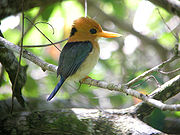 Like all Coraciiformes
, the kingfishers are cavity nesters, with most species nesting
in holes dug in the ground. These holes are usually in earth banks on the sides of rivers, lakes or man-made ditches. Some species may nest in holes in trees, the earth clinging to the roots of an uprooted tree, or arboreal nests of termites (termitarium). These termite nests are common in forest species. The nests take the form of a small chamber at the end of a tunnel. Nest-digging duties are shared between the sexes. During the initial excavations the bird may fly at the chosen site with considerable force, and birds have injured themselves fatally while doing this. The length of the tunnels varies by species and location, nests in termitariums are necessarily much shorter than those dug into the earth, and nests in harder substrates are shorter than those in soft soil or sand. The longest tunnels recorded are those of the Giant Kingfisher
, which have been found to be 8.5 m long.
The eggs of kinfishers are invariably white and glossy. The typical clutch
size varies by species; some of the very large and very small species lay as few as two eggs per clutch, whereas others may lay 10 eggs, the average is around three to six eggs. Both sexes incubate
the eggs.
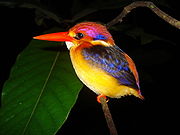 Kingfishers are generally shy birds, but in spite of this they feature heavily in human culture, generally due to the large head supporting its powerful mouth, their bright plumage, or in some species interesting behaviour.
For the Dusun
people of Borneo
, the Oriental Dwarf Kingfisher is considered a bad omen, and warriors that see one on the way to battle should return home. Another Bornean tribe consider the Banded Kingfisher
an omen bird, albeit generally a good omen.
The sacred Kingfisher, along with other Pacific kingfishers, was venerated by the Polynesians, who believed it had control over the seas and waves.
Modern taxonomy also refers to the winds and sea in naming kingfishers after a classical Greek myth. The first pair of the mythical-bird Halcyon (kingfishers) were created from a marriage of Alcyone and Ceyx. As gods they lived the sacrilege of referring to themselves as Zeus and Hera. They died for this, but the other gods, in an act of compassion, made them into birds and thus restored them to their original seaside habitat. In addition special "Halcyon days" were granted. These are the seven days either side of the winter solstice when storms shall never again occur for them. The Halcyon birds' "days" were for caring for the winter-hatched clutch (or brood), but the phrase "Halcyon days" also refers specifically to an idyllic time in the past, or in general to a peaceful time.
Various kinds of kingfishers and human cultural artifacts are named after the couple, in reference to this metamorphosis myth:
Not all the kingfishers are named in this way. The etymology of kingfisher (Alcedo atthis) is obscure; the term comes from king's fisher, but why that name was applied is not known.
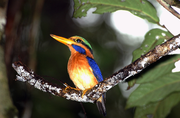 A number of species are considered threatened by human activities and are in danger of extinction
. The majority of these are forest species with limited distribution, particularly insular species. They are threatened by habitat loss
caused by forest clearance or degradation and in some cases by introduced species
. The Marquesan Kingfisher
of French Polynesia
is listed as critically endangered due to a combination of habitat loss and degradation caused by introduced cattle, and possibly due to predation by introduced species.
Bird
Birds are feathered, winged, bipedal, endothermic , egg-laying, vertebrate animals. Around 10,000 living species and 188 families makes them the most speciose class of tetrapod vertebrates. They inhabit ecosystems across the globe, from the Arctic to the Antarctic. Extant birds range in size from...
s in the order Coraciiformes
Coraciiformes
The Coraciiformes are a group of usually colorful near passerine birds including the kingfishers, the Hoopoe, the bee-eaters, the rollers, and the hornbills...
. They have a cosmopolitan distribution
Cosmopolitan distribution
In biogeography, a taxon is said to have a cosmopolitan distribution if its range extends across all or most of the world in appropriate habitats. For instance, the killer whale has a cosmopolitan distribution, extending over most of the world's oceans. Other examples include humans, the lichen...
, with most species being found in the Old World
Old World
The Old World consists of those parts of the world known to classical antiquity and the European Middle Ages. It is used in the context of, and contrast with, the "New World" ....
and Australia
Australia
Australia , officially the Commonwealth of Australia, is a country in the Southern Hemisphere comprising the mainland of the Australian continent, the island of Tasmania, and numerous smaller islands in the Indian and Pacific Oceans. It is the world's sixth-largest country by total area...
. The group is treated either as a single family
Family (biology)
In biological classification, family is* a taxonomic rank. Other well-known ranks are life, domain, kingdom, phylum, class, order, genus, and species, with family fitting between order and genus. As for the other well-known ranks, there is the option of an immediately lower rank, indicated by the...
, Alcedinidae, or as a suborder Alcedines containing three families, Alcedinidae (river kingfishers), Halcyonidae (tree kingfisher
Tree kingfisher
The tree kingfishers or wood kingfishers, family Halcyonidae, are the most numerous of the three families of birds in the kingfisher group, with between 56 and 61 species in around 12 genera, including several species of kookaburras. The family appears to have arisen in Indochina and the Maritime...
s), and Cerylidae (water kingfisher
Water Kingfisher
The water kingfishers or Cerylidae are one of the three families of kingfishers, and are also known as the cerylid kingfishers. All six American species are in this family....
s). There are roughly 90 species of kingfisher. All have large heads, long, sharp, pointed bills, short legs, and stubby tails. Most species have bright plumage
Plumage
Plumage refers both to the layer of feathers that cover a bird and the pattern, colour, and arrangement of those feathers. The pattern and colours of plumage vary between species and subspecies and can also vary between different age classes, sexes, and season. Within species there can also be a...
with little differences between the sexes. Most species are tropical in distribution, and a slight majority are found only in forests. They consume a wide range of prey as well as fish, usually caught by swooping down from a perch. Like other members of their order they nest in cavities, usually tunnels dug into the natural or artificial banks in the ground. A few species, principally insular forms, are threatened with extinction.
Taxonomy and evolution
The taxonomyTaxonomy
Taxonomy is the science of identifying and naming species, and arranging them into a classification. The field of taxonomy, sometimes referred to as "biological taxonomy", revolves around the description and use of taxonomic units, known as taxa...
of the three families is complex and rather controversial. Although commonly assigned to the order
Order (biology)
In scientific classification used in biology, the order is# a taxonomic rank used in the classification of organisms. Other well-known ranks are life, domain, kingdom, phylum, class, family, genus, and species, with order fitting in between class and family...
Coraciiformes
Coraciiformes
The Coraciiformes are a group of usually colorful near passerine birds including the kingfishers, the Hoopoe, the bee-eaters, the rollers, and the hornbills...
, from this level down confusion sets in.
The kingfishers were traditionally treated as one family, Alcedinidae with three subfamilies, but following the 1990s revolution
Sibley-Ahlquist taxonomy
The Sibley-Ahlquist taxonomy is a bird taxonomy proposed by Charles Sibley and Jon Edward Ahlquist. It is based on DNA-DNA hybridization studies conducted in the late 1970s and throughout the 1980s....
in bird taxonomy, the three former subfamilies are now often elevated to familial level. That move was supported by chromosome and DNA-DNA hybridisation studies, but challenged on the grounds that all three groups are monophyletic with respect to the other Coraciiformes
Coraciiformes
The Coraciiformes are a group of usually colorful near passerine birds including the kingfishers, the Hoopoe, the bee-eaters, the rollers, and the hornbills...
. This leads to them being grouped as the suborder Alcedines.
The tree kingfishers have been previously given the familial name Dacelonidae but Halcyonidae has priority.
The centre of kingfisher diversity is the Australasian region, but the family is not thought to have originated there, instead they evolved in the Northern Hemisphere and invaded the Australasian region a number of times. Fossil
Fossil
Fossils are the preserved remains or traces of animals , plants, and other organisms from the remote past...
kingfishers have been described from Lower Eocene
Eocene
The Eocene Epoch, lasting from about 56 to 34 million years ago , is a major division of the geologic timescale and the second epoch of the Paleogene Period in the Cenozoic Era. The Eocene spans the time from the end of the Palaeocene Epoch to the beginning of the Oligocene Epoch. The start of the...
rocks in Wyoming
Wyoming
Wyoming is a state in the mountain region of the Western United States. The western two thirds of the state is covered mostly with the mountain ranges and rangelands in the foothills of the Eastern Rocky Mountains, while the eastern third of the state is high elevation prairie known as the High...
and Middle Eocene rocks in Germany
Germany
Germany , officially the Federal Republic of Germany , is a federal parliamentary republic in Europe. The country consists of 16 states while the capital and largest city is Berlin. Germany covers an area of 357,021 km2 and has a largely temperate seasonal climate...
, around 30-40 million years ago. More recent fossil kingfishers have been described in the Miocene rocks of Australia
Australia
Australia , officially the Commonwealth of Australia, is a country in the Southern Hemisphere comprising the mainland of the Australian continent, the island of Tasmania, and numerous smaller islands in the Indian and Pacific Oceans. It is the world's sixth-largest country by total area...
(5-25 million years old). Several fossil birds have been erroneously ascribed to the kingfishers, including Halcyornis, from the Lower Eocene rocks in Kent
Kent
Kent is a county in southeast England, and is one of the home counties. It borders East Sussex, Surrey and Greater London and has a defined boundary with Essex in the middle of the Thames Estuary. The ceremonial county boundaries of Kent include the shire county of Kent and the unitary borough of...
, which has also been considered a gull
Gull
Gulls are birds in the family Laridae. They are most closely related to the terns and only distantly related to auks, skimmers, and more distantly to the waders...
, but is now thought to have been a member of an extinct family.
Amongst the four families the Alcedinidae are basal to the other two families. The few species found in the Americas, all from the family Cerylidae, suggest that the sparse representation in the western hemisphere resulted
Evolution
Evolution is any change across successive generations in the heritable characteristics of biological populations. Evolutionary processes give rise to diversity at every level of biological organisation, including species, individual organisms and molecules such as DNA and proteins.Life on Earth...
from just two original colonising species. The family is a comparatively recent split from the Halcyonidae, diversifying in the Old World as recently as the Miocene or Pliocene.
Distribution and habitat
Cosmopolitan distribution
In biogeography, a taxon is said to have a cosmopolitan distribution if its range extends across all or most of the world in appropriate habitats. For instance, the killer whale has a cosmopolitan distribution, extending over most of the world's oceans. Other examples include humans, the lichen...
, occurring throughout the worlds tropics and temperate regions. They are absent from the polar regions and some of the world's driest deserts. A number of species have reached islands groups, particularly those in the south and east Pacific Ocean
Pacific Ocean
The Pacific Ocean is the largest of the Earth's oceanic divisions. It extends from the Arctic in the north to the Southern Ocean in the south, bounded by Asia and Australia in the west, and the Americas in the east.At 165.2 million square kilometres in area, this largest division of the World...
. The Old World
Old World
The Old World consists of those parts of the world known to classical antiquity and the European Middle Ages. It is used in the context of, and contrast with, the "New World" ....
tropics and Australasia
Australasia
Australasia is a region of Oceania comprising Australia, New Zealand, the island of New Guinea, and neighbouring islands in the Pacific Ocean. The term was coined by Charles de Brosses in Histoire des navigations aux terres australes...
are the core area for this group. Europe
Europe
Europe is, by convention, one of the world's seven continents. Comprising the westernmost peninsula of Eurasia, Europe is generally 'divided' from Asia to its east by the watershed divides of the Ural and Caucasus Mountains, the Ural River, the Caspian and Black Seas, and the waterways connecting...
and North America
North America
North America is a continent wholly within the Northern Hemisphere and almost wholly within the Western Hemisphere. It is also considered a northern subcontinent of the Americas...
north of Mexico
Mexico
The United Mexican States , commonly known as Mexico , is a federal constitutional republic in North America. It is bordered on the north by the United States; on the south and west by the Pacific Ocean; on the southeast by Guatemala, Belize, and the Caribbean Sea; and on the east by the Gulf of...
are very poorly represented with only one common kingfisher (Common Kingfisher and Belted Kingfisher
Belted Kingfisher
The Belted Kingfisher is a large, conspicuous water kingfisher, the only member of that group commonly found in the northern United States and Canada. It is depicted on the 1986 series Canadian $5 note. All kingfishers were formerly placed in one family, Alcedinidae, but recent research suggests...
respectively), and a couple of uncommon or very local species each: (Ringed Kingfisher
Ringed Kingfisher
The Ringed Kingfisher is a large, conspicuous and noisy kingfisher, commonly found along the lower Rio Grande River valley in southeasternmost Texas in the United States through Central America to Tierra del Fuego in South America....
and Green Kingfisher
Green Kingfisher
The Green Kingfisher, Chloroceryle americana, is a resident breeding bird which occurs from southern Texas in the USA south through Central and South Americal to central Argentina....
in the southwest USA, Pied Kingfisher
Pied Kingfisher
The Pied Kingfisher is a water kingfisher and is found widely distributed across Africa and Asia. Their black and white plumage, crest and the habit of hovering over clear lakes and rivers before diving for fish makes it distinctive. Males have a double band across the breast while females have a...
and White-throated Kingfisher
White-throated Kingfisher
The White-throated Kingfisher also known as the White-breasted Kingfisher or Smyrna Kingfisher, is a tree kingfisher, widely distributed in Eurasia from Bulgaria, Turkey, east through South Asia to the Philippines. This kingfisher is a resident over much of its range, although some populations...
in SE Europe). The six species occurring in the Americas are four closely related green kingfishers in the genus Chloroceryle
American green kingfisher
The American green kingfishers are the Chloroceryle genus of kingfishers, which are native to tropical Central and South America, with one species extending north to south Texas.They comprise four species:...
and two large crested kingfishers in the genus Megaceryle
Megaceryle
Megaceryle is a genus of very large kingfishers. It comprises four species:* Giant Kingfisher, Megaceryle maxima* Crested Kingfisher, Megaceryle lugubris* Belted Kingfisher, Megaceryle alcyon* Ringed Kingfisher, Megaceryle torquata...
. Even tropical South America
South America
South America is a continent situated in the Western Hemisphere, mostly in the Southern Hemisphere, with a relatively small portion in the Northern Hemisphere. The continent is also considered a subcontinent of the Americas. It is bordered on the west by the Pacific Ocean and on the north and east...
has only five species plus wintering
Bird migration
Bird migration is the regular seasonal journey undertaken by many species of birds. Bird movements include those made in response to changes in food availability, habitat or weather. Sometimes, journeys are not termed "true migration" because they are irregular or in only one direction...
Belted Kingfisher. In comparison, the tiny Africa
Africa
Africa is the world's second largest and second most populous continent, after Asia. At about 30.2 million km² including adjacent islands, it covers 6% of the Earth's total surface area and 20.4% of the total land area...
n country of The Gambia
The Gambia
The Republic of The Gambia, commonly referred to as The Gambia, or Gambia , is a country in West Africa. Gambia is the smallest country on mainland Africa, surrounded by Senegal except for a short coastline on the Atlantic Ocean in the west....
has eight resident species in its 120 by 20 mi. (192 by 32 km) area.
Individual species may have massive ranges, like the Common Kingfisher, which ranges from Ireland
Ireland
Ireland is an island to the northwest of continental Europe. It is the third-largest island in Europe and the twentieth-largest island on Earth...
across Europe, North Africa and Asia as far as the Solomon Islands
Solomon Islands
Solomon Islands is a sovereign state in Oceania, east of Papua New Guinea, consisting of nearly one thousand islands. It covers a land mass of . The capital, Honiara, is located on the island of Guadalcanal...
in Australasia, or the Pied Kingfisher
Pied Kingfisher
The Pied Kingfisher is a water kingfisher and is found widely distributed across Africa and Asia. Their black and white plumage, crest and the habit of hovering over clear lakes and rivers before diving for fish makes it distinctive. Males have a double band across the breast while females have a...
, which has a widespread distribution across Africa and Asia. Other species have much narrower ranges, particularly insular species which are endemic to a single small island. The Kofiau Paradise Kingfisher
Kofiau Paradise Kingfisher
The Kofiau Paradise Kingfisher is a tree kingfisher endemic to the Indonesian island Kofiau. This little-known bird is sometimes considered a subspecies of the Common Paradise Kingfisher .-References:*...
is restricted to the tiny island of Kofiau
Kofiau
Kofiau is an island in the Raja Ampat Islands, in West Papua, Indonesia. The island is primarily raised coral limestone with some volcanic hills, covered in low forest. The island is home to the endemic Kofiau Paradise Kingfisher and Black-backed Monarch....
off New Guinea.
Kingfishers occupy a wide range of habitats. While they are often associated with rivers and lakes, over half the worlds species are found in forests and forested streams. They also occupy a wide range of other habitats. The Red-backed Kingfisher
Red-backed Kingfisher
The Red-backed Kingfisher is a species of kingfisher in the Halcyonidae family, also known as tree kingfishers. It is a predominantly blue-green and white bird with a chestnut rump...
of Australia lives in the driest deserts, although kingfishers are absent from other dry deserts like the Sahara. Other species live high in mountains, or in open woodland, and a number of species live on tropical coral atolls. Numerous species have adapted to human modified habitats, particularly those adapted to woodlands, and may be found in cultivated and agricultural areas, as well as parks and gardens in towns and cities.
Morphology
Giant Kingfisher
The Giant Kingfisher is the largest kingfisher in Africa, where it is a resident breeding bird over most of the continent south of the Sahara Desert other than the arid southwest....
(Megaceryle maxima), at an average of 355 g (13.5 oz) and 45 cm (18 inches). However, the familiar Australia
Australia
Australia , officially the Commonwealth of Australia, is a country in the Southern Hemisphere comprising the mainland of the Australian continent, the island of Tasmania, and numerous smaller islands in the Indian and Pacific Oceans. It is the world's sixth-largest country by total area...
n kingfisher known as the Laughing Kookaburra
Laughing Kookaburra
The Laughing Kookaburra, Dacelo novaeguineae, is a carnivorous bird in the kingfisher family Halcyonidae. Native to eastern Australia, it has also been introduced to parts of New Zealand, Tasmania and Western Australia. Male and female adults are similar in plumage, which is predominantly brown and...
(Dacelo novaeguineae) may be the heaviest species, since large individuals exceeding 450 g (1 lb) are not rare.
The plumage
Plumage
Plumage refers both to the layer of feathers that cover a bird and the pattern, colour, and arrangement of those feathers. The pattern and colours of plumage vary between species and subspecies and can also vary between different age classes, sexes, and season. Within species there can also be a...
of most kingfishers is bright, with green and blue being the most common colours. The brightness of the colours is neither the product of iridescence (except in the American kingfishers) or pigments, but is instead caused by the structure of the feathers, which causes scattering of blue light (the Tyndall effect
Tyndall effect
The Tyndall effect, also known as Tyndall scattering, is light scattering by particles in a colloid or particles in a fine suspension. It is named after the 19th century physicist John Tyndall. It is similar to Rayleigh scattering, in that the intensity of the scattered light depends on the fourth...
). In most species there are no differences between the sexes, when there are differences they are quite small (less than 10%).
The kingfishers have a long, dagger-like bill. The bill is usually longer and more compressed in species that hunt fish, and shorter and more broad in species that hunt prey off the ground. The largest and most atypical bill is that of the Shovel-billed Kookaburra
Shovel-billed Kookaburra
The Shovel-billed Kookaburra , also known as the Shovel-billed Kingfisher, is a large, approximately 33 cm long, dark brown tree kingfisher with a heavy, short and broad bill that is unique among the kingfishers...
, which is used to dig through the forest floor in search of prey. They generally have short legs, although species that feed on the ground have longer tarsi. Most species have four toes, three of which are forward pointing.
The irises of most species are dark brown. The kingfishers have excellent vision; they are capable of binocular vision and are thought in particular to have good colour vision. They have restricted movement of their eyes within the eye sockets, instead using head movements in order to track prey. In addition they are able to compensate for the refraction of water and reflection when hunting prey underwater, and are able to judge depth underwater accurately. They also have nictitating membranes that cover the eyes when they hit the water in order to protect them; in the Pied Kingfisher
Pied Kingfisher
The Pied Kingfisher is a water kingfisher and is found widely distributed across Africa and Asia. Their black and white plumage, crest and the habit of hovering over clear lakes and rivers before diving for fish makes it distinctive. Males have a double band across the breast while females have a...
has a bony plate which slides across the eye when the bird hits the water.
Diet and feeding
Crustacean
Crustaceans form a very large group of arthropods, usually treated as a subphylum, which includes such familiar animals as crabs, lobsters, crayfish, shrimp, krill and barnacles. The 50,000 described species range in size from Stygotantulus stocki at , to the Japanese spider crab with a leg span...
s, frog
Frog
Frogs are amphibians in the order Anura , formerly referred to as Salientia . Most frogs are characterized by a short body, webbed digits , protruding eyes and the absence of a tail...
s and other amphibian
Amphibian
Amphibians , are a class of vertebrate animals including animals such as toads, frogs, caecilians, and salamanders. They are characterized as non-amniote ectothermic tetrapods...
s, annelid
Annelid
The annelids , formally called Annelida , are a large phylum of segmented worms, with over 17,000 modern species including ragworms, earthworms and leeches...
worms, molluscs, insect
Insect
Insects are a class of living creatures within the arthropods that have a chitinous exoskeleton, a three-part body , three pairs of jointed legs, compound eyes, and two antennae...
s, spider
Spider
Spiders are air-breathing arthropods that have eight legs, and chelicerae with fangs that inject venom. They are the largest order of arachnids and rank seventh in total species diversity among all other groups of organisms...
s, centipede
Centipede
Centipedes are arthropods belonging to the class Chilopoda of the subphylum Myriapoda. They are elongated metameric animals with one pair of legs per body segment. Despite the name, centipedes can have a varying number of legs from under 20 to over 300. Centipedes have an odd number of pairs of...
s, reptiles (including snakes) and even birds and mammals. Individual species may specialise in a few items or take a wide variety of prey, and for species with large global distributions different populations may have different diets. Woodland and forest kingfishers take mainly insects, particularly grasshoppers, whereas the water kingfishers are more specialised in taking fish. The Red-backed Kingfisher
Red-backed Kingfisher
The Red-backed Kingfisher is a species of kingfisher in the Halcyonidae family, also known as tree kingfishers. It is a predominantly blue-green and white bird with a chestnut rump...
has been observed hammering into the mud nests of Fairy Martin
Fairy Martin
The Fairy Martin is a member of the swallow family of passerine birds which breeds in Australia. It is migratory wintering through most of Australia, with some birds reaching New Guinea and Indonesia. It is increasing a wanderer to New Zealand, and may have bred. This species is frequently placed...
s to feed on their nestlings. Kingfishers usually hunt from an exposed perch, when a prey item is observed the kingfisher swoops down to snatch it, then returns to the perch. Kingfishers of all three families beat larger prey on a perch in order to kill the prey and to dislodge or break protective spines and bones. Having beaten the prey it is manipulated and then swallowed. The Shovel-billed Kookaburra
Shovel-billed Kookaburra
The Shovel-billed Kookaburra , also known as the Shovel-billed Kingfisher, is a large, approximately 33 cm long, dark brown tree kingfisher with a heavy, short and broad bill that is unique among the kingfishers...
uses its massive wide bill as a shovel in order to dig for worms in soft mud.
Breeding
Kingfishers are territorialTerritory (animal)
In ethology the term territory refers to any sociographical area that an animal of a particular species consistently defends against conspecifics...
, some species defending their territories vigorously. They are generally monogamous
Monogamy
Monogamy /Gr. μονός+γάμος - one+marriage/ a form of marriage in which an individual has only one spouse at any one time. In current usage monogamy often refers to having one sexual partner irrespective of marriage or reproduction...
, although cooperative breeding has been observed in some species. In a few species cooperative breeding is quite common, for example the laughing Kookaburra
Laughing Kookaburra
The Laughing Kookaburra, Dacelo novaeguineae, is a carnivorous bird in the kingfisher family Halcyonidae. Native to eastern Australia, it has also been introduced to parts of New Zealand, Tasmania and Western Australia. Male and female adults are similar in plumage, which is predominantly brown and...
, where helpers
Helpers at the nest
Helpers at the nest is a term used in behavioural ecology and evolutionary biology to describe a social structure in which juveniles and sexually mature adolescents of either one or both sexes, remain in association with their parents and help them raise subsequent broods or litters, instead of...
aid the dominant breeding pair in raising the young.
Coraciiformes
The Coraciiformes are a group of usually colorful near passerine birds including the kingfishers, the Hoopoe, the bee-eaters, the rollers, and the hornbills...
, the kingfishers are cavity nesters, with most species nesting
Bird nest
A bird nest is the spot in which a bird lays and incubates its eggs and raises its young. Although the term popularly refers to a specific structure made by the bird itself—such as the grassy cup nest of the American Robin or Eurasian Blackbird, or the elaborately woven hanging nest of the...
in holes dug in the ground. These holes are usually in earth banks on the sides of rivers, lakes or man-made ditches. Some species may nest in holes in trees, the earth clinging to the roots of an uprooted tree, or arboreal nests of termites (termitarium). These termite nests are common in forest species. The nests take the form of a small chamber at the end of a tunnel. Nest-digging duties are shared between the sexes. During the initial excavations the bird may fly at the chosen site with considerable force, and birds have injured themselves fatally while doing this. The length of the tunnels varies by species and location, nests in termitariums are necessarily much shorter than those dug into the earth, and nests in harder substrates are shorter than those in soft soil or sand. The longest tunnels recorded are those of the Giant Kingfisher
Giant Kingfisher
The Giant Kingfisher is the largest kingfisher in Africa, where it is a resident breeding bird over most of the continent south of the Sahara Desert other than the arid southwest....
, which have been found to be 8.5 m long.
The eggs of kinfishers are invariably white and glossy. The typical clutch
Clutch (eggs)
A clutch of eggs refers to all the eggs produced by birds or reptiles, often at a single time, particularly those laid in a nest.In birds, destruction of a clutch by predators, , results in double-clutching...
size varies by species; some of the very large and very small species lay as few as two eggs per clutch, whereas others may lay 10 eggs, the average is around three to six eggs. Both sexes incubate
Avian incubation
Incubation refers to the process by which certain oviparous animals hatch their eggs, and to the development of the embryo within the egg. The most vital factor of incubation is the constant temperature required for its development over a specific period. Especially in domestic fowl, the act of...
the eggs.
Relationship with humans
For the Dusun
Dusun
Dusun is the collective name of a tribe or ethnic and linguistic group in the Malaysian state of Sabah of North Borneo. Due to similarities in culture and language with the Kadazan ethnic group, a new unified term called "Kadazan-Dusun" was created. Collectively, they form the largest ethnic group...
people of Borneo
Borneo
Borneo is the third largest island in the world and is located north of Java Island, Indonesia, at the geographic centre of Maritime Southeast Asia....
, the Oriental Dwarf Kingfisher is considered a bad omen, and warriors that see one on the way to battle should return home. Another Bornean tribe consider the Banded Kingfisher
Banded Kingfisher
The Banded Kingfisher is a tree kingfisher found in the lowland tropical forests of Myanmar, Thailand, Cambodia, Vietnam, Laos. Malaysia, Sumatra, Java and Brunei. It is extinct in Singapore...
an omen bird, albeit generally a good omen.
The sacred Kingfisher, along with other Pacific kingfishers, was venerated by the Polynesians, who believed it had control over the seas and waves.
Modern taxonomy also refers to the winds and sea in naming kingfishers after a classical Greek myth. The first pair of the mythical-bird Halcyon (kingfishers) were created from a marriage of Alcyone and Ceyx. As gods they lived the sacrilege of referring to themselves as Zeus and Hera. They died for this, but the other gods, in an act of compassion, made them into birds and thus restored them to their original seaside habitat. In addition special "Halcyon days" were granted. These are the seven days either side of the winter solstice when storms shall never again occur for them. The Halcyon birds' "days" were for caring for the winter-hatched clutch (or brood), but the phrase "Halcyon days" also refers specifically to an idyllic time in the past, or in general to a peaceful time.
Various kinds of kingfishers and human cultural artifacts are named after the couple, in reference to this metamorphosis myth:
- The genusGenusIn biology, a genus is a low-level taxonomic rank used in the biological classification of living and fossil organisms, which is an example of definition by genus and differentia...
CeyxCeyx (kingfisher)Ceyx is an Old World genus of river kingfishers.* Oriental Dwarf Kingfisher, Ceyx erithacus* Sulawesi Dwarf Kingfisher, Ceyx fallax* Variable Dwarf Kingfisher, Ceyx lepidus* Madagascar Pygmy Kingfisher, Ceyx madagascariensis...
(within the River kingfishersRiver kingfishersThe river kingfishers or Alcedinidae, are one of the three families of bird in the kingfisher group. The Alcedinidae once included all kingfishers, before the widespread recognition of Halcyonidae and Cerylidae...
familyFamily (biology)In biological classification, family is* a taxonomic rank. Other well-known ranks are life, domain, kingdom, phylum, class, order, genus, and species, with family fitting between order and genus. As for the other well-known ranks, there is the option of an immediately lower rank, indicated by the...
) is named after him. - The kingfisher family Halcyonidae (Tree KingfisherTree kingfisherThe tree kingfishers or wood kingfishers, family Halcyonidae, are the most numerous of the three families of birds in the kingfisher group, with between 56 and 61 species in around 12 genera, including several species of kookaburras. The family appears to have arisen in Indochina and the Maritime...
s) is named after his wife, as is the genus HalcyonHalcyon (genus)Halcyon is a genus of the tree kingfishers, near passerine birds in the family Halcyonidae.The following is the list of species:* Ruddy Kingfisher, Halcyon coromanda* Chocolate-backed Kingfisher, Halcyon badia...
. - The Belted KingfisherBelted KingfisherThe Belted Kingfisher is a large, conspicuous water kingfisher, the only member of that group commonly found in the northern United States and Canada. It is depicted on the 1986 series Canadian $5 note. All kingfishers were formerly placed in one family, Alcedinidae, but recent research suggests...
's Latin species name (Megaceryle alcyon) also references her name. - Their story features in The Book of the DuchessThe Book of the DuchessThe Book of the Duchess, also known as The Deth of Blaunche, Encyclopædia Britannica, 1910. Accessed March 11, 2008. is the earliest of Chaucer’s major poems, preceded only by his short poem, "An ABC," and possibly by his translation of The Romaunt of the Rose...
. - Their story is the basis for the opera AlcyoneAlcyone (opera)Alcyone is an opera by the French composer Marin Marais. It takes the form of a tragédie en musique in a prologue and five acts. The libretto, by Antoine Houdar de la Motte, is based on the Greek myth of Ceyx and Alcyone as recounted by Ovid in his Metamorphoses. The opera was first performed at...
by the French composer Marin MaraisMarin MaraisMarin Marais was a French composer and viol player. He studied composition with Jean-Baptiste Lully, often conducting his operas, and with master of the bass viol Monsieur de Sainte-Colombe for 6 months. He was hired as a musician in 1676 to the royal court of Versailles... - A collection of Canada's celebrated nature poet, Archibald LampmanArchibald LampmanArchibald Lampman, was a Canadian poet. "He has been described as 'the Canadian Keats;' and he is perhaps the most outstanding exponent of the Canadian school of nature poets." The Canadian Encyclopedia says that he is "generally considered the finest of Canada's late 19th-century poets in...
, Alcyone, his final set of poetry published posthumously in 1899, highlights both Lampman's apocalyptic and utopian visions of the future. - TS Eliot draws from this myth in The Dry SalvagesThe Dry Salvages"The Dry Salvages" is the third poem of T. S. Eliot's Four Quartets and marks the beginning of when the series was consciously being formed as a set of four poems. It was written and published in 1941 during the air-raids on Great Britain, an event that threatened him while giving lectures in the...
: "And the ragged rock in the restless waters,/Waves wash over it, fogs conceal it;/On a halcyon day it is merely a monument,/In navigable weather it is always a seamark/To lay a course by: but in the sombre season/Or the sudden fury, is what it always was."
Not all the kingfishers are named in this way. The etymology of kingfisher (Alcedo atthis) is obscure; the term comes from king's fisher, but why that name was applied is not known.
Status and conservation
Extinction
In biology and ecology, extinction is the end of an organism or of a group of organisms , normally a species. The moment of extinction is generally considered to be the death of the last individual of the species, although the capacity to breed and recover may have been lost before this point...
. The majority of these are forest species with limited distribution, particularly insular species. They are threatened by habitat loss
Habitat destruction
Habitat destruction is the process in which natural habitat is rendered functionally unable to support the species present. In this process, the organisms that previously used the site are displaced or destroyed, reducing biodiversity. Habitat destruction by human activity mainly for the purpose of...
caused by forest clearance or degradation and in some cases by introduced species
Introduced species
An introduced species — or neozoon, alien, exotic, non-indigenous, or non-native species, or simply an introduction, is a species living outside its indigenous or native distributional range, and has arrived in an ecosystem or plant community by human activity, either deliberate or accidental...
. The Marquesan Kingfisher
Marquesan Kingfisher
The Marquesan Kingfisher is a species of bird in the Alcedinidae family. It is endemic to French Polynesia. Its natural habitats are subtropical or tropical moist lowland forests and plantations. It is threatened by habitat loss.-References:* BirdLife International 2004. . Downloaded on 24...
of French Polynesia
French Polynesia
French Polynesia is an overseas country of the French Republic . It is made up of several groups of Polynesian islands, the most famous island being Tahiti in the Society Islands group, which is also the most populous island and the seat of the capital of the territory...
is listed as critically endangered due to a combination of habitat loss and degradation caused by introduced cattle, and possibly due to predation by introduced species.
External links
- ARKive - images and movies of the Kingfisher (Alcedo atthis)
- Kingfisher videos on the Internet Bird Collection