

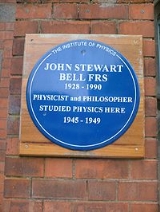
John Stewart Bell

Encyclopedia
John Stewart Bell FRS (28 June 1928 – 1 October 1990) was a British physicist
from Northern Ireland (Ulster), and the originator of Bell's theorem
, a significant theorem in quantum physics
regarding hidden variable theories.
, Northern Ireland
. When he was 11 years old, he decided to be a scientist, and at 16 graduated from Belfast Technical High School. Bell then attended the Queen's University of Belfast
, and obtained a bachelor's degree in experimental physics in 1948, and one in mathematical physics a year later. He went on to complete a Ph.D. in physics at the University of Birmingham
in 1956, specialising in nuclear physics
and quantum field theory
. In 1954 he married Mary Ross, also a physicist, whom he had met while working on accelerator
physics at Malvern, UK.
Bell's career began with the UK Atomic Energy Research Establishment
, near Harwell, Oxfordshire
, known as AERE or Harwell Laboratory. After several years he moved to the European Center for Nuclear Research (CERN
, Conseil Européen pour la Recherche Nucléaire). Here he worked almost exclusively on theoretical particle physics
and on accelerator design, but found time to pursue a major avocation
, investigating the foundations of quantum theory. He was elected a Foreign Honorary Member of the American Academy of Arts and Sciences
in 1987.
, the University of Wisconsin–Madison
and Brandeis University
, he wrote a paper entitled "On the Einstein-Podolsky-Rosen Paradox". In this work, he showed that carrying forward EPR's analysis permits one to derive the famous Bell's theorem
. The resultant inequality, derived from certain assumptions, is violated by quantum theory.
There is some disagreement regarding what Bell's inequality—in conjunction with the EPR analysis—can be said to imply. Bell held that not only local hidden variables, but any and all local theoretical explanations must conflict with the predictions of quantum theory: "It is known that with Bohm's example of EPR correlations, involving particles with spin, there is an irreducible nonlocality
." According to an alternative interpretation, not all local theories in general, but only local hidden variables theories (or "local realist" theories) have shown to be incompatible with the predictions of quantum theory.
Bell was impressed that in the formulation of Bohm’s
nonlocal hidden variable theory, no such boundary is needed, and it was this which sparked his interest in the field of research. Bell also criticized the standard formalism of quantum mechanics on the grounds of lack of physical precision:
But if he were to thoroughly explore the viability of Bohm's theory, Bell needed to answer the challenge of the so-called impossibility proofs against hidden variables. Bell addressed these in a paper entitled "On the Problem of Hidden Variables in Quantum Mechanics". (Bell had actually written this paper before his paper on the EPR paradox, but it did not appear until two years later, in 1966, due to publishing delays.) Here he showed that John von Neumann
’s argument does not prove the impossibility, as it was claimed. The argument fails in this regard due to its reliance on a physical assumption that is not valid for quantum mechanics—namely, that the probability-weighted average of the sum of observable quantities equals the sum of the average values of each of the separate observable quantities. In this same work, Bell showed that a stronger effort at such a proof (based upon Gleason's theorem
) also fails to eliminate the hidden variables program. The flaw in von Neumann's proof had been previously discovered by Grete Hermann
in 1935, but did not become common knowledge until rediscovered by Bell.
that have shown (under the extrapolation to ideal detector efficiencies) a violation of Bell's inequality was conducted. Bell himself concludes from these experiments that "It now seems that the non-locality is deeply rooted in quantum mechanics itself and will persist in any completion." This, according to Bell, also implied that quantum theory is not locally causal and cannot be embedded into any locally causal theory. Bell regretted that results of the tests did not agree with the concept of local hidden variables:
Bell seemed to have become resolved to the notion that future experiments would continue to agree with quantum mechanics and violate his inequality. Referring to the Bell test experiments
, he remarked:
Some people continue to believe that agreement with Bell's inequalities might yet be saved. They argue that in the future much more precise experiments could reveal that one of the known loopholes, for example the so-called "fair sampling loophole", had been biasing the interpretations. Most mainstream physicists are highly skeptical about all these "loopholes", admitting their existence but continuing to believe that Bell's inequalities must fail.
Bell remained interested in objective 'observer-free' quantum mechanics. He felt that at the most fundamental level, physical theories ought not to be concerned with observables, but with 'be-ables': "The http://en.wiktionary.org/wiki/beable beables of the theory are those elements which might correspond to elements of reality, to things which exist. Their existence does not depend on 'observation'." He remained impressed with Bohm's hidden variables as an example of such a scheme and he attacked the more subjective alternatives such as the Copenhagen interpretation
.
 Bell died unexpectedly of a cerebral hemorrhage in Belfast in 1990. Unbeknownst to Bell, that year he had been nominated for a Nobel prize (which is never awarded posthumously). His contribution to the issues raised by EPR was significant. Some regard him as having demonstrated the failure of local realism (local hidden variables). Bell's own interpretation is that locality itself met its demise.
In 2008 a prize named in honor of John Bell was created by the Centre for Quantum Information and Quantum Control at the University of Toronto
. Officially called "The John Stewart Bell Prize for Research on Fundamental Issues in Quantum Mechanics and their Applications," the prize is awarded every other year for significant contributions first published during the six preceding years. The award recognizes major advances relating to the foundations of quantum mechanics
and to the applications of these principles. In 2009 the first award was presented by Alain Aspect
to Professor Nicolas Gisin, University of Geneva
for his theoretical and experimental work on foundations and applications of quantum physics - notably quantum nonlocality
, quantum cryptography
, and quantum teleportation
.
Other work by Bell:
Physicist
A physicist is a scientist who studies or practices physics. Physicists study a wide range of physical phenomena in many branches of physics spanning all length scales: from sub-atomic particles of which all ordinary matter is made to the behavior of the material Universe as a whole...
from Northern Ireland (Ulster), and the originator of Bell's theorem
Bell's theorem
In theoretical physics, Bell's theorem is a no-go theorem, loosely stating that:The theorem has great importance for physics and the philosophy of science, as it implies that quantum physics must necessarily violate either the principle of locality or counterfactual definiteness...
, a significant theorem in quantum physics
Quantum mechanics
Quantum mechanics, also known as quantum physics or quantum theory, is a branch of physics providing a mathematical description of much of the dual particle-like and wave-like behavior and interactions of energy and matter. It departs from classical mechanics primarily at the atomic and subatomic...
regarding hidden variable theories.
Early life and work
John Bell was born in BelfastBelfast
Belfast is the capital of and largest city in Northern Ireland. By population, it is the 14th biggest city in the United Kingdom and second biggest on the island of Ireland . It is the seat of the devolved government and legislative Northern Ireland Assembly...
, Northern Ireland
Northern Ireland
Northern Ireland is one of the four countries of the United Kingdom. Situated in the north-east of the island of Ireland, it shares a border with the Republic of Ireland to the south and west...
. When he was 11 years old, he decided to be a scientist, and at 16 graduated from Belfast Technical High School. Bell then attended the Queen's University of Belfast
Queen's University of Belfast
Queen's University Belfast is a public research university in Belfast, Northern Ireland. The university's official title, per its charter, is the Queen's University of Belfast. It is often referred to simply as Queen's, or by the abbreviation QUB...
, and obtained a bachelor's degree in experimental physics in 1948, and one in mathematical physics a year later. He went on to complete a Ph.D. in physics at the University of Birmingham
University of Birmingham
The University of Birmingham is a British Redbrick university located in the city of Birmingham, England. It received its royal charter in 1900 as a successor to Birmingham Medical School and Mason Science College . Birmingham was the first Redbrick university to gain a charter and thus...
in 1956, specialising in nuclear physics
Nuclear physics
Nuclear physics is the field of physics that studies the building blocks and interactions of atomic nuclei. The most commonly known applications of nuclear physics are nuclear power generation and nuclear weapons technology, but the research has provided application in many fields, including those...
and quantum field theory
Quantum field theory
Quantum field theory provides a theoretical framework for constructing quantum mechanical models of systems classically parametrized by an infinite number of dynamical degrees of freedom, that is, fields and many-body systems. It is the natural and quantitative language of particle physics and...
. In 1954 he married Mary Ross, also a physicist, whom he had met while working on accelerator
Particle accelerator
A particle accelerator is a device that uses electromagnetic fields to propel charged particles to high speeds and to contain them in well-defined beams. An ordinary CRT television set is a simple form of accelerator. There are two basic types: electrostatic and oscillating field accelerators.In...
physics at Malvern, UK.
Bell's career began with the UK Atomic Energy Research Establishment
Atomic Energy Research Establishment
The Atomic Energy Research Establishment near Harwell, Oxfordshire, was the main centre for atomic energy research and development in the United Kingdom from the 1940s to the 1990s.-Founding:...
, near Harwell, Oxfordshire
Harwell, Oxfordshire
Harwell is a village and civil parish in the Vale of White Horse west of Didcot. It was part of Berkshire until the 1974 boundary changes transferred it to Oxfordshire.-Amenities:...
, known as AERE or Harwell Laboratory. After several years he moved to the European Center for Nuclear Research (CERN
CERN
The European Organization for Nuclear Research , known as CERN , is an international organization whose purpose is to operate the world's largest particle physics laboratory, which is situated in the northwest suburbs of Geneva on the Franco–Swiss border...
, Conseil Européen pour la Recherche Nucléaire). Here he worked almost exclusively on theoretical particle physics
Particle physics
Particle physics is a branch of physics that studies the existence and interactions of particles that are the constituents of what is usually referred to as matter or radiation. In current understanding, particles are excitations of quantum fields and interact following their dynamics...
and on accelerator design, but found time to pursue a major avocation
Avocation
An avocation is an activity that one engages in as a hobby outside one's main occupation. There are many examples of people whose professions were the ways that they made their livings, but for whom their activities outside of their workplaces were their true passions in life...
, investigating the foundations of quantum theory. He was elected a Foreign Honorary Member of the American Academy of Arts and Sciences
American Academy of Arts and Sciences
The American Academy of Arts and Sciences is an independent policy research center that conducts multidisciplinary studies of complex and emerging problems. The Academy’s elected members are leaders in the academic disciplines, the arts, business, and public affairs.James Bowdoin, John Adams, and...
in 1987.
Bell's theorem
In 1964, after a year's leave from CERN that he spent at Stanford UniversityStanford University
The Leland Stanford Junior University, commonly referred to as Stanford University or Stanford, is a private research university on an campus located near Palo Alto, California. It is situated in the northwestern Santa Clara Valley on the San Francisco Peninsula, approximately northwest of San...
, the University of Wisconsin–Madison
University of Wisconsin–Madison
The University of Wisconsin–Madison is a public research university located in Madison, Wisconsin, United States. Founded in 1848, UW–Madison is the flagship campus of the University of Wisconsin System. It became a land-grant institution in 1866...
and Brandeis University
Brandeis University
Brandeis University is an American private research university with a liberal arts focus. It is located in the southwestern corner of Waltham, Massachusetts, nine miles west of Boston. The University has an enrollment of approximately 3,200 undergraduate and 2,100 graduate students. In 2011, it...
, he wrote a paper entitled "On the Einstein-Podolsky-Rosen Paradox". In this work, he showed that carrying forward EPR's analysis permits one to derive the famous Bell's theorem
Bell's theorem
In theoretical physics, Bell's theorem is a no-go theorem, loosely stating that:The theorem has great importance for physics and the philosophy of science, as it implies that quantum physics must necessarily violate either the principle of locality or counterfactual definiteness...
. The resultant inequality, derived from certain assumptions, is violated by quantum theory.
There is some disagreement regarding what Bell's inequality—in conjunction with the EPR analysis—can be said to imply. Bell held that not only local hidden variables, but any and all local theoretical explanations must conflict with the predictions of quantum theory: "It is known that with Bohm's example of EPR correlations, involving particles with spin, there is an irreducible nonlocality
Quantum nonlocality
Quantum nonlocality is the phenomenon by which measurements made at a microscopic level necessarily refute one or more notions that are regarded as intuitively true in classical mechanics...
." According to an alternative interpretation, not all local theories in general, but only local hidden variables theories (or "local realist" theories) have shown to be incompatible with the predictions of quantum theory.
Discovery of the flaw in von Neumann's argument
Bell's interest in hidden variables was motivated by the existence in the formalism of quantum mechanics of a "movable boundary" between the quantum system and the classical apparatus:A possibility is that we find exactly where the boundary lies. More plausible to me is that we will find that there is no boundary. ... The wave functions would prove to be a provisional or incomplete description of the quantum-mechanical part, of which an objective account would become possible. It is this possibility, of a homogeneous account of the world, which is for me the chief motivation of the study of the so-called 'hidden variable' possibility.
Bell was impressed that in the formulation of Bohm’s
David Bohm
David Joseph Bohm FRS was an American-born British quantum physicist who contributed to theoretical physics, philosophy, neuropsychology, and the Manhattan Project.-Youth and college:...
nonlocal hidden variable theory, no such boundary is needed, and it was this which sparked his interest in the field of research. Bell also criticized the standard formalism of quantum mechanics on the grounds of lack of physical precision:
For the good books known to me are not much concerned with physical precision. This is clear already from their vocabulary. Here are some words which, however legitimate and necessary in application, have no place in a formulation with any pretension to physical precision: system, apparatus, environment, microscopic, macroscopic, reversible, irreversible, observable, information, measurement. .... On this list of bad words from good books, the worst of all is 'measurement'.
But if he were to thoroughly explore the viability of Bohm's theory, Bell needed to answer the challenge of the so-called impossibility proofs against hidden variables. Bell addressed these in a paper entitled "On the Problem of Hidden Variables in Quantum Mechanics". (Bell had actually written this paper before his paper on the EPR paradox, but it did not appear until two years later, in 1966, due to publishing delays.) Here he showed that John von Neumann
John von Neumann
John von Neumann was a Hungarian-American mathematician and polymath who made major contributions to a vast number of fields, including set theory, functional analysis, quantum mechanics, ergodic theory, geometry, fluid dynamics, economics and game theory, computer science, numerical analysis,...
’s argument does not prove the impossibility, as it was claimed. The argument fails in this regard due to its reliance on a physical assumption that is not valid for quantum mechanics—namely, that the probability-weighted average of the sum of observable quantities equals the sum of the average values of each of the separate observable quantities. In this same work, Bell showed that a stronger effort at such a proof (based upon Gleason's theorem
Gleason's theorem
Gleason's theorem, named after Andrew Gleason, is a mathematical result of particular importance for quantum logic. It proves that the Born rule for the probability of obtaining specific results to a given measurement, follows naturally from the structure formed by the lattice of events in a real...
) also fails to eliminate the hidden variables program. The flaw in von Neumann's proof had been previously discovered by Grete Hermann
Grete Hermann
Grete 'Hermann was a German mathematician and philosopher. She studied mathematics at Göttingen under Emmy Noether, where she achieved her Ph.D. in 1926...
in 1935, but did not become common knowledge until rediscovered by Bell.
Conclusions from experimental tests
In 1972 the first of many experimentsBell test experiments
The Bell test experiments serve to investigate the validity of the entanglement effect in quantum mechanics by using some kind of Bell inequality...
that have shown (under the extrapolation to ideal detector efficiencies) a violation of Bell's inequality was conducted. Bell himself concludes from these experiments that "It now seems that the non-locality is deeply rooted in quantum mechanics itself and will persist in any completion." This, according to Bell, also implied that quantum theory is not locally causal and cannot be embedded into any locally causal theory. Bell regretted that results of the tests did not agree with the concept of local hidden variables:
For me, it is so reasonable to assume that the photons in those experiments carry with them programs, which have been correlated in advance, telling them how to behave. This is so rational that I think that when Einstein saw that, and the others refused to see it, he was the rational man. The other people, although history has justified them, were burying their heads in the sand. ... So for me, it is a pity that Einstein's idea doesn't work. The reasonable thing just doesn't work."
Bell seemed to have become resolved to the notion that future experiments would continue to agree with quantum mechanics and violate his inequality. Referring to the Bell test experiments
Bell test experiments
The Bell test experiments serve to investigate the validity of the entanglement effect in quantum mechanics by using some kind of Bell inequality...
, he remarked:
It is difficult for me to believe that quantum mechanics, working very well for currently practical set-ups, will nevertheless fail badly with improvements in counter efficiency ..."
Some people continue to believe that agreement with Bell's inequalities might yet be saved. They argue that in the future much more precise experiments could reveal that one of the known loopholes, for example the so-called "fair sampling loophole", had been biasing the interpretations. Most mainstream physicists are highly skeptical about all these "loopholes", admitting their existence but continuing to believe that Bell's inequalities must fail.
Bell remained interested in objective 'observer-free' quantum mechanics. He felt that at the most fundamental level, physical theories ought not to be concerned with observables, but with 'be-ables': "The http://en.wiktionary.org/wiki/beable beables of the theory are those elements which might correspond to elements of reality, to things which exist. Their existence does not depend on 'observation'." He remained impressed with Bohm's hidden variables as an example of such a scheme and he attacked the more subjective alternatives such as the Copenhagen interpretation
Copenhagen interpretation
The Copenhagen interpretation is one of the earliest and most commonly taught interpretations of quantum mechanics. It holds that quantum mechanics does not yield a description of an objective reality but deals only with probabilities of observing, or measuring, various aspects of energy quanta,...
.
Death and legacy
In 2008 a prize named in honor of John Bell was created by the Centre for Quantum Information and Quantum Control at the University of Toronto
University of Toronto
The University of Toronto is a public research university in Toronto, Ontario, Canada, situated on the grounds that surround Queen's Park. It was founded by royal charter in 1827 as King's College, the first institution of higher learning in Upper Canada...
. Officially called "The John Stewart Bell Prize for Research on Fundamental Issues in Quantum Mechanics and their Applications," the prize is awarded every other year for significant contributions first published during the six preceding years. The award recognizes major advances relating to the foundations of quantum mechanics
Quantum mechanics
Quantum mechanics, also known as quantum physics or quantum theory, is a branch of physics providing a mathematical description of much of the dual particle-like and wave-like behavior and interactions of energy and matter. It departs from classical mechanics primarily at the atomic and subatomic...
and to the applications of these principles. In 2009 the first award was presented by Alain Aspect
Alain Aspect
Alain Aspect is a French physicist noted for his experimental work on quantum entanglement....
to Professor Nicolas Gisin, University of Geneva
University of Geneva
The University of Geneva is a public research university located in Geneva, Switzerland.It was founded in 1559 by John Calvin, as a theological seminary and law school. It remained focused on theology until the 17th century, when it became a center for Enlightenment scholarship. In 1873, it...
for his theoretical and experimental work on foundations and applications of quantum physics - notably quantum nonlocality
Quantum nonlocality
Quantum nonlocality is the phenomenon by which measurements made at a microscopic level necessarily refute one or more notions that are regarded as intuitively true in classical mechanics...
, quantum cryptography
Quantum cryptography
Quantum key distribution uses quantum mechanics to guarantee secure communication. It enables two parties to produce a shared random secret key known only to them, which can then be used to encrypt and decrypt messages...
, and quantum teleportation
Quantum teleportation
Quantum teleportation, or entanglement-assisted teleportation, is a process by which a qubit can be transmitted exactly from one location to another, without the qubit being transmitted through the intervening space...
.
See also
- EPR paradoxEPR paradoxThe EPR paradox is a topic in quantum physics and the philosophy of science concerning the measurement and description of microscopic systems by the methods of quantum physics...
, a thought experiment by EinsteinAlbert EinsteinAlbert Einstein was a German-born theoretical physicist who developed the theory of general relativity, effecting a revolution in physics. For this achievement, Einstein is often regarded as the father of modern physics and one of the most prolific intellects in human history...
, PodolskyBoris PodolskyBoris Yakovlevich Podolsky , was an American physicist of Russian Jewish descent.-Education:In 1896, Boris Podolsky was born into a poor Jewish family in Taganrog, in what was then the Russian Empire, and he moved to the United States in 1913...
, and RosenNathan RosenNathan Rosen was an American-Israeli physicist noted for his study on the structure of the hydrogen molecule and his work with Albert Einstein and Boris Podolsky on entangled wave functions and the EPR paradox.-Background:Nathan Rosen was born into a Jewish family in Brooklyn, New York...
published in 1935 as an attack on quantum theory - Local hidden variable theoryLocal hidden variable theoryIn quantum mechanics, a local hidden variable theory is one in which distant events are assumed to have no instantaneous effect on local ones....
- Quantum entanglementQuantum entanglementQuantum entanglement occurs when electrons, molecules even as large as "buckyballs", photons, etc., interact physically and then become separated; the type of interaction is such that each resulting member of a pair is properly described by the same quantum mechanical description , which is...
- Bell's theoremBell's theoremIn theoretical physics, Bell's theorem is a no-go theorem, loosely stating that:The theorem has great importance for physics and the philosophy of science, as it implies that quantum physics must necessarily violate either the principle of locality or counterfactual definiteness...
, published in the mid-1960s - Bell stateBell stateThe Bell states are a concept in quantum information science and represent the simplest possible examples of entanglement. They are named after John S. Bell, as they are the subject of his famous Bell inequality. An EPR pair is a pair of qubits which jointly are in a Bell state, that is, entangled...
- Bell test experimentsBell test experimentsThe Bell test experiments serve to investigate the validity of the entanglement effect in quantum mechanics by using some kind of Bell inequality...
- CHSH Bell test, an application of Bell's theorem
- Afshar experimentAfshar experimentThe Afshar experiment is an optical experiment, devised and carried out by Shahriar Afshar in 2001, which investigates the principle of complementarity in quantum mechanics...
- GHZ experimentGHZ experimentGHZ experiments are a class of physics experiments that may be used to generate starkly contrasting predictions from local hidden variable theory and quantum mechanical theory, and permit immediate comparison with actual experimental results. A GHZ experiment is similar to a test of Bell's...
- SuperdeterminismSuperdeterminismIn the context of quantum mechanics, superdeterminism is a term that has been used to describe a hypothetical class of theories which evade Bell's theorem by virtue of being completely deterministic. Bell's theorem depends on the assumption of counterfactual definiteness, which technically does...
Other work by Bell:
- Adler-Bell-Jackiw anomaly
- Bell's spaceship paradoxBell's spaceship paradoxBell's spaceship paradox is a thought experiment in special relativity involving accelerated spaceships and strings. The results of this thought experiment are for many people paradoxical. While J. S. Bell's 1976 version of the paradox is the most widely known, it was first designed by E. Dewan and M...