
All Topics  
EPR paradox


   Email Print
   Bookmark   Link


EPR paradox


In quantum mechanics
Quantum mechanics

Quantum mechanics is a set of principles underlying the most fundamental known description of all physical systems at the microscopic scale . Notable amongst these principles are both a dual wave-like and particle-like behavior of matter and radiation, and prediction of probabilities in situations where classical physics predicts certaintie...
, the EPR paradox (or Einstein–Podolsky–Rosen paradox) is a thought experiment
Thought experiment

A thought experiment , sometimes called a Gedanken experiment, is a proposal for an experiment that would test or illuminate a hypothesis or theory....
 which challenged long-held ideas about the relation between the observed values of physical quantities and the values that can be accounted for by a physical theory. "EPR" stands for Einstein
Albert Einstein

Albert Einstein was a Germany-born theoretical physics. He is best known for his theory of relativity and specifically mass?energy equivalence, expressed by the equation E = mc2....
, Podolsky
Boris Podolsky

Boris Podolsky born in 1896, Taganrog, Russia - died 1966, United States), was a Russia physicist....
, and Rosen
Nathan Rosen

Nathan Rosen Born into a Jewish family was an Israeli physicist.Nathan Rosen attended MIT. In 1935 he became Albert Einstein's assistant at The Institute for Advanced Study in Princeton, New Jersey and continued in that position until 1945....
, who introduced the thought experiment in a 1935 paper to argue that quantum mechanics is not a complete physical theory.

According to its authors the EPR experiment yields a dichotomy
Dichotomy

A dichotomy is any splitting of a whole into exactly two non-overlapping parts.In other words, it is a partition of a set of a whole into two parts that are:...
.


Discussion
Ask a question about 'EPR paradox'
Start a new discussion about 'EPR paradox'
Answer questions from other users
Full Discussion Forum


Encyclopedia


In quantum mechanics
Quantum mechanics

Quantum mechanics is a set of principles underlying the most fundamental known description of all physical systems at the microscopic scale . Notable amongst these principles are both a dual wave-like and particle-like behavior of matter and radiation, and prediction of probabilities in situations where classical physics predicts certaintie...
, the EPR paradox (or Einstein–Podolsky–Rosen paradox) is a thought experiment
Thought experiment

A thought experiment , sometimes called a Gedanken experiment, is a proposal for an experiment that would test or illuminate a hypothesis or theory....
 which challenged long-held ideas about the relation between the observed values of physical quantities and the values that can be accounted for by a physical theory. "EPR" stands for Einstein
Albert Einstein

Albert Einstein was a Germany-born theoretical physics. He is best known for his theory of relativity and specifically mass?energy equivalence, expressed by the equation E = mc2....
, Podolsky
Boris Podolsky

Boris Podolsky born in 1896, Taganrog, Russia - died 1966, United States), was a Russia physicist....
, and Rosen
Nathan Rosen

Nathan Rosen Born into a Jewish family was an Israeli physicist.Nathan Rosen attended MIT. In 1935 he became Albert Einstein's assistant at The Institute for Advanced Study in Princeton, New Jersey and continued in that position until 1945....
, who introduced the thought experiment in a 1935 paper to argue that quantum mechanics is not a complete physical theory.

According to its authors the EPR experiment yields a dichotomy
Dichotomy

A dichotomy is any splitting of a whole into exactly two non-overlapping parts.In other words, it is a partition of a set of a whole into two parts that are:...
. Either
  1. The result of a measurement performed on one part A of a quantum system has a non-local
    Principle of locality

    In physics, the principle of locality states that an object is influenced directly only by its immediate surroundings. Quantum mechanics predicts through Bell's inequality the direct violation of this principle....
     effect on the physical reality of another distant part B, in the sense that quantum mechanics can predict outcomes of some measurements carried out at B; or...
  2. Quantum mechanics is incomplete in the sense that some element of physical reality corresponding to B cannot be accounted for by quantum mechanics (that is, some extra variable is needed to account for it.)
As it was shown later by Bell one cannot introduce the notion of "elements of reality" without affecting the predictions of the theory. That is one cannot complete quantum mechanics with these "elements", because this automatically leads to some logical contradictions (of the type 1=-1).

Einstein never accepted quantum mechanics as a "real" and complete theory, struggling to the end of his life for an interpretation that could comply with relativity without complying with the Heisenberg Uncertainty Principle. As he once said: "God does not play dice", skeptically referring to the Copenhagen Interpretation
Copenhagen interpretation

The Copenhagen interpretation is an Interpretations of quantum mechanics of quantum mechanics. A key feature of quantum mechanics is that the state of every Elementary particle is described by a wavefunction, which is a mathematical representation used to calculate the probability for it to be found in a location, or state of motion....
 of quantum mechanics which says there exists no objective physical reality other than that which is revealed through measurement and observation.

The EPR paradox is a paradox
Physical paradox

A physical paradox is an apparent contradiction in physics of the universe. While many physical paradoxes have accepted resolutions, others defy resolution and may indicate flaws in scientific theory....
 in the following sense: if one adds to quantum mechanics some seemingly reasonable (but actually wrong, or questionable as a whole) conditions (referred to as locality
Principle of locality

In physics, the principle of locality states that an object is influenced directly only by its immediate surroundings. Quantum mechanics predicts through Bell's inequality the direct violation of this principle....
), realism (not to be confused with philosophical realism
Philosophical realism

Contemporary philosophical realism is the belief in a reality that is completely ontologically independent of our conceptual schemes, linguistic practices, beliefs, etc....
, counter factual definiteness, and completeness; see Bell inequality and Bell test experiments
Bell test experiments

The Bell test experiments serve to investigate the validity of the quantum entanglement effect in quantum mechanics by using some kind of Bell inequality....
), then one obtains a contradiction
Contradiction

In classical logic, a contradiction consists of a logical incompatibility between two or more propositions. It occurs when the propositions, taken together, yield two logical consequences which form the logical inversions of each other....
. However, quantum mechanics by itself does not appear to be internally inconsistent, nor — as it turns out — does it contradict relativity. As a result of further theoretical and experimental developments since the original EPR paper, most physicists today regard the EPR paradox as an illustration of how quantum mechanics violates classical
Classical physics

Classical physics is a general term used to describe the branches of physics based on principles developed before the rise of general theory of relativity and Quantum mechanics, usually including special theory of relativity....
 intuitions.

Quantum mechanics and its interpretation


During the twentieth century, quantum theory proved to be a successful theory, which describes the physical reality of the mesoscopic
Mesoscopic scale

In physics and chemistry, the mesoscopic scale refers to the length scale at which one can reasonably discuss the properties of a material or phenomenon without having to discuss the behavior of individual atoms, and concepts of averages such as density and temperature are useful....
 and microscopic world. Up to now, no method has been found to contradict the predictions made by quantum theory. This is remarkable, since measurement accuracy has increased, and the size of the systems under consideration has decreased at a fast pace.

Quantum mechanics was developed with the aim of describing atoms and to explain the observed spectral lines in a measurement apparatus. The fact that quantum theory allows for an accurate description of reality is clear from many physical experiments and has probably never been seriously disputed. Interpretations of quantum phenomena are another story.

The question of how to interpret the mathematical formulation of quantum mechanics has given rise to a variety of different answers
Interpretation of quantum mechanics

An interpretation of quantum mechanics is a statement which attempts to explain how quantum mechanics informs our understanding of nature. Although quantum mechanics has received thorough experimental testing, many of these experiments are open to different interpretations....
 from people of different philosophical backgrounds.

Quantum theory and quantum mechanics do not account for single measurement outcomes in a deterministic way. According to an accepted interpretation of quantum mechanics known as the Copenhagen interpretation
Copenhagen interpretation

The Copenhagen interpretation is an Interpretations of quantum mechanics of quantum mechanics. A key feature of quantum mechanics is that the state of every Elementary particle is described by a wavefunction, which is a mathematical representation used to calculate the probability for it to be found in a location, or state of motion....
, a measurement causes an instantaneous collapse of the wave function describing the quantum system, and the system after the collapse is random.

The most prominent opponent of the Copenhagen interpretation was Albert Einstein. Einstein did not believe in the idea of genuine randomness in nature, the main argument in the Copenhagen interpretation. In his view, quantum mechanics is incomplete and suggests that there had to be 'hidden' variables
Hidden variable theory

Historically, in physics, hidden variable theories were espoused by a minority of physicists who argued that the statistical nature of quantum mechanics indicated that quantum mechanics is "incomplete"....
 responsible for random measurement results.

The famous paper "Can Quantum-Mechanical Description of Physical Reality Be Considered Complete?", authored by Einstein, Podolsky and Rosen in 1935
1935 in science

The year 1935 in science and technology involved some significant events, listed below....
, condensed the philosophical discussion into a physical argument. They claim that given a specific experiment, in which the outcome of a measurement could be known before the measurement takes place, there must exist something in the real world, an "element of reality", which determines the measurement outcome. They postulate that these elements of reality are local
Principle of locality

In physics, the principle of locality states that an object is influenced directly only by its immediate surroundings. Quantum mechanics predicts through Bell's inequality the direct violation of this principle....
, in the sense that they belong to a certain point in spacetime
Spacetime

In physics, spacetime is any mathematical model that combines space and Time in physics into a single continuum . Spacetime is usually interpreted with space being Three-dimensional space and time playing the role of a fourth dimension that is of a different sort than the spatial dimensions....
. This element may only be influenced by events which are located in the backward light cone
Light cone

In special relativity, a light cone is the surface describing the temporal evolution of a flash of light in Minkowski spacetime. This can be visualized in 3-space if the two horizontal axes are chosen to be spatial dimensions, while the vertical axis is time....
 of this point in spacetime. Even though these claims sound reasonable and convincing, they are founded on assumptions about nature which constitute what is now known as local realism.

Though the EPR paper has often been taken as an exact expression of Einstein's views, it was primarily authored by Podolsky, based on discussions at the Institute for Advanced Study
Institute for Advanced Study

The Institute for Advanced Study, located in Princeton, New Jersey, United States, is a center for theoretical research. The Institute is perhaps best known as the academic home of Albert Einstein, John von Neumann, and Kurt G?del, after their immigration to the United States....
 with Einstein and Rosen. Einstein later expressed to Erwin Schrödinger
Erwin Schrödinger

Erwin Rudolf Josef Alexander Schr?dinger was an Austrian theoretical physicist who achieved fame for his contributions to quantum mechanics, especially the Schr?dinger equation, for which he received the Nobel Prize in 1933....
 that "It did not come out as well as I had originally wanted; rather, the essential thing was, so to speak, smothered by the formalism."

Description of the paradox


The EPR paradox draws on a phenomenon predicted by quantum mechanics, known as quantum entanglement
Quantum entanglement

Quantum entanglement is a possible property of a quantum state of a system of two or more Physical bodys in which the quantum states of the constituting objects are linked together so that one object can no longer be adequately described without full mention of its counterpart ? even though the individual objects may be nonlocality....
, to show that measurements performed on spatially separated parts of a quantum system can apparently have an instantaneous influence on one another.

This effect is now known as "nonlocal behavior
Nonlocality

In physics, nonlocality is a direct influence of one object on another, distant object, in violation of the principle of locality.In classical physics, nonlocality in the form of action at a distance appeared in corpuscular theory and later disappeared in Field theory ....
" (or colloquially as "quantum weirdness" or "spooky action at a distance
Action at a distance (physics)

In physics, action at a distance is the interaction of two objects which are separated in space with no known mediator of the interaction. This term was used most often with early theories of gravity and electromagnetism to describe how an object could "know" the mass or charge of another distant object....
"). In order to illustrate this, let us consider a simplified version of the EPR thought experiment put forth by David Bohm
David Bohm

David Joseph Bohm was an United States-born Quantum mechanics physicist who made significant contributions in the fields of theoretical physics, philosophy and neuropsychology, and to the Manhattan Project....
.

Simple version

Before delving into the complicated logic that leads to the 'paradox', it is perhaps worth mentioning the simple version of the argument, as described by Greene
Brian Greene

Brian Greene is a theoretical physicist and one of the best-known Super-string theory. Since 1996 he has been a professor at Columbia University....
 and others, which Einstein used to show that 'hidden variables' must exist.

Two electrons are emitted from a source, by pion
Pion

In particle physics, a pion is any of three subatomic particles: , and . Pions are the lightest mesons and play an important role in explaining low-energy properties of the strong nuclear force....
 decay, so that their spins are opposite; one electron’s spin about any axis is the negative of the other's. Also, due to uncertainty, making a measurement of a particle’s spin about one axis disturbs the particle so you now can’t measure its spin about any other axis.

Now say you measure one electron’s spin about the x-axis. This automatically tells you the other electron’s spin about the x-axis. Since you’ve done the measurement without disturbing the other electron in any way, it can’t be that the other electron "only came to have that state when you measured it", because you didn’t measure it! It must have had that spin all along. Also (although you can’t actually do it now you’ve disturbed the electron), you could have taken the measurement about any other axis. So it follows that the other electron also had a definite spin about any other axis – much more information than the particle is capable of holding, and a "hidden variable" according to EPR.

Measurements on an entangled state


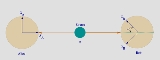
We have a source that emits pairs of electrons, with one electron sent to destination A, where there is an observer named Alice
Alice and Bob

Placeholder names are commonly used for archetypal characters in fields such as cryptography and physics. The names are used for convenience, since explanations such as "Person A wants to send a message to person B" can be difficult to follow in complex systems involving many steps....
, and another sent to destination B, where there is an observer named Bob
Alice and Bob

Placeholder names are commonly used for archetypal characters in fields such as cryptography and physics. The names are used for convenience, since explanations such as "Person A wants to send a message to person B" can be difficult to follow in complex systems involving many steps....
. According to quantum mechanics, we can arrange our source so that each emitted electron pair occupies a quantum state
Quantum state

In quantum physics, a quantum State is a mathematical object that fully describes a Quantum system. One typically imagines some experimental apparatus and procedure which "prepares" this quantum state; the mathematical object then reflects the setup of the apparatus....
 called a spin singlet. This can be viewed as a quantum superposition
Quantum superposition

Quantum superposition is the fundamental law of quantum mechanics. It defines the allowed state space of a quantum mechanical system.In Probability theory, every possible event has a non-negative real number between zero and one associated to it, the probability, which gives the chance that it happens....
 of two states, which we call state I and state II. In state I, electron A has spin
Spin (physics)

In quantum mechanics, spin is a fundamental property of atomic nucleus, hadrons, and elementary particles. For particles with non-zero spin, spin direction is an important intrinsic degrees of freedom ....
 pointing upward along the z-axis (+z) and electron B has spin pointing downward along the z-axis (-z). In state II, electron A has spin -z and electron B has spin +z. Therefore, it is impossible to associate either electron in the spin singlet with a state of definite spin. The electrons are thus said to be entangled
Quantum entanglement

Quantum entanglement is a possible property of a quantum state of a system of two or more Physical bodys in which the quantum states of the constituting objects are linked together so that one object can no longer be adequately described without full mention of its counterpart ? even though the individual objects may be nonlocality....
.

Epr Paradox Illus
Alice now measures the spin along the z-axis. She can obtain one of two possible outcomes: +z or -z. Suppose she gets +z. According to quantum mechanics, the quantum state of the system collapses
Wavefunction collapse

In quantum mechanics, wave function collapse is the process by which a wave function, initially in a Quantum superposition of different eigenstates, appears to reduce to a single one of the states after interaction with the external world....
 into state I. (Different interpretations of quantum mechanics
Interpretation of quantum mechanics

An interpretation of quantum mechanics is a statement which attempts to explain how quantum mechanics informs our understanding of nature. Although quantum mechanics has received thorough experimental testing, many of these experiments are open to different interpretations....
 have different ways of saying this, but the basic result is the same.) The quantum state determines the probable outcomes of any measurement performed on the system. In this case, if Bob subsequently measures spin along the z-axis, he will obtain -z with 100% probability. Similarly, if Alice gets -z, Bob will get +z.

There is, of course, nothing special about our choice of the z-axis. For instance, suppose that Alice and Bob now decide to measure spin along the x-axis, according to quantum mechanics, the spin singlet state may equally well be expressed as a superposition of spin states pointing in the x direction. We'll call these states Ia and IIa. In state Ia, Alice's electron has spin +x and Bob's electron has spin -x. In state IIa, Alice's electron has spin -x and Bob's electron has spin +x. Therefore, if Alice measures +x, the system collapses into Ia, and Bob will get -x. If Alice measures -x, the system collapses into IIa, and Bob will get +x.

In quantum mechanics, the x-spin and z-spin are "incompatible observables", which means that there is a Heisenberg uncertainty principle
Uncertainty principle

In quantum physics, the Werner Heisenberg uncertainty principle states that certain physical quantities, like the position and momentum, cannot both have precise values at the same time....
 operating between them: a quantum state cannot possess a definite value for both variables. Suppose Alice measures the z-spin and obtains +z, so that the quantum state collapses into state I. Now, instead of measuring the z-spin as well, Bob measures the x-spin. According to quantum mechanics, when the system is in state I, Bob's x-spin measurement will have a 50% probability of producing +x and a 50% probability of -x. Furthermore, it is fundamentally impossible to predict which outcome will appear until Bob actually performs the measurement.

Here is the crux of the matter. You might imagine that, when Bob measures the x-spin of his particle, he would get an answer with absolute certainty, since prior to this he hasn't disturbed his electron at all. But, as described above, Bob's electron has a 50% probability of producing +x and a 50% probability of -x - random behaviour, not certain. Bob's electron knows that Alice's electron has been measured, and its z-spin detected, and hence B's z-spin calculated, so its x-spin is 'out of bounds'.

Put another way, how does Bob's electron know, at the same time, which way to point if Alice decides (based on information unavailable to Bob) to measure x (i.e. be the opposite of Alice's electron's spin about the x-axis) and also how to point if Alice measures z (i.e. behave randomly), since it is only supposed to know one thing at a time? Using the usual Copenhagen interpretation rules that say the wave function "collapses" at the time of measurement, there must be action at a distance (entanglement) or the electron must know more than it is supposed to (hidden variables).

In case the explanation above is confusing, here is the paradox summed up;

Two photons are emitted, shoot off and are measured later. Whatever axis their spins are measured along, they are always found to be opposite. This can only be explained if the photons are linked in some way. Either they were created with a definite (opposite) spin about every axis - a "hidden variable" argument - or they are linked so that one electron knows what axis the other is having its spin measured along, and becomes its opposite about that one axis - an "entanglement" argument. Moreover, if the two photons have their spins measured about different axes, once A's spin has been measured about the x-axis (and B's spin about the x-axis deduced), B's spin about the y-axis will no longer be certain, as if it knows that the measurement has taken place. Either that, or it has a definite spin already, which gives it a spin about a second axis - a hidden variable.

Incidentally, although we have used spin as an example, many types of physical quantities — what quantum mechanics refers to as "observables" — can be used to produce quantum entanglement. The original EPR paper used momentum
Momentum

In classical mechanics, momentum is the product of the mass and velocity of an object . For more accurate measures of momentum, see the section Momentum#Modern definitions of momentum on this page....
 for the observable. Experimental realizations of the EPR scenario often use photon polarization
Photon polarization

Photon polarization is the Quantum mechanics description of the Classical physics polarized sinusoidal plane wave electromagnetic wave. Individual photons are completely polarized....
, because polarized photons are easy to prepare and measure.

Reality and completeness


We will now introduce two concepts used by Einstein, Podolsky, and Rosen (EPR), which are crucial to their attack on quantum mechanics: (i) the elements of physical reality and (ii) the completeness of a physical theory.

The authors (EPR) did not directly address the philosophical meaning of an "element of physical reality". Instead, they made the assumption that if the value of any physical quantity of a system can be predicted with absolute certainty prior to performing a measurement or otherwise disturbing it, then that quantity corresponds to an element of physical reality. Note that the converse is not assumed to be true; even if there are some "elements of physical reality" whose value cannot be predicted, this will not affect the argument.

Next, EPR defined a "complete physical theory" as one in which every element of physical reality is accounted for. The aim of their paper was to show, using these two definitions, that quantum mechanics is not a complete physical theory.

Let us see how these concepts apply to the above thought experiment. Suppose Alice decides to measure the value of spin along the z-axis (we'll call this the z-spin.) After Alice performs her measurement, the z-spin of Bob's electron is definitely known, so it is an element of physical reality. Similarly, if Bob decides to measure spin of his electron along the x-axis, the x-spin of Alice's electron becomes an element of physical reality after the measurement. After such measurements, the conclusion that Alice's and Bob's electrons now have definite values of spin along both the X and Z axis simultaneously is inevitable.

We have seen that a quantum state cannot possess a definite value for both x-spin and z-spin. If quantum mechanics is a complete physical theory in the sense given above, x-spin and z-spin cannot be elements of reality at the same time. This means that Alice's decision — whether to perform her measurement along the x- or z-axis — has an instantaneous effect on the elements of physical reality at Bob's location. However, this violates another principle, that of locality.

Locality in the EPR experiment


The principle of locality states that physical processes occurring at one place should have no immediate effect on the elements of reality at another location. At first sight, this appears to be a reasonable assumption to make, as it seems to be a consequence of special relativity
Special relativity

Special relativity is the physical theory of measurement in inertial frames of reference proposed in 1905 by Albert Einstein in the paper "Annus Mirabilis Papers#Special relativity"....
, which states that information
Information

Information as a Conveyed concept has a diversity of meanings, from everyday usage to technical settings. Generally speaking, the concept of information is closely related to notions of constraint, communication, control system, data, form, instruction, knowledge, Meaning , stimulation, pattern, perception, and knowledge representation....
 can never be transmitted faster than the speed of light
Speed of light

The speed of light in an free space is an important physical constant usually written as c, with a value of 299,792,458 metres per second....
 without violating causality
Causality (physics)

Causality describes the relationship between causes and effects, is fundamental to all natural science, especially physics, and has a basis in logic....
. It is generally believed that any theory which violates causality would also be internally inconsistent, and thus deeply unsatisfactory.

It turns out that the usual rules for combining quantum mechanical and classical descriptions violate the principle of locality without violating causality. Causality is preserved because there is no way for Alice to transmit messages (i.e. information) to Bob by manipulating her measurement axis. Whichever axis she uses, she has a 50% probability of obtaining "+" and 50% probability of obtaining "-", completely at random
Randomness

Randomness is a lack of order, purpose, Causality, or predictability. Randomness as defined by Aristotle is the situation, when a choice is to be made which has no logical component by which to determine or make the choice ....
; according to quantum mechanics, it is fundamentally impossible for her to influence what result she gets. Furthermore, Bob is only able to perform his measurement once: there is a fundamental property of quantum mechanics, known as the "no cloning theorem
No cloning theorem

The no cloning theorem is a result of quantum mechanics which forbids the creation of identical copies of an arbitrary unknown quantum state. It was stated by William Wootters, Wojciech Zurek, and Dennis Dieks in 1982, and has profound implications in quantum computer and related fields....
", which makes it impossible for him to make a million copies of the electron he receives, perform a spin measurement on each, and look at the statistical distribution of the results. Therefore, in the one measurement he is allowed to make, there is a 50% probability of getting "+" and 50% of getting "-", regardless of whether or not his axis is aligned with Alice's.

However, the principle of locality appeals powerfully to physical intuition, and Einstein, Podolsky and Rosen were unwilling to abandon it. Einstein derided the quantum mechanical predictions as "spooky action at a distance
Action at a distance (physics)

In physics, action at a distance is the interaction of two objects which are separated in space with no known mediator of the interaction. This term was used most often with early theories of gravity and electromagnetism to describe how an object could "know" the mass or charge of another distant object....
". The conclusion they drew was that quantum mechanics is not a complete theory.

In recent years, however, doubt has been cast on EPR's conclusion due to developments in understanding locality
Principle of locality

In physics, the principle of locality states that an object is influenced directly only by its immediate surroundings. Quantum mechanics predicts through Bell's inequality the direct violation of this principle....
 and especially quantum decoherence
Quantum decoherence

In quantum mechanics, quantum decoherence is the mechanism by which quantum systems interact with their environments to exhibit probabilistically additive behavior....
. The word locality
Principle of locality

In physics, the principle of locality states that an object is influenced directly only by its immediate surroundings. Quantum mechanics predicts through Bell's inequality the direct violation of this principle....
 has several different meanings in physics. For example, in quantum field theory
Quantum field theory

Quantum field theory or QFT provides a theoretical framework for constructing quantum mechanics models of systems classically described by field or of Many-body problem....
 "locality" means that quantum fields at different points of space do not interact with one another. However, quantum field theories that are "local" in this sense appear to violate the principle of locality
Principle of locality

In physics, the principle of locality states that an object is influenced directly only by its immediate surroundings. Quantum mechanics predicts through Bell's inequality the direct violation of this principle....
 as defined by EPR, but they nevertheless do not violate locality in a more general sense. Wavefunction collapse
Wavefunction collapse

In quantum mechanics, wave function collapse is the process by which a wave function, initially in a Quantum superposition of different eigenstates, appears to reduce to a single one of the states after interaction with the external world....
 can be viewed as an epiphenomenon of quantum decoherence
Quantum decoherence

In quantum mechanics, quantum decoherence is the mechanism by which quantum systems interact with their environments to exhibit probabilistically additive behavior....
, which in turn is nothing more than an effect of the underlying local time evolution of the wavefunction of a system and all of its environment. Since the underlying behaviour doesn't violate local causality, it follows that neither does the additional effect of wavefunction collapse, whether real or apparent. Therefore, as outlined in the example above, neither the EPR experiment nor any quantum experiment demonstrates that faster-than-light
Faster-than-light

Faster-than-light Superluminal communication and interstellar travel refer to the propagation of information or matter faster than the speed of light....
 signaling is possible.

Resolving the paradox


Hidden variables


There are several ways to resolve the EPR paradox. The one suggested by EPR is that quantum mechanics, despite its success in a wide variety of experimental scenarios, is actually an incomplete theory. In other words, there is some yet undiscovered theory of nature to which quantum mechanics acts as a kind of statistical approximation (albeit an exceedingly successful one). Unlike quantum mechanics, the more complete theory contains variables corresponding to all the "elements of reality". There must be some unknown mechanism acting on these variables to give rise to the observed effects of "non-commuting quantum observables", i.e. the Heisenberg uncertainty principle. Such a theory is called a hidden variable theory
Hidden variable theory

Historically, in physics, hidden variable theories were espoused by a minority of physicists who argued that the statistical nature of quantum mechanics indicated that quantum mechanics is "incomplete"....
.

To illustrate this idea, we can formulate a very simple hidden variable theory for the above thought experiment. One supposes that the quantum spin-singlet states emitted by the source are actually approximate descriptions for "true" physical states possessing definite values for the z-spin and x-spin. In these "true" states, the electron going to Bob always has spin values opposite to the electron going to Alice, but the values are otherwise completely random. For example, the first pair emitted by the source might be "(+z, -x) to Alice and (-z, +x) to Bob", the next pair "(-z, -x) to Alice and (+z, +x) to Bob", and so forth. Therefore, if Bob's measurement axis is aligned with Alice's, he will necessarily get the opposite of whatever Alice gets; otherwise, he will get "+" and "-" with equal probability.

Assuming we restrict our measurements to the z and x axes, such a hidden variable theory is experimentally indistinguishable from quantum mechanics. In reality, of course, there is an (uncountably) infinite number of axes along which Alice and Bob can perform their measurements, so there has to be an infinite number of independent hidden variables. However, this is not a serious problem; we have formulated a very simplistic hidden variable theory, and a more sophisticated theory might be able to patch it up. It turns out that there is a much more serious challenge to the idea of hidden variables.

Bell's inequality
In 1964, John Bell
John Stewart Bell

John Stewart Bell was a physicist, and the originator of Bell's Theorem, one of the most important theorems in quantum mechanics....
 showed that the predictions of quantum mechanics in the EPR thought experiment are significantly different from the predictions of a very broad class of hidden variable theories (the local hidden variable theories). Roughly speaking, quantum mechanics predicts much stronger statistical correlation
Correlation

In probability theory and statistics, correlation indicates the strength and direction of a linear relationship between two random variables....
s between the measurement results performed on different axes than the hidden variable theories. These differences, expressed using inequality relations
Inequality

In mathematics, an inequality is a statement about the relative size or order of two objects, or about whether they are the same or not *The notation a < b means that a is less than b....
 known as "Bell's inequalities", are in principle experimentally detectable. Later work by Eberhard showed that the key properties of local hidden variable theories that lead to Bell's inequalities are locality
Principle of locality

In physics, the principle of locality states that an object is influenced directly only by its immediate surroundings. Quantum mechanics predicts through Bell's inequality the direct violation of this principle....
 and counter-factual definiteness. Any theory in which these principles hold produces the inequalities. A. Fine subsequently showed that any theory satisfying the inequalities can be modeled by a local hidden variable theory.

After the publication of Bell's paper, a variety of experiments were devised to test Bell's inequalities. (As mentioned above, these experiments generally rely on photon
Photon

In physics, the photon is an elementary particle, the quantum of the electromagnetic field and the basic unit of light and all other forms of electromagnetic radiation....
 polarization
Polarization

Polarization is a property of waves that describes the orientation of their oscillations. For transverse waves such as many electromagnetic waves, it describes the orientation of the oscillations in the plane perpendicular to the wave's direction of travel....
 measurements.) All the experiments conducted to date have found behavior in line with the predictions of standard quantum mechanics.

However, Bell's theorem does not apply to all possible philosophically realist
Philosophical realism

Contemporary philosophical realism is the belief in a reality that is completely ontologically independent of our conceptual schemes, linguistic practices, beliefs, etc....
 theories, although a common misconception touted by new agers is that quantum mechanics is inconsistent with all notions of philosophical realism. Realist interpretations of quantum mechanics are possible, although as discussed above, such interpretations must reject either locality or counter-factual definiteness. Mainstream physics prefers to keep locality while still maintaining a notion of realism that nevertheless rejects counter-factual definiteness. Examples of such mainstream realist interpretations are the consistent histories
Consistent histories

In quantum mechanics, the consistent histories approach is intended to give a modern interpretation of quantum mechanics, generalising the conventional Copenhagen interpretation and providing a natural interpretation of quantum cosmology....
 interpretation and the transactional interpretation
Transactional interpretation

The transactional interpretation of quantum mechanics describes quantum interactions in terms of a standing wave formed by retarded and advanced waves....
. Fine's work showed that taking locality as a given there exist scenarios in which two statistical variables are correlated in a manner inconsistent with counter-factual definiteness and that such scenarios are no more mysterious than any other despite the inconsistency with counter-factual definiteness seeming 'counter-intuitive'. Violation of locality however is difficult to reconcile with special relativity
Special relativity

Special relativity is the physical theory of measurement in inertial frames of reference proposed in 1905 by Albert Einstein in the paper "Annus Mirabilis Papers#Special relativity"....
 and is thought to be incompatible with the principle of causality. On the other hand the Bohm interpretation
Bohm interpretation

The Bohm or Bohmian interpretation of quantum mechanics, which Bohm called the causal, or later, the ontological interpretation, is an interpretation of quantum mechanics postulated by David Bohm in 1952 as an alternative to the standard Copenhagen interpretation....
 of quantum mechanics instead keeps counter-factual definiteness while introducing a conjectured non-local mechanism called the 'quantum potential'. Some workers in the field have also attempted to formulate hidden variable theories that exploit loopholes in actual experiments, such as the assumptions made in interpreting experimental data although no such theory has been produced that can reproduce all the results of quantum mechanics.

There are also individual EPR-like experiments that have no local hidden variables explanation. Examples have been suggested by David Bohm
David Bohm

David Joseph Bohm was an United States-born Quantum mechanics physicist who made significant contributions in the fields of theoretical physics, philosophy and neuropsychology, and to the Manhattan Project....
 and by Lucien Hardy.

"Acceptable theories", and the experiment

According to the present view of the situation, quantum mechanics simply contradicts Einstein's philosophical postulate that any acceptable physical theory should fulfill "local realism".

In the EPR paper (1935) the authors realized that quantum mechanics was non-acceptable in the sense of their above-mentioned assumptions, and Einstein thought erroneously that it could simply be augmented by 'hidden variables', without any further change, to get an acceptable theory. He pursued these ideas until the end of his life (1955), i.e. over twenty years.

In contrast, John Bell
John Stewart Bell

John Stewart Bell was a physicist, and the originator of Bell's Theorem, one of the most important theorems in quantum mechanics....
, in his 1964 paper, showed "once and for all" that quantum mechanics and Einstein's assumptions lead to different results, different by a factor of , for certain correlations. So the issue of "acceptability", up to this time mainly concerning theory (even philosophy), finally became experimentally decidable.

There are many Bell test experiments
Bell test experiments

The Bell test experiments serve to investigate the validity of the quantum entanglement effect in quantum mechanics by using some kind of Bell inequality....
 hitherto, e.g. those of Alain Aspect
Alain Aspect

Alain Aspect is a France physicist and alumnus of the ?cole Normale Sup?rieure de Cachan in France. In the early 1980s, with collaborators in France, he performed the crucial "Bell test experiments" that showed that Albert Einstein, Boris Podolsky and Nathan Rosen's reductio ad absurdum of quantum mechanics, namely that it implied 'ghost...
 and others. They all show that pure quantum mechanics, and not Einstein's "local realism", is acceptable. Thus, according to Karl Popper
Karl Popper

Knight Bachelor Karl Raimund Popper Order of the Companions of Honour, Fellow of the Royal Society, Fellow of the British Academy was an Austrian and British philosopher and a professor at the London School of Economics....
 these experiments falsify Einstein's philosophical assumptions, especially the ideas on "hidden variables", whereas quantum mechanics itself remains a good candidate for a theory, which is acceptable in a wider context.

But apparently an experiment, which would also classify Bohm's non-local quasi-classical theory as non-acceptable, is still lacking.

Implications for quantum mechanics


Most physicists today believe that quantum mechanics is correct, and that the EPR paradox is a "paradox" only because classical intuitions do not correspond to physical reality. How EPR is interpreted regarding locality depends on the interpretation of quantum mechanics
Interpretation of quantum mechanics

An interpretation of quantum mechanics is a statement which attempts to explain how quantum mechanics informs our understanding of nature. Although quantum mechanics has received thorough experimental testing, many of these experiments are open to different interpretations....
 one uses. In the Copenhagen interpretation
Copenhagen interpretation

The Copenhagen interpretation is an Interpretations of quantum mechanics of quantum mechanics. A key feature of quantum mechanics is that the state of every Elementary particle is described by a wavefunction, which is a mathematical representation used to calculate the probability for it to be found in a location, or state of motion....
, it is usually understood that instantaneous wavefunction collapse does occur. However, the view that there is no causal instantaneous effect has also been proposed within the Copenhagen interpretation: in this alternate view, measurement affects our ability to define (and measure) quantities in the physical system, not the system itself. In the many-worlds interpretation
Many-worlds interpretation

The many-worlds interpretation is an interpretation of quantum mechanics.It is also known as MWI, the relative state formulation, theory of the universal wavefunction, parallel universes, many-universes interpretation or just many worlds....
, a kind of locality is preserved, since the effects of irreversible operations such as measurement arise from the relativization of a global state to a subsystem such as that of an observer.

The EPR paradox has deepened our understanding of quantum mechanics by exposing the fundamentally non-classical characteristics of the measurement process. Prior to the publication of the EPR paper, a measurement was often visualized as a physical disturbance inflicted directly upon the measured system. For instance, when measuring the position of an electron, one imagines shining a light on it, thus disturbing the electron and producing the quantum mechanical uncertainties in its position. Such explanations, which are still encountered in popular expositions of quantum mechanics, are debunked by the EPR paradox, which shows that a "measurement" can be performed on a particle without disturbing it directly, by performing a measurement on a distant entangled particle.

Technologies relying on quantum entanglement are now being developed. In quantum cryptography
Quantum cryptography

Quantum cryptography, or quantum key distribution , uses quantum mechanics to guarantee secure communication. It enables two parties to produce a shared random bit string known only to them, which can be used as a key to encrypt and decrypt messages....
, entangled particles are used to transmit signals that cannot be eavesdropped
Eavesdropping

Eavesdropping is the act of surreptitiously listening to a private conversation. This is commonly thought to be unethical and there is an old adage that eavesdroppers seldom hear anything good of themselves....
 upon without leaving a trace. In quantum computation, entangled quantum states are used to perform computations in parallel
Parallel computing

Parallel computing is a form of computing in which many calculations are carried out simultaneously, operating on the principle that large problems can often be divided into smaller ones, which are then solved Concurrency ....
, which may allow certain calculations to be performed much more quickly than they ever could be with classical computers.

Mathematical formulation


The above discussion can be expressed mathematically using the quantum mechanical formulation of spin
Spin (physics)

In quantum mechanics, spin is a fundamental property of atomic nucleus, hadrons, and elementary particles. For particles with non-zero spin, spin direction is an important intrinsic degrees of freedom ....
. The spin degree of freedom for an electron is associated with a two-dimensional Hilbert space
Hilbert space

The mathematics concept of a Hilbert space, named after David Hilbert, generalizes the notion of Euclidean space. It extends the methods of vector algebra from the two-dimensional plane and three-dimensional space to infinite-dimensional spaces....
 H, with each quantum state corresponding to a vector in that space. The operators corresponding to the spin along the x, y, and z direction, denoted Sx, Sy, and Sz respectively, can be represented using the Pauli matrices
Pauli matrices

The Pauli matrices are a set of 2 × 2 complex number Hermitian matrix and Unitary matrix matrix Usually indicated by the Greek letter 'sigma' , they are occasionally denoted with a 'tau' when used in connection with isospin symmetries....
:

where stands for Planck's constant divided by 2p.

The eigenstates of Sz are represented as

With qubit
Qubit

A quantum bit or qubit is a unit of quantum information. That information is described by a Quantum state in a Two-state quantum system, which is formally equivalent to a two-dimensional vector space over the complex numbers....
s it looks:


and the eigenstates of Sx are represented as

With qubit
Qubit

A quantum bit or qubit is a unit of quantum information. That information is described by a Quantum state in a Two-state quantum system, which is formally equivalent to a two-dimensional vector space over the complex numbers....
s it looks:


The Hilbert space of the electron pair is , the tensor product
Tensor product

In mathematics, the tensor product, denoted by , may be applied in different contexts to vector spaces, matrix , tensors, vector spaces, algebra over a field, topological vector spaces, and module s....
 of the two electrons' Hilbert spaces. The spin singlet state is

With qubits it looks:


where the two terms on the right hand side are what we have referred to as state I and state II above. This is also commonly written as

With qubits it looks:


From the above equations, it can be shown that the spin singlet can also be written as

With qubits it looks:


where the terms on the right hand side are what we have referred to as state Ia and state IIa.

To illustrate how this leads to the violation of local realism, we need to show that after Alice's measurement of Sz (or Sx), Bob's value of Sz (or Sx) is uniquely determined, and therefore corresponds to an "element of physical reality". This follows from the principles of measurement in quantum mechanics
Measurement in quantum mechanics

The framework of quantum mechanics requires a careful definition of measurement, and a thorough discussion of its practical and philosophical implications....
. When Sz is measured, the system state ? collapses into an eigenvector of Sz. If the measurement result is +z, this means that immediately after measurement the system state undergoes an orthogonal projection of ? onto the space of states of the form

With qubits it looks:


For the spin singlet, the new state is

With qubits it looks:


Similarly, if Alice's measurement result is -z, a system undergoes an orthogonal projection onto

With qubits it looks:


which means that the new state is

With qubits it looks:


This implies that the measurement for Sz for Bob's electron is now determined. It will be -z in the first case or +z in the second case.

It remains only to show that Sx and Sz cannot simultaneously possess definite values in quantum mechanics. One may show in a straightforward manner that no possible vector can be an eigenvector of both matrices. More generally, one may use the fact that the operators do not commute,

along with the Heisenberg uncertainty relation

See also

  • Bell test experiments
    Bell test experiments

    The Bell test experiments serve to investigate the validity of the quantum entanglement effect in quantum mechanics by using some kind of Bell inequality....
  • Bell state
    Bell state

    The Bell states are a concept in quantum information science and represent the simplest possible examples of Quantum entanglement. They are named after John S....
  • Bell's theorem
    Bell's theorem

    Bell's theorem is a theorem that shows that the predictions of quantum mechanics are counter intuitive, touching upon several fundamental philosophical issues related to modern physics....
  • CHSH Bell test
  • Coherence (physics)
    Coherence (physics)

    In physics, coherence is a property of waves, that enables stationary interference. More generally, coherence describes all correlation properties between physical quantities of a wave....
  • Counter-factual definiteness
  • Ghirardi-Rimini-Weber theory
    Ghirardi-Rimini-Weber theory

    The Ghirardi-Rimini-Weber theory, or GRW, is a Objective collapse theory in quantum mechanics. GRW differs from other collapse theories by proposing that wave function collapse happens spontaneously....
  • GHZ experiment
    GHZ experiment

    GHZ experiments are a class of experiments which arise in quantum mechanics, in discussion and experimental determination of whether local hidden variables are required for, or even compatible with, the representation of experimental results; and with particular relevance to the EPR paradox....
  • Interpretation of quantum mechanics
    Interpretation of quantum mechanics

    An interpretation of quantum mechanics is a statement which attempts to explain how quantum mechanics informs our understanding of nature. Although quantum mechanics has received thorough experimental testing, many of these experiments are open to different interpretations....
  • Local hidden variable theory
    Local hidden variable theory

    In quantum mechanics, a local hidden variable theory is one in which distant events are assumed to have no instantaneous effect on local ones....
  • Many-worlds interpretation
    Many-worlds interpretation

    The many-worlds interpretation is an interpretation of quantum mechanics.It is also known as MWI, the relative state formulation, theory of the universal wavefunction, parallel universes, many-universes interpretation or just many worlds....
  • Measurement in quantum mechanics
    Measurement in quantum mechanics

    The framework of quantum mechanics requires a careful definition of measurement, and a thorough discussion of its practical and philosophical implications....
  • Measurement problem
    Measurement problem

    The measurement problem in quantum mechanics is the unresolved problem of how wavefunction collapse occurs. The inability to observe this process directly has given rise to different interpretations of quantum mechanics, and poses a key set of questions that each interpretation must answer....
  • Penrose interpretation
    Penrose interpretation

    The Penrose interpretation is a prediction of Sir Roger Penrose about the mass scale at which standard quantum mechanics will fail. This idea is inspired by quantum gravity, because it uses both the physical constants and Gravitational Constant....


  • Philosophy of information
    Philosophy of information

    The philosophy of information is the area of research that studies conceptual issues arising at the intersection of computer science, information technology, and philosophy....
  • Philosophy of physics
    Philosophy of physics

    In philosophy, the philosophy of physics studies the fundamental philosophy questions underlying modern physics, the study of matter and energy and how they interaction....
  • Pondicherry interpretation
    Pondicherry interpretation

    The Pondicherry interpretation of quantum mechanics was developed by Ulrich Mohrhoff, who teaches at the Sri Aurobindo International Centre of Education in Pondicherry , India....
  • Popper's experiment
    Popper's experiment

    Popper's experiment is an experiment proposed by the 20th century philosopher of science Karl Popper, to test the standard interpretation of Quantum mechanics....
  • Quantum decoherence
    Quantum decoherence

    In quantum mechanics, quantum decoherence is the mechanism by which quantum systems interact with their environments to exhibit probabilistically additive behavior....
  • Quantum entanglement
    Quantum entanglement

    Quantum entanglement is a possible property of a quantum state of a system of two or more Physical bodys in which the quantum states of the constituting objects are linked together so that one object can no longer be adequately described without full mention of its counterpart ? even though the individual objects may be nonlocality....
  • Quantum gravity
    Quantum gravity

    Quantum gravity is the field of theoretical physics attempting to unify quantum mechanics, which describes three of the Fundamental interaction , with general relativity, the theory of the fourth fundamental force: Gravitation....
  • Quantum information
    Quantum information

    In quantum mechanics, quantum information is physical information that is held in the "state" of a quantum system. The most popular unit of quantum information is the qubit, a two-level quantum system....
  • Quantum pseudo-telepathy
    Quantum pseudo-telepathy

    Quantum pseudo-telepathy is a phenomenon in quantum game theory resulting in anomalously high success rates in coordination games between separated players....
  • Quantum teleportation
    Quantum teleportation

    Quantum teleportation, or entanglement-assisted teleportation, is a technique used to transfer Physical information on a quantum level, usually from one Elementary particle to another particle in another location via quantum entanglement....
  • Quantum Zeno effect
    Quantum Zeno effect

    The quantum Zeno effect is a name coined by George Sudarshan and Baidyanaith Misra of the University of Texas at Austin in 1977 in their analysis of the situation in which an unstable particle, if observed continuously, will never decay....
  • Sakurai's Bell inequality
    Sakurai's Bell inequality

    The intention of a "Bell inequality" is to serve as a test of local realism or local Hidden variable theory as against quantum mechanics, applying Bell's theorem, which shows them to be incompatible....
  • Synchronicity
    Synchronicity

    Synchronicity is the experience of two or more Event which are Causality occurring together in a supposedly Meaning manner. In order to count as synchronicity, the events should be unlikely to occur together by chance....
  • Wave function collapse


Selected papers


  • A. Aspect, Bell's inequality test: more ideal than ever, Nature 398 189 (1999).
  • J.S. Bell, , Physics 1 195 (1964).
  • J.S. Bell, Bertlmann's Socks and the Nature of Reality. Journal de Physique 42 (1981).
  • N. Bohr, Can quantum-mechanical description of physical reality be considered complete?, Phys. Rev. 48, 696 (1935)
  • P.H. Eberhard, Bell's theorem without hidden variables. Nuovo Cimento 38B1 75 (1977).
  • P.H. Eberhard, Bell's theorem and the different concepts of locality. Nuovo Cimento 46B 392 (1978).
  • A. Einstein, B. Podolsky, and N. Rosen, Phys. Rev. 47 777 (1935).


  • A. Fine, Hidden Variables, Joint Probability, and the Bell Inequalities. Phys. Rev. Lett. 48, 291 (1982).
  • A. Fine, Do Correlations need to be explained?, in Philosophical Consequences of Quantum Theory: Reflections on Bell's Theorem, edited by Cushing & McMullin (University of Notre Dame Press, 1986).
  • L. Hardy, Nonlocality for two particles without inequalities for almost all entangled states. Phys. Rev. Lett. 71 1665 (1993).
  • M. Mizuki, A classical interpretation of Bell's inequality. Annales de la Fondation Louis de Broglie 26 683 (2001).
  • P. Pluch, "Theory for Quantum Probability", PhD Thesis University of Klagenfurt (2006)
  • M. A. Rowe, D. Kielpinski, V. Meyer, C. A. Sackett, W. M. Itano, C. Monroe and D. J. Wineland, Experimental violation of a Bell's inequality with efficient detection, Nature 409, 791-794 (15 February 2001).
  • M. Smerlak, C. Rovelli, Relational EPR


Books


  • J.S. Bell, Speakable and Unspeakable in Quantum Mechanics (Cambridge University Press, 1987). ISBN 0-521-36869-3
  • J.J. Sakurai, Modern Quantum Mechanics (Addison-Wesley, 1994), pp. 174-187, 223-232. ISBN 0-201-53929-2
  • F. Selleri, Quantum Mechanics Versus Local Realism: The Einstein-Podolsky-Rosen Paradox (Plenum Press, New York, 1988) ISBN 0-306-42739-7
  • Roger Penrose
    Roger Penrose

    Sir Roger Penrose, Order of Merit , Royal Society is an English mathematical physicist and Emeritus Rouse Ball Professor of Mathematics at the Mathematical Institute, University of Oxford and Emeritus Fellow of Wadham College....
    , The Road to Reality
    The Road to Reality: A Complete Guide to the Laws of the Universe

    The Road to Reality is a book on modern physics by the British mathematical physicist Roger Penrose, published in 2004. It covers the basics of the standard model of modern physics, discussing general relativity and quantum mechanics and then expands on the possible unification of these two theories....
     (Alfred A. Knopf, 2005; Vintage Books, 2006 )


External links

  • A. Fine,
  • Abner Shimony, (2004)
  • From the Usenet Physics FAQ.