


Jewish Quarter

Encyclopedia
The Jewish Quarter is one of the four traditional quarters of the Old City of Jerusalem. The 116,000 square meter area lies in the southeastern sector of the walled city, and stretches from the Zion Gate in the south, along the Armenian Quarter
on the west, up to the Street of the Chain in the north and extends to the Western Wall
and the Temple Mount
in the east.
The quarter is inhabited by around 2,000 residents and is home to numerous yeshiva
s and synagogues, most notably the Hurva Synagogue
. After being built in 1701, destroyed, rebuilt in 1864, and destroyed in 1948, the Hurva was once again rebuilt, rededicated in 2010.
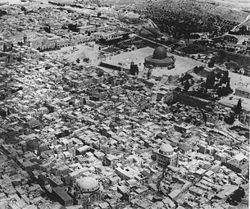 The quarter has had a rich history, with a nearly continual Jewish presence since the eighth century BCE. When, in CE 135, the Roman Emperor Hadrian
built the city of Aelia Capitolina
on the ruins of ancient Jerusalem, the Tenth Legion had their camp on the land that is now the Jewish Quarter. At the turn of the 20th century the Jewish population of the quarter reached 19,000. At no time was its population purely and homogenously Jewish - such a rule being neither desired by the Jewish inhabitants nor enforced by the Ottoman or British rulers; in fact, there had always been a considerable non-Jewish population living among its Jews. Almost all the properties in the Quarter were rented by their occupants from Muslim endowments (Waqf
s), which owned them. This is one of the reasons for the growth of buildings West of the city in the last years of the Ottoman Empire since land outside the city was freehold (mulk) and easier to acquire.
An Arabic inscription dating back to the 10th century CE from the Abbasid Caliphate has been found in the Jewish Quarter.
, its population of about 2,000 Jews was besieged, and forced to leave en masse. Colonel Abdullah el Tell
, local commander of the Jordanian Arab Legion
, with whom Mordechai Weingarten
negotiated the surrender terms, described the destruction of the Jewish Quarter, in his Memoirs (Cairo, 1959):
The Jordanian commander who led the operation is reported to have told his superiors: "For the first time in 1,000 years not a single Jew remains in the Jewish Quarter. Not a single building remains intact. This makes the Jews' return here impossible." The Hurva Synagogue
, originally built in 1701, was blown up by the Jordanian Arab Legion.
In the 1960s, American town planners, together with the Jordanian authorities, had planned that the quarter be transformed into a park. During the nineteen year Arab administration, a third of the Jewish Quarter's buildings had been demolished by the Jordanians. All but one of the fifty-three Jewish houses of worship that graced the Old City were destroyed. The synagogues were razed or pillaged and stripped and their interiors used as hen-houses or stables.
until the Six-Day War
of 1967. During the first week after taking the Quarter in June 1967, the Israeli army destroyed the Mughrabi Quarter
beside the Western Wall. These buildings dated from the reign of Afdal ed-Din, (1186–1196). Between 600 and 1,000 people were evicted; 135 houses and two mosques (al-Buraq and al-Afdaliya) were destroyed.
ordered that the Arab residents not be forcefully evacuated from the area. With Menachem Begin
's rise to power in 1977, he decided that 25 Arab families be allowed to remain in the Jewish Quarter as a gesture of good will, while the rest of the families who had not fled during the Six-Day War were offered compensation in return for their evacuation, although most declined. The quarter was rebuilt in keeping with the traditional standards of the dense urban fabric of the Old City. Residents of the quarter hold long-term leaseholds, leased from the Israel Lands Administration. As of 2004 the quarter's population stood at 2,348 and many large educational institutions have taken up residence.
Before being rebuilt, the quarter was carefully excavated under the supervision of Hebrew University archaeologist Nahman Avigad
. The archaeological remains, on display in a series of museums and outdoor parks to visit which tourists descend two or three stories beneath the level of the current city, collectively form one of the world's most accessible archaeological sites.
that once contained the Temple of Jerusalem and today is home to the Dome of the Rock
and Al-Aqsa Mosque
. It consists of huge ashlar
blocks that have been in place for two millennia. It is a major site for pilgrimage
for Jewish people from all over the world, and is also a major tourist attraction for people of all faiths. Visitors insert handwritten prayers into the interstices between the stones. Numerous worshipers continually read the entire book of Psalms
in front of the wall. Bar Mitzvahs are joyfully celebrated here.
Next to the Wall is a huge plaza, covering a substantial portion of the Jewish Quarter (see map above), allowing worshippers and visitors a good view of the Wall and access to it. The plaza has no artworks or monuments.
Armenian Quarter
The Armenian Quarter is one of the four quarters of the Old City of Jerusalem. The Armenian Quarter is the smallest of the four quarters, with the smallest number of residents....
on the west, up to the Street of the Chain in the north and extends to the Western Wall
Western Wall
The Western Wall, Wailing Wall or Kotel is located in the Old City of Jerusalem at the foot of the western side of the Temple Mount...
and the Temple Mount
Temple Mount
The Temple Mount, known in Hebrew as , and in Arabic as the Haram Ash-Sharif , is one of the most important religious sites in the Old City of Jerusalem. It has been used as a religious site for thousands of years...
in the east.
The quarter is inhabited by around 2,000 residents and is home to numerous yeshiva
Yeshiva
Yeshiva is a Jewish educational institution that focuses on the study of traditional religious texts, primarily the Talmud and Torah study. Study is usually done through daily shiurim and in study pairs called chavrutas...
s and synagogues, most notably the Hurva Synagogue
Hurva Synagogue
The Hurva Synagogue, , also known as Hurvat Rabbi Yehudah he-Hasid , is a historic synagogue located in the Jewish Quarter of the Old City of Jerusalem....
. After being built in 1701, destroyed, rebuilt in 1864, and destroyed in 1948, the Hurva was once again rebuilt, rededicated in 2010.
History
Hadrian
Hadrian , was Roman Emperor from 117 to 138. He is best known for building Hadrian's Wall, which marked the northern limit of Roman Britain. In Rome, he re-built the Pantheon and constructed the Temple of Venus and Roma. In addition to being emperor, Hadrian was a humanist and was philhellene in...
built the city of Aelia Capitolina
Aelia Capitolina
Aelia Capitolina was a city built by the emperor Hadrian, and occupied by a Roman colony, on the site of Jerusalem, which was in ruins since 70 AD, leading in part to the Bar Kokhba revolt of 132–136.-Politics:...
on the ruins of ancient Jerusalem, the Tenth Legion had their camp on the land that is now the Jewish Quarter. At the turn of the 20th century the Jewish population of the quarter reached 19,000. At no time was its population purely and homogenously Jewish - such a rule being neither desired by the Jewish inhabitants nor enforced by the Ottoman or British rulers; in fact, there had always been a considerable non-Jewish population living among its Jews. Almost all the properties in the Quarter were rented by their occupants from Muslim endowments (Waqf
Waqf
A waqf also spelled wakf formally known as wakf-alal-aulad is an inalienable religious endowment in Islamic law, typically denoting a building or plot of land for Muslim religious or charitable purposes. The donated assets are held by a charitable trust...
s), which owned them. This is one of the reasons for the growth of buildings West of the city in the last years of the Ottoman Empire since land outside the city was freehold (mulk) and easier to acquire.
An Arabic inscription dating back to the 10th century CE from the Abbasid Caliphate has been found in the Jewish Quarter.
1948 war
In 1948 during the Arab-Israeli War1948 Arab-Israeli War
The 1948 Arab–Israeli War, known to Israelis as the War of Independence or War of Liberation The war commenced after the termination of the British Mandate for Palestine and the creation of an independent Israel at midnight on 14 May 1948 when, following a period of civil war, Arab armies invaded...
, its population of about 2,000 Jews was besieged, and forced to leave en masse. Colonel Abdullah el Tell
Abdullah el Tell
Abdullah el-Tell, served in the Transjordanian Arab Legion during the 1948 war in Palestine rising from the rank of company commander to become Military Governor of the Old City of Jerusalem...
, local commander of the Jordanian Arab Legion
Arab Legion
The Arab Legion was the regular army of Transjordan and then Jordan in the early part of the 20th century.-Creation:...
, with whom Mordechai Weingarten
Mordechai Weingarten
Mordechai Weingarten was a Jewish community leader in Jerusalem during the British Mandate.Mordechai Weingarten, a long-time resident of the Old City of Jerusalem, was the mukhtar of the Jewish Quarter from 1935 to 1948. His family had lived in the courtyard of the Or HaChaim synagogue, on the way...
negotiated the surrender terms, described the destruction of the Jewish Quarter, in his Memoirs (Cairo, 1959):
The Jordanian commander who led the operation is reported to have told his superiors: "For the first time in 1,000 years not a single Jew remains in the Jewish Quarter. Not a single building remains intact. This makes the Jews' return here impossible." The Hurva Synagogue
Hurva Synagogue
The Hurva Synagogue, , also known as Hurvat Rabbi Yehudah he-Hasid , is a historic synagogue located in the Jewish Quarter of the Old City of Jerusalem....
, originally built in 1701, was blown up by the Jordanian Arab Legion.
In the 1960s, American town planners, together with the Jordanian authorities, had planned that the quarter be transformed into a park. During the nineteen year Arab administration, a third of the Jewish Quarter's buildings had been demolished by the Jordanians. All but one of the fifty-three Jewish houses of worship that graced the Old City were destroyed. The synagogues were razed or pillaged and stripped and their interiors used as hen-houses or stables.
1967 war
The quarter remained under Jordanian ruleRule of the West Bank and East Jerusalem by Jordan
The West Bank and East Jerusalem were occupied by Jordan for a period of nearly two decades starting from the 1948 Arab-Israeli War. In 1950, the British extended formal recognition to the union between the Hashemite Kingdom and of that part of Palestine under Jordanian occupation and control -...
until the Six-Day War
Six-Day War
The Six-Day War , also known as the June War, 1967 Arab-Israeli War, or Third Arab-Israeli War, was fought between June 5 and 10, 1967, by Israel and the neighboring states of Egypt , Jordan, and Syria...
of 1967. During the first week after taking the Quarter in June 1967, the Israeli army destroyed the Mughrabi Quarter
Moroccan Quarter
The Moroccan Quarter or Mughrabi Quarter was an 800-year old neighborhood in the southeast corner of the Old City of Jerusalem, bordering on the western wall of the Temple Mount on the east , the Old City walls on the south , the Jewish Quarter to the west, and the Muslim Quarter to...
beside the Western Wall. These buildings dated from the reign of Afdal ed-Din, (1186–1196). Between 600 and 1,000 people were evicted; 135 houses and two mosques (al-Buraq and al-Afdaliya) were destroyed.
Post-war developments
In April 1968 Pinhas Sapir, Israel's Minister of Finance, signed an order confiscating 129 dunams (about 32 acres) of land which had made up the Quarter before 1948. As a result, 6,000 residents were evicted from 1,048 apartments, and 437 shops and workshops employing 700 workers were closed. In 1969 the Jewish Quarter Development Company was established under the auspices of the Construction and Housing Ministry to rebuild the desolate Jewish Quarter. At this stage the Arab population of the Quarter reached approximately 1,000, most of whom were refugees who had appropriated the vacated Jewish houses in 1949. Although many had originally fled the Quarter in 1967, they later returned after Levi EshkolLevi Eshkol
' served as the third Prime Minister of Israel from 1963 until his death from a heart attack in 1969. He was the first Israeli Prime Minister to die in office.-Biography:...
ordered that the Arab residents not be forcefully evacuated from the area. With Menachem Begin
Menachem Begin
' was a politician, founder of Likud and the sixth Prime Minister of the State of Israel. Before independence, he was the leader of the Zionist militant group Irgun, the Revisionist breakaway from the larger Jewish paramilitary organization Haganah. He proclaimed a revolt, on 1 February 1944,...
's rise to power in 1977, he decided that 25 Arab families be allowed to remain in the Jewish Quarter as a gesture of good will, while the rest of the families who had not fled during the Six-Day War were offered compensation in return for their evacuation, although most declined. The quarter was rebuilt in keeping with the traditional standards of the dense urban fabric of the Old City. Residents of the quarter hold long-term leaseholds, leased from the Israel Lands Administration. As of 2004 the quarter's population stood at 2,348 and many large educational institutions have taken up residence.
Before being rebuilt, the quarter was carefully excavated under the supervision of Hebrew University archaeologist Nahman Avigad
Nahman Avigad
Dr. Nahman Avigad , born in Zawalow, Galicia , was an Israeli archaeologist.-Biography:...
. The archaeological remains, on display in a series of museums and outdoor parks to visit which tourists descend two or three stories beneath the level of the current city, collectively form one of the world's most accessible archaeological sites.
The Quarter today
The most famous site of the Jewish Quarter is The Western Wall, a portion of the massive retaining wall built by King Herod in the 1st century BCE, expanding the Temple MountTemple Mount
The Temple Mount, known in Hebrew as , and in Arabic as the Haram Ash-Sharif , is one of the most important religious sites in the Old City of Jerusalem. It has been used as a religious site for thousands of years...
that once contained the Temple of Jerusalem and today is home to the Dome of the Rock
Dome of the Rock
The Dome of the Rock is a shrine located on the Temple Mount in the Old City of Jerusalem. The structure has been refurbished many times since its initial completion in 691 CE at the order of Umayyad Caliph Abd al-Malik...
and Al-Aqsa Mosque
Al-Aqsa Mosque
Al-Aqsa Mosque also known as al-Aqsa, is the third holiest site in Sunni Islam and is located in the Old City of Jerusalem...
. It consists of huge ashlar
Ashlar
Ashlar is prepared stone work of any type of stone. Masonry using such stones laid in parallel courses is known as ashlar masonry, whereas masonry using irregularly shaped stones is known as rubble masonry. Ashlar blocks are rectangular cuboid blocks that are masonry sculpted to have square edges...
blocks that have been in place for two millennia. It is a major site for pilgrimage
Pilgrimage
A pilgrimage is a journey or search of great moral or spiritual significance. Typically, it is a journey to a shrine or other location of importance to a person's beliefs and faith...
for Jewish people from all over the world, and is also a major tourist attraction for people of all faiths. Visitors insert handwritten prayers into the interstices between the stones. Numerous worshipers continually read the entire book of Psalms
Psalms
The Book of Psalms , commonly referred to simply as Psalms, is a book of the Hebrew Bible and the Christian Bible...
in front of the wall. Bar Mitzvahs are joyfully celebrated here.
Next to the Wall is a huge plaza, covering a substantial portion of the Jewish Quarter (see map above), allowing worshippers and visitors a good view of the Wall and access to it. The plaza has no artworks or monuments.
See also
- Four Sephardic Synagogues
- Beit El SynagogueBeit El SynagogueThe Beit El Synagogue , has been the center of kabbalistic study in Jerusalem for over 250 years.-History of the Yeshivat HaMekubalim:The yeshiva was founded in 1737 by Rabbi Gedaliah Hayon, originally from...
- Hurva SynagogueHurva SynagogueThe Hurva Synagogue, , also known as Hurvat Rabbi Yehudah he-Hasid , is a historic synagogue located in the Jewish Quarter of the Old City of Jerusalem....
- Tiferet Yisrael Synagogue