
All Topics  
Hurva Synagogue

 
Hurva Synagogue

   Email Print
   Bookmark   Link


Hurva Synagogue


The Hurva Synagogue, ( , translit
Transliteration

Transliteration is the practice of transcribing a word or text written in one writing system into another writing system or system of rules for such practice....
: Beit ha-Knesset ha-Hurba), also known as Hurvat Rabbi Yehudah he-Hasid, (trans.
Translation

Translation is the hermeneutics of the Meaning of a text and the subsequent production of an Dynamic and formal equivalence text, likewise called a "translation," that communicates the same message in another language....
 Ruin of Rabbi Judah the Pious) located in the Jewish Quarter
Jewish Quarter

The Jewish Quarter is one of the four traditional quarters of the Old City of Jerusalem. The 45,000 square meter area lies in the southeastern sector of the walled city, and stretches from the Gates in Jerusalem's Old City Walls in the south, along the Armenian Quarter on the west, up to the Cardo in the north and extends to the Western W...
 of the Old City of Jerusalem was the site of Jerusalem's main Ashkenazi synagogue
Synagogue

A synagogue is a Jewish house of prayer.Synagogues usually have a large hall for prayer , smaller rooms for study and sometimes a social hall and offices....
 from ancient times until 1948. In 1864 a new synagogue officially consecrated Beis Yaakov Synagogue was erected by the Perushim
Perushim

The Perushim were disciples of the Vilna Gaon, Rabbi Vilna Gaon, who left Lithuania at the beginning of the nineteenth century to settle in the Land of Israel, then under Ottoman Empire....
 community.


Discussion
Ask a question about 'Hurva Synagogue'
Start a new discussion about 'Hurva Synagogue'
Answer questions from other users
Full Discussion Forum


Encyclopedia


The Hurva Synagogue, ( , translit
Transliteration

Transliteration is the practice of transcribing a word or text written in one writing system into another writing system or system of rules for such practice....
: Beit ha-Knesset ha-Hurba), also known as Hurvat Rabbi Yehudah he-Hasid, (trans.
Translation

Translation is the hermeneutics of the Meaning of a text and the subsequent production of an Dynamic and formal equivalence text, likewise called a "translation," that communicates the same message in another language....
 Ruin of Rabbi Judah the Pious) located in the Jewish Quarter
Jewish Quarter

The Jewish Quarter is one of the four traditional quarters of the Old City of Jerusalem. The 45,000 square meter area lies in the southeastern sector of the walled city, and stretches from the Gates in Jerusalem's Old City Walls in the south, along the Armenian Quarter on the west, up to the Cardo in the north and extends to the Western W...
 of the Old City of Jerusalem was the site of Jerusalem's main Ashkenazi synagogue
Synagogue

A synagogue is a Jewish house of prayer.Synagogues usually have a large hall for prayer , smaller rooms for study and sometimes a social hall and offices....
 from ancient times until 1948. In 1864 a new synagogue officially consecrated Beis Yaakov Synagogue was erected by the Perushim
Perushim

The Perushim were disciples of the Vilna Gaon, Rabbi Vilna Gaon, who left Lithuania at the beginning of the nineteenth century to settle in the Land of Israel, then under Ottoman Empire....
 community. It was later reduced to rubble during the 1948 Arab-Israeli War
1948 Arab-Israeli War

The 1948 Arab-Israeli War, known by the Israelis predominantly as War of Independence and War of Liberation , and by Palestinians as the Catastrophe , was the first in a series of wars fought between the Declaration of Independence State of Israel and its Arab neighbours in the long-running Arab-Israeli conflict....
. After Israel captured the Old City in 1967, a number of plans were submitted for the design of a new building. After years of deliberation, a commemorative arch was erected at site in 1977, itself becoming a prominent Jewish Quarter landmark. The plan to rebuild the synagogue in its original style received approval by the Israeli Government in 2000. It is due to be completed by 2009.

1700s: Reconstruction attempt by the followers of Judah he-Hasid

The site where the Hurva Synagogue stands today had been a courtyard and synagogue for the Ashkenazi community of Jerusalem since the 13th century. Another tradition claims that a synagogue existed on the site from the time of the 2nd century sage Judah ha-Nasi. It first gained notability when a group of between 300 to 1,000 people (sources vary on the number) led by Rabbi Judah he-Hasid
Judah he-Hasid (Jerusalem)

Judah he-Hasid , was a Jewish Sabbateans Maggid who led the largest organized group of Jewish immigrants to the Land of Israel in centuries....
 arrived from Poland
Poland

Poland , officially the Republic of Poland , is a country in Central Europe. Poland is bordered by Germany to the west; the Czech Republic and Slovakia to the south; Ukraine, Belarus and Lithuania to the east; and the Baltic Sea and Kaliningrad Oblast, a Russian Enclave and exclave, to the north....
 on October 14, 1700. Although the group was left leaderless when he-Hasid died a few days later, they persisted to establish themselves in the city. The group’s aspirations could only be realised at great expense. One of them, Rabbi Gedaliah of Siemiatycze, wrote of how they encountered difficulties with the Ottoman
Ottoman Empire

The Ottoman Empire , also known by its contemporaries as the Turkish Empire or Turkey , was an empire that lasted from 1299?1923. It was Treaty of Lausanne by the Republic of Turkey, which was officially proclaimed on October 29, 1923....
 authorities who had to be bribed to enable them to proceed with the construction of new buildings and dwellings. They wanted to rebuild the synagogue located in the courtyard next to the Ramban Synagogue
Ramban Synagogue

The Ramban Synagogue is the Oldest synagogues in the World active synagogue in the Old City of Jerusalem. It was founded by Nahmanides in 1267....
 on a larger scale than the old one, but the Turkish authorities forbade it. In order for them to receive permission, further bribes were made to the pasha
Pasha

Pasha or pacha, formerly bashaw, was a high rank in the Ottoman Empire political system, typically granted to governors and generals....
s. In addition, while construction was taking place, the pasha had to be paid 1,500 lion thaler
Thaler

The Thaler was a silver coin used throughout Europe for almost four hundred years. Its name lives on in various currencies as the dollar or Slovenian tolar....
s over three years. Then, since the building had been built higher than the old one without permission of the sultan, another pasha wished to halt the building. To satisfy him, another 500 lion thalers was handed over. Finally, a new pasha from Constantinople
Constantinople

Constantinople was the empire capital of the Roman Empire , the Byzantine Empire , the Latin Empire , and the Ottoman Empire . Strategically located between the Golden Horn and the Sea of Marmara at the point where Europe meets Asia, Byzantine Constantinople had been the capital of a Christendom empire, successor to ancient ancient Greece...
 arrived who also had to be appeased with 500 lion thalers. In order to finance all the unexpected costs, they were compelled to borrow large sums from the Turks at high rates of interest. Rabbi Gedaliah wrote that:
“Our debts press like a heavy yoke on our necks. We our continually taken into custody and before one debtor can be redeemed, another has already been detained. One scarcely dares to go out in the street, where, to cap it all, the tax collectors lie in wait like wolves and lions to devour us.”
Pressure and threats from the creditors led to a messenger being sent to Europe to solicit funds for repayment of the loan. However, twenty years later, the debt still had not been repaid. In late 1721 the lenders lost patience and set the building and its contents alight. The Ashkenasi community was subsequently expelled from the city until the debt could be repaid. For the following 89 years, no Ashkenasi Jews were to be found in Jerusalem. The courtyard was converted into shops and the synagogue lay desolate and descended into ruin. It thus became known as the "Ruin of Rabbi Judah the Pious".

1812–1830: Efforts of the Perushim regarding the Hurva

Between 1808 and 1812 a group of ascetic Jews known as Perushim
Perushim

The Perushim were disciples of the Vilna Gaon, Rabbi Vilna Gaon, who left Lithuania at the beginning of the nineteenth century to settle in the Land of Israel, then under Ottoman Empire....
 immigrated to Palestine from Lithuania
Lithuania

Lithuania , officially the Republic of Lithuania is a country in Northern Europe, the southernmost of the three Baltic states. Situated along the southeastern shore of the Baltic Sea, it shares borders with Latvia to the north, Belarus to the southeast, Poland, and the Russian exclave of Kaliningrad Oblast to the southwest....
. They were disciples of the Vilna Gaon
Vilna Gaon

Rabbi Elijah ben Shlomo Zalman, known as the Vilna Gaon or Elijah of Vilna and simply by his Hebrew language acronym Gra , , was an exceptional Talmud, Halakha, Kabbalah, and the foremost leader of non-hasidic world Jewry of the past few centuries....
 and had settled in Safed
Safed

Safed is a city in the North District of Israel of Israel and a center for Kabbalah, or Jewish mysticism. At an elevation of 800 meters above sea level, Safed is the highest city in the Galilee....
. Some had wished to settle in Jerusalem but desisted from doing so fearing that descendants of the creditors still held the old promissory note
Promissory note

A promissory note, also referred to as a note payable in accounting, is a contract where one party makes an unconditional promise in writing to pay a sum of money to the other , either at a fixed or determinable future time or on demand of the payee, under specific terms....
s relating to the century old debts incurred by the previous group of Ashkenasi immigrants, and that their new group would inherit responsibility for repayment. The descendants of the hasidim who made aliya
Aliyah

Aliyah refers to Jewish immigration to Greater Israel. The opposite action, Jewish emigration from Israel, is referred to as Yerida ....
 in 1777 also presented a problem. They apparently objected to any effort by the perushim to take control of the courtyard of the Hurva, claiming it had never belonged to the perushim or their ancestors. The hasidim claimed they had closer ties with the original owners and that their rights to the parcel of land were greater. In late 1815, Rabbi Menachem Mendel of Shklov arrived in Jerusalem with a group of his followers from Safed. The group directed their main efforts to rebuilding the synagogue, which had symbolised the expulsion of the Ashkenazim from Jerusalem. By reasserting control over the site and rebuilding it, they could demonstrate their intention to re-establish themselves in the city. Rebuilding one of Jerusalem’s ruins would also have symbolic kabbalistic
Kabbalah

Kabbalah is a discipline and school of thought discussing the mysticism aspect of Judaism. It is a set of esoteric teachings that are meant to explain the relationship between an infinite, eternal and essentially unknowable Creator deity with the finite and mortal universe of His creation....
 significance. The “repairing” of an earlier destruction would represent the first step of rebuilding the entire city, a required precursor for the arrival of the messiah
Messiah

Messiah literally means "anointed ".In Jewish messiah tradition and Jewish eschatology, messiah refers to a future monarch of United Monarchy from the Davidic line, who will rule the people of Israelite#The Twelve Tribes, and herald the Messianic Age of global peace....
. In 1816 the Perushim “pleaded with the powers in the city of Constantinople to obtain a royal decree that the Arabs residing in Jerusalem would not be permitted to enforce the debts of the Ashkenasim”, but nothing came of it. A year later, several leaders of the group including Solomon Zalman Shapira and Solomon Pach travelled to Constantinople to obtain the firman. Two years later in 1819 their efforts were realised when they received the relevant decree absolving the Ashkenasim of their debts. After acquiring an additional legal document delineating the entire Hurvah site acquired in 1700, including the dilapidated dwellings and the shops built by the creditors’ heirs on part of the site, they now had to secure another firman that would allow construction at the site, including a large synagogue within it. Two successive missions in 1820 and 1821 to obtain the firman from the sultan
Sultan

Sultan is an Islamic honorifics, with several historical meanings. Originally it was an Arabic language abstract noun meaning "strength", "authority", or "rulership", derived from the verbal noun ???? sulah, meaning "authority" or "power"....
’s court failed due to external factors.

Still waiting for permission to build in the courtyard, the Perushim proceeded by relying on an old firman given to the Jews in 1623 which stated that there could be no objection to the Jews building in their own quarters. Having received a supporting document issued by the Qadi
Qadi

Qadi is a judge ruling in accordance with the sharia, Islamic religious law. Because Islam makes no distinction between religious and secular domains, qadis traditionally have jurisdiction over all legal matters involving Muslims....
 of Jerusalem in March 1824, it was possible for them begin rebuilding the dwellings in the courtyard. In practise, however, construction never materialised as they were unable to exercise their authority over the plot of land. This was apparently due to confrontation with the Arab creditors and the local government’s disregard of the documents proving their ownership of the courtyard.

A mission to Europe in 1825 by Solomon Zalman Shapira to secure the necessary firman which would place the courtyard firmly in their possession and to raise funds to cover costs already incurred in trying to redeem the courtyard was unsuccessful, as was a later mission attempted in 1829 by Rabbi Zalman Zoref, a Lithuanian-born silversmith
Silversmith

A silversmith is a person who works primarily making objects in solid silver; historically the training and guild organization of goldsmiths included silversmiths as well, and the two crafts remain largely overlapping....
.

1831–1837: Ali gives building consent, Menachem Zion Synagogue established

With the annexation of Jerusalem by Muhammad Ali of Egypt
Muhammad Ali of Egypt

Muhammad Ali Pasha al-Mas'ud ibn Agha , Muhamed Ali Pasha in Albanian language or Kavalali Mehmet Ali Pasa in Turkish language, , was Wali of Egypt and Sudan, and is regarded as the "founder of modern Egypt"....
 in 1831, a window of opportunity arose for the Perushim. They petitioned Ali regarding the rebuilding of the Hurva, but permission was not forthcoming. Ali was apprehensive to deviate from the longstanding Muslim tradition and the Covenant of Omar
Covenant of Omar

The Covenant of Omar was a treaty concluded between Islamic Caliph Umar and the Patriarch of Jerusalem, Sophronius. The treaty outlines the rights of Christianity and Judaism as "People of the Book" or "people of protection" to enjoy religious freedom under Muslim rule, while outlining their responsibility to pay taxes ....
, which restricted the repair or construction of non-moslem houses of worship. However, five months after the earthquake of May 1834, Ali relaxed the prohibition and authorized the Sephardim to carry out repair works to their existing synagogues. This consent gave rise to further efforts by the Ashkenasim to receive authorisation to rebuild their synagogue.

On 23 June 1836, after traveling to Egypt, Zalman Zoref, together with the support of the Austrian and Russian consuls in Alexandria
Alexandria

Alexandria , with a population of 4.1 million, is the second-largest city in Egypt, and is the country's largest seaport, serving about 80% of Egypt's imports and exports....
, obtained the long-awaited firman. It seems he was successful in gaining support of the Austrian consul and Muhammad Ali by invoking the name of Baron Salomon Mayer von Rothschild of Vienna
Vienna

Vienna is the Capital of Republic of Austria and also one of the nine states of Austria. Vienna is Austria's primary city, with a population of about 1.7 million...
. Ali was hopeful that by giving his permission to rebuild the Hurva, Rothschild would be inclined to forge financial and political ties with him, which would in turn secure political support of Austria and France. In fact, Rothschild’s involvement was a ruse and as soon as Zoref received the firman, he contacted Zvi Hirsch Lehren of the Clerks’ Organisation in Amsterdam, requesting that funds his brother had pledged towards the building of synagogue in Palestine be applied to the Hurva. But Lehren had doubts as to what exactly the firman permitted. Explicit authorization for construction of a large synagogue was absent. A letter from the leaders of the community to Moses Montefiore
Moses Montefiore

Sir Moses Haim Montefiore, 1st Baronet, Kt was one of the most famous United Kingdom Jews of the 19th century. Montefiore was a finance, banker, philanthropist and Sheriff of London....
 in 1849 confirms that permission for a synagogue had not been sanctioned; they had only been allowed to build dwellings in the area.

In September 1836, confidently in possession of the firman, the Perushim began clearing away the rubble from the Hurva courtyard. The foundations of the original synagogue were revealed and construction began. Yet the Arab creditors refused to relinquish the claims they had on the Jews and continued to interfere with the works. Zoref was forced to appear in court requesting a further ruling cancelling the debts. He claimed the Ashkenasim currently in Jerusalem were not related in any way to those who had borrowed the money. He also mentioned that an injunction had already been passed which absolved the Ashkenasinm from paying the debt and maintained that the Turkish Statute of Limitations cancelled out the debts of Judah he-Hasid’s followers. The court ruled in the Askenasim’s favour and the building continued. Zoref nevertheless had to appease the Arabs with annual bribes. At some point the arrangement ceased and they tried to kill him. One night he was shot at by an unknown assailant. On a second occasion he was struck on the head with a sword and died of his wounds three months later. In the end, the Perushim prevailed and on Friday 6 January, 1837 the modest Menachem Zion
Menachem Zion

The Menachem Zion Synagogue located in the Jewish Quarter of the Old City, Jerusalem, Israel, was completed in 1837. Built by the Perushim, it was named after their leader Rabbi Menachem Mendel of Shklou and after the blessing of consolation recited on Tisha B'Av: "Blessed be He who consoles Zion and rebuilds Jerusalem"....
 Synagogue was dedicated and in 1854, a second smaller synagogue was built in the compound.

1857–1864: Construction of the Beis Yaakov Synagogue

In the early 1850s, the Perushim considered building a large synagogue at the same site. An outcome of the Crimean War
Crimean War

The Crimean War, also known in Russia as the Oriental War was fought between the Russian Empire on one side and an alliance of France, the United Kingdom of Great Britain and Ireland, the Kingdom of Sardinia, and the Ottoman Empire on the other....
 was the British Government's willingness to use its increased influence at Constantinople to intervene on behalf of its Jewish subjects who resided in Jerusalem. On 13 July, 1854, Consul James Finn
James Finn

James Finn was a United Kingdom of Great Britain and Ireland Consul in the 1850s in Jerusalem in the then Ottoman Empire. His wife was Elizabeth Anne Finn, a writer and philanthropist who helped establish the experimental farm at the village of Artas outside Bethlehem....
 of the British consulate in Jerusalem wrote to the British Ambassador in Constantinople describing the wishes of the 2,000 strong Ashkenasi community to build their own synagogue. He noted that funds for construction had been collected by Moses Montefiore
Moses Montefiore

Sir Moses Haim Montefiore, 1st Baronet, Kt was one of the most famous United Kingdom Jews of the 19th century. Montefiore was a finance, banker, philanthropist and Sheriff of London....
 twelve years earlier. He also enclosed a 150-year-old firman
Firman

A firman is a royal mandate or decree issued by a sovereign in certain historical Islamic states, including the Ottoman Empire, Mughal Empire, and Iran under Shah Mohammed Reza Pahlavi....
 which authorised the Ashkenasi Jews to rebuild their ruined synagogue. As the title to the plot of land was held by the Amzalag family who were British subjects, they designated London-born Rabbi Hershell to negotiate the transfer. The British consulate agreed to lend its sanction to the contract in order to avoid possible intrusion by the Turks. At issue was the question of whether the building of a synagogue at the site constituted the repair of an old house of non-Moslem worship or the establishment of a new synagogue. The Turks would have to grant a special license for the latter. Eventually in 1856, an imperial firman authorising the building of the synagogue was obtained at the personal intervention of Sir Moses Montefiore.

With permission granted, the next challenge faced by the impoverished community was funding for the edifice. Collection of monies took place throughout the diaspora
Jewish diaspora

The Jewish diaspora , the presence of Jews outside of the Land of Israel, is a result of the expulsion or emigration of Jews from Israel and religious conversion to Judaism....
. One notable emissary was Jacob Sapir who set off for Egypt in 1857 and returned in 1863 having visited Yemen, Aden, India, Java, Australia, New Zeland and Ceylon. The largest single gift came from Yechezkel Reuben, a wealthy sephardi Jew from Baghdad
Baghdad

Baghdad is the Capital of Iraq and of Baghdad Governorate, with which it is also coterminous. With a municipal population estimated at 6.5 million, it is the largest city in Iraq, and the second largest city in the Arab World....
, who gave 100,000 of the million piasters
Piastre

The piastre or piaster was a unit of currency. It was originally equal to one silver dollar or peso, served as the major unit of currency of French Indochina , and in the Ottoman Empire....
 needed. His son, Menashe, and daughter, Lady Sasson, later supplemented his donation. The combined "Reuben" donations eventually covered more than half the cost. It marked an important step in the unity of the Sephardi and Ashkenazi communities of the city. Another contributor was the King Frederick William IV of Prussia
Frederick William IV of Prussia

King Frederick William IV of Prussia , the eldest son and successor of Frederick William III of Prussia, reigned as King of Prussia from 1840 to 1861....
, whose name was inscribed above the entrance together with those of other benefactors. He also gave permission for funds to be collected from his Jewish subjects. Throughout Western Europe emissaries sought donations with the slogan "Merit Eternal Life with one stone".

On 11 April 1857, the cornerstone was laid in the presence of Chief Rabbi of Jerusalem Shmuel Salant
Shmuel Salant

Rabbi Shmuel Salant served as the Ashkenazi Jews Chief Rabbi of Jerusalem and was a renowned Talmudist and Torah scholar.He was born in Bialystok, then part of Russia....
, who had been instrumental is raising the necessary funding. Some of the stone used in construction of the building was purchased from the Industrial Plantation, where poor Jews assisted in quarrying and shaping the blocks.

Structure

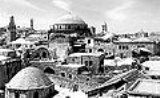
Hurva Sideview
The synagogue was designed by the Sultan's official architect Assad Effendi. Built in neo-Byzantine style
Neo-Byzantine architecture

Neo-Byzantine architecture is an Revivalism , most frequently seen in religious, institutional and public buildings. It emerged in 1840s in Western Europe and peaked in the last quarter of 19th century in the Russian Empire; an isolated Neo-Byzantine school was active in Yugoslavia between World War I and World War II....
, it was supported by four massive pilaster
Pilaster

A pilaster is a slightly-projecting column built into or applied to the face of a wall. Most commonly flattened or rectangular in form, pilasters can also take a half-round form or the shape of any type of column, including tortile....
s at each corner over which soared a large dome. The construction of only one of these towers was completed. The other three were missing the upper level and the small dome which capped it. The facade was covered in finely hewn stone and incorporated 42-foot-high window arches. The height of the synagogue to the bottom of its dome was around 16 meters and to the top of the dome it was 24 meters, (82 feet). Twelve windows were placed around the base of the dome which was surrounded by a veranda, which offered a fine view of large parts of the Old City and the area around Jerusalem. It was one of the tallest structures in the Old City and was visible for miles.

Interior

The synagogue prayer hall was reached via an entrance with three iron gates. The length was around 15.5 meters and the width was around 14 meters. The women's section was in the galleries, along the three sides of the chapel, except the eastern side. Access to the galleries was through towers situated at the corners of the building.

The Holy Ark together with its ornamental gates were brought to Jerusalem from the Nikolaijewsky synagogue located in Kherson
Kherson

Kherson is a city in southern Ukraine. It is the Capital city of the Kherson Oblast , and is designated as its own separate raion within the oblast....
, Russia. The Nikolaijewsky synagogue had been used by Russian Jewish conscripts who had been forced to spend twenty-five years in the Tsarist army. The Ark consisted of four Corinthian
Corinthian order

The Corinthian order is one of the Classical orders of Greece and Rome architecture, characterized by a slender Fluting column and an ornate capital decorated with acanthus leaves and scrolls....
 columns and was decorated with baroque
Baroque

In the the arts, the Baroque was a Western cultural Epoch , starting roughly at the beginning of the 17th century in Rome, Italy. It was exemplified by drama and grandeur in Baroque sculpture, Baroque painting, literature, Baroque dance, and Baroque music....
 carvings. The ark itself had two levels, was covered with a curtain and held 50 Torah scrolls. The alcove where the ark stood was adorned with dazzling woodcuts of flowers and birds. Above the ark was a triangular window with rounded points. To the right and in front of the ark was the cantor's podium, which was designed as a miniature version of the two-level ark. The centre of the synagogue originally contained a high wooden bimah
Bimah

A bimah , almemar or tebah is the elevated area or platform in a Judaism synagogue which is intended to serve the place where the person reading aloud from the Torah stands during the Torah reading....
, but this was later replaced with a flat platform covered with expensive marble plates.

Numerous crystal chandeliers hung from the dome. The dome itself was painted sky-blue and strewn with golden stars. Frescos with religious motifs, such as stars of David, the menorah, Mount Sinai
Mount Sinai

Mount Sinai , also known as Mount Horeb, Mount Musa, Gebel Musa or Jabal Musa by the Bedouin, is the name of a mountain in the Sinai Peninsula....
 and the Ten Commandments
Ten Commandments

The Ten Commandments, or Decalogue, are a list of religious and moral imperatives that, according to Judeo-Christian tradition, were authored by God and given to Moses on the mountain referred to as "Biblical Mount Sinai" or "Mount Horeb" in the form of two stone tablets....
, adorned every wall. In the four corners were drawings of four animals in accordance with the statement in Pirkei Avot: "Be strong as the leopard and swift as the eagle, fleet as the deer and brave as the lion to do the will of your Father in Heaven."

One of the most generous donations came from Pinchas Rosenberg, the Imperial Court tailor of St. Petersburg. In the diary of Rabbi Chaim ha-Levy, the emissary who had been sent from Jerusalem to collect funds for the synagogue, Rosenberg set out in details what his money was intended for. Among the items which were bought with his money were two big bronze candelabras; a silver Hanukah candlestick which "arrived miraculously on the 1st Tevet
Tevet

Tebet is the fourth month of the civil year and the tenth month of the ecclesiastical year on the Hebrew calendar. It follows Kislew and precedes Shebat....
 [1866] precisely in time to light the last eight Hanukah candles" and an iron door made under the holy ark for safe-keeping of the candlestick. He also earmarked funds towards the building of an "artistically wrought iron fence around the roof under the upper windows so that there be a veranda on which may stand all our brethren who go up in pilgrimage to behold our desolate Temple, and also a partition for the womenfolk on the Feast of Tabernacles and Simchat Torah
Simchat Torah

Simchat Torah is a celebration marking the conclusion of the annual cycle of public Torah readings, and the beginning of a new cycle. Simchat Torah is a component of the Bible Jewish holiday of Shemini Atzeret , which follows immediately after the festival of Sukkot in the month of Tishrei ....
."

1864–1948: The golden years

Construction work progressed slowly for lack of funds and it took a further eight years, till 1864, for the building to be completed. The new synagogue was dedicated by Baron Alphonse James de Rothschild
Alphonse James de Rothschild

Mayer Alphonse James Rothschild , was a banker and philanthropist and a member of the prominent Rothschild banking family of France.Known as Alphonse, he was the eldest son of James Mayer de Rothschild ....
, brother of Edmond James de Rothschild
Edmond James de Rothschild

Baron Edmond Benjamin James de Rothschild was a France member of the Rothschild family. A strong supporter of Zionism, his genorous donations lent significant support to the movement during its early years which helped lead to the establishment of the Israel....
, who dedicated much of his life supporting the Jews of Palestine. It was officially named "Beis Yaakov" — House of Jacob — in memory of their father James (Yaakov) Rothschild. The locals however, continued to call it the Hurva. As a token of gratitude to the British government for their involvement, The British consul, James Finn, was invited to the dedication ceremony which included a thanksgiving service. He describes the “beautiful chants and anthems in Hebrew”, the subsequent refreshments provided and the playing of Russian and Austrian music.

For the next 84 years, the building was considered the most beautiful and most important synagogue in the Land of Israel
Land of Israel

For other uses, see Israel The Land of Israel is the region which, according to the Hebrew Bible, was promised by God to the descendants of Abraham through his son Isaac and to the Israelites, descendants of Jacob, Abraham's grandson....
. It also housed part of the Etz Chaim Yeshiva
Etz Chaim Yeshiva

Etz Chaim Yeshiva is an orthodox yeshiva located on Jaffa Road close to the Mahane Yehuda Market in downtown Jerusalem....
, the largest yeshiva
Yeshiva

Yeshiva or yeshivah , or metivta or mesivta ) also frequently referred to as a Beth midrash, Talmudical Academy, Rabbinical Academy or Rabbinical School is an institution unique to classical Judaism for Torah study, the study of Talmud, Rabbinic literature and History of responsa....
 in Jerusalem. It was a focal point of Jewish spiritual life in the city and was the site of the installation of the Ashkenazi chief rabbis of both Palestine
Palestine

Palestine is a name which has been widely used since Roman times to refer to the region between the Mediterranean Sea and the Jordan River. It is derived from a name used already much earlier for a narrower geographical region, mainly along the coastal region....
 and Jerusalem. On his visit to Jerusalem in 1866, Moses Montefiore
Moses Montefiore

Sir Moses Haim Montefiore, 1st Baronet, Kt was one of the most famous United Kingdom Jews of the 19th century. Montefiore was a finance, banker, philanthropist and Sheriff of London....
 went to see the famed Hurva synagogue, placing a silver breastplate on one of the Torah scrolls. When he visited again in 1875, a crowd of 3,000 Jews turned out to greet him. On February 3, 1901 a memorial service for Queen Victoria
Victoria of the United Kingdom

Victoria was from 20 June 1837 the Queen regnant of the United Kingdom of Great Britain and Ireland and from 1 May 1876 the first Empress of India of the British Raj until her death....
 took place inside the synagogue in gratitude for the protection afforded to the Jews of Jerusalem by Britain. The service was presided over by the Ashkenazi Chief Rabbi, Shmuel Salant
Shmuel Salant

Rabbi Shmuel Salant served as the Ashkenazi Jews Chief Rabbi of Jerusalem and was a renowned Talmudist and Torah scholar.He was born in Bialystok, then part of Russia....
. According to a report in the Jewish Chronicle, the large building was “filled to its utmost capacity and policemen had to keep off the crowds, who vainly sought admission, by force".

1948 Arab-Israeli War: Reduced to rubble once again

On May 25, 1948, during the battle for the Old City
Siege of Jerusalem (1948)

The siege of Jerusalem was a complex series of military events beginning on December 1, 1947 and lasting through July 10, 1948. The siege was initiated by local Palestinian Arab militias immediately after the United Nations adopted a resolution ordering 1947 UN Partition Plan of Palestine into Jewish and Arab states....
, commander of the Jordanian Arab Legion
Arab Legion

The Arab Legion was the regular army of Transjordan and then Jordan in the early part of the 20th Century....
, Major Abdullah el-Tell, wrote to Otto Lehner of the Red Cross to warn that unless the Haganah
Haganah

Haganah was a Jewish paramilitary organization in what was then the British Mandate of Palestine from 1920 to 1948, which later became the core of the Israel Defense Forces....
 abandoned its positions in the synagogue and its adjoining courtyard, he would be forced to attack it. Moshe Russnak, commander of the Haganah in the Old City, ignored his request, knowing that if the Hurva fell, the battle for the Jewish Quarter would soon be lost. On May 26, 1948, the Jordanian Arab Legion delivered an ultimatum to the Jews to surrender within 12 hours; otherwise the Hurva would be bombarded.

On May 27, el-Tell, after receiving no answer to his proposition, told his men to “Get the Hurva Synagogue by noon.” Fawzi el-Kutub executed the mission by placing a 200-litre barrel filled with explosives against the synagogue wall. The explosion resulted in a gaping hole and Haganah fighters spent forty-five minutes fighting in vain to prevent the Legionnaires from entering. When they finally burst through, they tried to reach the top of its dome to plant an Arab flag. Three were shot by snipers, but the fourth succeeded. The Arab flag flying over the Old City skyline signaled the Legion’s triumph. A short while later a huge explosion reduced the synagogue, together with the Etz Chaim Yeshiva
Etz Chaim Yeshiva

Etz Chaim Yeshiva is an orthodox yeshiva located on Jaffa Road close to the Mahane Yehuda Market in downtown Jerusalem....
 attached to it, to rubble.

The question of whether responsibility for its destruction should rest on the shoulders of the Arab Legion or on the Haganah who had turned it into their last stronghold is debatable. What is for certain is that the building was deliberately mined and blown up after the Arabs had captured the area. el-Tell wrote in 1959 that “operations of calculated destruction had been set in motion because the Jewish Quarter had no strategic value. Its buildings and shrines were not destroyed in battle. All this took place after military activities had come to a standstill.”

Post 1967: Plans sought for a new design

Following the Six Day War, plans were mooted and designs sought for a new synagogue to be built at the site, part of the overall rehabilitation of the Jewish Quarter
Jewish Quarter

The Jewish Quarter is one of the four traditional quarters of the Old City of Jerusalem. The 45,000 square meter area lies in the southeastern sector of the walled city, and stretches from the Gates in Jerusalem's Old City Walls in the south, along the Armenian Quarter on the west, up to the Cardo in the north and extends to the Western W...
. Many religious and political figures supported the proposal to rebuild the original synagogue “where it was, as it was.” However, the Jewish Quarter Development Company in charge of the restoration of the Jewish Quarter, strongly opposed it. Their reasoning was based on a number of factors: a) The planners and architects involved in developing the area were all secular. They stressed the nationalist basis of the project and rejected the traditional religious character of the area; b) When “reconstruction” became the official religious and right-wing position, it became unacceptable to them; c) They wanted to promote unity and believed that reconstructing the synagogue of one particular group would have stirred opposition within other communities; d) Contrary to the 19th century design which was meant to blend in with the Oriental/Arab landscape, Israeli architects wanted the building to reflect their modern Western identity; e) Although it would have been possible to rebuild it as it was, neither the architects nor the masons were sufficiently qualified in traditional masonry technology to attempt it. Moreover, most of the original carved stones and surviving decorative elements had been removed, making a “reconstruction” unrealisable. Swayed by the creativity of contemporary architecture, they supported the redesign of a new Hurva by a prominent architect.

1968–1973: The Kahn plans

Leading the campaign to rebuild the Hurva was Rabbi Shlomo Zalman Tzoref's great-great-grandson, Ya'acov Salomon. He consulted Ram Karmi
Ram Karmi

Professor Ram Karmi is a leading Israeli architect and winner of the 2002 Israel Prize for architecture. He is head of the Tel Aviv-based Ram Karmi Architects company, and is known for his Brutalist architecture style....
, who in turn recommended Louis Kahn
Louis Kahn

Louis Isadore Kahn was a world-renowned architect of Estonian origin based in Philadelphia, United States. After working in various capacities for several companies in Philadelphia, he founded his own atelier in 1935....
, a world-renowned architect who was also a founding member of the Jerusalem Committee. Between 1968 and 1973, Kahn presented three plans for the reconstruction. The ruins were incorporated in a memorial garden, with a new structure on an adjacent lot and a promenade, the "Route of the Prophets," leading to the Western Wall
Western Wall

The Western Wall , sometimes referred to as the Wailing Wall or simply the Kotel , and as al-Buraq Wall by Muslims, is an important Jewish religious site located in the Old City ....
. Kahn proposed a structure within a structure, the outer one composed of 16 piers covered in golden Jerusalem stone
Jerusalem stone

Jerusalem stone is a name applied to various types of pale limestone, dolomite and dolomitic limestone, common in and around Jerusalem, Israel, that have been used in building since ancient times....
 cut in blocks of the same proportions as those of the Western Wall. In the bases of the four corners of the two-story, 12-meter high structure delineated by the piers would be small alcoves for meditation or individual prayer. The inner chamber, made of four inverted concrete pyramids supporting the building's roof, would be used for daily prayer services and allow for larger crowds on Sabbath or festivals. Kahn's model was displayed in the Israel Museum
Israel Museum

The Israel Museum, Jerusalem was founded in 1965 as Israel's national museum. It is situated on a hill in the Givat Ram neighborhood of Jerusalem, near the Knesset, the Israeli Supreme Court, and the Hebrew University of Jerusalem....
, but when he died in 1974, his plan was shelved. Former mayor Teddy Kollek
Teddy Kollek

Theodor "Teddy" Kollek was mayor of Jerusalem from 1965 to 1993, as well as founder of the Jerusalem Foundation. Kollek was re-elected five times, in 1969, 1973, 1978, 1983 and 1989....
 wrote to Kahn in 1968 that "the decision concerning your plans is essentially a political one. Should we in the Jewish Quarter have a building of major importance which competes with the mosque and the Holy Sepulchre, and should we in general have any building which would compete in importance with the Western Wall?"
Hakhurba Synagogue01m
Boston-based architect Moshe Safdie
Moshe Safdie

Moshe Safdie, Order of Canada is an architect and urban designer. He was born in the city of Haifa, British Mandate of Palestine now Israel....
, who has built extensively in Jerusalem and trained with Kahn in Philadelphia, was also in favour of rebuilding using contemporary design: "It's absurd to reconstruct the Hurva as if nothing had happened. If we have the desire to rebuild it, let's have the courage to have a great architect do it."

1977–1981: Commemorative arch, subsequent proposals shelved

As no permanent solution could be agreed upon, a temporary, symbolic solution was created. In 1977, one of the four arches that had originally supported the synagogue’s monumental dome was recreated. The 16 meter high stone arch spanning the space where the Hurva once stood was erected by two architects. The height of the original building, including the dome, had been twice as high as the symbolic arch. Together with the remains of the building and explanatory plaques, it was a stark reminder of what had once stood at the site.

With the disputes over the modern façade of the proposed new building, which some felt did not properly match the Jewish Quarter’s aesthetic, an Englishman named Sir Charles Clore
Charles Clore

Sir Charles Clore was a United Kingdom financier, retail and property magnate and philanthropist....
 took the initiative and agreed to fund the project, providing it could be completed in a specified number of years, (his wish was to see the project completed before his death). Between 1978 and 1981 Sir Denys Lasdun drew up plans that more closely adhered to the original, yet insufficiently as the plans were rejected by Prime Minister Menachem Begin
Menachem Begin

was the sixth Prime Minister of Israel. Before the establishment of the state, he was the leader of the Irgun, playing a central role in Jewish resistance to the British Mandate of Palestine....
, and the Minister of Interior at the time refused to sign the papers so that construction could begin. Time ran out and the Hurva was not rebuilt. However, Sir Charles’s daughter provided the necessary funds to create one of the few open spaces in the Jewish Quarter adjacent to the ruined synagogue.

2000: Approval granted for restoration of original design

The plan to rebuild the synagogue in its original style received approval by the Israeli Government in 2000. Jerusalem architect Nahum Meltzer was given the commission, and was told to hew as closely as possible to the 19th-century design. Meltzer feels that "both out of respect for the historical memory of the Jewish people and out of respect for the built-up area of the Old City, it is fitting for us to restore the lost glory and rebuild the Hurva Synagogue the way it was." The government-funded Jewish Quarter Development Corporation originally convinced the Israeli government to allocate $6.2 million (NIS 24m), about 85 percent of the cost, for the reconstruction of the old Ottoman synagogue with private donors contributing the remainder. In the end, the government only paid NIS 11m, with the remainder of the funds donated by a Ukrainian Jewish businessman and philanthropist, Vadim Rabinovitch.

2003: Excavations

During July and August 2003, before construction works commenced, an excavation took place inside the Hurva. It was carried out by the Institute for Archaeology at the Hebrew University and the Israel Exploration Society
Israel Exploration Society

The Israel Exploration Society was founded by a group of Jewish intellectuals in 1914 as the Society for the Reclamation of Antiquities, then renamed the Jewish Palestine Exploration Society....
. The excavation was funded by the Jewish Quarter Development Company of Jerusalem. Before the excavation, the Israel Antiquities Authority
Israel Antiquities Authority

The Israel Antiquities Authority [???? ???????] is an independent Israel governmental authority responsible for enforcing the 1978 Law of Antiquities by regulating excavation and conservation, and by promoting research....
 supervised the removal of the stone flooring which had been laid after the 1967 Six Day War. Earth was removed to a depth of two metres over an area of 300 m2. The dig revealed evidence from four main settlement periods: First Temple (800-600 BCE), Second Temple
Second Temple

The Second Temple was the reconstructed Temple in Jerusalem which stood between 516 BCE and 70 CE. During this time, it was the center of Judaism worship, which focused on the sacrifices known as the korbanot....
 (100 CE), Byzantine
Byzantine

The word Byzantine may refer to:Topics directly related to the Byzantine Empire* A citizen of Byzantine Empire, or native Greeks during the Middle Ages ....
 and Ottoman
Ottoman Empire

The Ottoman Empire , also known by its contemporaries as the Turkish Empire or Turkey , was an empire that lasted from 1299?1923. It was Treaty of Lausanne by the Republic of Turkey, which was officially proclaimed on October 29, 1923....
.

Events since 2005

Following comprehensive historic research, the reconstruction works began in 2005 and are expected to end in 2009.

On February 15, 2007, during construction works, Rabbi Simcha HaCohen Kook, rabbi of Rehovot
Rehovot

Rehovot is a city in the Center District of Israel, about 20 kilometre south of Tel Aviv. According to the Israel Central Bureau of Statistics , at the end of 2007 the city had a total population of 106,200....
, was appointed as the rabbi of the Hurva. A certificate of confirmation was signed by leading rabbis, including Yosef Sholom Eliashiv
Yosef Sholom Eliashiv

Rabbi Yosef Sholom Elyashiv is a Haredi Judaism rabbi and posek who lives in Jerusalem, Israel.Presently well into his nineties, he is active and remains the paramount leader of Israel's Lithuanian Jews non-Hasidic Judaism Haredi Ashkenazi Jews who regard him as the posek ha-dor , the contemporary leading authority on halakha, o...
. Menachem Porush, who remembered the original building in its glory, mentioned how overjoyed he was to see the fulfillment of his dream which he had never given up on – the rebuilding of the Hurva.

Image gallery


External links

  • - Company for the Reconstruction and Development of the Jewish Quarter
  • - Israel Antiquities Authority
    Israel Antiquities Authority

    The Israel Antiquities Authority [???? ???????] is an independent Israel governmental authority responsible for enforcing the 1978 Law of Antiquities by regulating excavation and conservation, and by promoting research....
  • - Philadelphia Architects and Buildings