

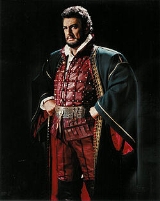
Otello

Encyclopedia
Otello is an opera
in four acts by Giuseppe Verdi
to an Italian libretto
by Arrigo Boito
, based on Shakespeare
's play
Othello
. It was Verdi's penultimate opera, and was first performed at the Teatro alla Scala
, Milan, on February 5, 1887.
in 1871, Verdi decided that it was time for him to end his successful career as a composer
of opera, though he was easily the most popular, and possibly the wealthiest, composer in Italy during the time, much as Rossini had done after the completion of the opera William Tell
.
, to be a waste of talent and possible profits.Thus a plot of sorts was hatched in order to coax the composer out of retirement to write another opera. Because of the importance of the dramatic aspects of opera to the composer, Verdi was especially selective in his choice of subjects. Consequently, if he were to agree to create another opera after a decade of retirement, the libretto would need to be one that would capture his interest. It was generally known that Verdi admired the dramatic works of Shakespeare and had, throughout his career, desired to create operas based on Shakespearian plays.However, his one attempt at doing so, Macbeth
(1847), although initially successful, was not well received when revised for performance in Paris in 1865. Because of its relatively straightforward story, the play Othello was selected as a likely target.
, subtly introduced the idea of a new opera to Verdi. During a dinner at Verdi’s Milan residence during the summer of 1879, Ricordi and Faccio guided the conversation towards Shakespeare’s play Othello
and to the librettist
Arrigo Boito
(whom Ricordi claimed to be a great fan of the play also). Suggestions were made, despite initial skepticism on the part of the composer, that Boito would be interested in creating a new libretto based upon the play. Within several days, Boito was brought to meet Verdi and present him with an outline of a libretto for an opera based on Othello. However, Verdi, still maintaining that his career had ended with the composition of Aida, made very little progress on the work. Nonetheless, collaborations with Boito in the revision of the earlier opera Simon Boccanegra
helped to convince Verdi of Boito’s ability as a librettist. Finally, production began on the opera, which Verdi initially referred to as Iago
.
, Milan, had already been selected as the conductor and the venue for the first performance. The two male protagonists had been selected, too: Italy's foremost dramatic tenor
, Francesco Tamagno
, was to sing Otello while the esteemed French singing-actor Victor Maurel
would assume the villainous baritone
role of Iago. Romilda Pantaleoni
, a well known singing-actress, was assigned Desdemona's soprano
part.
Upon the completion of the opera, preparations for the initial performance were conducted in absolute secrecy and Verdi reserved the right to cancel the premiere up to the last minute. Verdi need not have worried: Otellos debut proved to be a resounding success.The audience's enthusiasm for Verdi was shown by the 20 curtain calls that he took at the end of the opera. Further stagings of Otello soon followed at leading theatres throughout Europe and America.
Since three leading roles of the opera (Desdemona
, Iago
and Otello
) are among Verdi's most demanding, both vocally and dramatically, some of the most illustrious singers of the past 130 years have made Otello part of their repertoire. Famous Otellos of the past have included Tamagno, the role's trumpet-voiced creator, as well as Giovanni De Negri, Albert Alvarez, Francisco Viñas, Giuseppe Borgatti
, Antonio Paoli
, Giovanni Zenatello
, Renato Zanelli
, Giovanni Martinelli
, Aureliano Pertile
, Francesco Merli
, Giacomo Lauri-Volpi
, Frank Mullings
, Leo Slezak
, Jose Luccioni, Ramón Vinay
, Mario del Monaco
, James McCracken
, Jon Vickers
and Carlo Cossutta
. Pre-Second World War Wagnerian tenors such as Jacques Urlus
, Heinrich Knote
, Alexander Kirchner, Lauritz Melchior
and Franz Völker
also undertook the part (usually singing it in German). The Russian heroic tenor Ivan Yershov
was a renowned pre-World War I
Otello in his native country. His compatriot Arnold Azrikan
achieved his greatest recognition as a dramatic tenor in Otello. For this performance he was awarded the Stalin Prize in 1946.
Enrico Caruso was studying Otello when he died unexpectedly in 1921, thus thwarting the New York Metropolitan Opera
company's plans to stage the opera as a new vehicle for its star tenor. Currently, Plácido Domingo
has appeared in more video productions of the opera than any other tenor. Also, he has recorded the complete role twice on CD and appeared in numerous stage productions of the work on both sides of the Atlantic.
Domingo wrote about performing in the opera in his book My First Forty Years:"As to the other question — that of singing roles that, according to self-proclaimed experts, we ought not to be singing — I have a little story to tell. When I decided to sing Otello, many people told me that I was crazy. Mario Del Monaco, they said, had had the proper kind of voice for the role, and my voice was nothing like his. Twenty years earlier, Del Monaco had been warned not to sing Otello because his voice was nothing like that of Ramon Vinay, who was then performing the opera all over the world. Vinay, of course, had heard that only a tenor with a piercing sound like Giovanni Martinelli's ought to sing the part. Some years earlier, Martinelli had had Antonin Trantoul, who had sung Otello at La Scala in the twenties, held up to him as a shining example; but at La Scala, those who still remembered the very first Otello, Francesco Tamagno, had found Trantoul completely unsatisfactory. But there exists a letter from Verdi to his publisher in which the composer makes it quite clear that Tamagno left a great deal to be desired." (Verdi expressed reservations about Tamagno's softer singing, not about the power and ring of his vocalism in dramatic passages of the score.)
A long lineage of renowned baritones have sung Iago since 1887. Among them: Victor Maurel (the role's first exponent), Mattia Battistini
, Mario Ancona
, Antonio Scotti
, Titta Ruffo
, Pasquale Amato
, Carlo Galeffi
and Lawrence Tibbett
. Leading post-war exponents of the part have included Giuseppe Valdengo, Leonard Warren
, Robert Merrill
, Tito Gobbi
, Sherrill Milnes
and James Morris. As for Desdemona, too many top-class lyric sopranos to list here have undertaken the role since 1887.
Today, the opera is frequently performed throughout the world.
On a stormy night, the people of Cyprus anxiously await the arrival of the new governor, Otello, from the battle with the Turks (Chorus, Montano, Cassio, Iago, Roderigo
: Una vela! / "A sail!").Otello arrives safely and announces that the Turkish fleet has been destroyed, and the Cypriots cheer (Otello, chorus: Esultate! L’orgoglio musulmano sepolto è in mar / "Rejoice! The Mussulman's pride is buried in the sea").
Otello's ensign, Iago, offers to help the young Venetian gentleman Roderigo
in his seduction of Otello's wife Desdemona, because he (Iago) wants revenge against the Moor (Iago, Roderigo: Roderigo, ebben che pensi? / "Well, Roderigo, what are you thinking?").Otello has appointed Cassio
to be the captain of the navy, a position that Iago hoped to have.The people of Cyprus celebrate the navy's safe return by lighting a bonfire (Chorus: Fuoco di gioia!/ "Fire of joy").
In the tavern, Iago proposes a toast to Otello and his wife, while Cassio fulsomely praises Desdemona (Iago, Cassio, Chorus, Roderigo: Roderigo, beviam! / "Roderigo, let's drink!").Iago offers Cassio wine, but Cassio says he has had enough.Iago pressures him, and when Iago offers a toast to Otello and Desdemona, Cassio gives in.Iago sings a drinking song and continues to pour Cassio wine (Iago, Cassio, Roderigo, chorus: Inaffia l'ugola! / "Wet your throat").
Montano enters and calls for Cassio to begin his watch, but he is surprised to find Cassio drunk and barely able to stand upright.To Montano's surprise, Iago explains that this is how Cassio spends every evening.Roderigo laughs at Cassio's drunkenness and Cassio attacks him.Montano tells Cassio to refrain, but Cassio draws his sword and threatens to crack open Montano's head. (Montano, Cassio, Iago, Roderigo, chorus: Capitano, v’attende la fazione ai baluardi / "Captain, the guard awaits you on the ramparts".)Cassio and Montano begin to duel, and Iago sends Roderigo to call the alarm.Cassio wounds Montano as Otello enters.
Otello orders them to lower their swords. He then asks "honest Iago" to explain how the duel began, but Iago says he doesn't know.Otello then turns to Cassio, who feels embarrassed and cannot excuse his actions. When Otello discovers that Montano is wounded, he becomes enraged.Desdemona enters, and, upon seeing that his bride's rest has been disturbed, Otello declares that Cassio is no longer Captain. (Otello, Iago, Cassio, Montano: Abbasso le spade / "Down with your swords".)
The Cypriots leave Otello alone with Desdemona.Together Otello and Desdemona recall why they fell in love. They kiss and then walk back to the castle. (Otello, Desdemona: Già nella notte densa s'estingue ogni clamor /"Now in the dark night all noise is silenced".)
Iago suggests Cassio should ask Desdemona to talk to Otello about his demotion, because Desdemona can influence her husband to reinstate him (Iago, Cassio: Non ti crucciar / "Do not fret").Desdemona and Emilia can be seen walking the garden, Cassio approaches Desdemona. Watching from the room, Iago voices his nihilistic beliefs in a well-known credo (Credo in un Dio crudel / "I believe in a cruel God").
Otello enters the room; Iago, pretending not to notice him, says that he is deeply troubled. Cassio sees Otello from afar and goes discreetly away. Otello asks what's wrong with Iago, and he responds by giving vague answers. Finally he hints that Cassio and Desdemona are having an affair.Otello feels himself becoming jealous, but he wants proof of Desdemona's betrayal first. (Iago, Otello: Ciò m’accora... Che parli? / "That worries me..." "What did you say?")
A crowd of children, sailors, and Cypriots encircles Desdemona, praising her beauty and purity (Chorus, Iago, children, Desdemona, Otello: Dove guardi splendono raggi / "Wherever you look, brightness shines..."). They present her with gifts and wish her happiness before leaving.
Desdemona carries Cassio's request for reinstatement to Otello.Otello sourly tells her to ask him another time, and says he has a headache.Desdemona wraps his head in a handkerchief Otello once gave her, linen embroidered with strawberries.Otello throws it to the ground and says he doesn't need it (Desdemona, Otello: D'un uom che geme sotto il tuo disdegno la preghiera ti porto / "I bring a petition from one who suffers under your displeasure"). Emilia picks up the handkerchief.Desdemona asks for Otello's forgiveness.Aside, Iago demands that Emilia give him the handkerchief.When she refuses, Iago forcibly takes it from her.
Otello dismisses the others, and sings that he now believes that Desdemona may be deceiving him (Otello: Ora e per sempre addio sante memorie / "Now and forever farewell, holy memories").Iago returns, and the jealous Otello demands proof of Desdemona's infidelity.Iago says that once, when he and Cassio were sleeping in the same room, he heard Cassio talking to Desdemona in a dream.In the dream, says Iago, Cassio told Desdemona that they must be careful to conceal their love. (Iago: Era la notte, Cassio dormia / "It was night, Cassio was sleeping".)Iago says that dreams don't prove anything, but remarks that he saw Cassio carrying Desdemona's strawberry-embroidered handkerchief just the day before.Together, Otello and Iago swear vengeance on Desdemona and Cassio (Otello, Iago: Sì, pel ciel marmoreo giuro / "Yes, by the marble heavens I swear").
Iago explains to Otello that he will lure Cassio here and talk with him while Otello watches, hidden.He leaves to go get Cassio. (Iago: Qui trarrò Cassio / "Here I will bring Cassio".)
Desdemona enters and reminds Otello of Cassio's request.Otello says that he still has a headache, and asks her to wrap her handkerchief around his head.When Desdemona produces a different handkerchief, Otello demands the one with strawberries.When she says she does not have it, Otello says that it was a talisman, and troubles will befall her if she loses it.Desdemona says that he is trying to ignore Cassio's plea, and as she asks him about Cassio, he demands the handkerchief ever more insistently. (Desdemona, Otello: Dio ti giocondi, o sposo / "God keep you merry, husband".)Desdemona protests that she is faithful; Otello sends her away (Desdemona, Otello: Esterrefatta fisso lo sguardo tuo tremendo / "Terrified, I face your dreadful look").
Otello laments his fate (Dio! mi potevi scagliar tutti i mali / "God, you could have thrown every evil at me" ). When Iago calls out "Cassio is here!"Otello hides as Iago and Cassio enter.Cassio says he had hoped to see Desdemona here, for he wanted to know whether she had been successful with Otello(Iago, Cassio, Otello: Vieni; l’aula è deserta / "Come, the hall is deserted").Iago asks him to tell of his adventures with that woman.Cassio asks which woman, and, softly, so that Otello cannot hear, Iago says "Bianca" (the name of Cassio's actual lover).As Cassio laughs about his romantic adventures, Otello assumes he is speaking of Desdemona. In a conversation only partially heard, Cassio seems to be telling Iago that another woman, a secret admirer, left him a handkerchief as a token. At Iago's urging, Cassio produces it, whereupon Iago seizes it—for it is Desdemona's—and holds it out where he knows Otello can see it. He then returns it to Cassio and teases him, while in his hiding place Otello fumes (Iago, Cassio, Otello:Questa è una ragna dove il tuo cuor casca / "This is a spiderweb in which your heart is caught").
Bugles sound, announcing the arrival of the Venetian ambassador.Iago warns Cassio that he should leave unless he wants to see Otello.Cassio exits, and Otello determines to kill his wife by suffocating her in her bed, while Iago will take care of Cassio.
Lodovico, Desdemona, Emilia, Roderigo, and other dignitaries enter. When Lodovico notes Cassio's absence, Iago tells him that Cassio is out of favor, but Desdemona adds that he will soon be restored.Iago explains to the puzzled Lodovico that perhaps Cassio's restoration is her wish.Desdemona says that it is, for she has quite an affection for him.Otello calls her a demon and almost strikes her violently but is held back by Lodovico. Otello then calls for Cassio. (Lodovico, Otello, Desdemona, Emilia, Iago, chorus: Il Doge ed il Senato salutano l'eroe trionfatore / "The Doge and the Senate greet the triumphant hero".)Cassio enters and Otello reads (mixing in insults to Desdemona) a letter from the Doge
, announcing that he (Otello) has been called back to Venice and Cassio is to succeed him as governor of Cyprus.Enraged, Otello throws Desdemona to the ground. (Otello, Roderigo, Iago, Cassio, Lodovico: Messeri! il Doge mi richiama a Venezia / "Gentlemen!The Doge recalls me to Venice".)
Desdemona, on the ground, laments (A terra! … sì … nel livido fango / "Fallen! yes, in the foul mud..."). In full ensemble, the various characters express their different feelings: Emilia and Lodovico comfort Desdemona, Cassio marvels at his sudden change of fortune, and Roderigo laments that Desdemona will soon depart. In separate asides, Iago first tells Otello that tonight is the night to take revenge and then advises Roderigo that the only way to prevent Desdemona from leaving is for the new Duke to die, giving him encouragement to murder Cassio that night.(Emilia, Cassio, Desdemona, Roderigo, Lodovico, Iago, Otello, chorus: Quell’innocente un fremito d'odio non ha nè un gesto / "That innocent one is without feeling or gesture of hatred"). Otello orders everyone to leave.Desdemona goes to comfort him, but Lodovico pulls her away as Otello curses her.Otello raves about the handkerchief, then collapses.Iago presses Otello's forehead with his heel, then walks away.Outside the crowd of Cypriots calls out victory and glory for Otello. (Otello, Desdemona, Emilia, Cassio, Roderigo, Lodovico, Iago, chorus: Fuggite! / "Begone".)
Desdemona and Emilia are preparing for bed.Desdemona asks Emilia to put out the bridal gown she used on her wedding day, and says that if she dies, she wants to be buried in it.Emilia tells her not to talk about such things.Desdemona recalls how her mother had a servant named Barbara, who fell in love with a man but went mad when he left her(Desdemona: Piangea cantando nell’erma landa / "Singing, she wept on the lonely hearth", also known as the Willow Song).After Emilia leaves, Desdemona prays (Ave Maria) and then falls asleep.
Silently, Otello enters, with a sword.He kisses his wife three times; she awakens.Otello asks her if she has prayed tonight, because he does not want to kill her soul.She asks God for mercy, both for her and for Otello.Otello accuses her of sin, saying that he must kill her because she loves Cassio.Desdemona denies it and asks that he summon Cassio on her behalf.Otello says that Cassio is already dead.Desdemona pleads for mercy, but Otello tells her it's too late for that and strangles her (Otello, Desdemona: Diceste questa sera le vostre preci / "Have you said your prayers tonight?").
Emilia knocks at the door, announcing that Cassio has killed Roderigo.Desdemona softly calls out that she has been unjustly accused, and then dies.Emilia calls Otello a murderer; he retorts that Iago gave him proof of Desdemona's infidelity.Otello begins to threaten Emilia, who calls for help.Iago, Cassio, and Lodovico enter.Emilia demands that Iago deny Otello's accusation; he refuses.Otello says that the handkerchief Desdemona gave to Cassio is proof enough.Emilia, horrified, explains that Iago had stolen the handkerchief; Cassio corroborates her story.Montano enters and says that Roderigo, with his dying breath, has revealed Iago's plan.Iago, brandishing his sword, runs away. (Emilia, Otello, Desdemona, Cassio, Iago, Lodovico, Montano: Aprite! Aprite! / "Open up!")
After he realizes what has happened, Otello grieves over Desdemona's death. He then draws a dagger from his robe and stabs himself. Others try to stop him, but it is too late.Before he dies, he drags himself next to his wife and kisses her. He lies dead next to Desdemona. (Otello, Cassio, Lodovico, Montano: Niun mi tema / "That none fear me".)
-aria
structure of opera, much as Richard Wagner
had done, except that in some cases, the distinction between recitative and aria is more clearcut in Otello than in any of Wagner's operas.Nonetheless, the flow between the set pieces is much smoother than in any of Verdi's earlier works.Verdi's librettist, Arrigo Boito, was extremely faithful to Shakespeare's original play, though act 1 of the drama (everything having to do with Brabantio
, Desdemona
's father) was omitted and the other scenes were condensed in length. The roles of Otello (Othello) and Iago are among the most fully developed in all of opera, as much so as in Shakespeare's original drama—especially the character of Otello himself. (Iago is much more a standard villain in the opera than in the play). Verdi's orchestral writing in Otello is more highly developed than in any of Verdi's previous masterpieces. Whereas the orchestra served as little more than an accompaniment to the singing in his earlier works, in Otello, the orchestra plays a major part in conveying the events of the opera.It is used to portray the depth of the evil of Iago (an evil possibly only rivaled by that of Scarpia in Puccini's
Tosca
).
In the drinking song that follows, Verdi makes use of the bassoons and other low instruments in order to represent the internal effects of alcohol upon Cassio.However, this is gradually eclipsed by the merry themes which follow in the orchestra and chorus ("Chi all'esca ha morso").The merriment of the celebrations suddenly become frantic, as Cassio challenges Montano to a duel.The full orchestra builds up to a climax as they fight whilst Iago orders Roderigo to go and alert the entire town until the ordeal is interrupted by a loud statement made by the entering Otello.
Accented notes in the orchestra, particularly in the strings, reflect the annoyance of Otello at having his sleep disturbed.Notes played piano and pizzacato by the strings accompany Iago's account of the events, giving his account a feeling of false remorse and unhappiness.Upon Otello's orders, the disturbed islanders return to their homes, accompanied by legato notes in the upper strings and woodwinds depicting the calm that has once more been reestablished.
The great love duet which ends the act commences with a statement from Otello accompanied by cellos playing pianissimo.Desdemona's reply to him is accompanied by the violins and violas, providing a contrast to the statements made by Otello previously.When the duet proper starts ("Quando narravi"), sixteenth notes played by the harp and quarter notes played by the horns and bassoons give the music a sense of motion as Desdemona describes the narrations that Otello had given her about his life.As Otello commences to speak about how he narrated the battles in which he fought, thirty-second notes in the strings in addition to the inclusion of the lower brass instruments reflect the violent topics of Otello's previous narration.However, upon Desdemona's next vocal entrance several bars later, this immense energy is translated to a overall sense of the passion of the two lover's love for each other through the use of some of the more expressive wind instruments such as the English Horn.The duet continues to build up in passion until its climax, the appearance of the "kiss" theme which reappears twice more in the Opera near the end.After this, the music begins to tone down until the act ends with a trill in two of the first violins and a plucked chord on the harp.
Iago's brief conversation with Cassio is marked by the theme from the act's introduction, making Iago appear strangely affable when he suggests that Cassio consult Desdemona; however, as before, an underlying dark tone remains.
Upon Cassio's exit, this dark tone rapidly becomes predominant as the gestures which opened the act repeat, but this time, will a full string and woodwind section.The famous aria that follows ("Credo in un Dio crudel") is marked by trills in the lowest clarinet register and quick yet powerfully accented notes played by the full orchestra at several intervals that portray the evil of Iago to its fullest extent.
Nevertheless, Iago's evil reverie is interrupted by the appearance of Desdemona and Cassio.The urgency felt by Iago in the situation is reflected in the staccato eight notes in the strings which accompany his witnessing of the situation.However, upon Otello's entry the music suddenly becomes much calmer.Otello's response to Iago's question about the preexisting relationship between Cassio and Desdemona is a typical love melody which would have been standard in an earlier Verdi opera, yet it lacks the passion that would typically accompany it and is cut short by Iago's interjection.Otello's annoyance with Iago for not directly stating his "suspicions" is suddenly reflected by an outburst in the orchestra.This is the second instance in the opera in which Otello's potential anger has been made apparent.As Iago gives the equivalent of the famous Shakespearean line from the play ("È un'idra fosca"), the low strings and woodwinds create a dark tone during this scene.
This darkness, however is interrupted by the appearance of a chorus.The chorus is accompanied by folk instruments such as the mandolin and guitar in order to give the music a more authentic feel.However, the music is slow and intentionally sweet in quality, reflecting the kind innocence of Desdemona.
The quartet that follows the episode begins with a similarly sweet statement by Desdemona, asking for Otello to forgive her if she has done anything.This is overshadowed by the aside brooding of Otello about his perception of her guilt, which is marked by shorter, more separated phrases in the strings.Meanwhile, as Iago and Emilia join into the music with their quarrel, the music darkens until it is strangely sad towards the end, even when the orchestral accompaniment ends.After the end of the quartet proper, the music once again regains its sweet nature, as Desdemona's farewell statements are accompanied by the violins and oboe, however soon after her departure, it rapidly darkens, Otello broods to the incessant notes of the bassoons and lower violin statements.However, this is immediately transferred into an anger towards Iago which is reflected in the accented statements made by the full orchestra.Otello's distress is reflected by his farewell to fame and glory ("Ora e per sempre addio").Repeated lower chords on the harp along with triplet movement in the lower strings give the portion a dark tone, despite the majestic interludes of the brass and the melody (which would, on its own, be cheerful).
During Iago's untruthful account of Cassio's dream, strings and high woodwind instruments are used in order to create a dream-like atmosphere in the music.Descending chromatic scales both add to this atmosphere and maintain the dark overall tone which has pervaded.
The act ends with an energetic finale in which Iago and Otello swear to have vengeance.The energy of this final duet is provided by the full orchestra, which accompanies it.
Desdemona's appearance in the act is once again accompanied by a sweet melody, however, this is quickly subdued as Otello, in his frustration, calls her a "vile cortegiana" at which point the anger of Otello is once again portrayed by a full orchestra with brass.The music that accompanies Desdemona's reaction to this sudden outburst is sad, yet the woodwinds give it a oddly noble character, which again reaffirms her overall innocence.
After Desdemona's departure, Iago stages an interrogation of Cassio in front of Otello.This interrogation takes the form of a friendly conversation and is accompanied by jocular sixteenth note runs in the woodwinds, reflecting the joy of Cassio about his love interest with the woman Bianca.This happily playful tone is contrasted with the dark asides of the watching Otello.Throughout this scene, the dark tone pervades.
The full scene that follows is grand in the orchestration, with abundant use of brass throughout.However, following Otello's angry outbursts near the end, it quickly becomes dark and sad after Otello strikes Desdemona.
After the departure of all of the members of the scene, the turmoil within Otello's mind is reflected by the restlessness of the orchestra, which becomes increasingly violent as he falls into his trance.The dark singing of the triumphant Iago is contrasted with the majestic brass and external choral interjections praising Otello.
In the brief recitativo between Desdemona and Emilia which begins the act, the despairing tone begun in the introduction continues.
The "Willow Song" which follows is marked by an increasing orchestral sound, with woodwinds and strings adding to it, yet what compounds the sadness of the piece is the wail-like cries of "Salce" made by Desdemona followed by similarly despairing, yet softer "echoes" played by the English horn.Near the end of the song, Desdemona's fear, which has been hidden up to this point by a veil of sadness, is made apparent; she mistakes the noise of the wind for that of an intruder.The orchestra immediately builds to a fortissimo, reflecting the genuine worries possessed by Desdemona.The music that gradually lessens with the comforting of Emilia and returns for a final repetition of the theme of the "Willow Song".
Afterwards, Desdemona begins to bid Emilia adieu.This goodbye is initially accompanied by repeated notes on the lower woodwinds and strings such as those in the introduction of the act but in a much more noticeable and dominating manner.This reflects the increasing expectation of Desdemona of her death.Initially, she attempts to keep these feelings to herself, but the orchestra reveals her increasing inner thoughts.These feelings finally reach a point at which they can no longer be contained and Desdemona lets out a loud passionate cry of goodbye to Emilia, one that is reinforced by the full orchestral accompaniment.
Following Emilia's departure, Desdemona prays.Like many of Desdemona's earlier vocal appearances in the opera, these prayers contain a sweet nature, reflecting, for the final time, the innocence of the wrongly accused woman.The melody within the strings that appears later in the prayer scene adds significantly to the poignancy of the situation.
After she goes to bed, a sinister theme appears in the string bass, depicting Otello's entrance.This effectively replaces the sad tone which was present throughout the first portions with the dark one which marked much of the second and third acts.The low theme begins very slowly, but gradually accelerates until there is a sudden outburst with the full orchestra.However, soon afterwards, the music drops down to a soft tremolo in the strings.Above this, a theme that evokes Otello's longing for Desdemona appears in the English horn and bassoons.This theme builds up until it finally gives way to the "kiss" theme from act 1, as Otello embraces the sleeping Desdemona. However this second appearance of the theme is even more passionate than the first one and adds to the poignancy of the tragedy.
Once Desdemona awakens, the music retreats to the theme that accompanied Otello's entrance, but with a more threatening feel this time as brass instruments are added.As Otello demands that Desdemona confess, the music accelerates, reaching a climax at the point where Desdemona is strangled.After this, though the power of the orchestra lessens, it maintains its darkness throughout the scene of Emilia's discovery of the murder and Desdemona's final death.
The scene with that follows is marked by a theme that is somewhat majestic and proud, however, as it is limited to the woodwinds, it seems weak.This reflects the loss of power and honor that have faced Otello.
As Otello laments his actions to the theme of his longing, he decides to commit suicide.Just before he dies, the orchestra plays the "kiss" motif one final time before the opera ends.
In the orchestra
:
3 flute
s (the third doubles as a piccolo
),
2 oboe
s,
1 english horn,
2 clarinet
s,
1 bass clarinet
,
4 bassoon
s,
4 horn
s,
2 cornet
s,
2 trumpet
s,
4 trombone
s,
1 harp
,
percussion
(timpani
, cymbal
s, bass drum
, gong
),
strings (violin
I and II, viola
, cello
, double bass
)
Offstage:
6 trumpet
s,
4 trombone
s,
organ
,
bagpipes
,
mandolin
s,
guitar
s
and featuring such solid singers as Herva Nelli
, Ramón Vinay and Giuseppe Valdengo, is musically (if not in terms of sound quality) the best of these versions. The Toscanini account has been released on commercial LPs and on CD in a digitally remastered form. In addition, exciting performances of Otello were captured live as early as the 1920s (at the Royal Opera House
, Covent Garden, London) and the 1930s (at the Metropolitan Opera, New York City, the latter via the Metropolitan Opera radio broadcasts
). They, too, are available on CD reissues. A wide variety of stage performances dating from the 1950s to the present day are also to be had on CD or on DVD.
Individual arias, duets and scenes from Otello have been committed to disc by many celebrated tenors, baritones and sopranos since acceptable audio technology was first developed in the early 20th century. The best of these recorded extracts have been reissued on CD and make for fascinating comparative listening. Recordings made in the early 1900s by the creators of the roles of Otello and Iago, namely Francesco Tamagno and Victor Maurel, are among those now available in digital formats.
Opera
Opera is an art form in which singers and musicians perform a dramatic work combining text and musical score, usually in a theatrical setting. Opera incorporates many of the elements of spoken theatre, such as acting, scenery, and costumes and sometimes includes dance...
in four acts by Giuseppe Verdi
Giuseppe Verdi
Giuseppe Fortunino Francesco Verdi was an Italian Romantic composer, mainly of opera. He was one of the most influential composers of the 19th century...
to an Italian libretto
Libretto
A libretto is the text used in an extended musical work such as an opera, operetta, masque, oratorio, cantata, or musical. The term "libretto" is also sometimes used to refer to the text of major liturgical works, such as mass, requiem, and sacred cantata, or even the story line of a...
by Arrigo Boito
Arrigo Boito
Arrigo Boito , aka Enrico Giuseppe Giovanni Boito, pseudonym Tobia Gorrio, was an Italian poet, journalist, novelist and composer, best known today for his libretti, especially those for Giuseppe Verdi's operas Otello and Falstaff, and his own opera Mefistofele...
, based on Shakespeare
William Shakespeare
William Shakespeare was an English poet and playwright, widely regarded as the greatest writer in the English language and the world's pre-eminent dramatist. He is often called England's national poet and the "Bard of Avon"...
's play
Play (theatre)
A play is a form of literature written by a playwright, usually consisting of scripted dialogue between characters, intended for theatrical performance rather than just reading. There are rare dramatists, notably George Bernard Shaw, who have had little preference whether their plays were performed...
Othello
Othello
The Tragedy of Othello, the Moor of Venice is a tragedy by William Shakespeare, believed to have been written in approximately 1603, and based on the Italian short story "Un Capitano Moro" by Cinthio, a disciple of Boccaccio, first published in 1565...
. It was Verdi's penultimate opera, and was first performed at the Teatro alla Scala
La Scala
La Scala , is a world renowned opera house in Milan, Italy. The theatre was inaugurated on 3 August 1778 and was originally known as the New Royal-Ducal Theatre at La Scala...
, Milan, on February 5, 1887.
Verdi's early retirement
After the completion and premiere of the opera AidaAida
Aida sometimes spelled Aïda, is an opera in four acts by Giuseppe Verdi to an Italian libretto by Antonio Ghislanzoni, based on a scenario written by French Egyptologist Auguste Mariette...
in 1871, Verdi decided that it was time for him to end his successful career as a composer
Composer
A composer is a person who creates music, either by musical notation or oral tradition, for interpretation and performance, or through direct manipulation of sonic material through electronic media...
of opera, though he was easily the most popular, and possibly the wealthiest, composer in Italy during the time, much as Rossini had done after the completion of the opera William Tell
William Tell (opera)
Guillaume Tell is an opera in four acts by Gioachino Rossini to a French libretto by Etienne de Jouy and Hippolyte Bis, based on Friedrich Schiller's play Wilhelm Tell. Based on the legend of William Tell, this opera was Rossini's last, even though the composer lived for nearly forty more years...
.
Ricordi and the "plot" to end Verdi's retirement
Because of the immense popularity of Verdi’s music in Italy by the 1870s, Verdi’s retirement seemed to his publisher, Giulio RicordiGiulio Ricordi
Giulio Ricordi was an Italian editor and musician.-Biography:Ricordi was born in Milan, where he also died....
, to be a waste of talent and possible profits.Thus a plot of sorts was hatched in order to coax the composer out of retirement to write another opera. Because of the importance of the dramatic aspects of opera to the composer, Verdi was especially selective in his choice of subjects. Consequently, if he were to agree to create another opera after a decade of retirement, the libretto would need to be one that would capture his interest. It was generally known that Verdi admired the dramatic works of Shakespeare and had, throughout his career, desired to create operas based on Shakespearian plays.However, his one attempt at doing so, Macbeth
Macbeth (opera)
Macbeth is an opera in four acts by Giuseppe Verdi, with an Italian libretto by Francesco Maria Piave and additions by Andrea Maffei, based on Shakespeare's play of the same name...
(1847), although initially successful, was not well received when revised for performance in Paris in 1865. Because of its relatively straightforward story, the play Othello was selected as a likely target.
Proposal and Arrigo Boito
Finally, after some plotting, Ricordi, in conjunction with Verdi’s friend, the conductor Franco FaccioFranco Faccio
Franco Faccio was an Italian composer and conductor.-Biography:Born in Verona, Faccio became known as a conductor of Verdi's music. He studied music at the Milan Conservatory where he was a pupil of Stefano Ronchetti-Monteviti...
, subtly introduced the idea of a new opera to Verdi. During a dinner at Verdi’s Milan residence during the summer of 1879, Ricordi and Faccio guided the conversation towards Shakespeare’s play Othello
Othello
The Tragedy of Othello, the Moor of Venice is a tragedy by William Shakespeare, believed to have been written in approximately 1603, and based on the Italian short story "Un Capitano Moro" by Cinthio, a disciple of Boccaccio, first published in 1565...
and to the librettist
Libretto
A libretto is the text used in an extended musical work such as an opera, operetta, masque, oratorio, cantata, or musical. The term "libretto" is also sometimes used to refer to the text of major liturgical works, such as mass, requiem, and sacred cantata, or even the story line of a...
Arrigo Boito
Arrigo Boito
Arrigo Boito , aka Enrico Giuseppe Giovanni Boito, pseudonym Tobia Gorrio, was an Italian poet, journalist, novelist and composer, best known today for his libretti, especially those for Giuseppe Verdi's operas Otello and Falstaff, and his own opera Mefistofele...
(whom Ricordi claimed to be a great fan of the play also). Suggestions were made, despite initial skepticism on the part of the composer, that Boito would be interested in creating a new libretto based upon the play. Within several days, Boito was brought to meet Verdi and present him with an outline of a libretto for an opera based on Othello. However, Verdi, still maintaining that his career had ended with the composition of Aida, made very little progress on the work. Nonetheless, collaborations with Boito in the revision of the earlier opera Simon Boccanegra
Simon Boccanegra
Simon Boccanegra is an opera with a prologue and three acts by Giuseppe Verdi to an Italian libretto by Francesco Maria Piave, based on the play Simón Bocanegra by Antonio García Gutiérrez....
helped to convince Verdi of Boito’s ability as a librettist. Finally, production began on the opera, which Verdi initially referred to as Iago
Iago
Iago is a fictional character in Shakespeare's Othello . The character's source is traced to Giovanni Battista Giraldi Cinthio's tale "Un Capitano Moro" in Gli Hecatommithi . There, the character is simply "the ensign". Iago is a soldier and Othello's ancient . He is the husband of Emilia,...
.
Completion and production
As the Italian public became aware that the retired Verdi was composing another opera, rumors about it abounded. At the same time, many of the most illustrious conductors, singers and opera-house managers in Europe were vying for an opportunity to play a part in Otello 's premiere, despite the fact that Faccio and La ScalaLa Scala
La Scala , is a world renowned opera house in Milan, Italy. The theatre was inaugurated on 3 August 1778 and was originally known as the New Royal-Ducal Theatre at La Scala...
, Milan, had already been selected as the conductor and the venue for the first performance. The two male protagonists had been selected, too: Italy's foremost dramatic tenor
Tenor
The tenor is a type of male singing voice and is the highest male voice within the modal register. The typical tenor voice lies between C3, the C one octave below middle C, to the A above middle C in choral music, and up to high C in solo work. The low extreme for tenors is roughly B2...
, Francesco Tamagno
Francesco Tamagno
Francesco Tamagno was an operatic tenor from Italy who sang with enormous success throughout Europe and America. On 5 February 1887, he cemented his place in musical history by creating the role of Otello in Giuseppe Verdi's masterpiece of the same name...
, was to sing Otello while the esteemed French singing-actor Victor Maurel
Victor Maurel
Victor Maurel was a French operatic baritone who enjoyed an international reputation as a great singing-actor.-Biography:...
would assume the villainous baritone
Baritone
Baritone is a type of male singing voice that lies between the bass and tenor voices. It is the most common male voice. Originally from the Greek , meaning deep sounding, music for this voice is typically written in the range from the second F below middle C to the F above middle C Baritone (or...
role of Iago. Romilda Pantaleoni
Romilda Pantaleoni
Romilda Pantaleoni was an Italian soprano who had a prolific opera career in Italy during the 1870s and 1880s. She sang a wide repertoire that encompassed bel canto roles, Italian and French grand opera, verismo operas, and the German operas of Richard Wagner...
, a well known singing-actress, was assigned Desdemona's soprano
Soprano
A soprano is a voice type with a vocal range from approximately middle C to "high A" in choral music, or to "soprano C" or higher in operatic music. In four-part chorale style harmony, the soprano takes the highest part, which usually encompasses the melody...
part.
Upon the completion of the opera, preparations for the initial performance were conducted in absolute secrecy and Verdi reserved the right to cancel the premiere up to the last minute. Verdi need not have worried: Otellos debut proved to be a resounding success.The audience's enthusiasm for Verdi was shown by the 20 curtain calls that he took at the end of the opera. Further stagings of Otello soon followed at leading theatres throughout Europe and America.
Performance history
The opera was first seen in the US at the Academy of Music in New York on 16 April 1888 and in the UK on 5 July 1889 in London. When it was given in Paris in October 1894, "Verdi composed a short ballet (which) forms part of the ceremony of welcome for the Venetian ambassadors in the act 3 finale."Since three leading roles of the opera (Desdemona
Desdemona
Desdemona is a character in William Shakespeare's play Othello.Desdemona may also refer to:People* Desdemona , a soprano role in the 1816 opera Otello by Gioachino Rossini...
, Iago
Iago
Iago is a fictional character in Shakespeare's Othello . The character's source is traced to Giovanni Battista Giraldi Cinthio's tale "Un Capitano Moro" in Gli Hecatommithi . There, the character is simply "the ensign". Iago is a soldier and Othello's ancient . He is the husband of Emilia,...
and Otello
Othello (character)
Othello is a character in Shakespeare's Othello . The character's origin is traced to the tale, "Un Capitano Moro" in Gli Hecatommithi by Giovanni Battista Giraldi Cinthio. There, he is simply referred to as the Moor....
) are among Verdi's most demanding, both vocally and dramatically, some of the most illustrious singers of the past 130 years have made Otello part of their repertoire. Famous Otellos of the past have included Tamagno, the role's trumpet-voiced creator, as well as Giovanni De Negri, Albert Alvarez, Francisco Viñas, Giuseppe Borgatti
Giuseppe Borgatti
Giuseppe Borgatti was an Italian dramatic tenor with an outstanding voice...
, Antonio Paoli
Antonio Paolí
Antonio Paoli was a Puerto Rican tenor. He was known at the height of his fame as "The King of Tenors and The Tenor of Kings." He is considered to be the first Puerto Rican to reach international fame in the musical arts...
, Giovanni Zenatello
Giovanni Zenatello
Giovanni Zenatello was an Italian opera singer. Born in Verona, he enjoyed an international career as a dramatic tenor of the first rank. Otello became his most famous operatic role but he sang a wide repertoire. In 1904, he created the part of Pinkerton in Madama Butterfly.-Career:Zenatello...
, Renato Zanelli
Renato Zanelli
Renato Zanelli was a Chilean operatic baritone and later tenor, particularly associated with heroic Italian and German roles, notably Verdi's Otello.-Life and career:...
, Giovanni Martinelli
Giovanni Martinelli
Giovanni Martinelli was a celebrated Italian operatic tenor. He was particularly associated with the Italian lyric-dramatic repertory, although he performed French operatic roles to great acclaim as well...
, Aureliano Pertile
Aureliano Pertile
Aureliano Pertile was an Italian lyric-dramatic tenor. He is considered to have been one of the most exciting operatic artists of the inter-war period, and one of the most important tenors of the entire 20th century.- Life and career :Pertile was born in Montagnana, Northern Italy, 18 days after...
, Francesco Merli
Francesco Merli
Francesco Merli was an Italian opera singer, particularly associated with heavy roles such as Otello, Canio and Calaf. He ranks as one of the finest dramatic tenors of the inter-war period....
, Giacomo Lauri-Volpi
Giacomo Lauri-Volpi
Giacomo Lauri-Volpi was an Italian tenor with a lyric-dramatic voice of exceptional range and technical facility. He performed throughout Europe and the Americas in a top-class career that spanned 40 years....
, Frank Mullings
Frank Mullings
Frank Mullings was a leading English tenor with Sir Thomas Beecham's Beecham Opera Company and its successor, the British National Opera Company, during the 1910s and 1920s...
, Leo Slezak
Leo Slezak
Leo Slezak was a world-famous Moravian tenor. He was associated in particular with German opera as well as the title role in Verdi's Otello.- Beginnings :...
, Jose Luccioni, Ramón Vinay
Ramón Vinay
Ramón Vinay was a famous Chilean operatic tenor with a powerful, dramatic voice. He is probably best remembered for his appearances in the title role of Giuseppe Verdi's tragic opera Otello....
, Mario del Monaco
Mario del Monaco
Mario Del Monaco was an Italian tenor who is regarded by his admirers as being one of the greatest dramatic tenors of the 20th century....
, James McCracken
James McCracken
James McCracken was an American operatic tenor. At the time of his death The New York Times stated that McCracken was "the most successful dramatic tenor yet produced by the United States and a pillar of the Metropolitan Opera during the 1960s and 1970s."-Biography:Born in Gary, Indiana,...
, Jon Vickers
Jon Vickers
Jonathan Stewart Vickers, CC , known professionally as Jon Vickers, is a retired Canadian heldentenor.Born in Prince Albert, Saskatchewan, he was the sixth in a family of eight children. In 1950, he was awarded a scholarship to study opera at The Royal Conservatory of Music in Toronto...
and Carlo Cossutta
Carlo Cossutta
Carlo Cossutta was a prominent Italian dramatic tenor who had a major international opera career that spanned from the mid 1950s through the late 1990s. He began and ended his career at the Teatro Colón in Buenos Aires where he sang regularly from 1958 through 1998...
. Pre-Second World War Wagnerian tenors such as Jacques Urlus
Jacques Urlus
Jacques Urlus , was a Dutch dramatic tenor. He sang to great critical acclaim at major opera houses on both sides of the Atlantic, and his recordings of the music of Richard Wagner are considered to be among the finest ever made.-Biography:Jacques Urlus was born to music-loving Dutch parents in the...
, Heinrich Knote
Heinrich Knote
Heinrich Knote was an outstanding German dramatic tenor with an international reputation.Born in Munich, he studied in that Bavarian city with Emmanuel Kirschner before joining the Munich Opera in 1892, debuting in Lortzing's Der Waffenschmied...
, Alexander Kirchner, Lauritz Melchior
Lauritz Melchior
Lauritz Melchior was a Danish and later American opera singer. He was the pre-eminent Wagnerian tenor of the 1920s, 1930s, and 1940s, and has since come to be considered the quintessence of his voice type.-Biography:...
and Franz Völker
Franz Völker
Franz Völker was a dramatic tenor who enjoyed a major European career...
also undertook the part (usually singing it in German). The Russian heroic tenor Ivan Yershov
Ivan Yershov
Ivan Vasiliyevitch Yershov or Ershov , born November 8, 1867 - died November 21, 1943, was a Russian opera singer. He earned renown for his brilliant performances at the Mariinsky Theatre in Saint Petersburg, performing some of the most demanding roles written for the dramatic tenor...
was a renowned pre-World War I
World War I
World War I , which was predominantly called the World War or the Great War from its occurrence until 1939, and the First World War or World War I thereafter, was a major war centred in Europe that began on 28 July 1914 and lasted until 11 November 1918...
Otello in his native country. His compatriot Arnold Azrikan
Arnold Azrikan
Arnold Grigorevich Azrikan was a Ukrainian and Russian operatic dramatic tenor.-Biography and career:...
achieved his greatest recognition as a dramatic tenor in Otello. For this performance he was awarded the Stalin Prize in 1946.
Enrico Caruso was studying Otello when he died unexpectedly in 1921, thus thwarting the New York Metropolitan Opera
Metropolitan Opera
The Metropolitan Opera is an opera company, located in New York City. Originally founded in 1880, the company gave its first performance on October 22, 1883. The company is operated by the non-profit Metropolitan Opera Association, with Peter Gelb as general manager...
company's plans to stage the opera as a new vehicle for its star tenor. Currently, Plácido Domingo
Plácido Domingo
Plácido Domingo KBE , born José Plácido Domingo Embil, is a Spanish tenor and conductor known for his versatile and strong voice, possessing a ringing and dramatic tone throughout its range...
has appeared in more video productions of the opera than any other tenor. Also, he has recorded the complete role twice on CD and appeared in numerous stage productions of the work on both sides of the Atlantic.
Domingo wrote about performing in the opera in his book My First Forty Years:"As to the other question — that of singing roles that, according to self-proclaimed experts, we ought not to be singing — I have a little story to tell. When I decided to sing Otello, many people told me that I was crazy. Mario Del Monaco, they said, had had the proper kind of voice for the role, and my voice was nothing like his. Twenty years earlier, Del Monaco had been warned not to sing Otello because his voice was nothing like that of Ramon Vinay, who was then performing the opera all over the world. Vinay, of course, had heard that only a tenor with a piercing sound like Giovanni Martinelli's ought to sing the part. Some years earlier, Martinelli had had Antonin Trantoul, who had sung Otello at La Scala in the twenties, held up to him as a shining example; but at La Scala, those who still remembered the very first Otello, Francesco Tamagno, had found Trantoul completely unsatisfactory. But there exists a letter from Verdi to his publisher in which the composer makes it quite clear that Tamagno left a great deal to be desired." (Verdi expressed reservations about Tamagno's softer singing, not about the power and ring of his vocalism in dramatic passages of the score.)
A long lineage of renowned baritones have sung Iago since 1887. Among them: Victor Maurel (the role's first exponent), Mattia Battistini
Mattia Battistini
Mattia Battistini was an Italian operatic baritone. He became internationally famous due to the beauty of his voice and the virtuosity of his singing technique, and he earned the sobriquet "King of Baritones".-Early life:...
, Mario Ancona
Mario Ancona
Mario Ancona , was a leading Italian baritone and master of bel canto singing. He appeared at some of the most important opera houses in Europe and America during what is commonly referred to as the "Golden Age of Opera".-Career:Ancona was born into a middle-class Jewish family at Livorno, Tuscany,...
, Antonio Scotti
Antonio Scotti
Antonio Scotti was an Italian baritone. He was a principal artist of the New York Metropolitan Opera for more than 33 seasons, but also sang with great success at London's Royal Opera House, Covent Garden, and Milan's La Scala.-Life:Antonio Scotti was born in Naples, Italy...
, Titta Ruffo
Titta Ruffo
Titta Ruffo , born as Ruffo Titta Cafiero, was an Italian opera star who had a major international singing career. Known as the "Voce del leone" , he was greatly admired, even by rival baritones, such as Giuseppe De Luca, who said of Ruffo: "His was not a voice, it was a miracle" Titta Ruffo (9...
, Pasquale Amato
Pasquale Amato
Pasquale Amato was an outstanding Italian operatic baritone. Amato enjoyed an international reputation but attained the peak of his fame in New York City, where he sang with the Metropolitan Opera from 1908 until 1921....
, Carlo Galeffi
Carlo Galeffi
Carlo Galeffi was a leading Italian baritone, particularly associated with the operatic works of Giuseppe Verdi and the various verismo composers.- Life and career :...
and Lawrence Tibbett
Lawrence Tibbett
Lawrence Mervil Tibbett was a great American opera singer and recording artist who also performed as a film actor and radio personality. A baritone, he sang with the New York Metropolitan Opera company more than 600 times from 1923 to 1950...
. Leading post-war exponents of the part have included Giuseppe Valdengo, Leonard Warren
Leonard Warren
Leonard Warren was a famous American opera singer. A baritone, he was a leading artist for many years with the Metropolitan Opera in New York.-Biography:...
, Robert Merrill
Robert Merrill
Robert Merrill was an American operatic baritone.-Early life:Merrill was born Moishe Miller, later known as Morris Miller, in the Williamsburg section of Brooklyn, New York, to tailor Abraham Miller, originally Milstein, and his wife Lillian, née Balaban, immigrants from Warsaw, Poland.His mother...
, Tito Gobbi
Tito Gobbi
Tito Gobbi was an Italian operatic baritone with an international reputation.-Biography:Tito Gobbi was born in Bassano del Grappa and studied law at the University of Padua before he trained as a singer. Giulio Crimi, a well-known Italian tenor of a previous generation, was Gobbi's teacher in Rome...
, Sherrill Milnes
Sherrill Milnes
Sherrill Milnes is an American operatic baritone most famous for his Verdi roles. From 1965 until 1997 he was associated with the Metropolitan Opera....
and James Morris. As for Desdemona, too many top-class lyric sopranos to list here have undertaken the role since 1887.
Today, the opera is frequently performed throughout the world.
Roles
| Role | Voice type Voice type A voice type is a particular kind of human singing voice perceived as having certain identifying qualities or characteristics. Voice classification is the process by which human voices are evaluated and are thereby designated into voice types... |
Premiere cast, 5 February 1887 (Conductor: Franco Faccio Franco Faccio Franco Faccio was an Italian composer and conductor.-Biography:Born in Verona, Faccio became known as a conductor of Verdi's music. He studied music at the Milan Conservatory where he was a pupil of Stefano Ronchetti-Monteviti... ) |
|---|---|---|
| Otello, a Moorish general | tenor Tenor The tenor is a type of male singing voice and is the highest male voice within the modal register. The typical tenor voice lies between C3, the C one octave below middle C, to the A above middle C in choral music, and up to high C in solo work. The low extreme for tenors is roughly B2... |
Francesco Tamagno Francesco Tamagno Francesco Tamagno was an operatic tenor from Italy who sang with enormous success throughout Europe and America. On 5 February 1887, he cemented his place in musical history by creating the role of Otello in Giuseppe Verdi's masterpiece of the same name... |
| Desdemona, his wife | soprano Soprano A soprano is a voice type with a vocal range from approximately middle C to "high A" in choral music, or to "soprano C" or higher in operatic music. In four-part chorale style harmony, the soprano takes the highest part, which usually encompasses the melody... |
Romilda Pantaleoni Romilda Pantaleoni Romilda Pantaleoni was an Italian soprano who had a prolific opera career in Italy during the 1870s and 1880s. She sang a wide repertoire that encompassed bel canto roles, Italian and French grand opera, verismo operas, and the German operas of Richard Wagner... |
| Iago, Otello's ensign | baritone Baritone Baritone is a type of male singing voice that lies between the bass and tenor voices. It is the most common male voice. Originally from the Greek , meaning deep sounding, music for this voice is typically written in the range from the second F below middle C to the F above middle C Baritone (or... |
Victor Maurel Victor Maurel Victor Maurel was a French operatic baritone who enjoyed an international reputation as a great singing-actor.-Biography:... |
| Emilia, wife of Iago and maid of Desdemona | mezzo-soprano Mezzo-soprano A mezzo-soprano is a type of classical female singing voice whose range lies between the soprano and the contralto singing voices, usually extending from the A below middle C to the A two octaves above... |
Ginevra Petrovich |
| Cassio, Otello's captain | tenor | Giovanni Paroli |
| Roderigo, a gentleman of Venice | tenor | Vincenzo Fornari |
| Lodovico, ambassador of the Venetian Republic | bass Bass (voice type) A bass is a type of male singing voice and possesses the lowest vocal range of all voice types. According to The New Grove Dictionary of Opera, a bass is typically classified as having a range extending from around the second E below middle C to the E above middle C... |
Francesco Navarini |
| Montano, former Governor of Cyprus | bass | Napoleone Limonta |
| A herald | bass | Angelo Lagomarsino |
| Chorus: Venetian soldiers and sailors; and Cypriot townsfolk and children | ||
Act 1
In front of the castle, next to the harbor.On a stormy night, the people of Cyprus anxiously await the arrival of the new governor, Otello, from the battle with the Turks (Chorus, Montano, Cassio, Iago, Roderigo
Roderigo
Roderigo is a fictional character in Shakespeare's Othello . He is a dissolute Venetian lusting after Othello's wife Desdemona. Roderigo has opened his purse to Iago in the mistaken belief that Iago is using his money to pave the way to Desdemona's bed...
: Una vela! / "A sail!").Otello arrives safely and announces that the Turkish fleet has been destroyed, and the Cypriots cheer (Otello, chorus: Esultate! L’orgoglio musulmano sepolto è in mar / "Rejoice! The Mussulman's pride is buried in the sea").
Otello's ensign, Iago, offers to help the young Venetian gentleman Roderigo
Roderigo
Roderigo is a fictional character in Shakespeare's Othello . He is a dissolute Venetian lusting after Othello's wife Desdemona. Roderigo has opened his purse to Iago in the mistaken belief that Iago is using his money to pave the way to Desdemona's bed...
in his seduction of Otello's wife Desdemona, because he (Iago) wants revenge against the Moor (Iago, Roderigo: Roderigo, ebben che pensi? / "Well, Roderigo, what are you thinking?").Otello has appointed Cassio
Michael Cassio
Michael Cassio, or simply Cassio, is a fictional character in William Shakespeare's Othello. The source of the character is the 1565 tale "Un Capitano Moro" by Cinthio; Cassio is unnamed in Cinthio but referred to as "the squadron leader." In the play, Cassio is a young and handsome lieutenant...
to be the captain of the navy, a position that Iago hoped to have.The people of Cyprus celebrate the navy's safe return by lighting a bonfire (Chorus: Fuoco di gioia!/ "Fire of joy").
In the tavern, Iago proposes a toast to Otello and his wife, while Cassio fulsomely praises Desdemona (Iago, Cassio, Chorus, Roderigo: Roderigo, beviam! / "Roderigo, let's drink!").Iago offers Cassio wine, but Cassio says he has had enough.Iago pressures him, and when Iago offers a toast to Otello and Desdemona, Cassio gives in.Iago sings a drinking song and continues to pour Cassio wine (Iago, Cassio, Roderigo, chorus: Inaffia l'ugola! / "Wet your throat").
Montano enters and calls for Cassio to begin his watch, but he is surprised to find Cassio drunk and barely able to stand upright.To Montano's surprise, Iago explains that this is how Cassio spends every evening.Roderigo laughs at Cassio's drunkenness and Cassio attacks him.Montano tells Cassio to refrain, but Cassio draws his sword and threatens to crack open Montano's head. (Montano, Cassio, Iago, Roderigo, chorus: Capitano, v’attende la fazione ai baluardi / "Captain, the guard awaits you on the ramparts".)Cassio and Montano begin to duel, and Iago sends Roderigo to call the alarm.Cassio wounds Montano as Otello enters.
Otello orders them to lower their swords. He then asks "honest Iago" to explain how the duel began, but Iago says he doesn't know.Otello then turns to Cassio, who feels embarrassed and cannot excuse his actions. When Otello discovers that Montano is wounded, he becomes enraged.Desdemona enters, and, upon seeing that his bride's rest has been disturbed, Otello declares that Cassio is no longer Captain. (Otello, Iago, Cassio, Montano: Abbasso le spade / "Down with your swords".)
The Cypriots leave Otello alone with Desdemona.Together Otello and Desdemona recall why they fell in love. They kiss and then walk back to the castle. (Otello, Desdemona: Già nella notte densa s'estingue ogni clamor /"Now in the dark night all noise is silenced".)
Act 2
Inside the castle, a chamber next to the garden.Iago suggests Cassio should ask Desdemona to talk to Otello about his demotion, because Desdemona can influence her husband to reinstate him (Iago, Cassio: Non ti crucciar / "Do not fret").Desdemona and Emilia can be seen walking the garden, Cassio approaches Desdemona. Watching from the room, Iago voices his nihilistic beliefs in a well-known credo (Credo in un Dio crudel / "I believe in a cruel God").
Otello enters the room; Iago, pretending not to notice him, says that he is deeply troubled. Cassio sees Otello from afar and goes discreetly away. Otello asks what's wrong with Iago, and he responds by giving vague answers. Finally he hints that Cassio and Desdemona are having an affair.Otello feels himself becoming jealous, but he wants proof of Desdemona's betrayal first. (Iago, Otello: Ciò m’accora... Che parli? / "That worries me..." "What did you say?")
A crowd of children, sailors, and Cypriots encircles Desdemona, praising her beauty and purity (Chorus, Iago, children, Desdemona, Otello: Dove guardi splendono raggi / "Wherever you look, brightness shines..."). They present her with gifts and wish her happiness before leaving.
Desdemona carries Cassio's request for reinstatement to Otello.Otello sourly tells her to ask him another time, and says he has a headache.Desdemona wraps his head in a handkerchief Otello once gave her, linen embroidered with strawberries.Otello throws it to the ground and says he doesn't need it (Desdemona, Otello: D'un uom che geme sotto il tuo disdegno la preghiera ti porto / "I bring a petition from one who suffers under your displeasure"). Emilia picks up the handkerchief.Desdemona asks for Otello's forgiveness.Aside, Iago demands that Emilia give him the handkerchief.When she refuses, Iago forcibly takes it from her.
Otello dismisses the others, and sings that he now believes that Desdemona may be deceiving him (Otello: Ora e per sempre addio sante memorie / "Now and forever farewell, holy memories").Iago returns, and the jealous Otello demands proof of Desdemona's infidelity.Iago says that once, when he and Cassio were sleeping in the same room, he heard Cassio talking to Desdemona in a dream.In the dream, says Iago, Cassio told Desdemona that they must be careful to conceal their love. (Iago: Era la notte, Cassio dormia / "It was night, Cassio was sleeping".)Iago says that dreams don't prove anything, but remarks that he saw Cassio carrying Desdemona's strawberry-embroidered handkerchief just the day before.Together, Otello and Iago swear vengeance on Desdemona and Cassio (Otello, Iago: Sì, pel ciel marmoreo giuro / "Yes, by the marble heavens I swear").
Act 3
The great hall of the castle. A small hall next to the great hall.Iago explains to Otello that he will lure Cassio here and talk with him while Otello watches, hidden.He leaves to go get Cassio. (Iago: Qui trarrò Cassio / "Here I will bring Cassio".)
Desdemona enters and reminds Otello of Cassio's request.Otello says that he still has a headache, and asks her to wrap her handkerchief around his head.When Desdemona produces a different handkerchief, Otello demands the one with strawberries.When she says she does not have it, Otello says that it was a talisman, and troubles will befall her if she loses it.Desdemona says that he is trying to ignore Cassio's plea, and as she asks him about Cassio, he demands the handkerchief ever more insistently. (Desdemona, Otello: Dio ti giocondi, o sposo / "God keep you merry, husband".)Desdemona protests that she is faithful; Otello sends her away (Desdemona, Otello: Esterrefatta fisso lo sguardo tuo tremendo / "Terrified, I face your dreadful look").
Otello laments his fate (Dio! mi potevi scagliar tutti i mali / "God, you could have thrown every evil at me" ). When Iago calls out "Cassio is here!"Otello hides as Iago and Cassio enter.Cassio says he had hoped to see Desdemona here, for he wanted to know whether she had been successful with Otello(Iago, Cassio, Otello: Vieni; l’aula è deserta / "Come, the hall is deserted").Iago asks him to tell of his adventures with that woman.Cassio asks which woman, and, softly, so that Otello cannot hear, Iago says "Bianca" (the name of Cassio's actual lover).As Cassio laughs about his romantic adventures, Otello assumes he is speaking of Desdemona. In a conversation only partially heard, Cassio seems to be telling Iago that another woman, a secret admirer, left him a handkerchief as a token. At Iago's urging, Cassio produces it, whereupon Iago seizes it—for it is Desdemona's—and holds it out where he knows Otello can see it. He then returns it to Cassio and teases him, while in his hiding place Otello fumes (Iago, Cassio, Otello:Questa è una ragna dove il tuo cuor casca / "This is a spiderweb in which your heart is caught").
Bugles sound, announcing the arrival of the Venetian ambassador.Iago warns Cassio that he should leave unless he wants to see Otello.Cassio exits, and Otello determines to kill his wife by suffocating her in her bed, while Iago will take care of Cassio.
Lodovico, Desdemona, Emilia, Roderigo, and other dignitaries enter. When Lodovico notes Cassio's absence, Iago tells him that Cassio is out of favor, but Desdemona adds that he will soon be restored.Iago explains to the puzzled Lodovico that perhaps Cassio's restoration is her wish.Desdemona says that it is, for she has quite an affection for him.Otello calls her a demon and almost strikes her violently but is held back by Lodovico. Otello then calls for Cassio. (Lodovico, Otello, Desdemona, Emilia, Iago, chorus: Il Doge ed il Senato salutano l'eroe trionfatore / "The Doge and the Senate greet the triumphant hero".)Cassio enters and Otello reads (mixing in insults to Desdemona) a letter from the Doge
Doge of Venice
The Doge of Venice , often mistranslated Duke was the chief magistrate and leader of the Most Serene Republic of Venice for over a thousand years. Doges of Venice were elected for life by the city-state's aristocracy. Commonly the person selected as Doge was the shrewdest elder in the city...
, announcing that he (Otello) has been called back to Venice and Cassio is to succeed him as governor of Cyprus.Enraged, Otello throws Desdemona to the ground. (Otello, Roderigo, Iago, Cassio, Lodovico: Messeri! il Doge mi richiama a Venezia / "Gentlemen!The Doge recalls me to Venice".)
Desdemona, on the ground, laments (A terra! … sì … nel livido fango / "Fallen! yes, in the foul mud..."). In full ensemble, the various characters express their different feelings: Emilia and Lodovico comfort Desdemona, Cassio marvels at his sudden change of fortune, and Roderigo laments that Desdemona will soon depart. In separate asides, Iago first tells Otello that tonight is the night to take revenge and then advises Roderigo that the only way to prevent Desdemona from leaving is for the new Duke to die, giving him encouragement to murder Cassio that night.(Emilia, Cassio, Desdemona, Roderigo, Lodovico, Iago, Otello, chorus: Quell’innocente un fremito d'odio non ha nè un gesto / "That innocent one is without feeling or gesture of hatred"). Otello orders everyone to leave.Desdemona goes to comfort him, but Lodovico pulls her away as Otello curses her.Otello raves about the handkerchief, then collapses.Iago presses Otello's forehead with his heel, then walks away.Outside the crowd of Cypriots calls out victory and glory for Otello. (Otello, Desdemona, Emilia, Cassio, Roderigo, Lodovico, Iago, chorus: Fuggite! / "Begone".)
Act 4
Desdemona's chamber.A lit lamp in front of an image of the Virgin Mary.Desdemona and Emilia are preparing for bed.Desdemona asks Emilia to put out the bridal gown she used on her wedding day, and says that if she dies, she wants to be buried in it.Emilia tells her not to talk about such things.Desdemona recalls how her mother had a servant named Barbara, who fell in love with a man but went mad when he left her(Desdemona: Piangea cantando nell’erma landa / "Singing, she wept on the lonely hearth", also known as the Willow Song).After Emilia leaves, Desdemona prays (Ave Maria) and then falls asleep.
Silently, Otello enters, with a sword.He kisses his wife three times; she awakens.Otello asks her if she has prayed tonight, because he does not want to kill her soul.She asks God for mercy, both for her and for Otello.Otello accuses her of sin, saying that he must kill her because she loves Cassio.Desdemona denies it and asks that he summon Cassio on her behalf.Otello says that Cassio is already dead.Desdemona pleads for mercy, but Otello tells her it's too late for that and strangles her (Otello, Desdemona: Diceste questa sera le vostre preci / "Have you said your prayers tonight?").
Emilia knocks at the door, announcing that Cassio has killed Roderigo.Desdemona softly calls out that she has been unjustly accused, and then dies.Emilia calls Otello a murderer; he retorts that Iago gave him proof of Desdemona's infidelity.Otello begins to threaten Emilia, who calls for help.Iago, Cassio, and Lodovico enter.Emilia demands that Iago deny Otello's accusation; he refuses.Otello says that the handkerchief Desdemona gave to Cassio is proof enough.Emilia, horrified, explains that Iago had stolen the handkerchief; Cassio corroborates her story.Montano enters and says that Roderigo, with his dying breath, has revealed Iago's plan.Iago, brandishing his sword, runs away. (Emilia, Otello, Desdemona, Cassio, Iago, Lodovico, Montano: Aprite! Aprite! / "Open up!")
After he realizes what has happened, Otello grieves over Desdemona's death. He then draws a dagger from his robe and stabs himself. Others try to stop him, but it is too late.Before he dies, he drags himself next to his wife and kisses her. He lies dead next to Desdemona. (Otello, Cassio, Lodovico, Montano: Niun mi tema / "That none fear me".)
Critical evaluation of the opera
Most commentators and musicologists consider Otello to be Verdi's greatest, most mature opera. In it, he tried to do away with the traditional recitativeRecitative
Recitative , also known by its Italian name "recitativo" , is a style of delivery in which a singer is allowed to adopt the rhythms of ordinary speech...
-aria
Aria
An aria in music was originally any expressive melody, usually, but not always, performed by a singer. The term is now used almost exclusively to describe a self-contained piece for one voice usually with orchestral accompaniment...
structure of opera, much as Richard Wagner
Richard Wagner
Wilhelm Richard Wagner was a German composer, conductor, theatre director, philosopher, music theorist, poet, essayist and writer primarily known for his operas...
had done, except that in some cases, the distinction between recitative and aria is more clearcut in Otello than in any of Wagner's operas.Nonetheless, the flow between the set pieces is much smoother than in any of Verdi's earlier works.Verdi's librettist, Arrigo Boito, was extremely faithful to Shakespeare's original play, though act 1 of the drama (everything having to do with Brabantio
Brabantio
Brabantio is a character in William Shakespeare's Othello . He is a Venetian senator and the father of Desdemona. He has entertained Othello is his home countless times before the play opens, thus giving Othello and Desdemona opportunity to fall in love...
, Desdemona
Desdemona
Desdemona is a character in William Shakespeare's play Othello.Desdemona may also refer to:People* Desdemona , a soprano role in the 1816 opera Otello by Gioachino Rossini...
's father) was omitted and the other scenes were condensed in length. The roles of Otello (Othello) and Iago are among the most fully developed in all of opera, as much so as in Shakespeare's original drama—especially the character of Otello himself. (Iago is much more a standard villain in the opera than in the play). Verdi's orchestral writing in Otello is more highly developed than in any of Verdi's previous masterpieces. Whereas the orchestra served as little more than an accompaniment to the singing in his earlier works, in Otello, the orchestra plays a major part in conveying the events of the opera.It is used to portray the depth of the evil of Iago (an evil possibly only rivaled by that of Scarpia in Puccini's
Giacomo Puccini
Giacomo Antonio Domenico Michele Secondo Maria Puccini was an Italian composer whose operas, including La bohème, Tosca, Madama Butterfly, and Turandot, are among the most frequently performed in the standard repertoire...
Tosca
Tosca
Tosca is an opera in three acts by Giacomo Puccini to an Italian libretto by Luigi Illica and Giuseppe Giacosa. It premiered at the Teatro Costanzi in Rome on 14 January 1900...
).
Act 1
The storm which dominates the opening chorus is portrayed vividly by the orchestra.Rapidly changing sixteenth notes played by the lower strings and woodwinds create an image of a turbulent sea while rising and descending scales in the upper woodwinds represent the unpredictable patterns of the wind in the tempest.Frequent interjections from the brass and percussion portray the bolts of lightning and thunder which accompany the storm. Otello's first entrance is marked by brass instruments for a sense of grandeur. Verdi adds to the anxiety by having the organ hold its three lowest notes in a cluster (C-C#-D) through the entire scene.At the end, the woodwinds gradually calm down to portray the fading of the storm, and finally the release of the low organ discord completes the feeling of relief. When the chorus sings of their joy, the high woodwinds now portray the sparkling, cheerful flamesIn the drinking song that follows, Verdi makes use of the bassoons and other low instruments in order to represent the internal effects of alcohol upon Cassio.However, this is gradually eclipsed by the merry themes which follow in the orchestra and chorus ("Chi all'esca ha morso").The merriment of the celebrations suddenly become frantic, as Cassio challenges Montano to a duel.The full orchestra builds up to a climax as they fight whilst Iago orders Roderigo to go and alert the entire town until the ordeal is interrupted by a loud statement made by the entering Otello.
Accented notes in the orchestra, particularly in the strings, reflect the annoyance of Otello at having his sleep disturbed.Notes played piano and pizzacato by the strings accompany Iago's account of the events, giving his account a feeling of false remorse and unhappiness.Upon Otello's orders, the disturbed islanders return to their homes, accompanied by legato notes in the upper strings and woodwinds depicting the calm that has once more been reestablished.
The great love duet which ends the act commences with a statement from Otello accompanied by cellos playing pianissimo.Desdemona's reply to him is accompanied by the violins and violas, providing a contrast to the statements made by Otello previously.When the duet proper starts ("Quando narravi"), sixteenth notes played by the harp and quarter notes played by the horns and bassoons give the music a sense of motion as Desdemona describes the narrations that Otello had given her about his life.As Otello commences to speak about how he narrated the battles in which he fought, thirty-second notes in the strings in addition to the inclusion of the lower brass instruments reflect the violent topics of Otello's previous narration.However, upon Desdemona's next vocal entrance several bars later, this immense energy is translated to a overall sense of the passion of the two lover's love for each other through the use of some of the more expressive wind instruments such as the English Horn.The duet continues to build up in passion until its climax, the appearance of the "kiss" theme which reappears twice more in the Opera near the end.After this, the music begins to tone down until the act ends with a trill in two of the first violins and a plucked chord on the harp.
Act 2
The act commences with a series of dark threatening statements from the bassoons and cellos followed by repeats of these in the clarinets and violas.Quickly, a theme forms that appears to reflect the calm that has remained in the castle after the brawl the night before.However, this tone is only superficial; repeated descending chromatic scales in the strings during the brief orchestral prelude create a darker atmosphere associated with the plotting of Iago.Iago's brief conversation with Cassio is marked by the theme from the act's introduction, making Iago appear strangely affable when he suggests that Cassio consult Desdemona; however, as before, an underlying dark tone remains.
Upon Cassio's exit, this dark tone rapidly becomes predominant as the gestures which opened the act repeat, but this time, will a full string and woodwind section.The famous aria that follows ("Credo in un Dio crudel") is marked by trills in the lowest clarinet register and quick yet powerfully accented notes played by the full orchestra at several intervals that portray the evil of Iago to its fullest extent.
Nevertheless, Iago's evil reverie is interrupted by the appearance of Desdemona and Cassio.The urgency felt by Iago in the situation is reflected in the staccato eight notes in the strings which accompany his witnessing of the situation.However, upon Otello's entry the music suddenly becomes much calmer.Otello's response to Iago's question about the preexisting relationship between Cassio and Desdemona is a typical love melody which would have been standard in an earlier Verdi opera, yet it lacks the passion that would typically accompany it and is cut short by Iago's interjection.Otello's annoyance with Iago for not directly stating his "suspicions" is suddenly reflected by an outburst in the orchestra.This is the second instance in the opera in which Otello's potential anger has been made apparent.As Iago gives the equivalent of the famous Shakespearean line from the play ("È un'idra fosca"), the low strings and woodwinds create a dark tone during this scene.
This darkness, however is interrupted by the appearance of a chorus.The chorus is accompanied by folk instruments such as the mandolin and guitar in order to give the music a more authentic feel.However, the music is slow and intentionally sweet in quality, reflecting the kind innocence of Desdemona.
The quartet that follows the episode begins with a similarly sweet statement by Desdemona, asking for Otello to forgive her if she has done anything.This is overshadowed by the aside brooding of Otello about his perception of her guilt, which is marked by shorter, more separated phrases in the strings.Meanwhile, as Iago and Emilia join into the music with their quarrel, the music darkens until it is strangely sad towards the end, even when the orchestral accompaniment ends.After the end of the quartet proper, the music once again regains its sweet nature, as Desdemona's farewell statements are accompanied by the violins and oboe, however soon after her departure, it rapidly darkens, Otello broods to the incessant notes of the bassoons and lower violin statements.However, this is immediately transferred into an anger towards Iago which is reflected in the accented statements made by the full orchestra.Otello's distress is reflected by his farewell to fame and glory ("Ora e per sempre addio").Repeated lower chords on the harp along with triplet movement in the lower strings give the portion a dark tone, despite the majestic interludes of the brass and the melody (which would, on its own, be cheerful).
During Iago's untruthful account of Cassio's dream, strings and high woodwind instruments are used in order to create a dream-like atmosphere in the music.Descending chromatic scales both add to this atmosphere and maintain the dark overall tone which has pervaded.
The act ends with an energetic finale in which Iago and Otello swear to have vengeance.The energy of this final duet is provided by the full orchestra, which accompanies it.
Act 3
The brief prelude to the third act uses the theme which had accompanied Iago's warning to Otello about jealousy in the second act.It begin with the lower strings, immediately creating the dark theme that will be present throughout the act, even if in a hidden subsurface manner.The prelude gradually builds up until its climax with the entire orchestra.Desdemona's appearance in the act is once again accompanied by a sweet melody, however, this is quickly subdued as Otello, in his frustration, calls her a "vile cortegiana" at which point the anger of Otello is once again portrayed by a full orchestra with brass.The music that accompanies Desdemona's reaction to this sudden outburst is sad, yet the woodwinds give it a oddly noble character, which again reaffirms her overall innocence.
After Desdemona's departure, Iago stages an interrogation of Cassio in front of Otello.This interrogation takes the form of a friendly conversation and is accompanied by jocular sixteenth note runs in the woodwinds, reflecting the joy of Cassio about his love interest with the woman Bianca.This happily playful tone is contrasted with the dark asides of the watching Otello.Throughout this scene, the dark tone pervades.
The full scene that follows is grand in the orchestration, with abundant use of brass throughout.However, following Otello's angry outbursts near the end, it quickly becomes dark and sad after Otello strikes Desdemona.
After the departure of all of the members of the scene, the turmoil within Otello's mind is reflected by the restlessness of the orchestra, which becomes increasingly violent as he falls into his trance.The dark singing of the triumphant Iago is contrasted with the majestic brass and external choral interjections praising Otello.
Act 4
The act begins with a brief prelude of woodwind instruments, particularly the English horn and oboe, which bring a sad and mourning atmosphere to the act, reflecting the sentiments which manifest themselves in Desdemona.All the while, clarinets playing in the lowest register on repeating chords create a sense of impending doom.The theme upon which this prelude is built is that of the later "Willow Song".In the brief recitativo between Desdemona and Emilia which begins the act, the despairing tone begun in the introduction continues.
The "Willow Song" which follows is marked by an increasing orchestral sound, with woodwinds and strings adding to it, yet what compounds the sadness of the piece is the wail-like cries of "Salce" made by Desdemona followed by similarly despairing, yet softer "echoes" played by the English horn.Near the end of the song, Desdemona's fear, which has been hidden up to this point by a veil of sadness, is made apparent; she mistakes the noise of the wind for that of an intruder.The orchestra immediately builds to a fortissimo, reflecting the genuine worries possessed by Desdemona.The music that gradually lessens with the comforting of Emilia and returns for a final repetition of the theme of the "Willow Song".
Afterwards, Desdemona begins to bid Emilia adieu.This goodbye is initially accompanied by repeated notes on the lower woodwinds and strings such as those in the introduction of the act but in a much more noticeable and dominating manner.This reflects the increasing expectation of Desdemona of her death.Initially, she attempts to keep these feelings to herself, but the orchestra reveals her increasing inner thoughts.These feelings finally reach a point at which they can no longer be contained and Desdemona lets out a loud passionate cry of goodbye to Emilia, one that is reinforced by the full orchestral accompaniment.
Following Emilia's departure, Desdemona prays.Like many of Desdemona's earlier vocal appearances in the opera, these prayers contain a sweet nature, reflecting, for the final time, the innocence of the wrongly accused woman.The melody within the strings that appears later in the prayer scene adds significantly to the poignancy of the situation.
After she goes to bed, a sinister theme appears in the string bass, depicting Otello's entrance.This effectively replaces the sad tone which was present throughout the first portions with the dark one which marked much of the second and third acts.The low theme begins very slowly, but gradually accelerates until there is a sudden outburst with the full orchestra.However, soon afterwards, the music drops down to a soft tremolo in the strings.Above this, a theme that evokes Otello's longing for Desdemona appears in the English horn and bassoons.This theme builds up until it finally gives way to the "kiss" theme from act 1, as Otello embraces the sleeping Desdemona. However this second appearance of the theme is even more passionate than the first one and adds to the poignancy of the tragedy.
Once Desdemona awakens, the music retreats to the theme that accompanied Otello's entrance, but with a more threatening feel this time as brass instruments are added.As Otello demands that Desdemona confess, the music accelerates, reaching a climax at the point where Desdemona is strangled.After this, though the power of the orchestra lessens, it maintains its darkness throughout the scene of Emilia's discovery of the murder and Desdemona's final death.
The scene with that follows is marked by a theme that is somewhat majestic and proud, however, as it is limited to the woodwinds, it seems weak.This reflects the loss of power and honor that have faced Otello.
As Otello laments his actions to the theme of his longing, he decides to commit suicide.Just before he dies, the orchestra plays the "kiss" motif one final time before the opera ends.
Instrumentation
Otello is scored for the following instruments:In the orchestra
Orchestra
An orchestra is a sizable instrumental ensemble that contains sections of string, brass, woodwind, and percussion instruments. The term orchestra derives from the Greek ορχήστρα, the name for the area in front of an ancient Greek stage reserved for the Greek chorus...
:
3 flute
Flute
The flute is a musical instrument of the woodwind family. Unlike woodwind instruments with reeds, a flute is an aerophone or reedless wind instrument that produces its sound from the flow of air across an opening...
s (the third doubles as a piccolo
Piccolo
The piccolo is a half-size flute, and a member of the woodwind family of musical instruments. The piccolo has the same fingerings as its larger sibling, the standard transverse flute, but the sound it produces is an octave higher than written...
),
2 oboe
Oboe
The oboe is a double reed musical instrument of the woodwind family. In English, prior to 1770, the instrument was called "hautbois" , "hoboy", or "French hoboy". The spelling "oboe" was adopted into English ca...
s,
1 english horn,
2 clarinet
Clarinet
The clarinet is a musical instrument of woodwind type. The name derives from adding the suffix -et to the Italian word clarino , as the first clarinets had a strident tone similar to that of a trumpet. The instrument has an approximately cylindrical bore, and uses a single reed...
s,
1 bass clarinet
Bass clarinet
The bass clarinet is a musical instrument of the clarinet family. Like the more common soprano B clarinet, it is usually pitched in B , but it plays notes an octave below the soprano B clarinet...
,
4 bassoon
Bassoon
The bassoon is a woodwind instrument in the double reed family that typically plays music written in the bass and tenor registers, and occasionally higher. Appearing in its modern form in the 19th century, the bassoon figures prominently in orchestral, concert band and chamber music literature...
s,
4 horn
Horn (instrument)
The horn is a brass instrument consisting of about of tubing wrapped into a coil with a flared bell. A musician who plays the horn is called a horn player ....
s,
2 cornet
Cornet
The cornet is a brass instrument very similar to the trumpet, distinguished by its conical bore, compact shape, and mellower tone quality. The most common cornet is a transposing instrument in B. It is not related to the renaissance and early baroque cornett or cornetto.-History:The cornet was...
s,
2 trumpet
Trumpet
The trumpet is the musical instrument with the highest register in the brass family. Trumpets are among the oldest musical instruments, dating back to at least 1500 BCE. They are played by blowing air through closed lips, producing a "buzzing" sound which starts a standing wave vibration in the air...
s,
4 trombone
Trombone
The trombone is a musical instrument in the brass family. Like all brass instruments, sound is produced when the player’s vibrating lips cause the air column inside the instrument to vibrate...
s,
1 harp
Harp
The harp is a multi-stringed instrument which has the plane of its strings positioned perpendicularly to the soundboard. Organologically, it is in the general category of chordophones and has its own sub category . All harps have a neck, resonator and strings...
,
percussion
Percussion instrument
A percussion instrument is any object which produces a sound when hit with an implement or when it is shaken, rubbed, scraped, or otherwise acted upon in a way that sets the object into vibration...
(timpani
Timpani
Timpani, or kettledrums, are musical instruments in the percussion family. A type of drum, they consist of a skin called a head stretched over a large bowl traditionally made of copper. They are played by striking the head with a specialized drum stick called a timpani stick or timpani mallet...
, cymbal
Cymbal
Cymbals are a common percussion instrument. Cymbals consist of thin, normally round plates of various alloys; see cymbal making for a discussion of their manufacture. The greater majority of cymbals are of indefinite pitch, although small disc-shaped cymbals based on ancient designs sound a...
s, bass drum
Bass drum
Bass drums are percussion instruments that can vary in size and are used in several musical genres. Three major types of bass drums can be distinguished. The type usually seen or heard in orchestral, ensemble or concert band music is the orchestral, or concert bass drum . It is the largest drum of...
, gong
Gong
A gong is an East and South East Asian musical percussion instrument that takes the form of a flat metal disc which is hit with a mallet....
),
strings (violin
Violin
The violin is a string instrument, usually with four strings tuned in perfect fifths. It is the smallest, highest-pitched member of the violin family of string instruments, which includes the viola and cello....
I and II, viola
Viola
The viola is a bowed string instrument. It is the middle voice of the violin family, between the violin and the cello.- Form :The viola is similar in material and construction to the violin. A full-size viola's body is between and longer than the body of a full-size violin , with an average...
, cello
Cello
The cello is a bowed string instrument with four strings tuned in perfect fifths. It is a member of the violin family of musical instruments, which also includes the violin, viola, and double bass. Old forms of the instrument in the Baroque era are baryton and viol .A person who plays a cello is...
, double bass
Double bass
The double bass, also called the string bass, upright bass, standup bass or contrabass, is the largest and lowest-pitched bowed string instrument in the modern symphony orchestra, with strings usually tuned to E1, A1, D2 and G2...
)
Offstage:
6 trumpet
Trumpet
The trumpet is the musical instrument with the highest register in the brass family. Trumpets are among the oldest musical instruments, dating back to at least 1500 BCE. They are played by blowing air through closed lips, producing a "buzzing" sound which starts a standing wave vibration in the air...
s,
4 trombone
Trombone
The trombone is a musical instrument in the brass family. Like all brass instruments, sound is produced when the player’s vibrating lips cause the air column inside the instrument to vibrate...
s,
organ
Organ (music)
The organ , is a keyboard instrument of one or more divisions, each played with its own keyboard operated either with the hands or with the feet. The organ is a relatively old musical instrument in the Western musical tradition, dating from the time of Ctesibius of Alexandria who is credited with...
,
bagpipes
Bagpipes
Bagpipes are a class of musical instrument, aerophones, using enclosed reeds fed from a constant reservoir of air in the form of a bag. Though the Scottish Great Highland Bagpipe and Irish uilleann pipes have the greatest international visibility, bagpipes of many different types come from...
,
mandolin
Mandolin
A mandolin is a musical instrument in the lute family . It descends from the mandore, a soprano member of the lute family. The mandolin soundboard comes in many shapes—but generally round or teardrop-shaped, sometimes with scrolls or other projections. A mandolin may have f-holes, or a single...
s,
guitar
Guitar
The guitar is a plucked string instrument, usually played with fingers or a pick. The guitar consists of a body with a rigid neck to which the strings, generally six in number, are attached. Guitars are traditionally constructed of various woods and strung with animal gut or, more recently, with...
s
Recordings
Otello has been recorded complete on disc and film a number of times since the Second World War; but most music-guide reviewers contend that a recording made of a 1947 radio broadcast of the opera, conducted with thrilling verve and precision by Arturo ToscaniniArturo Toscanini
Arturo Toscanini was an Italian conductor. One of the most acclaimed musicians of the late 19th and 20th century, he was renowned for his intensity, his perfectionism, his ear for orchestral detail and sonority, and his photographic memory...
and featuring such solid singers as Herva Nelli
Herva Nelli
Herva Nelli was an Italian-born operatic soprano.-Biography:Named after the French socialist Gustave Hervé, she was born in Florence, where she attended a convent school...
, Ramón Vinay and Giuseppe Valdengo, is musically (if not in terms of sound quality) the best of these versions. The Toscanini account has been released on commercial LPs and on CD in a digitally remastered form. In addition, exciting performances of Otello were captured live as early as the 1920s (at the Royal Opera House
Royal Opera House
The Royal Opera House is an opera house and major performing arts venue in Covent Garden, central London. The large building is often referred to as simply "Covent Garden", after a previous use of the site of the opera house's original construction in 1732. It is the home of The Royal Opera, The...
, Covent Garden, London) and the 1930s (at the Metropolitan Opera, New York City, the latter via the Metropolitan Opera radio broadcasts
Metropolitan Opera radio broadcasts
The Metropolitan Opera radio broadcasts are a regular series of weekly broadcasts on network radio of full-length opera performances. They are transmitted live from the stage of the Metropolitan Opera in New York City...
). They, too, are available on CD reissues. A wide variety of stage performances dating from the 1950s to the present day are also to be had on CD or on DVD.
Individual arias, duets and scenes from Otello have been committed to disc by many celebrated tenors, baritones and sopranos since acceptable audio technology was first developed in the early 20th century. The best of these recorded extracts have been reissued on CD and make for fascinating comparative listening. Recordings made in the early 1900s by the creators of the roles of Otello and Iago, namely Francesco Tamagno and Victor Maurel, are among those now available in digital formats.
| Year | Cast (Otello, Desdemona, Iago) |
Conductor, Opera House and Orchestra |
Label |
|---|---|---|---|
| 1931–1932 | Nicola Fusati, Maria Carbone, Apollo Granforte Apollo Granforte Apollo Granforte was an Italian opera singer and one of the leading baritones active during the inter-war period of the 20th century.-Life and career:... |
Carlo Sabajno, La Scala La Scala La Scala , is a world renowned opera house in Milan, Italy. The theatre was inaugurated on 3 August 1778 and was originally known as the New Royal-Ducal Theatre at La Scala... Orchestra and Chorus |
CD: Preiser Records Cat: 20012 |
| 1947 | Ramón Vinay Ramón Vinay Ramón Vinay was a famous Chilean operatic tenor with a powerful, dramatic voice. He is probably best remembered for his appearances in the title role of Giuseppe Verdi's tragic opera Otello.... , Herva Nelli Herva Nelli Herva Nelli was an Italian-born operatic soprano.-Biography:Named after the French socialist Gustave Hervé, she was born in Florence, where she attended a convent school... , Giuseppe Valdengo Giuseppe Valdengo Giuseppe Valdengo was an Italian operatic baritone. Opera News said that, "Although his timbre lacked the innate beauty of some of his baritone contemporaries, Valdengo's performances were invariably satisfying — bold and assured in attack but scrupulously musical."-Biography:Valdengo first... |
Arturo Toscanini Arturo Toscanini Arturo Toscanini was an Italian conductor. One of the most acclaimed musicians of the late 19th and 20th century, he was renowned for his intensity, his perfectionism, his ear for orchestral detail and sonority, and his photographic memory... , NBC Symphony Orchestra NBC Symphony Orchestra The NBC Symphony Orchestra was a radio orchestra established by David Sarnoff of the National Broadcasting Company especially for conductor Arturo Toscanini... and chorus |
CD: Guild Historical Cat: 2275/76/77 CD: Naxos Historical Cat: 8111320-21 |
| 1960 | Jon Vickers Jon Vickers Jonathan Stewart Vickers, CC , known professionally as Jon Vickers, is a retired Canadian heldentenor.Born in Prince Albert, Saskatchewan, he was the sixth in a family of eight children. In 1950, he was awarded a scholarship to study opera at The Royal Conservatory of Music in Toronto... , Leonie Rysanek Leonie Rysanek Leopoldine "Leonie" Rysanek was an Austrian dramatic soprano.-Biography:Rysanek was born in Vienna and made her operatic debut in 1949 in Innsbruck. In 1951 the Bayreuth Festival reopened and the new leader Wieland Wagner asked her to sing Sieglinde... , Tito Gobbi Tito Gobbi Tito Gobbi was an Italian operatic baritone with an international reputation.-Biography:Tito Gobbi was born in Bassano del Grappa and studied law at the University of Padua before he trained as a singer. Giulio Crimi, a well-known Italian tenor of a previous generation, was Gobbi's teacher in Rome... |
Tullio Serafin Tullio Serafin -Biography:Tullio Serafin was a leading Italian opera conductor with a long career and a very broad repertoire who revived many 19th century bel canto operas by Bellini, Rossini and Donizetti to become staples of 20th century repertoire... , Rome Opera Orchestra and Chorus |
CD: RCA Victor Cat: 663180 |
| 1961 | Mario Del Monaco Mario del Monaco Mario Del Monaco was an Italian tenor who is regarded by his admirers as being one of the greatest dramatic tenors of the 20th century.... , Renata Tebaldi Renata Tebaldi Renata Tebaldi was an Italian lirico-spinto soprano popular in the post-war period... , Aldo Protti Aldo Protti Aldo Protti was an Italian baritone, particularly associated with the Italian repertory.... |
Herbert von Karajan Herbert von Karajan Herbert von Karajan was an Austrian orchestra and opera conductor. To the wider world he was perhaps most famously associated with the Berlin Philharmonic, of which he was principal conductor for 35 years... , Wiener Philharmoniker and Wiener Staatsopernchor |
CD: Decca Decca Records Decca Records began as a British record label established in 1929 by Edward Lewis. Its U.S. label was established in late 1934; however, owing to World War II, the link with the British company was broken for several decades.... Cat: 028941161826 |
| 1968 | James McCracken James McCracken James McCracken was an American operatic tenor. At the time of his death The New York Times stated that McCracken was "the most successful dramatic tenor yet produced by the United States and a pillar of the Metropolitan Opera during the 1960s and 1970s."-Biography:Born in Gary, Indiana,... , Dame Gwyneth Jones, Dietrich Fischer-Dieskau Dietrich Fischer-Dieskau Dietrich Fischer-Dieskau is a retired German lyric baritone and conductor of classical music, one of the most famous lieder performers of the post-war period and "one of the supreme vocal artists of the 20th century"... |
Sir John Barbirolli John Barbirolli Sir John Barbirolli, CH was an English conductor and cellist. Born in London, of Italian and French parentage, he grew up in a family of professional musicians. His father and grandfather were violinists... , New Philharmonia Orchestra Philharmonia Orchestra The Philharmonia Orchestra is one of the leading orchestras in Great Britain, based in London. Since 1995, it has been based in the Royal Festival Hall. In Britain it is also the resident orchestra at De Montfort Hall, Leicester and the Corn Exchange, Bedford, as well as The Anvil, Basingstoke... |
CD: EMI EMI The EMI Group, also known as EMI Music or simply EMI, is a multinational music company headquartered in London, United Kingdom. It is the fourth-largest business group and family of record labels in the recording industry and one of the "big four" record companies. EMI Group also has a major... Cat: 65296 |
| 1973 | Jon Vickers Jon Vickers Jonathan Stewart Vickers, CC , known professionally as Jon Vickers, is a retired Canadian heldentenor.Born in Prince Albert, Saskatchewan, he was the sixth in a family of eight children. In 1950, he was awarded a scholarship to study opera at The Royal Conservatory of Music in Toronto... , Mirella Freni Mirella Freni Mirella Freni, birth name Mirella Fregni, is an Italian opera soprano whose repertoire includes Verdi, Puccini, Mozart and Tchaikovsky... , Peter Glossop Peter Glossop Peter Glossop was an English baritone who was the only Englishman to have sung Verdi's great tragic baritone roles at La Scala, Milan... |
Herbert von Karajan Herbert von Karajan Herbert von Karajan was an Austrian orchestra and opera conductor. To the wider world he was perhaps most famously associated with the Berlin Philharmonic, of which he was principal conductor for 35 years... , Berliner Philharmoniker and Chor der Deutsche Oper Berlin Deutsche Oper Berlin The Deutsche Oper Berlin is an opera company located in the Charlottenburg district of Berlin, Germany. The resident building is also home to the Berlin State Ballet.-History:... |
CD: EMI Cat: CMS 769 3082 |
| 1976 | Plácido Domingo Plácido Domingo Plácido Domingo KBE , born José Plácido Domingo Embil, is a Spanish tenor and conductor known for his versatile and strong voice, possessing a ringing and dramatic tone throughout its range... , Mirella Freni Mirella Freni Mirella Freni, birth name Mirella Fregni, is an Italian opera soprano whose repertoire includes Verdi, Puccini, Mozart and Tchaikovsky... , Piero Cappuccilli Piero Cappuccilli Piero Cappuccilli was an Italian operatic baritone, particularly associated with Verdi roles, especiallyMacbeth and Simon Boccanegra; he was renowned for his extraordinary breath control and smooth legato, and is widely regarded as one of the finest Italian baritones of the second half of the 20th... |
Carlos Kleiber Carlos Kleiber Carlos Kleiber was a German-born, Austrian classical conductor who spent most of his early life in Berlin, Buenos Aires, Vienna and New York City, and from the early 1960s his professional career in Germany.- Early career :... , La Scala Orchestra and Chorus |
CD: Opera d'Oro Cat: OPD 7005; House of Opera Cat: CDBB 802 |
| 1977 | Carlo Cossutta Carlo Cossutta Carlo Cossutta was a prominent Italian dramatic tenor who had a major international opera career that spanned from the mid 1950s through the late 1990s. He began and ended his career at the Teatro Colón in Buenos Aires where he sang regularly from 1958 through 1998... , Margaret Price Margaret Price Dame Margaret Berenice Price, DBE was a Welsh soprano.-Early years:Price was born in Blackwood, Wales. Born with deformed legs, she was operated on at age four and suffered pain in her legs the rest of her life. She often looked after her younger brother John who was born with a mental handicap... , Gabriel Bacquier Gabriel Bacquier Gabriel Bacquier is a French operatic baritone. One of the leading baritones of the 20th century and particularly associated with the French and Italian repertories, he is considered a fine singing-actor equally at home in dramatic or comic roles.-Life and career:Gabriel Bacquier was born in... |
Sir Georg Solti Georg Solti Sir Georg Solti, KBE, was a Hungarian-British orchestral and operatic conductor. He was a major classical recording artist, holding the record for having received the most Grammy Awards, having personally won 31 as a conductor, including the Grammy Lifetime Achievement Award. In addition to his... , Wiener Philharmoniker, Wiener Staatsopernchor and Wiener Sängerknaben |
CD: Decca Decca Records Decca Records began as a British record label established in 1929 by Edward Lewis. Its U.S. label was established in late 1934; however, owing to World War II, the link with the British company was broken for several decades.... Cat: 440-045-2 |
| 1978 | Plácido Domingo Plácido Domingo Plácido Domingo KBE , born José Plácido Domingo Embil, is a Spanish tenor and conductor known for his versatile and strong voice, possessing a ringing and dramatic tone throughout its range... , Renata Scotto Renata Scotto Renata Scotto is an Italian soprano and opera director.Recognized for her sense of style, musicality and as a remarkable singer-actress, Scotto is considered one of the preeminent singers of her generation, specializing in the bel canto repertoire with excursions into the verismo and Verdi... , Sherrill Milnes Sherrill Milnes Sherrill Milnes is an American operatic baritone most famous for his Verdi roles. From 1965 until 1997 he was associated with the Metropolitan Opera.... |
James Levine James Levine James Lawrence Levine is an American conductor and pianist. He is currently the music director of the Metropolitan Opera and former music director of the Boston Symphony Orchestra. Levine's first performance conducting the Metropolitan Opera was on June 5, 1971, and as of May 2011 he has... , National Philharmonic Orchestra National Philharmonic Orchestra The National Philharmonic Orchestra was a British orchestra created exclusively for recording purposes. It was founded by RCA producer Charles Gerhardt and orchestra leader / contractor Sidney Sax due in part to the requirements of the Reader's Digest-History:... and Chorus |
CD: RCA Cat: 74321395012 |
| 1986 | Plácido Domingo Plácido Domingo Plácido Domingo KBE , born José Plácido Domingo Embil, is a Spanish tenor and conductor known for his versatile and strong voice, possessing a ringing and dramatic tone throughout its range... , Katia Ricciarelli Katia Ricciarelli -Biography:Born at Rovigo, Veneto, to a very poor family, she struggled during her younger years when she studied music.She studied at the Benedetto Marcello Conservatory in Venice, won several vocal competitions in 1968, and made her professional debut as Mimì in La bohème in Mantua in 1969,... , Justino Díaz Justino Díaz Justino Díaz is an internationally renowned bass-baritone opera singer. In 1963, Díaz won an annual contest held at the Metropolitan Opera of New York, becoming the "first" Puerto Rican to obtain such an honor and as a consequence, made his Metropolitan debut on October 1963 in Verdi's Rigoletto... |
Lorin Maazel Lorin Maazel Lorin Varencove Maazel is an American conductor, violinist and composer.- Early life :Maazel was born to Jewish-American parents in Neuilly-sur-Seine in France and brought up in the United States, primarily at his parents' home in Pittsburgh's Oakland neighborhood. His father, Lincoln Maazel , was... , La Scala orchestra and chorus (Otello, film directed by Franco Zeffirelli Franco Zeffirelli Franco Zeffirelli KBE is an Italian director and producer of films and television. He is also a director and designer of operas and a former senator for the Italian center-right Forza Italia party.... ) |
DVD: MGM Cat: 0 27616 88420 6 |
| 1991 | Luciano Pavarotti Luciano Pavarotti right|thumb|Luciano Pavarotti performing at the opening of the Constantine Palace in [[Strelna]], 31 May 2003. The concert was part of the celebrations for the 300th anniversary of [[St... , Kiri Te Kanawa Kiri Te Kanawa Dame Kiri Jeanette Te Kanawa, ONZ, DBE, AC is a New Zealand / Māori soprano who has had a highly successful international opera career since 1968. Acclaimed as one of the most beloved sopranos in both the United States and Britain she possesses a warm full lyric soprano voice, singing a wide array... , Leo Nucci Leo Nucci Leo Nucci is an Italian operatic baritone, particularly suited to Verdi roles.Born at Castiglione dei Pepoli, near Bologna, he studied with Giuseppe Marchese and made his stage debut in Spoleto, as Figaro in Il barbiere di Siviglia, in 1967, he then joined the chorus of La Scala in Milan, and... |
Sir Georg Solti Georg Solti Sir Georg Solti, KBE, was a Hungarian-British orchestral and operatic conductor. He was a major classical recording artist, holding the record for having received the most Grammy Awards, having personally won 31 as a conductor, including the Grammy Lifetime Achievement Award. In addition to his... , Chicago Symphony Orchestra Chicago Symphony Orchestra The Chicago Symphony Orchestra is an American orchestra based in Chicago, Illinois. It is one of the five American orchestras commonly referred to as the "Big Five". Founded in 1891, the Symphony makes its home at Orchestra Hall in Chicago and plays a summer season at the Ravinia Festival... and Chorus |
CD: Decca (London) Cat: 433 669-2 |
| 1992 | Plácido Domingo Plácido Domingo Plácido Domingo KBE , born José Plácido Domingo Embil, is a Spanish tenor and conductor known for his versatile and strong voice, possessing a ringing and dramatic tone throughout its range... , Dame Kiri Te Kanawa Kiri Te Kanawa Dame Kiri Jeanette Te Kanawa, ONZ, DBE, AC is a New Zealand / Māori soprano who has had a highly successful international opera career since 1968. Acclaimed as one of the most beloved sopranos in both the United States and Britain she possesses a warm full lyric soprano voice, singing a wide array... , Sergei Leiferkus Sergei Leiferkus Sergei Leiferkus is an operatic baritone from Russia, known for his dramatic technique and powerful voice particularly in Russian and Italian language repertoire. He is most notable for his roles as Scarpia in Tosca, Iago in Otello, Grand-prétre de Dagon in Samson et Dalila and Simon Boccanegra... |
Georg Solti Georg Solti Sir Georg Solti, KBE, was a Hungarian-British orchestral and operatic conductor. He was a major classical recording artist, holding the record for having received the most Grammy Awards, having personally won 31 as a conductor, including the Grammy Lifetime Achievement Award. In addition to his... , Royal Opera House Royal Opera, London The Royal Opera is an opera company based in central London, resident at the Royal Opera House, Covent Garden. Along with the English National Opera, it is one of the two principal opera companies in London. Founded in 1946 as the Covent Garden Opera Company, it was known by that title until 1968... , Covent Garden Chorus and Orchestra |
DVD:Kultur Video Cat: 0 32031 14929 8 |
| 1994 | Plácido Domingo Plácido Domingo Plácido Domingo KBE , born José Plácido Domingo Embil, is a Spanish tenor and conductor known for his versatile and strong voice, possessing a ringing and dramatic tone throughout its range... , Cheryl Studer Cheryl Studer Cheryl Studer is a Grammy Award winning American dramatic soprano who has sung at many of the world's major opera houses. A singer with unusual versatility, Studer has performed more than eighty roles ranging from the dramatic repertoire to roles more commonly associated with lyric sopranos and... , Sergei Leiferkus Sergei Leiferkus Sergei Leiferkus is an operatic baritone from Russia, known for his dramatic technique and powerful voice particularly in Russian and Italian language repertoire. He is most notable for his roles as Scarpia in Tosca, Iago in Otello, Grand-prétre de Dagon in Samson et Dalila and Simon Boccanegra... |
Myung-whun Chung Myung-Whun Chung Myung-whun Chung is a South Korean pianist and conductor.His sisters, violinist Kyung-wha Chung, and cellist Myung-wha Chung, and he at one time performed together as the Chung Trio. He was a joined second-prize winner in the 1974 International Tchaikovsky Competition. Chung studied conducting at... , Opéra Bastille Opéra Bastille L'Opéra Bastille ' is a modern opera house in Paris, France. It is the home base of the Opéra national de Paris and was designed to replace the Palais Garnier, which is nowadays mainly used for ballet performances.... , Paris |
CD: Deutsche Grammophon Deutsche Grammophon Deutsche Grammophon is a German classical record label which was the foundation of the future corporation to be known as PolyGram. It is now part of Universal Music Group since its acquisition and absorption of PolyGram in 1999, and it is also UMG's oldest active label... Cat: 439 805-2 |
| 1995 | Plácido Domingo Plácido Domingo Plácido Domingo KBE , born José Plácido Domingo Embil, is a Spanish tenor and conductor known for his versatile and strong voice, possessing a ringing and dramatic tone throughout its range... , Renée Fleming Renée Fleming Renée Fleming is an American soprano specializing in opera and lieder. Fleming has a full lyric soprano voice.Fleming has performed coloratura, lyric, and lighter spinto soprano repertoires. She has sung roles in Italian, German, French, Czech, and Russian, aside from her native English. She also... , James Morris |
James Levine James Levine James Lawrence Levine is an American conductor and pianist. He is currently the music director of the Metropolitan Opera and former music director of the Boston Symphony Orchestra. Levine's first performance conducting the Metropolitan Opera was on June 5, 1971, and as of May 2011 he has... , Metropolitan Opera Metropolitan Opera The Metropolitan Opera is an opera company, located in New York City. Originally founded in 1880, the company gave its first performance on October 22, 1883. The company is operated by the non-profit Metropolitan Opera Association, with Peter Gelb as general manager... orchestra and chorus |
DVD: Deutsche Grammophon Deutsche Grammophon Deutsche Grammophon is a German classical record label which was the foundation of the future corporation to be known as PolyGram. It is now part of Universal Music Group since its acquisition and absorption of PolyGram in 1999, and it is also UMG's oldest active label... Cat: 00440 073 0929 |
| 2001 | Plácido Domingo Plácido Domingo Plácido Domingo KBE , born José Plácido Domingo Embil, is a Spanish tenor and conductor known for his versatile and strong voice, possessing a ringing and dramatic tone throughout its range... , Barbara Frittoli Barbara Frittoli Barbara Frittoli is an Italian operatic soprano who has sung leading roles in opera houses throughout Europe and in the United States. She was born in Milan and graduated from the Milan Conservatory... , Leo Nucci Leo Nucci Leo Nucci is an Italian operatic baritone, particularly suited to Verdi roles.Born at Castiglione dei Pepoli, near Bologna, he studied with Giuseppe Marchese and made his stage debut in Spoleto, as Figaro in Il barbiere di Siviglia, in 1967, he then joined the chorus of La Scala in Milan, and... |
Riccardo Muti Riccardo Muti Riccardo Muti, Cavaliere di Gran Croce OMRI is an Italian conductor and music director of the Chicago Symphony Orchestra.-Childhood and education:... , La Scala orchestra and chorus |
DVD: TDK TDK , formerly , is a Japanese company which manufactures electronic materials, electronic components, and recording and data-storage media, and markets them globally. Their motto is "Contribute to culture and industry through creativity"... Cat: 8 2412100019 6 |
| 2008 | Aleksandrs Antonenko, Marina Poplavskaya Marina Poplavskaya Marina Poplavskaya is a Russian operatic soprano. Her repertoire includes leading roles in operas of the Romantic era; she is particularly known for her performances in the operas of Verdi.... , Carlos Álvarez Carlos Álvarez (baritone) Carlos Álvarez is a Spanish baritone who has had a major international opera career since the early 1990s. His recording of the title role in Isaac Albéniz's Merlin with Plácido Domingo as King Arthur won a Latin Grammy Award in 2001, and his recording of the role of Ford in Giuseppe Verdi's... |
Riccardo Muti Riccardo Muti Riccardo Muti, Cavaliere di Gran Croce OMRI is an Italian conductor and music director of the Chicago Symphony Orchestra.-Childhood and education:... , Vienna Philharmonic, Salzburg Festival Salzburg Festival The Salzburg Festival is a prominent festival of music and drama established in 1920. It is held each summer within the Austrian town of Salzburg, the birthplace of Wolfgang Amadeus Mozart... 2008 |
Blu-Ray: Naxos Naxos Records Naxos Records is a record label specializing in classical music. Through a number of imprints, Naxos also releases genres including Chinese music, jazz, world music, and early rock & roll. The company was founded in 1987 by Klaus Heymann, a German-born resident of Hong Kong.Naxos is the largest... Cat: 701504 |
Depictions in other media
- The play After AidaAfter AidaAfter Aida , is a 1985 play-with-music by Julian Mitchell. It is about Giuseppe Verdi, and the pressure put upon him after his attempt to retire from composing...
– a 1985 play-with-music by Julian MitchellJulian MitchellJulian Mitchell FRSL , full name Charles Julian Humphrey Mitchell, is an English playwright, screenwriter and occasional novelist...
– depicts the struggle of Giulio RicordiGiulio RicordiGiulio Ricordi was an Italian editor and musician.-Biography:Ricordi was born in Milan, where he also died....
and Franco FaccioFranco FaccioFranco Faccio was an Italian composer and conductor.-Biography:Born in Verona, Faccio became known as a conductor of Verdi's music. He studied music at the Milan Conservatory where he was a pupil of Stefano Ronchetti-Monteviti...
to get the retired Verdi to collaborate with the young librettist Boito on a new project, which became Otello. The play includes four full arias from Otello, plus arias from some of Verdi's previous works. - The 1986 comedy Lend Me a TenorLend Me a TenorLend Me a Tenor is a comedy by Ken Ludwig. The play was produced on both the West End and Broadway . Although it received seven Tony Award nominations, it won only one, for Best Actor. A Broadway revival opened in 2010. Lend Me a Tenor has been translated into sixteen languages and produced in...
by Ken LudwigKen LudwigKen Ludwig is an American playwright and theatre director.Born in York, Pennsylvania, Ludwig was educated at the York Suburban Senior High School, York PA Haverford College , Harvard Law School, and Trinity College at Cambridge University...
revolves around problems with a performance of Otello. After the original actor for the title role is unable to perform, a member of the production staff steps in and takes his place, causing a number of problems involving mistaken identity.