

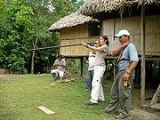
Huaorani

Encyclopedia
The Huaorani, Waorani or Waodani, also known as the Waos, are native Amerindians from the Amazonian Region of Ecuador
(Napo
, Orellana and Pastaza Province
s) who have marked differences from other ethnic groups from Ecuador. The alternate name Auca is a pejorative exonym used by the neighboring Quechua Indians, and commonly adopted by Spanish-speakers as well. Auca – awqa in Quechua
– means "enemy". They comprise almost 4,000 inhabitants and speak the Huaorani language
, a linguistic isolate
that is not known to be related to any other language. Their ancestral lands are located between the Curaray
and Napo
rivers, about 50 miles (80 km) south of El Coca
. These homelands – approximately 120 miles (190 km) wide and 75 to 100 miles (120 to 160 km) from north to south – are threatened by oil
exploration and illegal logging
practices. In the past, Huaorani were able to protect their culture and lands from both indigenous
enemies and settlers.
In the last 40 years, they have shifted from a hunting and gathering society to live mostly in permanent forest settlements. As many as five communities – the Tagaeri
, the Huiñatare, the Oñamenane, and two groups of the Taromenane
– have rejected all contact with the outside world and continue to move into more isolated areas.
/oil exploration.
The name Waodani (or the alternative English spelling Waorani) represents a transliteration by English-speaking missionary linguists. The phonetic equivalent used by Spanish-speakers is Huaorani (reflecting the absence of w in Spanish spelling.) The sounds represented by the English and Spanish letters d, r and n are allophones in Wao Tededo.
Waodani worldview, there is no distinction between the physical and spiritual world
s, and spirits are present throughout the world. The Waodani once believed that the entire world was a forest (and used the same word, ömë, for both). The Oriente’s rainforest remains the essential basis of their physical and cultural survival. For them, the forest is home, while the outside world is considered unsafe: living in the forest offered protection from the witchcraft
and attacks of neighboring peoples. In short, as one Huaorani put it, “The rivers and trees are our life.” In all its specificities, the forest is woven into each Huaorani’s life and conceptions of the world. They have remarkably detailed knowledge of its geography and ecology.
The Waodani believe the animals of their forest have a spiritual as well as physical existence. They believe that a person who dies walks a trail to the afterlife
which has a large anaconda
snake lying in wait. Those among the dead who cannot escape the snake fail to enter the domain of dead spirits and return to Earth to become animals, often termite
s. This underlies a mix of practices that recognize and respect animals, but does not shield them from harm for human use.
Hunting supplies a major part of the Waodani diet
and is of cultural significance. Traditionally, the creatures hunted were limited to monkey
s, birds, and wild peccaries
. Neither land-based predators nor birds of prey are hunted. Traditionally there was an extensive collection of hunting and eating taboos. They refused to eat deer
, on the grounds that deer eyes look similar to human eyes. While a joyful activity, hunting (even permitted animals) has ethical ramifications: “The Huaorani must kill animals to live, but they believed dead animal spirits live on and must be placated or else do harm in angry retribution.” To counterbalance the offense of hunting, a shaman demonstrated respect through the ritual preparation of the poison, curare
, used in blow darts. Hunting with such darts is not considered killing, but retrieving, essentially a kind of harvesting from the trees. Spearing wild peccaries
, on the other hand, is killing and is practiced with violence and rage.
While never hunted, two other animals, the snake
and the jaguar
, have special significance for the Huaorani. Snakes are considered "the most evil force in the Huaorani cosmology", particularly the imposing (though nonvenemous) anaconda
, or obe. A giant obe stands in the way of the forest trail that the dead follow to an afterlife
with the creator in the sky. Here on earth, snakes are a bad omen
, and traditionally killing them is considered taboo
.
The Waodani identify deeply with the jaguar, an important and majestic predator in the Oriente. According to myth, the Huaorani were the descendants of a mating between a jaguar and an eagle
. Elders became shamans by metaphorically adopting “jaguar sons” whose spirits communicate medical and spiritual knowledge. In the Huaorani belief system, jaguar shamans are able “to become a jaguar, and so to travel great distances telepathically and communicate with other Huaorani.”
Plants, especially trees, continue to hold a complex and important interest for the Huaorani. Their store of botanical
knowledge is extensive, ranging from knowledge of materials to poison
s to hallucinogens to medicine
s. They also relate plants to their own experiences, particularly that of growing. Among trees, certain kinds are auspicious. Canopy tree
s, with their distinctly colored young leaves and striking transformation as they mature to towering giants, are “admired for their solitary character … as well as for their profuse entanglement” with other plants. Other significant trees are the pioneer species of the peach palm
(used for making spears and blowguns, as well as for fruit), and fast-growing balsa wood
, used for ceremonial purposes. Peach palm trees are associated with past settlements and the ancestors who live there.
As with many peoples, the Waos maintain a strong in-group/out-group distinction, between Waodani (people who are kin
), Waodoni (others in their culture who are unrelated) and Cowodi. The use of Waodani as a term for their entire culture emerged in the last fifty years in a process of ethnogenesis
. This was accelerated by the creation of ONHAE, a radio
service, and a soccer league.
The Waodani notion of time is particularly oriented to the present, with few obligations extending backwards or forwards in time. Their one word for future times, baane, also means "tomorrow".
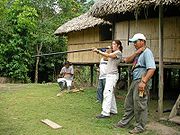 Spears are the main weapons of the Waodani culture used in person to person conflict.
Their main hunting weapon is the blowgun
. These weapons are typically from 3 to 4 metres long. The arrows used are dipped in curare poison, which paralyzes the muscles of the animal which is hit with it, so that it cannot breathe. Kapok
fluff is used to create an air-tight seal, by twisting the fibers around the end of the dart or arrow. With the introduction of Western technology in the 20th century, many Waodani now use rifles for hunting.
, especially cross-cousin marriages — a woman may marry her cousin(s) from one or more sisters on her father's side, or from brother(s) on her mother's side (and necessarily vice-versa with regard to females and their marriage choices). The men may also have multiple wives
. Sometimes, a man would kill another man to gain another wife; this was traditionally common if a man had no available cousin to marry.
Huaorani women remove all their body hair by first rubbing ash in the areas where they do not want hair – supposedly to reduce the pain – then pull out the hair.
, inter-clan killings greatly increased. At this time, it was estimated that up to 60% of all Huaorani deaths were due to murder. Some of the Huaorani trace the beginning of the killing to the breakdown of clan relationships around ten generations prior to this time. Prior to this period, large gatherings frequently brought distant clans together from time to time to celebrate and arrange marriages, among other activities. These were organized by informal tribal leaders (although the Huaorani had no chiefs or formal leadership in general). When these gatherings became less common, clans became estranged from and offended by one another. Conflicts began to escalate until the Huaorani became one of the most violent cultures ever documented.
In 1956, a group of five American
missionaries
, led by Jim Elliot
and pilot Nate Saint
, made contact with the Huaorani in what was known as Operation Auca
. Two days after friendly contact with three Huaorani, a larger group from the same Huaorani clan killed all five of the missionaries in a spearing attack. Nate Saint's sister, Rachel Saint, prior to these killings, had befriended a Huaorani woman named Dayuma. Saint, Dayuma, and Jim Elliot's wife Elisabeth convert
ed the majority of that Huaorani villiage to Christianity
. The incident was told in the film End of the Spear
. Nate Saint's personal story, Jungle Pilot, with an epilogue by his son, Steve Saint, was written in 1997.
Huaroni reliance upon missionaries for dealing with the outside world did, however, eventually allow increased oil scouting in the area over the years. With the discovery by Texaco
of large petroleum reserves in the Ecuadorian Amazon rainforest in 1968, potential for conflict was again renewed. Eventually a deal was brokered in which many of the Huaorani were subsequently concentrated into a protectorate
under the responsibility of SIL International
.
Huaorani schools were set up to teach the Bible and beliefs of Christianity
. Teachers were mainly of the neighboring Quichua. New systems of government were also introduced.
Currently (2008), the Huaorani have about 6,800 km² of land, about one third of their original territory. Some work with tourism companies, and others obtain education until university level. Half of the small children attend schools in Spanish
, but others still spend their days hunting and gathering.
depended on the knowledge of members from a Huaorani village to film Episode 12 of Season 2's Survivorman
. This episode was originally aired on August 17, 2007 and entitled "Amazon". He was lent a blowgun along with the related equipment, and among other things, a dugout canoe
. At one point in the episode, Stroud relates that he was near the edge of Tagaeri territory. The month before his arrival, several of his Huaorani benefactors had gone upriver and performed a spearing raid on the Tagaeri. It was entirely possible that a revenge spearing might have been performed against Huaorani village while he was being taught there. He explains that because of such incidents, natives of the area go to sleep with an escape route in mind in the event of a night attack. Stroud's safety crew stayed in the village, housed in a hut built with visitors in mind.
The end of filming was unexpectedly decided for Stroud when he realized that a jaguar was coming dangerously close to him, forcing him to flee to the Huaorani village with whatever survival equipment he could grab and two of his cameras. The jaguar more than likely stalked him all the way back, and Stroud was told that another jaguar had followed two village women who quickly returned to the safety of the village not long before he had. That night Stroud and the Huaorani could hear jaguar growls on the other side of a wall.
It turns out that the village had prepared a celebration for his week of survival and successful return. Stroud later learned that a village elder had spent 10 hours out in the jungle, catching tapir
and monkey for the feast.
covering some 6,125.60 square kilometers. The protected status of Yasuní National Park
, which overlaps with the Huaorani reserve, provides some measure of environmental protection. Additionally, the government has created a protected zone to avoid contact with the Tagaeri.
Ecuador
Ecuador , officially the Republic of Ecuador is a representative democratic republic in South America, bordered by Colombia on the north, Peru on the east and south, and by the Pacific Ocean to the west. It is one of only two countries in South America, along with Chile, that do not have a border...
(Napo
Napo Province
Napo is a province in Ecuador. Its capital is Tena. The province contains the Napo River. The province is low developed without much industrial presence. The thick rainforest is home to many natives that remain isolated by preference, descendents of those who fled the Spanish invasion in the Andes,...
, Orellana and Pastaza Province
Pastaza Province
Pastaza is a province in the Oriente of Ecuador located in the eastern jungle. The capital is Puyo, founded on May 12, 1899 and which boasts 25,800 inhabitants...
s) who have marked differences from other ethnic groups from Ecuador. The alternate name Auca is a pejorative exonym used by the neighboring Quechua Indians, and commonly adopted by Spanish-speakers as well. Auca – awqa in Quechua
Quechua languages
Quechua is a Native South American language family and dialect cluster spoken primarily in the Andes of South America, derived from an original common ancestor language, Proto-Quechua. It is the most widely spoken language family of the indigenous peoples of the Americas, with a total of probably...
– means "enemy". They comprise almost 4,000 inhabitants and speak the Huaorani language
Huaorani language
The Huaorani language, commonly known as Sabela is a language isolate spoken by the Huaorani people, an indigenous group living in the Amazon Rainforest between the Napo and Curaray Rivers...
, a linguistic isolate
Isolate
Isolate may refer to:* Genetic isolate, a population of organisms that has little genetic mixing with other organisms of the same species* Isolate , 2007* Isolate , 1992...
that is not known to be related to any other language. Their ancestral lands are located between the Curaray
Curaray River
The Curaray River is a river in eastern Ecuador and is part of the Amazon River basin. The land along the river is home to several indigenous people groups including the Quechua and Huaorani...
and Napo
Napo River
The Napo is a tributary to the Amazon River that rises in Ecuador on the flanks of the volcanoes of Antisana, Sincholagua and Cotopaxi.The total length of 1075 km. Catchment area of 100,518 square kilometers...
rivers, about 50 miles (80 km) south of El Coca
El Coca
Puerto Francisco de Orellana, also known as Coca, is the capital of province of Orellana in eastern Ecuador. The city is located in the Amazon Rainforest at the confluence of the Coca River and the Napo River. It has a population of 30,300 inhabitants as of 2010...
. These homelands – approximately 120 miles (190 km) wide and 75 to 100 miles (120 to 160 km) from north to south – are threatened by oil
Petroleum
Petroleum or crude oil is a naturally occurring, flammable liquid consisting of a complex mixture of hydrocarbons of various molecular weights and other liquid organic compounds, that are found in geologic formations beneath the Earth's surface. Petroleum is recovered mostly through oil drilling...
exploration and illegal logging
Logging
Logging is the cutting, skidding, on-site processing, and loading of trees or logs onto trucks.In forestry, the term logging is sometimes used in a narrow sense concerning the logistics of moving wood from the stump to somewhere outside the forest, usually a sawmill or a lumber yard...
practices. In the past, Huaorani were able to protect their culture and lands from both indigenous
Indigenous peoples of the Americas
The indigenous peoples of the Americas are the pre-Columbian inhabitants of North and South America, their descendants and other ethnic groups who are identified with those peoples. Indigenous peoples are known in Canada as Aboriginal peoples, and in the United States as Native Americans...
enemies and settlers.
In the last 40 years, they have shifted from a hunting and gathering society to live mostly in permanent forest settlements. As many as five communities – the Tagaeri
Tagaeri
The Tagaeri are a clan of Huaorani people living in Yasuni National Park, at the Ecuadorian Amazon Basin, named for their association with the warrior Taga...
, the Huiñatare, the Oñamenane, and two groups of the Taromenane
Taromenane
The Taromenane are an uncontacted clan living in Yasuni National Park, at the Ecuadorian Amazon Basin.Together with the Tagaeri they make up the two last known indigenous groups living in voluntary isolation in Ecuador....
– have rejected all contact with the outside world and continue to move into more isolated areas.
Etymology
The word Waodani (plural of Wao "person") means "humans" or "men" in Wao Tiriro. Before the mid 20th century, it included only those kin associated with the speaker. Others in the ethnic group were called Waodoni, while outsiders were and are known by the derogatory term Cowodi. This structure duplicates the in-group/out-group naming conventions used by many peoples. It reflects a period of traumatic conflict with outsiders during the 19th and early 20th century rubber boomRubber boom
The rubber boom was an important part of the economic and social history of Brazil and Amazonian regions of neighboring countries, being related with the extraction and commercialization of rubber...
/oil exploration.
The name Waodani (or the alternative English spelling Waorani) represents a transliteration by English-speaking missionary linguists. The phonetic equivalent used by Spanish-speakers is Huaorani (reflecting the absence of w in Spanish spelling.) The sounds represented by the English and Spanish letters d, r and n are allophones in Wao Tededo.
Subdivision
The Waodani are subdivided into the Huamuno Dayuno, Quehueruno, Garzacocha (Yasuní River), Quemperi (Cononaco River) Mima, and Caruhue.Worldview
In traditional animistAnimism
Animism refers to the belief that non-human entities are spiritual beings, or at least embody some kind of life-principle....
Waodani worldview, there is no distinction between the physical and spiritual world
Spirit world (spiritualism)
The spirit world, according to Spiritualism, is the world inhabited by spirits. Though a concept of a spirit world is in the constitution of most religions, it is not "itself the religion". Whereas religion regards an inner life, the spirit world is regarded as an external environment for spirits...
s, and spirits are present throughout the world. The Waodani once believed that the entire world was a forest (and used the same word, ömë, for both). The Oriente’s rainforest remains the essential basis of their physical and cultural survival. For them, the forest is home, while the outside world is considered unsafe: living in the forest offered protection from the witchcraft
Witchcraft
Witchcraft, in historical, anthropological, religious, and mythological contexts, is the alleged use of supernatural or magical powers. A witch is a practitioner of witchcraft...
and attacks of neighboring peoples. In short, as one Huaorani put it, “The rivers and trees are our life.” In all its specificities, the forest is woven into each Huaorani’s life and conceptions of the world. They have remarkably detailed knowledge of its geography and ecology.
The Waodani believe the animals of their forest have a spiritual as well as physical existence. They believe that a person who dies walks a trail to the afterlife
Afterlife
The afterlife is the belief that a part of, or essence of, or soul of an individual, which carries with it and confers personal identity, survives the death of the body of this world and this lifetime, by natural or supernatural means, in contrast to the belief in eternal...
which has a large anaconda
Anaconda
An anaconda is a large, non-venomous snake found in tropical South America. Although the name actually applies to a group of snakes, it is often used to refer only to one species in particular, the common or green anaconda, Eunectes murinus, which is one of the largest snakes in the world.Anaconda...
snake lying in wait. Those among the dead who cannot escape the snake fail to enter the domain of dead spirits and return to Earth to become animals, often termite
Termite
Termites are a group of eusocial insects that, until recently, were classified at the taxonomic rank of order Isoptera , but are now accepted as the epifamily Termitoidae, of the cockroach order Blattodea...
s. This underlies a mix of practices that recognize and respect animals, but does not shield them from harm for human use.
Hunting supplies a major part of the Waodani diet
Diet (nutrition)
In nutrition, diet is the sum of food consumed by a person or other organism. Dietary habits are the habitual decisions an individual or culture makes when choosing what foods to eat. With the word diet, it is often implied the use of specific intake of nutrition for health or weight-management...
and is of cultural significance. Traditionally, the creatures hunted were limited to monkey
Monkey
A monkey is a primate, either an Old World monkey or a New World monkey. There are about 260 known living species of monkey. Many are arboreal, although there are species that live primarily on the ground, such as baboons. Monkeys are generally considered to be intelligent. Unlike apes, monkeys...
s, birds, and wild peccaries
Peccary
A peccary is a medium-sized mammal of the family Tayassuidae, or New World Pigs. Peccaries are members of the artiodactyl suborder Suina, as are the pig family and possibly the hippopotamus family...
. Neither land-based predators nor birds of prey are hunted. Traditionally there was an extensive collection of hunting and eating taboos. They refused to eat deer
Deer
Deer are the ruminant mammals forming the family Cervidae. Species in the Cervidae family include white-tailed deer, elk, moose, red deer, reindeer, fallow deer, roe deer and chital. Male deer of all species and female reindeer grow and shed new antlers each year...
, on the grounds that deer eyes look similar to human eyes. While a joyful activity, hunting (even permitted animals) has ethical ramifications: “The Huaorani must kill animals to live, but they believed dead animal spirits live on and must be placated or else do harm in angry retribution.” To counterbalance the offense of hunting, a shaman demonstrated respect through the ritual preparation of the poison, curare
Curare
Curare is a common name for various arrow poisons originating from South America. The three main types of curare are:* tubocurare...
, used in blow darts. Hunting with such darts is not considered killing, but retrieving, essentially a kind of harvesting from the trees. Spearing wild peccaries
Peccary
A peccary is a medium-sized mammal of the family Tayassuidae, or New World Pigs. Peccaries are members of the artiodactyl suborder Suina, as are the pig family and possibly the hippopotamus family...
, on the other hand, is killing and is practiced with violence and rage.
While never hunted, two other animals, the snake
Snake
Snakes are elongate, legless, carnivorous reptiles of the suborder Serpentes that can be distinguished from legless lizards by their lack of eyelids and external ears. Like all squamates, snakes are ectothermic, amniote vertebrates covered in overlapping scales...
and the jaguar
Jaguar
The jaguar is a big cat, a feline in the Panthera genus, and is the only Panthera species found in the Americas. The jaguar is the third-largest feline after the tiger and the lion, and the largest in the Western Hemisphere. The jaguar's present range extends from Southern United States and Mexico...
, have special significance for the Huaorani. Snakes are considered "the most evil force in the Huaorani cosmology", particularly the imposing (though nonvenemous) anaconda
Anaconda
An anaconda is a large, non-venomous snake found in tropical South America. Although the name actually applies to a group of snakes, it is often used to refer only to one species in particular, the common or green anaconda, Eunectes murinus, which is one of the largest snakes in the world.Anaconda...
, or obe. A giant obe stands in the way of the forest trail that the dead follow to an afterlife
Afterlife
The afterlife is the belief that a part of, or essence of, or soul of an individual, which carries with it and confers personal identity, survives the death of the body of this world and this lifetime, by natural or supernatural means, in contrast to the belief in eternal...
with the creator in the sky. Here on earth, snakes are a bad omen
Omen
An omen is a phenomenon that is believed to foretell the future, often signifying the advent of change...
, and traditionally killing them is considered taboo
Taboo
A taboo is a strong social prohibition relating to any area of human activity or social custom that is sacred and or forbidden based on moral judgment, religious beliefs and or scientific consensus. Breaking the taboo is usually considered objectionable or abhorrent by society...
.
The Waodani identify deeply with the jaguar, an important and majestic predator in the Oriente. According to myth, the Huaorani were the descendants of a mating between a jaguar and an eagle
Eagle
Eagles are members of the bird family Accipitridae, and belong to several genera which are not necessarily closely related to each other. Most of the more than 60 species occur in Eurasia and Africa. Outside this area, just two species can be found in the United States and Canada, nine more in...
. Elders became shamans by metaphorically adopting “jaguar sons” whose spirits communicate medical and spiritual knowledge. In the Huaorani belief system, jaguar shamans are able “to become a jaguar, and so to travel great distances telepathically and communicate with other Huaorani.”
Plants, especially trees, continue to hold a complex and important interest for the Huaorani. Their store of botanical
Botany
Botany, plant science, or plant biology is a branch of biology that involves the scientific study of plant life. Traditionally, botany also included the study of fungi, algae and viruses...
knowledge is extensive, ranging from knowledge of materials to poison
Poison
In the context of biology, poisons are substances that can cause disturbances to organisms, usually by chemical reaction or other activity on the molecular scale, when a sufficient quantity is absorbed by an organism....
s to hallucinogens to medicine
Medicine
Medicine is the science and art of healing. It encompasses a variety of health care practices evolved to maintain and restore health by the prevention and treatment of illness....
s. They also relate plants to their own experiences, particularly that of growing. Among trees, certain kinds are auspicious. Canopy tree
Canopy (forest)
In biology, the canopy is the aboveground portion of a plant community or crop, formed by plant crowns.For forests, canopy also refers to the upper layer or habitat zone, formed by mature tree crowns and including other biological organisms .Sometimes the term canopy is used to refer to the extent...
s, with their distinctly colored young leaves and striking transformation as they mature to towering giants, are “admired for their solitary character … as well as for their profuse entanglement” with other plants. Other significant trees are the pioneer species of the peach palm
Bactris gasipaes
Bactris gasipaes is a species of palm native to the tropical forests of South and Central America.There are numerous common names for this plant in several languages and many countries...
(used for making spears and blowguns, as well as for fruit), and fast-growing balsa wood
Balsa
Ochroma pyramidale, commonly known as the balsa tree , is a species of flowering plant in the mallow family, Malvaceae. It is a large, fast-growing tree that can grow up to tall. It is the source of balsa wood, a very lightweight material with many uses...
, used for ceremonial purposes. Peach palm trees are associated with past settlements and the ancestors who live there.
As with many peoples, the Waos maintain a strong in-group/out-group distinction, between Waodani (people who are kin
Kin
-Places:* Kin, Okinawa, a town in Okinawa, Japan* Kin, Pakistan, a village along the Indus in Pakistan* Kin, Mogok, a village in Mogok Township, Burma * Kin, Ye, a village in Ye Township, Burma...
), Waodoni (others in their culture who are unrelated) and Cowodi. The use of Waodani as a term for their entire culture emerged in the last fifty years in a process of ethnogenesis
Ethnogenesis
Ethnogenesis is the process by which a group of human beings comes to be understood or to understand themselves as ethnically distinct from the wider social landscape from which their grouping emerges...
. This was accelerated by the creation of ONHAE, a radio
Radio
Radio is the transmission of signals through free space by modulation of electromagnetic waves with frequencies below those of visible light. Electromagnetic radiation travels by means of oscillating electromagnetic fields that pass through the air and the vacuum of space...
service, and a soccer league.
The Waodani notion of time is particularly oriented to the present, with few obligations extending backwards or forwards in time. Their one word for future times, baane, also means "tomorrow".
Weapons
Their main hunting weapon is the blowgun
Blowgun
"Blowpipe" and "blow tube" redirect here. For other uses of the terms, see GlassblowingA blowgun is a simple weapon consisting of a small tube for firing light projectiles, or darts....
. These weapons are typically from 3 to 4 metres long. The arrows used are dipped in curare poison, which paralyzes the muscles of the animal which is hit with it, so that it cannot breathe. Kapok
Kapok
Ceiba pentandra is a tropical tree of the order Malvales and the family Malvaceae , native to Mexico, Central America and the Caribbean, northern South America, and to tropical west Africa...
fluff is used to create an air-tight seal, by twisting the fibers around the end of the dart or arrow. With the introduction of Western technology in the 20th century, many Waodani now use rifles for hunting.
Marriage
Waodani families practiced endogamyEndogamy
Endogamy is the practice of marrying within a specific ethnic group, class, or social group, rejecting others on such basis as being unsuitable for marriage or other close personal relationships. A Greek Orthodox Christian endogamist, for example, would require that a marriage be only with another...
, especially cross-cousin marriages — a woman may marry her cousin(s) from one or more sisters on her father's side, or from brother(s) on her mother's side (and necessarily vice-versa with regard to females and their marriage choices). The men may also have multiple wives
Polygyny
Polygyny is a form of marriage in which a man has two or more wives at the same time. In countries where the practice is illegal, the man is referred to as a bigamist or a polygamist...
. Sometimes, a man would kill another man to gain another wife; this was traditionally common if a man had no available cousin to marry.
Huaorani women remove all their body hair by first rubbing ash in the areas where they do not want hair – supposedly to reduce the pain – then pull out the hair.
Recent history
Around the time of World War IIWorld War II
World War II, or the Second World War , was a global conflict lasting from 1939 to 1945, involving most of the world's nations—including all of the great powers—eventually forming two opposing military alliances: the Allies and the Axis...
, inter-clan killings greatly increased. At this time, it was estimated that up to 60% of all Huaorani deaths were due to murder. Some of the Huaorani trace the beginning of the killing to the breakdown of clan relationships around ten generations prior to this time. Prior to this period, large gatherings frequently brought distant clans together from time to time to celebrate and arrange marriages, among other activities. These were organized by informal tribal leaders (although the Huaorani had no chiefs or formal leadership in general). When these gatherings became less common, clans became estranged from and offended by one another. Conflicts began to escalate until the Huaorani became one of the most violent cultures ever documented.
In 1956, a group of five American
United States
The United States of America is a federal constitutional republic comprising fifty states and a federal district...
missionaries
Missionary
A missionary is a member of a religious group sent into an area to do evangelism or ministries of service, such as education, literacy, social justice, health care and economic development. The word "mission" originates from 1598 when the Jesuits sent members abroad, derived from the Latin...
, led by Jim Elliot
Jim Elliot
Philip James Elliot was an evangelical Christian who was one of five missionaries killed while participating in Operation Auca, an attempt to evangelize the Waodani people of Ecuador.-Early life:...
and pilot Nate Saint
Nate Saint
Nathanael "Nate" Saint was an evangelical Christian missionary pilot to Ecuador who, along with four others, was killed while attempting to evangelize the Waodani people through efforts known as Operation Auca....
, made contact with the Huaorani in what was known as Operation Auca
Operation Auca
Operation Auca was an attempt by five Evangelical Christian missionaries from the United States to bring the gospel to the Huaorani people of the rainforest of Ecuador...
. Two days after friendly contact with three Huaorani, a larger group from the same Huaorani clan killed all five of the missionaries in a spearing attack. Nate Saint's sister, Rachel Saint, prior to these killings, had befriended a Huaorani woman named Dayuma. Saint, Dayuma, and Jim Elliot's wife Elisabeth convert
Convert
The convert or try, in American football known as "point after", and Canadian football "Point after touchdown", is a one-scrimmage down played immediately after a touchdown during which the scoring team is allowed to attempt to score an extra one point by kicking the ball through the uprights , or...
ed the majority of that Huaorani villiage to Christianity
Christianity
Christianity is a monotheistic religion based on the life and teachings of Jesus as presented in canonical gospels and other New Testament writings...
. The incident was told in the film End of the Spear
End of the Spear
End of the Spear is a 2006 docudrama film that recounts the story of Operation Auca, in which five American Christian missionaries attempted to evangelize the Huaorani people of the jungle of Ecuador...
. Nate Saint's personal story, Jungle Pilot, with an epilogue by his son, Steve Saint, was written in 1997.
Huaroni reliance upon missionaries for dealing with the outside world did, however, eventually allow increased oil scouting in the area over the years. With the discovery by Texaco
Texaco
Texaco is the name of an American oil retail brand. Its flagship product is its fuel "Texaco with Techron". It also owns the Havoline motor oil brand....
of large petroleum reserves in the Ecuadorian Amazon rainforest in 1968, potential for conflict was again renewed. Eventually a deal was brokered in which many of the Huaorani were subsequently concentrated into a protectorate
Protectorate
In history, the term protectorate has two different meanings. In its earliest inception, which has been adopted by modern international law, it is an autonomous territory that is protected diplomatically or militarily against third parties by a stronger state or entity...
under the responsibility of SIL International
SIL International
SIL International is a U.S.-based, worldwide, Christian non-profit organization, whose main purpose is to study, develop and document languages, especially those that are lesser-known, in order to expand linguistic knowledge, promote literacy, translate the Christian Bible into local languages,...
.
Huaorani schools were set up to teach the Bible and beliefs of Christianity
Christianity
Christianity is a monotheistic religion based on the life and teachings of Jesus as presented in canonical gospels and other New Testament writings...
. Teachers were mainly of the neighboring Quichua. New systems of government were also introduced.
Currently (2008), the Huaorani have about 6,800 km² of land, about one third of their original territory. Some work with tourism companies, and others obtain education until university level. Half of the small children attend schools in Spanish
Spanish language
Spanish , also known as Castilian , is a Romance language in the Ibero-Romance group that evolved from several languages and dialects in central-northern Iberia around the 9th century and gradually spread with the expansion of the Kingdom of Castile into central and southern Iberia during the...
, but others still spend their days hunting and gathering.
Survivorman
Canadian filmmaker and survival expert Les StroudLes Stroud
Les Stroud is a Canadian musician, filmmaker, and survival expert best known as the creator, writer, producer, director, cameraman and host of the television series Survivorman...
depended on the knowledge of members from a Huaorani village to film Episode 12 of Season 2's Survivorman
Survivorman
Survivorman is a Canadian-produced television program, broadcast in Canada on the Outdoor Life Network , and internationally on Discovery Channel and Science Channel...
. This episode was originally aired on August 17, 2007 and entitled "Amazon". He was lent a blowgun along with the related equipment, and among other things, a dugout canoe
Canoe
A canoe or Canadian canoe is a small narrow boat, typically human-powered, though it may also be powered by sails or small electric or gas motors. Canoes are usually pointed at both bow and stern and are normally open on top, but can be decked over A canoe (North American English) or Canadian...
. At one point in the episode, Stroud relates that he was near the edge of Tagaeri territory. The month before his arrival, several of his Huaorani benefactors had gone upriver and performed a spearing raid on the Tagaeri. It was entirely possible that a revenge spearing might have been performed against Huaorani village while he was being taught there. He explains that because of such incidents, natives of the area go to sleep with an escape route in mind in the event of a night attack. Stroud's safety crew stayed in the village, housed in a hut built with visitors in mind.
The end of filming was unexpectedly decided for Stroud when he realized that a jaguar was coming dangerously close to him, forcing him to flee to the Huaorani village with whatever survival equipment he could grab and two of his cameras. The jaguar more than likely stalked him all the way back, and Stroud was told that another jaguar had followed two village women who quickly returned to the safety of the village not long before he had. That night Stroud and the Huaorani could hear jaguar growls on the other side of a wall.
It turns out that the village had prepared a celebration for his week of survival and successful return. Stroud later learned that a village elder had spent 10 hours out in the jungle, catching tapir
Tapir
A Tapir is a large browsing mammal, similar in shape to a pig, with a short, prehensile snout. Tapirs inhabit jungle and forest regions of South America, Central America, and Southeast Asia. There are four species of Tapirs: the Brazilian Tapir, the Malayan Tapir, Baird's Tapir and the Mountain...
and monkey for the feast.
Land rights
In 1990, the Waodani won the rights to an indigenous reserveReserve
-Economic:* Official gold reserves, held by central banks as a store of value* Foreign exchange reserves, the foreign currency deposits held by central banks and monetary authorities...
covering some 6,125.60 square kilometers. The protected status of Yasuní National Park
Yasuni National Park
Yasuni National Park is in Ecuador with an area of 9,820 km2 between the Napo and Curaray rivers in Napo and Pastaza provinces in Amazonian Ecuador. The park is about 250 km from Quito and was designated a UNESCO Biosphere Reserve in 1989...
, which overlaps with the Huaorani reserve, provides some measure of environmental protection. Additionally, the government has created a protected zone to avoid contact with the Tagaeri.
See also
- Beyond the Gates of SplendorBeyond the Gates of SplendorBeyond the Gates of Splendor is a feature-length documentary film that was released in 2004. It chronicles the events leading up to and following Operation Auca, an attempt to contact the Huaorani tribe of Ecuador in which five American missionaries were killed...
(2005). [Documentary]. - List of Huaorani people
- Operation AucaOperation AucaOperation Auca was an attempt by five Evangelical Christian missionaries from the United States to bring the gospel to the Huaorani people of the rainforest of Ecuador...
- Steve SaintSteve SaintStephen Farris Saint is an Ecuadorian-born business entrepreneur, pilot, and author. He is known for being the son of Nate Saint, a famous missionary pilot, as well as for his own work among indigenous tribes.-Early life:...
- Jungle Pilot