
"Blowpipe" and "blow tube" redirect here. For other uses of the terms, see GlassblowingGlassblowing is a glassforming technique that involves inflating the molten glass into a bubble, or parison, with the aid of the blowpipe, or blow tube...
A
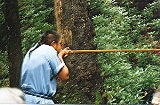
blowgun (also called a
blowpipe or
blow tube) is a simple
weaponA weapon is a tool used to apply force for the purpose of hunting, attack, self-defense, or defense in combat.Weapons can be as simple as a club, or as complex as an intercontinental ballistic missile, and include those that damage individual or group morale.-Prehistoric weapons:Very simple weapon...
consisting of a small tube for firing light
projectileA projectile is any object propelled through space by the exertion of a force which ceases after launch. Although a thrown baseball could be considered a projectile, the word more often refers to a weapon...
s, or
dartDarts are missile weapons, designed to fly such that a sharp, often weighted point will strike first. They can be distinguished from javelins by fletching and a shaft that is shorter and/or more flexible, and from arrows by the fact that they are not of the right length to use with a normal...
s. The wielder blows into one end, forcing the dart out the other. Its propulsive power is limited by its user's respiratory muscles. Sometimes, for increased effectiveness, the dart is tipped with a
poisonIn the context of biology, poisons are substances that can cause disturbances to organisms, usually by chemical reaction or other activity on the molecular scale, when a sufficient quantity is absorbed by an organism...
, most famously
curareCurare is a common name for various arrow poisons originating from South America. The three main types of curare are:* tubocurare...
.
Many cultures have used this weapon, but various indigenous rain forest tribes in
South AmericaSouth America is the southern continent of the Americas, situated entirely in the Western Hemisphere and mostly in the Southern Hemisphere, with a relatively small portion in the Northern Hemisphere...
and South East Asia are the best-known users.
"Blowpipe" and "blow tube" redirect here. For other uses of the terms, see GlassblowingGlassblowing is a glassforming technique that involves inflating the molten glass into a bubble, or parison, with the aid of the blowpipe, or blow tube...
A
blowgun (also called a
blowpipe or
blow tube) is a simple
weaponA weapon is a tool used to apply force for the purpose of hunting, attack, self-defense, or defense in combat.Weapons can be as simple as a club, or as complex as an intercontinental ballistic missile, and include those that damage individual or group morale.-Prehistoric weapons:Very simple weapon...
consisting of a small tube for firing light
projectileA projectile is any object propelled through space by the exertion of a force which ceases after launch. Although a thrown baseball could be considered a projectile, the word more often refers to a weapon...
s, or
dartDarts are missile weapons, designed to fly such that a sharp, often weighted point will strike first. They can be distinguished from javelins by fletching and a shaft that is shorter and/or more flexible, and from arrows by the fact that they are not of the right length to use with a normal...
s. The wielder blows into one end, forcing the dart out the other. Its propulsive power is limited by its user's respiratory muscles. Sometimes, for increased effectiveness, the dart is tipped with a
poisonIn the context of biology, poisons are substances that can cause disturbances to organisms, usually by chemical reaction or other activity on the molecular scale, when a sufficient quantity is absorbed by an organism...
, most famously
curareCurare is a common name for various arrow poisons originating from South America. The three main types of curare are:* tubocurare...
.
Many cultures have used this weapon, but various indigenous rain forest tribes in
South AmericaSouth America is the southern continent of the Americas, situated entirely in the Western Hemisphere and mostly in the Southern Hemisphere, with a relatively small portion in the Northern Hemisphere...
and South East Asia are the best-known users. Blowguns were very rarely used by these tribes as
anti-personnel weaponAn anti-personnel weapon is one primarily used to injure or kill people. Because these do not discriminate between soldiers and civilians, there are international political movements to ban these various weapons...
s, but primarily to hunt small game such as
monkeyA monkey is any cercopithecoid or platyrrhine primate. All primates that are not prosimians or apes are monkeys. The 264 known extant monkey species represent two of the three groupings of simian primates...
s.
North American CherokeesThe Cherokee are a Native American people from the Southeastern United States...
were known for making blowguns out of
river caneArundinaria, commonly known as the canes, is the sole temperate genus of bamboo native to the New World . The genus is endemic to the eastern United States from New Jersey south to Florida and west to Ohio and Texas. Within this region they are found from the Coastal Plain to medium elevations in...
to supplement their diet with
rabbitRabbits are small mammals in the family Leporidae of the order Lagomorpha, found in several parts of the world. There are seven different genera in the family classified as rabbits, including the European rabbit , Cottontail rabbit , and the Amami rabbit...
s and other small creatures.
Today blowguns are used with tranquilizer darts to capture wildlife or to stun caged dangerous animals.
HerpetologistHerpetology is the branch of zoology concerned with the study of amphibians and of reptiles .Herpetology is concerned with poikilothermic,...
s use blowguns to capture elusive
lizardLizards are a very large and widespread group of squamate reptiles, with nearly 5,000 species, ranging across all continents except Antarctica as well as most oceanic island chains...
s with stun darts. Blowguns are also used recreationally, with either darts or paintballs.
Sport blowgun
See also FukiyaFukiya is the Japanese blowgun. It consists of a 4 feet long tube blowgun, with darts around 20cm . Unlike American-style blowguns, the fukiya has no mouthpiece: instead, users wrap their lips around the pipe. The darts used in the fukiya were called fukibari...
for standards pursued by the International Fukiyado Association (IFA).
There are several competition styles practiced around the world. A standardization of competition style, based upon
fukiyaFukiya is the Japanese blowgun. It consists of a 4 feet long tube blowgun, with darts around 20cm . Unlike American-style blowguns, the fukiya has no mouthpiece: instead, users wrap their lips around the pipe. The darts used in the fukiya were called fukibari...
, is being pursued by the International Fukiyado Association and hoped to become an Olympic event. It is a 10 meter target shooting, using a standardized barrel caliber and length, and a standardized dart length and weight, as outlined by IFA.
Two other styles are also being pursued to make up the Olympic blowgun event, both based upon the Cherokee Annual Gathering Blowgun Competition. The Field Style competition is similar to the winter Biathlon, where the shooter runs from a starting line to a target lane, shoots and retrieves the darts, and continue to the next station. The course length varies from 400 to 800 m or longer, with from 9 to 16 targets at various heights and shooting distances. The final style is the Long Distance target shoot. The target is a circle of 24 cm diameter, and the firing line is 20 meters away. Three darts are fired by each shooter, at least one of which must stick in the target. All successful shooters move to the next round, moving back two meters each time.
Sport blowgun competition is managed by the International Fukiya Association, with which national associations in the United States, France, Germany and the Philippines are affiliated.
Specifications
As a primitive weapon, there are no set dimension for blowgun's length and diameter. However, generally there are three sizes:
- Fukiya — diameter is 13 mm (.51 cal) in Japan. Tournament length is 120.0 cm, but for practice one can use a 50 cm tube. No mouthpiece is used; users wrap their lips around the tube. International versions can be slightly more flexible, allowing a tube of 121.92 cm (4 ft) and .50 cal under IFA rules. Darts consist of a paper cone 20 cm long, weighing 0.8 gram.
- Cherokee — made of river cane
Arundinaria, commonly known as the canes, is the sole temperate genus of bamboo native to the New World . The genus is endemic to the eastern United States from New Jersey south to Florida and west to Ohio and Texas. Within this region they are found from the Coastal Plain to medium elevations in...
, 6 to 9 feet long. Dart is 8 to 22 inches long, similar to a fukibari, but has tufts for an air seal.
- Modern (US/EU) — typically have a diameter of 10 mm (.40 cal), with varying length. Bell-shaped mouthpiece. Length limited to 121.92 cm (4 feet) in competition.
- Paintball marker — Made to be identical to the size of a paintball (.68 cal)
Legality
In the
United KingdomThe United Kingdom of Great Britain and Northern Ireland is a sovereign state located off the northwestern coast of continental Europe. It is an island country, spanning an archipelago including Great Britain, the northeastern part of Ireland, and many small islands...
, the blowgun is categorized as an offensive weapon under the 1988
Criminal Justice ActCriminal Justice Act is a stock short title used for legislation in the United Kingdom, the Republic of Ireland and Canada relating to the criminal law...
, and as such it is illegal to manufacture, sell or hire or offer for sale or hire, expose or have in one's possession for the purpose of sale or hire, or lend or give to any other person. Antique blowguns are, however, exempt.
In
CanadaCanada is a country occupying most of northern North America, extending from the Atlantic Ocean in the east to the Pacific Ocean in the west and northward into the Arctic Ocean...
, the blowgun is classified as a prohibited weapon and is defined as any device that "being a tube or pipe designed for the purpose of shooting arrows or darts by the breath". Any imported blowguns must be deactivated by either drilling a hole or by blocking it. On the other hand, like many prohibited weapons, it can be used in a legal shooting range, and can be transported through legal channels.
In the United States, blowguns are legal to have and use.
See also
- Fukiya
Fukiya is the Japanese blowgun. It consists of a 4 feet long tube blowgun, with darts around 20cm . Unlike American-style blowguns, the fukiya has no mouthpiece: instead, users wrap their lips around the pipe. The darts used in the fukiya were called fukibari...
Japanese blowgun
- Loire style Blowgun (French page)
- blowdart
A blowdart is a pipe-based weapon still employed by some indigenous peoples of the South East Asia, Amazon and Guiana regions of South America to hunt. The darts are usually dipped in curare poison in order to paralyze the target....
External links