

Texaco

Encyclopedia
Texaco is the name of an American
oil
retail brand. Its flagship product is its fuel "Texaco with Techron". It also owns the Havoline
motor oil
brand.
Texaco was an independent company until it merged into Chevron Corporation
in 2001. It began as the Texas Fuel Company, founded in 1901 in Beaumont, Texas
, by Joseph S. Cullinan
, Thomas J. Donoghue, Walter Benona Sharp
, and Arnold Schlaet
upon the discovery of oil at Spindletop
. For many years, Texaco was the only company selling gasoline under the same brand name in all 50 states as well as Canada, making it the most truly national brand among its competitors. Its current logo features a white star in a red circle (a reference to the lone star
of Texas
), leading to the long-running advertising jingles "You can trust your car to the man who wears the star" and "Star of the American Road." The company was headquartered in Harrison, New York
, near White Plains
, prior to the merger with Chevron.
Texaco gasoline comes with Techron
, an additive developed by Chevron, as of 2005, replacing the previous CleanSystem3. The Texaco brand is strong in the U.S., Latin America and West Africa
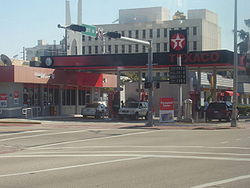
. It has a presence in Europe as well; for example, it is a well-known retail brand in the UK, with around 1,100 Texaco-branded service stations.
United States
The United States of America is a federal constitutional republic comprising fifty states and a federal district...
oil
Petroleum
Petroleum or crude oil is a naturally occurring, flammable liquid consisting of a complex mixture of hydrocarbons of various molecular weights and other liquid organic compounds, that are found in geologic formations beneath the Earth's surface. Petroleum is recovered mostly through oil drilling...
retail brand. Its flagship product is its fuel "Texaco with Techron". It also owns the Havoline
Havoline
Havoline is a motor oil brand of Texaco, a former major oil company based in the United States that is now merged with the Chevron Corporation.-History:First introduced 1904, the Havoline brand was named by Havemeyer Oil Company of New York....
motor oil
Motor oil
Motor oil or engine oil is an oil used for lubrication of various internal combustion engines. The main function is to lubricate moving parts; it also cleans, inhibits corrosion, improves sealing, and cools the engine by carrying heat away from moving parts.Motor oils are derived from...
brand.
Texaco was an independent company until it merged into Chevron Corporation
Chevron Corporation
Chevron Corporation is an American multinational energy corporation headquartered in San Ramon, California, United States and active in more than 180 countries. It is engaged in every aspect of the oil, gas, and geothermal energy industries, including exploration and production; refining,...
in 2001. It began as the Texas Fuel Company, founded in 1901 in Beaumont, Texas
Beaumont, Texas
Beaumont is a city in and county seat of Jefferson County, Texas, United States, within the Beaumont–Port Arthur Metropolitan Statistical Area. The city's population was 118,296 at the 2010 census. With Port Arthur and Orange, it forms the Golden Triangle, a major industrial area on the...
, by Joseph S. Cullinan
Joseph S. Cullinan
Joseph Stephen Cullinan was a U.S. oil industrialist. Although he was a native of Pennsylvania, his lifetime business endeavors would help shape the early oil industry of Texas...
, Thomas J. Donoghue, Walter Benona Sharp
Walter Benona Sharp
Walter Benona Sharp was an American oil drilling pioneer, innovator and philanthropist.Born in Tipton County, Tennessee, Sharp's mother died when he was eight and his father moved the family to Texas. By the age of twenty Sharp was operating a water well drilling company with his brother...
, and Arnold Schlaet
Arnold Schlaet
Arnold Schlaet was a U.S. oil industrialist and business man who, with Joseph S. Cullinan, co-founded Texaco Incorporated in 1902. Schlaet was an investor from New York who worked for H.P. Lapham and Co., managing that company's petroleum interests...
upon the discovery of oil at Spindletop
Spindletop
Spindletop is a salt dome oil field located in the southern portion of Beaumont, Texas in the United States. The Spindletop dome was derived from the Louann Salt evaporite layer of the Jurassic geologic period. On January 10, 1901, a well at Spindletop struck oil . The new oil field soon produced...
. For many years, Texaco was the only company selling gasoline under the same brand name in all 50 states as well as Canada, making it the most truly national brand among its competitors. Its current logo features a white star in a red circle (a reference to the lone star
Flag of Texas
The Flag of the State of Texas is defined by law as follows:The Texas flag is known as the "Lone Star Flag" . This flag was introduced to the Congress of the Republic of Texas on December 28, 1838, by Senator William H. Wharton...
of Texas
Texas
Texas is the second largest U.S. state by both area and population, and the largest state by area in the contiguous United States.The name, based on the Caddo word "Tejas" meaning "friends" or "allies", was applied by the Spanish to the Caddo themselves and to the region of their settlement in...
), leading to the long-running advertising jingles "You can trust your car to the man who wears the star" and "Star of the American Road." The company was headquartered in Harrison, New York
Harrison, New York
Harrison is a village and town in Westchester County, New York, United States, located approximately northeast of Manhattan. The population was 27,472 at the 2010 census.-Establishment:...
, near White Plains
White Plains, New York
White Plains is a city and the county seat of Westchester County, New York, United States. It is located in south-central Westchester, about east of the Hudson River and northwest of Long Island Sound...
, prior to the merger with Chevron.
Texaco gasoline comes with Techron
Techron
Techron is a patented fuel additive developed by the Chevron Corporation, usually consisting of gasoline mixed with 400 ppm of polyetheramine. With the introduction of Techron, Chevron gasolines became designated as meeting Top Tier standards for fuel cleanliness. Chevron gasolines with Techron...
, an additive developed by Chevron, as of 2005, replacing the previous CleanSystem3. The Texaco brand is strong in the U.S., Latin America and West Africa
West Africa
West Africa or Western Africa is the westernmost region of the African continent. Geopolitically, the UN definition of Western Africa includes the following 16 countries and an area of approximately 5 million square km:-Flags of West Africa:...
. It has a presence in Europe as well; for example, it is a well-known retail brand in the UK, with around 1,100 Texaco-branded service stations.
History
Founding through 1930s
- 1901 – Founded in Beaumont, Texas. Known as the Texas Fuel Company.
- 1905 – Texaco establishes an operation in Antwerp, Belgium, under the name Continental Petroleum Company.
- 1913 – Texaco acquires control of the Central Petroleum Company.
- 1914 – Occupied new offices in Houston on the corner of San Jacinto and Rusk.
- 1928 – Texaco becomes the first U.S. oil company to sell its gasoline nationwide under one single brand name in all 48 states (50 states after Alaska and Hawaii joined the Union in 1959).
- 1931 – The Texas Company (Texaco's corporate name) purchases Indian Oil Company, based in Illinois, a move that expands Texaco's refining and marketing base in the Midwest and also gives Texaco the rights to Indian's manufacturing processes of HavolineHavolineHavoline is a motor oil brand of Texaco, a former major oil company based in the United States that is now merged with the Chevron Corporation.-History:First introduced 1904, the Havoline brand was named by Havemeyer Oil Company of New York....
"Wax Free" motor oil, which becomes a Texaco product and provides the company with a higher-quality motor oil product. - 1932 – Texaco introduces Fire Chief gasoline nationwide, a motor fuel that meets the octane requirements for fire engines, and promotes it through a radio program over NBC hosted by Ed Wynn, the "Texaco Fire Chief."
- 1936 – Texaco begins supplying the Nationalist rebels in SpainSpanish RevolutionThe Spanish Revolution was a workers' social revolution that began during the outbreak of the Spanish Civil War in 1936 and resulted in the widespread implementation of anarchist and more broadly libertarian socialist organizational principles throughout various portions of the country for two to...
with oil, and continues to do so for the duration of the war, delivering some 3500000 barrels (556,455,532.5 l). - 1936 – Marketing operations east of Suez (including Asia, East Africa, and Australasia) are placed into a joint venture with Standard Oil Company of California - Socal (ChevronChevron CorporationChevron Corporation is an American multinational energy corporation headquartered in San Ramon, California, United States and active in more than 180 countries. It is engaged in every aspect of the oil, gas, and geothermal energy industries, including exploration and production; refining,...
) under the brand name CaltexCaltexCaltex is a petroleum brand name of Chevron Corporation used in more than 60 countries in the Asia-Pacific region, the Middle East, and southern Africa.-History:...
, in exchange for Socal placing its Bahrain refinery and Arabian oilfields into the venture. - 1937 – Texaco commissions industrial designer Walter Dorwin TeagueWalter Dorwin TeagueWalter Dorwin Teague was an American architect, designer and one of the most prolific American industrial designers in terms of volume of completed work. Teague's name and vision lives on through the legacy of his company....
to develop a modern service station design. The resulting "Teague" Texaco station design is a functional white building with green trimmings featuring one or more service bays for "Washing", "Marfak Lubrication", etc., an office area with large plate glass window for display of tires, batteries, and accessories, along with "Men" and "Ladies" restrooms featuring Texaco-green tile walls and floors. The Teague station design is typically built of white porcelain tile but local and regional variations could include painted brick, concrete brick, and stucco materials. Other features include red Texaco stars on the upper facade on outer sidewalls and above the service bays, and red lettering spelling out "TEXACO" above the office area. Stations are identified by the street from Texaco's "banjo" sign. - 1938 – Texaco introduces Sky Chief gasoline, a premium grade fuel developed from the ground up as a high-octane gasoline rather than just an ethylized regular product. Sky Chief is dispensed from a silver gas pump in contrast with the red pump used for Fire Chief gasoline - a move that lasts many years until the early 1960s.
- 1939 – Texaco becomes one of the first oil companies to introduce a "Registered Rest Room" program to ensure that restroom facilities at all Texaco stations nationwide maintained a standard level of cleanliness to the motoring public. The "Registered Rest Room" program is later copied by other oil companies and continued at Texaco until the energy crises of the 1970s, which was caused by oil embargoes.
1940s and 50s
- 1940 – Torkild Rieber, CEO, is led to resign when his connections with German Nazism, and his supply of oil to the Fascist forces during the Spanish Civil War are made public
- 1947 – Texaco's European marketing operations are also placed into the CaltexCaltexCaltex is a petroleum brand name of Chevron Corporation used in more than 60 countries in the Asia-Pacific region, the Middle East, and southern Africa.-History:...
joint venture - 1947 – Texaco merged its BritishUnited KingdomThe United Kingdom of Great Britain and Northern IrelandIn the United Kingdom and Dependencies, other languages have been officially recognised as legitimate autochthonous languages under the European Charter for Regional or Minority Languages...
operation with Trinidad Leaseholds under the name Regent; it gained full control of Regent in 1956, but the Regent brand remained in use until 1968-9. - 1954 – Texaco adds the detergent additive Petrox to its "Sky Chief" gasoline, which was also souped up with higher octane to meet the antiknock needs of new cars with high-compression engines. A new plant was built in Port Arthur, Texas specifically to manufacture Petrox.
- 1958 – Texaco became the sole sponsor of The Huntley-Brinkley Report on NBC-TV. The nightly newscast had had difficulty retaining sponsors since it first took the air in the fall of 1956.
- 1959 – The Texas Company changes its corporate name to Texaco, Inc. to better reflect the value of the Texaco brand name, which represented the biggest selling gasoline brand in the U.S. and only marketer selling gasoline under one brand name in all 50 states.
- 1959 – Texaco acquires McColl-Frontenac Oil Company Ltd. of Canada and changes its name to Texaco Canada Ltd.
- Late 1950s – Bought Paragon OilParagon OilParagon Oil was an American oil company, founded in 1925 in New York City by the Schwartz family, and sold to Texaco in the late 1950s.- Founding of the company :Paragon Oil was founded by brothers Henry, Irving, Robert, Benjamin, and Arnold Schwartz...
, a major fuel oil distribution company in the northeastern U.S.
1960s and 70s
- 1961 – Texaco introduces the "The Man who wears the Star" campaign with the "Texaco Star Theme" written by W.A. Fredricks. The radio jingle (as of 1961), went as follows:
-
-
- Both Fire Chief and Sky Chief gasolines are promoted as "Climate Controlled" as various blends of both gasolines are distributed to Texaco stations in various parts of the country.
- 1964 – Texaco introduces the "Matawan" service station design at a station in Matawan, New JerseyMatawan, New JerseyMatawan is a borough in Monmouth County, New Jersey, United States. As of the 2010 United States Census, the borough population was 8,810. The name "Matawan" comes from a Native American Lenape word....
. Features include mansard roofing design, service bays moved to the side of station and sheetrock covering over most exterior walls. - 1966 – Texaco replaces the long-running banjo sign with a new hexagon logo that had previously been test-marketed with the "Matawan" station design introduced two years earlier. The new logo featured red outline with TEXACO in black bold lettering and small banjo logo with red star and green T at bottom. Texaco also enters agreement with Howard Johnson'sHoward Johnson'sHoward Johnson's is a chain of hotels and restaurants, located primarily throughout the United States and Canada. Throughout the 1960s and 1970s, Howard Johnson's was the largest restaurant chain in the United States, with over 1,000 restaurants...
for Texaco credit card to be honored for charging of lodging and food at Howard Johnson motor lodges, a widespread trend of the time among major oil companies that would last until the 1973 oil crisis1973 oil crisisThe 1973 oil crisis started in October 1973, when the members of Organization of Arab Petroleum Exporting Countries or the OAPEC proclaimed an oil embargo. This was "in response to the U.S. decision to re-supply the Israeli military" during the Yom Kippur war. It lasted until March 1974. With the...
. - 1967 – Regent name replaced by Texaco at BritishUnited KingdomThe United Kingdom of Great Britain and Northern IrelandIn the United Kingdom and Dependencies, other languages have been officially recognised as legitimate autochthonous languages under the European Charter for Regional or Minority Languages...
petrol stations. - 1970 – In response to increasingly stringent federal emission standards that would ultimately lead to mandating of unleaded gasoline in 1975 and later-model cars and trucks, Texaco introduced Lead-free Texaco as the first regular-octane lead-free gasoline at stations in the Los AngelesLos ÁngelesLos Ángeles is the capital of the province of Biobío, in the commune of the same name, in Region VIII , in the center-south of Chile. It is located between the Laja and Biobío rivers. The population is 123,445 inhabitants...
area and throughout Southern CaliforniaSouthern CaliforniaSouthern California is a megaregion, or megapolitan area, in the southern area of the U.S. state of California. Large urban areas include Greater Los Angeles and Greater San Diego. The urban area stretches along the coast from Ventura through the Southland and Inland Empire to San Diego...
. Lead-free Texaco would become available nationwide in 1974, in time for the introduction of 1975-model vehicles. - 1978 – Texaco Canada Ltd. merges with Texaco Explorations Canada Ltd. to form Texaco Canada Inc.
- 1964 – Texaco introduces the "Matawan" service station design at a station in Matawan, New Jersey
1980s and 90s
- November 21, 1980 – Lake Peigneur/Jefferson Island disasterLake PeigneurLake Peigneur is located in the U.S. State of Louisiana north of Delcambre and west of New Iberia, near the northernmost tip of Vermilion Bay.-History:...
- 1982 – The new service station design emphasizes use of dark colors including, black, red and gray. Gasoline products receive name changes with the advent of self-service including Lead-free Texaco to Texaco Unleaded, Fire Chief to Texaco Regular, and Super Lead-free Sky Chief to Texaco Super Unleaded.
- 1985 – On November 19, PennzoilPennzoilPennzoil is an American oil company founded in Los Angeles, California in 1913. In 1955, it was acquired by Oil City, Pennsylvania company South Penn Oil, a former branch of Standard Oil. In 1963, South Penn Oil merged with Zapata Petroleum; the merged company took the Pennzoil name. During the...
(represented by famous Houston litigator Joe JamailJoe JamailJoseph Dahr Jamail, Jr. is a Lebanese American attorney and billionaire. The wealthiest practicing attorney in America, he is frequently referred to as the King of Torts. As of 2011, his net worth was estimated by Forbes to be $1.5 billion, making him the 833rd richest person in the world.Jamail...
) won a US$10.53 billion verdict against Texaco in the largest civil verdict in US history (Texaco established a signed contract to buy Getty OilGetty OilGetty Oil is an oil company founded by J. Paul Getty. It was at its height during the 1960s. In 1971, the Getty Realty division was formed to manage the real estate needs of Getty stations. The division was later spun off, but now owns the rights to the Getty brand...
after Pennzoil entered into an unsigned, yet still binding, buyout contract with Gordon GettyGordon GettyGordon Peter Getty was born on December 20, 1934. He is the fourth child of oil tycoon J. Paul Getty. His mother, Ann Rork, was his father's third wife. When his father died in 1976, Gordon assumed control of Getty's US$2 billion trust...
). - 1987 – Texaco files for bankruptcyBankruptcyBankruptcy is a legal status of an insolvent person or an organisation, that is, one that cannot repay the debts owed to creditors. In most jurisdictions bankruptcy is imposed by a court order, often initiated by the debtor....
; company continues trading under protection of U.S. bankruptcy laws. - 1988 – Texaco and Saudi AramcoSaudi AramcoSaudi Aramco , officially the Saudi Arabian Oil Company, is the national oil company of Saudi Arabia.Saudi Aramco is the world's largest and most valuable privately-held company, with estimates of its value in 2011 to be $7 trillion USD.Saudi Aramco has both the largest proven crude oil reserves,...
agree to form a joint venture known as Star Enterprise in which Saudi Aramco would own a 50% share of Texaco's refining and marketing operations in the eastern U.S. and Gulf Coast. - 1989 – Texaco introduces System3 gasolines in all three grades of fuel, featuring the latest detergent additive technology to improve performance by reducing deposits that clog fuel injection systems. Texaco Canada Inc sold to Imperial OilImperial OilImperial Oil Limited is Canada's largest petroleum company. The company is engaged in the exploration, production and sale of crude oil and natural gas. It is controlled by US based ExxonMobil, which owns 69.6% of its stock...
with retail operations converted to EssoEssoEsso is an international trade name for ExxonMobil and its related companies. Pronounced , it is derived from the initials of the pre-1911 Standard Oil, and as such became the focus of much litigation and regulatory restriction in the United States. In 1972, it was largely replaced in the U.S. by...
brand. - 1991 – The company was awarded the National Medal of ArtsNational Medal of ArtsThe National Medal of Arts is an award and title created by the United States Congress in 1984, for the purpose of honoring artists and patrons of the arts. It is the highest honor conferred to an individual artist on behalf of the people. Honorees are selected by the National Endowment for the...
. - 1993 – Several dozen tribal leaders and residents from the EcuadorEcuadorEcuador , officially the Republic of Ecuador is a representative democratic republic in South America, bordered by Colombia on the north, Peru on the east and south, and by the Pacific Ocean to the west. It is one of only two countries in South America, along with Chile, that do not have a border...
an AmazonAmazon RiverThe Amazon of South America is the second longest river in the world and by far the largest by waterflow with an average discharge greater than the next seven largest rivers combined...
file a billion-dollar class-action lawsuit against Texaco, as a result of massive ecologicalEcologyEcology is the scientific study of the relations that living organisms have with respect to each other and their natural environment. Variables of interest to ecologists include the composition, distribution, amount , number, and changing states of organisms within and among ecosystems...
pollutionPollutionPollution is the introduction of contaminants into a natural environment that causes instability, disorder, harm or discomfort to the ecosystem i.e. physical systems or living organisms. Pollution can take the form of chemical substances or energy, such as noise, heat or light...
of the area and rivers around Texaco's Ecuadorian offshore drillingOffshore drillingOffshore drilling refers to a mechanical process where a wellbore is drilled through the seabed. It is typically carried out in order to explore for and subsequently produce hydrocarbons which lie in rock formations beneath the seabed...
sites, causing toxic contaminationContaminationContamination is the presence of a minor and unwanted constituent in material, physical body, natural environment, at a workplace, etc.-Specifics:"Contamination" also has more specific meanings in science:...
of approximately 30,000 residents. - 1994 – Texaco's System3 gasolines replaced by new CleanSystem3 gasoline for improved engine performance.
- 1995 – Texaco merges its Danish and Norwegian downstream operations with those of Norsk HydroNorsk HydroNorsk Hydro ASA is a Norwegian aluminium and renewable energy company, headquartered in Oslo. Hydro is the fourth largest integrated aluminium company worldwide. It has operations in some 40 countries around the world and is active on all continents. The Norwegian state holds a 43.8 percent...
under the new brand HydroTexaco. This joint venture was sold in 2007 to Norwegian retail interests as YX Energi, following the purchase of Hydro by StatoilStatoilStatoil ASA is a Norwegian petroleum company established in 1972. It merged with Norsk Hydro in 2007 and was known as StatoilHydro until 2009, when the name was changed back to Statoil ASA. The brand Statoil was retained as a chain of fuel stations owned by StatoilHydro...
. - 1996 – Texaco pays over $170 million to settle racial discrimination lawsuits filed by blackAfrican AmericanAfrican Americans are citizens or residents of the United States who have at least partial ancestry from any of the native populations of Sub-Saharan Africa and are the direct descendants of enslaved Africans within the boundaries of the present United States...
employees at the company. It was the largest racial discrimination lawsuit settlement in the U.S. at the time, and was particularly damaging to Texaco's public relations when tapes were released containing ethnic slurs used repeatedly by company officers at high-level corporate meetings. - 1998 – Formed joint ventureJoint ventureA joint venture is a business agreement in which parties agree to develop, for a finite time, a new entity and new assets by contributing equity. They exercise control over the enterprise and consequently share revenues, expenses and assets...
Equilon with Shell Oil CompanyShell Oil CompanyShell Oil Company is the United States-based subsidiary of Royal Dutch Shell, a multinational oil company of Anglo Dutch origins, which is amongst the largest oil companies in the world. Approximately 22,000 Shell employees are based in the U.S. The head office in the U.S. is in Houston, Texas...
, combining their Western and Midwestern U.S. refining and marketing. This gave rise to the 2006 U.S. Supreme Court antitrust case of Texaco Inc. v. Dagher, which cleared both Texaco and Shell of any antitrust liability concerning the pricing of Equilon's gasoline. - 1998 – Formed joint venture Motiva with Shell Oil Company and Saudi AramcoSaudi AramcoSaudi Aramco , officially the Saudi Arabian Oil Company, is the national oil company of Saudi Arabia.Saudi Aramco is the world's largest and most valuable privately-held company, with estimates of its value in 2011 to be $7 trillion USD.Saudi Aramco has both the largest proven crude oil reserves,...
in which the Star Enterprise operations were merged with the Eastern and Gulf Coast U.S. refining and marketing operations of Shell.
2000 to 2010
- 2001 – Texaco purchases right to Nimh battery used in electric vehicles, Chevron CorporationChevron CorporationChevron Corporation is an American multinational energy corporation headquartered in San Ramon, California, United States and active in more than 180 countries. It is engaged in every aspect of the oil, gas, and geothermal energy industries, including exploration and production; refining,...
then merges with Texaco six days later. Shell purchases Texaco's interest in the Equilon and Motiva joint ventures. - 2002 – Shell Oil Company begins converting its Texaco stations to the Shell brand, a process expected to be complete by June 2004, "the largest retail re-branding initiative in American business history."
- July 2004 – Chevron regains non-exclusive rights to the Texaco brand name in the U.S.
- August 2005 – Texaco introduces the Techron additive into its fuels in the U.S. and parts of Latin America.
- July 2006 – Chevron regains exclusive rights to the Texaco brand name in the U.S. and begins opening up gas stations across the U.S. and sold some of its BPBPBP p.l.c. is a global oil and gas company headquartered in London, United Kingdom. It is the third-largest energy company and fourth-largest company in the world measured by revenues and one of the six oil and gas "supermajors"...
and its CitgoCitgoCITGO Petroleum Corporation is a United States-incorporated, Venezuela-owned refiner, transporter and marketer of transportation fuels, lubricants, petrochemicals and other industrial products. The company is owned by PDV America, Inc., an indirect wholly owned subsidiary of Petróleos de...
stations in the southeast. - 2007 – DelekDelek GroupDelek Group is of one Israel's largest companies, owned by Isaac Sharon , a self-made multi-millionaire. Delek Group is involved in the energy and infrastructure, with investments in upstream and downstream energy, water desalination and power plants. Delek Group' subsidiaries are also involved in...
Benelux took over marketing activities for Chevron Global Energy Inc. in Benelux, including 869 filling stations, mostly under the Texaco brand. Chevron CorporationChevron CorporationChevron Corporation is an American multinational energy corporation headquartered in San Ramon, California, United States and active in more than 180 countries. It is engaged in every aspect of the oil, gas, and geothermal energy industries, including exploration and production; refining,...
sold its Conoco stations in Mississippi to the Texaco brand name, a process to be complete at the end of the year. - April 2010 – ChevronChevron CorporationChevron Corporation is an American multinational energy corporation headquartered in San Ramon, California, United States and active in more than 180 countries. It is engaged in every aspect of the oil, gas, and geothermal energy industries, including exploration and production; refining,...
continued to allow independent jobbers to switch to the Texaco brand, such as the small chain of BPBPBP p.l.c. is a global oil and gas company headquartered in London, United Kingdom. It is the third-largest energy company and fourth-largest company in the world measured by revenues and one of the six oil and gas "supermajors"...
gas stations in Mississippi operated by Mississippi Oil/Smith Petroleum as Dandy Dan C-Stores. - July 2010 – Chevron and Texaco end retail operations in the Mid-Atlantic US, removing their brand from 1,100 stations in Delaware, Indiana, Kentucky, North Carolina, New Jersey, Maryland, Ohio, Pennsylvania, South Carolina, Virginia, West Virginia, Washington, D.C., and parts of Tennessee.
Corporate headquarters
Prior to the merger, Texaco's headquarters, a 750000 square feet (69,677.3 m²) building, were in Harrison, New YorkHarrison, New YorkHarrison is a village and town in Westchester County, New York, United States, located approximately northeast of Manhattan. The population was 27,472 at the 2010 census.-Establishment:...
, near White PlainsWhite Plains, New YorkWhite Plains is a city and the county seat of Westchester County, New York, United States. It is located in south-central Westchester, about east of the Hudson River and northwest of Long Island Sound...
. In 2002, ChevronChevron CorporationChevron Corporation is an American multinational energy corporation headquartered in San Ramon, California, United States and active in more than 180 countries. It is engaged in every aspect of the oil, gas, and geothermal energy industries, including exploration and production; refining,...
sold the former Texaco headquarters to Morgan StanleyMorgan StanleyMorgan Stanley is a global financial services firm headquartered in New York City serving a diversified group of corporations, governments, financial institutions, and individuals. Morgan Stanley also operates in 36 countries around the world, with over 600 offices and a workforce of over 60,000....
. Morgan Stanley bought the building and the surrounding 107 acre (0.43301402 km²) for $42 million.
Sponsorships
Texaco is associated with the Havoline HavolineHavoline is a motor oil brand of Texaco, a former major oil company based in the United States that is now merged with the Chevron Corporation.-History:First introduced 1904, the Havoline brand was named by Havemeyer Oil Company of New York....
brand of motor oil and other automotive products. It was one of the sponsors of NASCARNASCARThe National Association for Stock Car Auto Racing is a family-owned and -operated business venture that sanctions and governs multiple auto racing sports events. It was founded by Bill France Sr. in 1947–48. As of 2009, the CEO for the company is Brian France, grandson of the late Bill France Sr...
with drivers like Davey AllisonDavey AllisonDavid Carl "Davey" Allison was a NASCAR driver. He was best known for driving the #28 Texaco-Havoline Ford for Robert Yates Racing in the Winston Cup Series. Born in Hollywood, Florida, he was the eldest of four children born to Bobby Allison and wife Judy...
, Ernie IrvanErnie IrvanVirgil Earnest Irvan, more commonly known as Ernie Irvan is a former race driver in NASCAR. He is best remembered for his comeback after a serious head injury at Michigan International Speedway which earned him numerous awards and respect from his fellow drivers...
, Ricky RuddRicky RuddRicky Rudd is a former American NASCAR driver. He is the uncle of actor Skeet Ulrich and Nationwide Series driver Jason Rudd. Rudd is known as the "Iron Man" of NASCAR; holding the record for most consecutive starts in NASCAR racing. At the conclusion of the 2005 season, Rudd had made 788...
, Jamie McMurrayJamie McMurrayJames Christopher "Jamie" McMurray is a professional American race car driver. McMurray is best known for winning the 2002 UAW-GM Quality 500 as a substitute driver in his second Winston Cup start, and is one of three drivers to win both the Daytona 500 and Brickyard 400 in the same year...
, and Casey MearsCasey MearsCasey James Mears is the driver of the #13 GEICO Toyota for Germain Racing in the Sprint Cup Series. He is a former winner of the Coca-Cola 600....
. Texaco last sponsored Car 42, driven by Juan Pablo MontoyaJuan Pablo MontoyaJuan Pablo Montoya Roldán is a Colombian race car driver known internationally for participating and winning in Formula One and CART race competitions. He has enjoyed great success. Currently, he competes in NASCAR, driving the #42 Target Chevrolet Impala for Earnhardt Ganassi Racing in the Sprint...
. Havoline sponsored a NASCAR race car continuously from the early 1980s through the 2008 season. At the end of the 2008 NASCAR season, Texaco Havoline officially ended their sponsorship with NASCAR and Chip Ganassi Racing with Felix Sabates. This brought to a close a 20-plus year relationship with the sport. Texaco has also has also been involved in open wheel racingAmerican Championship Car RacingSince 1916 there has been a recognized United States national automobile racing National Championship for drivers of professional-level, single-seat open wheel race cars. The championship has been under the auspices of several different sanctioning bodies since 1909. Since 1911, the Indianapolis...
, sponsoring the Texaco Grand Prix of HoustonGrand Prix of HoustonThe Grand Prix of Houston was an annual auto race on the Champ Car World Series circuit. It was held in a street circuit located in downtown Houston, Texas, United States of America for four years, then returned for two years on a course laid out in the parking lot of the Reliant Park Complex...
along with sponsoring drivers like Indianapolis 500 winner Mario AndrettiMario AndrettiMario Gabriele Andretti is a retired Italian American world champion racing driver, one of the most successful Americans in the history of the sport. He is one of only two drivers to win races in Formula One, IndyCar, World Sportscar Championship and NASCAR...
and his son MichaelMichael AndrettiMichael Mario Andretti is a retired American CART and Formula One driver and owner of the Andretti Autosport team in the IndyCar Series. Andretti is the son of Mario Andretti. His son is Marco Andretti.-Early career:...
.
Texaco was long associated with the Metropolitan OperaMetropolitan OperaThe Metropolitan Opera is an opera company, located in New York City. Originally founded in 1880, the company gave its first performance on October 22, 1883. The company is operated by the non-profit Metropolitan Opera Association, with Peter Gelb as general manager...
as sole sponsor of its radioRadioRadio is the transmission of signals through free space by modulation of electromagnetic waves with frequencies below those of visible light. Electromagnetic radiation travels by means of oscillating electromagnetic fields that pass through the air and the vacuum of space...
broadcasts for 63 years. It was identified as well with such entertainment legends as Bob HopeBob HopeBob Hope, KBE, KCSG, KSS was a British-born American comedian and actor who appeared in vaudeville, on Broadway, and in radio, television and movies. He was also noted for his work with the US Armed Forces and his numerous USO shows entertaining American military personnel...
, Jack BennyJack BennyJack Benny was an American comedian, vaudevillian, and actor for radio, television, and film...
and Milton BerleMilton BerleMilton Berlinger , better known as Milton Berle, was an American comedian and actor. As the manic host of NBC's Texaco Star Theater , in 1948 he was the first major star of U.S. television and as such became known as Uncle Miltie and Mr...
(many of their shows were originally sponsored by Texaco - see Texaco Star Theatre, which includes the sponsorship lyrics of the opening theme: "We're the men of Texaco, We work from Maine to Mexico..."). Berle's program was broadcast in the same time slot as Fulton J. SheenFulton J. SheenServant of God Fulton John Sheen, born Peter John Sheen was an American archbishop of the Catholic Church known for his preaching and especially his work on television and radio...
's religious program for a while, thus leading to Berle's oft-quoted quip, "We both have the same boss - Sky Chief!"
In Latin America, Texaco sponsors Brazilian soccer superstar Ronaldinho. In West Africa, Texaco sponsors the soccer-based comic Supa Strikas.
Environmental issues
From 1965-1993, Texaco participated in a consortium to develop the Lago Agrio oil fieldLago Agrio oil fieldThe Lago Agrio oil field is an oil-rich area in the Ecuadorian province of Sucumbíos, discovered in the 1960s. The Lago Agrio field is known internationally for the serious ecological problems that oil development has created there, including water pollution, soil contamination, deforestation and...
in EcuadorEcuadorEcuador , officially the Republic of Ecuador is a representative democratic republic in South America, bordered by Colombia on the north, Peru on the east and south, and by the Pacific Ocean to the west. It is one of only two countries in South America, along with Chile, that do not have a border...
. It has been accused of extensive environmental damage from these operations, and faces legal claims from both private plaintiffs and the government of Ecuador. The case has been widely publicized by environmental activists and is the subject of Crude, a 2009 documentary film by Joe Berlinger. Chevron claims that it is being unfairly targeted as a deep pocketDeep pocketDeep pocket is an American slang term; it usually means "extensive financial wealth or resources". It is usually used in reference to big companies or organizations , although it can be used in reference to individuals .In the context of a lawsuit, the deep pocket is often the target defendant,...
defendant, when the actual responsibility lies with the government and its national oil company.
The NiMH chemistry used in modern hybrid vehicles was invented by ECD Ovonics founder, Stan Ovshinksy, and Dr. Masahiko Oshitani of the Yuasa Company In 1994, General Motors acquired a controlling interest in OvonicsOvonicsEnergy Conversion Devices is headquartered in Rochester Hills, Michigan.United Solar Ovonic, LLC is its wholly owned subsidiary located in Auburn Hills, Michigan...
's battery development and manufacturing. On October 10, 2001, Texaco purchased GM's share in GM Ovonics, and ChevronChevron CorporationChevron Corporation is an American multinational energy corporation headquartered in San Ramon, California, United States and active in more than 180 countries. It is engaged in every aspect of the oil, gas, and geothermal energy industries, including exploration and production; refining,...
completed its acquisition of Texaco six days later. In 2003, Texaco Ovonics Battery Systems was restructured into CobasysCobasysCobasys LLC supplies nickel metal hydride batteries, battery control systems, and packaged solutions for automotive applications, uninterruptable power supplies, telecommunications applications, and distributed power generation...
, a 50/50 joint venture between Chevron and Energy Conversion Devices (ECD) Ovonics. Chevron's influence over Cobasys extends beyond a strict 50/50 joint venture. Chevron holds a 19.99% interest in ECD Ovonics. In addition, Chevron maintains the right to seize all of Cobasys' intellectual property rights in the event that ECD Ovonics does not fulfill its contractual obligations. On September 10, 2007, Chevron filed a legal claim that ECD Ovonics has not fulfilled its obligations. ECD Ovonics disputes this claim. Since that time, the arbitration hearing was repeatedly suspended while the parties negotiate with an unknown prospective buyer. No agreement has been reached with the potential buyer. Cobasys's patents relating to NiMH batteries expire in 2015.
In her book, Plug-in Hybrids: The Cars that Will Recharge America, published in February 2007, Sherry BoschertSherry BoschertSherry Boschert is a reporter and co-founder of the non-profit organization and of the . She is the author of the book Plug-in Hybrids: The Cars that Will Recharge America. She is a senior reporter and San Francisco bureau chief of the International Medical News Group, a division of Elsevier,...
argues that large-format NiMH batteries are commercially viable but that Cobasys refuses to sell or license them to small companies or individuals. Boschert argues that Cobasys accepts only very large orders for these batteries. When Boschert conducted her research, major auto makers showed little interest in large orders for large-format NiMH batteries. However, Toyota employees complained about the difficulty in getting smaller orders of large format NiMH batteries to service the existing 825 RAV-4EVs. Because no other companies were willing to make large orders, Cobasys was not manufacturing nor licensing any large format NiMH battery technology for automotive purposes. Boschert concludes that "it's possible that Cobasys (ChevronChevron CorporationChevron Corporation is an American multinational energy corporation headquartered in San Ramon, California, United States and active in more than 180 countries. It is engaged in every aspect of the oil, gas, and geothermal energy industries, including exploration and production; refining,...
) is squelching all access to large NiMH batteries through its control of patent licenses in order to remove a competitor to gasoline. Or it's possible that Cobasys simply wants the market for itself and is waiting for a major automaker to start producing plug-in hybrids or electric vehicles."
In an interview with the Economist, Ovshinsky subscribed to the former view. "I think we at ECD we made a mistake of having a joint venture with an oil company, frankly speaking. And I think it’s not a good idea to go into business with somebody whose strategies would put you out of business, rather than building the business."
In December 2006, Cobasys and General MotorsGeneral MotorsGeneral Motors Company , commonly known as GM, formerly incorporated as General Motors Corporation, is an American multinational automotive corporation headquartered in Detroit, Michigan and the world's second-largest automaker in 2010...
announced that they had signed a contract under which Cobasys provides NiMH batteries for the Saturn Aura hybrid sedan. In March 2007, GM announced that it would use Cobasys NiMH batteries in the 2008 Chevrolet Malibu hybrid as well.
In October 2007, International Acquisitions Services, Inc. and Innovative Transportation Systems AG filed suit against Cobasys and its parents for refusing to fill a large, previously agreed-upon order for large-format NiMH batteries to be used in the electric Innovan.
In August 2008, Mercedes-Benz U.S. International Inc. filed suit against Cobasys claiming that Cobasys isn’t delivering the batteries it agreed to build for Mercedes-Benz’s planned hybrid SUV.
Cobasys was sold in 2009 to SB Li Motive, which is a joint venture formed by Bosch and Samsung to develop lithium ion batteries for automotive applications. The sale price was not disclosed. The German-Korean company will integrate Cobasys as the North American branch of the company. Cobasys will supply batteries to the new Mercedes ML450 hybrid.
See also
- Chevron CorporationChevron CorporationChevron Corporation is an American multinational energy corporation headquartered in San Ramon, California, United States and active in more than 180 countries. It is engaged in every aspect of the oil, gas, and geothermal energy industries, including exploration and production; refining,...
- CaltexCaltexCaltex is a petroleum brand name of Chevron Corporation used in more than 60 countries in the Asia-Pacific region, the Middle East, and southern Africa.-History:...
- joint venture between Texaco and Chevron, now a major international brand name of Chevron Corporation
External links
- Both Fire Chief and Sky Chief gasolines are promoted as "Climate Controlled" as various blends of both gasolines are distributed to Texaco stations in various parts of the country.
-