

Hill Air Force Base

Encyclopedia
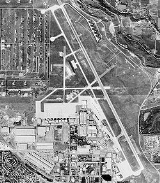
Hill Air Force Base is a major U.S. Air Force Base located in northern Utah
, just south of the city of Ogden
, and near the towns of Clearfield
, Riverdale
, Roy
, Sunset
, and Layton
. It is about 30 miles (48.3 km) north of Salt Lake City. The base was named in honor of Major Ployer Peter Hill
of the U.S. Army Air Corps, who died test-flying a prototype of the B-17 Flying Fortress bomber. In this decade Hill A.F.B. is still the sixth-largest employer in the state of Utah, and the third-largest one excluding the State Government and Higher Education
employers.
Hill A.F.B. is the home of the Air Force Materiel Command
's (AFMC) Ogden Air Logistics Center which is the worldwide manager for a wide range of aircraft, engines, missiles, software, avionics, and accessories components. The commander of the Air Logistics Center is currently Major General Andrew E. Busch. The Ogden Air Logistics Center is one of the three U.S.A.F.'s Air Logistics Center, with the others being the Oklahoma City Air Logistics Center at Tinker AFB, Oklahoma
, and the Warner-Robins Air Logistics Center at Robins AFB, Georgia
.
The host unit at Hill A.F.B. is the Air Force Material Command's 75th Air Base Wing
, which provides services and support for the Ogden Air Logistics Center and its subordinate organizations. The Wing and Installation Commander of Hill Air Force Base is presently Colonel Patrick Higby. Additional tenant units at Hill A.F.B. include operational fighter wings of the Air Combat Command
(ACC) and the Air Force Reserve Command
(AFRC).
is one of the only live-fire U.S. Air Force training ranges within the United States
. It is located in far western Utah, close to the Nevada
border, and it extends both north and south of Interstate Highway 80
, with several miles of separation on each side of the Interstate Highway. The portion of the bombing range that lies north of Interstate 80 is also west of the Great Salt Lake
. The Utah Test and Training Range lies in Tooele County
, and the land is owned by the state of Utah, but the use of the airspace and training exercises are scheduled by Hill A.F.B.
On September 8, 2004, the National Aeronautics and Space Administration's Genesis space probe
crash-landed on the nearby U.S. Army Dugway Proving Ground
, as planned.
(1894–1935), the Chief of the Flying Branch of the U.S. Army Air Corps Material Division of Wright Field, Dayton, Ohio
. Major Hill had died as a result of injuries he received from the crash of the Boeing Aircraft Company's experimental aircraft Boeing Model 299 at Wright Field, the prototype airplane for what became the famous B-17 Flying Fortress.
Hill Air Force Base traces its origins back to the ill-fated U.S. Army's Air Mail "experiment" of 1934, when the idea originated for a permanent air depot in the Salt Lake City area. In the following years, the Army Air Corps surveyed the region for a suitable location for the permanent western terminus of the air mail. Several sites in Utah were considered, and the present site near Ogden emerged as the clear favorite.
In July 1939, Congress appropriated $8.0 million for the establishment and construction of the Ogden Air Depot. Hill Field officially opened on 7 November 1940, and with the outbreak of war for the United States in December 1941, it soon became a key maintenance and supply base of World War II
, with a peak of 22,000 military and civilian workers in 1943.
During World War II
, Hill Field was an important maintenance and supply base, with round-the-clock operations geared to supporting the war effort. Battle weary warplanes like the A-26, B-17, B-24, B-29, P-40, P-47, P-61, and others depended on the men and women of Hill Field for structural repairs, engine overhauls, and spare parts. The peak wartime employment at Hill Field was reached in 1943 with a total of just over 22,000 military and civilian personnel. These dedicated men and women rehabilitated and returned thousands of warplanes to combat.
Starting in 1944, Hill Field became responsible for the long-term storage of surplus aircraft and their support equipment, including outmoded P-40 Tomahawks and P-40 Warhawks which had been removed from combat service and replaced by newer and better warplanes. Also ending up at Hill Field over the approaching years were warplanes like the P-47 Thunderbolt
, the B-24 Liberator
, the B-29 Superfortress
, and many other types of airplanes were prepared for storage and stored at this air base over the course of the 1940s and 1950s.
Hill Field became the Hill Air Force Base on 5 February 1948, following the transition of the new U.S. Air Force away from the Army and the United States Army Air Force, into an independent service, as called for by the National Security Act of 1947
. This transition actually took place in October 1947, but it took many months to fully implement.
During the Korean War
, Hill A.F.B. was assigned a major share of the Air Materiel Command's logistical effort to support the combat
in Korea
. Hill A.F.B. personnel quickly removed needed warplanes from storage, renovated them, and added them to active-service U.S.A.F. flying squadron
s.
Then during the 1960s, Hill A.F.B. began to perform the maintenance support for various kinds of jet warplanes, mainly the F-4 Phantom II
during the Vietnam War
, and then afterwards, the more modern F-16 Fighting Falcon
s, A-10 Thunderbolt II
s, and C-130 Hercules
, and also air combat missile systems and air-to-ground rockets. Hill A.F.B. continues to carry out these tasks to the present day.
Hill A.F.B. has also housed the 30 acres (121,405.8 m²) Hill Aerospace Museum
since 1981. This contains more than 80 former U.S.A.F. airplanes and helicopter
s.
Utah
Utah is a state in the Western United States. It was the 45th state to join the Union, on January 4, 1896. Approximately 80% of Utah's 2,763,885 people live along the Wasatch Front, centering on Salt Lake City. This leaves vast expanses of the state nearly uninhabited, making the population the...
, just south of the city of Ogden
Ogden, Utah
Ogden is a city in Weber County, Utah, United States. Ogden serves as the county seat of Weber County. The population was 82,825 according to the 2010 Census. The city served as a major railway hub through much of its history, and still handles a great deal of freight rail traffic which makes it a...
, and near the towns of Clearfield
Clearfield, Utah
Clearfield is a city in Davis County, Utah, United States. The population was 25,974 at the 2000 census. The city grew drastically during the 1940s, with the formation of Hill Air Force Base, and in the 1950s with the nation-wide increase in suburb and "bedroom" community populations and has been...
, Riverdale
Riverdale, Utah
Riverdale is a city in Weber County, Utah, United States. The population was 7,656 at the 2000 census. It is part of the Ogden–Clearfield, Utah Metropolitan Statistical Area.-Geography:Riverdale is located at ....
, Roy
Roy, Utah
-Demographics:As of the census of 2010, there were 36,884 people, 10,689 households, and 8,604 families residing in the city. The population density was 4,853 people per square mile . There were 11,053 housing units at an average density of 1,455.3 per square mile...
, Sunset
Sunset, Utah
Sunset is a city in Davis County, Utah, United States. It is part of the Ogden–Clearfield, Utah Metropolitan Statistical Area. The population was 5,204 at the 2000 census...
, and Layton
Layton, Utah
-External links:*...
. It is about 30 miles (48.3 km) north of Salt Lake City. The base was named in honor of Major Ployer Peter Hill
Ployer Peter Hill
Ployer Peter Hill was a pilot and an officer with a varied career, but is best known for his abilities as a test pilot. In an aviation career that spanned eighteen years, Hill piloted nearly 60 of the Army Air Corps' newest aircraft, testing and evaluating their capabilities for service.Pete Hill...
of the U.S. Army Air Corps, who died test-flying a prototype of the B-17 Flying Fortress bomber. In this decade Hill A.F.B. is still the sixth-largest employer in the state of Utah, and the third-largest one excluding the State Government and Higher Education
Higher education
Higher, post-secondary, tertiary, or third level education refers to the stage of learning that occurs at universities, academies, colleges, seminaries, and institutes of technology...
employers.
Hill A.F.B. is the home of the Air Force Materiel Command
Air Force Materiel Command
Air Force Materiel Command is a major command of the United States Air Force. AFMC was created July 1, 1992 through the reorganization of Air Force Logistics Command and Air Force Systems Command....
's (AFMC) Ogden Air Logistics Center which is the worldwide manager for a wide range of aircraft, engines, missiles, software, avionics, and accessories components. The commander of the Air Logistics Center is currently Major General Andrew E. Busch. The Ogden Air Logistics Center is one of the three U.S.A.F.'s Air Logistics Center, with the others being the Oklahoma City Air Logistics Center at Tinker AFB, Oklahoma
Oklahoma
Oklahoma is a state located in the South Central region of the United States of America. With an estimated 3,751,351 residents as of the 2010 census and a land area of 68,667 square miles , Oklahoma is the 28th most populous and 20th-largest state...
, and the Warner-Robins Air Logistics Center at Robins AFB, Georgia
Georgia (U.S. state)
Georgia is a state located in the southeastern United States. It was established in 1732, the last of the original Thirteen Colonies. The state is named after King George II of Great Britain. Georgia was the fourth state to ratify the United States Constitution, on January 2, 1788...
.
The host unit at Hill A.F.B. is the Air Force Material Command's 75th Air Base Wing
75th Air Base Wing
The 75th Air Base Wing is a wing of the United States Air Force based out of Hill Air Force Base, Ogden Utah.-Mission:Provide base operating support for the Ogden Air Logistics Center, the 388th and 419th Fighter Wings, 84th Combat Sustainment Wing, 309th Maintenance Wing, 526th ICBM Systems Wing,...
, which provides services and support for the Ogden Air Logistics Center and its subordinate organizations. The Wing and Installation Commander of Hill Air Force Base is presently Colonel Patrick Higby. Additional tenant units at Hill A.F.B. include operational fighter wings of the Air Combat Command
Air Combat Command
Air Combat Command is a major command of the United States Air Force. ACC is one of ten major commands , reporting to Headquarters, United States Air Force ....
(ACC) and the Air Force Reserve Command
Air Force Reserve Command
The Air Force Reserve Command is a major command of the U.S. Air Force with its headquarters at Robins AFB, Georgia.It stood up as a major command of the Air Force on 17 February 1997....
(AFRC).
Main Units
- Ogden Air Logistics CenterOgden Air Logistics CenterThe Ogden Air Logistics Center performs depot maintenance on a number of US Air Force weapon systems. Specifically it supports A-10 Thunderbolt II, B-2 Spirit, F-16 Fighting Falcon, and LGM-30G Minuteman III systems...
Provides worldwide engineerEngineerAn engineer is a professional practitioner of engineering, concerned with applying scientific knowledge, mathematics and ingenuity to develop solutions for technical problems. Engineers design materials, structures, machines and systems while considering the limitations imposed by practicality,...
ing and logistics management for the F-16 Fighting FalconF-16 Fighting FalconThe General Dynamics F-16 Fighting Falcon is a multirole jet fighter aircraft originally developed by General Dynamics for the United States Air Force . Designed as an air superiority day fighter, it evolved into a successful all-weather multirole aircraft. Over 4,400 aircraft have been built since...
, A-10 Thunderbolt IIA-10 Thunderbolt IIThe Fairchild Republic A-10 Thunderbolt II is an American single-seat, twin-engine, straight-wing jet aircraft developed by Fairchild-Republic in the early 1970s. The A-10 was designed for a United States Air Force requirement to provide close air support for ground forces by attacking tanks,...
, and Minuteman III intercontinental ballistic missile. - 75th Air Base Wing75th Air Base WingThe 75th Air Base Wing is a wing of the United States Air Force based out of Hill Air Force Base, Ogden Utah.-Mission:Provide base operating support for the Ogden Air Logistics Center, the 388th and 419th Fighter Wings, 84th Combat Sustainment Wing, 309th Maintenance Wing, 526th ICBM Systems Wing,...
Responsible for the base operating support of all units at Hill A.F.B. The 75th A.B.W. provides base operating support for the Ogden Air Logistics Center, the 388th and 419th Fighter Wings, the 84th Combat Sustainment Wing, the 309th Maintenance Wing, the 508th Aerospace Sustainment Wing, and 25 subordinate units.- 75th Civil Engineering Group
- 75th Medical Group
- 75th Mission Support Group
- 84th Combat Sustainment Wing84th Combat Sustainment WingThe 84th Combat Sustainment Wing is a wing of the United States Air Force based out of Hill Air Force Base, Utah.-Mission:Provide system support manager functions for air-to-surface munitions, and multiple Command, Control, Communication and Intelligence systems, and supply chain management for...
- 309th Maintenance Wing309th Maintenance WingThe 309th Maintenance Wing is a wing of the United States Air Force based out of Hill Air Force Base, Utah.-Mission:Provide depot repair, modification and maintenance for the F-22A Raptor, F-16 Fighting Falcon, A-10 Thunderbolt, C-130 Hercules, and the ICBM Peacekeeper and Minuteman III...
- 508th Aerospace Sustainment Wing508th Aerospace Sustainment WingThe 508th Aerospace Sustainment Wing is a wing of the United States Air Force based out of Hill Air Force Base, Utah.The 508th Aerospace Sustainment Wing provides sustainment of existing systems as well as the acquisition of new and improved airpower capabilities. It serves all U.S. military...
- 526th ICBM Systems Wing
Tenant Units
- 388th Fighter Wing388th Fighter WingThe 388th Fighter Wing is a United States Air Force unit assigned to the Air Combat Command Twelfth Air Force. The unit is stationed at Hill Air Force Base, Utah.-Mission:...
of the Air Combat CommandAir Combat CommandAir Combat Command is a major command of the United States Air Force. ACC is one of ten major commands , reporting to Headquarters, United States Air Force ....
- 4th Fighter Squadron4th Fighter SquadronThe 4th Fighter Squadron is part of the 388th Fighter Wing at Hill Air Force Base, Utah. It operates the F-16 Fighting Falcon aircraft conducting air superiority missions.-History:...
- 34th Fighter Squadron34th Fighter SquadronThe 34th Fighter Squadron was part of the 388th Fighter Wing at Hill Air Force Base, Utah. It operated the F-16 Fighting Falcon aircraft conducting air superiority missions.-History:...
- 421st Fighter Squadron421st Fighter SquadronThe 421st Fighter Squadron is part of the 388th Fighter Wing at Hill Air Force Base, Utah. It operates the F-16 Fighting Falcon aircraft conducting air superiority missions.-Mission:...
- 729th Air Control Squadron
- 388th Range Squadron
- 388th Operations Support Squadron
- 388th Maintenance Group
- 4th Fighter Squadron
- 419th Fighter Wing419th Fighter WingThe 419th Group trained in the Reserve for troop carrier operations from 1949 to 1951. Since 1982, the 419th, now as a wing, trained for worldwide combat fighter operations. It was the last wing to fly F-105 aircraft, and in early 1984 was the first Air Force Reserve wing to fly F-16s. Personnel of...
of the Air Force Reserve CommandAir Force Reserve CommandThe Air Force Reserve Command is a major command of the U.S. Air Force with its headquarters at Robins AFB, Georgia.It stood up as a major command of the Air Force on 17 February 1997....
- 419th Operations Group
- 466th Fighter Squadron466th Fighter SquadronThe 466th Fighter Squadron is the 419th Fighter Wing's designated flying squadron. They are located at Hill Air Force Base, Utah.-Overview:...
- 419th Operations Support Flight
- 466th Fighter Squadron
- 419th Maintenance Group
- 419th Operations Group
Utah Test and Training Range
The Utah Test and Training RangeUtah Test and Training Range
The Utah Test and Training Range is a military testing and training area located in Utah's West Desert, approximately west of Salt Lake City, Utah. UTTR is currently the largest overland contiguous block of supersonic authorized restricted airspace in the continental United States...
is one of the only live-fire U.S. Air Force training ranges within the United States
United States
The United States of America is a federal constitutional republic comprising fifty states and a federal district...
. It is located in far western Utah, close to the Nevada
Nevada
Nevada is a state in the western, mountain west, and southwestern regions of the United States. With an area of and a population of about 2.7 million, it is the 7th-largest and 35th-most populous state. Over two-thirds of Nevada's people live in the Las Vegas metropolitan area, which contains its...
border, and it extends both north and south of Interstate Highway 80
Interstate 80
Interstate 80 is the second-longest Interstate Highway in the United States, following Interstate 90. It is a transcontinental artery running from downtown San Francisco, California to Teaneck, New Jersey in the New York City Metropolitan Area...
, with several miles of separation on each side of the Interstate Highway. The portion of the bombing range that lies north of Interstate 80 is also west of the Great Salt Lake
Great Salt Lake
The Great Salt Lake, located in the northern part of the U.S. state of Utah, is the largest salt water lake in the western hemisphere, the fourth-largest terminal lake in the world. In an average year the lake covers an area of around , but the lake's size fluctuates substantially due to its...
. The Utah Test and Training Range lies in Tooele County
Tooele County, Utah
Tooele County is a county located in the U.S. state of Utah. As of 2000, the population was 40,735 and by 2005 was estimated at 51,311. Its county seat and largest city is Tooele....
, and the land is owned by the state of Utah, but the use of the airspace and training exercises are scheduled by Hill A.F.B.
On September 8, 2004, the National Aeronautics and Space Administration's Genesis space probe
Genesis (spacecraft)
The Genesis spacecraft was a NASA sample return probe which collected a sample of solar wind and returned it to Earth for analysis. It was the first NASA sample return mission to return material since the Apollo Program, and the first to return material from beyond the orbit of the Moon...
crash-landed on the nearby U.S. Army Dugway Proving Ground
Dugway Proving Ground
Dugway Proving Ground is a US Army facility located approximately 85 miles southwest of Salt Lake City, Utah in southern Tooele County and just north of Juab County...
, as planned.
History
Hill Air Force Base is named in honor of Major Ployer Peter HillPloyer Peter Hill
Ployer Peter Hill was a pilot and an officer with a varied career, but is best known for his abilities as a test pilot. In an aviation career that spanned eighteen years, Hill piloted nearly 60 of the Army Air Corps' newest aircraft, testing and evaluating their capabilities for service.Pete Hill...
(1894–1935), the Chief of the Flying Branch of the U.S. Army Air Corps Material Division of Wright Field, Dayton, Ohio
Dayton, Ohio
Dayton is the 6th largest city in the U.S. state of Ohio and the county seat of Montgomery County, the fifth most populous county in the state. The population was 141,527 at the 2010 census. The Dayton Metropolitan Statistical Area had a population of 841,502 in the 2010 census...
. Major Hill had died as a result of injuries he received from the crash of the Boeing Aircraft Company's experimental aircraft Boeing Model 299 at Wright Field, the prototype airplane for what became the famous B-17 Flying Fortress.
Hill Air Force Base traces its origins back to the ill-fated U.S. Army's Air Mail "experiment" of 1934, when the idea originated for a permanent air depot in the Salt Lake City area. In the following years, the Army Air Corps surveyed the region for a suitable location for the permanent western terminus of the air mail. Several sites in Utah were considered, and the present site near Ogden emerged as the clear favorite.
In July 1939, Congress appropriated $8.0 million for the establishment and construction of the Ogden Air Depot. Hill Field officially opened on 7 November 1940, and with the outbreak of war for the United States in December 1941, it soon became a key maintenance and supply base of World War II
World War II
World War II, or the Second World War , was a global conflict lasting from 1939 to 1945, involving most of the world's nations—including all of the great powers—eventually forming two opposing military alliances: the Allies and the Axis...
, with a peak of 22,000 military and civilian workers in 1943.
During World War II
World War II
World War II, or the Second World War , was a global conflict lasting from 1939 to 1945, involving most of the world's nations—including all of the great powers—eventually forming two opposing military alliances: the Allies and the Axis...
, Hill Field was an important maintenance and supply base, with round-the-clock operations geared to supporting the war effort. Battle weary warplanes like the A-26, B-17, B-24, B-29, P-40, P-47, P-61, and others depended on the men and women of Hill Field for structural repairs, engine overhauls, and spare parts. The peak wartime employment at Hill Field was reached in 1943 with a total of just over 22,000 military and civilian personnel. These dedicated men and women rehabilitated and returned thousands of warplanes to combat.
Starting in 1944, Hill Field became responsible for the long-term storage of surplus aircraft and their support equipment, including outmoded P-40 Tomahawks and P-40 Warhawks which had been removed from combat service and replaced by newer and better warplanes. Also ending up at Hill Field over the approaching years were warplanes like the P-47 Thunderbolt
P-47 Thunderbolt
Republic Aviation's P-47 Thunderbolt, also known as the "Jug", was the largest, heaviest, and most expensive fighter aircraft in history to be powered by a single reciprocating engine. It was heavily armed with eight .50-caliber machine guns, four per wing. When fully loaded, the P-47 weighed up to...
, the B-24 Liberator
B-24 Liberator
The Consolidated B-24 Liberator was an American heavy bomber, designed by Consolidated Aircraft of San Diego, California. It was known within the company as the Model 32, and a small number of early models were sold under the name LB-30, for Land Bomber...
, the B-29 Superfortress
B-29 Superfortress
The B-29 Superfortress is a four-engine propeller-driven heavy bomber designed by Boeing that was flown primarily by the United States Air Forces in late-World War II and through the Korean War. The B-29 was one of the largest aircraft to see service during World War II...
, and many other types of airplanes were prepared for storage and stored at this air base over the course of the 1940s and 1950s.
Hill Field became the Hill Air Force Base on 5 February 1948, following the transition of the new U.S. Air Force away from the Army and the United States Army Air Force, into an independent service, as called for by the National Security Act of 1947
National Security Act of 1947
The National Security Act of 1947 was signed by United States President Harry S. Truman on July 26, 1947, and realigned and reorganized the U.S. Armed Forces, foreign policy, and Intelligence Community apparatus in the aftermath of World War II...
. This transition actually took place in October 1947, but it took many months to fully implement.
During the Korean War
Korean War
The Korean War was a conventional war between South Korea, supported by the United Nations, and North Korea, supported by the People's Republic of China , with military material aid from the Soviet Union...
, Hill A.F.B. was assigned a major share of the Air Materiel Command's logistical effort to support the combat
Combat
Combat, or fighting, is a purposeful violent conflict meant to establish dominance over the opposition, or to terminate the opposition forever, or drive the opposition away from a location where it is not wanted or needed....
in Korea
Korea
Korea ) is an East Asian geographic region that is currently divided into two separate sovereign states — North Korea and South Korea. Located on the Korean Peninsula, Korea is bordered by the People's Republic of China to the northwest, Russia to the northeast, and is separated from Japan to the...
. Hill A.F.B. personnel quickly removed needed warplanes from storage, renovated them, and added them to active-service U.S.A.F. flying squadron
Squadron (aviation)
A squadron in air force, army aviation or naval aviation is mainly a unit comprising a number of military aircraft, usually of the same type, typically with 12 to 24 aircraft, sometimes divided into three or four flights, depending on aircraft type and air force...
s.
Then during the 1960s, Hill A.F.B. began to perform the maintenance support for various kinds of jet warplanes, mainly the F-4 Phantom II
F-4 Phantom II
The McDonnell Douglas F-4 Phantom II is a tandem two-seat, twin-engined, all-weather, long-range supersonic jet interceptor fighter/fighter-bomber originally developed for the United States Navy by McDonnell Aircraft. It first entered service in 1960 with the U.S. Navy. Proving highly adaptable,...
during the Vietnam War
Vietnam War
The Vietnam War was a Cold War-era military conflict that occurred in Vietnam, Laos, and Cambodia from 1 November 1955 to the fall of Saigon on 30 April 1975. This war followed the First Indochina War and was fought between North Vietnam, supported by its communist allies, and the government of...
, and then afterwards, the more modern F-16 Fighting Falcon
F-16 Fighting Falcon
The General Dynamics F-16 Fighting Falcon is a multirole jet fighter aircraft originally developed by General Dynamics for the United States Air Force . Designed as an air superiority day fighter, it evolved into a successful all-weather multirole aircraft. Over 4,400 aircraft have been built since...
s, A-10 Thunderbolt II
A-10 Thunderbolt II
The Fairchild Republic A-10 Thunderbolt II is an American single-seat, twin-engine, straight-wing jet aircraft developed by Fairchild-Republic in the early 1970s. The A-10 was designed for a United States Air Force requirement to provide close air support for ground forces by attacking tanks,...
s, and C-130 Hercules
C-130 Hercules
The Lockheed C-130 Hercules is a four-engine turboprop military transport aircraft designed and built originally by Lockheed, now Lockheed Martin. Capable of using unprepared runways for takeoffs and landings, the C-130 was originally designed as a troop, medical evacuation, and cargo transport...
, and also air combat missile systems and air-to-ground rockets. Hill A.F.B. continues to carry out these tasks to the present day.
Hill A.F.B. has also housed the 30 acres (121,405.8 m²) Hill Aerospace Museum
Hill Aerospace Museum
Hill Aerospace Museum, located near Ogden, Utah, is a U.S. Air Force museum that is part of the United States Air Force Heritage Program.The museum, founded in 1981 and moved to its current location in 1991, displays over 90 aircraft from around the world, in addition to a variety of munitions,...
since 1981. This contains more than 80 former U.S.A.F. airplanes and helicopter
Helicopter
A helicopter is a type of rotorcraft in which lift and thrust are supplied by one or more engine-driven rotors. This allows the helicopter to take off and land vertically, to hover, and to fly forwards, backwards, and laterally...
s.
Major Commands to which assigned
- Materiel Div, Office of Chief of the Air Corps, 1 December 1939 – 11 December 1941
- Air Service Comd, 11 December 1941 – 17 July 1944
- AAF Materiel and Services, 17 July 1944 – 31 August 1944
- AAF Technical Service Comd, 31 August 1944 – 1 July 1945
- Air Technical Service Comd, 1 July 1945 – 9 March 1946
- Air Materiel Comd, 9 March 1946 – 1 April 1961
- Air Force Logistics CommandAir Force Logistics CommandAir Force Logistics Command was a United States Air Force command. Its headquarters was located at Wright-Patterson Air Force Base, Ohio...
, 1 April 1961 – 1 June 1992 - Air Force Materiel CommandAir Force Materiel CommandAir Force Materiel Command is a major command of the United States Air Force. AFMC was created July 1, 1992 through the reorganization of Air Force Logistics Command and Air Force Systems Command....
1 June 1992 – present
Base operating units
- Ogden Air Depot, 7 November 1940 – 8 April 1942
- 9th Station Complement, 8 April 1942 – 2 January 1943
- 482d Base HQ and Air Base Sq, 2 January 1943 – 1 April 1944
- 4135th AAF Base Unit, 1 April 1944 – 26 September 1947
- 4135th AF Base Unit, 26 September 1947 – 27 August 1948
- HQ and HQ Sq, Ogden AMA, 27 August 1948 – 4 May 1950
- 25th Air Base Gp, 4 May 1950 – 1 May 1953
- 2849th Air Base Wg, 1 May 1953 – 8 July 1964
- 2849th Air Base Gp, 8 July 1964–1994
- 75th Air Base Wing 1994 – present
See also
- Utah World War II Army AirfieldsUtah World War II Army AirfieldsDuring World War II, the United States Army Air Force established numerous airfields in Utah for training pilots and aircrews of USAAF fighters and bombers....