

.gif)
HMS Queen Elizabeth (1913)

Encyclopedia
HMS Queen Elizabeth (pennant number
Pennant number
In the modern Royal Navy, and other navies of Europe and the Commonwealth, ships are identified by pennant numbers...
00) was the lead ship
Lead ship
The lead ship or class leader is the first of a series or class of ships all constructed according to the same general design. The term is applicable military ships and larger civilian craft.-Overview:...
of the Queen Elizabeth-class
Queen Elizabeth class battleship
The Queen Elizabeth-class battleships were a class of five super-dreadnoughts of the Royal Navy. The lead ship was named after Elizabeth I of England...
of dreadnought
Dreadnought
The dreadnought was the predominant type of 20th-century battleship. The first of the kind, the Royal Navy's had such an impact when launched in 1906 that similar battleships built after her were referred to as "dreadnoughts", and earlier battleships became known as pre-dreadnoughts...
battleship
Battleship
A battleship is a large armored warship with a main battery consisting of heavy caliber guns. Battleships were larger, better armed and armored than cruisers and destroyers. As the largest armed ships in a fleet, battleships were used to attain command of the sea and represented the apex of a...
s, named in honour of Elizabeth I of England
Elizabeth I of England
Elizabeth I was queen regnant of England and Ireland from 17 November 1558 until her death. Sometimes called The Virgin Queen, Gloriana, or Good Queen Bess, Elizabeth was the fifth and last monarch of the Tudor dynasty...
. She saw service in both World Wars. A Super-Dreadnought class of battleships, the HMS Queen Elizabeth vessels were the first British-built ships of their type to be powered by oil instead of immense amounts of coal.
World War One
She was launched on 16 October 1913 at PortsmouthPortsmouth
Portsmouth is the second largest city in the ceremonial county of Hampshire on the south coast of England. Portsmouth is notable for being the United Kingdom's only island city; it is located mainly on Portsea Island...
, Hampshire
Hampshire
Hampshire is a county on the southern coast of England in the United Kingdom. The county town of Hampshire is Winchester, a historic cathedral city that was once the capital of England. Hampshire is notable for housing the original birthplaces of the Royal Navy, British Army, and Royal Air Force...
, and entered service in January 1915 during World War I
World War I
World War I , which was predominantly called the World War or the Great War from its occurrence until 1939, and the First World War or World War I thereafter, was a major war centred in Europe that began on 28 July 1914 and lasted until 11 November 1918...
.
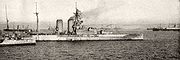
Dardanelles
The Dardanelles , formerly known as the Hellespont, is a narrow strait in northwestern Turkey connecting the Aegean Sea to the Sea of Marmara. It is one of the Turkish Straits, along with its counterpart the Bosphorus. It is located at approximately...
for the Allied attempt to knock the Ottoman Empire
Ottoman Empire
The Ottoman EmpireIt was usually referred to as the "Ottoman Empire", the "Turkish Empire", the "Ottoman Caliphate" or more commonly "Turkey" by its contemporaries...
out of the war. The Queen Elizabeth was the only modern battleship to participate, though a number of battlecruiser
Battlecruiser
Battlecruisers were large capital ships built in the first half of the 20th century. They were developed in the first decade of the century as the successor to the armoured cruiser, but their evolution was more closely linked to that of the dreadnought battleship...
s and pre-dreadnought battleships were also involved. She became the flagship
Flagship
A flagship is a vessel used by the commanding officer of a group of naval ships, reflecting the custom of its commander, characteristically a flag officer, flying a distinguishing flag...
for the preliminary naval operations in the Dardanelles Campaign
Naval operations in the Dardanelles Campaign
The naval operations in the Dardanelles Campaign of the First World War were mainly carried out by the Royal Navy with substantial support from the French and minor contributions from Russia and Australia. The Dardanelles Campaign began as a purely naval operation...
, leading the first line of British battleships in the battle of 18 March 1915. During the attempted military invasion of the Gallipoli
Battle of Gallipoli
The Gallipoli Campaign, also known as the Dardanelles Campaign or the Battle of Gallipoli, took place at the peninsula of Gallipoli in the Ottoman Empire between 25 April 1915 and 9 January 1916, during the First World War...
on 25 April, the Queen Elizabeth was the flagship for General Sir Ian Hamilton, commander of the Mediterranean Expeditionary Force
Mediterranean Expeditionary Force
The Mediterranean Expeditionary Force was part of the British Army during World War I, that commanded all Allied forces at Gallipoli and Salonika. This included the initial naval operation to force the straits of the Dardanelles. Its headquarters was formed in March 1915...
. However, after the sinking of HMS Goliath
HMS Goliath (1898)
HMS Goliath was one of the six Canopus-class pre-dreadnought battleships built by the Royal Navy in the late 19th century. In the First World War Goliath took part in the blockade of the German light cruiser in the Rufiji River but unsuccessful to bombard the cruiser in the delta.On 13 May 1915...
by a Turkish torpedo boat
Torpedo boat
A torpedo boat is a relatively small and fast naval vessel designed to carry torpedoes into battle. The first designs rammed enemy ships with explosive spar torpedoes, and later designs launched self-propelled Whitehead torpedoes. They were created to counter battleships and other large, slow and...
on 12 May, the Queen Elizabeth was immediately withdrawn to a safer position.
She joined Admiral Hugh Evan-Thomas
Hugh Evan-Thomas
Vice Admiral Sir Hugh Evan-Thomas GCB, KCMG, MVO was a British Royal Navy officer.During World War I he commanded the 5th Battle Squadron of the Grand Fleet, flying his flag in HMS Barham, and fought at the Battle of Jutland on 31 May – 1 June 1916.-Background:Evan-Thomas' family came from...
's 5th Battle Squadron
British 5th Battle Squadron
The British 5th Battle Squadron was a squadron consisting of battleships. The 5th Battle Squadron was initially part of the Royal Navy's Home Fleet. During the First World War, the Home Fleet was renamed the Grand Fleet.-August 1914:...
(consisting of Queen Elizabeth-class battleships) of the Grand Fleet based at Scapa Flow
Scapa Flow
right|thumb|Scapa Flow viewed from its eastern endScapa Flow is a body of water in the Orkney Islands, Scotland, United Kingdom, sheltered by the islands of Mainland, Graemsay, Burray, South Ronaldsay and Hoy. It is about...
, but she missed the Battle of Jutland
Battle of Jutland
The Battle of Jutland was a naval battle between the British Royal Navy's Grand Fleet and the Imperial German Navy's High Seas Fleet during the First World War. The battle was fought on 31 May and 1 June 1916 in the North Sea near Jutland, Denmark. It was the largest naval battle and the only...
due to being in dock for maintenance.
Inter war period
Between the wars she was the flagshipFlagship
A flagship is a vessel used by the commanding officer of a group of naval ships, reflecting the custom of its commander, characteristically a flag officer, flying a distinguishing flag...
of the Atlantic Fleet
British Atlantic Fleet
The Atlantic Fleet was a major fleet formation of the Royal Navy.There have been two main formations in the Royal Navy officially called the Atlantic Fleet. The first was created in 1909 and lasted until 1914...
from 1919 to 1924. The future First Sea Lord
First Sea Lord
The First Sea Lord is the professional head of the Royal Navy and the whole Naval Service; it was formerly known as First Naval Lord. He also holds the title of Chief of Naval Staff, and is known by the abbreviations 1SL/CNS...
John H. D. Cunningham served aboard her as Master of the Fleet
Master of the Fleet
In the Royal Navy, the rank of Master of the Fleet denoted the sailing master of a fleet flagship, or the senior sailing master in a fleet. Examples include John Bowen , Ian Hogg, and John H. D. Cunningham.By 1814, the title granted the master extra pay...
, in 1922. From 1924 she was the flagship of the Mediterranean Fleet. Following a refit, she rejoined the Mediterranean Fleet in 1927, went to the Atlantic Fleet in 1929, and later that year returned to the Mediterranean, where she served until 1937. During the 1930s she participated in the non-intervention blockade during the Spanish Civil War
Spanish Civil War
The Spanish Civil WarAlso known as The Crusade among Nationalists, the Fourth Carlist War among Carlists, and The Rebellion or Uprising among Republicans. was a major conflict fought in Spain from 17 July 1936 to 1 April 1939...
.
She was rebuilt twice between the world wars. In 1926–1927 bulges were added, the funnels were trunked, four 4 inch guns were added, and a new foretop was installed. In her 1937-1941 rebuild she was fitted with a tower bridge in place of her old bridge; her 6 inch (152 mm) guns were removed and in their place received 20 4.5 in (114 mm) guns and several smaller anti-aircraft guns; horizontal armour was added; engines and boilers were replaced; and the elevation of her main battery was increased to 30 degrees. Deck armour was increased to 5 inches over the magazines, 2.5 inches over the machinery, while the new 4.5" guns had between 1 and 2 inches of armour.Raven and Roberts, British Battleships of WW2, p247 She also received facilities for aircraft with a launching catapult amidships. New fire control equipment was installed, including the HACS
HACS
HACS, an acronym of High Angle Control System, was a British anti-aircraft fire-control system employed by the Royal Navy from 1931 onwards and used widely during World War II...
MkIV AA fire control system and the Admiralty Fire Control Table
Admiralty Fire Control Table
thumb|Admiralty Fire Control Table in the transmitting station of [[HMS Belfast |HMS Belfast]].The Admiralty Fire Control Table was an electromechanical analogue computer fire-control system that calculated the correct elevation and deflection of a Royal Navy cruiser or battleships' main armament,...
Mk VII for surface fire control of the main armament. This reconstruction was completed in January 1941, when Britain had been at war for over a year.
World War Two

Crete
Crete is the largest and most populous of the Greek islands, the fifth largest island in the Mediterranean Sea, and one of the thirteen administrative regions of Greece. It forms a significant part of the economy and cultural heritage of Greece while retaining its own local cultural traits...
in June 1941. She, along with HMS Valiant
HMS Valiant (1914)
HMS Valiant was a Queen Elizabeth-class battleship of the British Royal Navy. She was laid down at the Fairfield Shipbuilding and Engineering Company, Govan on 31 January 1913 and launched on 4 November 1914...
, was mined and seriously damaged by Italian
Italy
Italy , officially the Italian Republic languages]] under the European Charter for Regional or Minority Languages. In each of these, Italy's official name is as follows:;;;;;;;;), is a unitary parliamentary republic in South-Central Europe. To the north it borders France, Switzerland, Austria and...
frogmen
Frogman
A frogman is someone who is trained to scuba diving or swim underwater in a military capacity which can include combat. Such personnel are also known by the more formal names of combat diver or combatant diver or combat swimmer....
in an attack on 19 December 1941
Raid on Alexandria (1941)
The Raid on Alexandria was carried out on 19 December 1941 by Italian Navy forces attacking Royal Navy forces in the harbour of Alexandria.-Background:...
in shallow water in the harbour at Alexandria, Egypt, with the loss of nine men of her complement.
Although grounded on the harbour bottom, her decks were clear and the Italian crews were captured. For this reason, the British maintained the illusion of full operational status, in order to conceal the weak British position in the Mediterranean during the period the two ships were patched and refloated. However, this concealing action lasted through a few days only, whereas the Valiant went back into service after many months and the Queen Elizabeth after more than a year and half. Following completion of temporary repairs in an Alexandria drydock in June 1942, she steamed through the Suez Canal and around Africa to the Navy Yard
Norfolk Naval Shipyard
The Norfolk Naval Shipyard, often called the Norfolk Navy Yard and abbreviated as NNSY, is a U.S. Navy facility in Portsmouth, Virginia, for building, remodeling, and repairing the Navy's ships. It's the oldest and largest industrial facility that belongs to the U.S. Navy as well as the most...
in Norfolk, Virginia
Norfolk, Virginia
Norfolk is an independent city in the Commonwealth of Virginia in the United States. With a population of 242,803 as of the 2010 Census, it is Virginia's second-largest city behind neighboring Virginia Beach....
in the United States. From September of that year until June 1943, she was comprehensively repaired.
Queen Elizabeth went to the Home Fleet in July 1943, and in December she left for the Eastern Fleet, which she joined in January 1945. She took part in raids on Japan
Japan
Japan is an island nation in East Asia. Located in the Pacific Ocean, it lies to the east of the Sea of Japan, China, North Korea, South Korea and Russia, stretching from the Sea of Okhotsk in the north to the East China Sea and Taiwan in the south...
ese bases in Indonesia
Indonesia
Indonesia , officially the Republic of Indonesia , is a country in Southeast Asia and Oceania. Indonesia is an archipelago comprising approximately 13,000 islands. It has 33 provinces with over 238 million people, and is the world's fourth most populous country. Indonesia is a republic, with an...
, and was placed in reserve in August 1945.
The vessel was paid off in June and scrapped in July 1948.
External links
- Royal Navy History HMS Queen Elizabeth loading cordite and shells for firing.
- Maritimequest HMS Queen Elizabeth Photo Gallery
- HMS Queen Elizabeth at navalhistories