

.gif)
HMS Coventry (D118)

Encyclopedia
HMS Coventry (D118) was a Type 42 (Sheffield Class)
Type 42 destroyer
The Type 42 or Sheffield class, are guided missile destroyers used by the British Royal Navy and the Argentine Navy. The first ship of the class was ordered in 1968 and launched in 1971, and today three ships remain active in the Royal Navy and one in the Argentinian Navy...
destroyer
Destroyer
In naval terminology, a destroyer is a fast and maneuverable yet long-endurance warship intended to escort larger vessels in a fleet, convoy or battle group and defend them against smaller, powerful, short-range attackers. Destroyers, originally called torpedo-boat destroyers in 1892, evolved from...
of the Royal Navy
Royal Navy
The Royal Navy is the naval warfare service branch of the British Armed Forces. Founded in the 16th century, it is the oldest service branch and is known as the Senior Service...
. Laid down by Cammell Laird and Company, Limited
Cammell Laird
Cammell Laird, one of the most famous names in British shipbuilding during the nineteenth and twentieth centuries, came about following the merger of Laird, Son & Co. of Birkenhead and Johnson Cammell & Co. of Sheffield at the turn of the twentieth century.- Founding of the business :The Company...
, at Birkenhead
Birkenhead
Birkenhead is a town within the Metropolitan Borough of Wirral in Merseyside, England. It is on the Wirral Peninsula, along the west bank of the River Mersey, opposite the city of Liverpool...
on 29 January 1973, she was launched on 21 June 1974 and accepted into service on 20 October 1978 at a cost of £37,900,000.
She was sunk by Argentine Air Force
Argentine Air Force
The Argentine Air Force is the national aviation branch of the Armed Forces of the Argentine Republic. , it had 14,606 military and 6,854 civilian staff.-History:...
A-4 Skyhawk
A-4 Skyhawk
The Douglas A-4 Skyhawk is a carrier-capable ground-attack aircraft designed for the United States Navy and United States Marine Corps. The delta winged, single-engined Skyhawk was designed and produced by Douglas Aircraft Company, and later McDonnell Douglas. It was originally designated the A4D...
s on 25 May 1982 during the Falklands War
Falklands War
The Falklands War , also called the Falklands Conflict or Falklands Crisis, was fought in 1982 between Argentina and the United Kingdom over the disputed Falkland Islands and South Georgia and the South Sandwich Islands...
.
Background
The principal role of these ships is to provide the fleet with mid-range anti-air warfare capability with secondary roles of anti-surface and anti-submarine. A total of sixteen Type 42s were built between 1972 and 1985, in three batches, with Coventry the last of the first batch to be commissioned. To cut costs, the first two batches had 47 feet removed from the bow and the beam-to-length ratio reduced. These early Type 42s performed poorly during trials and are notoriously poor sea-keepers.Type 42 Destroyers were fitted with the Sea Dart
Sea Dart missile
Sea Dart or Guided Weapon System 30 is a British surface-to-air missile system designed by Hawker Siddeley Dynamics and built by British Aerospace from 1977...
surface-to-air missile
Surface-to-air missile
A surface-to-air missile or ground-to-air missile is a missile designed to be launched from the ground to destroy aircraft or other missiles...
s (SAM) designed in the 1960s to counter threats from manned aircraft. Sea Dart is constrained by limitations on its firing capacity and reaction time, but did prove itself during the Falklands War with seven kills, three of these attributed to Coventry.
1978-1982
Coventry commissioned on 10 November 1978 under the command of Captain C.P.O. Burne at Portsmouth. Following post-commissioning trials, the ship was used to trial the operation of the new Westland LynxWestland Lynx
The Westland Lynx is a British multi-purpose military helicopter designed and built by Westland Helicopters at its factory in Yeovil. Originally intended as a utility craft for both civil and naval usage, military interest led to the development of both battlefield and naval variants...
helicopter from the Type 42 platform, in order to test the combination's safe operating limits.
The ship's first major deployment came in 1980 when she was sent to the Far East; in September of that year, alongside HMS Antrim
HMS Antrim (D18)
HMS Antrim was a County-class destroyer of the Royal Navy launched on 19 October 1967. In the mid-1970s, the Royal Navy removed 'B' turret and replaced it with four Exocet launchers.-Falklands Conflict:...
and HMS Alacrity
HMS Alacrity (F174)
HMS Alacrity was a Type 21 frigate of the Royal Navy. Built by Yarrow Shipbuilders Ltd, Glasgow, Scotland, she was completed with Exocet launchers in "B" position....
, she became the first British warship to visit the People's Republic of China
People's Republic of China
China , officially the People's Republic of China , is the most populous country in the world, with over 1.3 billion citizens. Located in East Asia, the country covers approximately 9.6 million square kilometres...
in 30 years. En route back to the UK, Coventry was diverted to the Persian Gulf
Persian Gulf
The Persian Gulf, in Southwest Asia, is an extension of the Indian Ocean located between Iran and the Arabian Peninsula.The Persian Gulf was the focus of the 1980–1988 Iran-Iraq War, in which each side attacked the other's oil tankers...
following the outbreak of the Iran-Iraq War
Iran-Iraq War
The Iran–Iraq War was an armed conflict between the armed forces of Iraq and Iran, lasting from September 1980 to August 1988, making it the longest conventional war of the twentieth century...
, where the ship remained on patrol for six weeks until relieved by the start of the permanent Armilla patrol
Armilla patrol
The Armilla patrol is the British Royal Navy's permanent presence in the Persian Gulf.The Royal Navy withdrew its forces from the Persian Gulf in 1971 in line with the UK's general retreat from imperial commitments. However, tensions in the area remained high and Royal Navy ships were still a...
consisting of HMS Ardent
HMS Ardent (F184)
HMS Ardent was a Royal Navy Type 21 frigate. Built by Yarrow Shipbuilders Ltd, Glasgow, Scotland. She was completed with Exocet launchers in 'B' position...
and HMS Apollo
HMS Apollo (F70)
HMS Apollo was a Batch 3B Broadbeam Leander-class frigate of the Royal Navy . She was, like the rest of the class, named after a figure of mythology. Apollo was built by Yarrow Shipbuilders of Scotstoun...
. Throughout 1981 and into 1982, Coventry took part in various exercises in home waters, culminating in her deployment as part of Exercise Springtrain '82 in March 1982.
Falklands Campaign
HMS Coventry was taking part in the Exercise Springtrain 82 near the British base of GibraltarGibraltar
Gibraltar is a British overseas territory located on the southern end of the Iberian Peninsula at the entrance of the Mediterranean. A peninsula with an area of , it has a northern border with Andalusia, Spain. The Rock of Gibraltar is the major landmark of the region...
, during March 1982. Along with other vessels involved in the exercise she was detailed for service in the Falklands Campaign. She had a Union Flag
Union Flag
The Union Flag, also known as the Union Jack, is the flag of the United Kingdom. It retains an official or semi-official status in some Commonwealth Realms; for example, it is known as the Royal Union Flag in Canada. It is also used as an official flag in some of the smaller British overseas...
painted on the roof of her bridge and a black line painted through her funnel to her waterline to aid recognition, as the Argentines also operated two Type 42 Destroyers.
On 27 April, Coventry, in the company of , , and , entered the Total Exclusion Zone
Total Exclusion Zone
The Total Exclusion Zone was an area declared by the United Kingdom 30 April 1982 covering a circle of from the centre of the Falkland Islands...
, a 200-mile cordon around the Falkland Islands. Within 6 weeks, Sheffield and Coventry would be at the bottom of the South Atlantic, Glasgow would have a bomb pass straight through her and Glamorgan would be hit by a land-based Exocet
Exocet
The Exocet is a French-built anti-ship missile whose various versions can be launched from surface vessels, submarines, helicopters and fixed wing aircraft. Hundreds were fired in combat during the 1980s.-Etymology:...
Missile. In all, over fifty crew would be dead.
Coventry's contribution to the Falklands War
Falklands War
The Falklands War , also called the Falklands Conflict or Falklands Crisis, was fought in 1982 between Argentina and the United Kingdom over the disputed Falkland Islands and South Georgia and the South Sandwich Islands...
was considerable. Her helicopter was the first to fire Sea Skua
Sea Skua
The Sea Skua is a British lightweight short-range air-to-surface missile designed for use from helicopters against ships. It is primarily used by the Royal Navy on the Westland Lynx helicopter, although Kuwait uses it in a shore battery and on their Umm Al Maradem fast attack craft.The British...
(Air-to-Surface)
Air-to-surface missile
An air-to-surface missile is a missile designed to be launched from military aircraft and strike ground targets on land, at sea, or both...
anti-ship missile
Anti-ship missile
Anti-ship missiles are guided missiles that are designed for use against ships and large boats. Most anti-ship missiles are of the sea-skimming type, many use a combination of inertial guidance and radar homing...
s in action. Her Westland Lynx HAS.Mk.2
Westland Lynx
The Westland Lynx is a British multi-purpose military helicopter designed and built by Westland Helicopters at its factory in Yeovil. Originally intended as a utility craft for both civil and naval usage, military interest led to the development of both battlefield and naval variants...
fired two Sea Skua missiles on 3 May at ARA Alferez Sobral
ARA Alferez Sobral (A-9)
ARA Alferez Sobral is an aviso in Argentine Navy service since 1972. She had previously served in the US Navy as .-US Navy service:...
, the former . One missile missed and the other hit a small boat, knocking out the radio aerials and slightly injuring a crewman manning a 20 mm gun. 's Lynx fired two more Sea Skua, and the vessel retreated, with eight crew killed, eight wounded and heavy damage. Her damaged bridge is now on display at the Naval Museum in Tigre
Tigre Partido
Tigre Partido is a partido or municipality of Buenos Aires Province, Argentina, situated in the north of Greater Buenos Aires. The department covers a large section of the Paraná Delta and its low-lying islands...
, Argentina. This vessel remains in service in the Argentine Navy.

Sea Dart missile
Sea Dart or Guided Weapon System 30 is a British surface-to-air missile system designed by Hawker Siddeley Dynamics and built by British Aerospace from 1977...
surface-to-air missile
Surface-to-air missile
A surface-to-air missile or ground-to-air missile is a missile designed to be launched from the ground to destroy aircraft or other missiles...
s in anger when the ship fired three on 9 May at two Learjets of Escuadrón Fénix
Escuadrón Fénix
The Phoenix Squadron was a special unit of the Argentine Air Force formed during the 1982 Falklands War - History :...
, just missing the aircraft. reported that her radar tracked the missiles merging with the pair of contacts (call signs Litro and Pepe), but they missed the aircraft.
David Hart Dyke
Captain David Hart Dyke CBE LVO ADC RN is a retired Royal Navy Officer, former Aide-de-Camp to HM The Queen, and former Commanding officer of HMS Coventry, sunk during the Falklands War....
claims that two A-4C Skyhawks of Grupo 4 were shot down by the Sea Darts, but Aircraft (C-303 and C-313) were lost in bad weather, with both wrecks found on South Jason Island
South Jason Island
South Jason is one of the Jason Islands in the north west Falkland Islands . In Spanish it is considered one of"Islas las Llaves"...
. One on the Northwest side of the cliffs, the other in shallow waters on the SouthWest. Lt Casco and Lt Farias were both killed.
The first confirmed kill made by Coventry was an Aérospatiale Puma helicopter of 601 Assault Helicopter Battalion
601 Assault Helicopter Battalion
The 601 Assault Helicopter Battalion is a helicopter unit of the Argentine Army.This battalion is the main helicopter unit of the Argentine Army Aviation and is based on Campo de Mayo, Buenos Aires. The unit is composed by Bell UH-1H and Aerospatiale Puma helicopters. It is organised in two...
, shot down by a Sea Dart over Choiseul Sound
Choiseul Sound
Choiseul Sound is a stretch of sea in the Falkland Islands. It runs parallel to Eagle Passage and is between Lafonia and the north of East Falkland. Lively Island is in its mouth....
, killing its three man crew.
Coventry had been one of three Type 42 destroyers providing anti-aircraft cover for the fleet. With the loss of and damage to on 12 May, forcing her to return to the UK, Coventry was left to carry out the role alone, until other ships could arrive from the UK.
25 May 1982
On 25 May 1982 (one of Argentina's national dayNational Day
The National Day is a designated date on which celebrations mark the nationhood of a nation or non-sovereign country. This nationhood can be symbolized by the date of independence, of becoming republic or a significant date for a patron saint or a ruler . Often the day is not called "National Day"...
s: el Día de la Revolución de Mayo ), Coventry was ordered to take up position in Falkland Sound
Falkland Sound
The Falkland Sound is a sea strait in the Falkland Islands. Running south west - north east, it separates West and East Falkland.-Name:The sound was named by John Strong in 1690 for Viscount Falkland, the name only later being applied to the archipelago and its two largest islands...
, accompanied by . There she would act as a decoy to draw Argentinian aircraft away from other ships at San Carlos Bay
San Carlos Water
Not to be confused with the San Carlos River.San Carlos Water is a bay/fjord on the west coast of East Falkland, facing onto the Falkland Sound.-Name:...
. In this position, close to land, with not enough open sea between her and the land, her Sea Dart missiles would be less effective. Broadsword was armed with the Sea Wolf missile, which is for short range anti-aircraft and anti-missile use.
At first, the trap worked, with FAA A-4B Skyhawk C-244 of Grupo 5 shot down north of Pebble Island
Pebble Island
Pebble Island is one of the Falkland Islands, lying north of West Falkland.The island stretches about 19 miles from east to west and is about 4.3 miles at its widest point, with a total area of square miles .It has three high points: First Mountain , Middle Mountain and...
by a Sea Dart. Pilot Capitán Hugo Angel del Valle Palaver was killed. Later a FAA A-4C Skyhawk coded C-304 of Grupo 4 de Caza deployed to San Julian was shot down north east of Pebble Island by another Sea Dart while returning from a mission to San Carlos Water. Capitán Jorge Osvaldo García successfully ejected but was not recovered from the water. His body was washed ashore in a dinghy at Golding Island
Golding Island
Golding Island is one of the Falkland Islands, just to the north of West Falkland in Keppel Sound and near Keppel and Pebble Islands. It has a complex shape, with narrow headlands and bays, and a pond in the middle....
in 1983. Garcia's wingman, Teniente Ricardo Lucero, was also shot down during the raid on San Carlos by a Sea Cat from (also claimed by various others in the area including a Rapier battery), but he was luckier, and ejected into captivity, in front of waiting news crews.
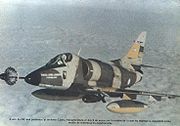
The two ships then came under attack by two waves of two Argentine A-4 Skyhawk
A-4 Skyhawk
The Douglas A-4 Skyhawk is a carrier-capable ground-attack aircraft designed for the United States Navy and United States Marine Corps. The delta winged, single-engined Skyhawk was designed and produced by Douglas Aircraft Company, and later McDonnell Douglas. It was originally designated the A4D...
s, with each aircraft carrying three 1000 lb bombs. This load was possible due to the proximity of the two Royal Navy warships to the Argentine mainland. The four Skyhawks flew so low that Coventry's targeting radar could not distinguish between them and the land and failed to lock on
Missile lock-on
Missile lock-on refers to a scenario where the guidance system for a missile can accurately track a target, and a fire-control system can calculate the required flightpath for the missile to hit the target...
. Broadsword attempted to target the first pair of attackers (Capitán Pablo Carballo
Pablo Carballo
Commodore Pablo Marcos Rafael Carballo is a retired member of the Argentine Air Force - the Fuerza Aérea Argentina - who fought in the 1982 Falklands War where he participated in actions that led to the sinking of three Royal Navy ships...
and Teniente Carlos Rinke) with her Sea Wolf missile
Sea Wolf missile
Sea Wolf is a naval guided missile system designed and built by BAC, later to become British Aerospace Dynamics . It is an automated point-defence weapon system designed as a final line of defence against both sea-skimming and high angle anti-ship missiles and aircraft...
system, but her own tracking system locked down during the attack and could not be reset before the aircraft released their bombs. Of the bombs released, one bounced off the sea and struck Broadsword's flight deck and, though it failed to explode, wrecked the ship's Lynx helicopter. Coventry claimed to have hit the second Skyhawk (Capitán P. Marcos Carballo) in the tail with small arms fire, although he did return safely to Argentina. In fact, Carballo's plane was hit under the right wing by a piece of shrapnel on his way in, that pierced his aircraft's right fuel tank.
The second pair of Skyhawks (Primer Teniente Mariano A. Velasco and Ensign Alférez Leonardo Barrionuevo), headed for Coventry 90 seconds later at a 20-degree angle to her port bow. Still unable to gain a missile lock, Coventry launched a Sea Dart
Sea Dart missile
Sea Dart or Guided Weapon System 30 is a British surface-to-air missile system designed by Hawker Siddeley Dynamics and built by British Aerospace from 1977...
in an attempt to distract them and turned hard to starboard to reduce her profile. On Broadsword the Sea Wolf system had been reset and successfully acquired the attacking aircraft, but was unable to fire as Coventry's turn took her directly into the line of fire.
Coventry used her 4.5-inch gun and small arms against the attacking aircraft. The port Oerlikon 20 mm cannon
Oerlikon 20 mm cannon
The Oerlikon 20 mm cannon is a series of autocannons, based on an original design by Reinhold Becker of Germany, very early in World War I, and widely produced by Oerlikon Contraves and others...
jammed, leaving the ship with only rifles and machine guns to defend herself. Coventry was struck by two bombs just above the water line on the port side. One of the bombs exploded beneath the computer room, destroying it and the nearby operations room, incapacitating almost all senior officers. The other entered the Forward Engine Room, exploding beneath the Junior Ratings Dining Room where the First Aid Party was stationed and the ship immediately began listing to port. The latter hit caused critical damage as it breached the bulkhead between the forward and aft engine rooms, exposing the largest open space in the ship to uncontrollable flooding. Given the design of the ship, with multiple watertight compartments, two hits virtually anywhere else may have been just survivable.
Within 20 minutes Coventry had been abandoned and had completely capsize
Capsize
Capsizing is an act of tipping over a boat or ship to disable it. The act of reversing a capsized vessel is called righting.If a capsized vessel has sufficient flotation to prevent sinking, it may recover on its own if the stability is such that it is not stable inverted...
d. Nineteen of her crew were lost and a further thirty injured. Coventry sank shortly after. After the ship was struck, her crew, waiting to be rescued, sang "Always Look on the Bright Side of Life
Always Look on the Bright Side of Life
"Always Look on the Bright Side of Life" is a popular song written by Eric Idle that was originally featured in the 1979 film Monty Python's Life of Brian and has gone on to become a common singalong at public events such as football matches as well as funerals.-History:Whilst trying to come up...
" from Monty Python's Life of Brian
Monty Python's Life of Brian
Monty Python's Life of Brian, also known as Life of Brian, is a 1979 British comedy film written, directed and largely performed by the Monty Python comedy team...
.
Tributes
No member of Coventry received an award for bravery. CPO Aircrewman M J Tupper of No.846 NAS was awarded a Distinguished Service MedalDistinguished Service Medal (United Kingdom)
The Distinguished Service Medal was a military decoration awarded to personnel of the Royal Navy and members of the other services, and formerly also to personnel of other Commonwealth countries, up to and including the rank of Chief Petty Officer, for bravery and resourcefulness on active service...
for his part in the rescue. After the war, a cross to commemorate crew members who lost their lives was erected on Pebble Island
Pebble Island
Pebble Island is one of the Falkland Islands, lying north of West Falkland.The island stretches about 19 miles from east to west and is about 4.3 miles at its widest point, with a total area of square miles .It has three high points: First Mountain , Middle Mountain and...
.
David Hart Dyke
David Hart Dyke
Captain David Hart Dyke CBE LVO ADC RN is a retired Royal Navy Officer, former Aide-de-Camp to HM The Queen, and former Commanding officer of HMS Coventry, sunk during the Falklands War....
, Coventrys commanding officer during the Falklands War, wrote about the ship's tale in his book Four Weeks in May: The Loss of HMS Coventry. This was adapted by the BBC
BBC
The British Broadcasting Corporation is a British public service broadcaster. Its headquarters is at Broadcasting House in the City of Westminster, London. It is the largest broadcaster in the world, with about 23,000 staff...
into a documentary Sea of Fire, with dramatised sequences and shown in June 2007. In 2011, it was announced that a feature-length film would be produced based on Four Weeks in May, to be written and directed by Tom Shankland
Tom Shankland
- Filmography :* The Children * WΔZ * Marple: The Moving Finger * Jericho * Family Business * No Night Is Too Long * Clocking Off * Going Down * Hearts and Bones * Bait * Bubbles - Awards :...
.
The wreck site is a controlled site under the Protection of Military Remains Act. About 8 months after Coventry sank, a RN Fleet Diving Team conducted an underwater survey of the wreck, which they found lying on her side in 100 metres of water. This survey was a prerequisite to a dive on the wreck, named "Operation Blackleg", to recover classified documentation and make the remaining weapons safe. The dive team recovered several personal items belonging to Hart Dyke and the ship's battle ensign, later presented to the next Coventry
HMS Coventry (F98)
HMS Coventry was a Type 22 frigate of the Royal Navy. She was originally intended to be named Boadicea but was named Coventry in honour of the previous Coventry , a Type 42 destroyer sunk in the Falklands War....
, a Type 22 frigate
Type 22 frigate
The Type 22 Broadsword class is a class of frigate built for the British Royal Navy. Fourteen of the class were built in total, with production divided into three batches. With the decommissioning of HMS Cornwall on 30 June 2011, the final Type 22 of the Royal Navy was retired from service...
. The divers also recovered the Cross of Nails, originally presented to the ship by Coventry Cathedral
Coventry Cathedral
Coventry Cathedral, also known as St Michael's Cathedral, is the seat of the Bishop of Coventry and the Diocese of Coventry, in Coventry, West Midlands, England. The current bishop is the Right Revd Christopher Cocksworth....
. This too was loaned to the new HMS Coventry, until her decommissioning in 2002, when it returned to the cathedral.