

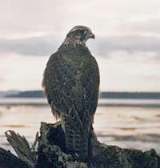
Gyrfalcon

Encyclopedia
The Gyrfalcon — Falco rusticolus — is the largest of the falcon
species. The Gyrfalcon breeds on Arctic
coasts and the islands of North America, Europe, and Asia. It is mainly resident there also, but some Gyrfalcons disperse
more widely after the breeding season, or in winter.Individual vagrancy can take birds for long distances. There is a story in the Unauthorized Biography of the Spring and Autumn of a hǎidōngqīng (海东青: Gyrfalcon) that succumbed to an arrow wound in the garden of Chen Hui Gong. Confucius
recognized the arrow as one of the Sushen
, whose fine stone arrowheads were a famous item of trade and tribute (RAM 2006). Although the Sushen's precise homeland at that time remains unknown, it was in the Manchuria
region, no less than c.600 and perhaps more than 1000 km from the Lu
capital of Qufu
. The Gyrfalcon is dispersed throughout much of the Northern Hemisphere, with populations in Northern America, Greenland, and Northern Europe. Its plumage varies with location, with birds being coloured from all-white to dark brown.
The bird's common name comes from French
gerfaucon; in medieval Latin
it is gyrofalco. The first part of the word may come from Old High German
gîr (cf. modern German
Geier) for "vulture
", referring to its size compared to other falcon
s; or from the Latin
gȳrus for "circle" or "curved path"—from the species' circling as it searches for prey, distinct from the hunting of other falcons in its range.In Scandinavia
n languages, it is generally named after its use in falconry
, whereas the modern Dutch name giervalk is peculiarly ambiguous: Gier means "vulture", whereas gieren means changing the yaw angle to circle in the air. The male Gyrfalcon is called a gyrkin in falconry
. The scientific name
is composed of the Latin term for a falcon, Falco, and for a countryside-dweller, rusticolus.
s (buzzard hawks). Males are 48 to 61 cm (19 to 24 in) long, weigh 805 to 1350 g (1.8 to 3 lbs) and have a wingspan from 110 to 130 cm (43 to 51 in). Females are bulkier and larger, at 51 to 65 cm (20 to 26 in) long, 124 to 160 cm (49 to 64 in) wingspan, and of 1180 to 2100 g (2.6 to 4.6 lbs) weight. The Gyrfalcon is larger than the Peregrine Falcon
and differs from the buzzard
in general structure, being unmistakably a falcon with pointed wings, and broader-winged and longer-tailed than the Peregrine.
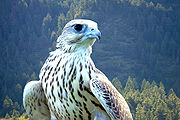
The Gyrfalcon is a very polymorphic
species, so its plumage varies greatly. The archetypal morphs are called "white", "silver", "brown", and "black", though they can be coloured on a spectrum that begins with all-white and ends with very dark. The brown form of the Gyrfalcon is distinguished from the Peregrine by the cream streaking on the nape and crown and by the absence of a well-defined malar stripe and cap. The black morph has its underside strongly spotted black, rather than finely barred as in the Peregrine. White form Gyrfalcons are unmistakable, as they are the only predominantly white falcons. Silver gyrfalcons resemble a light grey Lanner Falcon
of larger size. There is no difference in colouring between males and females; and juveniles are darker and browner than the corresponding adults.
The black color seems to be sex-linked and to occur mostly in females; it proved difficult for breeders to get males darker than the dark side of slate grey. A color variety that arose in captive breeding is "black chick".
 The Gyrfalcon is a member of the hierofalcon
complex. In this group, there is ample evidence for rampant hybridisation and incomplete lineage sorting
which confounds analyses of DNA sequence data to a massive extent. The radiation of the entire living diversity of hierofalcons took place in approximately the Eemian Stage at the start of the Late Pleistocene
. It represents lineages that expanded into the Holarctic
and adapted to local conditions; this is in contrast to less northerly populations of northeastern Africa
(where the radiation probably originated) which evolved into the Saker Falcon
. Gyrfalcons hybridize not infrequently with Sakers in the Altai Mountains and this gene flow
seems to be the origin of the Altai Falcon
.
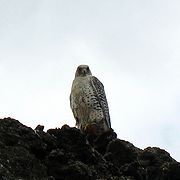
There is some correlation between locality and colour morph. Greenland
Gyrfalcons are lightest, with white plumage flecked with grey on the back and wings being most common. Other subpopulations have varying amounts of the darker morphs: the Icelandic birds tend towards pale, whereas the Eurasian populations are considerably darker and typically incorporate no white birds. Natural separation into regional subspecies is prevented by Gyrfalcons' habit of flying long distances whilst exchanging allele
s between subpopulations; thus, the allele distributions for the color polymorphism form clines and in darker birdsThe allele combination producing the white morph seems to be recessive. of unknown origin, theoretically any allele combination might be present. For instance, a mating of a pair of captive Gyrfalcons is documented to have produced a clutch
of 4 young: one white, one silver, one brown, and one black.
 In general, geographic variation follows Bergmann's Rule
for size and the demands of crypsis
for plumage coloration. Several subspecies
have been named according to perceived differences between populationsFalco rusticolus candicans from northern Greenland and adjacent North America which is often very white; F. r. obsoletus from the southern Greenland into subarctic
North America which is much darker, often brown or black; and F. r. islandus (Iceland), F. r. rusticolus (Scandinavia including the species' type locality, Sweden), as well as F. r. intermedius and F. r. grebnitzkii (Siberia), which all tend towards more or less dark "silver" coloration (Snow et al. 1998, Johnson et al. 2007). but none of these are consistent and thus no living subspecies are accepted today. Perhaps the Icelandic population described as Falco rusticolus islandus is the most distinct. The predominantly white Arctic forms are parapatric
and seamlessly grade into the subarctic
populations, whereas the birds of Iceland have presumably less gene flow
with their neighbors and indeed show less variation in plumage colors and often look quite similar to a large, washed-out Peregrine Falcon (although their habitus
is different). Comprehensive phylogeographic
studies to determine the proper status of the Icelandic population have yet to be determined.
A recent molecular study, however, identified the Iceland population as genetically unique relative to other sampled populations in both eastern and western Greenland, Canada, Alaska and Norway. Further, within Greenland, differing levels of gene flow between western and eastern sampling locations was identified with apparent asymmetric dispersal in western Greenland from north to south. This dispersal bias is in agreement with the distribution of plumage colour variants with white Gyrfalcons in much higher proportion in northern Greenland. Further work is required to determine the ecological factors contributing to these distributions relative to plumage differences, and whether renewed subspecies designations are warranted.
A paleosubspecies
, Falco rusticolus swarthi, existed during the Late Pleistocene
(125,000 to 13,000 years ago). Fossils found in Little Box Elder Cave (Converse County, Wyoming), Dark Canyon Cave (Eddy County, New Mexico
), and McKittrick, California
were initially described as Falco swarthi ("Swarth Falcon" or more properly "Swarth's Gyrfalcon") on account of their distinct size. They have meanwhile proven to be largely inseparable from those of living Gyrfalcons, except for being somewhat larger.
Swarth's Gyrfalcon was on the upper end of the present Gyrfalcon's size range, strong females even surpassing it (Miller 1935). It seems to have had some adaptations to the temperate semiarid climate that predominated in its range during the last ice age
. Ecologically more similar to the Siberian populations of today (which are generally composed of smaller birds) or to the Prairie Falcon
, this population of temperate steppe
habitat must have preyed on landbirds and mammals rather than the water—and on the seabirds which make up much of the American Gyrfalcon's diet today.
and mountains only, however, in June 2011 it was revealed that it spends considerable periods during the winter on sea ice far from land. It feeds only on birds and mammal
s. Like other hierofalcons, it usually hunts in a horizontal pursuit, rather than with the peregrine's speedy stoop from a height. Most prey is killed on the ground, whether they are captured there or, if the victim is a flying bird, forced to the ground. The diet is to some extent opportunistic, but a majority of breeding birds mostly rely on Lagopus
grouse
and avian marine species on coastal habitats. Avian prey can range in size from redpoll
s to geese
and can include gull
s, corvid
s, smaller passerine
s, wader
s, and other raptor
s (up to the size of Buteo
s). Mammalian prey can range in size from shrew
s to marmot
s (sometimes thrice the weight of the assaulting falcon), and often includes lemming
s, vole
s, ground squirrel
s, and hare
s. They are rarely observed eating carrion
.
 The Gyrfalcon almost invariably nests on cliff faces. Breeding pairs do not build their own nests, and often use a bare cliff ledge or the abandoned nest of other birds, particularly Golden Eagle
s and Common Raven
s. The clutch can range from 1 to 5 eggs, but is usually 2 to 4. The average size of an egg is 58.46 x 45 mm (2.31 x 1.8 in); the average weight is 62 g (2.2 oz). The incubation period averages 35 days, with the chicks hatching at a weight of around 52 g (1.8 oz). The nestlings are brooded usually for 10 to 15 days and leave the nest at 7 to 8 weeks. At 3 to 4 months of age, the immatures become independent of their parents, though they may associate with their siblings through the following winter.
The only natural predator of Gyrfalcons are Golden Eagles and even they rarely engage with these formidable falcons. Gyrfalcons have been recorded as aggressively harassing animals that come near their nests, although Common Ravens are the only predators known to successful pick off Gyrfalcon eggs and hatchlings. Even brown bear
s have been reportedly dive-bombed. Humans, whether accidentally (automobile collisions or poisoning of carrion to kill mammal
ian scavengers) or intentionally (through hunting), are the leading cause of death for Gyrfalcons. Gyrfalcons that survive into adulthood can live up to 20 years of age.
As F. rusticolus has such a wide range, it is not considered a threatened species by the IUCN. It is not much affected by habitat destruction
, but pollution, for instance by pesticide
s, depressed its numbers in the mid-20th century, and until 1994 it was considered "Near Threatened
". Improving environmental standards in developed countries have allowed the birds to make a comeback, and today they are not considered rare or endangered.
. The white falcon in the crest of the Icelandic Republic
's coat of arms is a variety of Gyrfalcon.
In medieval times, the Gyrfalcon was considered a royal
bird. It was highly prized as far away as the Sultan
's court in Egypt. The geographer and historian Ibn Said al-Maghribi (d. 1286) described certain northern Atlantic
islands west of Ireland
where these falcons would be brought from, and how the Egyptian Sultan paid 1,000 dinar
s for each Gyrfalcon (or, if it arrived dead, 500 dinars). Due to its rarity and the difficulties involved in obtaining it, in Europe
an falconry
the Gyrfalcon was generally reserved for kings and nobles; very rarely was a man of lesser rank seen with a Gyrfalcon on his fist.
In the 12th century AD the Jurchen tribes rebelled
against the Chinese
Liao Dynasty
which was ruled by the Khitan
. The primary cause was that the Khitan noble
s, among whom swan
hunting had become highly fashionable, extorted a big tax
of Gyrfalcons (海东青 hǎidōngqīng in Chinese). Especially under the last Liao Emperor Yēlǜ Yánxĭ (耶律延禧), tax collectors were even entitled to use force to procure the demanded quantity of Gyrfalcons. The rebellion caught on, and the Jurchen under chieftain Wányán Āgǔdǎ (完颜阿骨打) annihilated the Liao empire in 1125, establishing the Jīn Dynasty in its stead.
Gyrfalcons are today expensive to buy, and thus owners and breeders may keep them secret to avoid theft. They can and often do fly long distances, and falconers may fit a radio-tracker in order to aid recovery. Wild Gyrfalcons are not much exposed to disease, and as a result have immune system
s that are naive to many pathogens found around human environments. As a result, many Gyrfalcons taken from the wild quickly die of disease. Several generations of captive breeding from the survivors causes selection for a stronger immune system and thus better resistance to disease.
Falcons are known to be very susceptible to avian influenza. Therefore an experiment was done with hybrid gyr-saker
falcons, which found that 5 falcons vaccinated with a commercial H5N2 influenza vaccine survived infection with a highly pathogenic H5N1 strain, whereas 5 unvaccinated falcons died. Since both wild and captive gyrfalcons are valuable (for wildlife conservation and falconry, respectively), this means they can be protected from bird flu by vaccination.
Falcon
A falcon is any species of raptor in the genus Falco. The genus contains 37 species, widely distributed throughout Europe, Asia, and North America....
species. The Gyrfalcon breeds on Arctic
Arctic
The Arctic is a region located at the northern-most part of the Earth. The Arctic consists of the Arctic Ocean and parts of Canada, Russia, Greenland, the United States, Norway, Sweden, Finland, and Iceland. The Arctic region consists of a vast, ice-covered ocean, surrounded by treeless permafrost...
coasts and the islands of North America, Europe, and Asia. It is mainly resident there also, but some Gyrfalcons disperse
Bird migration
Bird migration is the regular seasonal journey undertaken by many species of birds. Bird movements include those made in response to changes in food availability, habitat or weather. Sometimes, journeys are not termed "true migration" because they are irregular or in only one direction...
more widely after the breeding season, or in winter.Individual vagrancy can take birds for long distances. There is a story in the Unauthorized Biography of the Spring and Autumn of a hǎidōngqīng (海东青: Gyrfalcon) that succumbed to an arrow wound in the garden of Chen Hui Gong. Confucius
Confucius
Confucius , literally "Master Kong", was a Chinese thinker and social philosopher of the Spring and Autumn Period....
recognized the arrow as one of the Sushen
Sushen
Sushen was an ancient ethnic group or people who dwelt in the northeastern part of China and the Russian Maritime Province, in the area of modern Jilin and Heilongjiang provinces. They were active during the Zhou Dynasty period...
, whose fine stone arrowheads were a famous item of trade and tribute (RAM 2006). Although the Sushen's precise homeland at that time remains unknown, it was in the Manchuria
Manchuria
Manchuria is a historical name given to a large geographic region in northeast Asia. Depending on the definition of its extent, Manchuria usually falls entirely within the People's Republic of China, or is sometimes divided between China and Russia. The region is commonly referred to as Northeast...
region, no less than c.600 and perhaps more than 1000 km from the Lu
Lu (state)
The State of Lu, was a Zhou Dynasty ducal vassal state before and during the Spring and Autumn Period of Chinese history. Founded in the 10th century BC, its dukes used Ji as their family name. The first duke was Boqin |Qi]] and to the south by the powerful state of Chu...
capital of Qufu
Qufu
Qufu is a city in southwestern Shandong province, People's Republic of China. It is located at 35° 36′ northern latitude and 117° 02′ east, about south of the provincial capital Jinan and northeast of the prefecture seat at Jining...
. The Gyrfalcon is dispersed throughout much of the Northern Hemisphere, with populations in Northern America, Greenland, and Northern Europe. Its plumage varies with location, with birds being coloured from all-white to dark brown.
The bird's common name comes from French
French language
French is a Romance language spoken as a first language in France, the Romandy region in Switzerland, Wallonia and Brussels in Belgium, Monaco, the regions of Quebec and Acadia in Canada, and by various communities elsewhere. Second-language speakers of French are distributed throughout many parts...
gerfaucon; in medieval Latin
Medieval Latin
Medieval Latin was the form of Latin used in the Middle Ages, primarily as a medium of scholarly exchange and as the liturgical language of the medieval Roman Catholic Church, but also as a language of science, literature, law, and administration. Despite the clerical origin of many of its authors,...
it is gyrofalco. The first part of the word may come from Old High German
Old High German
The term Old High German refers to the earliest stage of the German language and it conventionally covers the period from around 500 to 1050. Coherent written texts do not appear until the second half of the 8th century, and some treat the period before 750 as 'prehistoric' and date the start of...
gîr (cf. modern German
German language
German is a West Germanic language, related to and classified alongside English and Dutch. With an estimated 90 – 98 million native speakers, German is one of the world's major languages and is the most widely-spoken first language in the European Union....
Geier) for "vulture
Vulture
Vulture is the name given to two groups of convergently evolved scavenging birds, the New World Vultures including the well-known Californian and Andean Condors, and the Old World Vultures including the birds which are seen scavenging on carcasses of dead animals on African plains...
", referring to its size compared to other falcon
Falcon
A falcon is any species of raptor in the genus Falco. The genus contains 37 species, widely distributed throughout Europe, Asia, and North America....
s; or from the Latin
Latin
Latin is an Italic language originally spoken in Latium and Ancient Rome. It, along with most European languages, is a descendant of the ancient Proto-Indo-European language. Although it is considered a dead language, a number of scholars and members of the Christian clergy speak it fluently, and...
gȳrus for "circle" or "curved path"—from the species' circling as it searches for prey, distinct from the hunting of other falcons in its range.In Scandinavia
Scandinavia
Scandinavia is a cultural, historical and ethno-linguistic region in northern Europe that includes the three kingdoms of Denmark, Norway and Sweden, characterized by their common ethno-cultural heritage and language. Modern Norway and Sweden proper are situated on the Scandinavian Peninsula,...
n languages, it is generally named after its use in falconry
Falconry
Falconry is "the taking of wild quarry in its natural state and habitat by means of a trained raptor". There are two traditional terms used to describe a person involved in falconry: a falconer flies a falcon; an austringer flies a hawk or an eagle...
, whereas the modern Dutch name giervalk is peculiarly ambiguous: Gier means "vulture", whereas gieren means changing the yaw angle to circle in the air. The male Gyrfalcon is called a gyrkin in falconry
Falconry
Falconry is "the taking of wild quarry in its natural state and habitat by means of a trained raptor". There are two traditional terms used to describe a person involved in falconry: a falconer flies a falcon; an austringer flies a hawk or an eagle...
. The scientific name
Binomial nomenclature
Binomial nomenclature is a formal system of naming species of living things by giving each a name composed of two parts, both of which use Latin grammatical forms, although they can be based on words from other languages...
is composed of the Latin term for a falcon, Falco, and for a countryside-dweller, rusticolus.
Description
The gyrfalcon is a very large falcon, being about the same size as the largest buteoButeo
Buteo is a genus of medium to fairly large, wide-ranging raptors with a robust body and broad wings. In the Old World, members of this genus are called "buzzards", but "hawk" is used in North America...
s (buzzard hawks). Males are 48 to 61 cm (19 to 24 in) long, weigh 805 to 1350 g (1.8 to 3 lbs) and have a wingspan from 110 to 130 cm (43 to 51 in). Females are bulkier and larger, at 51 to 65 cm (20 to 26 in) long, 124 to 160 cm (49 to 64 in) wingspan, and of 1180 to 2100 g (2.6 to 4.6 lbs) weight. The Gyrfalcon is larger than the Peregrine Falcon
Peregrine Falcon
The Peregrine Falcon , also known as the Peregrine, and historically as the Duck Hawk in North America, is a widespread bird of prey in the family Falconidae. A large, crow-sized falcon, it has a blue-gray back, barred white underparts, and a black head and "moustache"...
and differs from the buzzard
Buzzard
A buzzard is one of several large birds, but there are a number of meanings as detailed below.-Old World:In the Old World Buzzard can mean:* One of several medium-sized, wide-ranging raptors with a robust body and broad wings....
in general structure, being unmistakably a falcon with pointed wings, and broader-winged and longer-tailed than the Peregrine.
The Gyrfalcon is a very polymorphic
Polymorphism (biology)
Polymorphism in biology occurs when two or more clearly different phenotypes exist in the same population of a species — in other words, the occurrence of more than one form or morph...
species, so its plumage varies greatly. The archetypal morphs are called "white", "silver", "brown", and "black", though they can be coloured on a spectrum that begins with all-white and ends with very dark. The brown form of the Gyrfalcon is distinguished from the Peregrine by the cream streaking on the nape and crown and by the absence of a well-defined malar stripe and cap. The black morph has its underside strongly spotted black, rather than finely barred as in the Peregrine. White form Gyrfalcons are unmistakable, as they are the only predominantly white falcons. Silver gyrfalcons resemble a light grey Lanner Falcon
Lanner Falcon
The Lanner Falcon is a large bird of prey that breeds in Africa, southeast Europe and just into Asia. It is mainly resident, but some birds disperse more widely after the breeding season.-Description:...
of larger size. There is no difference in colouring between males and females; and juveniles are darker and browner than the corresponding adults.
The black color seems to be sex-linked and to occur mostly in females; it proved difficult for breeders to get males darker than the dark side of slate grey. A color variety that arose in captive breeding is "black chick".
Systematics and evolution
Hierofalcon
The hierofalcons are four closely related species of falcon which make up the subgenus Hierofalco:* Lanner Falcon, Falco biarmicus* Laggar Falcon, Falco jugger* Saker Falcon, Falco cherrug* Gyrfalcon, Falco rusticolus...
complex. In this group, there is ample evidence for rampant hybridisation and incomplete lineage sorting
Coalescent theory
In genetics, coalescent theory is a retrospective model of population genetics. It attempts to trace all alleles of a gene shared by all members of a population to a single ancestral copy, known as the most recent common ancestor...
which confounds analyses of DNA sequence data to a massive extent. The radiation of the entire living diversity of hierofalcons took place in approximately the Eemian Stage at the start of the Late Pleistocene
Late Pleistocene
The Late Pleistocene is a stage of the Pleistocene Epoch. The beginning of the stage is defined by the base of the Eemian interglacial phase before the final glacial episode of the Pleistocene 126,000 ± 5,000 years ago. The end of the stage is defined exactly at 10,000 Carbon-14 years BP...
. It represents lineages that expanded into the Holarctic
Holarctic
The Holarctic ecozone refers to the habitats found throughout the northern continents of the world as a whole. This region is divided into the Palearctic, consisting of Northern Africa and all of Eurasia, with the exception of Southeast Asia and the Indian subcontinent, and the Nearctic,...
and adapted to local conditions; this is in contrast to less northerly populations of northeastern Africa
Africa
Africa is the world's second largest and second most populous continent, after Asia. At about 30.2 million km² including adjacent islands, it covers 6% of the Earth's total surface area and 20.4% of the total land area...
(where the radiation probably originated) which evolved into the Saker Falcon
Saker Falcon
The Saker Falcon is a very large falcon. This species breeds from eastern Europe eastwards across Asia to Manchuria. It is mainly migratory except in the southernmost parts of its range, wintering in Ethiopia, the Arabian peninsula, northern Pakistan and western China...
. Gyrfalcons hybridize not infrequently with Sakers in the Altai Mountains and this gene flow
Gene flow
In population genetics, gene flow is the transfer of alleles of genes from one population to another.Migration into or out of a population may be responsible for a marked change in allele frequencies...
seems to be the origin of the Altai Falcon
Altai Falcon
The Altai falcon is a large falcon of questionable taxonomic position. It is often considered to be a subspecies of the Saker falcon ....
.
There is some correlation between locality and colour morph. Greenland
Greenland
Greenland is an autonomous country within the Kingdom of Denmark, located between the Arctic and Atlantic Oceans, east of the Canadian Arctic Archipelago. Though physiographically a part of the continent of North America, Greenland has been politically and culturally associated with Europe for...
Gyrfalcons are lightest, with white plumage flecked with grey on the back and wings being most common. Other subpopulations have varying amounts of the darker morphs: the Icelandic birds tend towards pale, whereas the Eurasian populations are considerably darker and typically incorporate no white birds. Natural separation into regional subspecies is prevented by Gyrfalcons' habit of flying long distances whilst exchanging allele
Allele
An allele is one of two or more forms of a gene or a genetic locus . "Allel" is an abbreviation of allelomorph. Sometimes, different alleles can result in different observable phenotypic traits, such as different pigmentation...
s between subpopulations; thus, the allele distributions for the color polymorphism form clines and in darker birdsThe allele combination producing the white morph seems to be recessive. of unknown origin, theoretically any allele combination might be present. For instance, a mating of a pair of captive Gyrfalcons is documented to have produced a clutch
Clutch
A clutch is a mechanical device which provides for the transmission of power from one component to another...
of 4 young: one white, one silver, one brown, and one black.
Bergmann's Rule
Bergmann's rule is an ecogeographic principle that states that within a broadly distributed genus, species of larger size are found in colder environments, and species of smaller size are found in warmer regions. Although originally formulated in terms of species within a genus, it has often been...
for size and the demands of crypsis
Crypsis
In ecology, crypsis is the ability of an organism to avoid observation or detection by other organisms. It may be either a predation strategy or an antipredator adaptation, and methods include camouflage, nocturnality, subterranean lifestyle, transparency, and mimicry...
for plumage coloration. Several subspecies
Subspecies
Subspecies in biological classification, is either a taxonomic rank subordinate to species, ora taxonomic unit in that rank . A subspecies cannot be recognized in isolation: a species will either be recognized as having no subspecies at all or two or more, never just one...
have been named according to perceived differences between populationsFalco rusticolus candicans from northern Greenland and adjacent North America which is often very white; F. r. obsoletus from the southern Greenland into subarctic
Subarctic
The Subarctic is a region in the Northern Hemisphere immediately south of the true Arctic and covering much of Alaska, Canada, the north of Scandinavia, Siberia, and northern Mongolia...
North America which is much darker, often brown or black; and F. r. islandus (Iceland), F. r. rusticolus (Scandinavia including the species' type locality, Sweden), as well as F. r. intermedius and F. r. grebnitzkii (Siberia), which all tend towards more or less dark "silver" coloration (Snow et al. 1998, Johnson et al. 2007). but none of these are consistent and thus no living subspecies are accepted today. Perhaps the Icelandic population described as Falco rusticolus islandus is the most distinct. The predominantly white Arctic forms are parapatric
Parapatric speciation
Parapatry is a term from biogeography, referring to organisms whose ranges do not significantly overlap but are immediately adjacent to each other; they only occur together in the narrow contact zone, if at all. This geographical distribution is opposed to sympatry & allopatry or peripatry...
and seamlessly grade into the subarctic
Subarctic
The Subarctic is a region in the Northern Hemisphere immediately south of the true Arctic and covering much of Alaska, Canada, the north of Scandinavia, Siberia, and northern Mongolia...
populations, whereas the birds of Iceland have presumably less gene flow
Gene flow
In population genetics, gene flow is the transfer of alleles of genes from one population to another.Migration into or out of a population may be responsible for a marked change in allele frequencies...
with their neighbors and indeed show less variation in plumage colors and often look quite similar to a large, washed-out Peregrine Falcon (although their habitus
Morphology (biology)
In biology, morphology is a branch of bioscience dealing with the study of the form and structure of organisms and their specific structural features....
is different). Comprehensive phylogeographic
Phylogeography
Phylogeography is the study of the historical processes that may be responsible for the contemporary geographic distributions of individuals. This is accomplished by considering the geographic distribution of individuals in light of the patterns associated with a gene genealogy.This term was...
studies to determine the proper status of the Icelandic population have yet to be determined.
A recent molecular study, however, identified the Iceland population as genetically unique relative to other sampled populations in both eastern and western Greenland, Canada, Alaska and Norway. Further, within Greenland, differing levels of gene flow between western and eastern sampling locations was identified with apparent asymmetric dispersal in western Greenland from north to south. This dispersal bias is in agreement with the distribution of plumage colour variants with white Gyrfalcons in much higher proportion in northern Greenland. Further work is required to determine the ecological factors contributing to these distributions relative to plumage differences, and whether renewed subspecies designations are warranted.
A paleosubspecies
Chronospecies
A chronospecies describes a group of one or more species derived from a sequential development pattern which involves continual and uniform changes from an extinct ancestral form on an evolutionary scale. This sequence of alterations eventually produces a population which is physically,...
, Falco rusticolus swarthi, existed during the Late Pleistocene
Late Pleistocene
The Late Pleistocene is a stage of the Pleistocene Epoch. The beginning of the stage is defined by the base of the Eemian interglacial phase before the final glacial episode of the Pleistocene 126,000 ± 5,000 years ago. The end of the stage is defined exactly at 10,000 Carbon-14 years BP...
(125,000 to 13,000 years ago). Fossils found in Little Box Elder Cave (Converse County, Wyoming), Dark Canyon Cave (Eddy County, New Mexico
Eddy County, New Mexico
-2010:Whereas according to the 2010 U.S. Census Bureau:*77.4% White*1.4% Black*1.5% Native American*0.7% Asian*0.0% Native Hawaiian or Pacific Islander*3.0% Two or more races*16.0% Other races*44.1% Hispanic or Latino -2000:...
), and McKittrick, California
McKittrick, California
McKittrick is a census-designated place in Kern County, California, United States. McKittrick is located northwest of Taft, at an elevation of 1056 feet . The population was 115 at the 2010 census, down from 160 at the 2000 census.-Geography:...
were initially described as Falco swarthi ("Swarth Falcon" or more properly "Swarth's Gyrfalcon") on account of their distinct size. They have meanwhile proven to be largely inseparable from those of living Gyrfalcons, except for being somewhat larger.
Swarth's Gyrfalcon was on the upper end of the present Gyrfalcon's size range, strong females even surpassing it (Miller 1935). It seems to have had some adaptations to the temperate semiarid climate that predominated in its range during the last ice age
Quaternary glaciation
Quaternary glaciation, also known as the Pleistocene glaciation, the current ice age or simply the ice age, refers to the period of the last few million years in which permanent ice sheets were established in Antarctica and perhaps Greenland, and fluctuating ice sheets have occurred elsewhere...
. Ecologically more similar to the Siberian populations of today (which are generally composed of smaller birds) or to the Prairie Falcon
Prairie Falcon
The Prairie Falcon is a medium-sized falcon of western North America.It is about the size of a Peregrine Falcon or a crow, with an average length of 40 cm , wingspan of 1 metre , and weight of 720 g...
, this population of temperate steppe
Steppe
In physical geography, steppe is an ecoregion, in the montane grasslands and shrublands and temperate grasslands, savannas, and shrublands biomes, characterized by grassland plains without trees apart from those near rivers and lakes...
habitat must have preyed on landbirds and mammals rather than the water—and on the seabirds which make up much of the American Gyrfalcon's diet today.
Ecology
The Gyrfalcon was originally thought to be a bird of tundraTundra
In physical geography, tundra is a biome where the tree growth is hindered by low temperatures and short growing seasons. The term tundra comes through Russian тундра from the Kildin Sami word tūndâr "uplands," "treeless mountain tract." There are three types of tundra: Arctic tundra, alpine...
and mountains only, however, in June 2011 it was revealed that it spends considerable periods during the winter on sea ice far from land. It feeds only on birds and mammal
Mammal
Mammals are members of a class of air-breathing vertebrate animals characterised by the possession of endothermy, hair, three middle ear bones, and mammary glands functional in mothers with young...
s. Like other hierofalcons, it usually hunts in a horizontal pursuit, rather than with the peregrine's speedy stoop from a height. Most prey is killed on the ground, whether they are captured there or, if the victim is a flying bird, forced to the ground. The diet is to some extent opportunistic, but a majority of breeding birds mostly rely on Lagopus
Lagopus
Lagopus is a small genus of birds in the grouse subfamily. It contains three existing species.-Species:* Willow Ptarmigan or Willow Grouse, Lagopus lagopus* Rock Ptarmigan , Lagopus muta...
grouse
Grouse
Grouse are a group of birds from the order Galliformes. They are sometimes considered a family Tetraonidae, though the American Ornithologists' Union and many others include grouse as a subfamily Tetraoninae in the family Phasianidae...
and avian marine species on coastal habitats. Avian prey can range in size from redpoll
Redpoll
The Redpolls are a group of small passerine birds in the finch family Fringillidae which have characteristic red markings on their heads. They were formerly placed into the genus Acanthis together with the linnets and the twite, but their closest relatives are actually the crossbills, that are...
s to geese
Goose
The word goose is the English name for a group of waterfowl, belonging to the family Anatidae. This family also includes swans, most of which are larger than true geese, and ducks, which are smaller....
and can include gull
Gull
Gulls are birds in the family Laridae. They are most closely related to the terns and only distantly related to auks, skimmers, and more distantly to the waders...
s, corvid
Corvidae
Corvidae is a cosmopolitan family of oscine passerine birds that contains the crows, ravens, rooks, jackdaws, jays, magpies, treepies, choughs and nutcrackers. The common English names used are corvids or the crow family , and there are over 120 species...
s, smaller passerine
Passerine
A passerine is a bird of the order Passeriformes, which includes more than half of all bird species. Sometimes known as perching birds or, less accurately, as songbirds, the passerines form one of the most diverse terrestrial vertebrate orders: with over 5,000 identified species, it has roughly...
s, wader
Wader
Waders, called shorebirds in North America , are members of the order Charadriiformes, excluding the more marine web-footed seabird groups. The latter are the skuas , gulls , terns , skimmers , and auks...
s, and other raptor
Bird of prey
Birds of prey are birds that hunt for food primarily on the wing, using their keen senses, especially vision. They are defined as birds that primarily hunt vertebrates, including other birds. Their talons and beaks tend to be relatively large, powerful and adapted for tearing and/or piercing flesh....
s (up to the size of Buteo
Buteo
Buteo is a genus of medium to fairly large, wide-ranging raptors with a robust body and broad wings. In the Old World, members of this genus are called "buzzards", but "hawk" is used in North America...
s). Mammalian prey can range in size from shrew
Shrew
A shrew or shrew mouse is a small molelike mammal classified in the order Soricomorpha. True shrews are also not to be confused with West Indies shrews, treeshrews, otter shrews, or elephant shrews, which belong to different families or orders.Although its external appearance is generally that of...
s to marmot
Marmot
The marmots are a genus, Marmota, of squirrels. There are 14 species in this genus.Marmots are generally large ground squirrels. Those most often referred to as marmots tend to live in mountainous areas such as the Alps, northern Apennines, Eurasian steppes, Carpathians, Tatras, and Pyrenees in...
s (sometimes thrice the weight of the assaulting falcon), and often includes lemming
Lemming
Lemmings are small rodents, usually found in or near the Arctic, in tundra biomes. They are subniveal animals, and together with voles and muskrats, they make up the subfamily Arvicolinae , which forms part of the largest mammal radiation by far, the superfamily Muroidea, which also includes rats,...
s, vole
Vole
A vole is a small rodent resembling a mouse but with a stouter body, a shorter hairy tail, a slightly rounder head, smaller ears and eyes, and differently formed molars . There are approximately 155 species of voles. They are sometimes known as meadow mice or field mice in North America...
s, ground squirrel
Ground squirrel
The ground squirrels are members of the squirrel family of rodents which generally live on or in the ground, rather than trees. The term is most often used for the medium-sized ground squirrels, as the larger ones are more commonly known as marmots or prairie dogs, while the smaller and less...
s, and hare
Hare
Hares and jackrabbits are leporids belonging to the genus Lepus. Hares less than one year old are called leverets. Four species commonly known as types of hare are classified outside of Lepus: the hispid hare , and three species known as red rock hares .Hares are very fast-moving...
s. They are rarely observed eating carrion
Carrion
Carrion refers to the carcass of a dead animal. Carrion is an important food source for large carnivores and omnivores in most ecosystems. Examples of carrion-eaters include vultures, hawks, eagles, hyenas, Virginia Opossum, Tasmanian Devils, coyotes, Komodo dragons, and burying beetles...
.
Breeding
Golden Eagle
The Golden Eagle is one of the best known birds of prey in the Northern Hemisphere. Like all eagles, it belongs to the family Accipitridae. Once widespread across the Holarctic, it has disappeared from many of the more heavily populated areas...
s and Common Raven
Common Raven
The Common Raven , also known as the Northern Raven, is a large, all-black passerine bird. Found across the northern hemisphere, it is the most widely distributed of all corvids...
s. The clutch can range from 1 to 5 eggs, but is usually 2 to 4. The average size of an egg is 58.46 x 45 mm (2.31 x 1.8 in); the average weight is 62 g (2.2 oz). The incubation period averages 35 days, with the chicks hatching at a weight of around 52 g (1.8 oz). The nestlings are brooded usually for 10 to 15 days and leave the nest at 7 to 8 weeks. At 3 to 4 months of age, the immatures become independent of their parents, though they may associate with their siblings through the following winter.
The only natural predator of Gyrfalcons are Golden Eagles and even they rarely engage with these formidable falcons. Gyrfalcons have been recorded as aggressively harassing animals that come near their nests, although Common Ravens are the only predators known to successful pick off Gyrfalcon eggs and hatchlings. Even brown bear
Brown Bear
The brown bear is a large bear distributed across much of northern Eurasia and North America. It can weigh from and its largest subspecies, the Kodiak Bear, rivals the polar bear as the largest member of the bear family and as the largest land-based predator.There are several recognized...
s have been reportedly dive-bombed. Humans, whether accidentally (automobile collisions or poisoning of carrion to kill mammal
Mammal
Mammals are members of a class of air-breathing vertebrate animals characterised by the possession of endothermy, hair, three middle ear bones, and mammary glands functional in mothers with young...
ian scavengers) or intentionally (through hunting), are the leading cause of death for Gyrfalcons. Gyrfalcons that survive into adulthood can live up to 20 years of age.
As F. rusticolus has such a wide range, it is not considered a threatened species by the IUCN. It is not much affected by habitat destruction
Habitat destruction
Habitat destruction is the process in which natural habitat is rendered functionally unable to support the species present. In this process, the organisms that previously used the site are displaced or destroyed, reducing biodiversity. Habitat destruction by human activity mainly for the purpose of...
, but pollution, for instance by pesticide
Pesticide
Pesticides are substances or mixture of substances intended for preventing, destroying, repelling or mitigating any pest.A pesticide may be a chemical unicycle, biological agent , antimicrobial, disinfectant or device used against any pest...
s, depressed its numbers in the mid-20th century, and until 1994 it was considered "Near Threatened
Near Threatened
Near Threatened is a conservation status assigned to species or lower taxa that may be considered threatened with extinction in the near future, although it does not currently qualify for the threatened status...
". Improving environmental standards in developed countries have allowed the birds to make a comeback, and today they are not considered rare or endangered.
Interaction with humans
The Gyrfalcon has long associated with humans, who have found them useful primarily for hunting and the art of falconry. It is today the official bird of Canada's Northwest TerritoriesNorthwest Territories
The Northwest Territories is a federal territory of Canada.Located in northern Canada, the territory borders Canada's two other territories, Yukon to the west and Nunavut to the east, and three provinces: British Columbia to the southwest, and Alberta and Saskatchewan to the south...
. The white falcon in the crest of the Icelandic Republic
Iceland
Iceland , described as the Republic of Iceland, is a Nordic and European island country in the North Atlantic Ocean, on the Mid-Atlantic Ridge. Iceland also refers to the main island of the country, which contains almost all the population and almost all the land area. The country has a population...
's coat of arms is a variety of Gyrfalcon.
In medieval times, the Gyrfalcon was considered a royal
Monarch
A monarch is the person who heads a monarchy. This is a form of government in which a state or polity is ruled or controlled by an individual who typically inherits the throne by birth and occasionally rules for life or until abdication...
bird. It was highly prized as far away as the Sultan
Sultan
Sultan is a title with several historical meanings. Originally, it was an Arabic language abstract noun meaning "strength", "authority", "rulership", and "dictatorship", derived from the masdar سلطة , meaning "authority" or "power". Later, it came to be used as the title of certain rulers who...
's court in Egypt. The geographer and historian Ibn Said al-Maghribi (d. 1286) described certain northern Atlantic
Atlantic Ocean
The Atlantic Ocean is the second-largest of the world's oceanic divisions. With a total area of about , it covers approximately 20% of the Earth's surface and about 26% of its water surface area...
islands west of Ireland
Ireland
Ireland is an island to the northwest of continental Europe. It is the third-largest island in Europe and the twentieth-largest island on Earth...
where these falcons would be brought from, and how the Egyptian Sultan paid 1,000 dinar
Dinar
The dinar is the official currency of several countries.The history of the dinar dates to the gold dinar, an early Islamic coin corresponding to the Byzantine denarius auri...
s for each Gyrfalcon (or, if it arrived dead, 500 dinars). Due to its rarity and the difficulties involved in obtaining it, in Europe
Europe
Europe is, by convention, one of the world's seven continents. Comprising the westernmost peninsula of Eurasia, Europe is generally 'divided' from Asia to its east by the watershed divides of the Ural and Caucasus Mountains, the Ural River, the Caspian and Black Seas, and the waterways connecting...
an falconry
Falconry
Falconry is "the taking of wild quarry in its natural state and habitat by means of a trained raptor". There are two traditional terms used to describe a person involved in falconry: a falconer flies a falcon; an austringer flies a hawk or an eagle...
the Gyrfalcon was generally reserved for kings and nobles; very rarely was a man of lesser rank seen with a Gyrfalcon on his fist.
In the 12th century AD the Jurchen tribes rebelled
Rebellion
Rebellion, uprising or insurrection, is a refusal of obedience or order. It may, therefore, be seen as encompassing a range of behaviors aimed at destroying or replacing an established authority such as a government or a head of state...
against the Chinese
China
Chinese civilization may refer to:* China for more general discussion of the country.* Chinese culture* Greater China, the transnational community of ethnic Chinese.* History of China* Sinosphere, the area historically affected by Chinese culture...
Liao Dynasty
Liao Dynasty
The Liao Dynasty , also known as the Khitan Empire was an empire in East Asia that ruled over the regions of Manchuria, Mongolia, and parts of northern China proper between 9071125...
which was ruled by the Khitan
Khitan people
thumb|250px|Khitans [[Eagle hunting|using eagles to hunt]], painted during the Chinese [[Song Dynasty]].The Khitan people , or Khitai, Kitan, or Kidan, were a nomadic Mongolic people, originally located at Mongolia and Manchuria from the 4th century...
. The primary cause was that the Khitan noble
Nobility
Nobility is a social class which possesses more acknowledged privileges or eminence than members of most other classes in a society, membership therein typically being hereditary. The privileges associated with nobility may constitute substantial advantages over or relative to non-nobles, or may be...
s, among whom swan
Swan
Swans, genus Cygnus, are birds of the family Anatidae, which also includes geese and ducks. Swans are grouped with the closely related geese in the subfamily Anserinae where they form the tribe Cygnini. Sometimes, they are considered a distinct subfamily, Cygninae...
hunting had become highly fashionable, extorted a big tax
Tax
To tax is to impose a financial charge or other levy upon a taxpayer by a state or the functional equivalent of a state such that failure to pay is punishable by law. Taxes are also imposed by many subnational entities...
of Gyrfalcons (海东青 hǎidōngqīng in Chinese). Especially under the last Liao Emperor Yēlǜ Yánxĭ (耶律延禧), tax collectors were even entitled to use force to procure the demanded quantity of Gyrfalcons. The rebellion caught on, and the Jurchen under chieftain Wányán Āgǔdǎ (完颜阿骨打) annihilated the Liao empire in 1125, establishing the Jīn Dynasty in its stead.
Gyrfalcons are today expensive to buy, and thus owners and breeders may keep them secret to avoid theft. They can and often do fly long distances, and falconers may fit a radio-tracker in order to aid recovery. Wild Gyrfalcons are not much exposed to disease, and as a result have immune system
Immune system
An immune system is a system of biological structures and processes within an organism that protects against disease by identifying and killing pathogens and tumor cells. It detects a wide variety of agents, from viruses to parasitic worms, and needs to distinguish them from the organism's own...
s that are naive to many pathogens found around human environments. As a result, many Gyrfalcons taken from the wild quickly die of disease. Several generations of captive breeding from the survivors causes selection for a stronger immune system and thus better resistance to disease.
Falcons are known to be very susceptible to avian influenza. Therefore an experiment was done with hybrid gyr-saker
Saker Falcon
The Saker Falcon is a very large falcon. This species breeds from eastern Europe eastwards across Asia to Manchuria. It is mainly migratory except in the southernmost parts of its range, wintering in Ethiopia, the Arabian peninsula, northern Pakistan and western China...
falcons, which found that 5 falcons vaccinated with a commercial H5N2 influenza vaccine survived infection with a highly pathogenic H5N1 strain, whereas 5 unvaccinated falcons died. Since both wild and captive gyrfalcons are valuable (for wildlife conservation and falconry, respectively), this means they can be protected from bird flu by vaccination.
External links
- http://www.falconryforum.co.uk
- http://www.falconscanada.com/site/Welcome.html
- http://www.kentishfalconry.co.uk/
- http://www.Gyrfalcons.co.uk/
- http://www.mosquitonet.com/~akfalconer/ Alaska Falcons
- Gyrfalcon Information and Photos - South Dakota Birds and Birding
- Gyrfalcon Species Account - Cornell Lab of Ornithology
- Stamps (with RangeMap)
- Gyrfalcon photo gallery VIREO
- Videos and photo of Gryfalcon on the Internet Bird Collection