


Grimspound

Encyclopedia
Bronze Age
The Bronze Age is a period characterized by the use of copper and its alloy bronze as the chief hard materials in the manufacture of some implements and weapons. Chronologically, it stands between the Stone Age and Iron Age...
settlement, situated on Dartmoor
Dartmoor
Dartmoor is an area of moorland in south Devon, England. Protected by National Park status, it covers .The granite upland dates from the Carboniferous period of geological history. The moorland is capped with many exposed granite hilltops known as tors, providing habitats for Dartmoor wildlife. The...
in Devon
Devon
Devon is a large county in southwestern England. The county is sometimes referred to as Devonshire, although the term is rarely used inside the county itself as the county has never been officially "shired", it often indicates a traditional or historical context.The county shares borders with...
, England
England
England is a country that is part of the United Kingdom. It shares land borders with Scotland to the north and Wales to the west; the Irish Sea is to the north west, the Celtic Sea to the south west, with the North Sea to the east and the English Channel to the south separating it from continental...
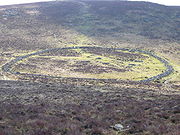
. It consists of a set of 24 hut circle
Roundhouse (dwelling)
The roundhouse is a type of house with a circular plan, originally built in western Europe before the Roman occupation using walls made either of stone or of wooden posts joined by wattle-and-daub panels and a conical thatched roof. Roundhouses ranged in size from less than 5m in diameter to over 15m...
s surrounded by a low stone wall. The name was first recorded by the Reverend Richard Polwhele
Richard Polwhele
Richard Polwhele was a Cornish clergyman, poet and topographer.-Biography:Born at Truro, Cornwall, Polwhele met literary luminaries Catharine Macaulay and Hannah More at an early age. He was educated at Truro Grammar School, where he precociously published The Fate of Llewellyn...
in 1797 - it was probably derived from the Anglo Saxon
Anglo-Saxons
Anglo-Saxon is a term used by historians to designate the Germanic tribes who invaded and settled the south and east of Great Britain beginning in the early 5th century AD, and the period from their creation of the English nation to the Norman conquest. The Anglo-Saxon Era denotes the period of...
god of war, Grim (more commonly known as Woden, or Odin
Odin
Odin is a major god in Norse mythology and the ruler of Asgard. Homologous with the Anglo-Saxon "Wōden" and the Old High German "Wotan", the name is descended from Proto-Germanic "*Wodanaz" or "*Wōđanaz"....
).
In 1893 an archaeological dig was carried out by the Dartmoor Exploration Committee, which recorded many details of Grimspound as well as, controversially, making a reconstruction of the site.
History
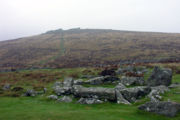
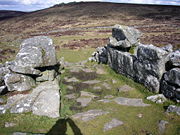
It was probably first settled about 1300 BC.The 24 hut circles are surrounded by a massive granite perimeter wall, which may have stood at 1.7 metres in places. The roundhouses, with an average diameter of 3.4 metres, were each built of a double ring of granite slabs with a rubble infill - a technique still used in Dry-stone walling. one, Hut 3, has a surviving porchway, with the two jamb stones still upright, although the lintel has fallen.
There is little evidence of human activity: few artefacts survive apart from the buildings, apart from some pottery, scrapers and pot boilers.
Early descriptions
The name Grimspound was first recorded by the reverend Polwhele in his History of Devon of 1797. He called it "The seat of judicature" for the River DartRiver Dart
The River Dart is a river in Devon, England which rises high on Dartmoor, and releases to the sea at Dartmouth. Its valley and surrounding area is a place of great natural beauty.-Watercourse:...
area, and also surmised that it was "one of the principal temple
Temple
A temple is a structure reserved for religious or spiritual activities, such as prayer and sacrifice, or analogous rites. A templum constituted a sacred precinct as defined by a priest, or augur. It has the same root as the word "template," a plan in preparation of the building that was marked out...
s of the Druid
Druid
A druid was a member of the priestly class in Britain, Ireland, and Gaul, and possibly other parts of Celtic western Europe, during the Iron Age....
s. Other ideas about Grimspound include supposed uses as an Iron Age
Iron Age
The Iron Age is the archaeological period generally occurring after the Bronze Age, marked by the prevalent use of iron. The early period of the age is characterized by the widespread use of iron or steel. The adoption of such material coincided with other changes in society, including differing...
fort, an encampment for tin
Tin
Tin is a chemical element with the symbol Sn and atomic number 50. It is a main group metal in group 14 of the periodic table. Tin shows chemical similarity to both neighboring group 14 elements, germanium and lead and has two possible oxidation states, +2 and the slightly more stable +4...
miners and even a Phoenicia
Phoenicia
Phoenicia , was an ancient civilization in Canaan which covered most of the western, coastal part of the Fertile Crescent. Several major Phoenician cities were built on the coastline of the Mediterranean. It was an enterprising maritime trading culture that spread across the Mediterranean from 1550...
n settlement.
Grimspound was first mapped by A. C. Shillibear in 1829. An 1855 plan by Nick Whitely shows hut circles outlying the perimeter wall, unrecorded elsewhere.
Excavation
In 1893 the Dartmoor Exploration Committee began a dig at the site. The dig, one of whose members was the rev. Sabine Baring-GouldSabine Baring-Gould
The Reverend Sabine Baring-Gould was an English hagiographer, antiquarian, novelist and eclectic scholar. His bibliography consists of more than 1240 publications, though this list continues to grow. His family home, Lew Trenchard Manor near Okehampton, Devon, has been preserved as he had it...
, reconstructed some of the site, a move criticised by some of the Committee at the time, and also by later researchers including R. Hansford Worth.
Location
Grimspound is located in the valley between Hameldown and Hookney Tor, at 450 metres above sea level. The nearest village, Widecombe-in-the-MoorWidecombe-in-the-Moor
Widecombe-in-the-Moor is a small village located within the heart of the Dartmoor National Park in Devon, England. . The name is thought to derive from 'Withy-combe' which means Willow Valley....
, is a few miles to the south.
Description
West Webburn River
The West Webburn is a stream in the Dartmoor moors in Devon in south-west England. It rises on the western side of the moors flowing off the east side of Hameldon ridge. Its source is extremely close to Grimspound Bronze Age settlement and it was probably the main source of water for the...
which was the main water source for the settlement.
Megalith
A megalith is a large stone that has been used to construct a structure or monument, either alone or together with other stones. Megalithic describes structures made of such large stones, utilizing an interlocking system without the use of mortar or cement.The word 'megalith' comes from the Ancient...
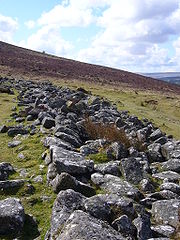
s and other large stones forming the sides. Butler states that it was not designed to exclude livestock.
Excavations at other sites on Dartmoor have shown that such walls were probably built by small teams of men working simultaneously on a section each, as shown by differences in building style; some evidence of this is visible here. However, these may simply be due to the reconstruction work by the 1894 excavation (see below).
The hut circles
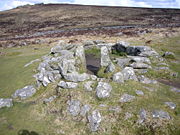
Porch
A porch is external to the walls of the main building proper, but may be enclosed by screen, latticework, broad windows, or other light frame walls extending from the main structure.There are various styles of porches, all of which depend on the architectural tradition of its location...
es. The doorways are paved with naturally flat stones, and all face both downhill and away from the prevailing wind.
The 1894 excavation reported that the huts nearest the entrance (save for hut 12) were devoid of signs of human habitation, and were therefore used for livestock or storage, as was hut 2 at the opposite side of the compound.
The huts range between 9 and 15 feet (2.7 - 4.5 metres) in diameter, with walls about 3 feet (1 m) thick, made of upright granite slabs packed with an infill of rubble and possibly peat
Peat
Peat is an accumulation of partially decayed vegetation matter or histosol. Peat forms in wetland bogs, moors, muskegs, pocosins, mires, and peat swamp forests. Peat is harvested as an important source of fuel in certain parts of the world...
. Excavations at sites such as Holne Moor have shown that such huts had an interior plank lining.
The hearth
Hearth
In common historic and modern usage, a hearth is a brick- or stone-lined fireplace or oven often used for cooking and/or heating. For centuries, the hearth was considered an integral part of a home, often its central or most important feature...
was variously at the centre of the hut, or opposite the door. Ash from the hearths was found to be from oak
Oak
An oak is a tree or shrub in the genus Quercus , of which about 600 species exist. "Oak" may also appear in the names of species in related genera, notably Lithocarpus...
and willow
Willow
Willows, sallows, and osiers form the genus Salix, around 400 species of deciduous trees and shrubs, found primarily on moist soils in cold and temperate regions of the Northern Hemisphere...
twigs. A lack of log remains and the presence of peat ash shows that by the time of grimspound's occupation, the local forests had been replaced by enough peat buildup for it to be cut for fuel. Cooking holes contained granite pot boiler
Pot boiler
A pot boiler is an externally-heated simple enclosure in which water is heated to produce steam. They can also use a heated stone when used in cooking. When the stone gets hot enough, it gets put in the pot to boil the contents. Usually, they are found in archeological sites, near fire or in inner...
s, pieces of stone heated in the fire and dropped into pots of water sunk into the ground (the pottery of the time not being fireproof).
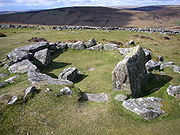
Dais
Dais is any raised platform located either in or outside of a room or enclosure, often for dignified occupancy, as at the front of a lecture hall or sanctuary....
", which was probably the sleeping area.
Four of the huts (3,7,17 and 18) contain raisd or upright stones, described as 'anvil' stones, the purpose of which are unknown.
Unlike many similar sites on Dartmoor, there is no obviously larger hut that can be identified as a headman's dwelling, although the Committee did suggest that a pillar outside hut 19 could have meant that the headman lived there.
Other objects
The acidAcid
An acid is a substance which reacts with a base. Commonly, acids can be identified as tasting sour, reacting with metals such as calcium, and bases like sodium carbonate. Aqueous acids have a pH of less than 7, where an acid of lower pH is typically stronger, and turn blue litmus paper red...
ic soil of Dartmoor has destroyed nearly all organic material; it is therefore difficult to tell what Grimspound must have been like during its occupation. A flint
Flint
Flint is a hard, sedimentary cryptocrystalline form of the mineral quartz, categorized as a variety of chert. It occurs chiefly as nodules and masses in sedimentary rocks, such as chalks and limestones. Inside the nodule, flint is usually dark grey, black, green, white, or brown in colour, and...
arrowhead
Arrowhead
An arrowhead is a tip, usually sharpened, added to an arrow to make it more deadly or to fulfill some special purpose. Historically arrowheads were made of stone and of organic materials; as human civilization progressed other materials were used...
found nearby, and the lack of querns
Quern-stone
Quern-stones are stone tools for hand grinding a wide variety of materials. They were used in pairs. The lower, stationary, stone is called a quern, whilst the upper, mobile, stone is called a handstone...
for grinding cereal
Cereal
Cereals are grasses cultivated for the edible components of their grain , composed of the endosperm, germ, and bran...
s, hints at some dependency on goods from outside the area (flint is not local to Dartmoor). The Exploration Committee also declared that the clay used in pottery fragments did not come from a local source.
External links
- Grimspound - official site at English Heritage
- Legendary Dartmoor page on the name origin, possible uses and excavation of Grimspound