

Green River Formation

Encyclopedia
The Green River Formation is an Eocene
geologic formation that records the sedimentation in a group of intermountain lakes. The sediments are deposited in very fine layers, a dark layer during the growing season and a light-hue inorganic layer in winter. Each pair of layers is called a varve and represents one year. The sediments of the Green River Formation present a continuous record of six million years. The mean thickness of a varve here is 0.18 mm, with a minimum thickness of 0.014 mm and maximum of 9.8 mm.
The sedimentary layers were formed in a large area named for the present-day Green River
, a tributary of the Colorado River
. The area of the formation exists as three separate basins around the Uinta Mountains
of northeastern Utah
:
Fossil Butte National Monument
in Lincoln County, Wyoming is in a part of the formation known as Fossil Lake because of its abundance of exceptionally well preserved fish fossils.
basin / lake environments during the Eocene resulted from mountain building and uplift of the Rocky Mountains
(late Cretaceous
Sevier orogeny
and the Paleogene
Laramide orogeny
). Tectonic highlands supplied the Eocene sedimentary basins with sediment from all directions: the Uinta Mountains
in the center; the Wind River Mountains to the north; the Front Range
, Park Range
and Sawatch Range
of the Colorado Rockies to the east; the Uncompahgre Plateau
and the San Juan Mountains
to the south and finally, the Wasatch Mountains of Utah and the ranges of eastern Idaho to the west.
The lithology
of the lake sediments is varied and includes sandstone
s, mudstone
s, siltstone
s, oil shale
s, coal
beds, saline evaporite
beds, and a variety of lacustrine limestone
s and dolostone
s. Volcanic ash
layers within the various sediments from the then active Absaroka Volcanic field to the north in the vicinity of Yellowstone
and the San Juan volcanic field
to the southeast provide dateable
horizons
within the sediments.
The trona
(hydrated sodium bicarbonate carbonate) beds of Sweetwater County, Wyoming are noted for a variety of rare evaporite minerals. The Green River Formation, is the type locality
for eight rare minerals: bradleyite, ewaldite, loughlinite, mckelveyite-(Y), norsethite, paralabuntsovite-Mg, shortite
and wegscheiderite. It also has a natural occurrence of moissanite
(SiC) and 23 other valid mineral species.
, with the precession, obliquity, and eccentricity orbital components all clearly detectable. This enables the beds to be internally dated with a high degree of accuracy, and astrochronological
dates agree very well with radiometric
dates.
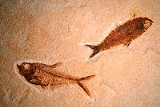
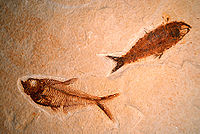 Within the Green River Formation of southwest Wyoming in the area known as Fossil Lake, two distinct zones of very fine-grained lime muds are particularly noted for preserving a variety of complete and detailed fossil
s. These layers are an Eocene Lagerstätte, a rare place where conditions were right for a rich accumulation of undisturbed fossils. The most productive zone—called the split fish layer—consists of a series of laminated or varve
d lime muds about 6 ft (1.8 m) thick, which contains abundant fish and other fossils. These are easily split along the layers to reveal the fossils. This thin zone represents some 4000 years of deposition. The second fossil zone, the 18 inch layer, is an unlaminated layer about 18 in (45.7 cm) thick that also contains abundant detailed fossils, but is harder to work because it is not composed of fissile laminae.
The limestone matrix is so fine-grained that fossils include rare soft parts of complete insects and fallen leaves in spectacular detail. More than twenty-two orders of insects are represented in the Green River collection at the Smithsonian Institution
in Washington, D.C., alone.
Fish fossils of Diplomystus
and Knightia
are found in Fossil Lake but not in Lake Gosiute. Only Lake Gosiute has fossils of catfish (Ictaluridae
and Hypsidoridae) and suckers (Catostomidae
). The catfish are found mostly in the deepest parts of the lake.
The Green River fossils date about 48 mya, but cover several million years, including the transition between the moist early Eocene climate and the slightly drier mid-Eocene. The climate was moist and mild enough to support crocodile
s, which do not tolerate frost, and the lakes were surrounded by sycamore
forests. As the lake configurations shifted, each Green River location is distinct in character and time. The lake system formed over underlying river deltas and shifted in the flat landscape with slight tectonic movements, receiving sediments from the Uinta highland and the Rocky Mountains
to the east and north. The lagerstätten formed in anoxic conditions in the fine carbonate muds that formed in the lakebeds. Lack of oxygen slowed bacterial decomposition and kept scavengers away, so leaves of palms, ferns and sycamores, some showing the insect damage they had sustained during their growth, were covered with fine-grained sediment and preserved. Insects were preserved whole, even delicate wing membranes and spider spinnerets.
Vertebrates were preserved too, including the scutes of Borealosuchus
, the crocodile that was an early clue to the mild Eocene climate of Western North America. Fish are common. The fossils of the herring-like Knightia, sometimes in dense layers, as if a school had wandered into anoxic water levels and were overcome, are familiar to fossil-lovers and are among the most commonly available fossils on the commercial market. There was one indigenous freshwater stingray
, Heliobatis
. Approximately sixty vertebrate taxa in all have been found at Green River. Besides fishes they include at least eleven species of reptiles, and some birds and one armadillo
-like mammal, Brachianodon westorum, with some scattered vertebrae of others, like the dog-sized Meniscotherium
and Notharctus
, one of the first primates. The earliest known bat
s (Icaronycteris index
, and Onychonycteris finneyi
), already full-developed for flight, are found here. Even a snake, Boavus idelmani, found its way into a lake and was preserved in the mudstone.
Geologist Dr. John Evans collected the first fossil fish, described as Culpea humilis (later renamed Knightia
eocaena), from the Green River beds in 1856. Edward Drinker Cope
collected extensively from the area and produced several publications on the fossil fish from 1870 onwards. Ferdinand Vandeveer Hayden
(geologist-in-charge of the United States Geological and Geographical Survey of the Territories, the forerunner of the United States Geological Survey
) first used the name "Green River Shales" for the fossil sites in 1869.
Millions of fish fossils have been collected from the area, commercial collectors operating from legal quarries on state and private land have
deposits in the world. The 213 billion ton
s of oil shale
contain an estimated 2.38 × 10¹¹ m³ (1.5 trillion US barrels
) of shale oil
.
, and in Colorado, the world's largest deposits of nahcolite
.
Eocene
The Eocene Epoch, lasting from about 56 to 34 million years ago , is a major division of the geologic timescale and the second epoch of the Paleogene Period in the Cenozoic Era. The Eocene spans the time from the end of the Palaeocene Epoch to the beginning of the Oligocene Epoch. The start of the...
geologic formation that records the sedimentation in a group of intermountain lakes. The sediments are deposited in very fine layers, a dark layer during the growing season and a light-hue inorganic layer in winter. Each pair of layers is called a varve and represents one year. The sediments of the Green River Formation present a continuous record of six million years. The mean thickness of a varve here is 0.18 mm, with a minimum thickness of 0.014 mm and maximum of 9.8 mm.
The sedimentary layers were formed in a large area named for the present-day Green River
Green River (Utah)
The Green River, located in the western United States, is the chief tributary of the Colorado River. The watershed of the river, known as the Green River Basin, covers parts of Wyoming, Utah, and Colorado. The Green River is long, beginning in the Wind River Mountains of Wyoming and flowing...
, a tributary of the Colorado River
Colorado River
The Colorado River , is a river in the Southwestern United States and northwestern Mexico, approximately long, draining a part of the arid regions on the western slope of the Rocky Mountains. The watershed of the Colorado River covers in parts of seven U.S. states and two Mexican states...
. The area of the formation exists as three separate basins around the Uinta Mountains
Uinta Mountains
The Uinta Mountains are a high chain of mountains in northeastern Utah and extreme northwestern Colorado in the United States. A subrange of the Rocky Mountains, they are unusual for being the highest range in the contiguous United States running east to west, and lie approximately east of Salt...
of northeastern Utah
Utah
Utah is a state in the Western United States. It was the 45th state to join the Union, on January 4, 1896. Approximately 80% of Utah's 2,763,885 people live along the Wasatch Front, centering on Salt Lake City. This leaves vast expanses of the state nearly uninhabited, making the population the...
:
- an area in northwestern ColoradoColoradoColorado is a U.S. state that encompasses much of the Rocky Mountains as well as the northeastern portion of the Colorado Plateau and the western edge of the Great Plains...
east of the Uintas - a larger area in the southwest corner of WyomingWyomingWyoming is a state in the mountain region of the Western United States. The western two thirds of the state is covered mostly with the mountain ranges and rangelands in the foothills of the Eastern Rocky Mountains, while the eastern third of the state is high elevation prairie known as the High...
just north of the Uintas known as Lake Gosiute - the largest area, in northeastern Utah and western Colorado south of the Uintas, known as Lake Uinta
Fossil Butte National Monument
Fossil Butte National Monument
Fossil Butte National Monument is a unit of the National Park Service located 15 miles west of Kemmerer, Wyoming; the national monument was established on October 23, 1972. The site preserves the best paleontological record of Tertiary aquatic communities in North America and possibly the world,...
in Lincoln County, Wyoming is in a part of the formation known as Fossil Lake because of its abundance of exceptionally well preserved fish fossils.
Lithology and formation
The formation of intermontaneIntermontane Plateaus
Physiographic regions of the U.S. InteriorSee:legendIn some places,high plateaus lie between the mountain ranges, for example,the plateau of Anatolia in Turkey and the plateau of Tibet.These are called "Intermontane plateaus"....
basin / lake environments during the Eocene resulted from mountain building and uplift of the Rocky Mountains
Rocky Mountains
The Rocky Mountains are a major mountain range in western North America. The Rocky Mountains stretch more than from the northernmost part of British Columbia, in western Canada, to New Mexico, in the southwestern United States...
(late Cretaceous
Cretaceous
The Cretaceous , derived from the Latin "creta" , usually abbreviated K for its German translation Kreide , is a geologic period and system from circa to million years ago. In the geologic timescale, the Cretaceous follows the Jurassic period and is followed by the Paleogene period of the...
Sevier orogeny
Sevier orogeny
The Sevier orogeny was a mountain-building event that affected western North America from Canada to the north to Mexico to the south. This orogeny was the result of convergent boundary tectonic activity between approximately 140 million years ago and 50 Ma. The Sevier River area of central Utah...
and the Paleogene
Paleogene
The Paleogene is a geologic period and system that began 65.5 ± 0.3 and ended 23.03 ± 0.05 million years ago and comprises the first part of the Cenozoic Era...
Laramide orogeny
Laramide orogeny
The Laramide orogeny was a period of mountain building in western North America, which started in the Late Cretaceous, 70 to 80 million years ago, and ended 35 to 55 million years ago. The exact duration and ages of beginning and end of the orogeny are in dispute, as is the cause. The Laramide...
). Tectonic highlands supplied the Eocene sedimentary basins with sediment from all directions: the Uinta Mountains
Uinta Mountains
The Uinta Mountains are a high chain of mountains in northeastern Utah and extreme northwestern Colorado in the United States. A subrange of the Rocky Mountains, they are unusual for being the highest range in the contiguous United States running east to west, and lie approximately east of Salt...
in the center; the Wind River Mountains to the north; the Front Range
Front Range
The Front Range is a mountain range of the Southern Rocky Mountains of North America located in the north-central portion of the U.S. State of Colorado and southeastern portion of the U.S. State of Wyoming. It is the first mountain range encountered moving west along the 40th parallel north across...
, Park Range
Park Range (Colorado)
The Park Range, elevation approximately , is a mountain range in the Rocky Mountains of northwestern Colorado in the United States. The range forms a relatively isolated part of the continental divide, extending north-to-south for approximately along the boundary between Jackson and Routt counties...
and Sawatch Range
Sawatch Range
The Sawatch Range is a mountain range in central Colorado which includes eight of the twenty highest peaks in the Rocky Mountains, including Mount Elbert, at elevation, the highest peak in the Rockies....
of the Colorado Rockies to the east; the Uncompahgre Plateau
Uncompahgre Plateau
The Uncompahgre Plateau in western Colorado is a distinctive large uplift part of the Colorado Plateau. Uncompahgre is a Ute Indian word that describes the water: "Dirty Water" or "Rocks that make Water Red"....
and the San Juan Mountains
San Juan Mountains
The San Juan Mountains are a high and rugged mountain range in the Rocky Mountains in southwestern Colorado. The area is highly mineralized and figured in the gold and silver mining industry of early Colorado. Major towns, all old mining camps, include Creede, Lake City, Silverton, Ouray, and...
to the south and finally, the Wasatch Mountains of Utah and the ranges of eastern Idaho to the west.
The lithology
Lithology
The lithology of a rock unit is a description of its physical characteristics visible at outcrop, in hand or core samples or with low magnification microscopy, such as colour, texture, grain size, or composition. It may be either a detailed description of these characteristics or be a summary of...
of the lake sediments is varied and includes sandstone
Sandstone
Sandstone is a sedimentary rock composed mainly of sand-sized minerals or rock grains.Most sandstone is composed of quartz and/or feldspar because these are the most common minerals in the Earth's crust. Like sand, sandstone may be any colour, but the most common colours are tan, brown, yellow,...
s, mudstone
Mudstone
Mudstone is a fine grained sedimentary rock whose original constituents were clays or muds. Grain size is up to 0.0625 mm with individual grains too small to be distinguished without a microscope. With increased pressure over time the platey clay minerals may become aligned, with the...
s, siltstone
Siltstone
Siltstone is a sedimentary rock which has a grain size in the silt range, finer than sandstone and coarser than claystones.- Description :As its name implies, it is primarily composed of silt sized particles, defined as grains 1/16 - 1/256 mm or 4 to 8 on the Krumbein phi scale...
s, oil shale
Oil shale
Oil shale, an organic-rich fine-grained sedimentary rock, contains significant amounts of kerogen from which liquid hydrocarbons called shale oil can be produced...
s, coal
Coal
Coal is a combustible black or brownish-black sedimentary rock usually occurring in rock strata in layers or veins called coal beds or coal seams. The harder forms, such as anthracite coal, can be regarded as metamorphic rock because of later exposure to elevated temperature and pressure...
beds, saline evaporite
Evaporite
Evaporite is a name for a water-soluble mineral sediment that result from concentration and crystallization by evaporation from an aqueous solution. There are two types of evaporate deposits, marine which can also be described as ocean deposits, and non-marine which are found in standing bodies of...
beds, and a variety of lacustrine limestone
Limestone
Limestone is a sedimentary rock composed largely of the minerals calcite and aragonite, which are different crystal forms of calcium carbonate . Many limestones are composed from skeletal fragments of marine organisms such as coral or foraminifera....
s and dolostone
Dolostone
Dolostone or dolomite rock is a sedimentary carbonate rock that contains a high percentage of the mineral dolomite. In old U.S.G.S. publications it was referred to as magnesian limestone. Most dolostone formed as a magnesium replacement of limestone or lime mud prior to lithification. It is...
s. Volcanic ash
Volcanic ash
Volcanic ash consists of small tephra, which are bits of pulverized rock and glass created by volcanic eruptions, less than in diameter. There are three mechanisms of volcanic ash formation: gas release under decompression causing magmatic eruptions; thermal contraction from chilling on contact...
layers within the various sediments from the then active Absaroka Volcanic field to the north in the vicinity of Yellowstone
Yellowstone National Park
Yellowstone National Park, established by the U.S. Congress and signed into law by President Ulysses S. Grant on March 1, 1872, is a national park located primarily in the U.S. state of Wyoming, although it also extends into Montana and Idaho...
and the San Juan volcanic field
San Juan volcanic field
The San Juan volcanic field, located in southwestern Colorado, contains two distinct phases of volcanism. The earlier volcanism is Oligocene in age, and consists of largely intermediate composition lavas and breccias. A few ash flow tuffs also constitute this phase of volcanism. Later volcanism is...
to the southeast provide dateable
Radiometric dating
Radiometric dating is a technique used to date materials such as rocks, usually based on a comparison between the observed abundance of a naturally occurring radioactive isotope and its decay products, using known decay rates...
horizons
Key bed
In geology, a key bed is a widespread sedimentary layer that formed at a single time, such that it is useful for geologic correlations and dating over a large area...
within the sediments.
The trona
Trona
Trona ; Na3•2H2O is an evaporite mineral. It is mined as the primary source of sodium carbonate in the United States, where it has replaced the Solvay process used in most of the rest of the world for sodium carbonate production.- Etymology :The word "trona" comes to English by way of either...
(hydrated sodium bicarbonate carbonate) beds of Sweetwater County, Wyoming are noted for a variety of rare evaporite minerals. The Green River Formation, is the type locality
Type locality (geology)
Type locality , also called type area or type locale, is the where a particular rock type, stratigraphic unit, fossil or mineral species is first identified....
for eight rare minerals: bradleyite, ewaldite, loughlinite, mckelveyite-(Y), norsethite, paralabuntsovite-Mg, shortite
Shortite
Shortite is a sodium – calcium carbonate mineral, with the chemical formula Na2Ca23. It was discovered by J. J. Fahey in well cuttings from the Green River Formation, Sweetwater County, Wyoming USA, and was named to honor Maxwell N...
and wegscheiderite. It also has a natural occurrence of moissanite
Moissanite
Moissanite originally referred to a rare mineral discovered by Henri Moissan having a chemical formula SiC and various crystalline polymorphs. Earlier, this material had been synthesized in the laboratory and named silicon carbide .- Background :...
(SiC) and 23 other valid mineral species.
Cyclicity
The beds display a pronounced cyclicityMilankovitch cycles
Milankovitch theory describes the collective effects of changes in the Earth's movements upon its climate, named after Serbian civil engineer and mathematician Milutin Milanković, who worked on it during First World War internment...
, with the precession, obliquity, and eccentricity orbital components all clearly detectable. This enables the beds to be internally dated with a high degree of accuracy, and astrochronological
Astrochronology
Astrochronology is the dating of sedimentary units by calibration with astronomically tuned timescales, such as Milankovic cycles, or even sunspot cycles. When used in concert with radiometric dating, it allows the resolution of timescales to a high degree of accuracy....
dates agree very well with radiometric
Radiometry
In optics, radiometry is a set of techniques for measuring electromagnetic radiation, including visible light. Radiometric techniques characterize the distribution of the radiation's power in space, as opposed to photometric techniques, which characterize the light's interaction with the human eye...
dates.
Fossil zones
Fossil
Fossils are the preserved remains or traces of animals , plants, and other organisms from the remote past...
s. These layers are an Eocene Lagerstätte, a rare place where conditions were right for a rich accumulation of undisturbed fossils. The most productive zone—called the split fish layer—consists of a series of laminated or varve
Varve
A varve is an annual layer of sediment or sedimentary rock.The word 'varve' is derived from the Swedish word varv whose meanings and connotations include 'revolution', 'in layers', and 'circle'. The term first appeared as Hvarfig lera on the first map produced by the Geological Survey of Sweden in...
d lime muds about 6 ft (1.8 m) thick, which contains abundant fish and other fossils. These are easily split along the layers to reveal the fossils. This thin zone represents some 4000 years of deposition. The second fossil zone, the 18 inch layer, is an unlaminated layer about 18 in (45.7 cm) thick that also contains abundant detailed fossils, but is harder to work because it is not composed of fissile laminae.
The limestone matrix is so fine-grained that fossils include rare soft parts of complete insects and fallen leaves in spectacular detail. More than twenty-two orders of insects are represented in the Green River collection at the Smithsonian Institution
Smithsonian Institution
The Smithsonian Institution is an educational and research institute and associated museum complex, administered and funded by the government of the United States and by funds from its endowment, contributions, and profits from its retail operations, concessions, licensing activities, and magazines...
in Washington, D.C., alone.
Fish fossils of Diplomystus
Diplomystus
Diplomystus is an extinct genus of non-clupeoid clupeomorph fish distantly related to modern-day extant herrings, alewives, and sardines. The genus was first named and described by Edward Drinker Cope in 1877. There are four species of Diplomystus: Diplomystus dentatus , D. birdii, D....
and Knightia
Knightia
Knightia is an extinct genus of bony fish which lived in the fresh water lakes and rivers of North America during the Eocene epoch. It was named by David Starr Jordan in 1907, in honor of the late University of Wyoming professor Wilbur Clinton Knight, "an indefatigable student of the paleontology...
are found in Fossil Lake but not in Lake Gosiute. Only Lake Gosiute has fossils of catfish (Ictaluridae
Ictaluridae
The Ictaluridae, sometimes called Ictalurids, are a family of catfish native to North America, where they are important food fish and sometimes as a sport fish. They include fish commonly known as bullheads, madtoms, channel catfish, and blue catfish....
and Hypsidoridae) and suckers (Catostomidae
Catostomidae
Catostomidae is the sucker family of the order Cypriniformes. There are 80 species in this family of freshwater fishes. Catostomidae are found in North America, east central China, and eastern Siberia...
). The catfish are found mostly in the deepest parts of the lake.
The Green River fossils date about 48 mya, but cover several million years, including the transition between the moist early Eocene climate and the slightly drier mid-Eocene. The climate was moist and mild enough to support crocodile
Crocodile
A crocodile is any species belonging to the family Crocodylidae . The term can also be used more loosely to include all extant members of the order Crocodilia: i.e...
s, which do not tolerate frost, and the lakes were surrounded by sycamore
Sycamore
Sycamore is a name which is applied at various times and places to three very different types of trees, but with somewhat similar leaf forms....
forests. As the lake configurations shifted, each Green River location is distinct in character and time. The lake system formed over underlying river deltas and shifted in the flat landscape with slight tectonic movements, receiving sediments from the Uinta highland and the Rocky Mountains
Rocky Mountains
The Rocky Mountains are a major mountain range in western North America. The Rocky Mountains stretch more than from the northernmost part of British Columbia, in western Canada, to New Mexico, in the southwestern United States...
to the east and north. The lagerstätten formed in anoxic conditions in the fine carbonate muds that formed in the lakebeds. Lack of oxygen slowed bacterial decomposition and kept scavengers away, so leaves of palms, ferns and sycamores, some showing the insect damage they had sustained during their growth, were covered with fine-grained sediment and preserved. Insects were preserved whole, even delicate wing membranes and spider spinnerets.
Vertebrates were preserved too, including the scutes of Borealosuchus
Borealosuchus
Borealosuchus is an extinct genus of crocodilian that lived from the Late Cretaceous to the Eocene in North America. It was named by Chris Brochu in 1997 for several species that had been assigned to Leidyosuchus. The species assigned to it are:B...
, the crocodile that was an early clue to the mild Eocene climate of Western North America. Fish are common. The fossils of the herring-like Knightia, sometimes in dense layers, as if a school had wandered into anoxic water levels and were overcome, are familiar to fossil-lovers and are among the most commonly available fossils on the commercial market. There was one indigenous freshwater stingray
Stingray
The stingrays are a group of rays, which are cartilaginous fishes related to sharks. They are classified in the suborder Myliobatoidei of the order Myliobatiformes, and consist of eight families: Hexatrygonidae , Plesiobatidae , Urolophidae , Urotrygonidae , Dasyatidae , Potamotrygonidae The...
, Heliobatis
Heliobatis
Heliobatis is an extinct genus of ray in the Myliobatiformes family Dasyatidae. At present the genus contains the single species Heliobatis radians....
. Approximately sixty vertebrate taxa in all have been found at Green River. Besides fishes they include at least eleven species of reptiles, and some birds and one armadillo
Armadillo
Armadillos are New World placental mammals, known for having a leathery armor shell. Dasypodidae is the only surviving family in the order Cingulata, part of the superorder Xenarthra along with the anteaters and sloths. The word armadillo is Spanish for "little armored one"...
-like mammal, Brachianodon westorum, with some scattered vertebrae of others, like the dog-sized Meniscotherium
Meniscotherium
Meniscotherium is an extinct genus of dog-sized mammal which lived 54-38 million years ago. It was a herbivore and had hooves. Fossils have been found in Utah, New Mexico. and Colorado. Many individuals have been found together, indicating that it lived in groups....
and Notharctus
Notharctus
Notharctus was an early primate that inhabited Europe and North America 50 million years ago. Modern lemurs evolved from primates similar to this genus....
, one of the first primates. The earliest known bat
Bat
Bats are mammals of the order Chiroptera "hand" and pteron "wing") whose forelimbs form webbed wings, making them the only mammals naturally capable of true and sustained flight. By contrast, other mammals said to fly, such as flying squirrels, gliding possums, and colugos, glide rather than fly,...
s (Icaronycteris index
Icaronycteris
Icaronycteris is an extinct genus of microchiropteran bat that lived in the early Eocene, approximately 52.2 million years ago. Four exceptionally preserved specimens are known from the Green River Formation of North America. There is only one thoroughly described species of bat in the genus, I...
, and Onychonycteris finneyi
Onychonycteris
Onychonycteris is the most primitive of the two oldest known monospecific genera of bat, having lived in the area that is current day Wyoming during the Eocene period, 52.5 million years ago.-History and description:...
), already full-developed for flight, are found here. Even a snake, Boavus idelmani, found its way into a lake and was preserved in the mudstone.
Discovery of the fossil beds
The first documented records of (invertebrate) fossils from what is now called the Green River Formation are in the journals of early missionaries and explorers such as S. A. Parker, 1840, and J. C. Fremont, 1845.Geologist Dr. John Evans collected the first fossil fish, described as Culpea humilis (later renamed Knightia
Knightia
Knightia is an extinct genus of bony fish which lived in the fresh water lakes and rivers of North America during the Eocene epoch. It was named by David Starr Jordan in 1907, in honor of the late University of Wyoming professor Wilbur Clinton Knight, "an indefatigable student of the paleontology...
eocaena), from the Green River beds in 1856. Edward Drinker Cope
Edward Drinker Cope
Edward Drinker Cope was an American paleontologist and comparative anatomist, as well as a noted herpetologist and ichthyologist. Born to a wealthy Quaker family, Cope distinguished himself as a child prodigy interested in science; he published his first scientific paper at the age of nineteen...
collected extensively from the area and produced several publications on the fossil fish from 1870 onwards. Ferdinand Vandeveer Hayden
Ferdinand Vandeveer Hayden
Dr. Ferdinand Vandeveer Hayden was an American geologist noted for his pioneering surveying expeditions of the Rocky Mountains in the late 19th century. He was also a physician who served with the Union Army during the Civil War.-Early life:Ferdinand Hayden was born in Westfield, Massachusetts...
(geologist-in-charge of the United States Geological and Geographical Survey of the Territories, the forerunner of the United States Geological Survey
United States Geological Survey
The United States Geological Survey is a scientific agency of the United States government. The scientists of the USGS study the landscape of the United States, its natural resources, and the natural hazards that threaten it. The organization has four major science disciplines, concerning biology,...
) first used the name "Green River Shales" for the fossil sites in 1869.
Millions of fish fossils have been collected from the area, commercial collectors operating from legal quarries on state and private land have
Oil shale
The Green River Formation contains the largest oil shaleOil shale geology
Oil shale geology is a branch of geologic sciences which studies the formation and composition of oil shales–fine-grained sedimentary rocks containing significant amounts of kerogen, and belonging to the group of sapropel fuels. Oil shale formation takes place in a number of depositional...
deposits in the world. The 213 billion ton
Ton
The ton is a unit of measure. It has a long history and has acquired a number of meanings and uses over the years. It is used principally as a unit of weight, and as a unit of volume. It can also be used as a measure of energy, for truck classification, or as a colloquial term.It is derived from...
s of oil shale
Oil shale
Oil shale, an organic-rich fine-grained sedimentary rock, contains significant amounts of kerogen from which liquid hydrocarbons called shale oil can be produced...
contain an estimated 2.38 × 10¹¹ m³ (1.5 trillion US barrels
Barrel (unit)
A barrel is one of several units of volume, with dry barrels, fluid barrels , oil barrel, etc...
) of shale oil
Shale oil
Shale oil, known also as kerogen oil or oil-shale oil, is an unconventional oil produced from oil shale by pyrolysis, hydrogenation, or thermal dissolution. These processes convert the organic matter within the rock into synthetic oil and gas...
.
Trona and nahcolite
The unusual chemistry of the lakes in which it was deposited makes the Green River Formation a major source of sodium carbonate salts. In southwest Wyoming the formation contains the world's largest deposits of tronaTrona
Trona ; Na3•2H2O is an evaporite mineral. It is mined as the primary source of sodium carbonate in the United States, where it has replaced the Solvay process used in most of the rest of the world for sodium carbonate production.- Etymology :The word "trona" comes to English by way of either...
, and in Colorado, the world's largest deposits of nahcolite
Nahcolite
Nahcolite is a soft, colourless or white carbonate mineral with the composition of sodium bicarbonate also called thermokalite. It crystallizes in the monoclinic system....
.
See also
- List of fossil sites (with link directory)
- LagerstätteLagerstätteA Lagerstätte is a sedimentary deposit that exhibits extraordinary fossil richness or completeness.Palaeontologists distinguish two kinds....