


Front Range

Encyclopedia
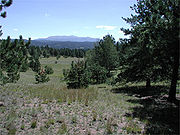
Mountain range
A mountain range is a single, large mass consisting of a succession of mountains or narrowly spaced mountain ridges, with or without peaks, closely related in position, direction, formation, and age; a component part of a mountain system or of a mountain chain...
of the Southern Rocky Mountains
Rocky Mountains
The Rocky Mountains are a major mountain range in western North America. The Rocky Mountains stretch more than from the northernmost part of British Columbia, in western Canada, to New Mexico, in the southwestern United States...
of North America
North America
North America is a continent wholly within the Northern Hemisphere and almost wholly within the Western Hemisphere. It is also considered a northern subcontinent of the Americas...
located in the north-central portion of the U.S. State of Colorado and southeastern portion of the U.S. State of Wyoming. It is the first mountain range encountered moving west along the 40th parallel north
40th parallel north
The 40th parallel north is a circle of latitude that is 40 degrees north of the Earth's equatorial plane. It crosses Europe, the Mediterranean Sea, Asia, the Pacific Ocean, North America, and the Atlantic Ocean....
across the Great Plains
Great Plains
The Great Plains are a broad expanse of flat land, much of it covered in prairie, steppe and grassland, which lies west of the Mississippi River and east of the Rocky Mountains in the United States and Canada. This area covers parts of the U.S...
of North America. The Front Range runs north-south between Casper, Wyoming
Casper, Wyoming
Casper is the county seat of Natrona County, Wyoming, United States.. Casper is the second-largest city in Wyoming , according to the 2010 census, with a population of 55,316...
and Pueblo, Colorado
Pueblo, Colorado
Pueblo is a Home Rule Municipality that is the county seat and the most populous city of Pueblo County, Colorado, United States. The population was 106,595 in 2010 census, making it the 246th most populous city in the United States....
. Longs Peak
Longs Peak
Longs Peak is one of the 53 mountains with summits over 14,000 feet in Colorado. It can be prominently seen from Longmont, Colorado, as well as from the rest of the Colorado Front Range. It is named after Major Stephen Long, who explored the area in the 1820s...
, Mount Evans
Mount Evans
Mount Evans is a mountain in the Front Range region of the Rocky Mountains, in Clear Creek County, Colorado. It is one of 54 fourteeners in Colorado, and the closest fourteener to Denver...
, and Pikes Peak
Pikes Peak
Pikes Peak is a mountain in the Front Range of the Rocky Mountains, west of Colorado Springs, Colorado, in El Paso County in the United States of America....
are its most prominent peaks, visible from the Interstate 25
Interstate 25
Interstate 25 is an Interstate Highway in the western United States. It is primarily a north–south highway. I-25 stretches from Interstate 10 at Las Cruces, New Mexico, , to Interstate 90 in Buffalo, Wyoming, .Interstate 25 is the main north–south expressway through...
corridor. The area is a popular destination for mountain biking, hiking, climbing, and camping during the warmer months and for skiing and snowboarding during winter. Millions of years ago the present-day Front Range was home to ancient mountain ranges, deserts, beaches, and even oceans..
The name "Front Range" is also applied to the Front Range Urban Corridor
Front Range Urban Corridor
The Front Range Urban Corridor is an oblong region of urban population located along the eastern face of the Southern Rocky Mountains in the U.S. states of Colorado and Wyoming. The corridor derives its name from the Front Range, the mountain range that defines the west central boundary of the...
, the populated region of Colorado and Wyoming
Wyoming
Wyoming is a state in the mountain region of the Western United States. The western two thirds of the state is covered mostly with the mountain ranges and rangelands in the foothills of the Eastern Rocky Mountains, while the eastern third of the state is high elevation prairie known as the High...
just east of the mountain range and extending from Cheyenne, Wyoming
Cheyenne, Wyoming
Cheyenne is the capital and most populous city of the U.S. state of Wyoming and the county seat of Laramie County. It is the principal city of the Cheyenne, Wyoming, Metropolitan Statistical Area which encompasses all of Laramie County. The population is 59,466 at the 2010 census. Cheyenne is the...
south to Pueblo, Colorado
Pueblo, Colorado
Pueblo is a Home Rule Municipality that is the county seat and the most populous city of Pueblo County, Colorado, United States. The population was 106,595 in 2010 census, making it the 246th most populous city in the United States....
. This urban corridor benefits from the weather-moderating effect of the Front Range mountains, which help block prevailing storms.
Pikes Peak Granite
About 1 billion years ago, the earth was producing mass amounts of molten rock that would one day amalgamateRodinia
In geology, Rodinia is the name of a supercontinent, a continent which contained most or all of Earth's landmass. According to plate tectonic reconstructions, Rodinia existed between 1.1 billion and 750 million years ago, in the Neoproterozoic era...
, drift together and combine, to ultimately form the continents we live on today. In the Colorado region, this molten rock spewed and cooled, forming what we now know as the Precambrian
Precambrian
The Precambrian is the name which describes the large span of time in Earth's history before the current Phanerozoic Eon, and is a Supereon divided into several eons of the geologic time scale...
Pikes Peak
Pikes Peak
Pikes Peak is a mountain in the Front Range of the Rocky Mountains, west of Colorado Springs, Colorado, in El Paso County in the United States of America....
Granite. Over the next 500 million years, little is known about changes in the sedimentation
Sedimentation
Sedimentation is the tendency for particles in suspension to settle out of the fluid in which they are entrained, and come to rest against a barrier. This is due to their motion through the fluid in response to the forces acting on them: these forces can be due to gravity, centrifugal acceleration...
(sediment deposition) after the granite was produced. However, at about 500 – 300 million years ago, the region began to sink and sediments began to deposit in the newly formed accommodation space. Eroded granite produced sand particles that began to form strata, layers of sediment, in the sinking basin. Sedimentation would continue to take place until about 300 million years ago.
Fountain formation
Around 300 million years ago, the sinking suddenly reversed, and the sediment-covered granite began to uplift, giving rise to the Ancestral Rocky Mountains. Over the next 150 million years, during uplift the mountains would continue to erode and cover themselves in their own sediment. Wind, gravity, rainwater, snow, and ice-melt supplied rivers that ultimately carved through the granite mountains and eventually led to their end. The sediment from these once gigantic mountains lies in the Fountain FormationFountain Formation
The Fountain Formation is a Pennsylvanian bedrock unit consisting primarily of conglomerate, sandstone, or arkose, in the states of Colorado and Wyoming in the USA, along the east side of the Front Range of the Rocky Mountains, and along the west edge of the Denver Basin.-Origin of name:The...
today. Red Rocks Amphitheater outside of Denver, Colorado, is actually set into the Fountain Formation.
Lyons Sandstone
At 280 million years ago, sea levels were low and present-day Colorado was part of the super-continent PangaeaPangaea
Pangaea, Pangæa, or Pangea is hypothesized as a supercontinent that existed during the Paleozoic and Mesozoic eras about 250 million years ago, before the component continents were separated into their current configuration....
. Sand deserts covered most of the area spreading as dunes seen in the rock record, known today as the Lyons Sandstone. These dunes appear to be cross-bedded and show various fossil
Fossil
Fossils are the preserved remains or traces of animals , plants, and other organisms from the remote past...
footprints and leaf imprints in many of the strata making up the section.
Lykins Formation
30 million years later, the sediment deposition was still taking place with the introduction of the Lykins Formation. This formation can be best attributed to its wavy layers of muddy limestoneLimestone
Limestone is a sedimentary rock composed largely of the minerals calcite and aragonite, which are different crystal forms of calcium carbonate . Many limestones are composed from skeletal fragments of marine organisms such as coral or foraminifera....
and signs of stromatolites that thrived in a smelly tidal flat at present-day Colorado. 250 million years ago, the Ancestral Rockies were burying themselves while the shoreline was present during the break-up of Pangaea. This formation began right after Earth’s largest extinction 251 million years ago at the Permian
Permian
The PermianThe term "Permian" was introduced into geology in 1841 by Sir Sir R. I. Murchison, president of the Geological Society of London, who identified typical strata in extensive Russian explorations undertaken with Edouard de Verneuil; Murchison asserted in 1841 that he named his "Permian...
-Triassic
Triassic
The Triassic is a geologic period and system that extends from about 250 to 200 Mya . As the first period of the Mesozoic Era, the Triassic follows the Permian and is followed by the Jurassic. Both the start and end of the Triassic are marked by major extinction events...
Boundary. Ninety percent of the planet’s marine life was destroyed and a great deal on land as well.
Morrison Formation
After 100 million years of deposition, a new environment brought rise to a new formation, the sandstone Morrison FormationMorrison Formation
The Morrison Formation is a distinctive sequence of Late Jurassic sedimentary rock that is found in the western United States, which has been the most fertile source of dinosaur fossils in North America. It is composed of mudstone, sandstone, siltstone and limestone and is light grey, greenish...
. The Morrison Formation contains some of the best fossils of the Late Jurassic
Jurassic
The Jurassic is a geologic period and system that extends from about Mya to Mya, that is, from the end of the Triassic to the beginning of the Cretaceous. The Jurassic constitutes the middle period of the Mesozoic era, also known as the age of reptiles. The start of the period is marked by...
. It is especially known for its sauropod tracks and sauropod bones among other dinosaur fossils. As identified by the fossil record, the environment was filled with various types of vegetation such as fern
Fern
A fern is any one of a group of about 12,000 species of plants belonging to the botanical group known as Pteridophyta. Unlike mosses, they have xylem and phloem . They have stems, leaves, and roots like other vascular plants...
s and zamites. While this time period boasts many types of plants, grass had not yet evolved.
Dakota Sandstone
The Dakota SandstoneDakota Sandstone
The Dakota Sandstone is a general term for an ill-defined early Cretaceous formation of the Rocky Mountains and Great Plains. It consists of sandy, shallow-marine deposits with intermittent mud flat sediments, and occasional stream deposits...
, which was deposited 100 million years ago towards Colorado’s eastern coast, shows evidence of ferns, and dinosaur tracks. Sheets of ripple marks can be seen on some of the strata, confirming the shallow-sea environment.
Pierre Shale
Over the next 30 million years, the region was finally taken over the by a deep sea, the CretaceousCretaceous
The Cretaceous , derived from the Latin "creta" , usually abbreviated K for its German translation Kreide , is a geologic period and system from circa to million years ago. In the geologic timescale, the Cretaceous follows the Jurassic period and is followed by the Paleogene period of the...
Western Interior Seaway
Western Interior Seaway
The Western Interior Seaway, also called the Cretaceous Seaway, the Niobraran Sea, and the North American Inland Sea, was a huge inland sea that split the continent of North America into two halves, Laramidia and Appalachia, during most of the mid- and late-Cretaceous Period...
, and deposited mass amounts of shale over the area known as the Pierre Shale. Both the thick section of shale and the marine life fossils found (ammonite
Ammonite
Ammonite, as a zoological or paleontological term, refers to any member of the Ammonoidea an extinct subclass within the Molluscan class Cephalopoda which are more closely related to living coleoids Ammonite, as a zoological or paleontological term, refers to any member of the Ammonoidea an extinct...
s and skeletons of fish and such marine reptiles as mosasaur
Mosasaur
Mosasaurs are large extinct marine lizards. The first fossil remains were discovered in a limestone quarry at Maastricht on the Meuse in 1764...
s, plesiosaur
Plesiosaur
Plesiosauroidea is an extinct clade of carnivorous plesiosaur marine reptiles. Plesiosauroids, are known from the Jurassic and Cretaceous Periods...
s, and extinct species of sea turtle
Sea turtle
Sea turtles are marine reptiles that inhabit all of the world's oceans except the Arctic.-Distribution:...
s, along with rare dinosaur
Dinosaur
Dinosaurs are a diverse group of animals of the clade and superorder Dinosauria. They were the dominant terrestrial vertebrates for over 160 million years, from the late Triassic period until the end of the Cretaceous , when the Cretaceous–Paleogene extinction event led to the extinction of...
and bird remains). Colorado eventually drained from being at the bottom of an ocean to land again, giving yield to another fossiliferous rock layer, the Denver Formation. At about 68 million years ago, the Front Range began to rise again due to the Laramide Orogeny in the west.
Denver Formation
The Denver Formation contained fossils and bones from dinosaurs like Tyrannosaurus rexTyrannosaurus
Tyrannosaurus meaning "tyrant," and sauros meaning "lizard") is a genus of coelurosaurian theropod dinosaur. The species Tyrannosaurus rex , commonly abbreviated to T. rex, is a fixture in popular culture. It lived throughout what is now western North America, with a much wider range than other...
and Triceratops
Triceratops
Triceratops is a genus of herbivorous ceratopsid dinosaur which lived during the late Maastrichtian stage of the Late Cretaceous Period, around 68 to 65 million years ago in what is now North America. It was one of the last dinosaur genera to appear before the great Cretaceous–Paleogene...
. While the forests of vegetation, dinosaurs, and other organisms thrived, their reign would come to an end at the K–T boundary
K–T boundary
The K–T boundary is a geological signature, usually a thin band, dated to 65.5 ± 0.3 Ma ago. K is the traditional abbreviation for the Cretaceous period, and T is the abbreviation for the Tertiary period...
. In an instant, millions of species are obliterated from a meteor impact in Mexico’s Yucatan Peninsula
Yucatán Peninsula
The Yucatán Peninsula, in southeastern Mexico, separates the Caribbean Sea from the Gulf of Mexico, with the northern coastline on the Yucatán Channel...
. While this extinction lead to the dinosaurs’ and other organisms’ demise, some life did prevail to repopulate the earth as it recovered from this tremendous disaster. The uplifted Front Range continued to constantly erode and, by 40 million years ago, the range was once again buried in its own rubble.
Castle Rock Conglomerate
Suddenly, 37 million years ago, a great volcanic eruption took place in the Collegiate Range and covered the landscape in molten hot ash that instantly torched and consumed everything across the landscape. An entire lush environment was capped in a matter of minutes with 20 feet of extremely resistant rock, rhyoliteRhyolite
This page is about a volcanic rock. For the ghost town see Rhyolite, Nevada, and for the satellite system, see Rhyolite/Aquacade.Rhyolite is an igneous, volcanic rock, of felsic composition . It may have any texture from glassy to aphanitic to porphyritic...
. However, as seen before, life rebounds, and after a few million years mass floods cut through the rhyolite and eroded much of it as plants and animals began to recolonize the landscape. The mass flooding and erosion of the volcanic rock gave way to the Castle Rock
Castle Rock, Colorado
The Town of Castle Rock is the county seat of Douglas County, Colorado, United States and is named for the prominent castle tower-shaped butte near the center of town. It is part of Colorado's Front Range Urban Corridor and is located roughly 28 miles south of Denver and 37 miles north of...
Conglomerate that can be found in the Front Range.
Quaternary deposits
Eventually, at about 10 million years ago, the Front Range began to rise up again and the resistant granite in the heart of the mountains thrust upwards and stood tall, while the weaker sediments deposited above it eroded away. As the Front Range rose, streams and recent (16,000 years ago) glaciations during the QuaternaryQuaternary
The Quaternary Period is the most recent of the three periods of the Cenozoic Era in the geologic time scale of the ICS. It follows the Neogene Period, spanning 2.588 ± 0.005 million years ago to the present...
age literally unburied the range by cutting through the weaker sediment and giving rise to the granitic peaks present today. This was the last step in forming the present-day geologic sequence and history of today’s Front Range.
Prominent peaks
The Front Range includes the highest peaks along the eastern edge of the Rockies. The highest mountain peak in the Front Range is Grays PeakGrays Peak
Grays Peak is the highest mountain in the Front Range of the Southern Rocky Mountains in the U.S. State of Colorado. It is one of 54 fourteeners in Colorado. Its nearest major city is Denver. The first man to ascend Grays Peak, botanist Charles C. Parry, named the peak for his botanist...
. Other notable mountains include Torreys Peak
Torreys Peak
Torreys Peak is a mountain in the Front Range region of the Rocky Mountains in Colorado. It is one of 54 fourteeners in Colorado. Its nearest major city is Denver. The first man to ascend Torreys Peak, botanist Charles C. Parry, named the peak for his botanist colleague John Torrey. Torrey...
, Mount Evans
Mount Evans
Mount Evans is a mountain in the Front Range region of the Rocky Mountains, in Clear Creek County, Colorado. It is one of 54 fourteeners in Colorado, and the closest fourteener to Denver...
, Longs Peak
Longs Peak
Longs Peak is one of the 53 mountains with summits over 14,000 feet in Colorado. It can be prominently seen from Longmont, Colorado, as well as from the rest of the Colorado Front Range. It is named after Major Stephen Long, who explored the area in the 1820s...
, Pikes Peak
Pikes Peak
Pikes Peak is a mountain in the Front Range of the Rocky Mountains, west of Colorado Springs, Colorado, in El Paso County in the United States of America....
, and Mount Bierstadt
Mount Bierstadt
Mount Bierstadt is a mountain in the Front Range region of the Rocky Mountains, in Clear Creek County, Colorado. It is one of 54 fourteeners in Colorado. It is located approximately 1.5 miles WSW of Mount Evans. The nearest major city is Denver...
.
| Rank Ranking A ranking is a relationship between a set of items such that, for any two items, the first is either 'ranked higher than', 'ranked lower than' or 'ranked equal to' the second.... |
Mountain Peak Summit (topography) In topography, a summit is a point on a surface that is higher in elevation than all points immediately adjacent to it. Mathematically, a summit is a local maximum in elevation... |
Subrange Mountain range A mountain range is a single, large mass consisting of a succession of mountains or narrowly spaced mountain ridges, with or without peaks, closely related in position, direction, formation, and age; a component part of a mountain system or of a mountain chain... |
Elevation | Prominence Topographic prominence In topography, prominence, also known as autonomous height, relative height, shoulder drop , or prime factor , categorizes the height of the mountain's or hill's summit by the elevation between it and the lowest contour line encircling it and no higher summit... |
Isolation Topographic isolation The topographic isolation of a summit is the minimum horizontal distance to the nearest point of higher elevation. Topographic isolation represents a radius of dominance in which the summit is the highest point. Topographic isolation can be calculated for small hills and islands as well as for... |
|---|---|---|
| 1 | Grays Peak Grays Peak Grays Peak is the highest mountain in the Front Range of the Southern Rocky Mountains in the U.S. State of Colorado. It is one of 54 fourteeners in Colorado. Its nearest major city is Denver. The first man to ascend Grays Peak, botanist Charles C. Parry, named the peak for his botanist... NGS |
Front Range |
| 2 | Mount Evans Mount Evans Mount Evans is a mountain in the Front Range region of the Rocky Mountains, in Clear Creek County, Colorado. It is one of 54 fourteeners in Colorado, and the closest fourteener to Denver... NGS |
Front Range |
| 3 | Longs Peak Longs Peak Longs Peak is one of the 53 mountains with summits over 14,000 feet in Colorado. It can be prominently seen from Longmont, Colorado, as well as from the rest of the Colorado Front Range. It is named after Major Stephen Long, who explored the area in the 1820s... NGS |
Front Range |
| 4 | Pikes Peak Pikes Peak Pikes Peak is a mountain in the Front Range of the Rocky Mountains, west of Colorado Springs, Colorado, in El Paso County in the United States of America.... NGS |
Pikes Peak Massif |
| 5 | Mount Silverheels Mount Silverheels Mount Silverheels is a mountain in Colorado, one of the 637 peaks above in elevation in the state . It is located in the Front Range in Park County, Colorado between Breckenridge and Fairplay, within the Pike National Forest... NGS |
Front Range |
| 6 | Bald Mountain | Front Range |
| 7 | Bard Peak | Front Range |
| 8 | Hagues Peak Hagues Peak Hagues Peak, elevation , is the highest summit of the Mummy Range of Rocky Mountain National Park in northern Colorado.... NGS |
Mummy Range Mummy Range The Mummy Range is a mountain range in the Rocky Mountains of northern Colorado in the United States. The range is a short subrange of the Front Range located in southwestern Larimer County northwest of the town of Estes Park... |
| 9 | North Arapaho Peak North Arapaho Peak North Arapaho Peak is a mountain on the Continental Divide in Colorado, one of the 637 peaks above in elevation in the state . It is located in the Indian Peaks area of the Front Range in Boulder County and Grand County, Colorado, within the Indian Peaks Wilderness Area of Arapaho and Roosevelt... |
Indian Peaks |
| 10 | Parry Peak Parry Peak Parry Peak is a mountain in the Rocky Mountains, about west of Denver, Colorado. The name honors Charles Christopher Parry, a botanist who made extensive studies of the Colorado mountain flora in the 1860s... |
Front Range |
| 11 | Mount Richthofen Mount Richthofen Mount Richthofen is a mountain located on the north end of the Never Summer Mountains in Colorado. At 12,940 feet it is the highest mountain of the range. Richthofen rises on the North Western corner of Rocky Mountain National Park.... |
Front Range |
| 12 | Specimen Mountain | Front Range |
| 13 | Bison Peak NGS | Tarryall Mountains |
| 14 | Waugh Mountain | South Park Hills |
| 15 | Black Mountain NGS | South Park Hills |
| 16 | Williams Peak Williams Peak Williams Peak is a prominent peak over 1,400 m in a nodal position between the drainage of the Hobbs, Salmon and Garwood Glaciers, in Victoria Land. Named by the Victoria University of Wellington Antarctic Expedition for Dr. J. Williams, Vice-Chancellor of the University.... NGS |
South Williams Fork Mountains |
| 17 | Puma Peak | South Park Hills |
| 18 | Thirtynine Mile Mountain | South Park Hills |
| 19 | Twin Sisters Peaks Twin Sisters Peaks The Twin Sisters Peaks are mountains in Colorado, located in the Front Range in Larimer County, Colorado, straddling Rocky Mountain National Park and Roosevelt National Forest... |
Front Range |
| 20 | South Bald Mountain South Bald Mountain South Bald Mountain, elevation , is the highest point in the Laramie Mountains. The summit in Roosevelt National Forest southwest of Red Feather Lakes is the highest of five peaks forming Bald Mountain.... http://www.ngs.noaa.gov/cgi-bin/ds_mark.prl?PidBox=LL1377 |
Laramie Mountains Laramie Mountains The Laramie Mountains are a range of moderately high peaks on the eastern edge of the Rocky Mountains in the U.S states of Wyoming and Colorado. The range is the northernmost extension of the line of the ranges along the eastern side of the Rockies, and in particular of the higher peaks of the... |
See also
- Colorado Front RangeColorado Front RangeThe Colorado Front Range is a colloquial geographic term for the most populous region of the state of Colorado in the United States. The area is located just east of the foothills of the Front Range, aligned in a north-south configuration on the western edge of the Great Plains, where they meet the...
- Eldorado Canyon State ParkEldorado Canyon State ParkEldorado Canyon State Park is part of the Colorado State Park system. It is located in Boulder County near the city of Boulder. The park consists of two areas, the Inner Canyon and Crescent Meadows . The park encompasses with a variety of recreation opportunities available...
- FlatironsFlatironsThe Flatirons are rock formations near Boulder, Colorado consisting of flatirons. There are five large, numbered Flatirons ranging from north to south along the east slope of Green Mountain, and the term "The Flatirons" sometimes refers to these five alone...
- Front Range Urban CorridorFront Range Urban CorridorThe Front Range Urban Corridor is an oblong region of urban population located along the eastern face of the Southern Rocky Mountains in the U.S. states of Colorado and Wyoming. The corridor derives its name from the Front Range, the mountain range that defines the west central boundary of the...
- Garden of the GodsGarden of the GodsGarden of the Gods is a public park located in Colorado Springs, Colorado, USA.-Genesis of the park:Entrance to the park is free according to the wish of Charles Elliott Perkins, whose children donated the land to the city of Colorado Springs in 1909....
- Geography of ColoradoGeography of ColoradoThe geography of the state of Colorado is diverse, encompassing both rugged mountainous terrain, vast plains, desert lands, desert canyons, and mesas. The state of Colorado is defined as the geospherical rectangle that stretches from 37°N to 41°N latitude and from 102°03'W to 109°03'W longitude . ...
- Mountain peaks of ColoradoMountain peaks of ColoradoThis article comprises three sortable tables of the major mountain peaks of the U.S. State of Colorado.Topographic elevation is the vertical distance above the reference geoid, a precise mathematical model of the Earth's sea level as an equipotential gravitational surface...
- Mountain ranges of ColoradoMountain ranges of ColoradoThe following table lists the major mountain ranges of the U.S. State of Colorado.-Mountain Ranges:-See also:*4000 meter peaks of Colorado*Colorado mountain passes*Geography of Colorado*Lists of mountains*Mountain peaks of Colorado...
- Mummy RangeMummy RangeThe Mummy Range is a mountain range in the Rocky Mountains of northern Colorado in the United States. The range is a short subrange of the Front Range located in southwestern Larimer County northwest of the town of Estes Park...
- Never Summer MountainsNever Summer MountainsThe Never Summer Mountains are a mountain range in the Rocky Mountains in north central Colorado in the United States. The range is located along the northwest border of Rocky Mountain National Park, forming the continental divide between the headwaters of the Colorado River in Rocky Mountain...
- Palmer DividePalmer DivideThe Palmer Divide is a ridge in central Colorado that separates the Arkansas River basin from the Missouri River basin. It extends from the Front Range of the Rockies in central Colorado, eastward toward the town of Limon....
- Pikes Peak Massif
- Red Rocks ParkRed Rocks ParkRed Rocks Park is a mountain park in Jefferson County, Colorado, owned and maintained by the city of Denver as part of the Denver Mountain Parks system. The park is known for its very large red sandstone outcrops. Many of these rock formations within the park have names, from the mushroom-shaped...
- Roxborough State ParkRoxborough State ParkRoxborough State Park is a Colorado State Park known for dramatic red sandstone formations. Located in Douglas County south of Denver, Colorado, the park was established in 1975. In 1980 it was recognized as a National Natural Landmark.-Geography:...
- Southern Rocky MountainsSouthern Rocky MountainsThe Southern Rocky Mountains are a major subregion of the Rocky Mountains of North America located in the southern portion of the U.S. state of Wyoming, the central and western portions of Colorado, the northern portion of New Mexico, and extreme eastern portions of Utah...
- State of Colorado
Further reading
- Fishman, N.S. et al. (2005). Principal areas of oil, natural gas, and coal production in the northern part of the Front Range, Colorado [Geologic Investigations Series I-2750-B]. Reston, VA: U.S. Department of the Interior, U.S. Geological Survey.
- Sprague, L.A., R.E. Zuellig, and J.A. Dupree. (2006). Effects of urban development on stream ecosystems along the Front Range of the Rocky Mountains, Colorado and Wyoming [USGS Fact Sheet 2006-3083]. Reston, VA: U.S. Department of the Interior, U.S. Geological Survey.