


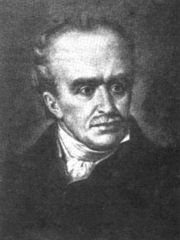
Gheorghe Sincai

Encyclopedia
Romanians
The Romanians are an ethnic group native to Romania, who speak Romanian; they are the majority inhabitants of Romania....
Transylvania
Transylvania
Transylvania is a historical region in the central part of Romania. Bounded on the east and south by the Carpathian mountain range, historical Transylvania extended in the west to the Apuseni Mountains; however, the term sometimes encompasses not only Transylvania proper, but also the historical...
n historian, philologist, translator, poet, and representative
Representation
Representation can refer to:* Representation , one's ability to influence the political process* Representative democracy* Representation, a type of diplomatic mission...
of the Enlightenment
Age of Enlightenment
The Age of Enlightenment was an elite cultural movement of intellectuals in 18th century Europe that sought to mobilize the power of reason in order to reform society and advance knowledge. It promoted intellectual interchange and opposed intolerance and abuses in church and state...
-influenced Transylvanian School
Transylvanian School
The Transylvanian School was a cultural movement which was founded after part of the Romanian Orthodox Church in Habsburg-ruled Transylvania accepted the leadership of the Pope and became the Greek-Catholic Church . The links with Rome brought to the Romanian Tranylvanians the ideas of the Age of...
.
As the director of Greek Catholic
Romanian Church United with Rome, Greek-Catholic
The Romanian Church United with Rome, Greek-Catholic is an Eastern Catholic Church which is in full union with the Roman Catholic Church. It is ranked as a Major Archiepiscopal Church and uses the Byzantine liturgical rite in the Romanian language....
education in Transylvania he brought a fundamental contribution to the process of promoting culture in rural environments. With Samuil Micu he composed the first written grammar
Romanian grammar
Standard Romanian shares largely the same grammar and most of the vocabulary and phonological processes with the other three surviving varieties of Eastern Romance, viz...
of the Romanian language
Romanian language
Romanian Romanian Romanian (or Daco-Romanian; obsolete spellings Rumanian, Roumanian; self-designation: română, limba română ("the Romanian language") or românește (lit. "in Romanian") is a Romance language spoken by around 24 to 28 million people, primarily in Romania and Moldova...
: Elementa linguae daco-romanae sive valachicae (The elements of the Daco-Roman
Daco-Romanian
Daco-Romanian is the term used to identify the Romanian language in contexts where distinction needs to be made between the various Eastern Romance languages...
or Wallachian
Vlachs
Vlach is a blanket term covering several modern Latin peoples descending from the Latinised population in Central, Eastern and Southeastern Europe. English variations on the name include: Walla, Wlachs, Wallachs, Vlahs, Olahs or Ulahs...
language) (Vienna
Vienna
Vienna is the capital and largest city of the Republic of Austria and one of the nine states of Austria. Vienna is Austria's primary city, with a population of about 1.723 million , and is by far the largest city in Austria, as well as its cultural, economic, and political centre...
, 1780), in which he demonstrated the Latin origins of the Romanian language.
Biography
Born in Râciu de Câmpie (now Șincai)Sincai
Şincai is a commune in Mureş County, Transylvania, Romania composed of four villages: Lechincioara , Pusta , Şincai and Şincai-Fânaţe .-Demographics:...
, now Mureş County
Mures County
Mureș is a county of Romania, in the historical region of Transylvania, with the administrative centre in Târgu Mureș.-Geography:The county has a total area of 6,714 km²....
, he studied at Târgu-Mureş
Târgu-Mures
Târgu Mureș is the seat of Mureș County in the north-central part of Romania. As of January 1, 2009 the city had a population of 145,151 inhabitants, making it the 16th most-populated city in Romania.-Names and etymology:...
, Cluj
Cluj-Napoca
Cluj-Napoca , commonly known as Cluj, is the fourth most populous city in Romania and the seat of Cluj County in the northwestern part of the country. Geographically, it is roughly equidistant from Bucharest , Budapest and Belgrade...
, Bistriţa
Bistrita
Bistrița is the capital city of Bistriţa-Năsăud County, Transylvania, Romania. It is situated on the Bistriţa River. The city has a population of approximately 80,000 inhabitants, and it administers six villages: Ghinda, Sărata, Sigmir, Slătiniţa, Unirea and Viişoara.-History:The earliest sign of...
, Blaj
Blaj
Blaj is a city in Alba County, Transylvania, Romania. It has a population of 20,758 inhabitants.The landmark of the city is the fact that it was the principal religious and cultural center of the Romanian Greek-Catholic Church in Transylvania....
, Vienna and Rome
Rome
Rome is the capital of Italy and the country's largest and most populated city and comune, with over 2.7 million residents in . The city is located in the central-western portion of the Italian Peninsula, on the Tiber River within the Lazio region of Italy.Rome's history spans two and a half...
(in the last two cities together with Samuil Micu, nephew of Bishop
Bishop
A bishop is an ordained or consecrated member of the Christian clergy who is generally entrusted with a position of authority and oversight. Within the Catholic Church, Eastern Orthodox, Oriental Orthodox Churches, in the Assyrian Church of the East, in the Independent Catholic Churches, and in the...
Inocenţiu Micu-Klein
Inocentiu Micu-Klein
Iaoan Inocenţiu Micu-Klein was a Bishop of Făgăraş and Primate of the Romanian Greek Catholic Church from 1730 to his resignation in 1751...
).
He turned out to be a polyglot
Polyglot (person)
A polyglot is someone with a high degree of proficiency in several languages. A bilingual person can speak two languages fluently, whereas a trilingual three; above that the term multilingual may be used.-Hyperpolyglot:...
, thoroughly mastering Greek
Greek language
Greek is an independent branch of the Indo-European family of languages. Native to the southern Balkans, it has the longest documented history of any Indo-European language, spanning 34 centuries of written records. Its writing system has been the Greek alphabet for the majority of its history;...
, Latin
Latin
Latin is an Italic language originally spoken in Latium and Ancient Rome. It, along with most European languages, is a descendant of the ancient Proto-Indo-European language. Although it is considered a dead language, a number of scholars and members of the Christian clergy speak it fluently, and...
, Hungarian
Hungarian language
Hungarian is a Uralic language, part of the Ugric group. With some 14 million speakers, it is one of the most widely spoken non-Indo-European languages in Europe....
, German
German language
German is a West Germanic language, related to and classified alongside English and Dutch. With an estimated 90 – 98 million native speakers, German is one of the world's major languages and is the most widely-spoken first language in the European Union....
, Italian
Italian language
Italian is a Romance language spoken mainly in Europe: Italy, Switzerland, San Marino, Vatican City, by minorities in Malta, Monaco, Croatia, Slovenia, France, Libya, Eritrea, and Somalia, and by immigrant communities in the Americas and Australia...
and French
French language
French is a Romance language spoken as a first language in France, the Romandy region in Switzerland, Wallonia and Brussels in Belgium, Monaco, the regions of Quebec and Acadia in Canada, and by various communities elsewhere. Second-language speakers of French are distributed throughout many parts...
. His knowledge and culture allowed him to occupy the function of librarian of the Congregation for the Evangelization of Peoples
Congregation for the Evangelization of Peoples
The Congregation for the Evangelization of Peoples in Rome is the congregation of the Roman Curia responsible for missionary work and related activities...
in Rome, having permission to research any type of document. In the Papal States
Papal States
The Papal State, State of the Church, or Pontifical States were among the major historical states of Italy from roughly the 6th century until the Italian peninsula was unified in 1861 by the Kingdom of Piedmont-Sardinia .The Papal States comprised territories under...
, and later in Hungary
Kingdom of Hungary
The Kingdom of Hungary comprised present-day Hungary, Slovakia and Croatia , Transylvania , Carpatho Ruthenia , Vojvodina , Burgenland , and other smaller territories surrounding present-day Hungary's borders...
and in Vienna (the capital of the Habsburg domains
Habsburg Monarchy
The Habsburg Monarchy covered the territories ruled by the junior Austrian branch of the House of Habsburg , and then by the successor House of Habsburg-Lorraine , between 1526 and 1867/1918. The Imperial capital was Vienna, except from 1583 to 1611, when it was moved to Prague...
), he carried out research work in various libraries, copying and transcribing exactly any reference to the history of the Romanians.
Șincai assiduously worked to educate commoners, dedicating himself to a career in teaching, and contributing to the establishment of an impressive number of Greek-Catholic parochial school
Parochial school
A parochial school is a school that provides religious education in addition to conventional education. In a narrower sense, a parochial school is a Christian grammar school or high school which is part of, and run by, a parish.-United Kingdom:...
s (in all, over 300). In 1784 he was named general director of Romanian Uniate schools in all of Transylvania.
He translated and expanded the following basic textbooks for educational purposes: Abecedarul (The Book of ABCs), Gramatica (Grammar), Aritmetica (Arithmetic) and Catehismul (The Catechism), adapting or creating the terminology necessary for pupils to understand these. He proved himself to be a remarkable translator, rendering the Bible
Bible
The Bible refers to any one of the collections of the primary religious texts of Judaism and Christianity. There is no common version of the Bible, as the individual books , their contents and their order vary among denominations...
into Romanian (in 1789, under the name of The Blaj Bible).
In 1794 Șincai came into direct conflict with Bishop Ion Bob; he was thrown into the harsh prison of Aiud
Aiud
Aiud is a city located in Alba county, Transylvania, Romania. The city has a population of 28,934 people. It has the status of municipality and is the second-largest city in the county, after county seat Alba Iulia. The Aiud administrative region is 142.2 square kilometres in area.- Administration...
, being followed and persecuted by the Habsburg authorities after his release in 1796.
In 1811 Șincai published a work of history, written in the form of annals and amply titled: Hronica românilor și a mai multor neamuri în cât au fost ele amestecate cu românii, cât lucrurile, întâmplările și faptele unora față de ale altora nu se pot scrie pre înțeles, din mai multe mii de autori, în cursul a treizeci și patru de ani culese (The chronicle of the Romanians and of other peoples insofar as they were mixed with the Romanians, as the things, events and facts of the one regarding the other cannot be written as if everyone understands them, from several thousand authors, gathered over the course of thirty-four years).
Șincai died at Sinea
Sinea
Sinea is a New World genus of assassin bugs, in the subfamily Harpactorinae. 13 species have been described, mostly from the Southwestern United States and Central America.-Partial list of species:*Sinea anacantha Hussey, 1953...
, near Košice
Košice
Košice is a city in eastern Slovakia. It is situated on the river Hornád at the eastern reaches of the Slovak Ore Mountains, near the border with Hungary...
in present-day Slovakia
Slovakia
The Slovak Republic is a landlocked state in Central Europe. It has a population of over five million and an area of about . Slovakia is bordered by the Czech Republic and Austria to the west, Poland to the north, Ukraine to the east and Hungary to the south...
.