

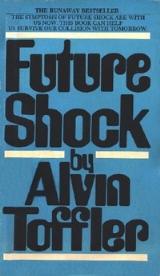
Future Shock

Encyclopedia
Future Shock is a book written by the futurist Alvin Toffler
in 1970. In the book, Toffler defines the term "future shock" as a certain psychological state of individuals and entire societies. His shortest definition for the term is a personal perception
of "too much change in too short a period of time". The book, which became an international bestseller, grew out of an article "The Future as a Way of Life" in Horizon magazine
, Summer 1965 issue. The book has sold over 6 million copies and has been widely translated.
A documentary film
based on the book was released in 1972 with Orson Welles
as on-screen narrator.
to a "super-industrial society". This change overwhelms people, he believed, the accelerated rate of technological and social change leaving people disconnected and suffering from "shattering stress and disorientation"—future shocked. Toffler stated that the majority of social problems are symptoms of future shock. In his discussion of the components of such shock he popularized the term "information overload
."
His analysis of the phenomenon of information overload is continued in his later publications, especially The Third Wave
and Powershift
.
's song "Future Shock
" on the album "Back to the World
" took its name from this book, and was in turn covered by Herbie Hancock
as the title track for his 1983 recording Future Shock. That album was considered groundbreaking for fusing jazz
and funk
with electronic music
. Darren Hayes
name checks the phrase many times in his song "Me Myself And I
". At least two more releases have been named for the book, a 1981 album
by Gillan
and a 1988 single by Stratovarius
.
Other works taking their title from the book include: the Futurama
episode "Future Stock
"; a segment on the Daily Show starring Samantha Bee
; Kevin Goldstein's recurring column on the Baseball Prospectus
website; a Magic: The Gathering
pre-constructed deck; and the National Wrestling Alliance
's 1989 Starrcade
event.
UK Comic 2000 AD
ran a series of short stories called Future Shocks
based on this concept, some of which were written by Alan Moore
. The abbreviated derogatory term Futzies was applied to citizens in 2000 AD stories (mainly in the Judge Dredd
universe) who had been driven insane by Future Shock.
Voiceworks
#62 (Summer 2005), edited by Tom Doig, was themed Future Shock: 'The future is here. Are you ready for it? Increasing computing power and nanotechnology will usher in an era of artificial intelligence, electronic telepathy and virtual immortality within a matter of years...'
Works deriving themes and elements from Future Shock include the science fiction novels The Forever War
(1974) by Joe Haldeman
, The Shockwave Rider
(1975) by John Brunner
, the RPG
Transhuman Space
(2002) by Steve Jackson Games
, and the indie RPG Shock: Social Science Fiction
(2006) by designer Joshua A.C. Newman.
Doomtree
recording artist Sims referenced the phenomenon of future shock with a song named after it on his album Bad Time Zoo (2011).
In 2011, the Unsound Music Festival
in Krakow, Poland, used the name "Future Shock" as their theme.
Alvin Toffler
Alvin Toffler is an American writer and futurist, known for his works discussing the digital revolution, communication revolution, corporate revolution and technological singularity....
in 1970. In the book, Toffler defines the term "future shock" as a certain psychological state of individuals and entire societies. His shortest definition for the term is a personal perception
Perception
Perception is the process of attaining awareness or understanding of the environment by organizing and interpreting sensory information. All perception involves signals in the nervous system, which in turn result from physical stimulation of the sense organs...
of "too much change in too short a period of time". The book, which became an international bestseller, grew out of an article "The Future as a Way of Life" in Horizon magazine
Horizon (U.S. magazine)
Horizon was a magazine published in the United States from 1958 to 1989. Originally published by American Heritage as a bi-monthly hardback, Horizon was subtitled A Magazine of the Arts. In 1978 Boone Inc. bought the magazine, which continued to cover the arts...
, Summer 1965 issue. The book has sold over 6 million copies and has been widely translated.
A documentary film
Future Shock (film)
Future Shock is a 1972 short documentary film directed by Alex Grasshoff and narrated by Orson Welles. It was screened at the 1973 Cannes Film Festival, but wasn't entered into the main competition. It is based on the book of the same name....
based on the book was released in 1972 with Orson Welles
Orson Welles
George Orson Welles , best known as Orson Welles, was an American film director, actor, theatre director, screenwriter, and producer, who worked extensively in film, theatre, television and radio...
as on-screen narrator.
Term
Toffler argued that society is undergoing an enormous structural change, a revolution from an industrial societyIndustrial society
In sociology, industrial society refers to a society driven by the use of technology to enable mass production, supporting a large population with a high capacity for division of labour. Such a structure developed in the west in the period of time following the Industrial Revolution, and replaced...
to a "super-industrial society". This change overwhelms people, he believed, the accelerated rate of technological and social change leaving people disconnected and suffering from "shattering stress and disorientation"—future shocked. Toffler stated that the majority of social problems are symptoms of future shock. In his discussion of the components of such shock he popularized the term "information overload
Information overload
"Information overload" is a term popularized by Alvin Toffler in his bestselling 1970 book Future Shock. It refers to the difficulty a person can have understanding an issue and making decisions that can be caused by the presence of too much information...
."
His analysis of the phenomenon of information overload is continued in his later publications, especially The Third Wave
The Third Wave (book)
The Third Wave is a book published in 1980 by Alvin Toffler. It is the sequel to Future Shock, published in 1970, and the second in what was originally just a trilogy that was continued with Powershift: Knowledge, Wealth and Violence at the Edge of the 21st Century in 1990...
and Powershift
Powershift: Knowledge, Wealth and Violence at the Edge of the 21st Century
Powershift: Knowledge, Wealth and Violence at the Edge of the 21st Century is the third book in a trilogy written by the futurist Alvin Toffler, following on from Future Shock and The Third Wave. The hardcover first edition was published October 1, 1990. ISBN-10 0553057766....
.
Broad cultural impact
Curtis MayfieldCurtis Mayfield
Curtis Lee Mayfield was an American soul, R&B, and funk singer, songwriter, and record producer.He is best known for his anthemic music with The Impressions during the Civil Rights Movement of the 1960's and for composing the soundtrack to the blaxploitation film Super Fly, Mayfield is highly...
's song "Future Shock
Future Shock (song)
-Personnel:*Timo Tolkki - Guitar, Vocals*Jyrki Lentonen - Bass*Tuomo Lassila - Drums, Percussion...
" on the album "Back to the World
Back to the World (Curtis Mayfield album)
Back to the World is the fourth studio album by Curtis Mayfield."The World" was what US GIs in Vietnam called America, and acclimating back into the world could be a harrowing experience. Curtis Mayfield addresses this problem in the title track to his 1973 album, Back to the World...
" took its name from this book, and was in turn covered by Herbie Hancock
Herbie Hancock
Herbert Jeffrey "Herbie" Hancock is an American pianist, bandleader and composer. As part of Miles Davis's "second great quintet," Hancock helped to redefine the role of a jazz rhythm section and was one of the primary architects of the "post-bop" sound...
as the title track for his 1983 recording Future Shock. That album was considered groundbreaking for fusing jazz
Jazz
Jazz is a musical style that originated at the beginning of the 20th century in African American communities in the Southern United States. It was born out of a mix of African and European music traditions. From its early development until the present, jazz has incorporated music from 19th and 20th...
and funk
Funk
Funk is a music genre that originated in the mid-late 1960s when African American musicians blended soul music, jazz and R&B into a rhythmic, danceable new form of music. Funk de-emphasizes melody and harmony and brings a strong rhythmic groove of electric bass and drums to the foreground...
with electronic music
Electronic music
Electronic music is music that employs electronic musical instruments and electronic music technology in its production. In general a distinction can be made between sound produced using electromechanical means and that produced using electronic technology. Examples of electromechanical sound...
. Darren Hayes
Darren Hayes
Darren Stanley Hayes is a UK-based Australian singer-songwriter. Hayes was the front man and singer of the pop duo Savage Garden, whose 1997 album Savage Garden peaked at No. 1 in Australia, No. 2 in United Kingdom and No. 3 in United States...
name checks the phrase many times in his song "Me Myself And I
Me, Myself and (I)
"Me, Myself and " is a song written by Australian singer-songwriter Darren Hayes and Justin Shave for Hayes' third solo album This Delicate Thing We've Made. The song was confirmed on Hayes' official MySpace page in July 2007 as the second single to be released off the album...
". At least two more releases have been named for the book, a 1981 album
Future Shock (Gillan album)
Future Shock is the fourth album by the British rock band Gillan. Released by Virgin in 1981, it reached number 2 in the UK album chart; this would remain the band's highest placing.The title is taken from Alvin Toffler's book Future Shock....
by Gillan
Gillan
Gillan was a rock band formed in 1978 by Deep Purple singer Ian Gillan.-History:In 1978 Ian Gillan had become dissatisfied with the jazz fusion style of his band called the Ian Gillan Band and dissolved it, retaining only keyboard player Colin Towns, and formed a new band entitled Gillan...
and a 1988 single by Stratovarius
Stratovarius
Stratovarius are a Finnish power metal band that formed in 1984. Since their formation they have released 13 studio albums and one live album. Along with Helloween, Blind Guardian, Rhapsody of Fire and Gamma Ray, Stratovarius are considered one of the leading groups of the power metal and symphonic...
.
Other works taking their title from the book include: the Futurama
Futurama
Futurama is an American animated science fiction sitcom created by Matt Groening and developed by Groening and David X. Cohen for the Fox Broadcasting Company. The series follows the adventures of a late 20th-century New York City pizza delivery boy, Philip J...
episode "Future Stock
Future Stock
"Future Stock" is the 21st episode in the third production season of Futurama. The episode first aired on March 31, 2002 as the ninth episode in the fourth broadcast season.-Plot:...
"; a segment on the Daily Show starring Samantha Bee
Samantha Bee
Samantha Bee is a Canadian comedic actress and author best known as a cast member on The Daily Show with Jon Stewart.-Early life:Bee was born in Toronto, Ontario into an unconventional family...
; Kevin Goldstein's recurring column on the Baseball Prospectus
Baseball Prospectus
Baseball Prospectus is an organization that publishes a website, BaseballProspectus.com, devoted to the sabermetric analysis of baseball. BP has a staff of regular columnists and provides advanced statistics as well player and team performance projections on the site...
website; a Magic: The Gathering
Magic: The Gathering
Magic: The Gathering , also known as Magic, is the first collectible trading card game created by mathematics professor Richard Garfield and introduced in 1993 by Wizards of the Coast. Magic continues to thrive, with approximately twelve million players as of 2011...
pre-constructed deck; and the National Wrestling Alliance
National Wrestling Alliance
The National Wrestling Alliance is a wrestling promotion company and sanctions various NWA championships in the United States. The NWA has been in operation since 1948...
's 1989 Starrcade
Starrcade (1989)
Starrcade '89 was the seventh annual Starrcade professional wrestling pay-per-view event produced under the National Wrestling Alliance banner. It was the second Starrcade event produced by World Championship Wrestling , and it took place on December 13, 1989 at The Omni in Atlanta, Georgia.The...
event.
UK Comic 2000 AD
2000 AD (comic)
2000 AD is a weekly British science fiction-oriented comic. As a comics anthology it serialises a number of separate stories each issue and was first published by IPC Magazines in 1977, the first issue dated 26 February. IPC then shifted the title to its Fleetway comics subsidiary which was sold...
ran a series of short stories called Future Shocks
Future Shocks
Future Shocks is the name given to a long running series of short strips in the weekly comic 2000 AD in 1977. The name originates in a book titled Future Shock, written by Alvin Toffler, published in 1970.-Publishing history:...
based on this concept, some of which were written by Alan Moore
Alan Moore
Alan Oswald Moore is an English writer primarily known for his work in comic books, a medium where he has produced a number of critically acclaimed and popular series, including Watchmen, V for Vendetta, and From Hell...
. The abbreviated derogatory term Futzies was applied to citizens in 2000 AD stories (mainly in the Judge Dredd
Judge Dredd
Judge Joseph Dredd is a comics character whose strip in the British science fiction anthology 2000 AD is the magazine's longest running . Dredd is an American law enforcement officer in a violent city of the future where uniformed Judges combine the powers of police, judge, jury and executioner...
universe) who had been driven insane by Future Shock.
Voiceworks
Voiceworks (journal)
Voiceworks is an Australian magazine that publishes fiction, poetry, essays and journalism by young writers, as well as comics, drawings and photos by young artists. Voiceworks was originally established as the monthly newsletter of Express Media Power Workshops...
#62 (Summer 2005), edited by Tom Doig, was themed Future Shock: 'The future is here. Are you ready for it? Increasing computing power and nanotechnology will usher in an era of artificial intelligence, electronic telepathy and virtual immortality within a matter of years...'
Works deriving themes and elements from Future Shock include the science fiction novels The Forever War
The Forever War
The Forever War is a science fiction novel by American author Joe Haldeman, telling the contemplative story of soldiers fighting an interstellar war between humanity and the enigmatic Tauran species...
(1974) by Joe Haldeman
Joe Haldeman
Joe William Haldeman is an American science fiction author.-Life :Haldeman was born June 9, 1943 in Oklahoma City, Oklahoma. His family traveled and he lived in Puerto Rico, New Orleans, Washington, D.C., Bethesda, Maryland and Anchorage, Alaska as a child. Haldeman married Mary Gay Potter, known...
, The Shockwave Rider
The Shockwave Rider
The Shockwave Rider is a science fiction novel by John Brunner, originally published in 1975. It is notable for its hero's use of computer hacking skills to escape pursuit in a dystopian future, and for the coining of the word "worm" to describe a program that propagates itself through a computer...
(1975) by John Brunner
John Brunner (novelist)
John Kilian Houston Brunner was a prolific British author of science fiction novels and stories. His 1968 novel Stand on Zanzibar, about an overpopulated world, won the 1968 Hugo Award for best science fiction novel. It also won the BSFA award the same year...
, the RPG
Role-playing game
A role-playing game is a game in which players assume the roles of characters in a fictional setting. Players take responsibility for acting out these roles within a narrative, either through literal acting, or through a process of structured decision-making or character development...
Transhuman Space
Transhuman Space
Transhuman Space is a role-playing game published by Steve Jackson Games as parts of the "Powered by GURPS" line. Set in the year 2100, humanity has begun to colonize the Solar System...
(2002) by Steve Jackson Games
Steve Jackson Games
Steve Jackson Games is a game company, founded in 1980 by Steve Jackson, that creates and publishes role-playing, board, and card games, and the gaming magazine Pyramid.-History:...
, and the indie RPG Shock: Social Science Fiction
Shock: Social Science Fiction
Shock: Social Science Fiction is a pen-and-paper indie RPG about the effects of the shock of cultural change on the individuals who make up that culture...
(2006) by designer Joshua A.C. Newman.
Doomtree
Doomtree
Doomtree is a hip hop collective based in Minneapolis, Minnesota. Members of Doomtree bring various bases of knowledge and musical backgrounds together to create alternative-influenced rap and hip-hop music. Nearly as prominent as the influence of hip-hop in their music is that of punk, and their...
recording artist Sims referenced the phenomenon of future shock with a song named after it on his album Bad Time Zoo (2011).
In 2011, the Unsound Music Festival
Unsound festival
Unsound Festival is an annual music festival that takes place in Kraków, Poland, dealing with evolving and mutating forms of music, as well as related visual arts....
in Krakow, Poland, used the name "Future Shock" as their theme.
Reprints
The book has been reprinted several times. ISBNs include:- ISBN 0-394-42586-3 (hardcoverHardcoverA hardcover, hardback or hardbound is a book bound with rigid protective covers...
, Random House, 1970) - ISBN 0-8488-0645-X (hardcover, Amereon Ltd, 1970)
- ISBN 0-553-20626-5 (mass market paperback, 1981)
- ISBN 0-553-27737-5 (mass market paperback, 1984)
- ISBN 0-553-24649-6 (paperbackPaperbackPaperback, softback or softcover describe and refer to a book by the nature of its binding. The covers of such books are usually made of paper or paperboard, and are usually held together with glue rather than stitches or staples...
, 1984) - ISBN 5-553-85765-1 (mass market paperback, 1991)
- ISBN 0-8085-0152-6 (mass market paperback in library bindingLibrary bindingLibrary binding is the term used to describe the method of binding serials, and re-binding paperback or hardcover books, for use within libraries. Library binding increases the durability of books, as well as making the materials easier to use...
, 1999)
See also
- AdhocracyAdhocracyAdhocracy is a type of organization that operates in opposite fashion to a bureaucracy. The term was first popularized in 1970 by Alvin Toffler, and has since become often used in the theory of management of organizations , further developed by academics such as Henry Mintzberg.- Etymology :The...
- AlienationSocial alienationThe term social alienation has many discipline-specific uses; Roberts notes how even within the social sciences, it “is used to refer both to a personal psychological state and to a type of social relationship”...
- Culture shockCulture shockCulture shock is the anxiety, feelings of frustration, alienation and anger that may occur when a person is emplaced in a new culture.One of the most common causes of culture shock involves individuals in a foreign country. Culture shock can be described as consisting of one or more distinct phases...
- Digital divideDigital divideThe Digital Divide refers to inequalities between individuals, households, business, and geographic areas at different socioeconomic levels in access to information and communication technologies and Internet connectivity and in the knowledge and skills needed to effectively use the information...
- Neo-LuddismNeo-luddismNeo-Luddism is a personal world view opposing any modern technology. Its name is based on the historical legacy of the British Luddites which were active between 1811 and 1816...
- The Experience EconomyThe Experience EconomyThe term Experience Economy was first described in an article published in 1998 by B. Joseph Pine II and James H. Gilmore, titled "The Experience Economy". In it they described the experience economy as the next economy following the agrarian economy, the industrial economy, and the most recent...
- Paradigm shiftParadigm shiftA Paradigm shift is, according to Thomas Kuhn in his influential book The Structure of Scientific Revolutions , a change in the basic assumptions, or paradigms, within the ruling theory of science...
- Technological singularityTechnological singularityTechnological singularity refers to the hypothetical future emergence of greater-than-human intelligence through technological means. Since the capabilities of such an intelligence would be difficult for an unaided human mind to comprehend, the occurrence of a technological singularity is seen as...
- Electric Dreams (TV series)Electric Dreams (TV series)Electric Dreams is a BBC television documentary series, co-produced with The Open University, that places a family of two parents and four children in their home with only the amenities available during each of the previous three decades , and recording their responses to the changing pace of...
Further reading
- Future Shock Levels by Eliezer YudkowskyEliezer YudkowskyEliezer Shlomo Yudkowsky is an American artificial intelligence researcher concerned with the singularity and an advocate of friendly artificial intelligence, living in Redwood City, California.- Biography :...
- Future Shock Level Analysis by Michael Anissimov