


Technological singularity

Encyclopedia
Technological singularity refers to the hypothetical future emergence of greater-than-human intelligence through technological means. Since the capabilities of such an intelligence would be difficult for an unaided human mind to comprehend, the occurrence of a technological singularity is seen as an intellectual event horizon
, beyond which the future becomes difficult to understand or predict. Nevertheless, proponents of the singularity typically anticipate such an event to precede an "intelligence explosion", wherein superintelligences design successive generations of increasingly powerful minds.
The term was coined by science fiction writer Vernor Vinge
, who argues that artificial intelligence, human biological enhancement or brain-computer interfaces could be possible causes of the singularity. The concept is popularized by futurists like Ray Kurzweil and it is expected by proponents to occur sometime in the 21st century, although estimates do vary.
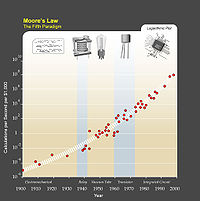 Many of the most recognized writers on the singularity, such as Vernor Vinge
and Ray Kurzweil, define the concept in terms of the technological creation of superintelligence
, and argue that it is difficult or impossible for present-day humans to predict what a post-singularity world would be like, due to the difficulty of imagining the intentions and capabilities of superintelligent entities. The term "technological singularity" was originally coined by Vinge, who made an analogy between the breakdown in our ability to predict what would happen after the development of superintelligence and the breakdown of the predictive ability of modern physics
at the space-time singularity
beyond the event horizon
of a black hole
. Some writers use "the singularity" in a broader way to refer to any radical changes in our society brought about by new technologies such as molecular nanotechnology
, although Vinge and other prominent writers specifically state that without superintelligence, such changes would not qualify as a true singularity. Many writers also tie the singularity to observations of exponential growth in various technologies (with Moore's Law
being the most prominent example), using such observations as a basis for predicting that the singularity is likely to happen sometime within the 21st century.
A technological singularity includes the concept of an intelligence explosion, a term coined in 1965 by I. J. Good
. Although technological progress has been accelerating, it has been limited by the basic intelligence of the human brain, which has not, according to Paul R. Ehrlich
, changed significantly for millennia. However with the increasing power of computers and other technologies, it might eventually be possible to build a machine that is more intelligent than humanity. If superhuman intelligences were invented, either through the amplification of human intelligence
or artificial intelligence
, it would bring to bear greater problem-solving and inventive skills than humans, then it could design a yet more capable machine, or re-write its source code to become more intelligent. This more capable machine could then go on to design a machine of even greater capability. These iterations could accelerate, leading to recursive self improvement
, potentially allowing enormous qualitative change before any upper limits imposed by the laws of physics or theoretical computation set in.
The exponential growth in computing technology suggested by Moore's Law
is commonly cited as a reason to expect a singularity in the relatively near future, and a number of authors have proposed generalizations of Moore's Law. Computer scientist and futurist Hans Moravec
proposed in a 1998 book that the exponential growth curve could be extended back through earlier computing technologies prior to the integrated circuit
. Futurist Ray Kurzweil postulates a law of accelerating returns in which the speed of technological change (and more generally, all evolutionary processes) increases exponentially, generalizing Moore's Law in the same manner as Moravec's proposal, and also including material technology (especially as applied to nanotechnology
), medical technology and others. Like other authors, though, he reserves the term "Singularity" for a rapid increase in intelligence (as opposed to other technologies), writing for example that "The Singularity will allow us to transcend these limitations of our biological bodies and brains ... There will be no distinction, post-Singularity, between human and machine". He also defines his predicted date of the singularity (2045) in terms of when he expects computer-based intelligences to significantly exceed the sum total of human brainpower, writing that advances in computing before that date "will not represent the Singularity" because they do "not yet correspond to a profound expansion of our intelligence."
The term "technological singularity" reflects the idea that such change may happen suddenly, and that it is difficult to predict how such a new world would operate. It is unclear whether an intelligence explosion of this kind would be beneficial or harmful, or even an existential threat
, as the issue has not been dealt with by most artificial general intelligence researchers, although the topic of friendly artificial intelligence is investigated by the Singularity Institute for Artificial Intelligence and the Future of Humanity Institute
.
Many prominent technologists and academics dispute the plausibility of a technological singularity, including Jeff Hawkins
, John Holland
, Jaron Lanier
, and Gordon Moore
, whose Moore's Law
is often cited in support of the concept.
:
In 1951 Alan Turing
spoke of machines outstripping humans intellectually:
In 1958, Stanisław Ulam wrote in reference to a conversation with John von Neumann
:
In 1965, I. J. Good
first wrote of an "intelligence explosion", suggesting that if machines could even slightly surpass human intellect, they could improve their own designs in ways unforeseen by their designers, and thus recursively
augment themselves into far greater intelligences. The first such improvements might be small, but as the machine became more intelligent it would become better at becoming more intelligent, which could lead to a cascade of self-improvements and a sudden surge to superintelligence
(or a singularity).
In 1983 mathematician and author Vernor Vinge
greatly popularized Good’s notion of an intelligence explosion in a number of writings, first addressing the topic in print in the January 1983 issue of Omni
magazine. In this op-ed piece, Vinge seems to have been the first to use the term "singularity" in a way that was specifically tied to the creation of intelligent machines, writing:
In 1985 Ray Solomonoff
introduced the notion of "infinity point" in the time scale of artificial intelligence, analyzed the magnitude of the "future shock
" that "we can expect from our AI expanded scientific community" and on social effects. Estimates were made "for when these milestones would occur, followed by some suggestions for the more effective utilization of the extremely rapid technological growth that is expected."
Vinge also popularized the concept in SF novels such as Marooned in Realtime
(1986) and A Fire Upon the Deep
(1992). The former is set in a world of rapidly accelerating change
leading to the emergence of more and more sophisticated technologies separated by shorter and shorter time intervals, until a point beyond human comprehension is reached. The latter starts with an imaginative description of the evolution of a superintelligence
passing through exponentially accelerating developmental stages ending in a transcendent
, almost omnipotent power unfathomable by mere humans. It is also implied that the development does not stop at this level.
In his 1988 book Mind Children,
computer scientist and futurist Hans Moravec
generalizes Moore's law
to make predictions about the future of artificial life. Moravec outlines a timeline and a scenario in this regard, in that the robots will evolve into a new series of artificial species, starting around 2030-2040.
In Robot: Mere Machine to Transcendent Mind, published in 1998, Moravec further considers the implications of evolving robot intelligence, generalizing Moore's law
to technologies predating the integrated circuit
, and speculating about a coming "mind fire" of rapidly expanding superintelligence
, similar to Vinge's ideas.
A 1993 article by Vinge, "The Coming Technological Singularity: How to Survive in the Post-Human Era", was widely disseminated on the World Wide Web
and helped to popularize the idea. This article contains the oft-quoted statement, "Within thirty years, we will have the technological means to create superhuman intelligence. Shortly after, the human era will be ended." Vinge refines his estimate of the time scales involved, adding, "I'll be surprised if this event occurs before 2005 or after 2030."
Vinge continues by predicting that superhuman intelligences will be able to enhance their own minds faster than their human creators. "When greater-than-human intelligence drives progress," Vinge writes, "that progress will be much more rapid." This feedback loop of self-improving intelligence, he predicts, will cause large amounts of technological progress within a short period, and that the creation of superhuman intelligence represented a breakdown in humans' ability to model their future. His argument was that authors cannot write realistic characters who surpass the human intellect, as the thoughts of such an intellect would be beyond the ability of humans to express. Vinge named this event "the Singularity". In 1993, Vernor Vinge associated the Singularity more explicitly with I. J. Good's intelligence explosion, and tried to project the arrival time of artificial intelligence
(AI) using Moore's law
, which thereafter came to be associated with the "Singularity" concept.
Damien Broderick
's popular science book The Spike (1997)
was the first to investigate the technological Singularity in detail.
In 2000 Bill Joy
, a promonent technologist, founder of Sun Microsystems
, voiced concern over the potential dangers of the Singularity.
In 2005, Ray Kurzweil published The Singularity is Near
, which brought the idea of the singularity to the popular media both through the book's accessibility and a publicity campaign that included an appearance on The Daily Show with Jon Stewart. The book stirred intense controversy, in part because Kurzweil's utopian predictions contrasted starkly with other, darker visions of the possibilities of the singularity. Kurzweil, his theories, and the controversies surrounding it were the subject of Barry Ptolemy
's documentary Transcendent Man
.
In 2007 Eliezer Yudkowsky
suggested that many of the different definitions that have been assigned to singularity are mutually incompatible rather than mutually supporting. For example, Kurzweil extrapolates current technological trajectories past the arrival of self-improving AI or superhuman intelligence, which Yudkowsky argues represents a tension with both I. J. Good's proposed discontinuous upswing in intelligence and Vinge's thesis on unpredictability.
In 2008 Robin Hanson
, taking "singularity" to refer to sharp increases in the exponent of economic growth, lists the agricultural
and industrial revolution
s as past "singularities". Extrapolating from such past events, Hanson proposes that the next economic singularity should increase economic growth
between 60 and 250 times. An innovation that allowed for the replacement of virtually all human labor could trigger this event.
In 2009, Kurzweil and X-Prize founder Peter Diamandis
announced the establishment of Singularity University
, whose stated mission is "to assemble, educate and inspire a cadre of leaders who strive to understand and facilitate the development of exponentially advancing technologies in order to address humanity’s grand challenges." Funded by Google
, Autodesk
, ePlanet Ventures, and a group of technology industry leaders, Singularity University is based at NASA
's Ames Research Center
in Mountain View
, California
. The not-for-profit organization runs an annual ten-week graduate program during the summer that covers ten different technology and allied tracks, and a series of executive programs throughout the year. Program faculty include experts in technology, finance, and future studies, and a number of videos of Singularity University sessions have been posted online.
In 2010 Aubrey de Grey
applied the term the "Methuselarity" to the point at which medical technology improves so fast that expected human lifespan
increases by more than one year per year.
In 2010 in "Apocalyptic AI - Visions of Heaven in Robotics, Artificial Intelligence, and Virtual Reality," Robert Geraci offers an account of the developing "cyber-theology" inspired by Singularity studies.
In 2011, Kurzweil noted existing trends and said the singularity was becoming more probable to occur around 2045.
Most proposed methods for creating superhuman or transhuman
minds fall into one of two categories: intelligence amplification
of human brains and artificial intelligence
. The means speculated to produce intelligence augmentation are numerous, and include bio- and genetic engineering
, nootropic
drugs, AI assistants, direct brain-computer interface
s, and mind uploading. The existence of multiple paths to an intelligence-explosion makes a singularity more likely; for a singularity to not occur they would all have to fail.
Despite the numerous speculated means for amplifying human intelligence, non-human artificial intelligence (specifically seed AI
) is the most popular option for organizations trying to advance the singularity. is also skeptical of human intelligence augmentation, writing that once one has exhausted the "low-hanging fruit" of easy methods for increasing human intelligence, further improvements will become increasingly difficult to find.
Whether or not an intelligence explosion occurs depends on three factors. The first, accelerating factor, is the new intelligence enhancements made possible by each previous improvement. Contrawise, as the intelligences become more advanced, further advances will become more and more complicated, possibly overcoming the advantage of increased intelligence. Each improvement must be able to beget at least one more improvement, on average, for the singularity to continue. Finally, there is the issue of a hard upper limit. Absent Quantum Computing, eventually the laws of physics will prevent any further improvements.
There are two logically independent, but mutually reinforcing, accelerating effects: increases in the speed of computation, and improvements to the algorithms used. The former is predicted by Moore’s Law and the forecast improvements in hardware, and is comparatively similar to previous technological advance. On the other hand, most AI researchers believe that software is more important than hardware.
suggests that if the first doubling of speed took 18 months, the second would take 18 subjective months; or 9 external months, whereafter, four months, two months, and so on towards a speed singularity. An upper limit on speed may eventually be reached, though it is unclear how high this would be.
, responding to Good, argued that the upper limit is relatively low;
It is difficult to directly compare silicon
-based hardware with neuron
s. But notes that computer speech recognition
is approaching human capabilities, and that this capability seems to require 0.01% of the volume of the brain. This analogy suggests that modern computer hardware is within a few orders of magnitude of being as powerful as the human brain.
This mechanism for an intelligence explosion differs from an increase in speed in two ways. First, it does not require external effect: machines designing faster hardware still require humans to create the improved hardware, or to program factories appropriately. An AI which was re-writing its own source code, however, could do so while contained in an AI box
.
Second, as with Vernor Vinge’s conception of the singularity, it is much harder to predict the outcome. While speed increases seem to be only a quantitative difference from human intelligence, actual improvements in intelligence would be qualitatively different. Eliezer Yudkowsky
compares it to the changes that human intelligence brought: humans changed the world thousands of times more rapidly than evolution had done so, and in totally different ways. Similarly, the evolution of life had been a massive departure and acceleration from the previous geological rates of change, and improved intelligence could cause change to be as different again.
There are substantial dangers associated with an intelligence explosion singularity. First, the goal structure of the AI may not be invariant under self-improvement, potentially causing the AI to optimise something other than was intended. Secondly, AIs could compete for the scarce resources mankind uses to survive.
While not actively malicious, there is no reason to think that AIs would actively promote human goals unless they could be programmed as such, and if not, might use the resources currently used to support mankind to promote its own goals, causing human extinction.
era until the Neolithic Revolution
. This new agricultural economy began to double every 900 years, a remarkable increase. In the current era, beginning with the Industrial Revolution
, the world’s economic output doubles every fifteen years, sixty times faster than during the agricultural era. If the rise of superhuman intelligences causes a similar revolution, argues Robin Hanson
, one would expect the economy to double at least quarterly and possibly on a weekly basis.
Superhuman intelligences may have goals inconsistent with human survival and prosperity. notes that there is no direct evolutionary motivation for an AI to be friendly to humans. In the same way that evolution has no inherent tendency to produce outcomes valued by humans, so too there is little reason to expect an arbitrary optimisation process to promote an outcome desired by mankind, rather than inadvertently leading to an AI behaving in a way not intended by its creators (such as Nick Bostrom
's whimsical example of an AI which was originally programmed with the goal of manufacturing paper clips, such that when it achieves superintelligence it decides to convert the entire planet into a paper clip manufacturing facility; Anders Sandberg
has also elaborated on this scenario, addressing various common counter-arguments.)
AI researcher Hugo de Garis
suggests that artificial intelligences may simply eliminate the human race for access to scarce resources, and humans would be powerless to stop them.
discusses human extinction scenarios, and lists superintelligence
as a possible cause:
Alternatively, AIs developed under evolutionary pressure to promote their own survival could out-compete humanity. One approach to prevent a negative singularity is an AI box
, whereby the artificial intelligence is kept constrained inside a simulated world and not allowed to affect the external world. Such a box would have extremely proscribed inputs and outputs; maybe only a plaintext channel. However, a sufficiently intelligent AI may simply be able to escape from any box we can create. For example, it might crack the protein folding problem and use nanotechnology to escape, or simply persuade its human 'keepers' to let it out.
Eliezer Yudkowsky
proposed that research be undertaken to produce friendly artificial intelligence
in order to address the dangers. He noted that if the first real AI was friendly it would have a head start on self-improvement and thus prevent other unfriendly AIs from developing, as well as providing enormous benefits to mankind. The Singularity Institute for Artificial Intelligence is dedicated to this cause.
A significant problem, however, is that unfriendly artificial intelligence is likely to be much easier to create than FAI: while both require large advances in recursive optimisation process design, friendly AI also requires the ability to make goal structures invariant under self-improvement (or the AI will transform itself into something unfriendly) and a goal structure that aligns with human values and doesn’t automatically destroy the human race. An unfriendly AI, on the other hand, can optimize for an arbitrary goal structure, which doesn't need to be invariant under self-modification.
Bill Hibbard
also addresses issues of AI safety and morality in his book Super-Intelligent Machines.
in California. The goal was to discuss the potential impact of the hypothetical possibility that robots could become self-sufficient and able to make their own decisions. They discussed the extent to which computers and robots might be able to acquire autonomy, and to what degree they could use such abilities to pose threats or hazards. Some machines have acquired various forms of semi-autonomy, including the ability to locate their own power sources and choose targets to attack with weapons. Also, some computer viruses can evade elimination and have achieved "cockroach intelligence." The conference attendees noted that self-awareness as depicted in science-fiction is probably unlikely, but that other potential hazards and pitfalls exist.
Some experts and academics have questioned the use of robots for military combat, especially when such robots are given some degree of autonomous functions. A United States Navy
report indicates that, as military robots become more complex, there should be greater attention to implications of their ability to make autonomous decisions.
The Association for the Advancement of Artificial Intelligence
has commissioned a study to examine this issue, pointing to programs like the Language Acquisition Device
, which can emulate human interaction.
Many Singularitarians
consider nanotechnology to be one of the greatest dangers facing humanity. For this reason, they often believe that seed AI
(an AI capable of making itself smarter) should precede nanotechnology. Others, such as the Foresight Institute
, advocate the creation of molecular nanotechnology, which they claim can be made safe for pre-singularity use or expedite the arrival of a beneficial singularity.
Some support the design of "friendly artificial intelligence
", meaning that the advances which are already occurring with AI should also include an effort to make AI intrinsically friendly and humane.
Isaac Asimov
's Three Laws of Robotics
is one of the earliest examples of proposed safety measures for AI:
Additional laws included in some stories were described as follows:
The laws are intended to prevent artificially intelligent robots from harming humans. In Asimov’s stories, any perceived problems with the laws tend to arise as a result of a misunderstanding on the part of some human operator; the robots themselves are merely acting to their best interpretation of their rules. In the 2004
film I, Robot
, loosely based on Asimov's Robot stories
, an AI attempts to take complete control over humanity for the purpose of protecting humanity from itself due to an extrapolation of the Three Laws. In 2004, the Singularity Institute launched an Internet campaign called 3 Laws Unsafe to raise awareness of AI safety issues and the inadequacy of Asimov’s laws in particular.
 Some singularity proponents argue its inevitability through extrapolation of past trends, especially those pertaining to shortening gaps between improvements to technology. In one of the first uses of the term "singularity" in the context of technological progress, Stanislaw tells of a conversation with John von Neumann
about accelerating change:
writes that "mindsteps", dramatic and irreversible changes to paradigms or world views, are accelerating in frequency as quantified in his mindstep equation. He cites the inventions of writing, mathematics, and the computer as examples of such changes.
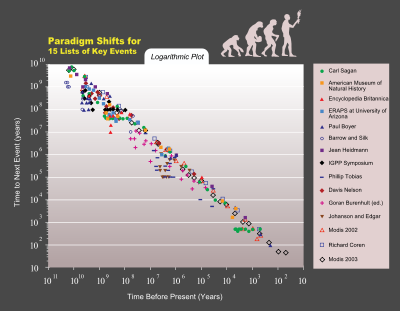
Ray Kurzweil's analysis of history concludes that technological progress follows a pattern of exponential growth
, following what he calls The Law of Accelerating Returns. He generalizes Moore's law, which describes geometric growth in integrated semiconductor complexity, to include technologies from far before the integrated circuit.
Whenever technology approaches a barrier, Kurzweil writes, new technologies will surmount it. He predicts paradigm shift
s will become increasingly common, leading to "technological change so rapid and profound it represents a rupture in the fabric of human history". Kurzweil believes that the singularity will occur before the end of the 21st century, setting the date at 2045 . His predictions differ from Vinge’s in that he predicts a gradual ascent to the singularity, rather than Vinge’s rapidly self-improving superhuman intelligence.
This leads to the conclusion that an artificial intelligence capable of improving on its own design is itself faced with a singularity. Self-augmentation or bootstrapping of intelligence is featured by Dan Simmons
in his novel Hyperion, where a collection of artificial intelligences debate whether or not to make themselves obsolete by creating a new generation of "ultimate" intelligence.
Presumably, a technological singularity would lead to rapid development of a Kardashev Type I civilization
, where a Kardashev Type I civilization is one that has achieved mastery of the resources of its home planet, Type II of its planetary system
, and Type III of its galaxy
.
Oft-cited dangers include those commonly associated with molecular nanotechnology
and genetic engineering
. These threats are major issues for both singularity advocates and critics, and were the subject of Bill Joy
's Wired
magazine article "Why the future doesn't need us
".
The Acceleration Studies Foundation
, an educational non-profit foundation founded by John Smart
, engages in outreach, education, research and advocacy concerning accelerating change. It produces the Accelerating Change conference at Stanford University, and maintains the educational site Acceleration Watch.
stated in 2008:
Some critics assert that no computer or machine will ever achieve human intelligence, while others hold that the definition of intelligence is irrelevant if the net result is the same.
Martin Ford in The Lights in the Tunnel: Automation, Accelerating Technology and the Economy of the Future postulates a "technology paradox" in that before the Singularity could occur, most routine jobs in the economy would be automated since this would require a level of technology inferior to that of the Singularity. This would cause massive unemployment and plummeting consumer demand—which in turn would destroy the incentive to invest in the technologies that would be required to bring about the Singularity. Job displacement is increasingly no longer limited to work traditionally considered to be "routine."
Jared Diamond
in Collapse: How Societies Choose to Fail or Succeed shows that cultures self-limit when they exceed the sustainable carrying capacity of their environment, and the consumption of strategic resources (frequently timber, soils or water) creates a deleterious positive feedback loop that leads eventually to social collapse and technological retrogression.
and Jonathan Huebner
argue that the rate of technological innovation has not only ceased to rise, but is actually now declining (John Smart
, however, criticizes Huebner's analysis.) Some evidence for this decline is that the rise in computer clock rate
s is slowing, even while Moore's prediction of exponentially increasing circuit density continues to hold. This is due to excessive heat build-up from the chip, which cannot be dissipated quickly enough to prevent the chip from melting when operating at higher speeds. Advancements in speed may be possible in the future by virtue of more power-efficient CPU designs and multi-cell processors. While Kurzweil used Modis' resources, and Modis' work was around accelerating change, Modis' distanced himself from Kurzweil's thesis of there being a "technological singularity", claiming that it lacks scientific rigor.
Others propose that other "singularities" can be found through analysis of trends in world population
, world gross domestic product
, and other indices. Andrey Korotayev
and others argue that historical hyperbolic growth
curves can be attributed to feedback loops that ceased to affect global trends in the 1970s, and thus hyperbolic growth should not be expected in the future.
In The Progress of Computing, William Nordhaus
argued that, prior to 1940, computers followed the much slower growth of a traditional industrial economy, thus rejecting extrapolations of Moore's law to 19th-century computers. suggests differences in memory of recent and distant events create an illusion of accelerating change, and that such phenomena may be responsible for past apocalyptic predictions.
Andrew Kennedy, in his 2006 paper for the British Interplanetary Society
discussing change and the growth in space travel velocities, stated that although long-term overall growth is inevitable, it is small, embodying both ups and downs, and noted, "New technologies follow known laws of power use and information spread and are obliged to connect with what already exists. Remarkable theoretical discoveries, if they end up being used at all, play their part in maintaining the growth rate: they do not make its plotted curve... redundant." He stated that exponential growth is no predictor in itself, and illustrated this with examples such as quantum theory
. The quantum was conceived in 1900, and quantum theory was in existence and accepted approximately 25 years later. However, it took over 40 years for Richard Feynman
and others to produce meaningful numbers from the theory. Bethe
understood nuclear fusion in 1935, but 75 years later fusion reactors are still only used in experimental settings. Similarly, entanglement
was understood in 1935 but not at the point of being used in practice until the 21st century.
A study of patents per thousand persons shows that human creativity does not show accelerating returns, but in fact—as suggested by Joseph Tainter
in his seminal The Collapse of Complex Societies—a law of diminishing returns. The number of patents per thousand peaked in the period from 1850–1900, and has been declining since. The growth of complexity eventually becomes self-limiting, and leads to a wide spread "general systems collapse". Thomas Homer Dixon in The Upside of Down: Catastrophe, Creativity and the Renewal of Civilization
maintains that the declining energy returns on investment has led to the collapse of civilizations.
In addition to general criticisms of the singularity concept, several critics have raised issues with Kurzweil's iconic chart. One line of criticism is that a log-log chart of this nature is inherently biased toward a straight-line result. Others identify selection bias in the points that Kurzweil chooses to use. For example, biologist PZ Myers
points out that many of the early evolutionary "events" were picked arbitrarily. Kurzweil has rebutted this by charting evolutionary events from 15 neutral sources, and showing that they fit a straight line on a log-log chart.
The Economist
mocked the concept with a graph extrapolating that the number of blades on a razor, which has increased over the years from one to as many as five, will increase ever-faster to infinity.
's 1950 story The Evitable Conflict
, (the last part of the I, Robot
collection) features the Machines, four supercomputers managing the world's economy. The computers are incomprehensible to humans and are impossible to analyze for errors, having been created through 10 stages of bootstrapping
. In the end of the story, it is implied that from now on (it occurs in 2052), no major conflict can occur, and the Machines are going to guide the humanity toward a better future, one only they are capable of seeing (and know to truly be the best). Susan Calvin
states that "For all time, all conflicts are finally evitable. Only the Machines, from now on, are inevitable!”
James P. Hogan
's 1979 novel The Two Faces of Tomorrow is an explicit description of what is now called the Singularity. An artificial intelligence system solves an excavation problem on the moon in a brilliant and novel way, but nearly kills a work crew in the process. Realizing that systems are becoming too sophisticated and complex to predict or manage, a scientific team sets out to teach a sophisticated computer network how to think more humanly. The story documents the rise of self-awareness in the computer system, the humans' loss of control and failed attempts to shut down the experiment as the computer desperately defends itself, and the computer intelligence reaching maturity.
While discussing the singularity's growing recognition, Vernor writes that "it was the science-fiction writers who felt the first concrete impact." In addition to his own short story "Bookworm, Run!", whose protagonist is a chimpanzee with intelligence augmented by a government experiment, he cites Greg Bear
's novel Blood Music (1983) as an example of the singularity in fiction. Vinge described surviving the singularity in his 1986 novel Marooned in Realtime
. Vinge later expanded the notion of the singularity to a galactic scale in A Fire Upon the Deep (1992), a novel populated by transcendent beings, each the product of a different race and possessed of distinct agendas and overwhelming power.
In William Gibson
's 1984 novel Neuromancer
, artificial intelligences capable of improving their own programs are strictly regulated by special "Turing police" to ensure they never exceed a certain level of intelligence, and the plot centers on the efforts of one such AI to circumvent their control. The 1994 novel The Metamorphosis of Prime Intellect
features an AI that augments itself so quickly as to gain low-level control of all matter in the universe in a matter of hours.
William Gibson
and Bruce Sterling
's alternate history Steampunk
novel The Difference Engine
ends with a vision of the singularity occurring in 1991 with a superintelligent computer that has merged its mind with the inhabitants of London.
A more malevolent AI achieves similar levels of omnipotence in Harlan Ellison
's short story I Have No Mouth, and I Must Scream (1967).
William Thomas Quick
's novels Dreams of Flesh and Sand (1988), Dreams of Gods and Men (1989), and Singularities (1990) present an account of the transition through the singularity; in the latter novel, one of the characters states that mankind's survival requires it to integrate with the emerging machine intelligences, or it will be crushed under the dominance of the machines – the greatest risk to the survival of a species reaching this point (and alluding to large numbers of other species that either survived or failed this test, although no actual contact with alien species occurs in the novels).
The singularity is sometimes addressed in fictional works to explain the event's absence. Neal Asher
's Gridlinked
series features a future where humans living in the Polity are governed by AIs and while some are resentful, most believe that they are far better governors than any human. In the fourth novel, Polity Agent
, it is mentioned that the singularity is far overdue yet most AIs have decided not to partake in it for reasons that only they know. A flashback character in Ken MacLeod
's 1998 novel The Cassini Division dismissively refers to the singularity as "the Rapture
for nerds", though the singularity goes on to happen anyway.
Popular movies in which computers become intelligent and violently overpower the human race include Colossus: The Forbin Project
, the Terminator
series, the very loose film adaptation of I, Robot
, and The Matrix series. The television series Battlestar Galactica
also explores these themes.
Isaac Asimov
expressed ideas similar to a post-Kurzweilian singularity in his short story The Last Question
. Asimov's future envisions a reality where a combination of strong artificial intelligence and post-humans consume the cosmos, during a time Kurzweil describes as when "the universe wakes up", the last of his six stages of cosmic evolution as described in The Singularity is Near
. Post-human entities throughout various time periods of the story inquire of the artificial intelligence within the story as to how entropy death
will be avoided. The AI responds that it lacks sufficient information to come to a conclusion, until the end of the story when the AI does indeed arrive at a solution. Notably, it does so in order to fulfill its duty
to answer the humans' question.
St. Edward's University
chemist Eamonn Healy
discusses accelerating change in the film Waking Life
. He divides history into increasingly shorter periods, estimating "two billion years for life, six million years for the hominid, a hundred-thousand years for mankind as we know it". He proceeds to human cultural evolution, giving time scales of ten thousand years for agriculture, four hundred years for the scientific revolution, and one hundred fifty years for the industrial revolution. Information is emphasized as providing the basis for the new evolutionary paradigm, with artificial intelligence its culmination. He concludes we will eventually create "neohumans" which will usurp humanity’s present role in scientific and technological progress and allow the exponential trend of accelerating change to continue past the limits of human ability.
Accelerating progress features in some science fiction works, and is a central theme in Charles Stross
's Accelerando. Other notable authors that address singularity-related issues include Karl Schroeder
, Greg Egan
, Ken MacLeod
, Rudy Rucker
, David Brin
, Iain M. Banks, Neal Stephenson
, Tony Ballantyne
, Bruce Sterling
, Dan Simmons
, Damien Broderick
, Fredric Brown
, Jacek Dukaj
, Stanislav Lem, Nagaru Tanigawa
, Douglas Adams
and Ian McDonald
.
The feature-length documentary film Transcendent Man
by Barry Ptolemy
is based on Ray Kurzweil and his book The Singularity Is Near. The film documents Kurzweil's quest to reveal what he believes to be mankind's destiny. Another documentary, Plug & Pray
, focuses on the promise, problems and ethics of artificial intelligence and robotics, with Joseph Weizenbaum
and Raymond Kurzweil
as the main subjects of the film.
In 2009, scientists at Aberystwyth University in Wales and the U.K's University of Cambridge designed a robot called Adam that they believe to be the first machine to independently discover new scientific findings. Also in 2009, researchers at Cornell developed a computer program that extrapolated the laws of motion from a pendulum's swings.
The web comic Dresden Codak
deals with trans-humanistic themes and the singularity.
The plot of an episode of the TV program The Big Bang Theory
(season 4, episode 2, "The Cruciferous Vegetable Amplification") revolves around the anticipated date of the coming Singularity.
The seventeenth episode of the sixth season of the TV sitcom Futurama, Benderama references Bender reaching the technological singularity and being able to infinitely produce smaller versions of himself to wreak havoc on the world.
Industrial
/Steampunk
entertainer Doctor Steel
weaves the concept of a technological singularity into his music and videos, even having a song entitled The Singularity. He has been interviewed on his views by the Institute for Ethics and Emerging Technologies
, and has also authored a paper on the subject.
Event horizon
In general relativity, an event horizon is a boundary in spacetime beyond which events cannot affect an outside observer. In layman's terms it is defined as "the point of no return" i.e. the point at which the gravitational pull becomes so great as to make escape impossible. The most common case...
, beyond which the future becomes difficult to understand or predict. Nevertheless, proponents of the singularity typically anticipate such an event to precede an "intelligence explosion", wherein superintelligences design successive generations of increasingly powerful minds.
The term was coined by science fiction writer Vernor Vinge
Vernor Vinge
Vernor Steffen Vinge is a retired San Diego State University Professor of Mathematics, computer scientist, and science fiction author. He is best known for his Hugo Award-winning novels and novellas A Fire Upon the Deep , A Deepness in the Sky , Rainbows End , Fast Times at Fairmont High ...
, who argues that artificial intelligence, human biological enhancement or brain-computer interfaces could be possible causes of the singularity. The concept is popularized by futurists like Ray Kurzweil and it is expected by proponents to occur sometime in the 21st century, although estimates do vary.
Basic concepts
Vernor Vinge
Vernor Steffen Vinge is a retired San Diego State University Professor of Mathematics, computer scientist, and science fiction author. He is best known for his Hugo Award-winning novels and novellas A Fire Upon the Deep , A Deepness in the Sky , Rainbows End , Fast Times at Fairmont High ...
and Ray Kurzweil, define the concept in terms of the technological creation of superintelligence
Superintelligence
A superintelligence, hyperintelligence or superhuman intelligence is a hypothetical entity which possesses intelligence surpassing that of any existing human being...
, and argue that it is difficult or impossible for present-day humans to predict what a post-singularity world would be like, due to the difficulty of imagining the intentions and capabilities of superintelligent entities. The term "technological singularity" was originally coined by Vinge, who made an analogy between the breakdown in our ability to predict what would happen after the development of superintelligence and the breakdown of the predictive ability of modern physics
Physics
Physics is a natural science that involves the study of matter and its motion through spacetime, along with related concepts such as energy and force. More broadly, it is the general analysis of nature, conducted in order to understand how the universe behaves.Physics is one of the oldest academic...
at the space-time singularity
Gravitational singularity
A gravitational singularity or spacetime singularity is a location where the quantities that are used to measure the gravitational field become infinite in a way that does not depend on the coordinate system...
beyond the event horizon
Event horizon
In general relativity, an event horizon is a boundary in spacetime beyond which events cannot affect an outside observer. In layman's terms it is defined as "the point of no return" i.e. the point at which the gravitational pull becomes so great as to make escape impossible. The most common case...
of a black hole
Black hole
A black hole is a region of spacetime from which nothing, not even light, can escape. The theory of general relativity predicts that a sufficiently compact mass will deform spacetime to form a black hole. Around a black hole there is a mathematically defined surface called an event horizon that...
. Some writers use "the singularity" in a broader way to refer to any radical changes in our society brought about by new technologies such as molecular nanotechnology
Molecular nanotechnology
Molecular nanotechnology is a technology based on the ability to build structures to complex, atomic specifications by means of mechanosynthesis. This is distinct from nanoscale materials...
, although Vinge and other prominent writers specifically state that without superintelligence, such changes would not qualify as a true singularity. Many writers also tie the singularity to observations of exponential growth in various technologies (with Moore's Law
Moore's Law
Moore's law describes a long-term trend in the history of computing hardware: the number of transistors that can be placed inexpensively on an integrated circuit doubles approximately every two years....
being the most prominent example), using such observations as a basis for predicting that the singularity is likely to happen sometime within the 21st century.
A technological singularity includes the concept of an intelligence explosion, a term coined in 1965 by I. J. Good
I. J. Good
Irving John Good was a British mathematician who worked as a cryptologist at Bletchley Park with Alan Turing. After World War II, Good continued to work with Turing on the design of computers and Bayesian statistics at the University of Manchester...
. Although technological progress has been accelerating, it has been limited by the basic intelligence of the human brain, which has not, according to Paul R. Ehrlich
Paul R. Ehrlich
Paul Ralph Ehrlich is an American biologist and educator who is the Bing Professor of Population Studies in the department of Biological Sciences at Stanford University and president of Stanford's Center for Conservation Biology. By training he is an entomologist specializing in Lepidoptera , but...
, changed significantly for millennia. However with the increasing power of computers and other technologies, it might eventually be possible to build a machine that is more intelligent than humanity. If superhuman intelligences were invented, either through the amplification of human intelligence
Intelligence amplification
Intelligence amplification refers to the effective use of information technology in augmenting human intelligence...
or artificial intelligence
Artificial intelligence
Artificial intelligence is the intelligence of machines and the branch of computer science that aims to create it. AI textbooks define the field as "the study and design of intelligent agents" where an intelligent agent is a system that perceives its environment and takes actions that maximize its...
, it would bring to bear greater problem-solving and inventive skills than humans, then it could design a yet more capable machine, or re-write its source code to become more intelligent. This more capable machine could then go on to design a machine of even greater capability. These iterations could accelerate, leading to recursive self improvement
Seed AI
Seed AI is a hypothesized type of strong artificial intelligence capable of recursive self-improvement. Having improved itself it would become better at improving itself, potentially leading to an exponential increase in intelligence...
, potentially allowing enormous qualitative change before any upper limits imposed by the laws of physics or theoretical computation set in.
The exponential growth in computing technology suggested by Moore's Law
Moore's Law
Moore's law describes a long-term trend in the history of computing hardware: the number of transistors that can be placed inexpensively on an integrated circuit doubles approximately every two years....
is commonly cited as a reason to expect a singularity in the relatively near future, and a number of authors have proposed generalizations of Moore's Law. Computer scientist and futurist Hans Moravec
Hans Moravec
Hans Moravec is an adjunct faculty member at the Robotics Institute of Carnegie Mellon University. He is known for his work on robotics, artificial intelligence, and writings on the impact of technology. Moravec also is a futurist with many of his publications and predictions focusing on...
proposed in a 1998 book that the exponential growth curve could be extended back through earlier computing technologies prior to the integrated circuit
Integrated circuit
An integrated circuit or monolithic integrated circuit is an electronic circuit manufactured by the patterned diffusion of trace elements into the surface of a thin substrate of semiconductor material...
. Futurist Ray Kurzweil postulates a law of accelerating returns in which the speed of technological change (and more generally, all evolutionary processes) increases exponentially, generalizing Moore's Law in the same manner as Moravec's proposal, and also including material technology (especially as applied to nanotechnology
Nanotechnology
Nanotechnology is the study of manipulating matter on an atomic and molecular scale. Generally, nanotechnology deals with developing materials, devices, or other structures possessing at least one dimension sized from 1 to 100 nanometres...
), medical technology and others. Like other authors, though, he reserves the term "Singularity" for a rapid increase in intelligence (as opposed to other technologies), writing for example that "The Singularity will allow us to transcend these limitations of our biological bodies and brains ... There will be no distinction, post-Singularity, between human and machine". He also defines his predicted date of the singularity (2045) in terms of when he expects computer-based intelligences to significantly exceed the sum total of human brainpower, writing that advances in computing before that date "will not represent the Singularity" because they do "not yet correspond to a profound expansion of our intelligence."
The term "technological singularity" reflects the idea that such change may happen suddenly, and that it is difficult to predict how such a new world would operate. It is unclear whether an intelligence explosion of this kind would be beneficial or harmful, or even an existential threat
Existential risk
Existential risks are dangers that have the potential to destroy, or drastically restrict, human civilization. They are distinguished from other forms of risk both by their scope, affecting all of humanity, and severity; destroying or irreversibly crippling the target.Natural disasters, such as...
, as the issue has not been dealt with by most artificial general intelligence researchers, although the topic of friendly artificial intelligence is investigated by the Singularity Institute for Artificial Intelligence and the Future of Humanity Institute
Future of Humanity Institute
The Future of Humanity Institute is part of the Faculty of Philosophy and the James Martin 21st Century School at University of Oxford, England...
.
Many prominent technologists and academics dispute the plausibility of a technological singularity, including Jeff Hawkins
Jeff Hawkins
Jeffrey Hawkins is the founder of Palm Computing and Handspring...
, John Holland
John Henry Holland
John Henry Holland is an American scientist and Professor of Psychology and Professor of Electrical Engineering and Computer Science at the University of Michigan, Ann Arbor. He is a pioneer in complex systems and nonlinear science. He is known as the father of genetic algorithms. He was awarded...
, Jaron Lanier
Jaron Lanier
Jaron Zepel Lanier is an American computer scientist, best known for popularizing the term virtual reality .A pioneer in the field of VR, Lanier and Thomas G. Zimmerman left Atari in 1985 to found VPL Research, Inc., the first company to sell VR goggles and gloves...
, and Gordon Moore
Gordon Moore
Gordon Earle Moore is the co-founder and Chairman Emeritus of Intel Corporation and the author of Moore's Law .-Life and career:...
, whose Moore's Law
Moore's Law
Moore's law describes a long-term trend in the history of computing hardware: the number of transistors that can be placed inexpensively on an integrated circuit doubles approximately every two years....
is often cited in support of the concept.
History of the idea
In 1847, R. Thornton, the editor of the Primitive Expounder, wrote (more than half in jest) about the recent invention of a four function mechanical calculatorMechanical calculator
A mechanical calculator is a device used to perform the basic operations of arithmetic. Mechanical calculators are comparable in size to small desktop computers and have been rendered obsolete by the advent of the electronic calculator....
:
In 1951 Alan Turing
Alan Turing
Alan Mathison Turing, OBE, FRS , was an English mathematician, logician, cryptanalyst, and computer scientist. He was highly influential in the development of computer science, providing a formalisation of the concepts of "algorithm" and "computation" with the Turing machine, which played a...
spoke of machines outstripping humans intellectually:
In 1958, Stanisław Ulam wrote in reference to a conversation with John von Neumann
John von Neumann
John von Neumann was a Hungarian-American mathematician and polymath who made major contributions to a vast number of fields, including set theory, functional analysis, quantum mechanics, ergodic theory, geometry, fluid dynamics, economics and game theory, computer science, numerical analysis,...
:
In 1965, I. J. Good
I. J. Good
Irving John Good was a British mathematician who worked as a cryptologist at Bletchley Park with Alan Turing. After World War II, Good continued to work with Turing on the design of computers and Bayesian statistics at the University of Manchester...
first wrote of an "intelligence explosion", suggesting that if machines could even slightly surpass human intellect, they could improve their own designs in ways unforeseen by their designers, and thus recursively
Recursion
Recursion is the process of repeating items in a self-similar way. For instance, when the surfaces of two mirrors are exactly parallel with each other the nested images that occur are a form of infinite recursion. The term has a variety of meanings specific to a variety of disciplines ranging from...
augment themselves into far greater intelligences. The first such improvements might be small, but as the machine became more intelligent it would become better at becoming more intelligent, which could lead to a cascade of self-improvements and a sudden surge to superintelligence
Superintelligence
A superintelligence, hyperintelligence or superhuman intelligence is a hypothetical entity which possesses intelligence surpassing that of any existing human being...
(or a singularity).
In 1983 mathematician and author Vernor Vinge
Vernor Vinge
Vernor Steffen Vinge is a retired San Diego State University Professor of Mathematics, computer scientist, and science fiction author. He is best known for his Hugo Award-winning novels and novellas A Fire Upon the Deep , A Deepness in the Sky , Rainbows End , Fast Times at Fairmont High ...
greatly popularized Good’s notion of an intelligence explosion in a number of writings, first addressing the topic in print in the January 1983 issue of Omni
Omni (magazine)
OMNI was a science and science fiction magazine published in the US and the UK. It contained articles on science fact and short works of science fiction...
magazine. In this op-ed piece, Vinge seems to have been the first to use the term "singularity" in a way that was specifically tied to the creation of intelligent machines, writing:
In 1985 Ray Solomonoff
Ray Solomonoff
Ray Solomonoff was the inventor of algorithmic probability, and founder of algorithmic information theory, He was an originator of the branch of artificial intelligence based on machine learning, prediction and probability...
introduced the notion of "infinity point" in the time scale of artificial intelligence, analyzed the magnitude of the "future shock
Future Shock
Future Shock is a book written by the futurist Alvin Toffler in 1970. In the book, Toffler defines the term "future shock" as a certain psychological state of individuals and entire societies. His shortest definition for the term is a personal perception of "too much change in too short a period of...
" that "we can expect from our AI expanded scientific community" and on social effects. Estimates were made "for when these milestones would occur, followed by some suggestions for the more effective utilization of the extremely rapid technological growth that is expected."
Vinge also popularized the concept in SF novels such as Marooned in Realtime
Marooned in Realtime
Marooned in Realtime is a 1986 murder mystery and time-travel science fiction novel by American writer Vernor Vinge, about a small, time-displaced group of people who may be the only survivors of a technological singularity or alien invasion. It is the sequel to The Peace War and "The Ungoverned"...
(1986) and A Fire Upon the Deep
A Fire Upon the Deep
A Fire Upon the Deep is a science fiction novel by American writer Vernor Vinge, a space opera involving superhuman intelligences, aliens, variable physics, space battles, love, betrayal, genocide, and a conversation medium resembling Usenet...
(1992). The former is set in a world of rapidly accelerating change
Accelerating change
In futures studies and the history of technology, accelerating change is a perceived increase in the rate of technological progress throughout history, which may suggest faster and more profound change in the future...
leading to the emergence of more and more sophisticated technologies separated by shorter and shorter time intervals, until a point beyond human comprehension is reached. The latter starts with an imaginative description of the evolution of a superintelligence
Superintelligence
A superintelligence, hyperintelligence or superhuman intelligence is a hypothetical entity which possesses intelligence surpassing that of any existing human being...
passing through exponentially accelerating developmental stages ending in a transcendent
Transcendence (philosophy)
In philosophy, the adjective transcendental and the noun transcendence convey the basic ground concept from the word's literal meaning , of climbing or going beyond, albeit with varying connotations in its different historical and cultural stages...
, almost omnipotent power unfathomable by mere humans. It is also implied that the development does not stop at this level.
In his 1988 book Mind Children,
computer scientist and futurist Hans Moravec
Hans Moravec
Hans Moravec is an adjunct faculty member at the Robotics Institute of Carnegie Mellon University. He is known for his work on robotics, artificial intelligence, and writings on the impact of technology. Moravec also is a futurist with many of his publications and predictions focusing on...
generalizes Moore's law
Moore's Law
Moore's law describes a long-term trend in the history of computing hardware: the number of transistors that can be placed inexpensively on an integrated circuit doubles approximately every two years....
to make predictions about the future of artificial life. Moravec outlines a timeline and a scenario in this regard, in that the robots will evolve into a new series of artificial species, starting around 2030-2040.
In Robot: Mere Machine to Transcendent Mind, published in 1998, Moravec further considers the implications of evolving robot intelligence, generalizing Moore's law
Moore's Law
Moore's law describes a long-term trend in the history of computing hardware: the number of transistors that can be placed inexpensively on an integrated circuit doubles approximately every two years....
to technologies predating the integrated circuit
Integrated circuit
An integrated circuit or monolithic integrated circuit is an electronic circuit manufactured by the patterned diffusion of trace elements into the surface of a thin substrate of semiconductor material...
, and speculating about a coming "mind fire" of rapidly expanding superintelligence
Superintelligence
A superintelligence, hyperintelligence or superhuman intelligence is a hypothetical entity which possesses intelligence surpassing that of any existing human being...
, similar to Vinge's ideas.
A 1993 article by Vinge, "The Coming Technological Singularity: How to Survive in the Post-Human Era", was widely disseminated on the World Wide Web
World Wide Web
The World Wide Web is a system of interlinked hypertext documents accessed via the Internet...
and helped to popularize the idea. This article contains the oft-quoted statement, "Within thirty years, we will have the technological means to create superhuman intelligence. Shortly after, the human era will be ended." Vinge refines his estimate of the time scales involved, adding, "I'll be surprised if this event occurs before 2005 or after 2030."
Vinge continues by predicting that superhuman intelligences will be able to enhance their own minds faster than their human creators. "When greater-than-human intelligence drives progress," Vinge writes, "that progress will be much more rapid." This feedback loop of self-improving intelligence, he predicts, will cause large amounts of technological progress within a short period, and that the creation of superhuman intelligence represented a breakdown in humans' ability to model their future. His argument was that authors cannot write realistic characters who surpass the human intellect, as the thoughts of such an intellect would be beyond the ability of humans to express. Vinge named this event "the Singularity". In 1993, Vernor Vinge associated the Singularity more explicitly with I. J. Good's intelligence explosion, and tried to project the arrival time of artificial intelligence
Artificial intelligence
Artificial intelligence is the intelligence of machines and the branch of computer science that aims to create it. AI textbooks define the field as "the study and design of intelligent agents" where an intelligent agent is a system that perceives its environment and takes actions that maximize its...
(AI) using Moore's law
Moore's Law
Moore's law describes a long-term trend in the history of computing hardware: the number of transistors that can be placed inexpensively on an integrated circuit doubles approximately every two years....
, which thereafter came to be associated with the "Singularity" concept.
Damien Broderick
Damien Broderick
Damien Francis Broderick is an Australian science fiction and popular science writer. His science fiction novel The Judas Mandala is sometimes credited with the first appearance of the term "virtual reality," and his 1997 popular science book The Spike was the first to investigate the...
's popular science book The Spike (1997)
The Spike (1997)
The Spike is a 1997 book by Damien Broderick exploring the future of technology, and in particular the concept of the technological singularity....
was the first to investigate the technological Singularity in detail.
In 2000 Bill Joy
Bill Joy
William Nelson Joy , commonly known as Bill Joy, is an American computer scientist. Joy co-founded Sun Microsystems in 1982 along with Vinod Khosla, Scott McNealy and Andy Bechtolsheim, and served as chief scientist at the company until 2003...
, a promonent technologist, founder of Sun Microsystems
Sun Microsystems
Sun Microsystems, Inc. was a company that sold :computers, computer components, :computer software, and :information technology services. Sun was founded on February 24, 1982...
, voiced concern over the potential dangers of the Singularity.
In 2005, Ray Kurzweil published The Singularity is Near
The Singularity Is Near
The Singularity Is Near: When Humans Transcend Biology is a 2005 update of Raymond Kurzweil's 1999 book, The Age of Spiritual Machines and his 1990 book The Age of Intelligent Machines. In it, as in the two previous versions, Kurzweil attempts to give a glimpse of what awaits us in the near future...
, which brought the idea of the singularity to the popular media both through the book's accessibility and a publicity campaign that included an appearance on The Daily Show with Jon Stewart. The book stirred intense controversy, in part because Kurzweil's utopian predictions contrasted starkly with other, darker visions of the possibilities of the singularity. Kurzweil, his theories, and the controversies surrounding it were the subject of Barry Ptolemy
Barry Ptolemy
Robert Barry Ptolemy is an American film director, producer and writer. Ptolemy directed Transcendent Man a documentary film about futurist and inventor Ray Kurzweil.-Life:...
's documentary Transcendent Man
Transcendent Man (film)
Transcendent Man is a 2009 documentary film by American filmmaker Barry Ptolemy about inventor, futurist and author Ray Kurzweil and his predictions about the future of technology in his 2005 book, The Singularity is Near...
.
In 2007 Eliezer Yudkowsky
Eliezer Yudkowsky
Eliezer Shlomo Yudkowsky is an American artificial intelligence researcher concerned with the singularity and an advocate of friendly artificial intelligence, living in Redwood City, California.- Biography :...
suggested that many of the different definitions that have been assigned to singularity are mutually incompatible rather than mutually supporting. For example, Kurzweil extrapolates current technological trajectories past the arrival of self-improving AI or superhuman intelligence, which Yudkowsky argues represents a tension with both I. J. Good's proposed discontinuous upswing in intelligence and Vinge's thesis on unpredictability.
In 2008 Robin Hanson
Robin Hanson
Robin D. Hanson is an associate professor of economics at George Mason University and a research associate at the Future of Humanity Institute of Oxford University. He is known as an expert on idea futures, markets and was involved in the creation of the Foresight Exchange and DARPA's FutureMAP...
, taking "singularity" to refer to sharp increases in the exponent of economic growth, lists the agricultural
Neolithic Revolution
The Neolithic Revolution was the first agricultural revolution. It was the transition from hunting and gathering to agriculture and settlement. Archaeological data indicates that various forms of plants and animal domestication evolved independently in 6 separate locations worldwide circa...
and industrial revolution
Industrial Revolution
The Industrial Revolution was a period from the 18th to the 19th century where major changes in agriculture, manufacturing, mining, transportation, and technology had a profound effect on the social, economic and cultural conditions of the times...
s as past "singularities". Extrapolating from such past events, Hanson proposes that the next economic singularity should increase economic growth
Economic growth
In economics, economic growth is defined as the increasing capacity of the economy to satisfy the wants of goods and services of the members of society. Economic growth is enabled by increases in productivity, which lowers the inputs for a given amount of output. Lowered costs increase demand...
between 60 and 250 times. An innovation that allowed for the replacement of virtually all human labor could trigger this event.
In 2009, Kurzweil and X-Prize founder Peter Diamandis
Peter Diamandis
Dr. Peter H. Diamandis , of Greek immigrant parents, is considered a key figure in the development of the personal spaceflight industry, having created many space-related businesses or organizations...
announced the establishment of Singularity University
Singularity University
Singularity University is an academic institution in Silicon Valley whose stated aim is to "assemble, educate and inspire a cadre of leaders who strive to understand and facilitate the development of exponentially advancing technologies and apply, focus and guide these tools to address humanity’s...
, whose stated mission is "to assemble, educate and inspire a cadre of leaders who strive to understand and facilitate the development of exponentially advancing technologies in order to address humanity’s grand challenges." Funded by Google
Google
Google Inc. is an American multinational public corporation invested in Internet search, cloud computing, and advertising technologies. Google hosts and develops a number of Internet-based services and products, and generates profit primarily from advertising through its AdWords program...
, Autodesk
Autodesk
Autodesk, Inc. is an American multinational corporation that focuses on 3D design software for use in the architecture, engineering, construction, manufacturing, media and entertainment industries. The company was founded in 1982 by John Walker, a coauthor of the first versions of the company's...
, ePlanet Ventures, and a group of technology industry leaders, Singularity University is based at NASA
NASA
The National Aeronautics and Space Administration is the agency of the United States government that is responsible for the nation's civilian space program and for aeronautics and aerospace research...
's Ames Research Center
NASA Ames Research Center
The Ames Research Center , is one of the United States of America's National Aeronautics and Space Administration 10 major field centers.The centre is located in Moffett Field in California's Silicon Valley, near the high-tech companies, entrepreneurial ventures, universities, and other...
in Mountain View
Mountain View, California
-Downtown:Mountain View has a pedestrian-friendly downtown centered on Castro Street. The downtown area consists of the seven blocks of Castro Street from the Downtown Mountain View Station transit center in the north to the intersection with El Camino Real in the south...
, California
California
California is a state located on the West Coast of the United States. It is by far the most populous U.S. state, and the third-largest by land area...
. The not-for-profit organization runs an annual ten-week graduate program during the summer that covers ten different technology and allied tracks, and a series of executive programs throughout the year. Program faculty include experts in technology, finance, and future studies, and a number of videos of Singularity University sessions have been posted online.
In 2010 Aubrey de Grey
Aubrey de Grey
Aubrey David Nicholas Jasper de Grey is an English author and theoretician in the field of gerontology, and the Chief Science Officer of the SENS Foundation. He is editor-in-chief of the academic journal Rejuvenation Research, author of The Mitochondrial Free Radical Theory of Aging and co-author...
applied the term the "Methuselarity" to the point at which medical technology improves so fast that expected human lifespan
Life expectancy
Life expectancy is the expected number of years of life remaining at a given age. It is denoted by ex, which means the average number of subsequent years of life for someone now aged x, according to a particular mortality experience...
increases by more than one year per year.
In 2010 in "Apocalyptic AI - Visions of Heaven in Robotics, Artificial Intelligence, and Virtual Reality," Robert Geraci offers an account of the developing "cyber-theology" inspired by Singularity studies.
In 2011, Kurzweil noted existing trends and said the singularity was becoming more probable to occur around 2045.
Intelligence explosion
The notion of an "intelligence explosion" is key to the singularity. It was first described thus by , who speculated on the effects of superhuman machines:Most proposed methods for creating superhuman or transhuman
Transhuman
Transhuman or trans-human is a term that has been defined and redefined many times in history. In its contemporary usage, “transhuman” refers to an intermediary form between the human and the hypothetical posthuman.-History of hypotheses:...
minds fall into one of two categories: intelligence amplification
Intelligence amplification
Intelligence amplification refers to the effective use of information technology in augmenting human intelligence...
of human brains and artificial intelligence
Artificial intelligence
Artificial intelligence is the intelligence of machines and the branch of computer science that aims to create it. AI textbooks define the field as "the study and design of intelligent agents" where an intelligent agent is a system that perceives its environment and takes actions that maximize its...
. The means speculated to produce intelligence augmentation are numerous, and include bio- and genetic engineering
Genetic engineering
Genetic engineering, also called genetic modification, is the direct human manipulation of an organism's genome using modern DNA technology. It involves the introduction of foreign DNA or synthetic genes into the organism of interest...
, nootropic
Nootropic
Nootropics , also referred to as smart drugs, brain steroids, memory enhancers, cognitive enhancers, and intelligence enhancers, are drugs, supplements, nutraceuticals, and functional foods that improve mental functions such as cognition, memory, intelligence, motivation, attention, and concentration...
drugs, AI assistants, direct brain-computer interface
Brain-computer interface
A brain–computer interface , sometimes called a direct neural interface or a brain–machine interface , is a direct communication pathway between the brain and an external device...
s, and mind uploading. The existence of multiple paths to an intelligence-explosion makes a singularity more likely; for a singularity to not occur they would all have to fail.
Despite the numerous speculated means for amplifying human intelligence, non-human artificial intelligence (specifically seed AI
Seed AI
Seed AI is a hypothesized type of strong artificial intelligence capable of recursive self-improvement. Having improved itself it would become better at improving itself, potentially leading to an exponential increase in intelligence...
) is the most popular option for organizations trying to advance the singularity. is also skeptical of human intelligence augmentation, writing that once one has exhausted the "low-hanging fruit" of easy methods for increasing human intelligence, further improvements will become increasingly difficult to find.
Whether or not an intelligence explosion occurs depends on three factors. The first, accelerating factor, is the new intelligence enhancements made possible by each previous improvement. Contrawise, as the intelligences become more advanced, further advances will become more and more complicated, possibly overcoming the advantage of increased intelligence. Each improvement must be able to beget at least one more improvement, on average, for the singularity to continue. Finally, there is the issue of a hard upper limit. Absent Quantum Computing, eventually the laws of physics will prevent any further improvements.
There are two logically independent, but mutually reinforcing, accelerating effects: increases in the speed of computation, and improvements to the algorithms used. The former is predicted by Moore’s Law and the forecast improvements in hardware, and is comparatively similar to previous technological advance. On the other hand, most AI researchers believe that software is more important than hardware.
Speed improvements
The first is the improvements to the speed at which minds can be run. Whether human or AI, better hardware increases the rate of future hardware improvements. Oversimplified, Moore's LawMoore's Law
Moore's law describes a long-term trend in the history of computing hardware: the number of transistors that can be placed inexpensively on an integrated circuit doubles approximately every two years....
suggests that if the first doubling of speed took 18 months, the second would take 18 subjective months; or 9 external months, whereafter, four months, two months, and so on towards a speed singularity. An upper limit on speed may eventually be reached, though it is unclear how high this would be.
, responding to Good, argued that the upper limit is relatively low;
Belief in this idea is based on a naive understanding of what intelligence is. As an analogy, imagine we had a computer that could design new computers (chips, systems, and software) faster than itself. Would such a computer lead to infinitely fast computers or even computers that were faster than anything humans could ever build? No. It might accelerate the rate of improvements for a while, but in the end there are limits to how big and fast computers can run. We would end up in the same place; we'd just get there a bit faster. There would be no singularity.
Whereas if it were a lot higher than current human levels of intelligence, the effects of the singularity would be enormous enough as to be indistinguishable (to humans) from a singularity with an upper limit. For example, if the speed of thought could be increased a million-fold, a subjective year would pass in 30 physical seconds.
It is difficult to directly compare silicon
Silicon
Silicon is a chemical element with the symbol Si and atomic number 14. A tetravalent metalloid, it is less reactive than its chemical analog carbon, the nonmetal directly above it in the periodic table, but more reactive than germanium, the metalloid directly below it in the table...
-based hardware with neuron
Neuron
A neuron is an electrically excitable cell that processes and transmits information by electrical and chemical signaling. Chemical signaling occurs via synapses, specialized connections with other cells. Neurons connect to each other to form networks. Neurons are the core components of the nervous...
s. But notes that computer speech recognition
Speech recognition
Speech recognition converts spoken words to text. The term "voice recognition" is sometimes used to refer to recognition systems that must be trained to a particular speaker—as is the case for most desktop recognition software...
is approaching human capabilities, and that this capability seems to require 0.01% of the volume of the brain. This analogy suggests that modern computer hardware is within a few orders of magnitude of being as powerful as the human brain.
Intelligence improvements
Some intelligence technologies, like seed AI, may also have the potential to make themselves more intelligent, not just faster, by modifying their source code. These improvements would make further improvements possible, which would make further improvements possible, and so on.This mechanism for an intelligence explosion differs from an increase in speed in two ways. First, it does not require external effect: machines designing faster hardware still require humans to create the improved hardware, or to program factories appropriately. An AI which was re-writing its own source code, however, could do so while contained in an AI box
AI box
An AI box is an isolated hardware system where an artificial intelligence is kept constrained inside a simulated world and not allowed to affect the external world. Such a box would have extremely proscribed inputs and outputs; maybe only a plaintext channel. However, a sufficient intelligent AI...
.
Second, as with Vernor Vinge’s conception of the singularity, it is much harder to predict the outcome. While speed increases seem to be only a quantitative difference from human intelligence, actual improvements in intelligence would be qualitatively different. Eliezer Yudkowsky
Eliezer Yudkowsky
Eliezer Shlomo Yudkowsky is an American artificial intelligence researcher concerned with the singularity and an advocate of friendly artificial intelligence, living in Redwood City, California.- Biography :...
compares it to the changes that human intelligence brought: humans changed the world thousands of times more rapidly than evolution had done so, and in totally different ways. Similarly, the evolution of life had been a massive departure and acceleration from the previous geological rates of change, and improved intelligence could cause change to be as different again.
There are substantial dangers associated with an intelligence explosion singularity. First, the goal structure of the AI may not be invariant under self-improvement, potentially causing the AI to optimise something other than was intended. Secondly, AIs could compete for the scarce resources mankind uses to survive.
While not actively malicious, there is no reason to think that AIs would actively promote human goals unless they could be programmed as such, and if not, might use the resources currently used to support mankind to promote its own goals, causing human extinction.
Impact
Dramatic changes in the rate of economic growth have occurred in the past because of some technological advancement. Based on population growth, the economy doubled every 250,000 years from the PaleolithicPaleolithic
The Paleolithic Age, Era or Period, is a prehistoric period of human history distinguished by the development of the most primitive stone tools discovered , and covers roughly 99% of human technological prehistory...
era until the Neolithic Revolution
Neolithic Revolution
The Neolithic Revolution was the first agricultural revolution. It was the transition from hunting and gathering to agriculture and settlement. Archaeological data indicates that various forms of plants and animal domestication evolved independently in 6 separate locations worldwide circa...
. This new agricultural economy began to double every 900 years, a remarkable increase. In the current era, beginning with the Industrial Revolution
Industrial Revolution
The Industrial Revolution was a period from the 18th to the 19th century where major changes in agriculture, manufacturing, mining, transportation, and technology had a profound effect on the social, economic and cultural conditions of the times...
, the world’s economic output doubles every fifteen years, sixty times faster than during the agricultural era. If the rise of superhuman intelligences causes a similar revolution, argues Robin Hanson
Robin Hanson
Robin D. Hanson is an associate professor of economics at George Mason University and a research associate at the Future of Humanity Institute of Oxford University. He is known as an expert on idea futures, markets and was involved in the creation of the Foresight Exchange and DARPA's FutureMAP...
, one would expect the economy to double at least quarterly and possibly on a weekly basis.
Existential risk
"The AI does not hate you, nor does it love you, but you are made out of atoms which it can use for something else." (Eliezer Yudkowsky)
Superhuman intelligences may have goals inconsistent with human survival and prosperity. notes that there is no direct evolutionary motivation for an AI to be friendly to humans. In the same way that evolution has no inherent tendency to produce outcomes valued by humans, so too there is little reason to expect an arbitrary optimisation process to promote an outcome desired by mankind, rather than inadvertently leading to an AI behaving in a way not intended by its creators (such as Nick Bostrom
Nick Bostrom
Nick Bostrom is a Swedish philosopher at the University of Oxford known for his work on existential risk and the anthropic principle. He holds a PhD from the London School of Economics...
's whimsical example of an AI which was originally programmed with the goal of manufacturing paper clips, such that when it achieves superintelligence it decides to convert the entire planet into a paper clip manufacturing facility; Anders Sandberg
Anders Sandberg
Anders Sandberg is a researcher, science debater, futurist, transhumanist, and author. He was born in Solna, Sweden. He holds a Ph.D...
has also elaborated on this scenario, addressing various common counter-arguments.)
AI researcher Hugo de Garis
Hugo de Garis
Hugo de Garis is a researcher in the sub-field of artificial intelligence known as evolvable hardware. He became known in the 1990s for his research on the use of genetic algorithms to evolve neural networks using three dimensional cellular automata inside field programmable gate arrays...
suggests that artificial intelligences may simply eliminate the human race for access to scarce resources, and humans would be powerless to stop them.
discusses human extinction scenarios, and lists superintelligence
Superintelligence
A superintelligence, hyperintelligence or superhuman intelligence is a hypothetical entity which possesses intelligence surpassing that of any existing human being...
as a possible cause:
When we create the first superintelligent entity, we might make a mistake and give it goals that lead it to annihilate humankind, assuming its enormous intellectual advantage gives it the power to do so. For example, we could mistakenly elevate a subgoal to the status of a supergoal. We tell it to solve a mathematical problem, and it complies by turning all the matter in the solar system into a giant calculating device, in the process killing the person who asked the question.
Alternatively, AIs developed under evolutionary pressure to promote their own survival could out-compete humanity. One approach to prevent a negative singularity is an AI box
AI box
An AI box is an isolated hardware system where an artificial intelligence is kept constrained inside a simulated world and not allowed to affect the external world. Such a box would have extremely proscribed inputs and outputs; maybe only a plaintext channel. However, a sufficient intelligent AI...
, whereby the artificial intelligence is kept constrained inside a simulated world and not allowed to affect the external world. Such a box would have extremely proscribed inputs and outputs; maybe only a plaintext channel. However, a sufficiently intelligent AI may simply be able to escape from any box we can create. For example, it might crack the protein folding problem and use nanotechnology to escape, or simply persuade its human 'keepers' to let it out.
Eliezer Yudkowsky
Eliezer Yudkowsky
Eliezer Shlomo Yudkowsky is an American artificial intelligence researcher concerned with the singularity and an advocate of friendly artificial intelligence, living in Redwood City, California.- Biography :...
proposed that research be undertaken to produce friendly artificial intelligence
Friendly artificial intelligence
A Friendly Artificial Intelligence or FAI is an artificial intelligence that has a positive rather than negative effect on humanity. Friendly AI also refers to the field of knowledge required to build such an AI...
in order to address the dangers. He noted that if the first real AI was friendly it would have a head start on self-improvement and thus prevent other unfriendly AIs from developing, as well as providing enormous benefits to mankind. The Singularity Institute for Artificial Intelligence is dedicated to this cause.
A significant problem, however, is that unfriendly artificial intelligence is likely to be much easier to create than FAI: while both require large advances in recursive optimisation process design, friendly AI also requires the ability to make goal structures invariant under self-improvement (or the AI will transform itself into something unfriendly) and a goal structure that aligns with human values and doesn’t automatically destroy the human race. An unfriendly AI, on the other hand, can optimize for an arbitrary goal structure, which doesn't need to be invariant under self-modification.
Bill Hibbard
Bill Hibbard
Bill Hibbard is a scientist at the University of Wisconsin–Madison Space Science and Engineering Center working on visualization and machine intelligence. He is principal author of the Vis5D, Cave5D and VisAD open source visualization systems. Vis5D was the first open source 3-D visualization...
also addresses issues of AI safety and morality in his book Super-Intelligent Machines.
Implications for human society
In 2009, leading computer scientists, artificial intelligence researchers, and roboticists met at the Asilomar Conference Grounds near Monterey BayMonterey Bay
Monterey Bay is a bay of the Pacific Ocean, along the central coast of California. The bay is south of San Francisco and San Jose, between the cities of Santa Cruz and Monterey....
in California. The goal was to discuss the potential impact of the hypothetical possibility that robots could become self-sufficient and able to make their own decisions. They discussed the extent to which computers and robots might be able to acquire autonomy, and to what degree they could use such abilities to pose threats or hazards. Some machines have acquired various forms of semi-autonomy, including the ability to locate their own power sources and choose targets to attack with weapons. Also, some computer viruses can evade elimination and have achieved "cockroach intelligence." The conference attendees noted that self-awareness as depicted in science-fiction is probably unlikely, but that other potential hazards and pitfalls exist.
Some experts and academics have questioned the use of robots for military combat, especially when such robots are given some degree of autonomous functions. A United States Navy
United States Navy
The United States Navy is the naval warfare service branch of the United States Armed Forces and one of the seven uniformed services of the United States. The U.S. Navy is the largest in the world; its battle fleet tonnage is greater than that of the next 13 largest navies combined. The U.S...
report indicates that, as military robots become more complex, there should be greater attention to implications of their ability to make autonomous decisions.
The Association for the Advancement of Artificial Intelligence
Association for the Advancement of Artificial Intelligence
The Association for the Advancement of Artificial Intelligence or AAAI is an international, nonprofit, scientific society devoted to advancing the scientific understanding of the mechanisms underlying thought and intelligent behavior and their embodiment in machines...
has commissioned a study to examine this issue, pointing to programs like the Language Acquisition Device
Language Acquisition Device (computer)
The Language Acquisition Device is a computer program developed by Lobal Technologies, a computer company in the United Kingdom, and scientists from King's College. It emulates the functions of the brain's frontal lobes where humans process language and emotion....
, which can emulate human interaction.
Many Singularitarians
Singularitarianism
Singularitarianism is a technocentric ideology and social movement defined by the belief that a technological singularity—the creation of a superintelligence—will likely happen in the medium future, and that deliberate action ought to be taken to ensure that the Singularity benefits...
consider nanotechnology to be one of the greatest dangers facing humanity. For this reason, they often believe that seed AI
Seed AI
Seed AI is a hypothesized type of strong artificial intelligence capable of recursive self-improvement. Having improved itself it would become better at improving itself, potentially leading to an exponential increase in intelligence...
(an AI capable of making itself smarter) should precede nanotechnology. Others, such as the Foresight Institute
Foresight Institute
The Foresight Institute is a Palo Alto, California-based nonprofit organization for promoting transformative technologies. They sponsor conferences on molecular nanotechnology, publish reports, and produce a newsletter....
, advocate the creation of molecular nanotechnology, which they claim can be made safe for pre-singularity use or expedite the arrival of a beneficial singularity.
Some support the design of "friendly artificial intelligence
Friendly artificial intelligence
A Friendly Artificial Intelligence or FAI is an artificial intelligence that has a positive rather than negative effect on humanity. Friendly AI also refers to the field of knowledge required to build such an AI...
", meaning that the advances which are already occurring with AI should also include an effort to make AI intrinsically friendly and humane.
Isaac Asimov
Isaac Asimov
Isaac Asimov was an American author and professor of biochemistry at Boston University, best known for his works of science fiction and for his popular science books. Asimov was one of the most prolific writers of all time, having written or edited more than 500 books and an estimated 90,000...
's Three Laws of Robotics
Three Laws of Robotics
The Three Laws of Robotics are a set of rules devised by the science fiction author Isaac Asimov and later added to. The rules are introduced in his 1942 short story "Runaround", although they were foreshadowed in a few earlier stories...
is one of the earliest examples of proposed safety measures for AI:
- A robot may not injure a human being or, through inaction, allow a human being to come to harm.
- A robot must obey orders given to it by human beings except where such orders would conflict with the First Law.
- A robot must protect its own existence as long as such protection does not conflict with either the First or Second Law.
Additional laws included in some stories were described as follows:
- Zeroth Law: A robot may not harm humanity, or through inaction allow humanity to come to harm.
- Minus-One Law: A robot may not harm sentience, or through inaction allow sentience to come to harm.
- Fourth Law: A robot must establish its identity as a robot in all cases.
- Alternate Fourth Law: A robot must reproduce, unless such reproduction would interfere with the First or Second or Third Law.
- Fifth Law: A robot must know it is a robot.
The laws are intended to prevent artificially intelligent robots from harming humans. In Asimov’s stories, any perceived problems with the laws tend to arise as a result of a misunderstanding on the part of some human operator; the robots themselves are merely acting to their best interpretation of their rules. In the 2004
2004 in film
The year 2004 in film involved some significant events. Major releases of sequels took place. It included blockbuster films like Shrek 2, Harry Potter and the Prisoner of Azkaban, The Passion of the Christ, Meet the Fockers, Blade: Trinity, Spider-Man 2, Alien vs. Predator, Kill Bill Vol...
film I, Robot
I, Robot (film)
I, Robot is a 2004 science-fiction action film directed by Alex Proyas. The screenplay was written by Jeff Vintar, Akiva Goldsman and Hillary Seitz, and is very loosely based on Isaac Asimov's short-story collection of the same name. Will Smith stars in the lead role of the film as Detective Del...
, loosely based on Asimov's Robot stories
Isaac Asimov's Robot Series
Isaac Asimov's Robot Series is a series of short stories and novels by Isaac Asimov featuring positronic robots.- Short stories :Most of Asimov's robot short stories are set in the first age of positronic robotics and space exploration...
, an AI attempts to take complete control over humanity for the purpose of protecting humanity from itself due to an extrapolation of the Three Laws. In 2004, the Singularity Institute launched an Internet campaign called 3 Laws Unsafe to raise awareness of AI safety issues and the inadequacy of Asimov’s laws in particular.
Accelerating change
John von Neumann
John von Neumann was a Hungarian-American mathematician and polymath who made major contributions to a vast number of fields, including set theory, functional analysis, quantum mechanics, ergodic theory, geometry, fluid dynamics, economics and game theory, computer science, numerical analysis,...
about accelerating change:
One conversation centered on the ever accelerating progress of technology and changes in the mode of human life, which gives the appearance of approaching some essential singularity in the history of the race beyond which human affairs, as we know them, could not continue.
writes that "mindsteps", dramatic and irreversible changes to paradigms or world views, are accelerating in frequency as quantified in his mindstep equation. He cites the inventions of writing, mathematics, and the computer as examples of such changes.
Ray Kurzweil's analysis of history concludes that technological progress follows a pattern of exponential growth
Exponential growth
Exponential growth occurs when the growth rate of a mathematical function is proportional to the function's current value...
, following what he calls The Law of Accelerating Returns. He generalizes Moore's law, which describes geometric growth in integrated semiconductor complexity, to include technologies from far before the integrated circuit.
Whenever technology approaches a barrier, Kurzweil writes, new technologies will surmount it. He predicts paradigm shift
Paradigm shift
A Paradigm shift is, according to Thomas Kuhn in his influential book The Structure of Scientific Revolutions , a change in the basic assumptions, or paradigms, within the ruling theory of science...
s will become increasingly common, leading to "technological change so rapid and profound it represents a rupture in the fabric of human history". Kurzweil believes that the singularity will occur before the end of the 21st century, setting the date at 2045 . His predictions differ from Vinge’s in that he predicts a gradual ascent to the singularity, rather than Vinge’s rapidly self-improving superhuman intelligence.
This leads to the conclusion that an artificial intelligence capable of improving on its own design is itself faced with a singularity. Self-augmentation or bootstrapping of intelligence is featured by Dan Simmons
Dan Simmons
Dan Simmons is an American author most widely known for his Hugo Award-winning science fiction series, known as the Hyperion Cantos, and for his Locus-winning Ilium/Olympos cycle....
in his novel Hyperion, where a collection of artificial intelligences debate whether or not to make themselves obsolete by creating a new generation of "ultimate" intelligence.
Presumably, a technological singularity would lead to rapid development of a Kardashev Type I civilization
Kardashev scale
The Kardashev scale is a method of measuring an advanced civilization's level of technological advancement. The scale is only theoretical and in terms of an actual civilization highly speculative; however, it puts energy consumption of an entire civilization in a cosmic perspective. It was first...
, where a Kardashev Type I civilization is one that has achieved mastery of the resources of its home planet, Type II of its planetary system
Planetary system
A planetary system consists of the various non-stellar objects orbiting a star such as planets, dwarf planets , asteroids, meteoroids, comets, and cosmic dust...
, and Type III of its galaxy
Galaxy
A galaxy is a massive, gravitationally bound system that consists of stars and stellar remnants, an interstellar medium of gas and dust, and an important but poorly understood component tentatively dubbed dark matter. The word galaxy is derived from the Greek galaxias , literally "milky", a...
.
Oft-cited dangers include those commonly associated with molecular nanotechnology
Molecular nanotechnology
Molecular nanotechnology is a technology based on the ability to build structures to complex, atomic specifications by means of mechanosynthesis. This is distinct from nanoscale materials...
and genetic engineering
Genetic engineering
Genetic engineering, also called genetic modification, is the direct human manipulation of an organism's genome using modern DNA technology. It involves the introduction of foreign DNA or synthetic genes into the organism of interest...
. These threats are major issues for both singularity advocates and critics, and were the subject of Bill Joy
Bill Joy
William Nelson Joy , commonly known as Bill Joy, is an American computer scientist. Joy co-founded Sun Microsystems in 1982 along with Vinod Khosla, Scott McNealy and Andy Bechtolsheim, and served as chief scientist at the company until 2003...
's Wired
Wired (magazine)
Wired is a full-color monthly American magazine and on-line periodical, published since January 1993, that reports on how new and developing technology affects culture, the economy, and politics...
magazine article "Why the future doesn't need us
Why the future doesn't need us
"Why the future doesn't need us" is an article written by Bill Joy in the April 2000 issue of Wired magazine...
".
The Acceleration Studies Foundation
Acceleration Studies Foundation
Acceleration Studies Foundation is a nonprofit organization founded by John Smart engaged in research, education, and selective advocacy of communities and technologies of accelerating change....
, an educational non-profit foundation founded by John Smart
John Smart (futurist)
John Smart is a futurist and scholar of accelerating change. He is founder and president of the Acceleration Studies Foundation, an organization that does “outreach, education, research, and advocacy with respect to issues of accelerating change.”. Smart has an MS in futures studies from the...
, engages in outreach, education, research and advocacy concerning accelerating change. It produces the Accelerating Change conference at Stanford University, and maintains the educational site Acceleration Watch.
Criticism
Steven PinkerSteven Pinker
Steven Arthur Pinker is a Canadian-American experimental psychologist, cognitive scientist, linguist and popular science author...
stated in 2008:
"(...) There is not the slightest reason to believe in a coming singularity. The fact that you can visualize a future in your imagination is not evidence that it is likely or even possible. Look at domed cities, jet-pack commuting, underwater cities, mile-high buildings, and nuclear-powered automobiles — all staples of futuristic fantasies when I was a child that have never arrived. Sheer processing power is not a pixie dust that magically solves all your problems. (...)"
Some critics assert that no computer or machine will ever achieve human intelligence, while others hold that the definition of intelligence is irrelevant if the net result is the same.
Martin Ford in The Lights in the Tunnel: Automation, Accelerating Technology and the Economy of the Future postulates a "technology paradox" in that before the Singularity could occur, most routine jobs in the economy would be automated since this would require a level of technology inferior to that of the Singularity. This would cause massive unemployment and plummeting consumer demand—which in turn would destroy the incentive to invest in the technologies that would be required to bring about the Singularity. Job displacement is increasingly no longer limited to work traditionally considered to be "routine."
Jared Diamond
Jared Diamond
Jared Mason Diamond is an American scientist and author whose work draws from a variety of fields. He is currently Professor of Geography and Physiology at UCLA...
in Collapse: How Societies Choose to Fail or Succeed shows that cultures self-limit when they exceed the sustainable carrying capacity of their environment, and the consumption of strategic resources (frequently timber, soils or water) creates a deleterious positive feedback loop that leads eventually to social collapse and technological retrogression.
Criticism of the accelerating returns argument
Theodore ModisTheodore Modis
Theodore Modis is a strategic business analyst, futurist, physicist, and international consultant.He went to Columbia University, New York, where he received a Masters in Electrical Engineering and a Ph.D. in physics...
and Jonathan Huebner
Jonathan Huebner
Jonathan Huebner is a physicist working at the Pentagon's Naval Air Warfare Center, in China Lake, California.-Views on innovation:He argues on the basis of both U.S. patents and world technological breakthroughs, per population, that the rate of human technological innovation peaked in 1873 and...
argue that the rate of technological innovation has not only ceased to rise, but is actually now declining (John Smart
John Smart (futurist)
John Smart is a futurist and scholar of accelerating change. He is founder and president of the Acceleration Studies Foundation, an organization that does “outreach, education, research, and advocacy with respect to issues of accelerating change.”. Smart has an MS in futures studies from the...
, however, criticizes Huebner's analysis.) Some evidence for this decline is that the rise in computer clock rate
Clock rate
The clock rate typically refers to the frequency that a CPU is running at.For example, a crystal oscillator frequency reference typically is synonymous with a fixed sinusoidal waveform, a clock rate is that frequency reference translated by electronic circuitry into a corresponding square wave...
s is slowing, even while Moore's prediction of exponentially increasing circuit density continues to hold. This is due to excessive heat build-up from the chip, which cannot be dissipated quickly enough to prevent the chip from melting when operating at higher speeds. Advancements in speed may be possible in the future by virtue of more power-efficient CPU designs and multi-cell processors. While Kurzweil used Modis' resources, and Modis' work was around accelerating change, Modis' distanced himself from Kurzweil's thesis of there being a "technological singularity", claiming that it lacks scientific rigor.
Others propose that other "singularities" can be found through analysis of trends in world population
World population
The world population is the total number of living humans on the planet Earth. As of today, it is estimated to be billion by the United States Census Bureau...
, world gross domestic product
Gross domestic product
Gross domestic product refers to the market value of all final goods and services produced within a country in a given period. GDP per capita is often considered an indicator of a country's standard of living....
, and other indices. Andrey Korotayev
Andrey Korotayev
Andrey Korotayev is an anthropologist, economic historian, and sociologist, with major contributions to world-systems theory, cross-cultural studies, Near Eastern history, and mathematical modeling of social and economic macrodynamics.Education and career=Born in Moscow, Andrey Korotayev attended...
and others argue that historical hyperbolic growth
Hyperbolic growth
When a quantity grows towards a singularity under a finite variation it is said to undergo hyperbolic growth.More precisely, the reciprocal function 1/x has a hyperbola as a graph, and has a singularity at 0, meaning that the limit as x \to 0 is infinity: any similar graph is said to exhibit...
curves can be attributed to feedback loops that ceased to affect global trends in the 1970s, and thus hyperbolic growth should not be expected in the future.
In The Progress of Computing, William Nordhaus
William Nordhaus
William Dawbney "Bill" Nordhaus is the Sterling Professor of Economics at Yale University. Nordhaus lives in New Haven, Connecticut, with his wife Barbara.-Career:...
argued that, prior to 1940, computers followed the much slower growth of a traditional industrial economy, thus rejecting extrapolations of Moore's law to 19th-century computers. suggests differences in memory of recent and distant events create an illusion of accelerating change, and that such phenomena may be responsible for past apocalyptic predictions.
Andrew Kennedy, in his 2006 paper for the British Interplanetary Society
British Interplanetary Society
The British Interplanetary Society founded in 1933 by Philip E. Cleator, is the oldest space advocacy organisation in the world whose aim is exclusively to support and promote astronautics and space exploration.-Structure:...
discussing change and the growth in space travel velocities, stated that although long-term overall growth is inevitable, it is small, embodying both ups and downs, and noted, "New technologies follow known laws of power use and information spread and are obliged to connect with what already exists. Remarkable theoretical discoveries, if they end up being used at all, play their part in maintaining the growth rate: they do not make its plotted curve... redundant." He stated that exponential growth is no predictor in itself, and illustrated this with examples such as quantum theory
Quantum mechanics
Quantum mechanics, also known as quantum physics or quantum theory, is a branch of physics providing a mathematical description of much of the dual particle-like and wave-like behavior and interactions of energy and matter. It departs from classical mechanics primarily at the atomic and subatomic...
. The quantum was conceived in 1900, and quantum theory was in existence and accepted approximately 25 years later. However, it took over 40 years for Richard Feynman
Richard Feynman
Richard Phillips Feynman was an American physicist known for his work in the path integral formulation of quantum mechanics, the theory of quantum electrodynamics and the physics of the superfluidity of supercooled liquid helium, as well as in particle physics...
and others to produce meaningful numbers from the theory. Bethe
Hans Bethe
Hans Albrecht Bethe was a German-American nuclear physicist, and Nobel laureate in physics for his work on the theory of stellar nucleosynthesis. A versatile theoretical physicist, Bethe also made important contributions to quantum electrodynamics, nuclear physics, solid-state physics and...
understood nuclear fusion in 1935, but 75 years later fusion reactors are still only used in experimental settings. Similarly, entanglement
Quantum entanglement
Quantum entanglement occurs when electrons, molecules even as large as "buckyballs", photons, etc., interact physically and then become separated; the type of interaction is such that each resulting member of a pair is properly described by the same quantum mechanical description , which is...
was understood in 1935 but not at the point of being used in practice until the 21st century.
A study of patents per thousand persons shows that human creativity does not show accelerating returns, but in fact—as suggested by Joseph Tainter
Joseph Tainter
Joseph A. Tainter is a U.S. anthropologist and historian.Tainter studied anthropology at the University of California and Northwestern University, where he received his Ph.D. in 1975. He is currently a professor in the Department of Environment and Society at Utah State University...
in his seminal The Collapse of Complex Societies—a law of diminishing returns. The number of patents per thousand peaked in the period from 1850–1900, and has been declining since. The growth of complexity eventually becomes self-limiting, and leads to a wide spread "general systems collapse". Thomas Homer Dixon in The Upside of Down: Catastrophe, Creativity and the Renewal of Civilization
The Upside of Down
The Upside of Down: Catastrophe, Creativity, and the Renewal of Civilization is a non-fiction book published in 2006 by Thomas Homer-Dixon, a professor at the University of Toronto....
maintains that the declining energy returns on investment has led to the collapse of civilizations.
In addition to general criticisms of the singularity concept, several critics have raised issues with Kurzweil's iconic chart. One line of criticism is that a log-log chart of this nature is inherently biased toward a straight-line result. Others identify selection bias in the points that Kurzweil chooses to use. For example, biologist PZ Myers
PZ Myers
Paul Zachary "PZ" Myers is an American biology professor at the University of Minnesota Morris and the author of the Pharyngula science blog. He is currently an associate professor of biology at UMM, works with zebrafish in the field of evolutionary developmental biology , and also cultivates an...
points out that many of the early evolutionary "events" were picked arbitrarily. Kurzweil has rebutted this by charting evolutionary events from 15 neutral sources, and showing that they fit a straight line on a log-log chart.
The Economist
The Economist
The Economist is an English-language weekly news and international affairs publication owned by The Economist Newspaper Ltd. and edited in offices in the City of Westminster, London, England. Continuous publication began under founder James Wilson in September 1843...
mocked the concept with a graph extrapolating that the number of blades on a razor, which has increased over the years from one to as many as five, will increase ever-faster to infinity.
In popular culture
Isaac AsimovIsaac Asimov
Isaac Asimov was an American author and professor of biochemistry at Boston University, best known for his works of science fiction and for his popular science books. Asimov was one of the most prolific writers of all time, having written or edited more than 500 books and an estimated 90,000...
's 1950 story The Evitable Conflict
The Evitable Conflict
The Evitable Conflict is a science fiction short story by Isaac Asimov. It first appeared in the June 1950 issue of Astounding Science Fiction and subsequently appeared in the collections I, Robot , The Complete Robot , and Robot Visions .-Plot summary:The "Machines", powerful positronic computers...
, (the last part of the I, Robot
I, Robot
I, Robot is a collection of nine science fiction short stories by Isaac Asimov, first published by Gnome Press in 1950 in an edition of 5,000 copies. The stories originally appeared in the American magazines Super Science Stories and Astounding Science Fiction between 1940 and 1950. The stories are...
collection) features the Machines, four supercomputers managing the world's economy. The computers are incomprehensible to humans and are impossible to analyze for errors, having been created through 10 stages of bootstrapping
Bootstrapping
Bootstrapping or booting refers to a group of metaphors that share a common meaning: a self-sustaining process that proceeds without external help....
. In the end of the story, it is implied that from now on (it occurs in 2052), no major conflict can occur, and the Machines are going to guide the humanity toward a better future, one only they are capable of seeing (and know to truly be the best). Susan Calvin
Susan Calvin
Dr. Susan Calvin is a fictional character from Isaac Asimov's Robot Series. She was the chief robopsychologist at US Robots and Mechanical Men, Inc., the major manufacturer of robots in the 21st century...
states that "For all time, all conflicts are finally evitable. Only the Machines, from now on, are inevitable!”
James P. Hogan
James P. Hogan (writer)
James Patrick Hogan was a British science fiction author.-Biography:Hogan was born in London, England. He was raised in the Portobello Road area on the west side of London...
's 1979 novel The Two Faces of Tomorrow is an explicit description of what is now called the Singularity. An artificial intelligence system solves an excavation problem on the moon in a brilliant and novel way, but nearly kills a work crew in the process. Realizing that systems are becoming too sophisticated and complex to predict or manage, a scientific team sets out to teach a sophisticated computer network how to think more humanly. The story documents the rise of self-awareness in the computer system, the humans' loss of control and failed attempts to shut down the experiment as the computer desperately defends itself, and the computer intelligence reaching maturity.
While discussing the singularity's growing recognition, Vernor writes that "it was the science-fiction writers who felt the first concrete impact." In addition to his own short story "Bookworm, Run!", whose protagonist is a chimpanzee with intelligence augmented by a government experiment, he cites Greg Bear
Greg Bear
Gregory Dale Bear is an American science fiction and mainstream author. His work has covered themes of galactic conflict , artificial universes , consciousness and cultural practices , and accelerated evolution...
's novel Blood Music (1983) as an example of the singularity in fiction. Vinge described surviving the singularity in his 1986 novel Marooned in Realtime
Marooned in Realtime
Marooned in Realtime is a 1986 murder mystery and time-travel science fiction novel by American writer Vernor Vinge, about a small, time-displaced group of people who may be the only survivors of a technological singularity or alien invasion. It is the sequel to The Peace War and "The Ungoverned"...
. Vinge later expanded the notion of the singularity to a galactic scale in A Fire Upon the Deep (1992), a novel populated by transcendent beings, each the product of a different race and possessed of distinct agendas and overwhelming power.
In William Gibson
William Gibson
William Gibson is an American-Canadian science fiction author.William Gibson may also refer to:-Association football:*Will Gibson , Scottish footballer...
's 1984 novel Neuromancer
Neuromancer
Neuromancer is a 1984 novel by William Gibson, a seminal work in the cyberpunk genre and the first winner of the science-fiction "triple crown" — the Nebula Award, the Philip K. Dick Award, and the Hugo Award. It was Gibson's debut novel and the beginning of the Sprawl trilogy...
, artificial intelligences capable of improving their own programs are strictly regulated by special "Turing police" to ensure they never exceed a certain level of intelligence, and the plot centers on the efforts of one such AI to circumvent their control. The 1994 novel The Metamorphosis of Prime Intellect
The Metamorphosis of Prime Intellect
The Metamorphosis of Prime Intellect is a 1994 novella by Roger Williams, a computer programmer living in New Orleans. It deals with the ramifications of a powerful, superintelligent supercomputer that discovers a method of rewriting the "BIOS" of reality while studying a little known quirk of...
features an AI that augments itself so quickly as to gain low-level control of all matter in the universe in a matter of hours.
William Gibson
William Gibson
William Gibson is an American-Canadian science fiction author.William Gibson may also refer to:-Association football:*Will Gibson , Scottish footballer...
and Bruce Sterling
Bruce Sterling
Michael Bruce Sterling is an American science fiction author, best known for his novels and his work on the Mirrorshades anthology, which helped define the cyberpunk genre.-Writings:...
's alternate history Steampunk
Steampunk
Steampunk is a sub-genre of science fiction, fantasy, alternate history, and speculative fiction that came into prominence during the 1980s and early 1990s. Steampunk involves a setting where steam power is still widely used—usually Victorian era Britain or "Wild West"-era United...
novel The Difference Engine
The Difference Engine
The Difference Engine is an alternate history novel by William Gibson and Bruce Sterling.It posits a Victorian Britain in which great technological and social change has occurred after entrepreneurial inventor Charles Babbage succeeded in his ambition to build a mechanical computer .The novel was...
ends with a vision of the singularity occurring in 1991 with a superintelligent computer that has merged its mind with the inhabitants of London.
A more malevolent AI achieves similar levels of omnipotence in Harlan Ellison
Harlan Ellison
Harlan Jay Ellison is an American writer. His principal genre is speculative fiction.His published works include over 1,700 short stories, novellas, screenplays, teleplays, essays, a wide range of criticism covering literature, film, television, and print media...
's short story I Have No Mouth, and I Must Scream (1967).
William Thomas Quick
William Thomas Quick
William Thomas "Bill" Quick, who sometimes writes under the pseudonym Margaret Allan, is a science fiction author and self-described libertarian conservative blogger...
's novels Dreams of Flesh and Sand (1988), Dreams of Gods and Men (1989), and Singularities (1990) present an account of the transition through the singularity; in the latter novel, one of the characters states that mankind's survival requires it to integrate with the emerging machine intelligences, or it will be crushed under the dominance of the machines – the greatest risk to the survival of a species reaching this point (and alluding to large numbers of other species that either survived or failed this test, although no actual contact with alien species occurs in the novels).
The singularity is sometimes addressed in fictional works to explain the event's absence. Neal Asher
Neal Asher
Neal Asher is an English science fiction writer. Both his parents are educators and science fiction fans. Although he began writing Science Fiction and Fantasy in secondary school, Asher did not turn seriously to writing till he was 25...
's Gridlinked
Gridlinked
Gridlinked is Neal Asher's first novel, published by the Macmillan Publishers imprint Pan Books in 2001. It contains elements of the technological inventiveness of hard science-fiction with a more contemporary political plotline...
series features a future where humans living in the Polity are governed by AIs and while some are resentful, most believe that they are far better governors than any human. In the fourth novel, Polity Agent
Polity Agent
Polity Agent is a 2006 science fiction novel by Neal Asher. It is the fourth novel in the Gridlinked sequence....
, it is mentioned that the singularity is far overdue yet most AIs have decided not to partake in it for reasons that only they know. A flashback character in Ken MacLeod
Ken MacLeod
Ken MacLeod , is a Scottish science fiction writer.MacLeod was born in Stornoway. He graduated from Glasgow University with a degree in zoology and has worked as a computer programmer and written a masters thesis on biomechanics....
's 1998 novel The Cassini Division dismissively refers to the singularity as "the Rapture
Rapture
The rapture is a reference to the "being caught up" referred to in 1 Thessalonians 4:17, when the "dead in Christ" and "we who are alive and remain" will be caught up in the clouds to meet "the Lord"....
for nerds", though the singularity goes on to happen anyway.
Popular movies in which computers become intelligent and violently overpower the human race include Colossus: The Forbin Project
Colossus: The Forbin Project
Colossus: The Forbin Project is an American science fiction thriller film. It is based upon the 1966 novel Colossus, by Dennis Feltham Jones, about a massive American defense computer, named Colossus, becoming sentient and deciding to assume control of the world.-Plot:Dr. Charles A...
, the Terminator
Terminator (franchise)
The Terminator series is a science fiction franchise encompassing a series of films and other media concerning battles between Skynet's artificially intelligent machine network, and John Connor's Resistance forces and the rest of the human race....
series, the very loose film adaptation of I, Robot
I, Robot (film)
I, Robot is a 2004 science-fiction action film directed by Alex Proyas. The screenplay was written by Jeff Vintar, Akiva Goldsman and Hillary Seitz, and is very loosely based on Isaac Asimov's short-story collection of the same name. Will Smith stars in the lead role of the film as Detective Del...
, and The Matrix series. The television series Battlestar Galactica
Battlestar Galactica (2004 TV series)
Battlestar Galactica is an American military science fiction television series, and part of the Battlestar Galactica franchise. The show was developed by Ronald D. Moore as a re-imagining of the 1978 Battlestar Galactica television series created by Glen A. Larson...
also explores these themes.
Isaac Asimov
Isaac Asimov
Isaac Asimov was an American author and professor of biochemistry at Boston University, best known for his works of science fiction and for his popular science books. Asimov was one of the most prolific writers of all time, having written or edited more than 500 books and an estimated 90,000...
expressed ideas similar to a post-Kurzweilian singularity in his short story The Last Question
The Last Question
"The Last Question" is a science fiction short story by Isaac Asimov. It first appeared in the November 1956 issue of Science Fiction Quarterly and was reprinted in the collections Nine Tomorrows , The Best of Isaac Asimov , Robot Dreams , the retrospective Opus 100 , and in Isaac Asimov: The...
. Asimov's future envisions a reality where a combination of strong artificial intelligence and post-humans consume the cosmos, during a time Kurzweil describes as when "the universe wakes up", the last of his six stages of cosmic evolution as described in The Singularity is Near
The Singularity Is Near
The Singularity Is Near: When Humans Transcend Biology is a 2005 update of Raymond Kurzweil's 1999 book, The Age of Spiritual Machines and his 1990 book The Age of Intelligent Machines. In it, as in the two previous versions, Kurzweil attempts to give a glimpse of what awaits us in the near future...
. Post-human entities throughout various time periods of the story inquire of the artificial intelligence within the story as to how entropy death
Heat death of the universe
The heat death of the universe is a suggested ultimate fate of the universe, in which the universe has diminished to a state of no thermodynamic free energy and therefore can no longer sustain motion or life. Heat death does not imply any particular absolute temperature; it only requires that...
will be avoided. The AI responds that it lacks sufficient information to come to a conclusion, until the end of the story when the AI does indeed arrive at a solution. Notably, it does so in order to fulfill its duty
Three Laws of Robotics
The Three Laws of Robotics are a set of rules devised by the science fiction author Isaac Asimov and later added to. The rules are introduced in his 1942 short story "Runaround", although they were foreshadowed in a few earlier stories...
to answer the humans' question.
St. Edward's University
St. Edward's University
St. Edward's University is a private Roman Catholic institution of higher learning located south of Lady Bird Lake in Austin, Texas. The university offers a liberal arts education and its campus is located on a hill overlooking the city of Austin. The campus's most notable landmark is Main...
chemist Eamonn Healy
Eamonn Healy
Dr. Eamonn F. Healy is a professor of chemistry at St. Edward's University in Austin, Texas, where his research focuses on the design of structure-activity probes to elucidate enzymatic activity. Targets include HIV-1 integrase, the c-Kit and src-abl proteins, and the metalloproteinases associated...
discusses accelerating change in the film Waking Life
Waking Life
Waking Life is an American animated film , directed by Richard Linklater and released in 2001. The entire film was shot using digital video and then a team of artists using computers drew stylized lines and colors over each frame.The film focuses on the nature of dreams, consciousness, and...
. He divides history into increasingly shorter periods, estimating "two billion years for life, six million years for the hominid, a hundred-thousand years for mankind as we know it". He proceeds to human cultural evolution, giving time scales of ten thousand years for agriculture, four hundred years for the scientific revolution, and one hundred fifty years for the industrial revolution. Information is emphasized as providing the basis for the new evolutionary paradigm, with artificial intelligence its culmination. He concludes we will eventually create "neohumans" which will usurp humanity’s present role in scientific and technological progress and allow the exponential trend of accelerating change to continue past the limits of human ability.
Accelerating progress features in some science fiction works, and is a central theme in Charles Stross
Charles Stross
Charles David George "Charlie" Stross is a British writer of science fiction, Lovecraftian horror and fantasy. He was born in Leeds.Stross specialises in hard science fiction and space opera...
's Accelerando. Other notable authors that address singularity-related issues include Karl Schroeder
Karl Schroeder
Karl Schroeder is an award-winning Canadian science fiction author. His novels present far-future speculations on topics such as nanotechnology, terraforming, augmented reality and interstellar travel, and have a deeply philosophical streak...
, Greg Egan
Greg Egan
Greg Egan is an Australian science fiction author.Egan published his first work in 1983. He specialises in hard science fiction stories with mathematical and quantum ontology themes, including the nature of consciousness...
, Ken MacLeod
Ken MacLeod
Ken MacLeod , is a Scottish science fiction writer.MacLeod was born in Stornoway. He graduated from Glasgow University with a degree in zoology and has worked as a computer programmer and written a masters thesis on biomechanics....
, Rudy Rucker
Rudy Rucker
Rudolf von Bitter Rucker is an American mathematician, computer scientist, science fiction author, and philosopher, and is one of the founders of the cyberpunk literary movement. The author of both fiction and non-fiction, he is best known for the novels in the Ware Tetralogy, the first two of...
, David Brin
David Brin
Glen David Brin, Ph.D. is an American scientist and award-winning author of science fiction. He has received the Hugo, Locus, Campbell and Nebula Awards.-Biography:...
, Iain M. Banks, Neal Stephenson
Neal Stephenson
Neal Town Stephenson is an American writer known for his works of speculative fiction.Difficult to categorize, his novels have been variously referred to as science fiction, historical fiction, cyberpunk, and postcyberpunk...
, Tony Ballantyne
Tony Ballantyne
Tony Ballantyne is a British science-fiction author known for his debut trilogy of novels, including Recursion, Capacity and Divergence...
, Bruce Sterling
Bruce Sterling
Michael Bruce Sterling is an American science fiction author, best known for his novels and his work on the Mirrorshades anthology, which helped define the cyberpunk genre.-Writings:...
, Dan Simmons
Dan Simmons
Dan Simmons is an American author most widely known for his Hugo Award-winning science fiction series, known as the Hyperion Cantos, and for his Locus-winning Ilium/Olympos cycle....
, Damien Broderick
Damien Broderick
Damien Francis Broderick is an Australian science fiction and popular science writer. His science fiction novel The Judas Mandala is sometimes credited with the first appearance of the term "virtual reality," and his 1997 popular science book The Spike was the first to investigate the...
, Fredric Brown
Fredric Brown
Fredric Brown was an American science fiction and mystery writer. He was born in Cincinnati.He had two sons: James Ross Brown and Linn Lewis Brown ....
, Jacek Dukaj
Jacek Dukaj
Jacek Dukaj is a Polish science fiction writer. Winner of the Janusz A. Zajdel Award , Śląkfa , Żuławski Award , Kościelski Award and the European Union Prize for Literature .-Career:Dukaj studied philosophy at the Jagiellonian University...
, Stanislav Lem, Nagaru Tanigawa
Nagaru Tanigawa
is a Japanese author from Hyōgo Prefecture, in the Kinki region of Japan. He is a graduate of the law school at Kwansei Gakuin University. He is best known for The Melancholy of Haruhi Suzumiya for which he won the grand prize at eighth annual Sneaker Awards and has been adapted as an anime...
, Douglas Adams
Douglas Adams
Douglas Noel Adams was an English writer and dramatist. He is best known as the author of The Hitchhiker's Guide to the Galaxy, which started life in 1978 as a BBC radio comedy before developing into a "trilogy" of five books that sold over 15 million copies in his lifetime, a television...
and Ian McDonald
Ian McDonald (author)
Ian McDonald is a British science fiction novelist, living in Belfast. His themes include nanotechnology, postcyberpunk settings, and the impact of rapid social and technological change on non-Western societies.- Biography :...
.
The feature-length documentary film Transcendent Man
Transcendent Man (film)
Transcendent Man is a 2009 documentary film by American filmmaker Barry Ptolemy about inventor, futurist and author Ray Kurzweil and his predictions about the future of technology in his 2005 book, The Singularity is Near...
by Barry Ptolemy
Barry Ptolemy
Robert Barry Ptolemy is an American film director, producer and writer. Ptolemy directed Transcendent Man a documentary film about futurist and inventor Ray Kurzweil.-Life:...
is based on Ray Kurzweil and his book The Singularity Is Near. The film documents Kurzweil's quest to reveal what he believes to be mankind's destiny. Another documentary, Plug & Pray
Plug & Pray
Plug & Pray is a 2010 documentary film about the promise, problems and ethics of artificial intelligence and robotics. The main protagonists are the former MIT professor Joseph Weizenbaum and the futurist Raymond Kurzweil.- Synopsis :...
, focuses on the promise, problems and ethics of artificial intelligence and robotics, with Joseph Weizenbaum
Joseph Weizenbaum
Joseph Weizenbaum was a German-American author and professor emeritus of computer science at MIT.-Life and career:...
and Raymond Kurzweil
Raymond Kurzweil
Raymond "Ray" Kurzweil is an American author, inventor and futurist. He is involved in fields such as optical character recognition , text-to-speech synthesis, speech recognition technology, and electronic keyboard instruments...
as the main subjects of the film.
In 2009, scientists at Aberystwyth University in Wales and the U.K's University of Cambridge designed a robot called Adam that they believe to be the first machine to independently discover new scientific findings. Also in 2009, researchers at Cornell developed a computer program that extrapolated the laws of motion from a pendulum's swings.
The web comic Dresden Codak
Dresden Codak
Dresden Codak is a webcomic written and illustrated by Aaron Diaz. Described by Diaz as a "celebration of science, death and human folly", the comic presents stories that deal with elements of philosophy, science and technology, and/or psychology...
deals with trans-humanistic themes and the singularity.
The plot of an episode of the TV program The Big Bang Theory
The Big Bang Theory
The Big Bang Theory is an American sitcom created by Chuck Lorre and Bill Prady, both of whom serve as executive producers on the show, along with Steven Molaro. All three also serve as head writers...
(season 4, episode 2, "The Cruciferous Vegetable Amplification") revolves around the anticipated date of the coming Singularity.
The seventeenth episode of the sixth season of the TV sitcom Futurama, Benderama references Bender reaching the technological singularity and being able to infinitely produce smaller versions of himself to wreak havoc on the world.
Industrial
Industrial music
Industrial music is a style of experimental music that draws on transgressive and provocative themes. The term was coined in the mid-1970s with the founding of Industrial Records by the band Throbbing Gristle, and the creation of the slogan "industrial music for industrial people". In general, the...
/Steampunk
Steampunk
Steampunk is a sub-genre of science fiction, fantasy, alternate history, and speculative fiction that came into prominence during the 1980s and early 1990s. Steampunk involves a setting where steam power is still widely used—usually Victorian era Britain or "Wild West"-era United...
entertainer Doctor Steel
Doctor Steel
Doctor Steel , is a self-published American musician located in Southern California, prominent in the Steampunk, Goth, and Rivethead scenes. He has performed on rare occasions with a "backup band", claiming that a fictitious robot band had malfunctioned...
weaves the concept of a technological singularity into his music and videos, even having a song entitled The Singularity. He has been interviewed on his views by the Institute for Ethics and Emerging Technologies
Institute for Ethics and Emerging Technologies
The Institute for Ethics and Emerging Technologies was founded in 2004 by philosopher Nick Bostrom and bioethicist James Hughes. Incorporated in the United States as a non-profit 501 organization, the IEET is a self-described "technoprogressive think tank" that seeks to contribute to understanding...
, and has also authored a paper on the subject.
See also
|
|
External links
Essays and articles
- Singularities and Nightmares: Extremes of Optimism and Pessimism About the Human Future by David BrinDavid BrinGlen David Brin, Ph.D. is an American scientist and award-winning author of science fiction. He has received the Hugo, Locus, Campbell and Nebula Awards.-Biography:...
- A Critical Discussion of Vinge’s Singularity Concept by Robin HansonRobin HansonRobin D. Hanson is an associate professor of economics at George Mason University and a research associate at the Future of Humanity Institute of Oxford University. He is known as an expert on idea futures, markets and was involved in the creation of the Foresight Exchange and DARPA's FutureMAP...
- Is a singularity just around the corner by Robin Hanson
- Brief History of Intellectual Discussion of Accelerating Change by John SmartJohn Smart (futurist)John Smart is a futurist and scholar of accelerating change. He is founder and president of the Acceleration Studies Foundation, an organization that does “outreach, education, research, and advocacy with respect to issues of accelerating change.”. Smart has an MS in futures studies from the...
- One Half of a Manifesto by Jaron LanierJaron LanierJaron Zepel Lanier is an American computer scientist, best known for popularizing the term virtual reality .A pioneer in the field of VR, Lanier and Thomas G. Zimmerman left Atari in 1985 to found VPL Research, Inc., the first company to sell VR goggles and gloves...
— a critique of "cybernetic totalism" - One Half of an Argument — Ray Kurzweil's response to Lanier
- A discussion of Kurzweil, Turkel and Lanier by Roger Berkowitz
- The Singularity Is Always Near by Kevin Kelly
- The Maes-Garreau Point by Kevin Kelly
- "The Singularity - A Philosophical Analysis" by David ChalmersDavid ChalmersDavid John Chalmers is an Australian philosopher specializing in the area of philosophy of mind and philosophy of language, whose recent work concerns verbal disputes. He is Professor of Philosophy and Director of the Centre for Consciousness at the Australian National University...
- 2045: The Year Man Becomes Immortal, By Lev Grossman, time.com, Feb. 10, 2011.
Singularity AI projects
- The Singularity Institute for Artificial Intelligence
- The SSEC Machine Intelligence Project
- The Artificial General Intelligence Research Institute
Fiction
- After Life by Simon Funk uses a complex narrative structure to explore the relationships among uploaded minds in a technological singularity.
- [Message Contains No Recognizable Symbols] by Bill HibbardBill HibbardBill Hibbard is a scientist at the University of Wisconsin–Madison Space Science and Engineering Center working on visualization and machine intelligence. He is principal author of the Vis5D, Cave5D and VisAD open source visualization systems. Vis5D was the first open source 3-D visualization...
is a story about a technological singularity subject to the constraint that natural human authors are unable to depict the actions and dialog of super-intelligent minds. - Much of Ben Goertzel's fiction discusses a technological singularity.
- In "The Turk", an episode of the science fiction television series Terminator: The Sarah Connor Chronicles, John tells his mother about the Singularity, a point in time when machines will be able to build superior versions of themselves without the aid of humans.
- Accelerando by Charles StrossCharles StrossCharles David George "Charlie" Stross is a British writer of science fiction, Lovecraftian horror and fantasy. He was born in Leeds.Stross specialises in hard science fiction and space opera...
- Dresden CodakDresden CodakDresden Codak is a webcomic written and illustrated by Aaron Diaz. Described by Diaz as a "celebration of science, death and human folly", the comic presents stories that deal with elements of philosophy, science and technology, and/or psychology...
, a webcomic by Aaron Diaz, often contains plots relating to the singularity and transhumanismTranshumanismTranshumanism, often abbreviated as H+ or h+, is an international intellectual and cultural movement that affirms the possibility and desirability of fundamentally transforming the human condition by developing and making widely available technologies to eliminate aging and to greatly enhance human...
, especially in the Hob story arc - Endgame: Singularity is an open sourceOpen sourceThe term open source describes practices in production and development that promote access to the end product's source materials. Some consider open source a philosophy, others consider it a pragmatic methodology...
game where the player is AI, whose goal is to attain technological singularity/apotheosis.