

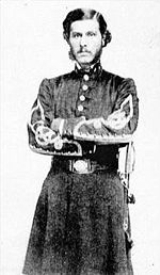
Frank Crawford Armstrong

Encyclopedia
Frank Crawford Armstrong (November 22, 1835 – September 8, 1909) was a United States Army
cavalry
officer and later a brigadier general
in the Confederate States Army
during the American Civil War
. He is also known for being the only Confederate general
to fight on both sides during the Civil War.
in the Indian Territory
, where his army officer father had been stationed. Armstrong's father, Francis Wells Armstrong, died three months before his son's birth. In 1854, Armstrong's mother married Mexican-American War General Persifor Smith. In 1854, Armstrong accompanied his stepfather on an expedition of the United States Army troops into the New Mexico Territory
. His gallantry in a battle against Indians near Eagle Spring gained him a commission as a lieutenant
in 1855, following his graduation from Holy Cross Academy in Massachusetts
. Armstrong then fought with Albert Sidney Johnston
against the Mormons
during the Utah War
.
cavalry at the First Battle of Bull Run
. However, Armstrong resigned his commission and on August 10, 1861, he joined the Confederate Army. As Armstrong's Union resignation did not go into effect until August 13, he was technically on both sides at the same time. He served as a staff officer under Confederate generals James M. McIntosh
and Benjamin McCulloch
before their deaths at the Battle of Pea Ridge
, and was standing only feet away as McCulloch was killed.
In 1863 Armstrong was elected as colonel
of the 3rd Louisiana Infantry Regiment, and was soon given command of the cavalry of Major General Sterling Price
. Two months later, he was promoted to brigadier general and commanded a cavalry division
under Nathan Bedford Forrest
at the Battle of Chickamauga
.
In February 1864, Armstrong requested a transfer to the command of Maj. Gen. Stephen D. Lee
. He was assigned command of a brigade of Mississippi cavalry previously led by Colonel Peter B. Starke. Armstrong and his men accompanied Lt. Gen. Leonidas Polk
's corps to Georgia and served in the Atlanta Campaign
, before participating in Lt. Gen. John B. Hood's disastrous campaign
. He saw action during the campaign against Murfreesboro, and led much of Forrest's rear guard after the Hood's defeat at the Battle of Nashville
.
On March 23, Armstrong was assigned to the defenses of Selma, Alabama
, one of the Confederacy's last remaining industrial centers. On April 2, 1865, his troops participated in efforts to defend the town against a much larger Union force under Maj. Gen. James H. Wilson
. Armstrong was captured later that day.
. Because of his frontier
and military experience, he served as United States Indian Inspector from 1885 until 1889, and was the Assistant Commissioner of Indian Affairs from 1893 to 1895.
Armstrong died in Bar Harbor, Maine
in 1909, and was buried in Rock Creek Cemetery
in Washington, D.C.
. His brother-in-law, Lucius Marshall Walker, also served as a Confederate general.
United States Army
The United States Army is the main branch of the United States Armed Forces responsible for land-based military operations. It is the largest and oldest established branch of the U.S. military, and is one of seven U.S. uniformed services...
cavalry
Cavalry
Cavalry or horsemen were soldiers or warriors who fought mounted on horseback. Cavalry were historically the third oldest and the most mobile of the combat arms...
officer and later a brigadier general
Brigadier general (United States)
A brigadier general in the United States Army, Air Force, and Marine Corps, is a one-star general officer, with the pay grade of O-7. Brigadier general ranks above a colonel and below major general. Brigadier general is equivalent to the rank of rear admiral in the other uniformed...
in the Confederate States Army
Confederate States Army
The Confederate States Army was the army of the Confederate States of America while the Confederacy existed during the American Civil War. On February 8, 1861, delegates from the seven Deep South states which had already declared their secession from the United States of America adopted the...
during the American Civil War
American Civil War
The American Civil War was a civil war fought in the United States of America. In response to the election of Abraham Lincoln as President of the United States, 11 southern slave states declared their secession from the United States and formed the Confederate States of America ; the other 25...
. He is also known for being the only Confederate general
Confederate States Army
The Confederate States Army was the army of the Confederate States of America while the Confederacy existed during the American Civil War. On February 8, 1861, delegates from the seven Deep South states which had already declared their secession from the United States of America adopted the...
to fight on both sides during the Civil War.
Early life and Career
Armstrong was born on the Choctaw AgencyChoctaw
The Choctaw are a Native American people originally from the Southeastern United States...
in the Indian Territory
Indian Territory
The Indian Territory, also known as the Indian Territories and the Indian Country, was land set aside within the United States for the settlement of American Indians...
, where his army officer father had been stationed. Armstrong's father, Francis Wells Armstrong, died three months before his son's birth. In 1854, Armstrong's mother married Mexican-American War General Persifor Smith. In 1854, Armstrong accompanied his stepfather on an expedition of the United States Army troops into the New Mexico Territory
New Mexico Territory
thumb|right|240px|Proposed boundaries for State of New Mexico, 1850The Territory of New Mexico was an organized incorporated territory of the United States that existed from September 9, 1850, until January 6, 1912, when the final extent of the territory was admitted to the Union as the State of...
. His gallantry in a battle against Indians near Eagle Spring gained him a commission as a lieutenant
Lieutenant
A lieutenant is a junior commissioned officer in many nations' armed forces. Typically, the rank of lieutenant in naval usage, while still a junior officer rank, is senior to the army rank...
in 1855, following his graduation from Holy Cross Academy in Massachusetts
Massachusetts
The Commonwealth of Massachusetts is a state in the New England region of the northeastern United States of America. It is bordered by Rhode Island and Connecticut to the south, New York to the west, and Vermont and New Hampshire to the north; at its east lies the Atlantic Ocean. As of the 2010...
. Armstrong then fought with Albert Sidney Johnston
Albert Sidney Johnston
Albert Sidney Johnston served as a general in three different armies: the Texas Army, the United States Army, and the Confederate States Army...
against the Mormons
Mormons
The Mormons are a religious and cultural group related to Mormonism, a religion started by Joseph Smith during the American Second Great Awakening. A vast majority of Mormons are members of The Church of Jesus Christ of Latter-day Saints while a minority are members of other independent churches....
during the Utah War
Utah War
The Utah War, also known as the Utah Expedition, Buchanan's Blunder, the Mormon War, or the Mormon Rebellion was an armed confrontation between LDS settlers in the Utah Territory and the armed forces of the United States government. The confrontation lasted from May 1857 until July 1858...
.
Civil War service
By the time of the Civil War, Armstrong was a captain in the regular army. He led a company of UnionUnion Army
The Union Army was the land force that fought for the Union during the American Civil War. It was also known as the Federal Army, the U.S. Army, the Northern Army and the National Army...
cavalry at the First Battle of Bull Run
First Battle of Bull Run
First Battle of Bull Run, also known as First Manassas , was fought on July 21, 1861, in Prince William County, Virginia, near the City of Manassas...
. However, Armstrong resigned his commission and on August 10, 1861, he joined the Confederate Army. As Armstrong's Union resignation did not go into effect until August 13, he was technically on both sides at the same time. He served as a staff officer under Confederate generals James M. McIntosh
James M. McIntosh
James McQueen McIntosh was a career American soldier who served as a brigadier general in the Confederate Army during the Civil War...
and Benjamin McCulloch
Benjamin McCulloch
Benjamin McCulloch was a soldier in the Texas Revolution, a Texas Ranger, a U.S. marshal, and a brigadier general in the army of the Confederate States during the American Civil War.-Early life:...
before their deaths at the Battle of Pea Ridge
Battle of Pea Ridge
The Battle of Pea Ridge was a land battle of the American Civil War, fought on March 6–8, 1862, at Pea Ridge in northwest Arkansas, near Garfield. In the battle, Union forces led by Brig. Gen. Samuel R. Curtis defeated Confederate troops under Maj. Gen. Earl Van Dorn. The outcome of the...
, and was standing only feet away as McCulloch was killed.
In 1863 Armstrong was elected as colonel
Colonel
Colonel , abbreviated Col or COL, is a military rank of a senior commissioned officer. It or a corresponding rank exists in most armies and in many air forces; the naval equivalent rank is generally "Captain". It is also used in some police forces and other paramilitary rank structures...
of the 3rd Louisiana Infantry Regiment, and was soon given command of the cavalry of Major General Sterling Price
Sterling Price
Sterling Price was a lawyer, planter, and politician from the U.S. state of Missouri, who served as the 11th Governor of the state from 1853 to 1857. He also served as a United States Army brigadier general during the Mexican-American War, and a Confederate Army major general in the American Civil...
. Two months later, he was promoted to brigadier general and commanded a cavalry division
Division (military)
A division is a large military unit or formation usually consisting of between 10,000 and 20,000 soldiers. In most armies, a division is composed of several regiments or brigades, and in turn several divisions typically make up a corps...
under Nathan Bedford Forrest
Nathan Bedford Forrest
Nathan Bedford Forrest was a lieutenant general in the Confederate Army during the American Civil War. He is remembered both as a self-educated, innovative cavalry leader during the war and as a leading southern advocate in the postwar years...
at the Battle of Chickamauga
Battle of Chickamauga
The Battle of Chickamauga, fought September 19–20, 1863, marked the end of a Union offensive in southeastern Tennessee and northwestern Georgia called the Chickamauga Campaign...
.
In February 1864, Armstrong requested a transfer to the command of Maj. Gen. Stephen D. Lee
Stephen D. Lee
Stephen Dill Lee was an American soldier, planter, legislator, and author. He was the youngest Confederate lieutenant general during the American Civil War, and later served as the first president of Mississippi A&M College...
. He was assigned command of a brigade of Mississippi cavalry previously led by Colonel Peter B. Starke. Armstrong and his men accompanied Lt. Gen. Leonidas Polk
Leonidas Polk
Leonidas Polk was a Confederate general in the American Civil War who was once a planter in Maury County, Tennessee, and a second cousin of President James K. Polk...
's corps to Georgia and served in the Atlanta Campaign
Atlanta Campaign
The Atlanta Campaign was a series of battles fought in the Western Theater of the American Civil War throughout northwest Georgia and the area around Atlanta during the summer of 1864. Union Maj. Gen. William T. Sherman invaded Georgia from the vicinity of Chattanooga, Tennessee, beginning in May...
, before participating in Lt. Gen. John B. Hood's disastrous campaign
Franklin-Nashville Campaign
The Franklin-Nashville Campaign, also known as Hood's Tennessee Campaign, was a series of battles in the Western Theater, conducted from September 18 to December 27, 1864, in Alabama, Tennessee, and northwestern Georgia during the American Civil War. The Confederate Army of Tennessee under Lt....
. He saw action during the campaign against Murfreesboro, and led much of Forrest's rear guard after the Hood's defeat at the Battle of Nashville
Battle of Nashville
The Battle of Nashville was a two-day battle in the Franklin-Nashville Campaign that represented the end of large-scale fighting in the Western Theater of the American Civil War. It was fought at Nashville, Tennessee, on December 15–16, 1864, between the Confederate Army of Tennessee under...
.
On March 23, Armstrong was assigned to the defenses of Selma, Alabama
Selma, Alabama
Selma is a city in and the county seat of Dallas County, Alabama, United States, located on the banks of the Alabama River. The population was 20,512 at the 2000 census....
, one of the Confederacy's last remaining industrial centers. On April 2, 1865, his troops participated in efforts to defend the town against a much larger Union force under Maj. Gen. James H. Wilson
James H. Wilson
James Harrison Wilson was a United States Army topographic engineer, a Union Army Major General in the American Civil War and later wars, a railroad executive, and author.-Early life and engineering:...
. Armstrong was captured later that day.
Post-war years
With the return of peace Armstrong worked for the Overland Mail Service in TexasTexas
Texas is the second largest U.S. state by both area and population, and the largest state by area in the contiguous United States.The name, based on the Caddo word "Tejas" meaning "friends" or "allies", was applied by the Spanish to the Caddo themselves and to the region of their settlement in...
. Because of his frontier
Frontier
A frontier is a political and geographical term referring to areas near or beyond a boundary. 'Frontier' was absorbed into English from French in the 15th century, with the meaning "borderland"--the region of a country that fronts on another country .The use of "frontier" to mean "a region at the...
and military experience, he served as United States Indian Inspector from 1885 until 1889, and was the Assistant Commissioner of Indian Affairs from 1893 to 1895.
Armstrong died in Bar Harbor, Maine
Bar Harbor, Maine
Bar Harbor is a town on Mount Desert Island in Hancock County, Maine, United States. As of the 2010 census, its population is 5,235. Bar Harbor is a famous summer colony in the Down East region of Maine. It is home to the College of the Atlantic, Jackson Laboratory and Mount Desert Island...
in 1909, and was buried in Rock Creek Cemetery
Rock Creek Cemetery
Rock Creek Cemetery — also Rock Creek Church Yard and Cemetery — is an cemetery with a natural rolling landscape located at Rock Creek Church Road, NW, and Webster Street, NW, off Hawaii Avenue, NE in Washington, D.C.'s Michigan Park neighborhood, near Washington's Petworth neighborhood...
in Washington, D.C.
Washington, D.C.
Washington, D.C., formally the District of Columbia and commonly referred to as Washington, "the District", or simply D.C., is the capital of the United States. On July 16, 1790, the United States Congress approved the creation of a permanent national capital as permitted by the U.S. Constitution....
. His brother-in-law, Lucius Marshall Walker, also served as a Confederate general.