
All Topics  
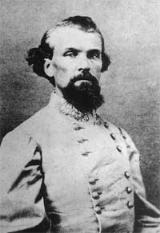
Nathan Bedford Forrest

 
Nathan Bedford Forrest

   Email Print
   Bookmark   Link


Nathan Bedford Forrest


Nathan Bedford Forrest (July 13, 1821 – October 29, 1877) was a lieutenant general in the Confederate Army
Confederate States Army

The Confederate States Army was a military organization whose primary mission was to provide the necessary forces and capabilities to support the National Security and defense of the Confederate States of America during its brief existence from 1861 to 1865....
 during the American Civil War
American Civil War

The American Civil War , also known as the War Between the States and several Naming the American Civil War, was a civil war in the United States....
. He is remembered both as a self made and innovative cavalry
Cavalry

The Cavalry is the second oldest of the Combat Arms, and as soldiers or warriors who fought mounted on horseback in combat, it represents the mobility and offensive power of the armed forces....
 leader during the war and as a figure in the postwar establishment of the first Ku Klux Klan
Ku Klux Klan

Ku Klux Klan is the name of several past and present secret domestic militant organizations in the United States, originating in the southern states and eventually having national scope, that are best known for advocating white supremacy and acting as terrorists while hidden behind conical hats, masks and white robes....
 organization opposing the reconstruction era in the South.

A cavalry and military commander in the war, Forrest is also one of the war's most unusual figures.


Discussion
Ask a question about 'Nathan Bedford Forrest'
Start a new discussion about 'Nathan Bedford Forrest'
Answer questions from other users
Full Discussion Forum


Recent Posts


Encyclopedia


Nathan Bedford Forrest (July 13, 1821 – October 29, 1877) was a lieutenant general in the Confederate Army
Confederate States Army

The Confederate States Army was a military organization whose primary mission was to provide the necessary forces and capabilities to support the National Security and defense of the Confederate States of America during its brief existence from 1861 to 1865....
 during the American Civil War
American Civil War

The American Civil War , also known as the War Between the States and several Naming the American Civil War, was a civil war in the United States....
. He is remembered both as a self made and innovative cavalry
Cavalry

The Cavalry is the second oldest of the Combat Arms, and as soldiers or warriors who fought mounted on horseback in combat, it represents the mobility and offensive power of the armed forces....
 leader during the war and as a figure in the postwar establishment of the first Ku Klux Klan
Ku Klux Klan

Ku Klux Klan is the name of several past and present secret domestic militant organizations in the United States, originating in the southern states and eventually having national scope, that are best known for advocating white supremacy and acting as terrorists while hidden behind conical hats, masks and white robes....
 organization opposing the reconstruction era in the South.

A cavalry and military commander in the war, Forrest is also one of the war's most unusual figures. A crude man who had made his fortune as a slave trader, was noted for both his violence and his hatred of blacks. In the words of historian James M. McPherson, “Forrest possessed a killer instinct toward . . . blacks in any capacity other than slave.” He was one of the very few in either army to enlist as a private and end the war at the rank of general. Forrest discovered and established new doctrines for mobile forces, earning the nickname The Wizard of the Saddle. He was accused of responsibility for war crime
War crime

War crimes are "violations of the laws or customs of war"; including but not limited to "murder, the ill-treatment or deportation of civilian residents of an occupied territory to slave labor camps", "the murder or ill-treatment of prisoner of war", the killing of hostages, "the wanton destruction of cities, towns and villages, and any devast...
s at the Battle of Fort Pillow
Battle of Fort Pillow

The Battle of Fort Pillow, known as the Fort Pillow Massacre, particularly in the North, was fought on April 12 1864, at Fort Pillow State Park on the Mississippi River in Henning, Tennessee, during the American Civil War....
 for leading Confederate soldiers in a massacre of unarmed black Union Army
Union Army

The Union Army was the army that fought for the Union during the American Civil War. It was also known as the Federal Army, the U.S....
 prisoners, but in the face of conflicting evidence was later cleared by the US Congress. After the war Forrest opposed Reconstruction policies and federal occupation by serving as the first Grand Wizard of the Ku Klux Klan
Ku Klux Klan

Ku Klux Klan is the name of several past and present secret domestic militant organizations in the United States, originating in the southern states and eventually having national scope, that are best known for advocating white supremacy and acting as terrorists while hidden behind conical hats, masks and white robes....
 and commander of the Grand Dragons of the Realms. In their postwar writings, both Confederate President Jefferson Davis
Jefferson Davis

Jefferson Finis Davis was an United States politician who served as President of the Confederate States of America for its entire history, 1861 to 1865, during the American Civil War....
 and General Robert E. Lee
Robert E. Lee

Robert Edward Lee , was a career United States United States Army officer , an engineer, and among the most celebrated generals in American history....
 stated the Confederate high command had failed to adequately use Forrest's talents.

Early life

Nathan Bedford Forrest was born to a poor family in Chapel Hill, Tennessee
Chapel Hill, Tennessee

Chapel Hill is a town in the northern part of Marshall County, Tennessee, Tennessee, United States. The town was named after Chapel Hill, North Carolina by settlers from that area....
. He was the first of blacksmith William Forrest's twelve children with Miriam Beck. After his father's death, Forrest became head of the family at the age of 17. In 1841 Forrest went into business with his uncle in Hernando, Mississippi
Hernando, Mississippi

Hernando is a city in central DeSoto County, Mississippi. The population was 6,812 at the 2000 census. The 2006 census estimate reflects a population of 10,580....
. His uncle was killed there during an argument with the Matlock brothers. Forrest shot and killed two of them with his two-shot pistol and wounded two others with a knife thrown to him. Ironically, one of the wounded men survived and served under Forrest during the Civil War.

Forrest became a businessman, a planter - owner of several plantation
Plantation

A plantation is usually a large farm or Estate , especially in a tropical or semitropical country, like Brazil or Nicaragua on which cotton, tobacco, lice coffee, sugar cane and the like are cultivated, usually by resident laborers....
s, a slave owner, and slave trader
Slavery

Slavery is a form of forced labor where a person is compelled to Labor for another . Slaves are held against their will from the time of their capture, purchase, or birth, and are deprived of the right to leave, to refuse to work, or to receive Remuneration in return for their labor....
 based on Adams Street in Memphis
Memphis, Tennessee

Memphis is a city in the southwest corner of the U.S. state of Tennessee, and the county seat of Shelby County, Tennessee. Memphis rises above the Mississippi River on the 4th Chickasaw Bluff just south of the mouth of the Wolf River ....
. In 1858 Forrest was elected as a Memphis city alderman
Alderman

An alderman is a member of a Municipal government assembly or council in many jurisdictions. Historically the term could also refer to local municipal judges in small legal proceedings ....
. Forrest provided financially for his mother and put his younger brothers through college. By the time the Civil War started in 1861, he was a millionaire and one of the richest men in the South
Southern United States

The Southern United States—commonly referred to as the American South, Dixie, or simply the South—constitutes a large distinctive region in the southeastern and south-central United States....
. Forrest had amassed a personal net worth of more than $1.5 million. Before the Civil War, "Forrest was well known as a Memphis speculator and Mississippi gambler. He was for some time captain
Captain (nautical)

The captain or master of a merchant vessel is a licensed mariner in ultimate command of the vessel. A ship's captain is responsible for its safe and efficient operation, including cargo operations and navigation, and ensuring that the vessel complies with local and international laws, as well as company policies....
 of a boat which ran between Memphis, Tennessee
Memphis, Tennessee

Memphis is a city in the southwest corner of the U.S. state of Tennessee, and the county seat of Shelby County, Tennessee. Memphis rises above the Mississippi River on the 4th Chickasaw Bluff just south of the mouth of the Wolf River ....
 and Vicksburg, Mississippi
Vicksburg, Mississippi

Vicksburg is a city in Warren County, Mississippi, Mississippi, United States. It is located 234 miles north by west of New Orleans, Louisiana on the Mississippi River and Yazoo River rivers, and 40 miles due west of Jackson, Mississippi, the state capital....
. As his fortune increased he engaged in plantation speculation, and became the nominal owner of two plantations not far from Goodrich's Landing, above Vicksburg, where he worked some hundred or more slaves," according to his obituary. "He was known to his acquaintances as a man of obscure origin and low associations, a shrewd speculator, negro trader, and duelist, but a man of great energy and brute courage.

Career

After war broke out, Forrest returned to Tennessee and enlisted as a private
Private (rank)

A Private is a soldier of the lowest military rank . The term dates from the Middle Ages, where privates were known as "private soldiers" who were either hired, conscripted, or feudalism into service by a nobleman forming an army....
 in the Confederate States Army
Confederate States Army

The Confederate States Army was a military organization whose primary mission was to provide the necessary forces and capabilities to support the National Security and defense of the Confederate States of America during its brief existence from 1861 to 1865....
. On July 14, 1861, he joined Captain J.S. White's Company "E", Tennessee Mounted Rifles. Forrest received military training at Fort Wright
Fort Wright (Tennessee)

Fort Wright was onstructed in 1861 and located on the second Chickasaw Bluff at Randolph, Tennessee, Tipton County, Tennessee, Tennessee. Fort Wright was a American Civil War fortification and the first military training facility of the Confederate States Army in Tennessee....
.

His superior officers and the state governor
Governor

A governor is a governing official, usually the Executive of a non-sovereign level of government, ranking under the head of state. In federations, a governor may be the title of each appointed or elected politician who governs a constitutive state....
 Isham G. Harris were surprised that someone of Forrest's wealth and prominence had enlisted as a soldier, especially since planters were exempted from service. As a result they commissioned him as a colonel
Lieutenant Colonel (United States)

In the United States Army, United States Air Force, and United States Marine Corps, lieutenant colonel is a field officer United States Military Officer military rank just above the rank of Major and just below the rank of Colonel ....
 and authorized him to recruit and train a battalion of Confederate Mounted Rangers. In October 1861 he was given command of his own regiment, "Forrest's Tennessee Cavalry Battalion". Though Forrest had no prior formalized military training or experience, he applied himself diligently to learn. With strong leadership abilities and apparently an intuition for successful tactics
Military tactics

Military tactics are the techniques for using weapons or military units in combination for engaging and defeating an Enemy in battle. Changes in philosophy and technology over time have been reflected in changes to military tactics....
, Forrest soon became an exemplary officer. In Tennessee, there was much public debate concerning the state's decision to join the Confederacy, and both the CSA and the Union
Union Army

The Union Army was the army that fought for the Union during the American Civil War. It was also known as the Federal Army, the U.S....
 armies were actively seeking Tennessean recruits. Forrest sought men eager for battle, promising them that they would have "ample opportunity to kill Yankees".

At six-foot, two-inches (1.88 m) tall and 210 pounds (95 kg; 15 stone), Forrest was physically imposing and intimidating, especially for the time. He used his skills as a hard rider and fierce swordsman to great effect. (He was known to sharpen both the top and bottom edges of his heavy saber.)

It has been surmised from contemporaneous records that Forrest may have personally killed more than thirty-three men with saber, pistol and shotgun.

When the Civil War began, Forrest offered freedom to 44 of his slaves if they would serve with him in the Confederate army. All 44 agreed. One later deserted; the other 43 served faithfully until the end of the war. Although they had many chances to leave, they chose to remain loyal to the South and to Forrest. Part of Forrest's command included his own Escort Company (his "Special Forces"), made up of the very best soldiers available. This unit, which varied in size from 40-90 men, was the elite of the cavalry. Eight of these picked men were black soldiers and all served gallantly and bravely throughout the war. All were armed with at least 2 pistols and a rifle. Most also carried two additional pistols in saddle holsters. At war's end, when Forrest's cavalry surrendered in May 1865, there were 65 black troopers on the muster roll.

Cavalry command

Forrest distinguished himself first at the Battle of Fort Donelson
Battle of Fort Donelson

The Battle of Fort Donelson was fought from February 11 to February 16, 1862, in the Western Theater of the American Civil War of the American Civil War....
 in February 1862. His cavalry captured a Union artillery battery
Artillery battery

In military organizations, an artillery battery is a unit of guns, mortar s, or rockets, so grouped in order to facilitate better battlefield communication and command and control, as well as to provide dispersion for its constituent gunnery crews and their systems....
 and then he broke out of a Union Army siege headed by Major General
Major General

Major General or Major-General is a military rank used in many countries. It is derived from the older rank of Sergeant Major General. A Major General is a high-ranking officer, normally subordinate to the rank of Lieutenant General and senior to the ranks of Brigadier and Brigadier General....
 Ulysses S. Grant
Ulysses S. Grant

Ulysses S. Grant, born Hiram Ulysses Grant , was an United States general and the List of Presidents of the United States President of the United States ....
. Forrest rallied nearly 4,000 troops and led them across the river.

A few days after Fort Donelson, with the fall of Nashville
Nashville, Tennessee

Nashville is the Capital of the U.S. state of Tennessee and the county seat of Davidson County, Tennessee. It is the second most populous city in the state after Memphis, Tennessee....
 imminent, Forrest took command of the city. Industry included millions of dollars worth of heavy ordnance machinery. Forrest arranged for transport of both the machinery and several important government officials.

A month later, Forrest was back in action at the Battle of Shiloh
Battle of Shiloh

The Battle of Shiloh, also known as the Battle of Pittsburg Landing, was a major battle in the Western Theater of the American Civil War of the American Civil War, fought on April 6 and April 7, 1862, in southwestern Tennessee....
 (April 6 to April 7, 1862). He commanded a Confederate rear guard after the Union victory. In an incident called Fallen Timbers, he drove through the Union skirmish line. In the midst of Union troops with his own men in retreat, he emptied his Colt Army Revolvers into the swirling mass of Union Soldiers and pulled out his saber. A Union infantryman wounded Forrest in the hip with a musket shot, nearly knocking the cavalry man out of the saddle. Forrest was said to be the last man wounded at the Battle of Shiloh.

By early summer, Forrest commanded a new brigade of green cavalry regiments. In July, he led them into Middle Tennessee under orders to launch a cavalry raid. On July 13, 1862, his men joined the First Battle of Murfreesboro
Battle of Murfreesboro I

}|-||}The First Battle of Murfreesboro was fought on July 13, 1862, in Rutherford County, Tennessee, as part of the American Civil War.On June 10, 1862, Major General#United States Don Carlos Buell, commanding the Army of the Ohio, started a leisurely advance toward Chattanooga, Tennessee , which Union Army Brigadier General#United S...
, and Forrest is said to have won this battle.

According to a report by a Union commander:

Promoted in July 1862 to brigadier general, Forrest was given command of a Confederate cavalry brigade. In December 1862, Forrest's veteran troopers were reassigned by Bragg to another officer, against his protest. Forrest had to recruit a new brigade, composed of about 2,000 inexperienced recruits, most of whom lacked weapons. Again, Bragg ordered a raid, this one into west Tennessee to disrupt the communications of the Union forces under Grant, threatening the city of Vicksburg, Mississippi
Vicksburg, Mississippi

Vicksburg is a city in Warren County, Mississippi, Mississippi, United States. It is located 234 miles north by west of New Orleans, Louisiana on the Mississippi River and Yazoo River rivers, and 40 miles due west of Jackson, Mississippi, the state capital....
. Forrest protested that to send these untrained men behind enemy lines was suicidal, but Bragg insisted, and Forrest obeyed his orders. On the ensuing raid, he again showed his brilliance, leading thousands of Union soldiers in west Tennessee on a "wild goose chase" trying to locate his fast-moving forces. Forrest never stayed in one place long enough to be located, raided as far north as the banks of the Ohio River
Ohio River

The Ohio River is the largest tributary, by volume, of the Mississippi River. It is approximately 981 miles long and is located in the eastern United States....
 in southwest Kentucky
Kentucky

The Commonwealth of Kentucky is a U.S. state located in the East Central United States of America. Kentucky is normally included in the group of Southern United States , but it is uncommonly included, geographically and culturally, in the Midwestern United States....
, and came back to his base in Mississippi
Mississippi

Mississippi is a U.S. state located in the Deep South of the United States. Jackson, Mississippi is the state capital and largest city. The state's name comes from the Mississippi River, which flows along its western boundary, and takes its name from the Anishinaabe language word misi-ziibi ....
 with more men than he had started with. All of them were then fully armed with captured Union weapons. As a result, Grant was forced to revise and delay the strategy of his Vicksburg Campaign
Vicksburg Campaign

The Vicksburg Campaign was a series of maneuvers and battles in the Western Theater of the American Civil War of the American Civil War directed against Vicksburg, Mississippi, a fortress city that dominated the last Confederate States of America-controlled section of the Mississippi River....
. "He was the only Confederate cavalryman of whom Grant stood in much dread," a friend of Grant's was quoted as saying.

Forrest continued to lead his men in small-scale operations until April 1863. The Confederate army dispatched him into the backcountry of northern Alabama
Alabama

Alabama is a state located in the Southern United States of the United States of America. It is bordered by Tennessee to the north, Georgia to the east, Florida and the Gulf of Mexico to the south, and Mississippi to the west....
 and west Georgia
Georgia (U.S. state)

Georgia is a U.S. state in the United States and was one of the original Thirteen Colonies that revolted against United Kingdom rule in the American Revolution....
 to deal with an attack of 3,000 Union cavalrymen under the command of Col. Abel Streight
Abel Streight

Abel D. Streight was a lumber merchant, publisher, and a Union Army General officer in the American Civil War, noted for his daring cavalry raid, Streight's Raid, in 1863....
. Streight had orders to cut the Confederate railroad south of Chattanooga, Tennessee
Chattanooga, Tennessee

Chattanooga, "the Scenic City", is the fourth-largest city in Tennessee , and the county seat of Hamilton County, Tennessee, in the United States....
, to cut off Bragg's supply line and force him to retreat into Georgia. Forrest chased Streight's men for 16 days, harassing them all the way. Streight's goal became simply to escape pursuit. On May 3, Forrest caught up with Streight's unit east of Cedar Bluff, Alabama
Cedar Bluff, Alabama

Cedar Bluff is a town in Cherokee County, Alabama, Alabama, United States. At the 2000 census the population was 1,467. NASCAR driver Tina Gordon is from the town....
. Forrest had fewer men, but repeatedly paraded some of them around a hilltop to appear a larger force, and convinced Streight to surrender his 1,500 exhausted troops.

Forrest served with the main army at the Battle of Chickamauga
Battle of Chickamauga

The Battle of Chickamauga, fought September 19–20, 1863, marked the end of a Union Army offensive in south-central Tennessee and northwestern Georgia called the Chickamauga Campaign....
 (September 18 to September 20, 1863). He pursued the retreating Union army and took hundreds of prisoners. Like several others under Bragg's command, he urged an immediate follow-up attack to recapture Chattanooga, which had fallen a few weeks before. Bragg failed to do so, upon which Forrest was quoted as saying, "What does he fight battles for?" After Forrest made death threats against Bragg during a confrontation , Forrest was reassigned to an independent command in Mississippi. He was promoted to the rank of major general on December 4, 1863.

Fort Pillow

On April 12, 1864, General Forrest led his forces in the attack and capture of Fort Pillow
Fort Pillow State Park

Fort Pillow State Park is a state park in western Tennessee that preserves the American Civil War site of the Battle of Fort Pillow. The 1,642 acre Fort Pillow, located in Lauderdale County, Tennessee on the Chickasaw Bluffs overlooking the Mississippi River, is rich in both historic and archaeological significance....
 on the Mississippi River
Mississippi River

The Mississippi River is the longest river in the United States, with a length of from its source in Lake Itasca in Minnesota to its mouth in the Gulf of Mexico....
 in Henning, Tennessee
Henning, Tennessee

Henning is a town in Lauderdale County, Tennessee, Tennessee, United States. The population was 970 at the 2000 census....
. The Battle of Fort Pillow led to great controversy about whether a massacre
Massacre

Massacre may refer to:*...
 of surrendered African-American Union troops was conducted or condoned by General Forrest.

Forrest's men insisted that the Federals, although fleeing, kept their weapons and frequently turned to shoot, forcing the Confederates to keep firing in self defense.. The Union flag was still flying over the fort, which indicated that the force had not formally surrendered. A contemporary newspaper account from Jackson, Tennessee, states that "General Forrest begged them to surrender," but "not the first sign of surrender was ever given." Similar accounts were reported in many Southern newspapers at the time.

These denials, however, are contradicted by accounts of the massacre found in the letters of the Confederate soldiers who were there. Achilles Clark, a soldier with the 20th Tennessee cavalry, wrote the following in a letter to his sister penned immediately after the battle. "The slaughter was awful. Words cannot describe the scene. The poor, deluded, negroes would run up to our men, fall upon their knees, and with uplifted hands scream for mercy but they were ordered to their feet and then shot down. I, with several others, tried to stop the butchery, and at one time had partially succeeded, but General Forrest ordered them shot down like dogs and the carnage continued. Finally our men became sick of blood and the firing ceased."

Faced with these conflicting claims the U.S. Congress first accused, then cleared, Forrest of responsibility for war crimes at the battle.

The battle remains controversial, and historians differ on the interpretations. Richard Fuchs, author of An Unerring Fire concludes that “The affair at Fort Pillow was simply an orgy of death, a mass lynching to satisfy the basest of conduct – intentional murder – for the vilest of reasons – racism and personal enmity.” Andrew Ward downplays the controversy, “Whether the massacre was premeditated or spontaneous does not address the more fundamental question of whether a massacre took place… it certainly did, in every dictionary sense of the word.” John Cimprich states “The new paradigm in social attitudes and the fuller use of available evidence has favored a massacre interpretation… Debate over the memory of this incident formed a part of sectional and racial conflicts for many years after the war, but the reinterpretation of the event during the last thirty years offers some hope that society can move beyond past intolerance.”

Brice's Crossroad

Forrest's greatest victory came on June 10, 1864, when his 3,500-man force clashed with 8,500 men commanded by Union Maj. Gen. Samuel D. Sturgis
Samuel D. Sturgis

Samuel Davis Sturgis was an American military officer who served in the Mexican-American War, as a Union Army general in the American Civil War, and later in the Indian Wars....
 at the Battle of Brice's Crossroads
Battle of Brice's Crossroads

The Battle of Brice's Crossroads was fought on June 10, 1864, near Baldwyn, Mississippi in Lee County, Mississippi, during the American Civil War....
. Here, his mobility of force and superior tactics led to victory. He swept the Union forces from a large expanse of southwest Tennessee and northern Mississippi. Forrest set up a position for an attack to repulse a pursuing force commanded by Sturgis who had been sent to impede Forrest from destroying Union supplies and fortifications. When Sturgis's Federal army came upon the crossroad, they were ambushed by Forrest's cavalry. Sturgis ordered his infantry to advance to the front line to counteract the cavalry. The infantry, tired and weary, were quickly broken and sent into mass retreat. Forrest sent a full charge after the retreating army and captured 16 artillery pieces, 176 wagons and 1,500 stands of small arms. In all, the maneuver had cost Forrest 96 men killed and 396 wounded. However the day was far worse for Union troops which suffered 223 killed, 394 wounded and 1,623 men missing. This was an especially deep blow to the black regiment under Sturgis's command. In the hasty retreat, they stripped off commemorative badges that read "Remember Fort Pillow
Battle of Fort Pillow

The Battle of Fort Pillow, known as the Fort Pillow Massacre, particularly in the North, was fought on April 12 1864, at Fort Pillow State Park on the Mississippi River in Henning, Tennessee, during the American Civil War....
" to avoid further goading the Confederate force pursuing them.

Conclusion of the war

One month later, Forrest's first major tactical defeat came at the Battle of Tupelo
Battle of Tupelo

The Battle of Tupelo was a Union victory over Confederate forces in northern Mississippi which ensured the safety of General William T. Sherman's supply lines....
. Concerned about his supply lines, Union Maj. Gen. William T. Sherman sent a force under the command of Maj. Gen. Andrew J. Smith to deal with Forrest. The Union forces sent Forrest from the field, but his forces were not wholly destroyed. He continued to oppose Union efforts in the West for the remainder of the war.

Forrest led other raids that summer and fall, including a famous one into Union-held downtown Memphis
Memphis, Tennessee

Memphis is a city in the southwest corner of the U.S. state of Tennessee, and the county seat of Shelby County, Tennessee. Memphis rises above the Mississippi River on the 4th Chickasaw Bluff just south of the mouth of the Wolf River ....
 in August 1864 (the Second Battle of Memphis
Second Battle of Memphis

The Second Battle of Memphis was a battle of the American Civil War occurring on August 21 1864, in Shelby County, Tennessee.At 4:00 a.m. on August 21 1864, Maj....
), and another on a Union supply depot at Johnsonville
New Johnsonville, Tennessee

New Johnsonville is a city in Humphreys County, Tennessee, Tennessee, United States. The population was 1,905 at the 2000 census....
, Tennessee, on October 3, 1864, causing millions of dollars in damage. In December, he fought alongside the Confederate Army of Tennessee
Army of Tennessee

The Army of Tennessee was the principal Confederate States Army operating between the Appalachian Mountains and the Mississippi River during the American Civil War....
 in the disastrous Franklin-Nashville Campaign
Franklin-Nashville Campaign

The Franklin-Nashville Campaign, also known as Hood's Tennessee Campaign, was a series of battles in the Western Theater of the American Civil War , fought in the fall of 1864 in Alabama, Tennessee, and northwestern Georgia during the American Civil War....
. He once again fought bitterly with his superior officer, demanding permission from General John Bell Hood
John Bell Hood

John Bell Hood was a Confederate States Army general during the American Civil War. Hood had a reputation for bravery and aggressiveness that sometimes bordered on recklessness....
, the newest (and last) commander of the Army of Tennessee to cross the river during the Second Battle of Franklin
Battle of Franklin II

The Second Battle of Franklin was fought at Franklin, Tennessee, on November 30, 1864, as part of the Franklin-Nashville Campaign of the American Civil War....
 and cut off Union Maj. Gen. John M. Schofield
John Schofield

John McAllister Schofield was an United States soldier who held major commands during the American Civil War. He later served as U.S. Secretary of War and commanding general of the United States Army....
's army's escape route (the attempt was eventually made and defeated). After his bloody defeat at Franklin
Battle of Franklin II

The Second Battle of Franklin was fought at Franklin, Tennessee, on November 30, 1864, as part of the Franklin-Nashville Campaign of the American Civil War....
, Hood continued to Nashville while Forrest led an independent raid against the Murfreesboro
Murfreesboro, Tennessee

Murfreesboro is a city in and the county seat of Rutherford County, Tennessee, Tennessee, United States. The population was 100,575 according to the city's 2008 official special census, up from 81,393 residents certified during the 2005 special census....
 garrison. Forrest engaged Union forces near Murfreesboro on December 5, 1864, and was soundly defeated at what would be known as the Third Battle of Murfreesboro
Battle of Murfreesboro III

The Third Battle of Murfreesboro was fought December 5–7, 1864, in Rutherford County, Tennessee, as part of the Franklin-Nashville Campaign of the American Civil War....
. After Hood's Army of Tennessee
Army of Tennessee

The Army of Tennessee was the principal Confederate States Army operating between the Appalachian Mountains and the Mississippi River during the American Civil War....
 was all but destroyed at the Battle of Nashville
Battle of Nashville

The Battle of Nashville was a two-day battle in the Franklin-Nashville Campaign that represented the end of large-scale fighting in the Western Theater of the American Civil War of the American Civil War....
, Forrest again distinguished himself by commanding the Confederate rear-guard in a series of actions that allowed what was left of the army to escape. For this, he earned promotion to the rank of lieutenant general.

In 1865, Forrest attempted, without success, to defend the state of Alabama
Alabama

Alabama is a state located in the Southern United States of the United States of America. It is bordered by Tennessee to the north, Georgia to the east, Florida and the Gulf of Mexico to the south, and Mississippi to the west....
 against Wilson's Raid
Wilson's Raid

Wilson's Raid was a cavalry operation through Alabama and Georgia in March-April 1865, late in the American Civil War. Brigadier General James H....
. His opponent, Brig. Gen.
Brigadier General

Brigadier General is the lowest ranking General Officer in some countries, usually sitting between the ranks of Colonel and Major General.The rank can be traced back to the militaries of Europe where a brigadier general, or simply a brigadier, would command a brigade in the field....
 James H. Wilson
James H. Wilson

James Harrison Wilson was a United States Army topography, a Union Army General officer in the American Civil War and later wars, a railroad executive, and author....
, defeated Forrest in battle. When news of Lee's surrender reached him, Forrest chose also to surrender. On May 9, 1865, at Gainesville
Gainesville, Alabama

Gainesville is a town in Sumter County, Alabama, Alabama, United States. At the 2000 census the population was 220....
, Forrest read his farewell address to his troops.

In the four years of the war, reputedly a total of 30 horses were shot out from under Forrest and he may have personally killed 31 people. "I was a horse ahead at the end," he said.

Forrest's Farewell Address To His Troops, May 9, 1865

The following text is excerpted from Forrest's farewell address to his troops. It showed an understanding of the difficulties likely in postwar years.

Civil war, such as you have just passed through naturally engenders feelings of animosity, hatred, and revenge. It is our duty to divest ourselves of all such feelings; and as far as it is in our power to do so, to cultivate friendly feelings towards those with whom we have so long contended, and heretofore so widely, but honestly, differed. Neighborhood feuds, personal animosities, and private differences should be blotted out; and, when you return home, a manly, straightforward course of conduct will secure the respect of your enemies. Whatever your responsibilities may be to Government, to society, or to individuals meet them like men.

The attempt made to establish a separate and independent Confederation has failed; but the consciousness of having done your duty faithfully, and to the end, will, in some measure, repay for the hardships you have undergone. In bidding you farewell, rest assured that you carry with you my best wishes for your future welfare and happiness. Without, in any way, referring to the merits of the Cause in which we have been engaged, your courage and determination, as exhibited on many hard-fought fields, has elicited the respect and admiration of friend and foe. And I now cheerfully and gratefully acknowledge my indebtedness to the officers and men of my command whose zeal, fidelity and unflinching bravery have been the great source of my past success in arms.

I have never, on the field of battle, sent you where I was unwilling to go myself; nor would I now advise you to a course which I felt myself unwilling to pursue. You have been good soldiers, you can be good citizens. Obey the laws, preserve your honor, and the Government to which you have surrendered can afford to be, and will be, magnanimous.


N.B. Forrest, Lieut.-General
Headquarters, Forrest's Cavalry Corps
Gainesville, Alabama
May 9, 1865


Impact of Forrest's doctrines

Forrest was one of the first men to grasp the doctrines of "mobile warfare" that became prevalent in the 20th century. Paramount in his strategy was fast movement, even if it meant pushing his horses at a killing pace, which he did more than once. Noted Civil War scholar Bruce Catton
Bruce Catton

Bruce Catton was a journalist and a notable historian of the American Civil War. He won a Pulitzer Prize for history in 1954 for A Stillness at Appomattox, his study of the final campaign of the war in Virginia....
 writes:
"Forrest ... used his horsemen as a modern general would use motorized infantry. He liked horses because he liked fast movement, and his mounted men could get from here to there much faster than any infantry could; but when they reached the field they usually tied their horses to trees and fought on foot, and they were as good as the very best infantry. Not for nothing did Forrest say the essence of strategy was 'to git thar fust with the most men'."


Forrest is often erroneously quoted as saying his strategy was to "git thar fustest with the mostest," but this quote first appeared in print in a New York Times story in 1917, written to provide colorful comments in reaction to European interest in Civil War generals. Bruce Catton writes:
"Do not, under any circumstances whatever, quote Forrest as saying 'fustest' and 'mostest'. He did not say it that way, and nobody who knows anything about him imagines that he did."


Forrest became well-known for his early use of "maneuver" tactics as applied to a mobile horse cavalry deployment. He sought to constantly harass the enemy in fast-moving raids, and to disrupt supply trains and enemy communications by destroying railroad track and cutting telegraph
Telegraphy

Telegraphy is the long-distance transmission of written messages without physical transport of letters. Radiotelegraphy or wireless telegraphy transmits messages using radio....
 lines, as he wheeled around the Union Army's flank. His success in doing so is reported to have driven Ulysses S. Grant to fits of anger.

Many students of warfare have come to appreciate Forrest's somewhat novel approach to cavalry deployment and quick hit-and-run tactics, both of which have influenced mobile tactics in the modern mechanized era. A report on the Battle of Paducah
Battle of Paducah

The Battle of Paducah was fought on March 25, 1864, during the American Civil War. A Confederate States Army force led by Major General Nathan Bedford Forrest launched a successful raid on Paducah, Kentucky, to capture supplies....
 stated that Forrest led a mounted cavalry of 2,500 troopers in only 50 hours.

One of Forrest's most famous quotes is:
"War means fightin', and fightin' means killin'."


War record and promotions

Nathanbedfordforrestpark02 27 06
*Enlisted as Private
Private (rank)

A Private is a soldier of the lowest military rank . The term dates from the Middle Ages, where privates were known as "private soldiers" who were either hired, conscripted, or feudalism into service by a nobleman forming an army....
 July 1861. (Company "E", Tennessee Mounted Rifles)
  • Commissioned lieutenant colonel
    Lieutenant Colonel (United States)

    In the United States Army, United States Air Force, and United States Marine Corps, lieutenant colonel is a field officer United States Military Officer military rank just above the rank of Major and just below the rank of Colonel ....
     October 1861. (Raised 7th Tennessee Cavalry)
  • Promoted, Colonel
    Colonel (United States)

    In the United States Army, United States Air Force, and United States Marine Corps, Colonel is a senior field officer United States Military Officer military rank just above the rank of Lieutenant Colonel and just below the rank of Brigadier General ....
     February 1862, Battle of Fort Donelson
    Battle of Fort Donelson

    The Battle of Fort Donelson was fought from February 11 to February 16, 1862, in the Western Theater of the American Civil War of the American Civil War....
    .
  • Wounded, Battle of Shiloh
    Battle of Shiloh

    The Battle of Shiloh, also known as the Battle of Pittsburg Landing, was a major battle in the Western Theater of the American Civil War of the American Civil War, fought on April 6 and April 7, 1862, in southwestern Tennessee....
    , April 1862.
  • Promoted, Brigadier General, July 21, 1862, 3rd Tennessee Cavalry.
  • First Battle of Murfreesboro
    Battle of Murfreesboro I

    }|-||}The First Battle of Murfreesboro was fought on July 13, 1862, in Rutherford County, Tennessee, as part of the American Civil War.On June 10, 1862, Major General#United States Don Carlos Buell, commanding the Army of the Ohio, started a leisurely advance toward Chattanooga, Tennessee , which Union Army Brigadier General#United S...
    , July 1862.
  • Raids in Tennessee, Kentucky, and Mississippi, Fall 1862 – Spring 1863.
  • Battle of Day's Gap
    Battle of Day's Gap

    The Battle of Day's Gap, fought on April 30, 1863, was the first in a series of American Civil War skirmishes in Cullman County, Alabama, that lasted until May 2, known as Streight's Raid....
    , April – May 1863.
  • Battle of Chickamauga
    Battle of Chickamauga

    The Battle of Chickamauga, fought September 19–20, 1863, marked the end of a Union Army offensive in south-central Tennessee and northwestern Georgia called the Chickamauga Campaign....
    , September 1863.
  • Promoted, Major General, December 4, 1863.
  • Battle of Paducah
    Battle of Paducah

    The Battle of Paducah was fought on March 25, 1864, during the American Civil War. A Confederate States Army force led by Major General Nathan Bedford Forrest launched a successful raid on Paducah, Kentucky, to capture supplies....
    , March 1864.
  • Battle of Fort Pillow
    Battle of Fort Pillow

    The Battle of Fort Pillow, known as the Fort Pillow Massacre, particularly in the North, was fought on April 12 1864, at Fort Pillow State Park on the Mississippi River in Henning, Tennessee, during the American Civil War....
    , April 1864.
  • Battle of Brice's Crossroads
    Battle of Brice's Crossroads

    The Battle of Brice's Crossroads was fought on June 10, 1864, near Baldwyn, Mississippi in Lee County, Mississippi, during the American Civil War....
    , June 1864.
  • Battle of Tupelo
    Battle of Tupelo

    The Battle of Tupelo was a Union victory over Confederate forces in northern Mississippi which ensured the safety of General William T. Sherman's supply lines....
    , July 14-15, 1864
  • Raids in Tennessee, August – October 1864.
  • Battle of Spring Hill
    Battle of Spring Hill

    The Battle of Spring Hill was fought November 29, 1864, in Maury County, Tennessee, as part of the Franklin-Nashville Campaign of the American Civil War....
    , November 29, 1864.
  • Battle of Franklin
    Battle of Franklin II

    The Second Battle of Franklin was fought at Franklin, Tennessee, on November 30, 1864, as part of the Franklin-Nashville Campaign of the American Civil War....
    , November 30, 1864.
  • Third Battle of Murfreesboro
    Battle of Murfreesboro III

    The Third Battle of Murfreesboro was fought December 5–7, 1864, in Rutherford County, Tennessee, as part of the Franklin-Nashville Campaign of the American Civil War....
    , December 5-7, 1864
  • Battle of Nashville
    Battle of Nashville

    The Battle of Nashville was a two-day battle in the Franklin-Nashville Campaign that represented the end of large-scale fighting in the Western Theater of the American Civil War of the American Civil War....
    , December 15-16, 1864.
  • Promoted, Lieutenant General, February 28, 1865.
  • Final Address to his troops, May 1865.


Postwar years

After the war, Forrest settled in Memphis, Tennessee, building a house on a bank of the Mississippi River
Mississippi River

The Mississippi River is the longest river in the United States, with a length of from its source in Lake Itasca in Minnesota to its mouth in the Gulf of Mexico....
. With slavery abolished, the former slave trader suffered a major financial setback. He later found employment at the Selma
Selma, Alabama

Selma is a city in and the county seat of Dallas County, Alabama, Alabama, United States, located on the banks of the Alabama River. The population was 20,512 at the United States Census, 2000....
-based Marion & Memphis Railroad and eventually became the company president. He was not as successful in railroad promoting as in war, and under his direction the company went bankrupt.

Although Forrest has been associated with the Ku Klux Klan
Ku Klux Klan

Ku Klux Klan is the name of several past and present secret domestic militant organizations in the United States, originating in the southern states and eventually having national scope, that are best known for advocating white supremacy and acting as terrorists while hidden behind conical hats, masks and white robes....
 movement, he officially denied participation and no evidence of a formal link exists. Upon learning of the Klan and its goal to reinstate the "true" Southern leaders, Forrest is alleged to have remarked, "That's a good thing; that's a damn good thing. We can use that to keep the niggers in their place." Delegates at an 1867 KKK
Ku Klux Klan

Ku Klux Klan is the name of several past and present secret domestic militant organizations in the United States, originating in the southern states and eventually having national scope, that are best known for advocating white supremacy and acting as terrorists while hidden behind conical hats, masks and white robes....
 convention in Nashville
Nashville, Tennessee

Nashville is the Capital of the U.S. state of Tennessee and the county seat of Davidson County, Tennessee. It is the second most populous city in the state after Memphis, Tennessee....
 named him the organization's honorary Grand Wizard
Grand Wizard

Grand Wizard was the title given to the overall leader of the earliest form of the Ku Klux Klan, which formed during The South Reconstruction era of the United States....
, or leader-in-chief without him being present.

Forrest's personal sentiments on the issue of race, however, were quite different from that of the KKK. Forrest was invited and gave a speech to organization of black Southerners called the "Jubilee of Pole-Bearers" in 1875. In this speech, Forrest espoused a radically progressive agenda of equality and harmony between black and white Americans. In accepting flowers from the group, Forrest kissed the black woman who presented the flowers. He also referred to her as a black "lady".

At this, his last public appearance, he made what the New York Times described as a "friendly speech" in which he called for reconciliation between the races and called for the admission of blacks into the professional classes from which they had heretofore been excluded.

In an 1868 interview by a Cincinnati newspaper, Forrest claimed that the Klan had 550,000 members in the Southern states. He said he sympathized with them, but denied any formal connection. He claimed he could muster thousands of men himself. He described the Klan as "a protective political military organization...The members are sworn to recognize the government of the United States...Its objects originally were protection against Loyal Leagues and the Grand Army of the Republic
Grand Army of the Republic

The Grand Army of the Republic was a fraternal organization composed of veterans of the Union Army who had served in the American Civil War. The GAR was among the first organized interest groups in American politics....
..."

In the Congressional investigation on Klan activities in 1871, the committee concluded that Forrest's involvement with the Klan was limited to trying to get it to disband. They determined there was no evidence that he had founded or led the Klan.

Nearly ruined as the result of the failure of the Marion & Memphis Railroad in the early 1870s, Forrest spent his final days running a prison work farm on President's Island in the Mississippi River. There were financial failures across the country in the Panic of 1873. Forrest's health was in steady decline. He and his wife lived in a log cabin they had salvaged from his plantation.

Forrest died in Memphis in October 1877, reportedly from acute complications of diabetes. He was buried at Elmwood Cemetery
Elmwood Cemetery (Memphis, Tennessee)

Historic Elmwood Cemetery is the oldest active cemetery in Memphis, Tennessee. It was established in 1852 as one of the first rural garden cemeteries in the South....
. In 1904 his remains were disinterred and moved to Forrest Park, a Memphis city park named in his honor.

Posthumous legacy

Many memorials were erected to Forrest in Tennessee. Obelisks in his memory were placed at his birthplace in Chapel Hill
Chapel Hill, Tennessee

Chapel Hill is a town in the northern part of Marshall County, Tennessee, Tennessee, United States. The town was named after Chapel Hill, North Carolina by settlers from that area....
 and at Nathan Bedford Forrest State Park
Nathan Bedford Forrest State Park

Nathan Bedford Forrest State Park is a state park in Benton County, Tennessee, in the southeastern United States. The park is situated on the western shore of the Kentucky Lake impoundment of the Tennessee River, just north of the community of Eva, Tennessee....
 near Camden. A statue of General Forrest was erected in Memphis's Nathan Bedford Forrest Park. A bust sculpted by Jane Baxendale is on display at the state capitol building in Nashville. The World War II
World War II

World War II, or the Second World War , was a global military conflict which involved a Participants in World War II, including all of the great powers, organised into two opposing military alliances: the Allies of World War II and the Axis powers....
 Army base Camp Forrest in Tullahoma, Tennessee
Tullahoma, Tennessee

Tullahoma is a city in Coffee County, Tennessee and Franklin County, Tennessee counties in the south-central part of the U.S. state of Tennessee....
 was named after him. It is now the site of the Arnold Engineering Development Center
Arnold Engineering Development Center

Arnold Engineering Development Center is a ground-based flight test facility operated by the US Air Force Air Force Materiel Command ....
.

A massive but strange statue of Forrest on horseback stands south of Nashville. Here his face takes on a comical growl, and his over sized silver body sits atop an undersized bronze mount. Both detractors and admirers of Forrest dislike this rendering so intensely that in 2002 it was reported that someone shot at it.

Tennessee has dedicated 32 historical markers linked to Nathan Bedford Forrest, more than are dedicated to the three Presidents who came from the state—Andrew Jackson
Andrew Jackson

Andrew Jackson was the List of Presidents of the United States President of the United States . He was List of governors of Florida of Florida , commander of the American forces at the Battle of New Orleans , and eponym of the era of Jacksonian democracy....
, James K. Polk
James K. Polk

James Knox Polk was the List of Presidents of the United States President of the United States, serving from March 4, 1845 to March 4, 1849. He was 49 years old at the time of his inauguration, making him the youngest President up to that time....
, and Andrew Johnson
Andrew Johnson

Andrew Johnson was the List of Presidents of the United States President of the United States , succeeding to the Presidency upon Abraham Lincoln assassination of Abraham Lincoln....
. Finally, the Tennessee legislature established July 13 as "Nathan Bedford Forrest Day."

A monument to Forrest in the Old Live Oak Cemetery in Selma
Selma, Alabama

Selma is a city in and the county seat of Dallas County, Alabama, Alabama, United States, located on the banks of the Alabama River. The population was 20,512 at the United States Census, 2000....
, Alabama
Alabama

Alabama is a state located in the Southern United States of the United States of America. It is bordered by Tennessee to the north, Georgia to the east, Florida and the Gulf of Mexico to the south, and Mississippi to the west....
, reads "Defender of Selma, Wizard of the Saddle, Untutored Genius, The first with the most. This monument stands as testament of our perpetual devotion and respect for Lieutenant General
History of Confederate States Army Generals

The General Officers of the Confederate States of America were the senior military leaders of the Confederate States Army , serving during the American Civil War between 1861 and 1865....
 Nathan Bedford Forrest. CSA 1821-1877, one of the south's finest heroes. In honor of Gen. Forrest's unwavering defense of Selma, the great state of Alabama, and the Confederacy, this memorial is dedicated. DEO VINDICE." As armory for the Confederacy, Selma
Selma, Alabama

Selma is a city in and the county seat of Dallas County, Alabama, Alabama, United States, located on the banks of the Alabama River. The population was 20,512 at the United States Census, 2000....
 provided most of the South's ammunition.

High schools are named for Forrest in Chapel Hill, Tennessee, and Jacksonville, Florida. On November 3rd, 2008 the Duval County School Board voted 5-2 against changing the name of Nathan Bedford Forrest High School in Jacksonville. The two votes for changing the name were cast by the Board's only black members. The school was named for Forrest in 1959 at the urging of the Daughters of the Confederacy because they were angry over the 1954 Brown v. Board of Education
Brown v. Board of Education

'Brown v. Board of Education of Topeka', Case citation , was a landmark decision of the Supreme Court of the United States, which overturned earlier rulings going back to Plessy v....
 decision. At the time the school was all white, but now more than half the student body is black Leaders in other localities have tried to remove or eliminate Forrest monuments, with mixed success.

In 2005, Shelby County
Shelby County, Tennessee

Shelby County is a county located in the U.S. state of Tennessee. The county is the state's largest in terms of both population and geographic area....
 Commissioner Walter Bailey started an effort to move the statue over Forrest's grave and rename Forrest Park. Memphis Mayor Willie Herenton, who is black, blocked the move. Others have tried to get a bust of Forrest removed from the Tennessee House of Representatives chamber.

At Middle Tennessee State University
Middle Tennessee State University

Middle Tennessee State University, commonly abbreviated as MTSU, is a public university university located in Murfreesboro, Tennessee, Tennessee....
, the ROTC
Reserve Officers' Training Corps

The Reserve Officers' Training Corps is a college-based, commissioned officer program, predominantly in the United States. It is designed as a college elective that focuses on leadership development, problem solving, strategic planning, and professional ethics....
 building was named after Forrest. The building's name has become more controversial in recent years.

Forrest City, Arkansas, was named in his honor and a private K-12 school operated there during the 1970s. The school named Nathan Bedford Forrest Academy was closed in 1981 due to declining enrollment and poor financial performance.

Forrest's great-grandson, Nathan Bedford Forrest III
Nathan Bedford Forrest III

Nathan Bedford Forrest III was a Brigadier General of the United States Army Air Forces, and a great-grandson of Confederate States of America General officer Nathan Bedford Forrest....
, pursued a military career, first in cavalry, then in aviation, and attained the rank of brigadier general
History of Confederate States Army Generals

The General Officers of the Confederate States of America were the senior military leaders of the Confederate States Army , serving during the American Civil War between 1861 and 1865....
 in the United States Army Air Forces
United States Army Air Forces

The United States Army Air Forces was the military aviation arm of the United States of America during and immediately after World War II. The direct precursor to the United States Air Force, its peak size was over 2.4 million men and women in service and nearly 80,000 aircraft in 1944, and 783 domestic bases in December 1943....
 during World War II. On June 13, 1943, N. B. Forrest III was killed in action while participating in a bombing raid over Germany
Germany

Germany , officially the Federal Republic of Germany , is a country in Central Europe. It is bordered to the north by the North Sea, Denmark, and the Baltic Sea; to the east by Poland and the Czech Republic; to the south by Austria and Switzerland; and to the west by France, Luxembourg, Belgium, and the Netherlands....
, the first U.S. general to be killed-in-action in World War II. His family was awarded his Distinguished Service Cross (second only to the Congressional Medal of Honor) for staying with the controls of his B-17 bomber while his crew bailed out. The plane exploded before Forrest could bail out. Tragically, by the time German air-sea rescue could arrive, only one of the crew was still alive in the freezing water.

In popular culture

In the PBS documentary The Civil War by Ken Burns
Ken Burns

Kenneth Lauren Burns is an United States director and producer of documentary films known for his style of making use of archival footage and photographs....
, historian Shelby Foote
Shelby Foote

Shelby Dade Foote, Jr. was an United States novelist and a noted historian of the American Civil War, writing a massive, three-volume history of the war entitled The Civil War: A Narrative....
 states that the Civil War produced two authentic geniuses: Abraham Lincoln and Nathan Bedford Forrest.

In the 1994 motion picture Forrest Gump, the eponymous Tom Hanks
Tom Hanks

Thomas Jeffrey "Tom" Hanks is an American film actor, film director, voice-over artist, writer and film producer. Hanks worked in television and family-friendly comedies before achieving success as a dramatic actor portraying several notable roles, including Andrew Beckett in Philadelphia , the title role in Forrest Gump, Commander J...
 character stated that he was named after his ancestor General Nathan Bedford Forrest. Due to the character's low IQ, he did not know of the Klan as a racist group, but rather a "club" that rode horses and "dressed up as ghosts". He then continued to explain he was called that to remind himself that people can do things that "just don't make no sense."

In the 1967 independent film In The Woods the ghost of Nathan Bedford Forrest appears and says he is "Happy to have founded the Ku Klux Klan
Ku Klux Klan

Ku Klux Klan is the name of several past and present secret domestic militant organizations in the United States, originating in the southern states and eventually having national scope, that are best known for advocating white supremacy and acting as terrorists while hidden behind conical hats, masks and white robes....
". In the alternative history/science fiction novel The Guns of the South
The Guns of the South

The Guns of the South is a novel by writer Harry Turtledove....
 by Harry Turtledove
Harry Turtledove

Harry Norman Turtledove is an United Statesn novelist, who has produced works in several genres including historical fiction, fantasy and science fiction....
, Forrest runs for president of the Confederacy in its 1867 election. John Grisham refers to Forrest in his book The Summons
The Summons

The Summons is a legal thriller novel written in December 2002 by noted American author John Grisham....
.

The song "The Decline and Fall of Country" and "Western Civilization" by Lambchop
Lambchop (band)

Lambchop, originally Posterchild, is a band from Nashville, Tennessee, Tennessee. Lambchop is loosely associated with the alternative country genre, though its music resists easy classification....
 begins with the lines: "I hate Nathan Bedford Forrest / He's the featured artist in the Devil's chorus."

In addition to Forrest City, Arkansas
Forrest City, Arkansas

Forrest City is a city in and the county seat of St. Francis County, Arkansas, Arkansas, United States. It was named for General Nathan Bedford Forrest, who used the location as a campsite for a construction crew completing a railroad between Memphis, Tennessee and Little Rock, Arkansas, shortly after the American Civil War....
 being named after Gen. Forrest, Forrest County, Mississippi
Forrest County, Mississippi

Forrest County is a county located in the U.S. state of Mississippi. It is part of the Hattiesburg metropolitan area. As of 2000, the population was 72,604....
 (Hattiesburg) was also named for the general in 1908.

The Fort Pillow affair

On October 30, 1877, The New York Times
The New York Times

The New York Times is an American daily newspaper published in New York City. The largest metropolitan newspaper in the United States, "The Gray Lady"?named for its staid appearance and style?is regarded as a national newspaper of record....
 reported that "General Bedford Forrest, the great Confederate cavalry officer, died at 7:30 o'clock this evening at the residence of his brother, Colonel Jesse Forrest."

But The Times also reported that it would not be for military victories that Forrest would pass into history:
"It is in connection with one of the most atrocious and cold-blooded massacres that ever disgraced civilized warfare that his name will for ever be inseparably associated. "Fort Pillow Forrest" was the title which the deed conferred upon him, and by this he will be remembered by the present generation, and by it he will pass into history. The massacre occurred on the 12th of April, 1864. Fort Pillow is 65 miles above Memphis, and its capture was effected during Forrest's celebrated raid through Tennessee, a State which was at the time practically in possession of the Union forces. ..."


"Late in March (Forrest) passed into that State, and the route of his advance was marked by outrages and brutalities of the most cold-blooded character. He captured most of the small garrisons on his line of march, in each case summoning the defenders to surrender under a threat that if he had to storm the works he would give no quarter. On the 12th of April he appeared before Fort Pillow. This fort was garrisoned by 500 troops, about half of them colored. Forrest's force numbered about 5,000 or 6,000. His first attack was a complete surprise, and the commanding officer was killed early in the engagement. Still the defenders fought so gallantly that at 2 o'clock the enemy had gained no material advantage. Forrest then sent in a flag of truce, demanding unconditional surrender. After a short consultation, major
Major (United States)

In the United States Army, United States Air Force, and United States Marine Corps, major is a field officer United States Military Officer military rank just above the rank of Captain and just below the rank of Lieutenant colonel ....
 Bradford, on whom the command had devolved, sent word refusing to surrender. Instantly the bugles sounded the assault. The enemy were now within 100 yards of the fort, and at the sound they rushed on the works, shouting. The garrison was seized with a panic: the men threw down their arms and sought safety in flight toward the river, in the neighboring ravine, behind logs, bushes, trees, and in fact everywhere where there was a chance for concealment. It was in vain. The captured fort and its vicinity became a human shambles."


"Forrest reported his own loss at 20 killed and 60 wounded; and states that he buried 228 Federals on the evening of the assault. Yet in the face of this he claimed that the Fort Pillow capture was "a bloody victory, only made a massacre by dastardly Yankee reporters." The news of the massacre aroused the whole country to a paroxysm of horror and fury."...


This northern newspaper obituary further stated:
"Since the war, Forrest has lived at Memphis, and his principal occupation seems to have been to try and explain away the Fort Pillow affair. He wrote several letters about it, which were published, and always had something to say about it in any public speech he delivered. He seemed as if he were trying always to rub away the blood stains which marked him."


There were conflicting reports about what happened at Fort Pillow. Only 90 out of approximately 262 US Colored Troops survived the battle. Casualties were also high among white defenders of the fort, with 205 out of about 500 surviving. Bedford's Confederate forces were accused of subjecting captured soldiers to brutality, with allegations that some were burned to death.

Forrest's men were alleged to have set fire to Union barracks with wounded Union soldiers inside. The report of Union Lieutenant Daniel Van Horn said that act was due to orders carried out by Union Lieutenant
Lieutenant

Lieutenant is a military, naval, paramilitary, fire service, emergency medical services or police commissioned officer military rank.Lieutenant may also appear as part of a title used in various other organisations with a codified command structure....
 John D. Hill. Van Horn also reported that, "There never was a surrender of the fort, both officers and men declaring they never would surrender or ask for quarter."

These claims were directly disputed in letters written by Confederate soldiers to their own families, which describe wanton brutality on the part of Southern troops.

Following the cessation of hostilities, Forrest transferred the 14 most seriously wounded United States Colored Troops (USCT) to the U.S. Steamer Silver Cloud. He sent 39 USCT taken as prisoners to higher command.

See also

  • Cavalry in the American Civil War
    Cavalry in the American Civil War

    Cavalry in the American Civil War was a branch of army service in a process of transition. It suffered from emerging technology threats, difficult logistics, and sometimes misguided or inept commanders....
  • Forrest City, Arkansas
    Forrest City, Arkansas

    Forrest City is a city in and the county seat of St. Francis County, Arkansas, Arkansas, United States. It was named for General Nathan Bedford Forrest, who used the location as a campsite for a construction crew completing a railroad between Memphis, Tennessee and Little Rock, Arkansas, shortly after the American Civil War....
  • Forrest County, Mississippi
    Forrest County, Mississippi

    Forrest County is a county located in the U.S. state of Mississippi. It is part of the Hattiesburg metropolitan area. As of 2000, the population was 72,604....
  • Emma Sansom
    Emma Sansom

    Emma Sansom was an Alabama farmgirl noted for her bravery during the American Civil War.Sansom was a native of Social Circle, Georgia, and moved with her family to just outside Gadsden, Alabama, in about 1852....
  • Nathan Bedford Forrest State Park
    Nathan Bedford Forrest State Park

    Nathan Bedford Forrest State Park is a state park in Benton County, Tennessee, in the southeastern United States. The park is situated on the western shore of the Kentucky Lake impoundment of the Tennessee River, just north of the community of Eva, Tennessee....


Further reading

  • Bearss, Edwin C. Forrest at Brice's Cross Roads and in North Mississippi in 1864. Dayton OH: Press of Morningside Bookshop, 1979.
  • Bearss, Ed
    Ed Bearss

    Edwin Cole Bearss , a U.S. Marine Corps veteran of World War II, is a military historian and author known for his work on the American Civil War and World War II eras and is a popular tour guide of historic battlefields....
    . Unpublished remarks to Gettysburg College
    Gettysburg College

    Gettysburg College is a private national four-year Liberal arts colleges in the United States founded in 1832, in Gettysburg, Pennsylvania, adjacent to the famous Gettysburg Battlefield....
     Civil War Institute, July 1, 2005.
  • Carney, Court, "The Contested Image of Nathan Bedford Forrest", Journal of Southern History. Volume: 67. Issue: 3., 2001, pp 601+.
  • Harcourt, Edward John. "Who Were the Pale Faces? New Perspectives on the Tennessee Ku Klux", Civil War History. Volume: 51. Issue: 1, 2005, pp: 23+.
  • Henry, Robert Selph. First with the Most, 1944.
  • Horn, Stanley F., Invisible Empire: The Story of the Ku Klux Klan, 1866–1871, Montclair, NJ: Patterson Smith Publishing Corporation, 1939.
  • Lytle, Andrew Nelson. Bedford Forrest and His Critter Company, 1931. Republished in 1984 by J.S. Sanders & Co.
  • Tap, Bruce. "'These Devils are Not Fit to Live on God's Earth': War Crimes and the Committee on the Conduct of the War, 1864-1865," Civil War History, XLII (June 1996), 116-32. on Ft Pillow.
  • Williams, Edward F. Fustest with the mostest; the military career of Tennessee's greatest Confederate, Lieutenant General
    History of Confederate States Army Generals

    The General Officers of the Confederate States of America were the senior military leaders of the Confederate States Army , serving during the American Civil War between 1861 and 1865....
     Nathan Bedford Forrest Memphis
    , Distributed by Southern Books, 1969.
  • Wills, Brian Steel. A Battle from the Start: The Life of Nathan Bedford Forrest, 1992.
  • Wyeth, John Allen. That Devil Forrest, 1899 (original) republished in 1989 by Louisiana State University Press.


External links

  • in Wikisource
    Wikisource

    Wikisource is an online library of free content source text, operated by the Wikimedia Foundation. Its aims are to harbour all forms of free text, in many languages....
  • , New York Times, October 30, 1877