

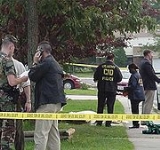
Forensics

Encyclopedia
Forensic science is the application of a broad spectrum of science
s to answer questions of interest to a legal system. This may be in relation to a crime or a civil action. The word forensic comes from the Latin forēnsis, meaning "of or before the forum." In Roman times, a criminal charge meant presenting the case before a group of public individuals in the forum. Both the person accused of the crime and the accuser would give speeches based on their sides of the story. The individual with the best argument and delivery would determine the outcome of the case. This origin is the source of the two modern usages of the word forensic – as a form of legal evidence and as a category of public presentation.
In modern use, the term "forensics" in the place of "forensic science" can be considered correct as the term "forensic" is effectively a synonym
for "legal" or "related to courts". However the term is now so closely associated with the scientific field that many dictionaries include the meaning that equates the word "forensics" with "forensic science".
lacked standardized forensic practices, which aided criminals in escaping punishment. Criminal investigations and trials relied on forced confessions and witness testimony
. However ancient sources contain several accounts of techniques that foreshadow the concepts of forensic science that is developed centuries later, such as the "Eureka" legend told of Archimedes
(287–212 BC).
The account about Archimedes tells of how he invented a method for determining the volume of an object with an irregular shape. According to Vitruvius
, a votive crown
for a temple had been made for King Hiero II, who had supplied the pure gold
to be used, and Archimedes was asked to determine whether some silver
had been substituted by the dishonest goldsmith. Archimedes had to solve the problem without damaging the crown, so he could not melt it down into a regularly shaped body in order to calculate its density
.
While taking a bath, he noticed that the level of the water in the tub rose as he got in, and realized that this effect could be used to determine the volume
of the crown. For practical purposes water is incompressible, so the submerged crown would displace an amount of water equal to its own volume. By dividing the mass of the crown by the volume of water displaced, the density of the crown could be obtained. This density would be lower than that of gold if cheaper and less dense metals had been added. Archimedes then took to the streets naked, so excited by his discovery that he had forgotten to dress, crying "Eureka
!" (Greek
: "εὕρηκα!," meaning "I have found it!"). The test was conducted successfully, proving that silver had indeed been mixed in.
The first written account of using medicine
and entomology
to solve (separate) criminal cases is attributed to the book of Xi Yuan Lu
(translated as "Washing Away of Wrongs"), written in Song Dynasty
China by Song Ci
(宋慈, 1186–1249) in 1248. In one of the accounts, the case of a person murdered with a sickle was solved by a death investigator who instructed everyone to bring his sickle to one location. (He realized it was a sickle by testing various blades on an animal carcass and comparing the wound.) Flies, attracted by the smell of blood, eventually gathered on a single sickle. In light of this, the murderer confessed. The book also offered advice on how to distinguish between a drowning
(water in the lungs) and strangulation (broken neck cartilage
), along with other evidence from examining corpses on determining if a death was caused by murder, suicide or an accident.
, a French army surgeon
, systematically studied the effects of violent death on internal organs. Two Italian
surgeons, Fortunato Fidelis and Paolo Zacchia, laid the foundation of modern pathology
by studying changes that occurred in the structure of the body as the result of disease. In the late 18th century, writings on these topics began to appear. These included A Treatise on Forensic Medicine and Public Health by the French physician Fodéré and The Complete System of Police Medicine by the German medical expert Johann Peter Franck.
In 1773 a Swedish chemist Carl Wilhelm Scheele
devised a way of detecting arsenous oxide, simple arsenic
, in corpses, although only in large quantities. This investigation was expanded, in 1806, by German chemist Valentin Ross, who learned to detect the poison in the walls of a victim's stomach, and by English chemist James Marsh, who used chemical processes to confirm arsenic as the cause of death in an 1836 murder trial.
Two early examples of English forensic science in individual legal proceedings demonstrate the increasing use of logic
and procedure
in criminal investigations. In 1784, in Lancaster
, John Toms was tried and convicted for murdering Edward Culshaw with a pistol. When the dead body of Culshaw was examined, a pistol wad (crushed paper used to secure powder and balls in the muzzle) found in his head wound matched perfectly with a torn newspaper found in Toms' pocket. In Warwick
in 1816, a farm labourer was tried and convicted of the murder of a young maidservant. She had been drowned in a shallow pool and bore the marks of violent assault. The police found footprints and an impression from corduroy cloth with a sewn patch in the damp earth near the pool. There were also scattered grains of wheat
and chaff. The breeches of a farm labourer who had been threshing wheat nearby were examined and corresponded exactly to the impression in the earth near the pool.
Police started using fingerprints for evidence when Juan Vucetich
solved a murder case in Argentina by cutting off a piece of door with a bloody fingerprint on it. Later in the 20th century several British pathologists, Bernard Spilsbury
, Francis Camps
, Sydney Smith
and Keith Simpson
pioneered new forensic science methods in Britain. In 1909 Rodolphe Archibald Reiss founded the first school of forensic science in the world: the "Institut de police scientifique" at the University of Lausanne (UNIL)
.
Forensic science has been fostered by a number of national forensic science learned bodies including the American Academy of Forensic Sciences
(founded 1948; publishers of the Journal of Forensic Sciences), the Canadian Society of Forensic Science
(founded 1953; publishers of the Journal of the Canadian Society of Forensic Science
), The British Academy of Forensic Sciences (founded 1960; publishers of Medicine,science and the law (journal)), and the Australian Academy of Forensic Sciences
(founded 1967; publishers of the Australian Journal of Forensic Sciences).
A history of forensic photography
can be viewed here.
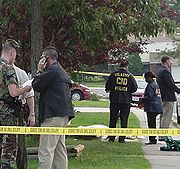
This uses demonstrative evidence
, which is evidence created in preparation of trial by attorneys
or paralegal
s.
, the fictional character created by Sir Arthur Conan Doyle in works produced from 1887 to 1915, used forensic science as one of his investigating methods. Conan Doyle credited the inspiration for Holmes on his teacher at the medical school of the University of Edinburgh
, the gifted surgeon and forensic detective Joseph Bell
.
Agatha Christie's Hercule Poirot and Miss Marple books and television series were also a big hit worldwide.
Decades later the comic strip
Dick Tracy
also featured a detective using a considerable number of forensic methods, although sometimes the methods were more fanciful than actually possible.
Barry Allen (alter ego of The Flash) is a forensic scientist for the Central City police department.
Defence attorney Perry Mason
occasionally used forensic techniques, both in the novels and television series.
One of the earliest television series
to focus on the scientific analysis of evidence was Quincy, M.E.
(1976-83, and based loosely on an even earlier Canadian series titled Wojeck
), with the title character, a medical examiner
working in Los Angeles
solving crimes through careful study. The opening theme of each episode featured a clip of the title character, played by Jack Klugman
, beginning a lecture to a group of police officers with "Gentlemen, you are about to enter the fascinating sphere of police work, the world of forensic medicine." Later series with similar premises include Dexter
, The Mentalist
, CSI
, Cold Case, Bones
, Law & Order
, NCIS
, Criminal Minds
, Silent Witness
, Case Closed
, Monk
, Midsomer Murders
and Waking the Dead
, depict glamorized versions of the activities of 21st-century forensic scientists. Some claim these TV shows have changed individuals' expectations of forensic science, an influence termed the "CSI effect
".
Non-fiction TV shows such as Forensic Files
, The New Detectives
, American Justice
, and Dayle Hinman
's Body of Evidence
have also popularized forensic science.
The Ace Attorney series features forensic science, mainly in Apollo Justice: Ace Attorney and the DS-only game in Phoenix Wright: Ace Attorney
.
On 25 June 2009 the Supreme Court issued a 5-to-4 decision in Melendez-Diaz v. Massachusetts
stating that crime laboratory reports may not be used against criminal defendants at trial unless the analysts responsible for creating them give testimony and subject themselves to cross-examination. The Supreme Court cited the National Academies report Strengthening Forensic Science in the United States in their decision. Writing for the majority, Justice Antonin Scalia referred to the National Research Council report in his assertion that "Forensic evidence is not uniquely immune from the risk of manipulation."
Science
Science is a systematic enterprise that builds and organizes knowledge in the form of testable explanations and predictions about the universe...
s to answer questions of interest to a legal system. This may be in relation to a crime or a civil action. The word forensic comes from the Latin forēnsis, meaning "of or before the forum." In Roman times, a criminal charge meant presenting the case before a group of public individuals in the forum. Both the person accused of the crime and the accuser would give speeches based on their sides of the story. The individual with the best argument and delivery would determine the outcome of the case. This origin is the source of the two modern usages of the word forensic – as a form of legal evidence and as a category of public presentation.
In modern use, the term "forensics" in the place of "forensic science" can be considered correct as the term "forensic" is effectively a synonym
Synonym
Synonyms are different words with almost identical or similar meanings. Words that are synonyms are said to be synonymous, and the state of being a synonym is called synonymy. The word comes from Ancient Greek syn and onoma . The words car and automobile are synonyms...
for "legal" or "related to courts". However the term is now so closely associated with the scientific field that many dictionaries include the meaning that equates the word "forensics" with "forensic science".
Antiquity and the Middle Age
The ancient worldAncient history
Ancient history is the study of the written past from the beginning of recorded human history to the Early Middle Ages. The span of recorded history is roughly 5,000 years, with Cuneiform script, the oldest discovered form of coherent writing, from the protoliterate period around the 30th century BC...
lacked standardized forensic practices, which aided criminals in escaping punishment. Criminal investigations and trials relied on forced confessions and witness testimony
Testimony
In law and in religion, testimony is a solemn attestation as to the truth of a matter. All testimonies should be well thought out and truthful. It was the custom in Ancient Rome for the men to place their right hand on a Bible when taking an oath...
. However ancient sources contain several accounts of techniques that foreshadow the concepts of forensic science that is developed centuries later, such as the "Eureka" legend told of Archimedes
Archimedes
Archimedes of Syracuse was a Greek mathematician, physicist, engineer, inventor, and astronomer. Although few details of his life are known, he is regarded as one of the leading scientists in classical antiquity. Among his advances in physics are the foundations of hydrostatics, statics and an...
(287–212 BC).
The account about Archimedes tells of how he invented a method for determining the volume of an object with an irregular shape. According to Vitruvius
Vitruvius
Marcus Vitruvius Pollio was a Roman writer, architect and engineer, active in the 1st century BC. He is best known as the author of the multi-volume work De Architectura ....
, a votive crown
Votive crown
A votive crown is a votive offering in the form of a crown, normally in precious metals and often adorned with jewels. Especially in the Early Middle Ages, they are of a special form, designed to be suspended by chains at an altar, shrine or image...
for a temple had been made for King Hiero II, who had supplied the pure gold
Gold
Gold is a chemical element with the symbol Au and an atomic number of 79. Gold is a dense, soft, shiny, malleable and ductile metal. Pure gold has a bright yellow color and luster traditionally considered attractive, which it maintains without oxidizing in air or water. Chemically, gold is a...
to be used, and Archimedes was asked to determine whether some silver
Silver
Silver is a metallic chemical element with the chemical symbol Ag and atomic number 47. A soft, white, lustrous transition metal, it has the highest electrical conductivity of any element and the highest thermal conductivity of any metal...
had been substituted by the dishonest goldsmith. Archimedes had to solve the problem without damaging the crown, so he could not melt it down into a regularly shaped body in order to calculate its density
Density
The mass density or density of a material is defined as its mass per unit volume. The symbol most often used for density is ρ . In some cases , density is also defined as its weight per unit volume; although, this quantity is more properly called specific weight...
.
While taking a bath, he noticed that the level of the water in the tub rose as he got in, and realized that this effect could be used to determine the volume
Volume
Volume is the quantity of three-dimensional space enclosed by some closed boundary, for example, the space that a substance or shape occupies or contains....
of the crown. For practical purposes water is incompressible, so the submerged crown would displace an amount of water equal to its own volume. By dividing the mass of the crown by the volume of water displaced, the density of the crown could be obtained. This density would be lower than that of gold if cheaper and less dense metals had been added. Archimedes then took to the streets naked, so excited by his discovery that he had forgotten to dress, crying "Eureka
Eureka (word)
"Eureka" is an interjection used to celebrate a discovery, a transliteration of a word attributed to Archimedes.-Etymology:The word comes from ancient Greek εὕρηκα heúrēka "I have found ", which is the 1st person singular perfect indicative active of the verb heuriskō "I find"...
!" (Greek
Greek language
Greek is an independent branch of the Indo-European family of languages. Native to the southern Balkans, it has the longest documented history of any Indo-European language, spanning 34 centuries of written records. Its writing system has been the Greek alphabet for the majority of its history;...
: "εὕρηκα!," meaning "I have found it!"). The test was conducted successfully, proving that silver had indeed been mixed in.
The first written account of using medicine
Medicine
Medicine is the science and art of healing. It encompasses a variety of health care practices evolved to maintain and restore health by the prevention and treatment of illness....
and entomology
Entomology
Entomology is the scientific study of insects, a branch of arthropodology...
to solve (separate) criminal cases is attributed to the book of Xi Yuan Lu
Collected Cases of Injustice Rectified
Collected Cases of Injustice Rectified or Washing away of wrongs is a Chinese book written by Song Ci in 1247 during the Song Dynasty as a handbook for coroners. The author combined many historical cases of forensic science with his own experiences and wrote the book with an eye to avoiding...
(translated as "Washing Away of Wrongs"), written in Song Dynasty
Song Dynasty
The Song Dynasty was a ruling dynasty in China between 960 and 1279; it succeeded the Five Dynasties and Ten Kingdoms Period, and was followed by the Yuan Dynasty. It was the first government in world history to issue banknotes or paper money, and the first Chinese government to establish a...
China by Song Ci
Song Ci
Song Ci was a forensic medical expert active during the Southern Song Dynasty who wrote a groundbreaking book titled Collected Cases of Injustice Rectified ....
(宋慈, 1186–1249) in 1248. In one of the accounts, the case of a person murdered with a sickle was solved by a death investigator who instructed everyone to bring his sickle to one location. (He realized it was a sickle by testing various blades on an animal carcass and comparing the wound.) Flies, attracted by the smell of blood, eventually gathered on a single sickle. In light of this, the murderer confessed. The book also offered advice on how to distinguish between a drowning
Drowning
Drowning is death from asphyxia due to suffocation caused by water entering the lungs and preventing the absorption of oxygen leading to cerebral hypoxia....
(water in the lungs) and strangulation (broken neck cartilage
Cartilage
Cartilage is a flexible connective tissue found in many areas in the bodies of humans and other animals, including the joints between bones, the rib cage, the ear, the nose, the elbow, the knee, the ankle, the bronchial tubes and the intervertebral discs...
), along with other evidence from examining corpses on determining if a death was caused by murder, suicide or an accident.
Modern history
In the 16th-century Europe medical practitioners in army and university settings began to gather information on cause and manner of death. Ambroise ParéAmbroise Paré
Ambroise Paré was a French surgeon. He was the great official royal surgeon for kings Henry II, Francis II, Charles IX and Henry III and is considered as one of the fathers of surgery and modern forensic pathology. He was a leader in surgical techniques and battlefield medicine, especially the...
, a French army surgeon
Surgery
Surgery is an ancient medical specialty that uses operative manual and instrumental techniques on a patient to investigate and/or treat a pathological condition such as disease or injury, or to help improve bodily function or appearance.An act of performing surgery may be called a surgical...
, systematically studied the effects of violent death on internal organs. Two Italian
Italian people
The Italian people are an ethnic group that share a common Italian culture, ancestry and speak the Italian language as a mother tongue. Within Italy, Italians are defined by citizenship, regardless of ancestry or country of residence , and are distinguished from people...
surgeons, Fortunato Fidelis and Paolo Zacchia, laid the foundation of modern pathology
Pathology
Pathology is the precise study and diagnosis of disease. The word pathology is from Ancient Greek , pathos, "feeling, suffering"; and , -logia, "the study of". Pathologization, to pathologize, refers to the process of defining a condition or behavior as pathological, e.g. pathological gambling....
by studying changes that occurred in the structure of the body as the result of disease. In the late 18th century, writings on these topics began to appear. These included A Treatise on Forensic Medicine and Public Health by the French physician Fodéré and The Complete System of Police Medicine by the German medical expert Johann Peter Franck.
In 1773 a Swedish chemist Carl Wilhelm Scheele
Carl Wilhelm Scheele
Carl Wilhelm Scheele was a German-Swedish pharmaceutical chemist. Isaac Asimov called him "hard-luck Scheele" because he made a number of chemical discoveries before others who are generally given the credit...
devised a way of detecting arsenous oxide, simple arsenic
Arsenic
Arsenic is a chemical element with the symbol As, atomic number 33 and relative atomic mass 74.92. Arsenic occurs in many minerals, usually in conjunction with sulfur and metals, and also as a pure elemental crystal. It was first documented by Albertus Magnus in 1250.Arsenic is a metalloid...
, in corpses, although only in large quantities. This investigation was expanded, in 1806, by German chemist Valentin Ross, who learned to detect the poison in the walls of a victim's stomach, and by English chemist James Marsh, who used chemical processes to confirm arsenic as the cause of death in an 1836 murder trial.
Two early examples of English forensic science in individual legal proceedings demonstrate the increasing use of logic
Logic
In philosophy, Logic is the formal systematic study of the principles of valid inference and correct reasoning. Logic is used in most intellectual activities, but is studied primarily in the disciplines of philosophy, mathematics, semantics, and computer science...
and procedure
Procedure (term)
A procedure is a sequence of actions or operations which have to be executed in the same manner in order to always obtain the same result under the same circumstances ....
in criminal investigations. In 1784, in Lancaster
Lancaster, Lancashire
Lancaster is the county town of Lancashire, England. It is situated on the River Lune and has a population of 45,952. Lancaster is a constituent settlement of the wider City of Lancaster, local government district which has a population of 133,914 and encompasses several outlying towns, including...
, John Toms was tried and convicted for murdering Edward Culshaw with a pistol. When the dead body of Culshaw was examined, a pistol wad (crushed paper used to secure powder and balls in the muzzle) found in his head wound matched perfectly with a torn newspaper found in Toms' pocket. In Warwick
Warwick
Warwick is the county town of Warwickshire, England. The town lies upon the River Avon, south of Coventry and just west of Leamington Spa and Whitnash with which it is conjoined. As of the 2001 United Kingdom census, it had a population of 23,350...
in 1816, a farm labourer was tried and convicted of the murder of a young maidservant. She had been drowned in a shallow pool and bore the marks of violent assault. The police found footprints and an impression from corduroy cloth with a sewn patch in the damp earth near the pool. There were also scattered grains of wheat
Wheat
Wheat is a cereal grain, originally from the Levant region of the Near East, but now cultivated worldwide. In 2007 world production of wheat was 607 million tons, making it the third most-produced cereal after maize and rice...
and chaff. The breeches of a farm labourer who had been threshing wheat nearby were examined and corresponded exactly to the impression in the earth near the pool.
Police started using fingerprints for evidence when Juan Vucetich
Juan Vucetich
Juan Vucetich was a Croatian-born Argentine anthropologist and police official who pioneered the use of fingerprinting.-Biography:...
solved a murder case in Argentina by cutting off a piece of door with a bloody fingerprint on it. Later in the 20th century several British pathologists, Bernard Spilsbury
Bernard Spilsbury
Sir Bernard Henry Spilsbury was an English pathologist. His cases include Hawley Harvey Crippen, the Seddon case and Major Armstrong poisonings, the "brides in the bath" murders by George Joseph Smith, Louis Voisin, Jean-Pierre Vaquier, the Crumbles murders, Norman Thorne, Donald Merrett, the...
, Francis Camps
Francis Camps
Francis Edward Camps, FRCP, FRCpath was a famous English pathologist notable for his work on the cases of serial killer John Christie and suspected serial killer John Bodkin Adams.-Early life and training:...
, Sydney Smith
Sydney Smith (forensic expert)
Sir Sydney Alfred Smith CBE , was a renowned forensic scientist and pathologist. From 1928 to 1953, Smith was Regius Professor of Forensic Medicine at the University of Edinburgh, a well-known forensic department of that time...
and Keith Simpson
Keith Simpson (professor)
Cedric Keith Simpson, CBE, FRCP was an eminent English pathologist. He was Professor of Forensic Medicine in the University of London at Guy's Hospital, and Lecturer in Forensic Medicine at the University of Oxford.-Career:...
pioneered new forensic science methods in Britain. In 1909 Rodolphe Archibald Reiss founded the first school of forensic science in the world: the "Institut de police scientifique" at the University of Lausanne (UNIL)
University of Lausanne
The University of Lausanne in Lausanne, Switzerland was founded in 1537 as a school of theology, before being made a university in 1890. Today about 12,000 students and 2200 researchers study and work at the university...
.
Forensic science has been fostered by a number of national forensic science learned bodies including the American Academy of Forensic Sciences
American Academy of Forensic Sciences
The American Academy of Forensic Sciences is a professional society for people in all areas of forensics.For over sixty years, the AAFS has served a distinguished and diverse membership. Its nearly 6,000 members are divided into eleven sections spanning the forensic enterprise...
(founded 1948; publishers of the Journal of Forensic Sciences), the Canadian Society of Forensic Science
Canadian Society of Forensic Science
The Canadian Society of Forensic Science is a professional association aimed at maintaining professional standards and promoting and enhancing the study and stature of forensic science. Membership in the society is open internationally to professionals with an active interest in the forensic...
(founded 1953; publishers of the Journal of the Canadian Society of Forensic Science
Journal of the Canadian Society of Forensic Science
The Canadian Society of Forensic Science Journal is a Canadian peer reviewed academic journal which publishes original research papers, comments and reviews relating to forensic science....
), The British Academy of Forensic Sciences (founded 1960; publishers of Medicine,science and the law (journal)), and the Australian Academy of Forensic Sciences
Australian Academy of Forensic Sciences
The Australian Academy of Forensic Sciences is a multi-disciplinary learned society founded in 1967 modelled on the British Academy of Forensic Sciences...
(founded 1967; publishers of the Australian Journal of Forensic Sciences).
A history of forensic photography
History of forensic photography
Forensic science holds the branch of Forensic photography which encompasses documenting both suspected and convicted criminals, and also the crime scenes, victims, and other evidence needed to make a conviction...
can be viewed here.
Subdivisions
- Computational forensicsComputational forensicsComputational forensics is a quantitative approach to the methodology of the forensic sciences. It involves computer-based modeling, computer simulation, analysis, and recognition in studying and solving problems posed in various forensic disciplines...
concerns the development of algorithms and software to assist forensic examination. - CriminalisticsCrime LabA crime laboratory - often shortened to crime lab - is a scientific laboratory, using primarily forensic science for the purpose of examining evidence from criminal cases.- Lab personnel :A typical crime lab has two sets of personnel:...
is the application of various sciences to answer questions relating to examination and comparison of biological evidence, trace evidenceTrace evidenceTrace evidence is evidence that occurs when different objects contact one another. Such materials are often transferred by heat induced by contact friction....
, impression evidence (such as fingerprintFingerprintA fingerprint in its narrow sense is an impression left by the friction ridges of a human finger. In a wider use of the term, fingerprints are the traces of an impression from the friction ridges of any part of a human hand. A print from the foot can also leave an impression of friction ridges...
s, footwear impressionsForensic footwear evidenceForensic footwear evidence can be used in legal proceedings to help prove the identities of persons at the crime scene. Footwear evidence is often the most abundant form of evidence at a crime scene and in some cases can prove to be as specific as a fingerprint. Initially investigators will look to...
, and tire tracksForensic tire tread evidenceForensic tire tread evidence records and analyzes impressions of vehicle tire treads for use in legal proceedings to help prove the identities of persons at the crime scene. Every tire will show different amounts of tread wear, different amounts of damage in the form of tiny cuts and nicks...
), controlled substanceControlled substanceA controlled substance is generally a drug or chemical whose manufacture, possession, or use are regulated by a government. This may include illegal drugs and prescription medications ....
s, ballisticsBallisticsBallistics is the science of mechanics that deals with the flight, behavior, and effects of projectiles, especially bullets, gravity bombs, rockets, or the like; the science or art of designing and accelerating projectiles so as to achieve a desired performance.A ballistic body is a body which is...
, firearm and toolmark examination, and other evidence in criminal investigations. In typical circumstances evidence is processed in a Crime labCrime LabA crime laboratory - often shortened to crime lab - is a scientific laboratory, using primarily forensic science for the purpose of examining evidence from criminal cases.- Lab personnel :A typical crime lab has two sets of personnel:...
. - Digital forensicsDigital forensicsDigital forensics is a branch of forensic science encompassing the recovery and investigation of material found in digital devices, often in relation to computer crime...
is the application of proven scientific methods and techniques in order to recover data from electronic / digital media. Digital Forensic specialists work in the field as well as in the lab. - Forensic accountingForensic accountingForensic accounting is the specialty practice area of accountancy that describes engagements that result from actual or anticipated disputes or litigation. "Forensic" means "suitable for use in a court of law", and it is to that standard and potential outcome that forensic accountants generally...
is the study and interpretation of accounting evidence - Forensic aerial photography is the study and interpretation of aerial photographic evidence
- Forensic anthropologyForensic anthropologyForensic anthropology is the application of the science of physical anthropology and human osteology in a legal setting, most often in criminal cases where the victim's remains are in the advanced stages of decomposition. A forensic anthropologist can assist in the identification of deceased...
is the application of physical anthropologyPhysical anthropologyBiological anthropology is that branch of anthropology that studies the physical development of the human species. It plays an important part in paleoanthropology and in forensic anthropology...
in a legal setting, usually for the recovery and identification of skeletonizedSkeletonization (forensics)In forensics, skeletonization refers to the complete decomposition of the non-bony tissues of a corpse, leading to a bare skeleton. In a temperate climate, it usually requires three weeks to several years for a body to completely decompose into a skeleton, depending on factors such as temperature,...
human remains. - Forensic archaeologyForensic archaeologyForensic archaeology, a forensic science, is the application of archaeological principles, techniques and methodologies in a legal context .-Overview:...
is the application of a combination of archaeological techniques and forensic science, typically in law enforcement. - Forensic astronomyForensic astronomyForensic astronomy is the use of astronomy – the study of celestial objects – to determine past celestial constellations. This has been used, if relatively rarely, in forensic science and for resolving historical problems more generally, notably issues in art history.-Forensic science:As a...
uses methods from astronomyAstronomyAstronomy is a natural science that deals with the study of celestial objects and phenomena that originate outside the atmosphere of Earth...
to determine past celestial constellations for forensic purposes. - Forensic botany is the study of plant life in order to gain information regarding possible crimes.
- Forensic chemistryForensic chemistryForensic chemistry is the application of chemistry to law enforcement or the failure of products or processes. Many different analytical methods may be used to reveal what chemical changes occurred during an incident, and so help reconstruct the sequence of events...
is the study of detection and identification of illicit drugs, accelerants used in arson cases, explosive and gunshot residueGunshot residueGunshot residue is principally composed of burnt and unburnt particles from the explosive primer, the propellant, as well as components from the bullet, the cartridge case and the firearm used...
. - Forensic dactyloscopyFingerprintA fingerprint in its narrow sense is an impression left by the friction ridges of a human finger. In a wider use of the term, fingerprints are the traces of an impression from the friction ridges of any part of a human hand. A print from the foot can also leave an impression of friction ridges...
is the study of fingerprints. - Forensic document examination or questioned document examinationQuestioned document examinationQuestioned document examination is the forensic science discipline pertaining to documents that are in dispute in a court of law...
answers questions about a disputed document using a variety of scientific processes and methods. Many examinations involve a comparison of the questioned document, or components of the document, with a set of known standards. The most common type of examination involves handwriting, whereby the examiner tries to address concerns about potential authorship. - Forensic DNA analysisGenetic fingerprintingDNA profiling is a technique employed by forensic scientists to assist in the identification of individuals by their respective DNA profiles. DNA profiles are encrypted sets of numbers that reflect a person's DNA makeup, which can also be used as the person's identifier...
takes advantage of the uniqueness of an individual's DNA to answer forensic questions such as paternity/maternity testing and placing a suspect at a crime scene, e.g. in a rape investigationRape investigationRape investigation is the procedure to gather facts about a suspected rape, including forensic identification of a perpetrator, type of rape and other details....
. - Forensic engineeringForensic engineeringForensic engineering is the investigation of materials, products, structures or components that fail or do not operate or function as intended, causing personal injury or damage to property. The consequences of failure are dealt with by the law of product liability. The field also deals with...
is the scientific examination and analysis of structures and products relating to their failure or cause of damage. - Forensic entomologyForensic entomologyForensic entomology is the application and study of insect and other arthropod biology to criminal matters. It is primarily associated with death investigations; however, it may also be used to detect drugs and poisons, determine the location of an incident, and find the presence and time of the...
deals with the examination of insects in, on and around human remains to assist in determination of time or location of death. It is also possible to determine if the body was moved after death. - Forensic geologyForensic geologyForensic Geology is the study of evidence relating to minerals, soil, petroleums, and other materials found in the Earth used to answer questions raised by the legal system....
deals with trace evidence in the form of soils, minerals and petroleum. - Forensic geophysics is the application of geophysical techniques such as radar for detecting objects hidden underground or underwater.
- Forensic intelligence process starts with the collection of data and ends with the integration of results within into the analysis of crimes under investigation
- Forensic Interviews are conducted using the science of professionally using expertise to conduct a variety of investigative interviews with victims, witnesses, suspects or other sources to determine the facts regarding suspicions, allegations or specific incidents in either public or private sector settings.
- Forensic limnology is the analysis of evidence collected from crime scenes in or around fresh-water sources. Examination of biological organisms, in particular diatomDiatomDiatoms are a major group of algae, and are one of the most common types of phytoplankton. Most diatoms are unicellular, although they can exist as colonies in the shape of filaments or ribbons , fans , zigzags , or stellate colonies . Diatoms are producers within the food chain...
s, can be useful in connecting suspects with victims. - Forensic linguisticsForensic linguisticsForensic linguistics is the application of linguistic knowledge, methods and insights to the forensic context of law, language, crime investigation, trial, and judicial procedure. It is a branch of applied linguistics...
deals with issues in the legal system that requires linguistic expertise. - Forensic meteorologyForensic meteorologyForensic meteorology is the process of reconstructing weather events for a certain location. This is done by acquiring local weather reports, radar and satellite images, and eyewitness accounts. Forensic meteorology is most often used in court cases for either insurance companies or a murder...
is a site-specific analysis of past weather conditions for a point of loss. - Forensic odontology is the study of the uniqueness of dentition, better known as the study of teeth.
- Forensic optometry is the study of glasses and other eye wear relating to crime scenes and criminal investigations
- Forensic pathologyForensic pathologyForensic pathology is a branch of pathology concerned with determining the cause of death by examination of a corpse. The autopsy is performed by the pathologist at the request of a coroner or medical examiner usually during the investigation of criminal law cases and civil law cases in some...
is a field in which the principles of medicineMedicineMedicine is the science and art of healing. It encompasses a variety of health care practices evolved to maintain and restore health by the prevention and treatment of illness....
and pathologyPathologyPathology is the precise study and diagnosis of disease. The word pathology is from Ancient Greek , pathos, "feeling, suffering"; and , -logia, "the study of". Pathologization, to pathologize, refers to the process of defining a condition or behavior as pathological, e.g. pathological gambling....
are applied to determine a cause of death or injury in the context of a legal inquiry. - Forensic podiatryForensic PodiatryForensic Podiatry is a sub-discipline of forensic science wherein knowledge of forensic medicine is used in conjunction with knowledge of the anatomy, function, deformities and diseases of the foot, ankle, lower extremities, and at times, the entire human body, to examine foot-related evidence in a...
is an application of the study of feet footprintFootprintFootprints are the impressions or images left behind by a person walking. Hoofprints and pawprints are those left by animals with hooves or paws rather than feet, while "shoeprints" is the specific term for prints made by shoes...
or footwear and their traces to analyze scene of crime and to establish personal identity in forensic examinations. - Forensic psychiatryForensic psychiatryForensic psychiatry is a sub-speciality of psychiatry and an auxiliar science of criminology. It encompasses the interface between law and psychiatry...
is a specialised branch of psychiatry as applied to and based on scientific criminology. - Forensic psychologyForensic psychologyForensic psychology is the intersection between psychology and the criminal justice system. It involves understanding criminal law in the relevant jurisdictions in order to be able to interact appropriately with judges, attorneys and other legal professionals...
is the study of the mind of an individual, using forensic methods. Usually it determines the circumstances behind a criminal's behavior. - Forensic seismologyForensic seismologyForensic seismology is the forensic use of the techniques of seismology to detect and study distant phenomena, particularly explosions, including those of nuclear weapons....
is the study of techniques to distinguish the seismic signals generated by underground nuclear explosions from those generated by earthquakes. - Forensic serologyForensic serologyForensic serology is the detection, classification and study of various bodily fluids such as blood, semen, fecal matter and perspiration, and their relationship to a crime scene. A forensic serologist may also be involved in DNA analysis and bloodstain pattern analysis....
is the study of the body fluids. - Forensic toxicologyForensic toxicologyForensic toxicology is the use of toxicology and other disciplines such as analytical chemistry, pharmacology and clinical chemistry to aid medical or legal investigation of death, poisoning, and drug use...
is the study of the effect of drugsHard and soft drugsHard and Soft drugs are terms to distinguish between psychoactive drugs that are addictive and perceived as especially damaging and drugs that are believed to be non-addictive and with fewer dangers associated with their use...
and poisonPoisonIn the context of biology, poisons are substances that can cause disturbances to organisms, usually by chemical reaction or other activity on the molecular scale, when a sufficient quantity is absorbed by an organism....
s on/in the human body. - Forensic video analysis is the scientific examination, comparison and evaluation of video in legal matters.
- Mobile device forensicsMobile device forensicsMobile device forensics is a branch of digital forensics relating to recovery of digital evidence or data from a mobile device under forensically sound conditions...
is the scientific examination and evaluation of evidence found in mobile phones, e.g. Call History and Deleted SMS, and includes SIM Card Forensics - Trace evidenceTrace evidenceTrace evidence is evidence that occurs when different objects contact one another. Such materials are often transferred by heat induced by contact friction....
analysis is the analysis and comparison of trace evidence including glass, paint, fibres and hair.
Notable forensic scientists
- Michael BadenMichael BadenMichael M. Baden is a physician and board-certified forensic pathologist known for his work investigating high-profile deaths and as a host of HBO's Autopsy. He is also the Forensic Science Contributor for Fox News Channel...
(1934 – ) - William M. BassWilliam M. BassWilliam Marvin Bass III is an American forensic anthropologist, best known for his research on human osteology and human decomposition. He has also assisted federal, local, and non-U.S. authorities in the identification of human remains...
- Joseph BellJoseph BellJoseph Bell, JP, DL, FRCS was a famous Scottish lecturer at the medical school of the University of Edinburgh in the 19th century. He is perhaps best known as an inspiration for the literary character Sherlock Holmes....
(1837–1911) - Sara C. BiselSara C. BiselDr. Sara C. Bisel was a physical anthropologist and classical archaeologist who played a prominent role in early scientific research at Herculaneum, a Mediterranean coastal town destroyed by the 79 CE eruption of Mount Vesuvius. Her pioneering work in the chemical and physical analysis of...
(1932–1996) - Ellis R. KerleyEllis R. KerleyEllis R. Kerley was a Canadian anthropologist, and pioneer in the field of Forensic anthropology, which is a field of expertise particularly useful to criminal investigators and for the identification of human remains for humanitarian purposes...
(1924–1998) - Paul L. Kirk (1902–1970)
- Clea KoffClea KoffClea Koff is a British-born American forensic anthropologist who worked several years for the United Nations International Criminal Tribunal for Rwanda and the International Criminal Tribunal for the former Yugoslavia in Rwanda, Bosnia, Croatia, Serbia, and in 2000 in Kosovo.-Early life:Koff, who...
(1972 – ) - Wilton M. Krogman (1903–1987)
- Henry C. Lee (1938 – )
- Edmond LocardEdmond LocardDr. Edmond Locard was a pioneer in forensic science who became known as the Sherlock Holmes of France. He formulated the basic principle of forensic science: "Every contact leaves a trace"...
(1877–1966) - William R. MaplesWilliam R. Maples* Maples, William R. and Browning, Michael . Dead Men Do Tell Tales. Existe versión en español "Los muertos también hablan" -External links:* * *...
(1937–1997) - Albert S. OsbornAlbert S. OsbornAlbert Sherman Osborn is considered the father of the science of questioned document examination in North America . His seminal book Questioned Documents was first published in 1910 and later heavily revised as a second edition in 1929...
(1858–1946) - Skip PalenikSkip PalenikSkip Palenik is an American analytical microscopist, forensic scientist, lecturer, and author. He is most famous for providing trace evidence analysis and forensic microscopy for many high-profile cases including the Oklahoma City Bombing, Unabomber investigation, Hillside Strangler investigation...
(1946 - ) - Francis CampsFrancis CampsFrancis Edward Camps, FRCP, FRCpath was a famous English pathologist notable for his work on the cases of serial killer John Christie and suspected serial killer John Bodkin Adams.-Early life and training:...
(1905-1972) - Keith SimpsonKeith Simpson (professor)Cedric Keith Simpson, CBE, FRCP was an eminent English pathologist. He was Professor of Forensic Medicine in the University of London at Guy's Hospital, and Lecturer in Forensic Medicine at the University of Oxford.-Career:...
(1907–1985) - Clyde SnowClyde SnowClyde Snow is a well known U.S. forensic anthropologist. Some of his skeletal confirmations include John F. Kennedy, victims of John Wayne Gacy, King Tutankhamun, victims of the Oklahoma City bombing, and Dr. Josef Mengele.Snow started his higher education at the New Mexico Military Institute were...
(1928 – ) - Bernard SpilsburyBernard SpilsburySir Bernard Henry Spilsbury was an English pathologist. His cases include Hawley Harvey Crippen, the Seddon case and Major Armstrong poisonings, the "brides in the bath" murders by George Joseph Smith, Louis Voisin, Jean-Pierre Vaquier, the Crumbles murders, Norman Thorne, Donald Merrett, the...
(1877–1947) - Auguste Ambroise TardieuAuguste Ambroise TardieuAuguste Ambroise Tardieu was a French medical doctor and the pre-eminent forensic medical scientist of the mid-19th century.Tardieu's specialties were forensic medicine and toxicology...
(1818–1879) - Paul UhlenhuthPaul UhlenhuthPaul Theodor Uhlenhuth was a German bacteriologist and hygienist and an assistant professor at the Institute of Hygiene at the University of Greifswald...
(1870–1957) - Cyril WechtCyril WechtDr. Cyril Harrison Wecht is an American forensic pathologist. He has been a consultant in numerous high-profile cases, but is perhaps best known for his criticism of the Warren Commission's findings concerning the assassination of John F...
(1931 – )
Questionable techniques
Some forensic techniques, believed to be scientifically sound at the time they were used, have turned out later to have much less scientific merit or none. Some such techniques include:- Comparative bullet-lead analysisComparative bullet-lead analysisComparative bullet-lead analysis also known as Compositional bullet-lead analysis) is a now discredited and abandoned forensic technique which used chemistry to link crime scene bullets to ones possessed by suspects on the theory that each batch of lead had a unique elemental makeup.The technique...
was used by the FBI for over four decades, starting with the John F. Kennedy assassinationJohn F. Kennedy assassinationJohn Fitzgerald Kennedy, the thirty-fifth President of the United States, was assassinated at 12:30 p.m. Central Standard Time on Friday, November 22, 1963, in Dealey Plaza, Dallas, Texas...
in 1963. The theory was that each batch of ammunitionAmmunitionAmmunition is a generic term derived from the French language la munition which embraced all material used for war , but which in time came to refer specifically to gunpowder and artillery. The collective term for all types of ammunition is munitions...
possessed a chemical makeup so distinct that a bullet could be traced back to a particular batch or even a specific box. Internal studies and an outside study by the National Academy of SciencesUnited States National Academy of SciencesThe National Academy of Sciences is a corporation in the United States whose members serve pro bono as "advisers to the nation on science, engineering, and medicine." As a national academy, new members of the organization are elected annually by current members, based on their distinguished and...
found that the technique was unreliable, and the FBI abandoned the test in 2005. - Forensic dentistryForensic DentistryForensic dentistry or forensic odontology is the proper handling, examination and evaluation of dental evidence, which will be then presented in the interest of justice. The evidence that may be derived from teeth, is the age and identification of the person to whom the teeth belong...
has come under fire: in at least two cases bite-mark evidence has been used to convict people of murder who were later freed by DNA evidence. A 1999 study by a member of the American Board of Forensic Odontology found a 63 percent rate of false identifications and is commonly referenced within online news stories and conspiracy websites. The study was based on an informal workshop during an ABFO meeting, which many members did not consider a valid scientific setting.
Litigation science
Litigation science describes analysis or data developed or produced expressly for use in a trial versus those produced in the course of independent research. This distinction was made by the US 9th Circuit Court of Appeals when evaluating the admissibility of experts.This uses demonstrative evidence
Demonstrative evidence
Demonstrative evidence is evidence in the form of a representation of an object. This is, as opposed to, real evidence, testimony, or other forms of evidence used at trial.-Examples:...
, which is evidence created in preparation of trial by attorneys
Lawyer
A lawyer, according to Black's Law Dictionary, is "a person learned in the law; as an attorney, counsel or solicitor; a person who is practicing law." Law is the system of rules of conduct established by the sovereign government of a society to correct wrongs, maintain the stability of political...
or paralegal
Paralegal
Paralegal is used in most jurisdictions to describe a paraprofessional who assists qualified lawyers in their legal work. This is true in the United States and many other countries. However, in Ontario, Canada, paralegals are licensed by the Law Society of Upper Canada, giving paralegals an...
s.
Examples in popular culture
Sherlock HolmesSherlock Holmes
Sherlock Holmes is a fictional detective created by Scottish author and physician Sir Arthur Conan Doyle. The fantastic London-based "consulting detective", Holmes is famous for his astute logical reasoning, his ability to take almost any disguise, and his use of forensic science skills to solve...
, the fictional character created by Sir Arthur Conan Doyle in works produced from 1887 to 1915, used forensic science as one of his investigating methods. Conan Doyle credited the inspiration for Holmes on his teacher at the medical school of the University of Edinburgh
University of Edinburgh
The University of Edinburgh, founded in 1583, is a public research university located in Edinburgh, the capital of Scotland, and a UNESCO World Heritage Site. The university is deeply embedded in the fabric of the city, with many of the buildings in the historic Old Town belonging to the university...
, the gifted surgeon and forensic detective Joseph Bell
Joseph Bell
Joseph Bell, JP, DL, FRCS was a famous Scottish lecturer at the medical school of the University of Edinburgh in the 19th century. He is perhaps best known as an inspiration for the literary character Sherlock Holmes....
.
Agatha Christie's Hercule Poirot and Miss Marple books and television series were also a big hit worldwide.
Decades later the comic strip
Comic strip
A comic strip is a sequence of drawings arranged in interrelated panels to display brief humor or form a narrative, often serialized, with text in balloons and captions....
Dick Tracy
Dick Tracy
Dick Tracy is a comic strip featuring Dick Tracy, a hard-hitting, fast-shooting and intelligent police detective. Created by Chester Gould, the strip made its debut on October 4, 1931, in the Detroit Mirror. It was distributed by the Chicago Tribune New York News Syndicate...
also featured a detective using a considerable number of forensic methods, although sometimes the methods were more fanciful than actually possible.
Barry Allen (alter ego of The Flash) is a forensic scientist for the Central City police department.
Defence attorney Perry Mason
Perry Mason
Perry Mason is a fictional character, a defense attorney who was the main character in works of detective fiction authored by Erle Stanley Gardner. Perry Mason was featured in more than 80 novels and short stories, most of which had a plot involving his client's murder trial...
occasionally used forensic techniques, both in the novels and television series.
One of the earliest television series
Television program
A television program , also called television show, is a segment of content which is intended to be broadcast on television. It may be a one-time production or part of a periodically recurring series...
to focus on the scientific analysis of evidence was Quincy, M.E.
Quincy, M.E.
Quincy, M.E., also called Quincy, is a United States television series from Universal Studios that aired from October 3, 1976, to September 5, 1983, on NBC...
(1976-83, and based loosely on an even earlier Canadian series titled Wojeck
Wojeck
Wojeck is a Canadian dramatic television series, which aired on the CBC from 1966 to 1968. It was the first successful drama series on English Canadian television....
), with the title character, a medical examiner
Medical examiner
A medical examiner is a medically qualified government officer whose duty is to investigate deaths and injuries that occur under unusual or suspicious circumstances, to perform post-mortem examinations, and in some jurisdictions to initiate inquests....
working in Los Angeles
Los Ángeles
Los Ángeles is the capital of the province of Biobío, in the commune of the same name, in Region VIII , in the center-south of Chile. It is located between the Laja and Biobío rivers. The population is 123,445 inhabitants...
solving crimes through careful study. The opening theme of each episode featured a clip of the title character, played by Jack Klugman
Jack Klugman
Jacob Joachim "Jack" Klugman is an American stage, film and television actor known for his roles in sitcoms, movies, and television and on Broadway...
, beginning a lecture to a group of police officers with "Gentlemen, you are about to enter the fascinating sphere of police work, the world of forensic medicine." Later series with similar premises include Dexter
Dexter (TV series)
Dexter is an American television drama series, which debuted on Showtime on October 1, 2006. The sixth season premiered on October 2, 2011. The series centers on Dexter Morgan , a bloodstain pattern analyst for the Miami Metro Police Department who moonlights as a serial killer...
, The Mentalist
The Mentalist
The Mentalist is an American police procedural television series which debuted on September 23, 2008, on CBS. The show was created by Bruno Heller, who is also the show's executive producer...
, CSI
CSI: Crime Scene Investigation
CSI: Crime Scene Investigation is an American crime drama television series, which premiered on CBS on October 6, 2000. The show was created by Anthony E. Zuiker and produced by Jerry Bruckheimer...
, Cold Case, Bones
Bones (TV series)
Bones is an American crime drama television series that premiered on the Fox Network on September 13, 2005. The show is based on forensic anthropology and forensic archaeology, with each episode focusing on an FBI case file concerning the mystery behind human remains brought by FBI Special Agent...
, Law & Order
Law & Order
Law & Order is an American police procedural and legal drama television series, created by Dick Wolf and part of the Law & Order franchise. It aired on NBC, and in syndication on various cable networks. Law & Order premiered on September 13, 1990, and completed its 20th and final season on May 24,...
, NCIS
NCIS (TV series)
NCIS, formerly known as NCIS: Naval Criminal Investigative Service, is an American police procedural drama television series revolving around a fictional team of special agents from the Naval Criminal Investigative Service, which conducts criminal investigations involving the U.S...
, Criminal Minds
Criminal Minds
Criminal Minds is an American police procedural drama that premiered September 22, 2005, on CBS. The series follows a team of profilers from the FBI's Behavioral Analysis Unit based in Quantico, Virginia. The BAU is part of the FBI National Center for the Analysis of Violent Crime...
, Silent Witness
Silent Witness
Silent Witness is a BBC crime thriller series focusing on a team of forensic pathology experts and their investigations into various crimes. First broadcast in February 1996, the series is still airing to the present day, with a fifteenth series expected to air in January 2012. The series was...
, Case Closed
Case Closed
Case Closed, known as in Japan, is a Japanese detective manga series written and illustrated by Gosho Aoyama. The series is serialized in Shogakukan's Weekly Shōnen Sunday since February 2, 1994, and has been collected in 73 tankōbon volumes as of September 2011...
, Monk
Monk (TV series)
Monk is an American comedy-drama detective mystery television series created by Andy Breckman and starring Tony Shalhoub as the titular character, Adrian Monk. It originally ran from 2002 to 2009 and is primarily a mystery series, although it has dark and comic touches.The series debuted on July...
, Midsomer Murders
Midsomer Murders
Midsomer Murders is a British television detective drama that has aired on ITV since 1997. The show is based on the books by Caroline Graham, as originally adapted by Anthony Horowitz. The lead character is DCI Tom Barnaby who works for Causton CID. When Nettles left the show in 2011 he was...
and Waking the Dead
Waking the Dead (TV series)
Waking the Dead is a British television police procedural crime drama series produced by the BBC featuring a fictional Cold Case Unit comprising CID police officers, a psychological profiler and a forensic scientist. A pilot episode aired in September 2000 and there have been a total of nine series...
, depict glamorized versions of the activities of 21st-century forensic scientists. Some claim these TV shows have changed individuals' expectations of forensic science, an influence termed the "CSI effect
CSI Effect
The CSI effect, also known as the CSI syndrome and the CSI infection, is any of several ways in which the exaggerated portrayal of forensic science on crime television shows such as CSI: Crime Scene Investigation influences public perception...
".
Non-fiction TV shows such as Forensic Files
Forensic Files
Forensic Files is an American documentary-style series which reveals how forensic science is used to solve violent crimes, mysterious accidents, and even outbreaks of illness. The show is broadcast on truTV, narrated by Peter Thomas, and produced by Medstar Television, in association with truTV...
, The New Detectives
The New Detectives
The New Detectives: Case Studies in Forensic Science is a documentary true crime television show that aired two to three different cases in forensic science per episode. Episode reruns currently air on the Discovery Channel, TLC and the Investigation Discovery network...
, American Justice
American Justice
American Justice is an American criminal justice television program on the A&E Network, hosted by Bill Kurtis. The show features interesting or notable cases, such as the Selena Murder of a Star, Scarsdale Diet doctor murder, the Hillside Stranglers, Matthew Shepard, or the Wells Fargo heist, with...
, and Dayle Hinman
Dayle Hinman
Dayle Hinman is a retired FBI-trained criminal profiler. She has starred in a television series on TruTV , Body of Evidence: From the case files of Dayle Hinman, documenting some of the cases she was assigned to while working as a Special Agent at the Florida Department of Law Enforcement , since...
's Body of Evidence
Body of Evidence
Body of Evidence may refer to:*Body of Evidence: From the case files of Dayle Hinman, television series showcasing the case files of Dayle Hinman on truTV*Body of Evidence , a 1993 erotic drama starring Madonna and Willem Dafoe...
have also popularized forensic science.
The Ace Attorney series features forensic science, mainly in Apollo Justice: Ace Attorney and the DS-only game in Phoenix Wright: Ace Attorney
Phoenix Wright: Ace Attorney
Phoenix Wright: Ace Attorney, released in Japan as , is an adventure video game published and developed by Capcom in Japan, North America, and Europe, and published by Nintendo in Australia...
.
Controversies
Questions about forensic science, fingerprint evidence and the assumption behind these disciplines have been brought to light in some publications, the latest being an article in the New York Post. The article stated that "No one has proved even the basic assumption: That everyone's fingerprint is unique." The article also stated that "Now such assumptions are being questioned - and with it may come a radical change in how forensic science is used by police departments and prosecutors."On 25 June 2009 the Supreme Court issued a 5-to-4 decision in Melendez-Diaz v. Massachusetts
Melendez-Diaz v. Massachusetts
Melendez-Diaz v. Massachusetts, 129 S.Ct. 2527 , is a United States Supreme Court case in which the Court held that it was a violation of the Sixth Amendment right of confrontation for a prosecutor to submit a chemical drug test report without the testimony of the person who performed the test...
stating that crime laboratory reports may not be used against criminal defendants at trial unless the analysts responsible for creating them give testimony and subject themselves to cross-examination. The Supreme Court cited the National Academies report Strengthening Forensic Science in the United States in their decision. Writing for the majority, Justice Antonin Scalia referred to the National Research Council report in his assertion that "Forensic evidence is not uniquely immune from the risk of manipulation."
See also
Further reading
- Anil Aggrawal's Internet Journal of Forensic Medicine and Toxicology.
- Crime Science: Methods of Forensic Detection by Joe Nickell and John F. Fischer. University Press of KentuckyUniversity Press of KentuckyThe University Press of Kentucky is the scholarly publisher for the Commonwealth of Kentucky, and was organized in 1969 as successor to the University of Kentucky Press. The university had sponsored scholarly publication since 1943. In 1949 the press was established as a separate academic agency...
, 1999. ISBN 0-8131-2091-8. - Dead Reckoning: The New Science of Catching Killers by Michael Baden, M.D, former New York City Medical Examiner, and Marion Roach. Simon & Schuster, 2001. ISBN 0-684-86758-3.
- Forensic MagazineForensic MagazineForensic Magazine is a business-to-business magazine published by Vicon Publishing, Inc.The first issue was published in Spring 2004. It has a circulation of more than 9,500 qualified subscribers in both print and digital.Published six times per year, Forensic Magazine is the leading source of...
- Forensicmag.com. - Forensic Materials Engineering: Case Studies by Peter Rhys Lewis, Colin Gagg, Ken Reynolds. CRC PressCRC PressThe CRC Press, LLC is a publishing group which specializes in producing technical books. While many of their books relate to engineering, science and mathematics, their scope also includes books on business, forensics and information technology...
, 2004. - Forensic Science Communications, an open access journal of the FBIFederal Bureau of InvestigationThe Federal Bureau of Investigation is an agency of the United States Department of Justice that serves as both a federal criminal investigative body and an internal intelligence agency . The FBI has investigative jurisdiction over violations of more than 200 categories of federal crime...
. - Forensic sciences international - An international journal dedicated to the applications of medicine and science in the administration of justice - ISSN: 0379-0738 - ElsevierElsevierElsevier is a publishing company which publishes medical and scientific literature. It is a part of the Reed Elsevier group. Based in Amsterdam, the company has operations in the United Kingdom, USA and elsewhere....
- Guide to Information Sources in the Forensic Sciences by Cynthia Holt. Libraries Unlimited, 2006. ISBN 1-59158-221-0.
- International Journal of Digital Crime and Forensics (IJDCF)
- Owen, D. (2000) Hidden Evidence; The Story of Forensic Science and how it Helped to Solve 40 of the World's Toughest Crimes Quintet Publishing, London. ISBN 1-86155-278-5.
- Quinche, Nicolas, Crime, Science et Identité. Anthologie des textes fondateurs de la criminalistique européenne (1860–1930). Genève: Slatkine, 2006, 368p.
- Quinche, Nicolas, « Les victimes, les mobiles et le modus operandi du criminaliste suisse R.-A. Reiss. Enquête sur les stratégies discursives d’un expert du crime (1906-1922)" in Revue Suisse d’Histoire, 58, no 4, décembre 2008, pp. 426–444.
- Quinche, Nicolas, « L’ascension du criminaliste Rodolphe Archibald Reiss », in Le théâtre du crime : Rodolphe A. Reiss (1875–1929). Lausanne : Presses polytechniques et universitaires romandes, 2009, pp. 231–250.
- Quinche, Nicolas, « Sur les traces du crime : la naissance de la police scientifique et technique en Europe », in Revue internationale de criminologie et de police technique et scientifique, vol. LXII, no 2, juin 2009, pp. 8–10.
- Quinche, Nicolas, and Margot, Pierre, « Coulier, Paul-Jean (1824-1890) : A precursor in the history of fingermark detection and their potential use for identifying their source (1863) », in Journal of forensic identification (Californie), 60 (2), March–April 2010, pp. 129–134.
- Quinche, Nicolas, "Sur les traces du crime : de la naissance du regard indicial à l’institutionnalisation de la police scientifique et technique en Suisse et en France. L’essor de l’Institut de police scientifique de l’Université de Lausanne". Genève : Slatkine, 2011, 686p., (Coll. Travaux des Universités suisses), (Thèse de doctorat de l’Université de Lausanne).
- Science Against Crime by Stuart Kind and Michael Overman. Doubleday, 1972. ISBN 0-385-09249-0.
- Structure Magazine no. 40, "RepliSet: High Resolution Impressions of the Teeth of Human Ancestors" by Debbie Guatelli-Steinberg, Assistant Professor of Biological Anthropology, The Ohio State University and John C. Mitchell, Assistant Professor of Biomaterials and Biomechanics School of Dentistry, Oregon Health and Science University.
- The Internet Journal of Biological Anthropology.
- Wiley Encyclopedia of Forensic Science by Allan Jamieson and Andre Moenssens (eds). John Wiley & Sons Ltd, 2009. ISBN 978-0-470-01826-2.
- Wiley Encyclopedia of Forensic Science The online version of the Wiley Encyclopedia of Forensic Science by Allan Jamieson and Andre Moenssens (eds)