


Flying car

Encyclopedia
A slightly different concept that is sometimes referred to as a "flying car
Flying car (fiction)
In fiction, a flying car is a car that can be flown in much the same way as a car may be driven. In some cases such flying cars can also be driven on roads....
", particularly in science fiction, is that of an aircraft that would be practical enough for every-day travel, but would not necessarily be drivable on the roads.
Early experiments
Glenn CurtissGlenn Curtiss
Glenn Hammond Curtiss was an American aviation pioneer and a founder of the U.S. aircraft industry. He began his career as a bicycle then motorcycle builder and racer, later also manufacturing engines for airships as early as 1906...
, the chief rival of the Wright brothers
Wright brothers
The Wright brothers, Orville and Wilbur , were two Americans credited with inventing and building the world's first successful airplane and making the first controlled, powered and sustained heavier-than-air human flight, on December 17, 1903...
, was the first to design a flying car. His large, three-wing Curtiss Autoplane was able to hop, not fly.
In 1926, Henry Ford
Henry Ford
Henry Ford was an American industrialist, the founder of the Ford Motor Company, and sponsor of the development of the assembly line technique of mass production. His introduction of the Model T automobile revolutionized transportation and American industry...
displayed an experimental single-seat aeroplane that he called the "sky flivver
Ford Flivver
The Ford Flivver was a single-seat aircraft introduced by Henry Ford as the "Model T of the Air". After a fatal crash in the prototype, production plans were halted.-Development:...
". The project was abandoned two years later when a distance-record attempt flight crashed, killing the pilot. The Flivver was not a flying car at all, but it did get press attention at the time, exciting the public that they would have a mass produced affordable airplane product that would be made, marketed, sold, and maintained just like an automobile. The airplane was to be as commonplace in the future as the Model T of the time.
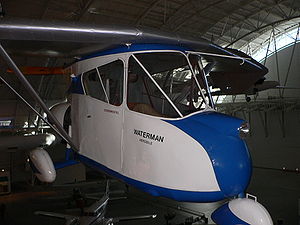
The first flying car to actually fly was built by Waldo Waterman
Waldo Waterman
thumb|200px|Waldo Waterman in 1920Waldo Dean Waterman was an inventor and aviation pioneer from San Diego, California...
. Waterman was associated with Curtiss while Curtiss was pioneering naval aviator on North Island on San Diego Bay
San Diego Bay
San Diego Bay is a natural harbor and deepwater port adjacent to San Diego, California. It is 12 mi/19 km long, 1 mi/1.6 km–3 mi/4.8 km wide...
in the 1910s. On March 21, 1937, Waterman's Arrowbile first took to the air. The Arrowbile was a development of Waterman's tailless aircraft, the Whatsit
Waterman Whatsit
The Whatsit was a swept-wing, tail-less airplane designed by Waldo Waterman between 1911 and 1932...
. It had a wingspan of 38 feet (11 m) and a length of 20 feet 6 inches (6.25 m). On the ground and in the air it was powered by a Studebaker
Studebaker
Studebaker Corporation was a United States wagon and automobile manufacturer based in South Bend, Indiana. Founded in 1852 and incorporated in 1868 under the name of the Studebaker Brothers Manufacturing Company, the company was originally a producer of wagons for farmers, miners, and the...
engine. It could fly at 112 mph (180 km/h) and drive at 56 mph (90 km/h).
Post-war development
In the 1950s, the western world was recovering from World War IIWorld War II
World War II, or the Second World War , was a global conflict lasting from 1939 to 1945, involving most of the world's nations—including all of the great powers—eventually forming two opposing military alliances: the Allies and the Axis...
and everything seemed possible. The flying car was a vision of transportation in the 21st century, and a common feature of science fiction futures.
Although several designs (such as the Convair flying car) have flown, none have enjoyed commercial success, and those that have flown are not widely known about by the general public. The most successful example, in that several were made and one is still flying, is the 1949 Taylor Aerocar. One notable design, Henry Smolinski's Mizar
AVE Mizar
-External links:* * * * * -See also:...
, made by mating the rear end of a Cessna Skymaster
Cessna Skymaster
The Cessna Skymaster is a United States twin-engine civil utility aircraft built in a push-pull configuration. Its engines are mounted in the nose and rear of its pod-style fuselage. Twin booms extend aft of the wings to the vertical stabilizers, with the rear engine between them. The horizontal...
with a Ford Pinto
Ford Pinto
The Ford Pinto is a subcompact car produced by the Ford Motor Company for the model years 1971–1980. The car's name derives from the Pinto horse. Initially offered as a two-door sedan, Ford offered "Runabout" hatchback and wagon models the following year, competing in the U.S. market with the AMC...
, disintegrated during test flights, killing Smolinski and the pilot.
In the 1950s, Ford Motor Company
Ford Motor Company
Ford Motor Company is an American multinational automaker based in Dearborn, Michigan, a suburb of Detroit. The automaker was founded by Henry Ford and incorporated on June 16, 1903. In addition to the Ford and Lincoln brands, Ford also owns a small stake in Mazda in Japan and Aston Martin in the UK...
performed a serious feasibility study for a flying car product. They concluded that such a product was technically feasible, economically manufacturable, and had significant realistic markets. The markets explored included ambulance services, police and emergency services, military uses, and initially, luxury transportation. Some of these markets are now served by light helicopters. However, the flying car explored by Ford was projected to be at least fiftyfold less expensive.
When Ford approached the U.S. Federal Aviation Administration
Federal Aviation Administration
The Federal Aviation Administration is the national aviation authority of the United States. An agency of the United States Department of Transportation, it has authority to regulate and oversee all aspects of civil aviation in the U.S...
(FAA) about regulatory issues, the critical problem was that the (then) known forms of air traffic control were inadequate for the volume of traffic Ford proposed. At the time, air traffic control consisted of flight numbers, altitudes and headings written on little slips of paper and placed in a case. Quite possibly computerized traffic control, or some form of directional allocation by altitude could resolve the problems. Other problems would also need to be resolved in some ways, however, including intoxicated pilots or pilots that drive/fly without a license. Standards would have to be agreed upon by the international community, such as air miles being translated to nautical miles and not affecting the reading of the odometer. Furthermore, there would be serious concerns among the public in built up urban areas, that malfunctioning or incorrectly operated flying cars could crash into houses, shopping districts or pedestrian areas, severely damaging buildings or killing civilians.
Historic flying cars and roadable aircraft
- Skroback Roadable Airplane - 19341934 in aviationThis is a list of aviation-related events from 1934:-Events:* Sir Alan Cobhams Flight Refuelling Ltd. develops the looped-hose aerial refueling system, a weighted cable let out of a tanker aircraft and grabbed by a grapnel fired from the receiving aircraft...
Tested only on the ground, this vehicle used 3 pairs of short wings in tandem. - Autogiro Company of America AC-35Autogiro Company of America AC-35|-See also:-Notes:* Popular Science Monthly, October 1933, conceptual drawing based on information supplied by manufacture...
– 19361936 in aviationThis is a list of aviation-related events from 1936:- Events :* The Royal Air Forces first monoplane bomber, the Avro Anson, enters service.*The German Luftwaffe begins experiments with helle Nachtjagd techniques, the operation of night fighters with the aid of searchlights.*The Soviet aviator...
One example of a roadable autogyro demonstrated for the Bureau of Air Commerce. - Autoplane - 19361936 in aviationThis is a list of aviation-related events from 1936:- Events :* The Royal Air Forces first monoplane bomber, the Avro Anson, enters service.*The German Luftwaffe begins experiments with helle Nachtjagd techniques, the operation of night fighters with the aid of searchlights.*The Soviet aviator...
- Gwinn AircarGwinn AircarThe Gwinn Aircar was a single-engined biplane with a cabin for two, designed in the USA as a safe and simple private aircraft. Lacking a rudder, it had several unusual control features as well as an early tricycle undercarriage. Development was abandoned after a crash in 1938.-Design:The Gwinn...
- 19381938 in aviationThis is a list of aviation-related events from 1938:- Events :* Imperial Airways inaugurates scheduled service from London to Montreal. Pan American World Airways is banned from British airports out of fears that more advanced U.S... - Waterman AerobileWaldo Watermanthumb|200px|Waldo Waterman in 1920Waldo Dean Waterman was an inventor and aviation pioneer from San Diego, California...
– 19371937 in aviationThis is a list of aviation-related events from 1937:- Events :* The Hawker Hurricane enters service as the Royal Air Forces first monoplane fighter....
two examples in museums as of 2004 - Airmaster - 19441944 in aviationThis is a list of aviation-related events from 1944:-January:* United States Coast Guard pilot Lieutenant, junior grade, Stewart Graham makes the first helicopter flight from a merchant ship in convoy in the North Atlantic Ocean...
- BelGeddes - 19451945 in aviationThis is a list of aviation-related events from 1945:- Events :* The probe-and-drogue aerial refueling system, in which the tanker aircraft trails a hose with a stabilizing conical drogue at its end which mates to a fixed probe mounted on the receiving aircraft, is perfected...
- Fulton Airphibian – 19461946 in aviationThis is a list of aviation-related events from 1946:- Events :* The American Section of the International League of Aviators resurrects the National Trophy, a Harmon Trophy awarded from 1926 to 1938 to the outstanding aviator of the year in each of the 21 member countries of the now-defunct League...
, one example in Canada Aviation MuseumCanada Aviation MuseumThe Canada Aviation and Space Museum is Canada's national aviation history museum. The museum is located in Ottawa, Ontario, Canada, at the Ottawa/Rockcliffe Airport...
. - Convair Model 118Convair Model 118|-See also:-References:NotesBibliography* Wegg, John. General Dynamics Aircraft and their Predecessors. London: Putnam, 1990. ISBN 0-85177-833-X.* Yenne, Bill. The World's Worst Aircraft. New York: Dorset Press, 1993. ISBN 0-88029-490-6....
– 19471947 in aviationThis is a list of aviation-related events from 1947:-January:* January 11 – The BOAC Douglas C-47A G-AGJX crashes into a hill at Stowting in southeast England, killing eight of the 16 people on board and injuring all eight survivors...
, ConvAirCar, Two prototypes built. - Aerocar – 19491949 in aviationThis is a list of aviation-related events from 1949:- Events :* Aerolíneas Argentinas is established.* Royal Jordanian Air Force is formed as the Arab League Air Force.* Republic of Korea Air Force is formed.* Lebanese Air Force is formed....
, one example still flying as of 2006; two examples in museums - Aerauto PL.5CAerauto PL.5CThe Aerauto PL.5C was a roadable aircraft developed in Italy in the early 1950s. It was a high-wing two-seat monoplane whose wings could be folded to quickly transform it into an automobile. It was different from many such projects in that it used its pusher propeller for propulsion not only in...
– early 1950s - Bryan Autoplane – 19531953 in aviationThis is a list of aviation-related events from 1953:- Events :*The first year in which the world's airlines carried more than 50 million people*Argentina initiates a study of the feasibility of converting either a cargo ship or a heavy cruiser into an aircraft carrier in an Argentine shipyard....
, a series of folding wing roadable aircraft based on the Erco Ercoupe. - Ford Volante - 19581958 in aviationThis is a list of aviation-related events from 1958:- Events :* Gulfstream Aerospace is founded in Savannah, Georgia, in the United States.* The Argentine Navy acquires its first aircraft carrier by purchasing HMS Warrior from the United Kingdom....
- Curtiss-Wright VZ-7Curtiss-Wright VZ-7-See also:...
– 19581958 in aviationThis is a list of aviation-related events from 1958:- Events :* Gulfstream Aerospace is founded in Savannah, Georgia, in the United States.* The Argentine Navy acquires its first aircraft carrier by purchasing HMS Warrior from the United Kingdom....
, one example in United States Army Aviation MuseumUnited States Army Aviation MuseumThe United States Army Aviation Museum is an aviation museum located on Fort Rucker near Ozark, Alabama. It has the largest collection of helicopters held by a museum in the world. The museum features some 50 aircraft on public display with aviation artifacts ranging from a replica of the Wright...
. - Chrysler VZ-6Chrysler VZ-6|-See also:...
– 19591959 in aviationThis is a list of aviation-related events from 1959:- Events :* The Canadian Golden Hawks aerobatic team is formed.* The United States Department of the Navy merges its Bureau of Aeronautics and Bureau of Ordnance to form a new Bureau of Naval Weapons.... - Piasecki VZ-8 Airgeep – 19621962 in aviationThis is a list of aviation-related events from 1962:- Events :* Early 1962 – In Operation High Jump, the United States Navy McDonnell F4H-1 Phantom II fighter sets a number of world climb-to altitude records: 34.523 seconds to 3,000 meters , 48.787 seconds to 6,000 meters , 61.629 seconds to...
- Wagner AerocarWagner Aerocar-References:*Flight International, June 1968*Aero Engines; Flight International, Jan 2, 1969*http://www.abpic.co.uk/search.php?q=Wagner%20Rotocar%203&u=type...
– 19651965 in aviationThis is a list of aviation-related events from 1965:-January:* January 2 - Denis Healey, the United Kingdoms Secretary of Defence, cancels the nation's fighter and military transport programmes and orders the purchase of the US-built F-4 Phantom and C-130 Hercules in their place.* January 26 -...
, The Wagner FJ-V3 Aerocar was a protoype 4-place flying automobile. The vehicle used counter-rotating rotor helicopter technology for flight. - AVE MizarAVE Mizar-External links:* * * * * -See also:...
– 19731973 in aviationThis is a list of aviation-related events from 1973:- Events :*Don Taylor attempts round-the-world trip in his homebuilt Thorp T-18, ended by a spate of really bad weather between northern Japan and the Aleutian Islands. His next attempt in the summer of 1976 is successful.-January:* U.S...
, Cessna SkymasterCessna SkymasterThe Cessna Skymaster is a United States twin-engine civil utility aircraft built in a push-pull configuration. Its engines are mounted in the nose and rear of its pod-style fuselage. Twin booms extend aft of the wings to the vertical stabilizers, with the rear engine between them. The horizontal...
/Ford PintoFord PintoThe Ford Pinto is a subcompact car produced by the Ford Motor Company for the model years 1971–1980. The car's name derives from the Pinto horse. Initially offered as a two-door sedan, Ford offered "Runabout" hatchback and wagon models the following year, competing in the U.S. market with the AMC...
hybrid. Crashed, killing developer. - AviAuto - 1990's
Modern development
There is an active movement in the search for a practical flying car. Several conventions are held yearly to discuss and review current flying car projects. Two notable events are the Flying Car forum held at the world-famous EAA AirventureOshkosh Airshow
EAA AirVenture Oshkosh is America's largest annual gathering of aviation enthusiasts held each summer at Wittman Regional Airport in Oshkosh, Wisconsin, United States....
at Oshkosh, Wisconsin
Oshkosh, Wisconsin
As of the census of 2000, there were 62,916 people, 24,082 households, and 13,654 families residing in the city. The population density was 2,662.2 people per square mile . There were 25,420 housing units at an average density of 1,075.6 per square mile...
, and the Society of Automotive Engineers (SAE) conventions held at various cities.
The American Defense Advanced Research Projects Agency, has shown a interest in the concept with a sixty five million dollar program to develop a four place roadable aircraft by 2015. The vehicle is required to take off vertically, and have a 280 mile range. Terrafugia
Terrafugia
Terrafugia is a small, privately held American corporation that is developing a roadable aircraft dubbed the Transition. Their General Aviation , Light-Sport Aircraft is designed to fold its wings, enabling the vehicle to also operate as a street-legal road vehicle, and is scheduled for...
, AAI Corporation
AAI Corporation
AAI Corporation is an aerospace and defense development and manufacturing firm in Hunt Valley, Maryland, USA. It is formerly a wholly owned subsidiary of United Industrial Corporation, AAI was acquired by Textron in 2007 and currently is an operating unit of Textron Systems Corporation...
, and other Textron
Textron
Textron is a conglomerate that includes Bell Helicopter, E-Z-GO, Cessna Aircraft Company, and Greenlee, among others. It was founded by Royal Little in 1923 as the Special Yarns Company, and is headquartered at the Textron Tower in Providence, Rhode Island, United States.With total revenues of...
companies have been awarded the contract.
Flying cars fall into one of two styles; integrated (all the pieces can be carried in the vehicle), or modular (the pieces to fly are left at the airport when the vehicle is driven).
Current development examples
A number of companies are developing vehicles, although few have demonstrated a full-sized vehicle capable of free flight. These include:- The Parajet SkycarParajet SkycarThe Parajet SkyCar is a flying car, now in production, developed by British paramotor manufacturer Parajet. It utilises a paramotor and a ParaWing attached to a road worthy vehicle to achieve sustained level flight. Should the engine fail, the vehicle can glide back to the ground...
utilises a paramotorParamotorParamotor is a generic name for the propulsive portion of a powered paraglider . It consists of a frame that combines the motor, propeller, harness and cage...
for propulsion and a parafoilParafoilA parafoil is a nonrigid airfoil with an aerodynamic cell structure which is inflated by the wind. Ram-air inflation forces the parafoil into a classic wing cross-section. Parafoils are most commonly constructed out of ripstop nylon....
for lift. The main body consists of a modified dune buggy. It has a top speed of 80 mi/h and a maximum range of 180 miles (289.7 km) in flight. On the ground it has a top speed of 112 mi/h and a maximum range of 249 miles (400.7 km). Parajet flew and drove its prototype from LondonLondonLondon is the capital city of :England and the :United Kingdom, the largest metropolitan area in the United Kingdom, and the largest urban zone in the European Union by most measures. Located on the River Thames, London has been a major settlement for two millennia, its history going back to its...
to TimbuktuTimbuktuTimbuktu , formerly also spelled Timbuctoo, is a town in the West African nation of Mali situated north of the River Niger on the southern edge of the Sahara Desert. The town is the capital of the Timbuktu Region, one of the eight administrative regions of Mali...
in January 2009. The company intends to produce a commercial version which would cost £50,000. - The Wernicke SkyCar The Wernicke four seat AirCar was designed during the 1990s and involves narrow wing technology to enable it to transition between flying and highway use without any alterations whatsoever. Motive power on the ground and in the air is by hydraulic drive and therefore no added gearbox is required. Prototype one-third scale models were extensively wind tunnel and flight tested.
- TerrafugiaTerrafugiaTerrafugia is a small, privately held American corporation that is developing a roadable aircraft dubbed the Transition. Their General Aviation , Light-Sport Aircraft is designed to fold its wings, enabling the vehicle to also operate as a street-legal road vehicle, and is scheduled for...
, a private company founded by MIT graduates, has developed the Transition, a roadable aircraft that the company describes as a "Personal Air Vehicle". The aircraft can fold its wings in 30 seconds and drive the front wheels, enabling it to operate as a traditional road vehicle and as a general aviation aeroplane. The Transition "Personal Air VehiclePersonal air vehicleA personal air vehicle or PAV, also personal aerial vehicle, is a class of light general aviation aircraft which meets design and performance goals intended to make flying as commonplace as driving...
" will be released to customers in late 2011. An operational prototype was displayed at Oshkosh in 2008 and its first flight occurred on 2009-03-05. The estimated purchase price is $250,000. Owners will drive the car from their garage to an airport where they will then be able to fly within a range of 100 mi (160.9 km) to 500 mi (804.7 km). It will carry two people plus luggage and its Rotax 912S engine operates on a single tank of premium unleaded gas. - StrongMobile's Magic Dragon Aircar has been developed by retired Air Force pilot-engineer Rich Strong over a 50-year period. The design uses an automobile-type lifting body fuselage and automotive suspension. Flight propulsion uses a front-mounted ducted fan with side outlets. Automatic conversion uses a combination of folding and swinging to stow the wings into the body. The current design envisions a core market of frequent regional business travellers whose time savings make using the StrongMobile virtually revenue neutral.
- LaBiche Aerospace's LaBiche FSC-1 is a developmental prototype Flying Car and is an example of a practical flying car capable of utilizing today's automotive and aviation infrastructure to provide true "door-to-door" travel. The vehicle can be parked in any garage or parking space available for cars. The FSC-1 is the first known vehicle capable of automatic conversion from aircraft to car at the touch of a button. LaBiche has flown a 1/10 scale model, tested a ¼-scale model and is currently finishing the FSC-1 prototype for road and air testing, as of 2006. Currently, the FSC-1 requires a pilot and driver's license to operate. However, upon approval from the FAA, development is underway for utilizing a new satellite-navigation "hands free" flight system to travel from airport to airport that will eliminate the need for a pilot's license. Numerous safety systems and fail safes are also employed on the FSC-1, such as a recovery parachute. No news has been added to the website since September, 2007.
- The Haynes Aero Skyblazer is a development stage vehicle that uses a single turbofan engine to provide thrust in the air and to generate electricity to power electric motors for ground travel. In "car mode", a patented mechanism allows the wings to fold into the body of the vehicle, which is designed to fit into a single car garage and regular parking space. In "aircraft mode" the vehicle will have STOLSTOLSTOL is an acronym for short take-off and landing, a term used to describe aircraft with very short runway requirements.-Definitions:There is no one accepted definition of STOL and many different definitions have been used by different authorities and nations at various times and for a myriad of...
capabilities and be able to use almost any public use airfield. It is expected to have a top speed of 400 mi/h and a range of 830 miles (1,335.8 km). The skyblazer team has completed wind tunnel, stability and control testing and flown a 1/6 scale model. - The Milner AirCar is an advanced composite four-door, four-passenger roadable aircraft (flying car) with foldable main wing at the rear and foldable canard in the front. The AirCar has a wingspan of 28 ft (8.5 m), maximum gross weight of 3000 lb (1,360.8 kg) and a total of 300 hp from dual ducted fans. Cruise airspeed and range are expected to be 200 mi/h for 1000 miles (1,609.3 km). After landing the wings fold to a width of 7 ft (2.1 m) so the vehicle can drive on public roads. A drive-able, but non-flyable prototype is complete.
- The Moller Skycar M400 is a prototypePrototypeA prototype is an early sample or model built to test a concept or process or to act as a thing to be replicated or learned from.The word prototype derives from the Greek πρωτότυπον , "primitive form", neutral of πρωτότυπος , "original, primitive", from πρῶτος , "first" and τύπος ,...
personal VTOLVTOLA vertical take-off and landing aircraft is one that can hover, take off and land vertically. This classification includes fixed-wing aircraft as well as helicopters and other aircraft with powered rotors, such as cyclogyros/cyclocopters and tiltrotors...
(vertical take-off and landing) aircraftAircraftAn aircraft is a vehicle that is able to fly by gaining support from the air, or, in general, the atmosphere of a planet. An aircraft counters the force of gravity by using either static lift or by using the dynamic lift of an airfoil, or in a few cases the downward thrust from jet engines.Although...
that some refer to as a flying car, although it cannot be driven as an automobile. However, the Skycar is a good demonstration of the technological barriers to developing the VTOL flying car. Moller International continues to develop the Skycar M400, which is powered by four pairs of in-tandem Wankel rotary engines, and is approaching the problems of satellite-navigation, incorporated in the proposed Small Aircraft Transportation System. Moller also advises that, currently, the Skycar would only be allowed to fly from airports & heliports. Moller has been developing VTOL craft since the late 1960s, but no Moller vehicle has ever achieved free flight out of ground effect. The proposed Autovolantor model has an all-electric version powered by AltairnanoAltairnanoAltair Nanotechnologies is a Reno, Nevada-based research company that develops nanotechnology-based products for energy storage and the life sciences. In particular, the company is known for its "NanoSafe" lithium-ion battery technology that is used in battery-electric vehicles...
batteries. - Urban Aeronautics' X-Hawk is a VTOLVTOLA vertical take-off and landing aircraft is one that can hover, take off and land vertically. This classification includes fixed-wing aircraft as well as helicopters and other aircraft with powered rotors, such as cyclogyros/cyclocopters and tiltrotors...
aircraftAircraftAn aircraft is a vehicle that is able to fly by gaining support from the air, or, in general, the atmosphere of a planet. An aircraft counters the force of gravity by using either static lift or by using the dynamic lift of an airfoil, or in a few cases the downward thrust from jet engines.Although...
which operates much like a tandem rotorTandem rotorTandem rotor helicopters have two large horizontal rotor assemblies mounted one in front of the other. Currently this configuration is mainly used for large cargo helicopters....
helicopterHelicopterA helicopter is a type of rotorcraft in which lift and thrust are supplied by one or more engine-driven rotors. This allows the helicopter to take off and land vertically, to hover, and to fly forwards, backwards, and laterally...
, however it doesn't have the exposed rotors which make helicopters dangerous for personal use. This is accomplished by containing the rotors in large 'ducts' which make up most of the body of the craft; the requisite decrease in rotor size also decreases fuel efficiency. The X-Hawk is being promoted for rescue and utility functions. It is scheduled to be available for about $3 million around 2010. - MACRO Industries – SkyRider is a prototype of a flying car developed by MACRO Industries, Inc. Lighter than the Moller Skycar.
- MotoPOD LLC, advocates the combined use of airplanes and motorcycles to achieve door-to-door transportation. The company has developed a Motorcycle PodMotorcycle podA motorcycle pod is a specialized container that allows the pilot of an aircraft to carry a street-legal motorcycle in a relatively safe way. After landing, the pilot may remove the motorcycle, unfold the handlebars and ride away...
that allows pilots to carry a street-legal motorcycle beneath their airplane. After landing, it takes only a few minutes to remove the motorcycle, unfold the handlebars and ride away. The company believes this modular solution will appeal to pilots who currently enjoy airplanes and motorcycles separately. - PAL-V Europe BV: the PAL-V ONE is a hybrid of a gyrocopter with a car. It has 3 wheels and a top speed of 200 kilometre per hour on land and air. It can run on petrol, biodisel or bio-ethanol and will cost $US75 000. The vehicle has a very short take of and vertical landing capability. At less than 70 decibels it is quieter than a helicopter due to the slower rotation of the main rotor. The PAL-V ONE has one seat.
- The Volante Aircraft. This is a modular design, in development. The flying module attaches to the driving module for flight, while when detached, the driving module is roadable.
- The Wolff AeroCycle. is a motorcycle that can have the airplane parts attached in order to fly, and then detached to drive on the road.
- The Switchblade, by SAMSON MOTORWORKS LLC is a three-wheel concept with scissor wings. First introduced at AirVenture 2008, the Switchblade is to utilize a single Wankel rotary engine and ducted fanDucted fanA ducted fan is a propulsion arrangement whereby a fan, which is a type of propeller, is mounted within a cylindrical shroud or duct. The duct reduces losses in thrust from the tip vortices of the fan, and varying the cross-section of the duct allows the designer to advantageously affect the...
to keep the propeller out of harm's way on the ground. The wheels and propeller are to be powered by the same engine, but wheel-power only to be utilized on the ground. Development is ongoing at DAR Corp of Lawrence, Kansas, with flying prototype targeted for 2010. A predicted top speed of 110 mi/h on the ground is nearly as fast as the anticipated 150 mi/h in the air. No parts are left at the airport after conversion from aircraft to ground vehicle, as the main wing and tail retract into the vehicle body. The vehicle leans into the turns on the ground, to impart the feeling of being 'flown' on the ground as well. - The I-TECIndigenous People’s Technology and Education CenterIndigenous People’s Technology and Education Center is a 501 not-for-profit Christian missionary organization located in Dunnellon, Florida...
'Maverick' Flying Dune Buggy was designed as an off-road vehicle that could unfurl an advanced parachute and then travel by air over impassable terrain when roadways were no longer usable. Designed by the Indigenous People’s Technology and Education Center (I-TEC) of FloridaFloridaFlorida is a state in the southeastern United States, located on the nation's Atlantic and Gulf coasts. It is bordered to the west by the Gulf of Mexico, to the north by Alabama and Georgia and to the east by the Atlantic Ocean. With a population of 18,801,310 as measured by the 2010 census, it...
, a Christian ministryChristian ministryIn Christianity, ministry is an activity carried out by Christians to express or spread their faith. 2003's Encyclopedia of Christianity defines it as "carrying forth Christ's mission in the world", indicating that it is "conferred on each Christian in baptism." It is performed by all Christians...
, the 1100-pound 'Maverick' vehicle is powered by a 128 hp engine that can also drive a five-bladed pusher propellerPropeller (aircraft)Aircraft propellers or airscrews convert rotary motion from piston engines or turboprops to provide propulsive force. They may be fixed or variable pitch. Early aircraft propellers were carved by hand from solid or laminated wood with later propellers being constructed from metal...
. It was initially conceived of in order to help minister to remote Amazon rainforestAmazon RainforestThe Amazon Rainforest , also known in English as Amazonia or the Amazon Jungle, is a moist broadleaf forest that covers most of the Amazon Basin of South America...
communities, but will also be marketed for visual pipeline inspectionPipeline transportPipeline transport is the transportation of goods through a pipe. Most commonly, liquids and gases are sent, but pneumatic tubes that transport solid capsules using compressed air are also used....
and other similar activities in desolate areas or difficult terrain. - The Aerocar 2000 is a modular design currently in development by Ed Sweeney, owner of one of Moulton Taylor's Aerocars.
- The Plane Driven PD-1 Roadable GlastarPlane Driven PD-1 Roadable Glastar- External links :...
is a modification to the Glastar Sportsman GS-2 to make a practical roadable aircraft. The approach is novel in that it uses a mostly stock aircraft with a modified landing gear "pod" that carries the engine for road propulsion. The wings fold along the side, and the main landing gear and engine pod slide aft in driving configuration to compensate for the rearward center of gravity with the wings folded, and provide additional stability for road travel. - The iCar 101 has extensible cylindrical wings which spin to provide lift due to the Magnus effectMagnus effectThe Magnus effect is the phenomenon whereby a spinning object flying in a fluid creates a whirlpool of fluid around itself, and experiences a force perpendicular to the line of motion...
. - The Scaled Composites Model 367 BiPodScaled Composites Model 367 BiPodThe BiPod is a developmental flying car developed by Scaled Composites. It is Burt Rutan's final design prior to his retirement.-Development:The Bipod was originally designed to be a electric propulsion testbed, later evolving into the flying car concept...
is a developmental hybrid using joined fuselages, and twin combustion engines powering four 15 kW electric propellers.
See also
- Flying car (fiction)Flying car (fiction)In fiction, a flying car is a car that can be flown in much the same way as a car may be driven. In some cases such flying cars can also be driven on roads....
- Future of the carFuture of the carPotential future car technologies include varied energy sources and materials, which are being developed in order to make automobiles more more energy efficient with and reduced regulated emissions...
- Personal Air VehiclePersonal air vehicleA personal air vehicle or PAV, also personal aerial vehicle, is a class of light general aviation aircraft which meets design and performance goals intended to make flying as commonplace as driving...
- CarterCopterCarterCopterThe CarterCopter is an experimental compound autogyro developed by Carter Aviation Technologies to demonstrate slowed rotor technology. On 17 June 2005, the CarterCopter became the first rotorcraft to achieve mu-1 , an equal ratio of airspeed to rotor tip speed, but crashed on the next flight and...
- Motorcycle PodMotorcycle podA motorcycle pod is a specialized container that allows the pilot of an aircraft to carry a street-legal motorcycle in a relatively safe way. After landing, the pilot may remove the motorcycle, unfold the handlebars and ride away...
- Intermodal passenger transportIntermodal passenger transportIntermodal passenger transport involves more than one mode of transport of passengers. Some modes of transportation have always been intermodal; for example, most major airports have extensive facilities for automobile parking and have good rail or bus connections to the cities nearby. Urban bus...
External links
- Roadable Times – pictures and descriptions of over 70 designs of flying cars and roadable aircraft, past and present
- Waterman Aerobile at the Smithsonian
- Flying cars in 25 years (BBC News OnlineBBC News OnlineBBC News Online is the website of BBC News, the division of the BBC responsible for newsgathering and production. The website is the most popular news website in the United Kingdom and forms a major part of BBC Online ....
) - How Flying Cars Will Work from HowStuffWorksHowStuffWorksHowStuffWorks is a commercial edutainment website that was founded by Marshall Brain with the goal of giving its target audience an insight into the way in which many things work. The site uses various media in its effort to explain complex concepts, terminology and mechanisms, including...
- Tales of Future Past
- X-Hawk from HowStuffWorks
- Sky Divers – slideshow by The First PostThe First PostThe First Post is a British daily online news magazine based in London. It was launched in August 2005. It publishes news, current affairs, lifestyle, opinion, arts and sports pages, and it features an online games arcade and a cinema featuring short films, virals, trailers and eyewitness news...
- Future Flying Cars
- Flying Car "iCar 101" with Magnus effect wings
- Flying Cars & Airborne Oddities – slideshow by Life magazine
- Transition Flying Car video on TED