


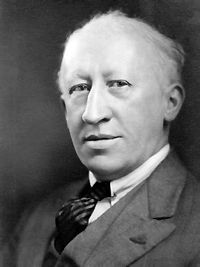
Ernest Newman

Encyclopedia
Neville Cardus
Sir John Frederick Neville Cardus CBE was an English writer and critic, best known for his writing on music and cricket. For many years, he wrote for The Manchester Guardian. He was untrained in music, and his style of criticism was subjective, romantic and personal, in contrast with his critical...
, was reflected in his books on Richard Wagner
Richard Wagner
Wilhelm Richard Wagner was a German composer, conductor, theatre director, philosopher, music theorist, poet, essayist and writer primarily known for his operas...
, Hugo Wolf
Hugo Wolf
Hugo Wolf was an Austrian composer of Slovene origin, particularly noted for his art songs, or lieder. He brought to this form a concentrated expressive intensity which was unique in late Romantic music, somewhat related to that of the Second Viennese School in concision but utterly unrelated in...
, Richard Strauss
Richard Strauss
Richard Georg Strauss was a leading German composer of the late Romantic and early modern eras. He is known for his operas, which include Der Rosenkavalier and Salome; his Lieder, especially his Four Last Songs; and his tone poems and orchestral works, such as Death and Transfiguration, Till...
and others. He was music critic of The Sunday Times
The Sunday Times
The Sunday Times is a British Sunday newspaper.The Sunday Times may also refer to:*The Sunday Times *The Sunday Times *The Sunday Times *The Sunday Times...
from 1920 until his death nearly forty years later.
Early years
Newman was born William Roberts in Everton, a district of LiverpoolLiverpool
Liverpool is a city and metropolitan borough of Merseyside, England, along the eastern side of the Mersey Estuary. It was founded as a borough in 1207 and was granted city status in 1880...
, the only child of Seth Roberts, a Welsh tailor, and his second wife Harriet, née Spark, both of whom had children by their first marriages. He was educated at St Saviour's School, Everton, Liverpool College and University College, Liverpool, graduating in 1886, where he studied English literature, philosophy and art. He had no formal musical education but taught himself to play the piano "after a fashion", could read music as easily as books, studied vocal music, composition, harmony and counterpoint, and introduced himself to a wide range of music through reading scores. The young Roberts was intended to pursue a career in the Indian Civil Service, but his health broke down, and he was medically advised not to contemplate residence in India. He became a clerk in the Bank of Liverpool from 1889 to 1903. In his spare time he acquired complete or partial competence in nine foreign languages, wrote for a number of journals on music, literature, religion and philosophical subjects, and published his first two books, Gluck
Christoph Willibald Gluck
Christoph Willibald Ritter von Gluck was an opera composer of the early classical period. After many years at the Habsburg court at Vienna, Gluck brought about the practical reform of opera's dramaturgical practices that many intellectuals had been campaigning for over the years...
and the Opera, in 1895 and A Study of Wagner
Richard Wagner
Wilhelm Richard Wagner was a German composer, conductor, theatre director, philosopher, music theorist, poet, essayist and writer primarily known for his operas...
, in 1899.
Newman had been brought up as an Anglican, but as an adult he rejected the church. He joined the National Secular Society in 1894, through which he met J. M. Robertson
J. M. Robertson
John Mackinnon Robertson was a prolific journalist, advocate of rationalism and secularism, and Liberal Member of Parliament in the United Kingdom for Tyneside from 1906 to 1918.- Biography :...
, who became a lifelong friend, influencing his approach to criticism. In 1897, Newman wrote Pseudo-Philosophy at the End of the Nineteenth Century, a critique of imprecise and subjective writing. This displayed, in the words of the Oxford Dictionary of National Biography, "the three most prominent characteristics of his critical thought: scepticism, dialectic skill, and passion for accuracy." He published the book under the pen name Hugh Mortimer Cecil, but all his other works bore the name Ernest Newman, which he adopted to suggest the fresh approach he intended to take toward his subjects: "a new man in earnest". He subsequently used the name in his private life as well as his public life, although he never made the change legal. In 1894 Newman married Kate Eleanor Woollett. His early articles on music were written for the composer Granville Bantock
Granville Bantock
Sir Granville Bantock was a British composer of classical music.-Biography:Granville Ransome Bantock was born in London. His father was a Scottish doctor. He was intended by his parents for the Indian Civil Service but was drawn into the musical world. His first teacher was Dr Gordon Saunders at...
's New Quarterly Musical Review. In 1903 as principal of the Birmingham and Midland Institute school of music Bantock invited Newman to join his staff to teach singing and musical theory.
Music critic
Newman moved from Birmingham in 1905 to become music critic of The Manchester Guardian, where he was a controversial reviewer, sometimes displeasing the local musical establishment. His trenchancy cost him his job, and he left Manchester the following year, succeeded by Samuel LangfordSamuel Langford
Samuel Langford was an influential English music critic of the early twentieth century.Trained as a pianist, Langford became chief music critic of The Manchester Guardian in 1906, serving in that post until his death...
, and moved back to Birmingham as music critic of The Birmingham Post. The Guardian later said of this period in his career, "At Birmingham he was at his best, pungent every morning about the latest singer or fiddler, quick to value a new work, while every week he turned his Monday article into an exciting debating-ground."
During his Birmingham years he wrote studies of Richard Strauss
Richard Strauss
Richard Georg Strauss was a leading German composer of the late Romantic and early modern eras. He is known for his operas, which include Der Rosenkavalier and Salome; his Lieder, especially his Four Last Songs; and his tone poems and orchestral works, such as Death and Transfiguration, Till...
(1908), Edward Elgar
Edward Elgar
Sir Edward William Elgar, 1st Baronet OM, GCVO was an English composer, many of whose works have entered the British and international classical concert repertoire. Among his best-known compositions are orchestral works including the Enigma Variations, the Pomp and Circumstance Marches, concertos...
(1906), Hugo Wolf
Hugo Wolf
Hugo Wolf was an Austrian composer of Slovene origin, particularly noted for his art songs, or lieder. He brought to this form a concentrated expressive intensity which was unique in late Romantic music, somewhat related to that of the Second Viennese School in concision but utterly unrelated in...
(1907) and Richard Wagner
Richard Wagner
Wilhelm Richard Wagner was a German composer, conductor, theatre director, philosopher, music theorist, poet, essayist and writer primarily known for his operas...
(1914). His Hugo Wolf remained the only English study of the composer for more than forty years and achieved the distinction of being translated and published in Germany. The Times
The Times
The Times is a British daily national newspaper, first published in London in 1785 under the title The Daily Universal Register . The Times and its sister paper The Sunday Times are published by Times Newspapers Limited, a subsidiary since 1981 of News International...
said of his 1914 Wagner book, "His enormous admiration for the artist and his contempt for the man were set out in Wagner as Man and Artist, a powerful book exasperating to the devout believers in the cult of Bayreuth
Bayreuth Festival
The Bayreuth Festival is a music festival held annually in Bayreuth, Germany, at which performances of operas by the 19th century German composer Richard Wagner are presented...
."
His first wife died in 1918. In 1919 he married Vera Hands, a former music student at the Midland Institute, and in the same year, finding Birmingham "unmusical, and in a general way uncultured", he moved to London as music critic of the Sunday newspaper The Observer
The Observer
The Observer is a British newspaper, published on Sundays. In the same place on the political spectrum as its daily sister paper The Guardian, which acquired it in 1993, it takes a liberal or social democratic line on most issues. It is the world's oldest Sunday newspaper.-Origins:The first issue,...
. He had previously resisted any move to London, reluctant to undertake the daily schedule of routine concerts that was then expected of music critics on London daily papers, but The Observer offered him conditions that he found irresistibly congenial.
Sunday Times
Within a year Newman was induced to move to the rival Sunday TimesThe Sunday Times
The Sunday Times is a British Sunday newspaper.The Sunday Times may also refer to:*The Sunday Times *The Sunday Times *The Sunday Times *The Sunday Times...
. As the critic of a Sunday paper, Newman "could pick out the more interesting musical events of the week and discuss them in conjunction and with an air of comparative leisure. His weekly articles soon became a valued feature which all musically minded people had to read." He remained at The Sunday Times from 1920 until his death nearly forty years later, except for a short break when he was guest critic of the New York Evening Post in 1923. He also wrote weekly articles for The Manchester Guardian (1919–24) and Glasgow Herald (1924-28) and contributed to The Musical Times
The Musical Times
The Musical Times is an academic journal of classical music edited and produced in the United Kingdom. It is currently the oldest such journal that is still publishing in the UK, having been published continuously since 1844. It was published as The Musical Times and Singing Class Circular until...
between 1910 and 1955 on subjects as varied as Claude Debussy
Claude Debussy
Claude-Achille Debussy was a French composer. Along with Maurice Ravel, he was one of the most prominent figures working within the field of impressionist music, though he himself intensely disliked the term when applied to his compositions...
; Women and Music; Elgar; Johannes Brahms
Johannes Brahms
Johannes Brahms was a German composer and pianist, and one of the leading musicians of the Romantic period. Born in Hamburg, Brahms spent much of his professional life in Vienna, Austria, where he was a leader of the musical scene...
; Beethoven
Ludwig van Beethoven
Ludwig van Beethoven was a German composer and pianist. A crucial figure in the transition between the Classical and Romantic eras in Western art music, he remains one of the most famous and influential composers of all time.Born in Bonn, then the capital of the Electorate of Cologne and part of...
's "Unsterbliche Geliebte"; Bayreuth; Franz Liszt
Franz Liszt
Franz Liszt ; ), was a 19th-century Hungarian composer, pianist, conductor, and teacher.Liszt became renowned in Europe during the nineteenth century for his virtuosic skill as a pianist. He was said by his contemporaries to have been the most technically advanced pianist of his age...
; J. S. Bach; Bantock; Hugo Wolf; Arnold Schoenberg
Arnold Schoenberg
Arnold Schoenberg was an Austrian composer, associated with the expressionist movement in German poetry and art, and leader of the Second Viennese School...
; Russian Opera and Russian Nationalism; Hector Berlioz
Hector Berlioz
Hector Berlioz was a French Romantic composer, best known for his compositions Symphonie fantastique and Grande messe des morts . Berlioz made significant contributions to the modern orchestra with his Treatise on Instrumentation. He specified huge orchestral forces for some of his works; as a...
; Enrique Granados
Enrique Granados
Enrique Granados y Campiña was a Spanish pianist and composer of classical music. His music is in a uniquely Spanish style and, as such, representative of musical nationalism...
; and Modest Mussorgsky
Modest Mussorgsky
Modest Petrovich Mussorgsky was a Russian composer, one of the group known as 'The Five'. He was an innovator of Russian music in the romantic period...
. From 1930 he made weekly radio broadcasts about music and wrote a sporting column for the Evening Standard
Evening Standard
The Evening Standard, now styled the London Evening Standard, is a free local daily newspaper, published Monday–Friday in tabloid format in London. It is the dominant regional evening paper for London and the surrounding area, with coverage of national and international news and City of London...
.
Newman's largest work was The Life of Richard Wagner, in four volumes, published between 1933 and 1947. In 1959, The Times judged it "likely to remain the standard biography of Wagner in the English language," and Grove's Dictionary of Music and Musicians commented in 2009, "it has still not been surpassed although research has uncovered much that is new." While working on this study, he paused to write a book about Wagner's father-in-law, Franz Liszt (1934), but Newman was sharply critical of Liszt's character, and it has been maintained that the bias of the book "tarnished his critical integrity". Other books published by Newman during his Sunday Times years include the popular collections Opera Nights (1944, an unexpected wartime bestseller), Wagner Nights (1949) and More Opera Nights (1954), published in the U.S. under the title Seventeen Famous Operas (1955).
Troubled by deteriorating eyesight, Newman ceased to write his weekly Sunday Times article after the autumn of 1958. He died the following year at Tadworth
Tadworth
Tadworth is a large suburban village in Surrey, on the south-east slope of Epsom Downs. It forms part of the Borough of Reigate and Banstead. The census area Tadworth and Walton has a population of 7,016. Neighbouring settlements include Walton-on-the-Hill, Kingswood, Epsom, Burgh Heath, Banstead,...
, Surrey
Surrey
Surrey is a county in the South East of England and is one of the Home Counties. The county borders Greater London, Kent, East Sussex, West Sussex, Hampshire and Berkshire. The historic county town is Guildford. Surrey County Council sits at Kingston upon Thames, although this has been part of...
, age 90. He was survived by his second wife.
Honours and reputation
For most of his life, Newman strongly resisted all official honours, but in his old age he agreed to accept Finland's Order of the White Rose in 1956 and Germany's Grosse Dienstkreuz in 1958, as well as an honorary doctorate from the University of ExeterUniversity of Exeter
The University of Exeter is a public university in South West England. It belongs to the 1994 Group, an association of 19 of the United Kingdom's smaller research-intensive universities....
in 1959. In 1955 a tribute described as a Festschrift
Festschrift
In academia, a Festschrift , is a book honoring a respected person, especially an academic, and presented during his or her lifetime. The term, borrowed from German, could be translated as celebration publication or celebratory writing...
, Fanfare for Ernest Newman was published to mark his golden jubilee as a critic, with contributions from Neville Cardus, Philip Hope-Wallace, Gerald Abraham
Gerald Abraham
Gerald Ernest Heal Abraham, CBE, FBA was an English musicologist; he was President of the Royal Musical Association, 1970-74.- Career :* Assistant Editor, Radio Times, 1935–39* Deputy Editor, The Listener, 1939–42...
, Winton Dean
Winton Dean
Winton Dean is an English musicologist of the 20th century, most famous for his research concerning the life and works—in particular the operas and oratorios—of Handel, as detailed in his book Handel’s Dramatic Oratorios and Masques .Dean was born in Birkenhead...
, Christopher Hassall
Christopher Hassall
Christopher Vernon Hassall was an English actor, dramatist, librettist, lyricist and poet, who found his greatest fame in a memorable musical partnership with the actor and composer Ivor Novello after working together in the same touring company...
and Sir Jack Westrup
Jack Westrup
Sir Jack Westrup was an English musicologist, writer, teacher and occasional composer.-Biography:Jack Allan Westrup was the second of the three sons of George Westrup, insurance clerk, of Dulwich, and his wife, Harriet Sophia née Allan. He was educated at Dulwich College, London 1917-22, and at...
, among others.
In 1963, Newman's widow published a memoir of him. Reviewing the book, Jack Westrup wrote, "Her narrative records quite simply her day-to-day life with her husband over a period of forty years.... Here is the picture of a relentless worker, frequently struggling with ill health, obstinate in his determination to make enough to live on, groaning under the self-imposed burden of his life of Wagner.... The only faintly disturbing note is the fact that he did not like children."
Grove's Dictionary of Music and Musicians wrote of Newman:
In an obituary tribute, The Observer said of Newman, "Unlike most scholars, Newman was unsurpassed as a musical journalist. The vigour of his prose and the sense of a large personality that it breathed, his wit and trenchancy as well as his learning made him beyond question the outstanding critic of his time."
Original Works
- 1895 Gluck and the Opera: A study in Musical History
- 1899 A Study of Wagner
- 1904 Wagner
- 1904 Richard Strauss With a Personal Note by A. Kalisch
- 1905 Musical Studies
- 1906 Elgar
- 1907 Hugo Wolf
- 1908 Richard Strauss
- 1914 Wagner as Man and Artist (revised 1924)
- 1919 A Musical Motley
- 1920 The Piano-Player and Its Music
- 1923 Confessions of a Musical Critic (reprinted in Testament of Music, 1962)
- 1923 Solo Singing
- 1925 A Musical Critic's Holiday
- 1927 The Unconscious Beethoven
- 1928 What to Read on the Evolution of Music
- 1931 Fact and Fiction about Wagner. A Criticism of "The Truth about Wagner" by P.D.Hurne and W.L.Root
- 1934 The Man Liszt:' A Study of the Tragi-Comedy of a Soul Divided Against Itself."
- 1933-47 Life of Richard Wagner. 4 vols.
- 1940 Wagner (Novello's Biographies of Great Musicians)
- 1943 Opera Nights
- 1949 Wagner Nights
- 1954 More Opera Nights
- 1956-58 From the World of Music (3 vols)
- 1972 (ed. Peter Heyworth): Berlioz, Romantic and Classic: Writings by Ernest Newman
Translations
- 1906 [N.E. 1925] On Conducting by Felix Weingartner
- 1911 J.S. Bach by Albert Schweitzer
- 1912 ff. Wagner Libretti: The Flying Dutchman,Tannhauser,The Ring,Tristan,The Mastersingers,Parsifal
- 1929 Beethoven the Creator by R. Rolland