

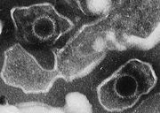
Epstein-Barr virus

Encyclopedia
The Epstein–Barr virus (EBV), also called human herpesvirus 4 (HHV-4), is a virus
of the herpes family
and is one of the most common viruses in human
s. It is best known as the cause of infectious mononucleosis
. It is also associated with particular forms of cancer
, particularly Hodgkin's lymphoma
, Burkitt's lymphoma
, nasopharyngeal carcinoma
, and central nervous system lymphoma
s associated with HIV
. Finally, there is evidence that infection with the virus is associated with a higher risk of certain autoimmune disease
s, especially dermatomyositis
, systemic lupus erythematosus
, rheumatoid arthritis
, Sjögren's syndrome
, and multiple sclerosis
.
Most people become infected with EBV and gain adaptive immunity. In the United States, about half of all five-year-olds and 90–95% of adults have evidence of previous infection. Infants become susceptible to EBV as soon as maternal antibody protection disappears. Many children become infected with EBV, and these infections usually cause no symptoms or are indistinguishable from the other mild, brief illnesses of childhood. In the United States and in other developed countries, many people are not infected with EBV in their childhood years. When infection with EBV occurs during adolescence or teenage years, it causes infectious mononucleosis 35% to 69% of the time.
, Professor Emeritus at the University of Bristol
and Yvonne Barr
, who discovered and documented the virus. In 1961, Michael Anthony Epstein, a pathologist and expert electron microscopist
, attended a lecture on "The Commonest Children's Cancer in Tropical Africa—A Hitherto Unrecognised Syndrome." This lecture, by Denis Parsons Burkitt
, a surgeon practicing in Uganda
, was the description of the "endemic variant" (pediatric form) of the disease that bears his name
. In 1963, a specimen was sent from Uganda to Middlesex Hospital
to be cultured. Virus particles were identified in the cultured cells, and the results were published in The Lancet
in 1964 by Epstein, Bert Achong
, and Barr. Cell lines were sent to Werner and Gertrude Henle at the Children's Hospital of Philadelphia
who developed serological
markers. In 1967, a technician in their laboratory developed mononucleosis and they were able to compare a stored serum sample, showing that antibodies
to the virus developed.
which can be broadly categorized as being lytic cycle or latent cycle.
cell lines, at least three programs exist:
It is also postulated that a program exists in which all viral protein expression is shut off(latency 0).
can be maintained and manipulated in the laboratory in continual latency. While many viruses are assumed to have this property during infection of their natural host, they do not have an easily managed system for studying this part of the viral lifecycle. Further, Walter Henle and Gertrude Henlehttp://165.112.6.70/hmd/manuscripts/ead/henle.html, together with Harald zur Hausen
, discovered that EBV can directly immortalize B cells after infection, mimicking some forms of EBV-related neoplasia
http://www.sciencemag.org/cgi/reprint/157/3792/1064.
On infecting the B-lymphocyte by binding to the complement
receptor, the linear genome circularizes and the virus subsequently persists within the cell as an episome.
In primary infection, EBV replicates in oro-pharyngeal epithelial cells and establishes Latency III, II, and I infections in B-lymphocytes. EBV latent infection of B-lymphocytes is necessary for virus persistence, subsequent replication in epithelial cells, and release of infectious virus into saliva. EBV Latency III and II infections of B-lymphocytes, Latency II infection of oral epithelial cells, and Latency II infection of NK- or T-cell can result in malignancies, marked by uniform EBV genome presence and gene expression.
, lymphoblastoid cell lines eventually emerge that are capable of indefinite growth. The growth transformation of these cell lines is the consequence of viral protein expression.
EBNA-2, EBNA-3C and LMP-1 are essential for transformation while EBNA-LP and the EBERs are not. The EBNA-1 protein is essential for maintenance of the virus genome
.
It is postulated that following natural infection with EBV, the virus executes some or all of its repertoire of gene expression programs to establish a persistent infection. Given the initial absence of host immunity
, the lytic cycle produces large amounts of virus to infect other (presumably) B-lymphocytes within the host.
The latent programs reprogram and subvert infected B-lymphocytes to proliferate and bring infected cells to the sites at which the virus presumably persists. Eventually, when host immunity develops, the virus persists by turning off most (or possibly all) of its genes, only occasionally reactivating to produce fresh virions. A balance is eventually struck between occasional viral reactivation and host immune surveillance removing cells that activate viral gene expression.
The site of persistence of EBV may be bone marrow
. EBV-positive patients who have had their own bone marrow replaced with bone marrow from an EBV-negative donor are found to be EBV-negative after transplantation
.
(in the conventional nomenclature). The genes are ordered EBNA-LP/EBNA-2/EBNA-3A/EBNA-3B/EBNA-3C/EBNA-1 within the genome.
The initiation codon of the EBNA-LP coding region is created by an alternate splice of the nuclear protein transcript. In the absence of this initiation codon, EBNA-2/EBNA-3A/EBNA-3B/EBNA-3C/EBNA-1 will be expressed depending on which of these genes is alternatively spliced into the transcript.
To infect B cells, the gp350 viral protein binds to the cellular receptor complement receptor 2 (CR2, also known as CD21), and triggers endocytosis
. In addition, gp42 binds to MHC class II
molecule. Through these interactions, the fusion machinery, composed of gHgL and gB, is triggered and the viral membrane fuses with the endosomal membrane to release viral genetic materials.
To infect epithelial cells, gp350 also binds to CR2; however, endocytosis is not triggered. Then, gHgL interacts with a gHgL receptor (possibly integrins αvβ6 or αvβ8) and the fusion machinery gHgL and gB is triggered to allow fusion on cell membrane. Fusion with epithelial cells is actually impeded by gp42.
H (gH) is essential for penetration of B cells but also plays a role in attachment of virus to epithelial cells.
In laboratory and animal trials in 2000, it was shown that both antagonism of RA-mediated growth inhibition and promotion of LCL proliferation were efficiently reversed by the glucocorticoid receptor (GR) antagonist RU486.
Virus
A virus is a small infectious agent that can replicate only inside the living cells of organisms. Viruses infect all types of organisms, from animals and plants to bacteria and archaea...
of the herpes family
Herpesviridae
The Herpesviridae are a large family of DNA viruses that cause diseases in animals, including humans. The members of this family are also known as herpesviruses. The family name is derived from the Greek word herpein , referring to the latent, recurring infections typical of this group of viruses...
and is one of the most common viruses in human
Human
Humans are the only living species in the Homo genus...
s. It is best known as the cause of infectious mononucleosis
Infectious mononucleosis
Infectious mononucleosis is an infectious, widespread viral...
. It is also associated with particular forms of cancer
Cancer
Cancer , known medically as a malignant neoplasm, is a large group of different diseases, all involving unregulated cell growth. In cancer, cells divide and grow uncontrollably, forming malignant tumors, and invade nearby parts of the body. The cancer may also spread to more distant parts of the...
, particularly Hodgkin's lymphoma
Hodgkin's lymphoma
Hodgkin's lymphoma, previously known as Hodgkin's disease, is a type of lymphoma, which is a cancer originating from white blood cells called lymphocytes...
, Burkitt's lymphoma
Burkitt's lymphoma
Burkitt's lymphoma is a cancer of the lymphatic system...
, nasopharyngeal carcinoma
Nasopharyngeal carcinoma
Nasopharyngeal carcinoma is the most common cancer originating in the nasopharynx, the uppermost region of the pharynx , behind the nose where the nasal passages and auditory tubes join the remainder of the upper respiratory tract. NPC differs significantly from other cancers of the head and neck...
, and central nervous system lymphoma
Lymphoma
Lymphoma is a cancer in the lymphatic cells of the immune system. Typically, lymphomas present as a solid tumor of lymphoid cells. Treatment might involve chemotherapy and in some cases radiotherapy and/or bone marrow transplantation, and can be curable depending on the histology, type, and stage...
s associated with HIV
HIV
Human immunodeficiency virus is a lentivirus that causes acquired immunodeficiency syndrome , a condition in humans in which progressive failure of the immune system allows life-threatening opportunistic infections and cancers to thrive...
. Finally, there is evidence that infection with the virus is associated with a higher risk of certain autoimmune disease
Autoimmune disease
Autoimmune diseases arise from an overactive immune response of the body against substances and tissues normally present in the body. In other words, the body actually attacks its own cells. The immune system mistakes some part of the body as a pathogen and attacks it. This may be restricted to...
s, especially dermatomyositis
Dermatomyositis
Dermatomyositis is a connective-tissue disease related to polymyositis and Bramaticosis that is characterized by inflammation of the muscles and the skin.- Causes :...
, systemic lupus erythematosus
Systemic lupus erythematosus
Systemic lupus erythematosus , often abbreviated to SLE or lupus, is a systemic autoimmune disease that can affect any part of the body. As occurs in other autoimmune diseases, the immune system attacks the body's cells and tissue, resulting in inflammation and tissue damage...
, rheumatoid arthritis
Rheumatoid arthritis
Rheumatoid arthritis is a chronic, systemic inflammatory disorder that may affect many tissues and organs, but principally attacks synovial joints. The process produces an inflammatory response of the synovium secondary to hyperplasia of synovial cells, excess synovial fluid, and the development...
, Sjögren's syndrome
Sjögren's syndrome
Sjögren's syndrome , also known as "Mikulicz disease" and "Sicca syndrome", is a systemic autoimmune disease in which immune cells attack and destroy the exocrine glands that produce tears and saliva....
, and multiple sclerosis
Multiple sclerosis
Multiple sclerosis is an inflammatory disease in which the fatty myelin sheaths around the axons of the brain and spinal cord are damaged, leading to demyelination and scarring as well as a broad spectrum of signs and symptoms...
.
Most people become infected with EBV and gain adaptive immunity. In the United States, about half of all five-year-olds and 90–95% of adults have evidence of previous infection. Infants become susceptible to EBV as soon as maternal antibody protection disappears. Many children become infected with EBV, and these infections usually cause no symptoms or are indistinguishable from the other mild, brief illnesses of childhood. In the United States and in other developed countries, many people are not infected with EBV in their childhood years. When infection with EBV occurs during adolescence or teenage years, it causes infectious mononucleosis 35% to 69% of the time.
History
Epstein–Barr virus is named after Michael Anthony EpsteinAnthony Epstein
Sir Michael Anthony Epstein CBE, FRS is one of the discoverers of the Epstein-Barr virus.Epstein was educated at St. Paul's School in London, Trinity College, Cambridge and Middlesex Hospital Medical School. Epstein was Professor of Pathology, 1968-85 , and Head of Department, 1968-82 at the...
, Professor Emeritus at the University of Bristol
University of Bristol
The University of Bristol is a public research university located in Bristol, United Kingdom. One of the so-called "red brick" universities, it received its Royal Charter in 1909, although its predecessor institution, University College, Bristol, had been in existence since 1876.The University is...
and Yvonne Barr
Yvonne Barr
Yvonne Barr is a British virologist. She assisted Michael Anthony Epstein in the discovery of the Epstein-Barr virus . Barr graduated from the University of London in 1966 with a Ph.D. Later in her life, she married an Australian, and moved to his home country.-External links:*...
, who discovered and documented the virus. In 1961, Michael Anthony Epstein, a pathologist and expert electron microscopist
Electron microscope
An electron microscope is a type of microscope that uses a beam of electrons to illuminate the specimen and produce a magnified image. Electron microscopes have a greater resolving power than a light-powered optical microscope, because electrons have wavelengths about 100,000 times shorter than...
, attended a lecture on "The Commonest Children's Cancer in Tropical Africa—A Hitherto Unrecognised Syndrome." This lecture, by Denis Parsons Burkitt
Denis Parsons Burkitt
Denis Parsons Burkitt , surgeon, was born in Enniskillen, County Fermanagh, Ireland. He was the son of James Parsons Burkitt. Aged eleven he lost his right eye in an accident. He attended Portora Royal School in Enniskillen and Dean Close School, England...
, a surgeon practicing in Uganda
Uganda
Uganda , officially the Republic of Uganda, is a landlocked country in East Africa. Uganda is also known as the "Pearl of Africa". It is bordered on the east by Kenya, on the north by South Sudan, on the west by the Democratic Republic of the Congo, on the southwest by Rwanda, and on the south by...
, was the description of the "endemic variant" (pediatric form) of the disease that bears his name
Burkitt's lymphoma
Burkitt's lymphoma is a cancer of the lymphatic system...
. In 1963, a specimen was sent from Uganda to Middlesex Hospital
Middlesex Hospital
The Middlesex Hospital was a teaching hospital located in the Fitzrovia area of London, United Kingdom. First opened in 1745 on Windmill Street, it was moved in 1757 to Mortimer Street where it remained until it was finally closed in 2005. Its staff and services were transferred to various sites...
to be cultured. Virus particles were identified in the cultured cells, and the results were published in The Lancet
The Lancet
The Lancet is a weekly peer-reviewed general medical journal. It is one of the world's best known, oldest, and most respected general medical journals...
in 1964 by Epstein, Bert Achong
Bert Achong
Bert Geoffrey Achong is best known for co-discovering the Epstein-Barr virus through use of electron microscopy. After excelling in school in Trinidad, Achong enrolled at University College Dublin, where he received his medical degree...
, and Barr. Cell lines were sent to Werner and Gertrude Henle at the Children's Hospital of Philadelphia
Children's Hospital of Philadelphia
The Children's Hospital of Philadelphia is one of the largest and oldest children's hospitals in the world. CHOP has been ranked as the best children's hospital in the United States by U.S. News & World Report and Parents Magazine in recent years. As of 2008, it was ranked #1 in the nation for...
who developed serological
Serology
Serology is the scientific study of blood serum and other bodily fluids. In practice, the term usually refers to the diagnostic identification of antibodies in the serum...
markers. In 1967, a technician in their laboratory developed mononucleosis and they were able to compare a stored serum sample, showing that antibodies
Antibody
An antibody, also known as an immunoglobulin, is a large Y-shaped protein used by the immune system to identify and neutralize foreign objects such as bacteria and viruses. The antibody recognizes a unique part of the foreign target, termed an antigen...
to the virus developed.
Virology
The virus can execute many distinct programs of gene expressionGene expression
Gene expression is the process by which information from a gene is used in the synthesis of a functional gene product. These products are often proteins, but in non-protein coding genes such as ribosomal RNA , transfer RNA or small nuclear RNA genes, the product is a functional RNA...
which can be broadly categorized as being lytic cycle or latent cycle.
- The lytic cycleLytic cycleThe lytic cycle is one of the two cycles of viral reproduction, the other being the lysogenic cycle. The lytic cycle is typically considered the main method of viral replication, since it results in the destruction of the infected cell...
or productive infection results in staged expression of several viral proteinViral proteinA viral protein is a protein generated by a virus.Many are structural, forming the viral envelope and capsid. However, there are also viral nonstructural proteins and viral regulatory and accessory proteins.More than 490 have been identified....
s with the ultimate objective of producing infectious virions. Formally, this phase of infection does not inevitably lead to lysis of the host cellCell (biology)The cell is the basic structural and functional unit of all known living organisms. It is the smallest unit of life that is classified as a living thing, and is often called the building block of life. The Alberts text discusses how the "cellular building blocks" move to shape developing embryos....
as EBV virions are produced by budding from the infected cell. Lytic proteins include gp350 and gp110. - The latent cycle (lysogenic) programs are those that do not result in production of virions. A very limited, distinct set of viral proteins are produced during latent cycle infection. These include Epstein–Barr nuclear antigenAntigenAn antigen is a foreign molecule that, when introduced into the body, triggers the production of an antibody by the immune system. The immune system will then kill or neutralize the antigen that is recognized as a foreign and potentially harmful invader. These invaders can be molecules such as...
(EBNA)-1, EBNA-2, EBNA-3A, EBNA-3B, EBNA-3C, EBNA-leader protein (EBNA-LP) and latent membrane proteinMembrane proteinA membrane protein is a protein molecule that is attached to, or associated with the membrane of a cell or an organelle. More than half of all proteins interact with membranes.-Function:...
s (LMP)-1, LMP-2A and LMP-2B and the Epstein–Barr encoded RNARNARibonucleic acid , or RNA, is one of the three major macromolecules that are essential for all known forms of life....
s (EBERs). In addition, EBV codes for at least twenty microRNAs which are expressed in latently infected cells and at least one snoRNASnoRNASmall nucleolar RNAs are a class of small RNA molecules that primarily guide chemical modifications of other RNAs, mainly ribosomal RNAs, transfer RNAs and small nuclear RNAs...
expressed during lytic cycle.
Programs
From studies of EBV gene expression in cultured Burkitt's lymphomaBurkitt's lymphoma
Burkitt's lymphoma is a cancer of the lymphatic system...
cell lines, at least three programs exist:
- EBER1&2 EBNA1 (Latency I)
- EBER1&2 LMP2A LMP2B EBNA1 LMP1 (Latency II)
- EBER1&2 LMP2A LMP2B EBNA1 LMP1 EBNA2,3,4,5,6 (Latency III)
It is also postulated that a program exists in which all viral protein expression is shut off(latency 0).
Latent cycle
Epstein–Barr virus and its sister virus KSHVKaposi's sarcoma-associated herpesvirus
Kaposi's sarcoma-associated herpesvirus is one of seven currently known human cancer viruses, or oncoviruses. It is also the eighth human herpesvirus; its formal name according to the International Committee on Taxonomy of Viruses is HHV-8. Like other herpesviruses, its informal name is used...
can be maintained and manipulated in the laboratory in continual latency. While many viruses are assumed to have this property during infection of their natural host, they do not have an easily managed system for studying this part of the viral lifecycle. Further, Walter Henle and Gertrude Henlehttp://165.112.6.70/hmd/manuscripts/ead/henle.html, together with Harald zur Hausen
Harald zur Hausen
Harald zur Hausen is a German virologist and professor emeritus. He has done research on cancer of the cervix, where he discovered the role of papilloma viruses, for which he received the Nobel Prize in Physiology or Medicine 2008.-Biography:Zur Hausen was born in Gelsenkirchen, Germany, went to...
, discovered that EBV can directly immortalize B cells after infection, mimicking some forms of EBV-related neoplasia
Neoplasia
Neoplasm is an abnormal mass of tissue as a result of neoplasia. Neoplasia is the abnormal proliferation of cells. The growth of neoplastic cells exceeds and is not coordinated with that of the normal tissues around it. The growth persists in the same excessive manner even after cessation of the...
http://www.sciencemag.org/cgi/reprint/157/3792/1064.
On infecting the B-lymphocyte by binding to the complement
Complement system
The complement system helps or “complements” the ability of antibodies and phagocytic cells to clear pathogens from an organism. It is part of the immune system called the innate immune system that is not adaptable and does not change over the course of an individual's lifetime...
receptor, the linear genome circularizes and the virus subsequently persists within the cell as an episome.
In primary infection, EBV replicates in oro-pharyngeal epithelial cells and establishes Latency III, II, and I infections in B-lymphocytes. EBV latent infection of B-lymphocytes is necessary for virus persistence, subsequent replication in epithelial cells, and release of infectious virus into saliva. EBV Latency III and II infections of B-lymphocytes, Latency II infection of oral epithelial cells, and Latency II infection of NK- or T-cell can result in malignancies, marked by uniform EBV genome presence and gene expression.
Transformation
When EBV infects B-lymphocytes in vitroIn vitro
In vitro refers to studies in experimental biology that are conducted using components of an organism that have been isolated from their usual biological context in order to permit a more detailed or more convenient analysis than can be done with whole organisms. Colloquially, these experiments...
, lymphoblastoid cell lines eventually emerge that are capable of indefinite growth. The growth transformation of these cell lines is the consequence of viral protein expression.
EBNA-2, EBNA-3C and LMP-1 are essential for transformation while EBNA-LP and the EBERs are not. The EBNA-1 protein is essential for maintenance of the virus genome
Genome
In modern molecular biology and genetics, the genome is the entirety of an organism's hereditary information. It is encoded either in DNA or, for many types of virus, in RNA. The genome includes both the genes and the non-coding sequences of the DNA/RNA....
.
It is postulated that following natural infection with EBV, the virus executes some or all of its repertoire of gene expression programs to establish a persistent infection. Given the initial absence of host immunity
Immunity (medical)
Immunity is a biological term that describes a state of having sufficient biological defenses to avoid infection, disease, or other unwanted biological invasion. Immunity involves both specific and non-specific components. The non-specific components act either as barriers or as eliminators of wide...
, the lytic cycle produces large amounts of virus to infect other (presumably) B-lymphocytes within the host.
The latent programs reprogram and subvert infected B-lymphocytes to proliferate and bring infected cells to the sites at which the virus presumably persists. Eventually, when host immunity develops, the virus persists by turning off most (or possibly all) of its genes, only occasionally reactivating to produce fresh virions. A balance is eventually struck between occasional viral reactivation and host immune surveillance removing cells that activate viral gene expression.
The site of persistence of EBV may be bone marrow
Bone marrow
Bone marrow is the flexible tissue found in the interior of bones. In humans, bone marrow in large bones produces new blood cells. On average, bone marrow constitutes 4% of the total body mass of humans; in adults weighing 65 kg , bone marrow accounts for approximately 2.6 kg...
. EBV-positive patients who have had their own bone marrow replaced with bone marrow from an EBV-negative donor are found to be EBV-negative after transplantation
Organ transplant
Organ transplantation is the moving of an organ from one body to another or from a donor site on the patient's own body, for the purpose of replacing the recipient's damaged or absent organ. The emerging field of regenerative medicine is allowing scientists and engineers to create organs to be...
.
Latent antigens
All EBV nuclear proteins are produced by alternative splicing of a transcript starting at either the Cp or Wp promoters at the left end of the genomeGenome
In modern molecular biology and genetics, the genome is the entirety of an organism's hereditary information. It is encoded either in DNA or, for many types of virus, in RNA. The genome includes both the genes and the non-coding sequences of the DNA/RNA....
(in the conventional nomenclature). The genes are ordered EBNA-LP/EBNA-2/EBNA-3A/EBNA-3B/EBNA-3C/EBNA-1 within the genome.
The initiation codon of the EBNA-LP coding region is created by an alternate splice of the nuclear protein transcript. In the absence of this initiation codon, EBNA-2/EBNA-3A/EBNA-3B/EBNA-3C/EBNA-1 will be expressed depending on which of these genes is alternatively spliced into the transcript.
Viral entry
EBV can infect a number of different cell types, including B cells and epithelial cells, and under certain cases, it may infect T cells, natural killer cells, and smooth muscle cells. Infecting both the B cells and the epithelial cells is part of the viral normal cycle to persist. However, the entry mechanism and the proteins involved in entry for these two cells are different.To infect B cells, the gp350 viral protein binds to the cellular receptor complement receptor 2 (CR2, also known as CD21), and triggers endocytosis
Endocytosis
Endocytosis is a process by which cells absorb molecules by engulfing them. It is used by all cells of the body because most substances important to them are large polar molecules that cannot pass through the hydrophobic plasma or cell membrane...
. In addition, gp42 binds to MHC class II
MHC class II
MHC Class II molecules are found only on a few specialized cell types, including macrophages, dendritic cells and B cells, all of which are professional antigen-presenting cells ....
molecule. Through these interactions, the fusion machinery, composed of gHgL and gB, is triggered and the viral membrane fuses with the endosomal membrane to release viral genetic materials.
To infect epithelial cells, gp350 also binds to CR2; however, endocytosis is not triggered. Then, gHgL interacts with a gHgL receptor (possibly integrins αvβ6 or αvβ8) and the fusion machinery gHgL and gB is triggered to allow fusion on cell membrane. Fusion with epithelial cells is actually impeded by gp42.
Tropism
The viral three-part glycoprotein complexes of gHgLgp42 mediate B cell membrane fusion; while the two-part complexes of gHgL mediate epithelial cell membrane fusion. EBV that are made in the B cells have low numbers of the gHgLgp42 complexes as the three-part complexes interact with HLA class II in the endoplasmic reticulum and are degraded. In contrast, EBV from epithelial cells are rich in the three-part complexes because these cells do not have MHC class II. As a result, EBV made from B cells are more infectious to epithelial cells, and EBV made from epithelial cells are more infectious to B cells.Protein/genes
| Protein/gene/antigen | Stage | Description |
|---|---|---|
| EBNA-1 | latent+lytic | EBNA-1 protein binds to a replication origin (oriP) within the viral genome and mediates replication and partitioning of the episome during division of the host cell. It is the only viral protein expressed during group I latency. |
| EBNA-2 | latent+lytic | EBNA-2 is the main viral transactivator. |
| EBNA-3 | latent+lytic | These genes also bind the host RBP-Jκ RBPJ Recombining binding protein suppressor of hairless is a protein that in humans is encoded by the RBPJ gene.RBPJ, also named as CBF1, is a human homolog for the Drosophila gene Suppressor of Hairless... protein. |
| LMP-1 | latent | LMP-1 is a six-span transmembrane protein that is also essential for EBV-mediated growth transformation. |
| LMP-2 | latent | LMP-2A/LMP-2B are transmembrane proteins that act to block tyrosine kinase Tyrosine kinase A tyrosine kinase is an enzyme that can transfer a phosphate group from ATP to a protein in a cell. It functions as an "on" or "off" switch in many cellular functions.... signaling. |
| EBER EBER EBER refers to two short small nuclear RNAs associated with the Epstein-Barr virus.EBER1 and EBER2 are 167 and 172 nucleotides in length respectively. They are not required for EBV-mediated growth transformation. These two RNAs are transcribed by the host's RNA polymerase III even during a latent... |
latent | EBER-1/EBER-2 are small nuclear RNAs, which bind to certain nucleoprotein particles, enabling binding to PKR (dsRNA dependent serin/threonin protein kinase) thus inhibiting its function. EBER-particles also induce the production of IL-10 which enhances growth and inhibits cytotoxic T-cells. |
| miRNAs | latent | EBV microRNAs are encoded by two transcripts, one set in the BART gene and one set near the BHRF1 cluster. The three BHRF1 miRNAS are expressed during type III latency while the large cluster of BART miRNAs (up to 20 miRNAs) are expressed during type II latency. The functions of these miRNAs are currently unknown. |
| EBV-EA | lytic | early antigen |
| EBV-MA | lytic | membrane antigen |
| EBV-VCA | lytic | viral capsid antigen |
| EBV-AN | lytic | alkaline nuclease |
Surface receptors
The Epstein–Barr virus surface glycoproteinGlycoprotein
Glycoproteins are proteins that contain oligosaccharide chains covalently attached to polypeptide side-chains. The carbohydrate is attached to the protein in a cotranslational or posttranslational modification. This process is known as glycosylation. In proteins that have segments extending...
H (gH) is essential for penetration of B cells but also plays a role in attachment of virus to epithelial cells.
In laboratory and animal trials in 2000, it was shown that both antagonism of RA-mediated growth inhibition and promotion of LCL proliferation were efficiently reversed by the glucocorticoid receptor (GR) antagonist RU486.
See also
- AIDSAIDSAcquired immune deficiency syndrome or acquired immunodeficiency syndrome is a disease of the human immune system caused by the human immunodeficiency virus...
- Chronic fatigue syndromeChronic fatigue syndromeChronic fatigue syndrome is the most common name used to designate a significantly debilitating medical disorder or group of disorders generally defined by persistent fatigue accompanied by other specific symptoms for a minimum of six months, not due to ongoing exertion, not substantially...
- David VetterDavid VetterDavid Phillip Vetter was a boy from Shenandoah, Texas, United States who suffered from a rare genetic disease now known as severe combined immune deficiency syndrome . Forced to live in a sterile environment, he became popular with the media as the boy in the plastic bubble...
- Scientific research on the ISS - Immunology and Haematology
External links
- Epstein–Barr Virus: Implicated in Cancer Etiology in China, Impetus for a Vaccine Article in The Scientist 13(6):1, Mar. 15, 1999 (registration required)
- National (USA) Center for Infectious Diseases website on EBV
- Epstein Barr Virus Editor: Erle S. Robertson Department of Microbiology and the Abramson Comprehensive Cancer Center, University of Pennsylvania Medical School, Philadelphia, Pennsylvania 19104, USA
- International Association for Research on EBV Body that organizes the two-yearly EBV research meeting.