


Emergentism

Encyclopedia
In philosophy
, emergentism is the belief in emergence
, particularly as it involves consciousness
and the philosophy of mind
, and as it contrasts (or not) with reductionism
. A property of a system
is said to be emergent if it is in some sense more than the "sum" of the properties of the system
's parts. An emergent property is said to be dependent on some more basic properties (and their
relationships and configuration), so that it can have no separate existence. However, a degree of independence is also asserted of emergent properties, so that they are not identical to, or reducible to, or predictable from,
or deducible from their bases. The different ways in which the independence requirement can be satisfied lead to various sub-varieties of emergence.
, the theory that the universe is composed exclusively of physical entities, and in particular with the evidence relating changes in the brain with changes in mental functioning. As a theory of mind (which it is not always), emergentism differs from idealism
, eliminative materialism
, identity theories, neutral monism
, panpsychism
and substance dualism, whilst being closely associated with property dualism
. In particular, the dependence of an emergent mind on its base means there is no metaphysical possibility of life after death
, in contrast with substance dualism. It is generally not obvious whether an emergent theory of mind embraces mental causation or must be considered epiphenomenal.
Some varieties of emergentism are not specifically concerned with the mind-body problem, and instead suggest a hierarchical or layered view of the whole of nature, with the layers arranged in terms of increasing complexity
with each requiring its own special science. Typically physics
is basic, with chemistry
built on top of it, then biology
, psychology
and social sciences
. Reductionists respond that the arrangement of the sciences is a matter of convenience, and that chemistry is derivable from physics (and so forth) in principle, an argument which gained force after the establishment of a quantum-mechanical basis for chemistry
Other varieties see mind
or consciousness
as specifically and anomalously requiring emergentist explanation, and therefore constitute a family of positions in the philosophy of mind
. Douglas Hofstadter
summarises this view as "the soul is more than the sum of its parts". A number of philosophers have offered the argument that qualia
constitute the hard problem of consciousness
, and resist reductive explanation in a way that all other phenomena do not. In contrast, reductionists generally see the task of accounting for the possibly atypical properties of mind and of living things as a matter of showing that, contrary to appearances, such properties are indeed fully accountable in terms of the properties of the basic constituents of nature and therefore in no way genuinely atypical.
Intermediate positions are possible: for instance, some emergentists hold that emergence is neither universal nor restricted to consciousness, but applies to (for instance) living creatures, or self organising systems, or complex
systems.
Some philosophers hold that emergent properties causally interact with more fundamental levels, an idea known as downward causation. Others maintain that higher-order properties simply supervene over lower levels without direct causal interaction.
All the cases so far discussed have been synchronic
, i.e. the emergent property exists simultaneously with its basis.
Yet another variation operates diachnronically. Emergentists of this type believe that genuinely novel properties can come into being, without being accountable in terms of the preceding history of the universe. (Contrast with indeterminism
where it is only the arrangement or configuration of matter that is unaccountable). These evolution-inspired theories often have a theological aspect, as in the process philosophy
of Alfred North Whitehead
and Charles Hartshorne
.
The concept of emergence has been applied to the theory of literature and art, history, linguistics, cognitive sciences, etc. by the teachings of Jean-Marie Grassin et the University of Limoges (v. esp.: J. Fontanille, B. Westphal, J. Vion-Dury, éds. L'Émergence -- Poétique de l'Émergence, en réponse aux travaux de Jean-Marie Grassin, Bern, Berlin, etc., 2011; and: the article "Emergence" in the International Dictionary of Literary Terms (DITL).
may be recognized in contemporary molecular histology in the proposal that some key organising and structuring features of organisms, perhaps including even life itself, are examples of emergent process
es; those in which a complexity arises, out of interacting chemical processes forming interconnected feedback cycles, that cannot fully be described in terms of those processes since the system as a whole has properties that the constituent reactions lack.
Whether emergent system properties should be grouped with traditional vitalist concepts is a matter of semantic controversy. In a light-hearted millennial vein, Kirshner and Michison call research into integrated cell and organismal physiology “molecular vitalism.”
According to Emmeche et al. (1997):
Emmeche et al. (1998) state that "there is a very important difference between the vitalists and the emergentists: the vitalist's creative forces were relevant only in organic substances, not in inorganic matter. Emergence hence is creation of new properties regardless of the substance involved." "The assumption of an extra-physical vitalis (vital force, entelechy, élan vital
, etc.), as formulated in most forms (old or new) of vitalism, is usually without any genuine explanatory power. It has served altogether too often as an intellectual tranquilizer or verbal sedative—stifling scientific inquiry rather than encouraging it to proceed in new directions."
, is found in the case of families of molecules known as isomers, which are made up of precisely the same atoms, differently arranged, which nevertheless have different physical properties. Similarly, enantiomers are molecules made up of precisely the same atoms, in precisely the same arrangement, but which exist in "right-handed" and "left-handed" forms, and also have different properties when interacting with other molecules.
Biologists Ursula Goodenough
and Terrence Deacon
in their 2006 essay The Sacred Emergence of Nature have assembled a range of examples of physical and biological emergent properties that provide the evidential basis for emergentism as a philosophy that comports with a modern scientific understanding of how complexity arises in the natural world, and as a philosophy that supports religious naturalism
. A longer compilation of emergent forms in nature is the 2004 book by biologist Harold Morowitz: The Emergence of Everything.
In the game of Go, the rules stipulate various constraints on the placement and removal of playing pieces. As a consequence of this, an "emergent" pattern is that groups of pieces with two eyes
are "alive" and can never be removed. This is a vital part of the game, without which it cannot be played or understood; but is not part of the rules. Similarly, in John Conweay's Game of Life, some patterns of cells have strking properties — such as the ability to move or reproduce — which are not explicitly coded into the rules.
Although examples of higher level properties which are not identical to lower order properties are easy to find, examples where they are not reducible to or predicable from their bases are more controversial.
outlined his version of emergentism in System of Logic (1843). Mill argued that the properties of some physical systems, such as those in which dynamic forces
combine to produce simple motions, are subject to a law of nature he called the "Composition of Causes
". According to Mill, emergent properties are not subject to this law, but instead amount to more than the sums of the properties of their parts.
Mill believed that various chemical reaction
s (poorly understood in his time) could provide examples of emergent properties, although some critics believe that modern physical chemistry
has shown that these reactions can be given satisfactory reductionist explanations. For instance, it has been claimed that the whole of chemistry is, in principle,
contained in the Schrödinger equation
.
is the most likely solution to the mind-body problem.
Broad defined emergence as follows;-
This definition amounted to the claim that mental properties would count as emergent if and only if philosophical zombie
s were metaphysically possible. Many philosophers take this position to be inconsistent with some formulations of psychophysical supervenience.
's views on emergentism, argued in Space, Time, and Deity (1920), were inspired in part by the ideas in psychologist C. Lloyd Morgan
's Emergent Evolution
. Alexander believed that emergence was fundamentally inexplicable, and that emergentism was simply a "brute empirical fact":
"The higher quality emerges from the lower level of existence and has its roots therein, but it emerges therefrom, and it does not belong to that level, but constitutes its possessor a new order of existent with its special laws of behaviour. The existence of emergent qualities thus described is something to be noted, as some would say, under the compulsion of brute empirical fact, or, as I should prefer to say in less harsh terms, to be accepted with the “natural piety” of the investigator. It admits no explanation." (Space, Time, and Deity)
Despite the causal and explanatory gap between the phenomena on different levels, Alexander held that emergent qualities were not epiphenomenal. His view can perhaps best be described as a form of nonreductive physicalism (NRP) or supervenience
theory.
founded General System Theory (GST), which is a more contemporary approach to emergentism. A popularization of many of the elements of GST may be found in The Web of Life by Fritjof Capra
.
 Addressing emergentism (under the guise of non-reductive physicalism) as a solution mind-body problem Jaegwon Kim
has raised an objection based on causal closure
and overdetermination
.
Emergentism strives to be compatible with physicalism, and physicalism, according to Kim, has a principle of causal closure according to which every physical event is fully accountable in terms of physical causes. This seems to leave no "room"
for mental causation to operate. If our bodily movements were caused by the preceding state of our bodies and our decisions and intentions, they would be overdetermined. Mental causation in this sense is not
the same as free will
, but is only the claim that mental states are causally relevant. If emergentists respond by abandoning the idea of mental causation, their position becomes a form of epiphenomenalism
.
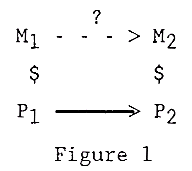
In detail: he proposes (using the chart on the right) that M1 causes M2 (these are mental events) and P1 causes P2 (these are physical events). P1 realises M1 and P2 realises M2. However M1 does not causally effect P1 (i.e., M1 is a consequent
event of P1). If P1 causes P2, and M1 is a result of P1, then M2 is a result of P2. He says that the only alternatives to this problem is to accept dualism
(where the mental events are independent of the physical events) or eliminativism (where the mental events do not exist).
Philosophy
Philosophy is the study of general and fundamental problems, such as those connected with existence, knowledge, values, reason, mind, and language. Philosophy is distinguished from other ways of addressing such problems by its critical, generally systematic approach and its reliance on rational...
, emergentism is the belief in emergence
Emergence
In philosophy, systems theory, science, and art, emergence is the way complex systems and patterns arise out of a multiplicity of relatively simple interactions. Emergence is central to the theories of integrative levels and of complex systems....
, particularly as it involves consciousness
Consciousness
Consciousness is a term that refers to the relationship between the mind and the world with which it interacts. It has been defined as: subjectivity, awareness, the ability to experience or to feel, wakefulness, having a sense of selfhood, and the executive control system of the mind...
and the philosophy of mind
Philosophy of mind
Philosophy of mind is a branch of philosophy that studies the nature of the mind, mental events, mental functions, mental properties, consciousness and their relationship to the physical body, particularly the brain. The mind-body problem, i.e...
, and as it contrasts (or not) with reductionism
Reductionism
Reductionism can mean either an approach to understanding the nature of complex things by reducing them to the interactions of their parts, or to simpler or more fundamental things or a philosophical position that a complex system is nothing but the sum of its parts, and that an account of it can...
. A property of a system
System
System is a set of interacting or interdependent components forming an integrated whole....
is said to be emergent if it is in some sense more than the "sum" of the properties of the system
System
System is a set of interacting or interdependent components forming an integrated whole....
's parts. An emergent property is said to be dependent on some more basic properties (and their
relationships and configuration), so that it can have no separate existence. However, a degree of independence is also asserted of emergent properties, so that they are not identical to, or reducible to, or predictable from,
or deducible from their bases. The different ways in which the independence requirement can be satisfied lead to various sub-varieties of emergence.
Varieties
All varieties of emergentism strive to be compatible with physicalismPhysicalism
Physicalism is a philosophical position holding that everything which exists is no more extensive than its physical properties; that is, that there are no kinds of things other than physical things...
, the theory that the universe is composed exclusively of physical entities, and in particular with the evidence relating changes in the brain with changes in mental functioning. As a theory of mind (which it is not always), emergentism differs from idealism
Idealism
In philosophy, idealism is the family of views which assert that reality, or reality as we can know it, is fundamentally mental, mentally constructed, or otherwise immaterial. Epistemologically, idealism manifests as a skepticism about the possibility of knowing any mind-independent thing...
, eliminative materialism
Eliminative materialism
Eliminative materialism is a materialist position in the philosophy of mind. Its primary claim is that people's common-sense understanding of the mind is false and that certain classes of mental states that most people believe in do not exist...
, identity theories, neutral monism
Neutral monism
Neutral monism, in philosophy, is the metaphysical view that the mental and the physical are two ways of organizing or describing the same elements, which are themselves "neutral," that is, neither physical nor mental. This view denies that the mental and the physical are two fundamentally...
, panpsychism
Panpsychism
In philosophy, panpsychism is the view that all matter has a mental aspect, or, alternatively, all objects have a unified center of experience or point of view...
and substance dualism, whilst being closely associated with property dualism
Property dualism
Property dualism describes a category of positions in the philosophy of mind which hold that, although the world is constituted of just one kind of substance - the physical kind - there exist two distinct kinds of properties: physical properties and mental properties...
. In particular, the dependence of an emergent mind on its base means there is no metaphysical possibility of life after death
Life After Death
Life After Death is the second and final studio album by American rapper The Notorious B.I.G., released March 25, 1997 on Bad Boy Records. A double album, it was released posthumously following his death on March 9, 1997 and serves as his final studio album...
, in contrast with substance dualism. It is generally not obvious whether an emergent theory of mind embraces mental causation or must be considered epiphenomenal.
Some varieties of emergentism are not specifically concerned with the mind-body problem, and instead suggest a hierarchical or layered view of the whole of nature, with the layers arranged in terms of increasing complexity
Complexity
In general usage, complexity tends to be used to characterize something with many parts in intricate arrangement. The study of these complex linkages is the main goal of complex systems theory. In science there are at this time a number of approaches to characterizing complexity, many of which are...
with each requiring its own special science. Typically physics
Physics
Physics is a natural science that involves the study of matter and its motion through spacetime, along with related concepts such as energy and force. More broadly, it is the general analysis of nature, conducted in order to understand how the universe behaves.Physics is one of the oldest academic...
is basic, with chemistry
Chemistry
Chemistry is the science of matter, especially its chemical reactions, but also its composition, structure and properties. Chemistry is concerned with atoms and their interactions with other atoms, and particularly with the properties of chemical bonds....
built on top of it, then biology
Biology
Biology is a natural science concerned with the study of life and living organisms, including their structure, function, growth, origin, evolution, distribution, and taxonomy. Biology is a vast subject containing many subdivisions, topics, and disciplines...
, psychology
Psychology
Psychology is the study of the mind and behavior. Its immediate goal is to understand individuals and groups by both establishing general principles and researching specific cases. For many, the ultimate goal of psychology is to benefit society...
and social sciences
Social sciences
Social science is the field of study concerned with society. "Social science" is commonly used as an umbrella term to refer to a plurality of fields outside of the natural sciences usually exclusive of the administrative or managerial sciences...
. Reductionists respond that the arrangement of the sciences is a matter of convenience, and that chemistry is derivable from physics (and so forth) in principle, an argument which gained force after the establishment of a quantum-mechanical basis for chemistry
Other varieties see mind
Mind
The concept of mind is understood in many different ways by many different traditions, ranging from panpsychism and animism to traditional and organized religious views, as well as secular and materialist philosophies. Most agree that minds are constituted by conscious experience and intelligent...
or consciousness
Consciousness
Consciousness is a term that refers to the relationship between the mind and the world with which it interacts. It has been defined as: subjectivity, awareness, the ability to experience or to feel, wakefulness, having a sense of selfhood, and the executive control system of the mind...
as specifically and anomalously requiring emergentist explanation, and therefore constitute a family of positions in the philosophy of mind
Philosophy of mind
Philosophy of mind is a branch of philosophy that studies the nature of the mind, mental events, mental functions, mental properties, consciousness and their relationship to the physical body, particularly the brain. The mind-body problem, i.e...
. Douglas Hofstadter
Douglas Hofstadter
Douglas Richard Hofstadter is an American academic whose research focuses on consciousness, analogy-making, artistic creation, literary translation, and discovery in mathematics and physics...
summarises this view as "the soul is more than the sum of its parts". A number of philosophers have offered the argument that qualia
Qualia
Qualia , singular "quale" , from a Latin word meaning for "what sort" or "what kind," is a term used in philosophy to refer to subjective conscious experiences as 'raw feels'. Examples of qualia are the pain of a headache, the taste of wine, the experience of taking a recreational drug, or the...
constitute the hard problem of consciousness
Hard problem of consciousness
The hard problem of consciousness is the problem of explaining how and why we have qualitative phenomenal experiences. David Chalmers contrasts this with the "easy problems" of explaining the ability to discriminate, integrate information, report mental states, focus attention, etc...
, and resist reductive explanation in a way that all other phenomena do not. In contrast, reductionists generally see the task of accounting for the possibly atypical properties of mind and of living things as a matter of showing that, contrary to appearances, such properties are indeed fully accountable in terms of the properties of the basic constituents of nature and therefore in no way genuinely atypical.
Intermediate positions are possible: for instance, some emergentists hold that emergence is neither universal nor restricted to consciousness, but applies to (for instance) living creatures, or self organising systems, or complex
Complex
A complex is a whole that comprehends a number of intricate parts, especially one with interconnected or mutually related parts; for example, a complex of buildings.Complex may refer to:-Biology:...
systems.
Some philosophers hold that emergent properties causally interact with more fundamental levels, an idea known as downward causation. Others maintain that higher-order properties simply supervene over lower levels without direct causal interaction.
All the cases so far discussed have been synchronic
Synchronic
Synchronic may refer to:*Synchronicity*Synchronic analysis, in linguistics * Synchronic, an adjective referring to a quality of music....
, i.e. the emergent property exists simultaneously with its basis.
Yet another variation operates diachnronically. Emergentists of this type believe that genuinely novel properties can come into being, without being accountable in terms of the preceding history of the universe. (Contrast with indeterminism
Indeterminism
Indeterminism is the concept that events are not caused, or not caused deterministically by prior events. It is the opposite of determinism and related to chance...
where it is only the arrangement or configuration of matter that is unaccountable). These evolution-inspired theories often have a theological aspect, as in the process philosophy
Process philosophy
Process philosophy identifies metaphysical reality with change and dynamism. Since the time of Plato and Aristotle, philosophers have posited true reality as "timeless", based on permanent substances, whilst processes are denied or subordinated to timeless substances...
of Alfred North Whitehead
Alfred North Whitehead
Alfred North Whitehead, OM FRS was an English mathematician who became a philosopher. He wrote on algebra, logic, foundations of mathematics, philosophy of science, physics, metaphysics, and education...
and Charles Hartshorne
Charles Hartshorne
Charles Hartshorne was a prominent American philosopher who concentrated primarily on the philosophy of religion and metaphysics. He developed the neoclassical idea of God and produced a modal proof of the existence of God that was a development of St. Anselm's Ontological Argument...
.
The concept of emergence has been applied to the theory of literature and art, history, linguistics, cognitive sciences, etc. by the teachings of Jean-Marie Grassin et the University of Limoges (v. esp.: J. Fontanille, B. Westphal, J. Vion-Dury, éds. L'Émergence -- Poétique de l'Émergence, en réponse aux travaux de Jean-Marie Grassin, Bern, Berlin, etc., 2011; and: the article "Emergence" in the International Dictionary of Literary Terms (DITL).
Relationship to emergentism
A refinement of vitalismVitalism
Vitalism, as defined by the Merriam-Webster dictionary, is#a doctrine that the functions of a living organism are due to a vital principle distinct from biochemical reactions...
may be recognized in contemporary molecular histology in the proposal that some key organising and structuring features of organisms, perhaps including even life itself, are examples of emergent process
Emergence
In philosophy, systems theory, science, and art, emergence is the way complex systems and patterns arise out of a multiplicity of relatively simple interactions. Emergence is central to the theories of integrative levels and of complex systems....
es; those in which a complexity arises, out of interacting chemical processes forming interconnected feedback cycles, that cannot fully be described in terms of those processes since the system as a whole has properties that the constituent reactions lack.
Whether emergent system properties should be grouped with traditional vitalist concepts is a matter of semantic controversy. In a light-hearted millennial vein, Kirshner and Michison call research into integrated cell and organismal physiology “molecular vitalism.”
According to Emmeche et al. (1997):
"On the one hand, many scientists and philosophers regard emergence as having only a pseudo-scientific status. On the other hand, new developments in physics, biology, psychology, and crossdisciplinary fields such as cognitive science, artificial life, and the study of non-linear dynamical systems have focused strongly on the high level 'collective behaviour' of complex systems, which is often said to be truly emergent, and the term is increasingly used to characterize such systems."
Emmeche et al. (1998) state that "there is a very important difference between the vitalists and the emergentists: the vitalist's creative forces were relevant only in organic substances, not in inorganic matter. Emergence hence is creation of new properties regardless of the substance involved." "The assumption of an extra-physical vitalis (vital force, entelechy, élan vital
Élan vital
Élan vital was coined by French philosopher Henri Bergson in his 1907 book Creative Evolution, in which he addresses the question of self-organisation and spontaneous morphogenesis of things in an increasingly complex manner. Elan vital was translated in the English edition as "vital impetus", but...
, etc.), as formulated in most forms (old or new) of vitalism, is usually without any genuine explanatory power. It has served altogether too often as an intellectual tranquilizer or verbal sedative—stifling scientific inquiry rather than encouraging it to proceed in new directions."
Examples
The first emergentist theorists used the example of water having a new property when hydrogen, H, and oxygen, O, combine to form H2O (water). In this example there emerge such new properties as liquidity under standard conditions. (Analogous hydrides of the oxygen family, such as hydrogen sulfide, are gases). However, a better and more recent example of an emergent phenomenon, one provided by physicist Erwin SchrödingerErwin Schrödinger
Erwin Rudolf Josef Alexander Schrödinger was an Austrian physicist and theoretical biologist who was one of the fathers of quantum mechanics, and is famed for a number of important contributions to physics, especially the Schrödinger equation, for which he received the Nobel Prize in Physics in 1933...
, is found in the case of families of molecules known as isomers, which are made up of precisely the same atoms, differently arranged, which nevertheless have different physical properties. Similarly, enantiomers are molecules made up of precisely the same atoms, in precisely the same arrangement, but which exist in "right-handed" and "left-handed" forms, and also have different properties when interacting with other molecules.
Biologists Ursula Goodenough
Ursula Goodenough
Ursula W. Goodenough is a Professor of Biology at Washington University in St. Louis and author of the best selling book Sacred Depths of Nature...
and Terrence Deacon
Terrence Deacon
Terrence William Deacon is an American anthropologist . He taught at Harvard for eight years, relocated to Boston University in 1992, and is currently Professor of Biological Anthropology and Neuroscience at the University of California, Berkeley.-Theoretical interests:Prof...
in their 2006 essay The Sacred Emergence of Nature have assembled a range of examples of physical and biological emergent properties that provide the evidential basis for emergentism as a philosophy that comports with a modern scientific understanding of how complexity arises in the natural world, and as a philosophy that supports religious naturalism
Religious naturalism
Religious naturalism is an approach to spirituality that is devoid of supernaturalism. The focus is on the religious attributes of the universe/Nature, the understanding of it and our response to it . These provide for the development of an eco-morality...
. A longer compilation of emergent forms in nature is the 2004 book by biologist Harold Morowitz: The Emergence of Everything.
In the game of Go, the rules stipulate various constraints on the placement and removal of playing pieces. As a consequence of this, an "emergent" pattern is that groups of pieces with two eyes
Life and death
Life and death is a fundamental concept in the game of Go, where the status of a distinct group of stones is determined as either being "alive", and may remain on the board indefinitely, or "dead," where the group will be lost as "captured"...
are "alive" and can never be removed. This is a vital part of the game, without which it cannot be played or understood; but is not part of the rules. Similarly, in John Conweay's Game of Life, some patterns of cells have strking properties — such as the ability to move or reproduce — which are not explicitly coded into the rules.
Although examples of higher level properties which are not identical to lower order properties are easy to find, examples where they are not reducible to or predicable from their bases are more controversial.
John Stuart Mill
John Stuart MillJohn Stuart Mill
John Stuart Mill was a British philosopher, economist and civil servant. An influential contributor to social theory, political theory, and political economy, his conception of liberty justified the freedom of the individual in opposition to unlimited state control. He was a proponent of...
outlined his version of emergentism in System of Logic (1843). Mill argued that the properties of some physical systems, such as those in which dynamic forces
Dynamics (mechanics)
In the field of physics, the study of the causes of motion and changes in motion is dynamics. In other words the study of forces and why objects are in motion. Dynamics includes the study of the effect of torques on motion...
combine to produce simple motions, are subject to a law of nature he called the "Composition of Causes
Composition of Causes
The Composition of Causes was a set of philosophical laws advanced by John Stuart Mill in his watershed essay, A System of Logic. These laws outlined Mill's view of the epistemological components of emergentism, a school of philosophical laws that posited a decidedly opportunistic approach to the...
". According to Mill, emergent properties are not subject to this law, but instead amount to more than the sums of the properties of their parts.
Mill believed that various chemical reaction
Chemical reaction
A chemical reaction is a process that leads to the transformation of one set of chemical substances to another. Chemical reactions can be either spontaneous, requiring no input of energy, or non-spontaneous, typically following the input of some type of energy, such as heat, light or electricity...
s (poorly understood in his time) could provide examples of emergent properties, although some critics believe that modern physical chemistry
Physical chemistry
Physical chemistry is the study of macroscopic, atomic, subatomic, and particulate phenomena in chemical systems in terms of physical laws and concepts...
has shown that these reactions can be given satisfactory reductionist explanations. For instance, it has been claimed that the whole of chemistry is, in principle,
contained in the Schrödinger equation
Schrödinger equation
The Schrödinger equation was formulated in 1926 by Austrian physicist Erwin Schrödinger. Used in physics , it is an equation that describes how the quantum state of a physical system changes in time....
.
C. D. Broad
British philosopher C. D. Broad defended a realistic epistemology in The Mind and its Place in Nature (1925) arguing that emergent materialismEmergent materialism
In the philosophy of mind, emergent materialism is a theory which asserts that the mind is an irreducible existent in some sense, albeit not in the sense of being an ontological simple, and that the study of mental phenomena is independent of other sciences.The view can be divided into emergence...
is the most likely solution to the mind-body problem.
Broad defined emergence as follows;-
Put in abstract terms the emergent theory asserts that there are certain wholes, composed (say)
of constituents A, B, and C in a relation R to each other; that all wholes composed of
constituents of the same kind as A, B, and C in relations of the same kind as R have certain
characteristic properties; that A, B, and C are capable of occurring in other kinds of complex
where the relation is not of the same kind as R; and that the characteristic properties of the
whole R(A, B, C) cannot, even in theory, be deduced from the most complete knowledge of
the properties of A, B, and C in isolation or in other wholes which are not of the form R(A, B,
C).
This definition amounted to the claim that mental properties would count as emergent if and only if philosophical zombie
Philosophical zombie
A philosophical zombie or p-zombie in the philosophy of mind and perception is a hypothetical being that is indistinguishable from a normal human being except in that it lacks conscious experience, qualia, or sentience...
s were metaphysically possible. Many philosophers take this position to be inconsistent with some formulations of psychophysical supervenience.
C. Lloyd Morgan and Samuel Alexander
Samuel AlexanderSamuel Alexander
Samuel Alexander OM was an Australian-born British philosopher. He was the first Jewish fellow of an Oxbridge college.-Early life:...
's views on emergentism, argued in Space, Time, and Deity (1920), were inspired in part by the ideas in psychologist C. Lloyd Morgan
C. Lloyd Morgan
Conwy Lloyd Morgan, FRS was a British psychologist. He is best remembered for the experimental approach to animal psychology now known as "Morgan's canon"....
's Emergent Evolution
Emergent evolution
Emergent evolution is the hypothesis that, in the course of evolution, some entirely new properties, such as life and consciousness, appear at certain critical points, usually because of an unpredictable rearrangement of the already existing entities...
. Alexander believed that emergence was fundamentally inexplicable, and that emergentism was simply a "brute empirical fact":
"The higher quality emerges from the lower level of existence and has its roots therein, but it emerges therefrom, and it does not belong to that level, but constitutes its possessor a new order of existent with its special laws of behaviour. The existence of emergent qualities thus described is something to be noted, as some would say, under the compulsion of brute empirical fact, or, as I should prefer to say in less harsh terms, to be accepted with the “natural piety” of the investigator. It admits no explanation." (Space, Time, and Deity)
Despite the causal and explanatory gap between the phenomena on different levels, Alexander held that emergent qualities were not epiphenomenal. His view can perhaps best be described as a form of nonreductive physicalism (NRP) or supervenience
Supervenience
In philosophy, supervenience is a kind of dependency relationship. For example, mental states might depend on physical brain states. This dependency is typically held to obtain between sets of properties. A classic example is that mental states of pain supervene on 'C-fibers firing'...
theory.
Ludwig von Bertalanffy
Ludwig von BertalanffyLudwig von Bertalanffy
Karl Ludwig von Bertalanffy was an Austrian-born biologist known as one of the founders of general systems theory . GST is an interdisciplinary practice that describes systems with interacting components, applicable to biology, cybernetics, and other fields...
founded General System Theory (GST), which is a more contemporary approach to emergentism. A popularization of many of the elements of GST may be found in The Web of Life by Fritjof Capra
Fritjof Capra
Fritjof Capra is an Austrian-born American physicist. He is a founding director of the Center for Ecoliteracy in Berkeley, California, and is on the faculty of Schumacher College....
.
Jaegwon Kim
Jaegwon Kim
Jaegwon Kim is a Korean American philosopher currently working at Brown University. He is best known for his work on mental causation and the mind-body problem. Key themes in his work include: a rejection of Cartesian metaphysics, the limitations of strict psychophysical identity, supervenience,...
has raised an objection based on causal closure
Causal closure
Causal closure is a metaphysical theory about the nature of causation in the physical realm with significant ramifications in the study of the mind.-Definition:Causal closure has two main formulations - a weak and a strong form....
and overdetermination
Overdetermination
Overdetermination, the idea that a single observed effect is determined by multiple causes at once , was originally a key concept of Sigmund Freud's psychoanalysis....
.
Emergentism strives to be compatible with physicalism, and physicalism, according to Kim, has a principle of causal closure according to which every physical event is fully accountable in terms of physical causes. This seems to leave no "room"
for mental causation to operate. If our bodily movements were caused by the preceding state of our bodies and our decisions and intentions, they would be overdetermined. Mental causation in this sense is not
the same as free will
Free will
"To make my own decisions whether I am successful or not due to uncontrollable forces" -Troy MorrisonA pragmatic definition of free willFree will is the ability of agents to make choices free from certain kinds of constraints. The existence of free will and its exact nature and definition have long...
, but is only the claim that mental states are causally relevant. If emergentists respond by abandoning the idea of mental causation, their position becomes a form of epiphenomenalism
Epiphenomenalism
In philosophy of mind, epiphenomenalism, also known as Type-E Dualism, is a view that "mental" states do not have any influence on "physical" states.-Background:...
.
In detail: he proposes (using the chart on the right) that M1 causes M2 (these are mental events) and P1 causes P2 (these are physical events). P1 realises M1 and P2 realises M2. However M1 does not causally effect P1 (i.e., M1 is a consequent
Consequent
A consequent is the second half of a hypothetical proposition. In the standard form of such a proposition, it is the part that follows "then".Examples:* If P, then Q.Q is the consequent of this hypothetical proposition....
event of P1). If P1 causes P2, and M1 is a result of P1, then M2 is a result of P2. He says that the only alternatives to this problem is to accept dualism
Dualism
Dualism denotes a state of two parts. The term 'dualism' was originally coined to denote co-eternal binary opposition, a meaning that is preserved in metaphysical and philosophical duality discourse but has been diluted in general or common usages. Dualism can refer to moral dualism, Dualism (from...
(where the mental events are independent of the physical events) or eliminativism (where the mental events do not exist).
External links
- Emergentism in the Stanford Encyclopedia of Philosophy, 2007.
- Emergentism in the Dictionary of Philosophy of Mind, 2007.