


Ludwig von Bertalanffy

Encyclopedia
Karl Ludwig von Bertalanffy (September 19, 1901, Atzgersdorf
near Vienna
, Austria
– June 12, 1972, Buffalo, New York
, USA
) was an Austria
n-born biologist
known as one of the founders of general systems theory
(GST). GST is an interdisciplinary practice that describes systems with interacting components, applicable to biology
, cybernetics
, and other fields. Bertalanffy proposed that the laws of thermodynamics applied to closed systems, but not necessarily to "open systems," such as living things. His mathematical model of an organism's growth over time, published in 1934, is still in use today.
Von Bertalanffy grew up in Austria and subsequently worked in Vienna, London, Canada and the USA.
) near Vienna
. The Bertalanffy family had roots in the 16th century nobility of Hungary
which included several scholars and court officials. His grandfather Charles Joseph von Bertalanffy (1833–1912) had settled in Austria and was a state theatre director in Klagenfurt
, Graz
, and Vienna
, which were important positions in imperial Austria. Ludwig's father Gustav von Bertalanffy (1861–1919) was a prominent railway administrator. On his mother's side Ludwig's grandfather Joseph Vogel was an imperial counsellor and a wealthy Vienna publisher. Ludwig's mother Charlotte Vogel was seventeen when she married the thirty-four year old Gustav. They divorced when Ludwig was ten, and both remarried outside the Catholic Church in civil ceremonies.
Ludwig von Bertalanffy grew up as an only child educated at home by private tutors until he was ten. When he went to the gymnasium/grammar school he was already well trained in self study, and kept studying on his own. His neighbour, the famous biologist Paul Kammerer
, became a mentor and an example to the young Ludwig. In 1918 he started his studies at the university level with the philosophy and art history, first at the University of Innsbruck and then at the University of Vienna. Ultimately, Bertalanffy had to make a choice between studying philosophy of science
and biology
, and chose the latter because, according to him, one could always become a philosopher later, but not a biologist. In 1926 he finished his PhD thesis (translated title: Fechner and the problem of integration of higher order) on the physicist and philosopher Gustav Theodor Fechner.
Von Bertalanffy met his future wife Maria in April 1924 in the Austrian Alps, and were almost never apart for the next forty-eight years. She wanted to finish studying but never did, instead devoting her life to Bertalanffy's career. Later in Canada she would work both for him and with him in his career, and after his death she compiled two of Bertalanffy's last works. They had one child, who would follow in his father's footsteps by making his profession in the field of cancer research.
Von Bertalanffy was a professor at the University of Vienna
from 1934–48, University of London
(1948–49), Université de Montréal
(1949), University of Ottawa
(1950–54), University of Southern California
(1955–58), the Menninger Foundation
(1958–60), University of Alberta
(1961–68), and State University of New York at Buffalo (SUNY) (1969–72). In 1972, he died from a sudden heart attack.
, and extended into cybernetics
, education
, history
, philosophy
, psychiatry
, psychology
and sociology
. Some of his admirers even believe that this theory will one day provide a conceptual framework for all these disciplines". Spending most of his life in semi-obscurity, Ludwig von Bertalanffy may well be the least known intellectual titan of the twentieth century.
model published by von Bertalanffy in 1934 is widely used in biological models and exists in a number of permutations.
In its simplest version the so-called von Bertalanffy growth equation is expressed as a differential equation
of length (L) over time (t):

when is the von Bertalanffy growth rate and
  the ultimate length of the individual. This model was proposed earlier by A. Pütter in 1920 (Arch. Gesamte Physiol. Mensch. Tiere, 180: 298-340).
The Dynamic Energy Budget
theory provides a mechanistic explanation of this model in the case of isomorph
s that experience a constant food availability. The inverse of the von Bertalanffy growth rate appears to depend linearly on the ultimate length, when different food levels are compared. The intercept relates to the maintenance costs, the slope to the rate at which reserve is mobilized for use by metabolism. The ultimate length equals the maximum length at high food availabilities.
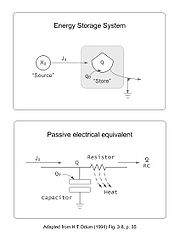
named the storage symbol of his General Systems Language
as the Bertalanffy module (see image right).
(GST). The theory attempted to provide alternatives to conventional models of organization
. GST defined new foundations and developments as a generalized theory of systems with applications to numerous areas of study, emphasizing holism
over reductionism, organism
over mechanism.
models based on classical science and the second law of thermodynamics
were untenable. Bertalanffy maintained that “the conventional formulation of physics are, in principle, inapplicable to the living organism being open system having steady state
. We may well suspect that many characteristics of living systems which are paradoxical in view of the laws of physics are a consequence of this fact.” However, while closed physical system
s were questioned, questions equally remained over whether or not open physical systems could justifiably lead to a definitive science for the application of an open systems view to a general theory of systems.
In Bertalanffy’s model, the theorist defined general principles of open systems and the limitations of conventional models. He ascribed applications to biology, information theory
and cybernetics
. Concerning biology
, examples from the open systems view suggested they “may suffice to indicate briefly the large fields of application
” that could be the “outlines of a wider generalization
;” from which, a hypothesis
for cybernetics. Although potential applications exist in other areas, the theorist developed only the implications for biology and cybernetics. Bertalanffy also noted unsolved problems, which included continued questions over thermodynamics, thus the unsubstantiated claim that there are physical law
s to support generalizations (particularly for information theory), and the need for further research into the problems and potential with the applications of the open system view from physics.
from a modern systems approach that included “the concept of general system, of feedback
, information
, communication
, etc.” The theorist critiqued classical “atomistic” conceptions of social systems and ideation “such as ‘social physics’ as was often attempted in a reductionist spirit.” Bertalanffy also recognized difficulties with the application of a new general theory to social science due to the complexity of the intersections between natural sciences and human social systems. However, the theory still encouraged for new developments from sociology, to anthropology
, economics
, political science
, and psychology
among other areas. Today, Bertalanffy's GST remains a bridge for interdisciplinary study of systems in the social sciences.
The first articles from Bertalanffy on General Systems Theory:
Atzgersdorf
Atzgersdorf is a former municipality in Lower Austria that is now a part of the 23rd Viennese district Liesing. A small part of the former municipality today is part of the 12th Viennese district Meidling....
near Vienna
Vienna
Vienna is the capital and largest city of the Republic of Austria and one of the nine states of Austria. Vienna is Austria's primary city, with a population of about 1.723 million , and is by far the largest city in Austria, as well as its cultural, economic, and political centre...
, Austria
Austria
Austria , officially the Republic of Austria , is a landlocked country of roughly 8.4 million people in Central Europe. It is bordered by the Czech Republic and Germany to the north, Slovakia and Hungary to the east, Slovenia and Italy to the south, and Switzerland and Liechtenstein to the...
– June 12, 1972, Buffalo, New York
New York
New York is a state in the Northeastern region of the United States. It is the nation's third most populous state. New York is bordered by New Jersey and Pennsylvania to the south, and by Connecticut, Massachusetts and Vermont to the east...
, USA
United States
The United States of America is a federal constitutional republic comprising fifty states and a federal district...
) was an Austria
Austria
Austria , officially the Republic of Austria , is a landlocked country of roughly 8.4 million people in Central Europe. It is bordered by the Czech Republic and Germany to the north, Slovakia and Hungary to the east, Slovenia and Italy to the south, and Switzerland and Liechtenstein to the...
n-born biologist
Biology
Biology is a natural science concerned with the study of life and living organisms, including their structure, function, growth, origin, evolution, distribution, and taxonomy. Biology is a vast subject containing many subdivisions, topics, and disciplines...
known as one of the founders of general systems theory
Systems theory
Systems theory is the transdisciplinary study of systems in general, with the goal of elucidating principles that can be applied to all types of systems at all nesting levels in all fields of research...
(GST). GST is an interdisciplinary practice that describes systems with interacting components, applicable to biology
Biology
Biology is a natural science concerned with the study of life and living organisms, including their structure, function, growth, origin, evolution, distribution, and taxonomy. Biology is a vast subject containing many subdivisions, topics, and disciplines...
, cybernetics
Cybernetics
Cybernetics is the interdisciplinary study of the structure of regulatory systems. Cybernetics is closely related to information theory, control theory and systems theory, at least in its first-order form...
, and other fields. Bertalanffy proposed that the laws of thermodynamics applied to closed systems, but not necessarily to "open systems," such as living things. His mathematical model of an organism's growth over time, published in 1934, is still in use today.
Von Bertalanffy grew up in Austria and subsequently worked in Vienna, London, Canada and the USA.
Biography
Ludwig von Bertalanffy was born and grew up in the little village of Atzgersdorf (now LiesingLiesing
Liesing is the 23rd district of Vienna . It is on the southwest edge of Vienna, Austria.It was formed after Austria's Anschluss with Germany, when Vienna expanded from 21 districts to 26...
) near Vienna
Vienna
Vienna is the capital and largest city of the Republic of Austria and one of the nine states of Austria. Vienna is Austria's primary city, with a population of about 1.723 million , and is by far the largest city in Austria, as well as its cultural, economic, and political centre...
. The Bertalanffy family had roots in the 16th century nobility of Hungary
Hungary
Hungary , officially the Republic of Hungary , is a landlocked country in Central Europe. It is situated in the Carpathian Basin and is bordered by Slovakia to the north, Ukraine and Romania to the east, Serbia and Croatia to the south, Slovenia to the southwest and Austria to the west. The...
which included several scholars and court officials. His grandfather Charles Joseph von Bertalanffy (1833–1912) had settled in Austria and was a state theatre director in Klagenfurt
Klagenfurt
-Name:Carinthia's eminent linguists Primus Lessiak and Eberhard Kranzmayer assumed that the city's name, which literally translates as "ford of lament" or "ford of complaints", had something to do with the superstitious thought that fateful fairies or demons tend to live around treacherous waters...
, Graz
Graz
The more recent population figures do not give the whole picture as only people with principal residence status are counted and people with secondary residence status are not. Most of the people with secondary residence status in Graz are students...
, and Vienna
Vienna
Vienna is the capital and largest city of the Republic of Austria and one of the nine states of Austria. Vienna is Austria's primary city, with a population of about 1.723 million , and is by far the largest city in Austria, as well as its cultural, economic, and political centre...
, which were important positions in imperial Austria. Ludwig's father Gustav von Bertalanffy (1861–1919) was a prominent railway administrator. On his mother's side Ludwig's grandfather Joseph Vogel was an imperial counsellor and a wealthy Vienna publisher. Ludwig's mother Charlotte Vogel was seventeen when she married the thirty-four year old Gustav. They divorced when Ludwig was ten, and both remarried outside the Catholic Church in civil ceremonies.
Ludwig von Bertalanffy grew up as an only child educated at home by private tutors until he was ten. When he went to the gymnasium/grammar school he was already well trained in self study, and kept studying on his own. His neighbour, the famous biologist Paul Kammerer
Paul Kammerer
Paul Kammerer was an Austrian biologist who studied and advocated the now abandoned Lamarckian theory of inheritance – the notion that organisms may pass to their offspring characteristics they have acquired in their lifetime...
, became a mentor and an example to the young Ludwig. In 1918 he started his studies at the university level with the philosophy and art history, first at the University of Innsbruck and then at the University of Vienna. Ultimately, Bertalanffy had to make a choice between studying philosophy of science
Philosophy of science
The philosophy of science is concerned with the assumptions, foundations, methods and implications of science. It is also concerned with the use and merit of science and sometimes overlaps metaphysics and epistemology by exploring whether scientific results are actually a study of truth...
and biology
Biology
Biology is a natural science concerned with the study of life and living organisms, including their structure, function, growth, origin, evolution, distribution, and taxonomy. Biology is a vast subject containing many subdivisions, topics, and disciplines...
, and chose the latter because, according to him, one could always become a philosopher later, but not a biologist. In 1926 he finished his PhD thesis (translated title: Fechner and the problem of integration of higher order) on the physicist and philosopher Gustav Theodor Fechner.
Von Bertalanffy met his future wife Maria in April 1924 in the Austrian Alps, and were almost never apart for the next forty-eight years. She wanted to finish studying but never did, instead devoting her life to Bertalanffy's career. Later in Canada she would work both for him and with him in his career, and after his death she compiled two of Bertalanffy's last works. They had one child, who would follow in his father's footsteps by making his profession in the field of cancer research.
Von Bertalanffy was a professor at the University of Vienna
University of Vienna
The University of Vienna is a public university located in Vienna, Austria. It was founded by Duke Rudolph IV in 1365 and is the oldest university in the German-speaking world...
from 1934–48, University of London
University of London
-20th century:Shortly after 6 Burlington Gardens was vacated, the University went through a period of rapid expansion. Bedford College, Royal Holloway and the London School of Economics all joined in 1900, Regent's Park College, which had affiliated in 1841 became an official divinity school of the...
(1948–49), Université de Montréal
Université de Montréal
The Université de Montréal is a public francophone research university in Montreal, Quebec, Canada. It comprises thirteen faculties, more than sixty departments and two affiliated schools: the École Polytechnique and HEC Montréal...
(1949), University of Ottawa
University of Ottawa
The University of Ottawa is a bilingual, research-intensive, non-denominational, international university in Ottawa, Ontario. It is one of the oldest universities in Canada. It was originally established as the College of Bytown in 1848 by the Missionary Oblates of Mary Immaculate...
(1950–54), University of Southern California
University of Southern California
The University of Southern California is a private, not-for-profit, nonsectarian, research university located in Los Angeles, California, United States. USC was founded in 1880, making it California's oldest private research university...
(1955–58), the Menninger Foundation
Menninger Foundation
The Menninger Foundation was founded in 1919 by the Menninger family in Topeka, Kansas, and consists of a clinic, a sanatorium, and a school of psychiatry, all of which bear the Menninger name. In 2003, the Menninger Clinic moved to Houston. The foundation was started by Drs. Karl, Will, and...
(1958–60), University of Alberta
University of Alberta
The University of Alberta is a public research university located in Edmonton, Alberta, Canada. Founded in 1908 by Alexander Cameron Rutherford, the first premier of Alberta and Henry Marshall Tory, its first president, it is widely recognized as one of the best universities in Canada...
(1961–68), and State University of New York at Buffalo (SUNY) (1969–72). In 1972, he died from a sudden heart attack.
Work
Today, Bertalanffy is considered to be a founder and one of the principal authors of the interdisciplinary school of thought known as general systems theory. According to Weckowicz (1989), he "occupies an important position in the intellectual history of the twentieth century. His contributions went beyond biologyBiology
Biology is a natural science concerned with the study of life and living organisms, including their structure, function, growth, origin, evolution, distribution, and taxonomy. Biology is a vast subject containing many subdivisions, topics, and disciplines...
, and extended into cybernetics
Cybernetics
Cybernetics is the interdisciplinary study of the structure of regulatory systems. Cybernetics is closely related to information theory, control theory and systems theory, at least in its first-order form...
, education
Education
Education in its broadest, general sense is the means through which the aims and habits of a group of people lives on from one generation to the next. Generally, it occurs through any experience that has a formative effect on the way one thinks, feels, or acts...
, history
History
History is the discovery, collection, organization, and presentation of information about past events. History can also mean the period of time after writing was invented. Scholars who write about history are called historians...
, philosophy
Philosophy
Philosophy is the study of general and fundamental problems, such as those connected with existence, knowledge, values, reason, mind, and language. Philosophy is distinguished from other ways of addressing such problems by its critical, generally systematic approach and its reliance on rational...
, psychiatry
Psychiatry
Psychiatry is the medical specialty devoted to the study and treatment of mental disorders. These mental disorders include various affective, behavioural, cognitive and perceptual abnormalities...
, psychology
Psychology
Psychology is the study of the mind and behavior. Its immediate goal is to understand individuals and groups by both establishing general principles and researching specific cases. For many, the ultimate goal of psychology is to benefit society...
and sociology
Sociology
Sociology is the study of society. It is a social science—a term with which it is sometimes synonymous—which uses various methods of empirical investigation and critical analysis to develop a body of knowledge about human social activity...
. Some of his admirers even believe that this theory will one day provide a conceptual framework for all these disciplines". Spending most of his life in semi-obscurity, Ludwig von Bertalanffy may well be the least known intellectual titan of the twentieth century.
The individual growth model
The individual growthCell growth
The term cell growth is used in the contexts of cell development and cell division . When used in the context of cell division, it refers to growth of cell populations, where one cell grows and divides to produce two "daughter cells"...
model published by von Bertalanffy in 1934 is widely used in biological models and exists in a number of permutations.
In its simplest version the so-called von Bertalanffy growth equation is expressed as a differential equation
Differential equation
A differential equation is a mathematical equation for an unknown function of one or several variables that relates the values of the function itself and its derivatives of various orders...
of length (L) over time (t):
when
is the von Bertalanffy growth rate and the ultimate length of the individual. This model was proposed earlier by A. Pütter in 1920 (Arch. Gesamte Physiol. Mensch. Tiere, 180: 298-340).The Dynamic Energy Budget
Dynamic energy budget
The Dynamic Energy Budget theory aims to identify simple quantitative rules for the organization of metabolism of individual organisms that can be understood from basic first principles...
theory provides a mechanistic explanation of this model in the case of isomorph
Isomorph
An isomorph is an organism that does not change in shape during growth. The implication is that its volume is proportional to its cubed length, and its surface area to its squared length...
s that experience a constant food availability. The inverse of the von Bertalanffy growth rate appears to depend linearly on the ultimate length, when different food levels are compared. The intercept relates to the maintenance costs, the slope to the rate at which reserve is mobilized for use by metabolism. The ultimate length equals the maximum length at high food availabilities.
Bertalanffy Module
To honor Bertalanffy, ecological systems engineer and scientist Howard T. OdumHoward T. Odum
Howard Thomas Odum was an American ecologist...
named the storage symbol of his General Systems Language
Energy Systems Language
The Energy Systems Language , also referred to as Energese, Energy Circuit Language and Generic Systems Symbols, was developed by the ecologist Howard T. Odum and colleagues in the 1950s during studies of the tropical forests funded by the United States Atomic Energy Commission...
as the Bertalanffy module (see image right).
General System Theory (GST)
The biologist is widely recognized for his contributions to science as a systems theorist; specifically, for the development of a theory known as General System TheorySystems theory
Systems theory is the transdisciplinary study of systems in general, with the goal of elucidating principles that can be applied to all types of systems at all nesting levels in all fields of research...
(GST). The theory attempted to provide alternatives to conventional models of organization
Organization
An organization is a social group which distributes tasks for a collective goal. The word itself is derived from the Greek word organon, itself derived from the better-known word ergon - as we know `organ` - and it means a compartment for a particular job.There are a variety of legal types of...
. GST defined new foundations and developments as a generalized theory of systems with applications to numerous areas of study, emphasizing holism
Holism
Holism is the idea that all the properties of a given system cannot be determined or explained by its component parts alone...
over reductionism, organism
Organism
In biology, an organism is any contiguous living system . In at least some form, all organisms are capable of response to stimuli, reproduction, growth and development, and maintenance of homoeostasis as a stable whole.An organism may either be unicellular or, as in the case of humans, comprise...
over mechanism.
Open systems
Bertalanffy's contribution to systems theory is best known for his theory of open systems. The system theorist argued that traditional closed systemClosed system
-In physics:In thermodynamics, a closed system can exchange energy , but not matter, with its surroundings.In contrast, an isolated system cannot exchange any of heat, work, or matter with the surroundings, while an open system can exchange all of heat, work and matter.For a simple system, with...
models based on classical science and the second law of thermodynamics
Second law of thermodynamics
The second law of thermodynamics is an expression of the tendency that over time, differences in temperature, pressure, and chemical potential equilibrate in an isolated physical system. From the state of thermodynamic equilibrium, the law deduced the principle of the increase of entropy and...
were untenable. Bertalanffy maintained that “the conventional formulation of physics are, in principle, inapplicable to the living organism being open system having steady state
Steady state
A system in a steady state has numerous properties that are unchanging in time. This implies that for any property p of the system, the partial derivative with respect to time is zero:...
. We may well suspect that many characteristics of living systems which are paradoxical in view of the laws of physics are a consequence of this fact.” However, while closed physical system
Physical system
In physics, the word system has a technical meaning, namely, it is the portion of the physical universe chosen for analysis. Everything outside the system is known as the environment, which in analysis is ignored except for its effects on the system. The cut between system and the world is a free...
s were questioned, questions equally remained over whether or not open physical systems could justifiably lead to a definitive science for the application of an open systems view to a general theory of systems.
In Bertalanffy’s model, the theorist defined general principles of open systems and the limitations of conventional models. He ascribed applications to biology, information theory
Information theory
Information theory is a branch of applied mathematics and electrical engineering involving the quantification of information. Information theory was developed by Claude E. Shannon to find fundamental limits on signal processing operations such as compressing data and on reliably storing and...
and cybernetics
Cybernetics
Cybernetics is the interdisciplinary study of the structure of regulatory systems. Cybernetics is closely related to information theory, control theory and systems theory, at least in its first-order form...
. Concerning biology
Biology
Biology is a natural science concerned with the study of life and living organisms, including their structure, function, growth, origin, evolution, distribution, and taxonomy. Biology is a vast subject containing many subdivisions, topics, and disciplines...
, examples from the open systems view suggested they “may suffice to indicate briefly the large fields of application
Applied science
Applied science is the application of scientific knowledge transferred into a physical environment. Examples include testing a theoretical model through the use of formal science or solving a practical problem through the use of natural science....
” that could be the “outlines of a wider generalization
Generalization
A generalization of a concept is an extension of the concept to less-specific criteria. It is a foundational element of logic and human reasoning. Generalizations posit the existence of a domain or set of elements, as well as one or more common characteristics shared by those elements. As such, it...
;” from which, a hypothesis
Hypothesis
A hypothesis is a proposed explanation for a phenomenon. The term derives from the Greek, ὑποτιθέναι – hypotithenai meaning "to put under" or "to suppose". For a hypothesis to be put forward as a scientific hypothesis, the scientific method requires that one can test it...
for cybernetics. Although potential applications exist in other areas, the theorist developed only the implications for biology and cybernetics. Bertalanffy also noted unsolved problems, which included continued questions over thermodynamics, thus the unsubstantiated claim that there are physical law
Physical law
A physical law or scientific law is "a theoretical principle deduced from particular facts, applicable to a defined group or class of phenomena, and expressible by the statement that a particular phenomenon always occurs if certain conditions be present." Physical laws are typically conclusions...
s to support generalizations (particularly for information theory), and the need for further research into the problems and potential with the applications of the open system view from physics.
Systems in the social sciences
In the social sciences, Bertalanffy did believe that general systems concepts were applicable, e.g. theories that had been introduced into the field of sociologySociology
Sociology is the study of society. It is a social science—a term with which it is sometimes synonymous—which uses various methods of empirical investigation and critical analysis to develop a body of knowledge about human social activity...
from a modern systems approach that included “the concept of general system, of feedback
Feedback
Feedback describes the situation when output from an event or phenomenon in the past will influence an occurrence or occurrences of the same Feedback describes the situation when output from (or information about the result of) an event or phenomenon in the past will influence an occurrence or...
, information
Information
Information in its most restricted technical sense is a message or collection of messages that consists of an ordered sequence of symbols, or it is the meaning that can be interpreted from such a message or collection of messages. Information can be recorded or transmitted. It can be recorded as...
, communication
Communication
Communication is the activity of conveying meaningful information. Communication requires a sender, a message, and an intended recipient, although the receiver need not be present or aware of the sender's intent to communicate at the time of communication; thus communication can occur across vast...
, etc.” The theorist critiqued classical “atomistic” conceptions of social systems and ideation “such as ‘social physics’ as was often attempted in a reductionist spirit.” Bertalanffy also recognized difficulties with the application of a new general theory to social science due to the complexity of the intersections between natural sciences and human social systems. However, the theory still encouraged for new developments from sociology, to anthropology
Anthropology
Anthropology is the study of humanity. It has origins in the humanities, the natural sciences, and the social sciences. The term "anthropology" is from the Greek anthrōpos , "man", understood to mean mankind or humanity, and -logia , "discourse" or "study", and was first used in 1501 by German...
, economics
Economics
Economics is the social science that analyzes the production, distribution, and consumption of goods and services. The term economics comes from the Ancient Greek from + , hence "rules of the house"...
, political science
Political science
Political Science is a social science discipline concerned with the study of the state, government and politics. Aristotle defined it as the study of the state. It deals extensively with the theory and practice of politics, and the analysis of political systems and political behavior...
, and psychology
Psychology
Psychology is the study of the mind and behavior. Its immediate goal is to understand individuals and groups by both establishing general principles and researching specific cases. For many, the ultimate goal of psychology is to benefit society...
among other areas. Today, Bertalanffy's GST remains a bridge for interdisciplinary study of systems in the social sciences.
By Bertalanffy
- 1928, Kritische Theorie der Formbildung, Borntraeger. In English: Modern Theories of Development: An Introduction to Theoretical Biology, Oxford University Press, New York: Harper, 1933
- 1928, Nikolaus von Kues, G. Müller, München 1928.
- 1930, Lebenswissenschaft und Bildung, Stenger, Erfurt 1930
- 1937, Das Gefüge des Lebens, Leipzig: Teubner.
- 1940, Vom Molekül zur Organismenwelt, Potsdam: Akademische Verlagsgesellschaft Athenaion.
- 1949, Das biologische Weltbild, Bern: Europäische Rundschau. In English: Problems of Life: An Evaluation of Modern Biological and Scientific Thought, New York: Harper, 1952.
- 1953, Biophysik des Fliessgleichgewichts, Braunschweig: Vieweg. 2nd rev. ed. by W. Beier and R. Laue, East Berlin: Akademischer Verlag, 1977
- 1953, "Die Evolution der Organismen", in Schöpfungsglaube und Evolutionstheorie, Stuttgart: Alfred Kröner Verlag, pp 53–66
- 1955, "An Essay on the Relativity of Categories." Philosophy of Science, Vol. 22, No. 4, pp. 243–263.
- 1959, Stammesgeschichte, Umwelt und Menschenbild, Schriften zur wissenschaftlichen Weltorientierung Vol 5. Berlin: Lüttke
- 1962, Modern Theories of Development, New York: Harper
- 1967, Robots, Men and Minds: Psychology in the Modern World, New York: George Braziller, 1969 hardcover: ISBN 0-8076-0428-3, paperback: ISBN 0-8076-0530-1
- 1968, General System theory: Foundations, Development, Applications, New York: George Braziller, revised edition 1976: ISBN 0-8076-0453-4
- 1968, The Organismic Psychology and Systems Theory, Heinz Werner lectures, Worcester: Clark University Press.
- 1975, Perspectives on General Systems Theory. Scientific-Philosophical Studies, E. Taschdjian (eds.), New York: George Braziller, ISBN 0-8076-0797-5
- 1981, A Systems View of Man: Collected Essays, editor Paul A. LaViolette, Boulder: Westview Press, ISBN 0-86531-094-7
The first articles from Bertalanffy on General Systems Theory:
- 1945, Zu einer allgemeinen Systemlehre, Blätter für deutsche Philosophie, 3/4. (Extract in: Biologia Generalis, 19 (1949), 139-164.
- 1950, An Outline of General System Theory, British Journal for the Philosophy of Science 1, p. 139-164
- 1951, General system theory - A new approach to unity of science (Symposium), Human Biology, Dec 1951, Vol. 23, p. 303-361.
About Bertalanffy
- Sabine Brauckmann (1999). Ludwig von Bertalanffy (1901--1972), ISSS Luminaries of the Systemics Movement, January 1999.
- Peter CorningPeter CorningPeter Andrew Corning is an American biologist, consultant, and complex systems scientist, and Director of the Institute for the Study of Complex Systems, in Friday Harbor, Washington, and is known especially for his work on the causal role of synergy in evolution.- Biography :Peter Corning was...
(2001). Fulfilling von Bertalanffy's Vision: The Synergism Hypothesis as a General Theory of Biological and Social Systems, ISCS 2001. - Mark Davidson (1983). Uncommon Sense: The Life and Thought of Ludwig Von Bertalanffy, Los Angeles: J. P. Tarcher.
- Debora HammondDebora HammondDebora Hammond is an American historian of science, Provost and Professor Interdisciplinary Studies of the Hutchins School of Liberal Studies at the Sonoma State University...
(2005). Philosophical and Ethical Foundations of Systems Thinking, tripleC 3(2): pp. 20–27. (Dead Link) - Ervin LászlóErvin LászlóErvin László is a Hungarian philosopher of science, systems theorist, integral theorist, originally a classical pianist. He has published about 75 books and over 400 papers, and is editor of World Futures: The Journal of General Evolution...
eds. (1972). The Relevance of General Systems Theory: Papers Presented to Ludwig Von Bertalanffy on His Seventieth Birthday, New York: George Braziller, 1972. - David Pouvreau (2006). Une biographie non officielle de Ludwig von Bertalanffy (1901-1972), Vienna
- David Pouvreau & Manfred Drack (2007). On the history of Ludwig von Bertalanffy's "General Systemology", and on its relationship to cybernetics, in: International Journal of General Systems, Volume 36, Issue 3 June 2007, pages 281 - 337.
- Thaddus E. Weckowicz (1989). Ludwig von Bertalanffy (1901-1972): A Pioneer of General Systems Theory, Center for Systems Research Working Paper No. 89-2. Edmonton AB: University of Alberta, February 1989.
External links
- International Society for the Systems Sciences' biography of Ludwig von Bertalanffy
- Bertalanffy Center for the Study of Systems Science BCSSS in Vienna.
- Ludwig von Bertalanffy (1901-1972): A Pioneer of General Systems Theory working paper by T.E. Weckowicz, University of Alberta Center for Systems Research.