
Home      Discussion      Topics      Dictionary      Almanac
Signup       Login
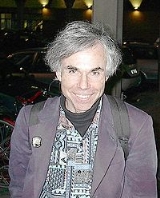
Douglas Hofstadter

Douglas Hofstadter

Overview
Douglas Richard Hofstadter (born February 15, 1945 in New York, New York) is an American
United States
The United States of America is a federal constitutional republic comprising fifty states and a federal district...

 academic
Academia
Academia, Acadème, or the Academy are collective terms for the community of students and scholars engaged in higher education and research....

 whose research focuses on consciousness, thinking and creativity. He is best known for his book Gödel, Escher, Bach: an Eternal Golden Braid
Gödel, Escher, Bach
Gödel, Escher, Bach: An Eternal Golden Braid is a Pulitzer Prize-winning book by Douglas Hofstadter, described as "a metaphorical fugue on minds and machines in the spirit of Lewis Carroll"....

, first published in 1979, for which he was awarded the 1980 Pulitzer Prize
Pulitzer Prize
The Pulitzer Prize is a U.S. award for achievements in newspaper journalism, literature and musical composition. It was established by Hungarian-American publisher Joseph Pulitzer and is administered by Columbia University in New York City....

 for general non-fiction.

Hofstadter is the son of Nobel Prize
Nobel Prize
The Nobel Prize is a Sweden-based international monetary prize. The award was established by the 1895 will and estate of Swedish chemist and inventor Alfred Nobel. It was first awarded in Physics, Chemistry, Physiology or Medicine, Literature, and Peace in 1901...

-winning physicist Robert Hofstadter
Robert Hofstadter
Robert Hofstadter was an American physicist. He was the winner of the 1961 Nobel Prize in Physics "for his pioneering studies of electron scattering in atomic nuclei and for his consequent discoveries concerning the structure of nucleons."-Biography :Born in New York City, he entered City College...

. Douglas grew up on the campus of Stanford University
Stanford University
The Leland Stanford Junior University, commonly referred to as Stanford University or Stanford, is a private research university located in Stanford, California, United States...

, where his father was a professor.
Discussion
Ask a question about 'Douglas Hofstadter'
Start a new discussion about 'Douglas Hofstadter'
Answer questions from other users
Full Discussion Forum
 
Quotations

Which statement seems more true: (1) I have a brain. (2) I am a brain.

The Mind's I|The Mind's I with Daniel C. Dennett (1981)

In fact, a sense of essence is, in essence, the essence of sense, in effect.

Metamagical Themas|Metamagical Themas (1985)

The "Strange Loop" phenomenon occurs whenever, by moving upwards (or downwards) through levels of some hierarchial system, we unexpectedly find ourselves right back where we started.

"Introduction: A Musico-Logical Offering"

The proverbial German phenomenon of the verb-at-the-end about which droll tales of absentminded professors who would begin a sentence, ramble on for an entire lecture, and then finish up by rattling off a string of verbs by which their audience, for whom the stack had long since lost its coherence, would be totally nonplussed, are told, is an excellent example of linguistic recursion.

Chapter 5: "Recursive Structures and Processes"

Hofstadter's Law: It always takes longer than you expect, even when you take into account Hofstadter's Law.

Chapter 5: "Recursive Structures and Processes"

Perhaps the most concise summary of enlightenment would be: transcending dualism. … Dualism is the conceptual division of the world into categories. … human perception is by nature a dualistic phenomenon— which makes the quest for enlightenment an uphill struggle, to say the least.

Chapter 9: "Mumon and Gödel"

Relying on words to lead you to the truth is like relying on an incomplete formal system to lead you to the truth. A formal system will give you some truths, but as we shall soon see, a formal system, no matter how powerful—cannot lead to all truths.

Chapter 9: "Mumon and Gödel"

Below Every Tangled Hierarchy Lies An Inviolate Level

Chapter 20: "Strange Loops Or Tangled Hierarchies"
Encyclopedia
Douglas Richard Hofstadter (born February 15, 1945 in New York, New York) is an American
United States
The United States of America is a federal constitutional republic comprising fifty states and a federal district...

 academic
Academia
Academia, Acadème, or the Academy are collective terms for the community of students and scholars engaged in higher education and research....

 whose research focuses on consciousness, thinking and creativity. He is best known for his book Gödel, Escher, Bach: an Eternal Golden Braid
Gödel, Escher, Bach
Gödel, Escher, Bach: An Eternal Golden Braid is a Pulitzer Prize-winning book by Douglas Hofstadter, described as "a metaphorical fugue on minds and machines in the spirit of Lewis Carroll"....

, first published in 1979, for which he was awarded the 1980 Pulitzer Prize
Pulitzer Prize
The Pulitzer Prize is a U.S. award for achievements in newspaper journalism, literature and musical composition. It was established by Hungarian-American publisher Joseph Pulitzer and is administered by Columbia University in New York City....

 for general non-fiction.

Early life and education


Hofstadter is the son of Nobel Prize
Nobel Prize
The Nobel Prize is a Sweden-based international monetary prize. The award was established by the 1895 will and estate of Swedish chemist and inventor Alfred Nobel. It was first awarded in Physics, Chemistry, Physiology or Medicine, Literature, and Peace in 1901...

-winning physicist Robert Hofstadter
Robert Hofstadter
Robert Hofstadter was an American physicist. He was the winner of the 1961 Nobel Prize in Physics "for his pioneering studies of electron scattering in atomic nuclei and for his consequent discoveries concerning the structure of nucleons."-Biography :Born in New York City, he entered City College...

. Douglas grew up on the campus of Stanford University
Stanford University
The Leland Stanford Junior University, commonly referred to as Stanford University or Stanford, is a private research university located in Stanford, California, United States...

, where his father was a professor. Douglas attended the International School of Geneva
International School of Geneva
The International School of Geneva also known as Ecolint, is a private international school based in Geneva, Switzerland. It is the oldest currently operating International School. The International Baccalaureate program, which most English-speaking students at the school follow, was created at...

 for a year. He graduated with Distinction in Mathematics
Mathematics
Mathematics is the science and study of quantity, structure, space, and change. Mathematicians seek out patterns, formulate new conjectures, and establish truth by rigorous deduction from appropriately chosen axioms and definitions....

 from Stanford in 1965. He spent a few years in Sweden
Sweden
Sweden , officially the Kingdom of Sweden , is a Nordic country on the Scandinavian Peninsula in Northern Europe...

 in the mid 1960's. He continued his education and received his Ph.D.
Doctor of Philosophy
Doctor of Philosophy, abbreviated PhD , for the Latin , meaning "teacher of philosophy", or alternatively, DPhil, for the equivalent , is an advanced academic degree awarded by universities...

 in Physics
Physics
Physics is a natural science; it is the study of matter and its motion through spacetime and all that derives from these, such as energy and force...

 from the University of Oregon
University of Oregon
The University of Oregon is a public, coeducational research university in Eugene, Oregon, United States. The second oldest public university in the state, UO was founded in 1876, and graduated its first class two years later. The University of Oregon is one of 60 members of the Association of...

 in 1975.

Academic career


Hofstadter is College of Arts and Sciences Distinguished Professor of Cognitive Science at Indiana University in Bloomington, where he directs the Center for Research on Concepts and Cognition which consists of himself and his graduate students, forming the "Fluid Analogies Research Group" (FARG). He was initially appointed to the Indiana University's Computer Science Department faculty in 1977, and at that time he launched his research program in computer modeling of mental processes (which at that time he called "artificial intelligence research", a label that he has since dropped in favor of "cognitive science research"). In 1984, he moved to the University of Michigan
University of Michigan
The University of Michigan, Ann Arbor is a public research university located in the state of Michigan in the United States. It is the state's oldest university, the flagship campus of the University of Michigan, and one of the top public universities in the world...

 in Ann Arbor, where he was hired as a professor of psychology and was also appointed to the Walgreen Chair for the Study of Human Understanding. In 1988 he returned to Bloomington as "College of Arts and Sciences Professor" in both Cognitive Science and Computer Science, and also was appointed Adjunct Professor of History and Philosophy of Science, Philosophy, Comparative Literature, and Psychology, but he states that his involvement with most of these departments is nominal. In April, 2009, Hofstadter was elected a Fellow of the American Academy of Arts and Sciences
American Academy of Arts and Sciences
The American Academy of Arts and Sciences is an independent policy research center that conducts multidisciplinary studies of complex and emerging problems. The Academy’s elected members are leaders in the academic disciplines, the arts, business, and public affairs.James Bowdoin, John Adams, and...

 and a Member of the American Philosophical Society
American Philosophical Society
The American Philosophical Society is a discussion group founded in 1743 by Benjamin Franklin as an offshoot of his earlier club, the Junto...

.

Hofstadter's many interests include music, visual art, the mind
Mind
Mind is the aspect of intellect and consciousness experienced as combinations of thought, perception, memory, emotion, will and imagination, including all unconscious cognitive processes. The term is often used to refer, by implication, to the thought processes of reason. Mind manifests itself...

, creativity
Creativity
Creativity is a mental and social process involving the generation of new ideas or concepts, or new associations of the creative mind between existing ideas or concepts. Creativity is fueled by the process of either conscious or unconscious insight...

, consciousness
Consciousness
Consciousness is subjective experience or awareness or wakefulness or the executive control system of the mind. It is an umbrella term that may refer to a variety of mental phenomena...

, self-reference
Self-reference
Self-reference occurs in natural or formal languages when a sentence or formula refers to itself. The reference may be expressed either directly; through some intermediate sentence or formula; or by means of some encoding...

, translation
Translation
Translation is the interpreting of the meaning of a text and the subsequent production of an equivalent text, likewise called a "translation," that communicates the same message in another language...

 and mathematics
Mathematics
Mathematics is the science and study of quantity, structure, space, and change. Mathematicians seek out patterns, formulate new conjectures, and establish truth by rigorous deduction from appropriately chosen axioms and definitions....

. He has numerous recursive sequences and geometric constructions named after him.

At the University of Michigan and Indiana University, he co-authored, with Melanie Mitchell
Melanie Mitchell
Melanie Mitchell is a professor of computer science at Portland State University. She has worked at the Santa Fe Institute and Los Alamos National Laboratory...

, a computational model of "high-level perception" — Copycat
Copycat (software)
Copycat is a model of analogy making and human cognition based on the concept of the parallel terraced scan, developed by Douglas Hofstadter, Melanie Mitchell, and others at the at , Indiana University Bloomington...

 — and several other models of analogy-making
Analogy
Analogy is a cognitive process of transferring information from a particular subject to another particular subject , and a linguistic expression corresponding to such a process...

 and cognition
Cognition
Cognition is the scientific term for "the process of thought". Usage of the term varies in different disciplines; for example in psychology and cognitive science, it usually refers to an information processing view of an individual's psychological functions...

. The Copycat project was subsequently extended under the name "Metacat" by Hofstadter's doctoral student James Marshall. The Letter Spirit project, implemented by Gary McGraw and John Rehling, aims to model the act of artistic creativity by designing stylistically uniform "gridfonts" (typefaces limited to a grid). Other more recent models are Phaeaco (implemented by Harry Foundalis) and SeqSee (Abhijit Mahabal), which model high-level perception and analogy-making in the microdomains of Bongard problem
Bongard problem
A Bongard problem is a kind of puzzle invented by the American computer scientist Mikhail Moiseevich Bongard, probably in the mid-1960s. They were published in his eponymous 1967 book on pattern recognition. Bongard, in the introduction of the book credits the ideas in it to a group including M....

s and number sequences, respectively.

Hofstadter collects and studies cognitive errors (largely, but not solely, speech errors), "bon mots" (spontaneous humorous quips), and analogies of all sorts, and his long-time observation of these diverse products of cognition, and his theories about the mechanisms that underlie them, have exerted a powerful influence on the architectures of the computational models developed by himself and FARG members.

All FARG computational models share certain key principles, among which are: that human thinking is carried out by thousands of independent small actions in parallel, biased by the concepts that are currently activated; that activation spreads from activated concepts to less activated "neighbor concepts"; that there is a "mental temperature" that regulates the degree of randomness in the parallel activity; that promising avenues tend to be explored more rapidly than unpromising ones. FARG models also have an overarching philosophy that all cognition is built from the making of analogies. The computational architectures that share these precepts are called "active symbols" architectures.

Provoked by predictions of a technological singularity
Technological singularity
Technological singularity is a term used with varying meanings related to self-improving artificial intelligence, superintelligence, breakdowns in the predictability of the future, accelerating change of the exponential or superexponential/catastrophic sort, and more generic "big events" in...

 (the hypothetical moment at which artificial intelligence
Artificial intelligence
Artificial intelligence is the intelligence of machines and the branch of computer science which aims to create it. Textbooks define the field as "the study and design of intelligent agents,"...

 will surpass human intelligence), Hofstadter has both organized and participated in several public discussions of the topic. At Indiana University in 1999 he organized such a symposium, and in April 2000, he organized a larger symposium entitled "Spiritual Robots" at Stanford University, in which he moderated a panel consisting of Ray Kurzweil, Hans Moravec
Hans Moravec
Hans Moravec is an adjunct faculty member at the Robotics Institute of Carnegie Mellon University. He is known for his work on robotics, artificial intelligence, and writings on the impact of technology. Moravec also is a futurist with many of his publications and predictions focusing on...

, Kevin Kelly
Kevin Kelly
This article refers to the founding executive editor of Wired magazine. For others by this name, see Kevin Kelly.Kevin Kelly is the founding executive editor of Wired magazine, and a former editor/publisher of the Whole Earth Catalog...

, Ralph Merkle
Ralph Merkle
Ralph C. Merkle is a researcher in public key cryptography, and more recently a researcher and speaker on molecular nanotechnology and cryonics...

, Bill Joy
Bill Joy
William Nelson Joy , commonly known as Bill Joy, is an American computer scientist. Joy co-founded Sun Microsystems in 1982 along with Vinod Khosla, Scott McNealy, Andy Bechtolsheim and Vaughan Pratt, and served as chief scientist at the company until 2003...

, Frank Drake
Frank Drake
Dr. Frank Donald Drake is an American astronomer and astrophysicist. He is most famous for founding SETI and creating the Drake equation and Arecibo Message.-Early life and education:...

, John Holland
John Holland
John Holland may refer to:*John Holland , New Zealand athlete, bronze medallist in the 400m hurdles at the 1952 Summer Olympics*John Holland , founder of the Bank of Scotland in 1695, the central bank of the Kingdom of Scotland...

, John Koza
John Koza
John R. Koza is a computer scientist and a consulting professor at Stanford University, most notable for his work in pioneering the use of genetic programming for the optimization of complex problems...

. Hofstadter was also an invited panelist at the first Singularity Summit
Singularity Summit
The Singularity Summit is the annual conference of the Singularity Institute for Artificial Intelligence. It was started in 2006 at Stanford University by Ray Kurzweil, Eliezer Yudkowsky, and Peter Thiel, and the subsequent summits in 2007 and 2008 have been held in San Francisco and San Jose,...

, held at Stanford in May 2006. Hofstadter expressed doubt about the likelihood of the singularity coming to pass in the foreseeable future.

Hofstadter's thesis about consciousness, first expressed in GEB but also present in several of his later books, is that it is an emergent consequence of seething lower-level activity in the brain. In GEB he draws an analogy between the social organization of a colony of ants and the mind seen as a coherent "colony" of neurons. In particular, Hofstadter claims that our sense of having (or being) an "I" comes from the abstract pattern he terms a "strange loop", which is an abstract cousin of such concrete phenomena as audio
Audio feedback
Audio feedback is a special kind of feedback which occurs when a sound loop exists between an audio input and an audio output...

 and video feedback
Optical feedback
Optical feedback is the optical equivalent of acoustic feedback. The feedback occurs when a loop exists between an optical input, for example, a videocamera, and an optical output, for example, a television screen or monitor...

, and which Hofstadter has defined as "a level-crossing feedback loop". The prototypical example of this abstract notion is the self-referential structure at the core of Gödel's incompleteness theorems
Gödel's incompleteness theorems
In mathematical logic, Gödel's incompleteness theorems, proved by Kurt Gödel in 1931, are two theorems stating inherent limitations of all but the most trivial formal systems for arithmetic of mathematical interest. The theorems are of considerable importance to the philosophy of mathematics...

. Hofstadter's 2007 book I Am a Strange Loop carries his vision of consciousness considerably further, including the idea that each human "I" is distributed over numerous brains, rather than being limited to precisely one brain.

Public image


Hofstadter has said that he feels "uncomfortable with the nerd culture that centers on computers." He admits that "a large fraction [of his audience] seems to be those who are fascinated by technology", but when it was suggested that his work "has inspired many students to begin careers in computing and artificial intelligence" he replied that he has "no interest in computers." In that interview he also mentioned a course he has twice given at Indiana University, in which he took a "skeptical look at a number of highly-touted AI projects and overall approaches". For example, upon the defeat of Kasparov by Deep Blue, he commented that "It was a watershed event, but it doesn't have to do with computers becoming intelligent."

In April 2007, while replying to the following question by Deborah Solomon in Questions for Douglas Hofstadter: "Your entry in Wikipedia says that your work has inspired many students to begin careers in computing and artificial intelligence", (making this Wikipedia entry self-referential
Self-reference
Self-reference occurs in natural or formal languages when a sentence or formula refers to itself. The reference may be expressed either directly; through some intermediate sentence or formula; or by means of some encoding...

!) he replied, "The entry is filled with inaccuracies, and it kind of depresses me." When asked why he didn't fix it, he replied, "The next day someone will fix it back."

In 1988 Dutch director Piet Hoenderdos created a docudrama about Hofstadter and his ideas entitled "Victim of the Brain" based on The Mind's I
The Mind's I
The Mind's I: Fantasies and reflections on self and soul is a 1981 book composed and arranged by Douglas R. Hofstadter and Daniel C. Dennett...

. It includes interviews with Hofstadter about his work. In 2010: Odyssey Two
2010: Odyssey Two
2010: Odyssey Two is a best-selling science fiction novel by Arthur C. Clarke, which was published in January 1982. It is the sequel to 2001: A Space Odyssey and was nominated for the Hugo Award for Best Novel in 1983...

, Arthur C. Clarke
Arthur C. Clarke
Sri Lankabhimanya Sir Arthur Charles Clarke, CBE, FRAS was a British science fiction author, inventor, and futurist, most famous for the novel 2001: A Space Odyssey, written in collaboration with director Stanley Kubrick, a collaboration which also produced the film of the same name; and as a...

's first sequel to 2001: A Space Odyssey
2001: A Space Odyssey (novel)
2001: A Space Odyssey is a science fiction novel by Arthur C. Clarke. It was developed concurrently with Stanley Kubrick's film version and published after the release of the film...

, HAL 9000
HAL 9000
HAL 9000 is a fictional computer in Arthur C. Clarke's Space Odyssey saga. It was ranked #13 on a list of greatest film villains of all time on the AFI's 100 Years... 100 Heroes and Villains....

 is described by Dr. Chandra as being caught in a "Hofstadter-Moebius
August Ferdinand Möbius
August Ferdinand Möbius was a German mathematician and theoretical astronomer.He is best known for his discovery of the Möbius strip, a non-orientable two-dimensional surface with only one side when embedded in three-dimensional Euclidean space. It was independently discovered by Johann Benedict...

 loop". Hofstadter's book Fluid Concepts & Creative Analogies: Computer Models of the Fundamental Mechanisms of Thought
Fluid Concepts and Creative Analogies
Fluid Concepts and Creative Analogies: Computer Models of the Fundamental Mechanisms of Thought is a 1995 book by Douglas Hofstadter and other members of the Fluid Analogies Research Group exploring the mechanisms of intelligence through computer modeling...

was the first book ever sold by Amazon.com
Amazon.com
Amazon.com, Inc. is an American-based multinational electronic commerce company. Headquartered in Seattle, Washington, it is America's largest online retailer, with nearly three times the Internet sales revenue of the runner up, Staples, Inc....

.

Columnist


When Martin Gardner
Martin Gardner
Martin Gardner is an American mathematics and science writer specializing in recreational mathematics, but with interests encompassing micromagic, stage magic, pseudoscience, literature , philosophy, scientific skepticism, and religion...

 retired from writing his "Mathematical Games" column for Scientific American
Scientific American
Scientific American is a popular science magazine published since August 28, 1845, which according to the magazine makes it the oldest continuously published magazine in the United States...

magazine, Hofstadter succeeded him in 1981-1983 with a column entitled Metamagical Themas
Metamagical Themas
Metamagical Themas is an eclectic collection of articles written for Scientific American during the early 1980s by Douglas Hofstadter, and published together as a book in 1985 by Basic Books ....

(an anagram of "Mathematical Games"). An idea he introduced in one of these columns was the concept of "Reviews of This Book", a book containing nothing but cross-referenced reviews of itself which has an online implementation. One of Hofstadter's columns in Scientific American concerned the damaging effects of sexist language, and two chapters of his book Metamagical Themas
Metamagical Themas
Metamagical Themas is an eclectic collection of articles written for Scientific American during the early 1980s by Douglas Hofstadter, and published together as a book in 1985 by Basic Books ....

are devoted to that topic, one of which is a biting analogy-based satire entitled "A Person Paper on Purity in Language", in which the reader's presumed revulsion at racism and racist language is used as a lever to motivate an analogous revulsion to sexism and sexist language. Another reported on an iterated Prisoner's Dilemma
Prisoner's dilemma
The prisoner's dilemma constitutes a problem in game theory. It was originally framed by Merrill Flood and Melvin Dresher working at RAND in 1950. Albert W...

 computer strategies tournament developed with Indiana University graduate student Marek Lugowski. These columns ranged vastly in theme and subject matter, and included patterns in Frederic Chopin
Frédéric Chopin
Frédéric François Chopin was a Polish composer and virtuoso pianist. He was one of the great masters of Romantic music....

's piano music (the Études), the concept of superrationality (cooperating or defecting when the other party/adversary is assumed to be acting as maximally rational), as well as game theory within law (Nomic
Nomic
Nomic is a game created in 1982 by philosopher Peter Suber in which the rules of the game include mechanisms for the players to change those rules, usually beginning through a system of democratic voting...

), to name three.

Personal


Hofstadter was married to Carol Ann Brush. They met in Bloomington, and married in Ann Arbor in 1985. They had two children, Danny and Monica, but Carol died in 1993 from the sudden onset of a brain tumor — glioblastoma multiforme
Glioblastoma multiforme
Glioblastoma multiforme is the most common and most aggressive type of primary brain tumor in humans, involving glial cells and accounting for 52% of all parenchymal brain tumor cases and 20% of all intracranial tumors. Despite being the most prevalent form of primary brain tumor, GBMs occur in...

 — when their children were five and two. The Carol Ann Brush Hofstadter Memorial Scholarship for Bologna-bound IU students was established in 1996 in her name. Hofstadter's book Le Ton beau de Marot is dedicated to their two children and its dedication reads "To M. & D., living sparks of their Mommy's soul".

Both inside and outside his professional work, Hofstadter is driven by a pursuit of beauty. He seeks beautiful mathematical patterns, beautiful explanations, beautiful typefaces, beautiful sonic patterns in poetry, and so forth. Hofstadter has said of himself, "I'm someone who has one foot in the world of humanities and arts, and the other foot in the world of science." He has had several exhibitions of his artworks in various university art galleries. These shows have featured large collections of his gridfonts, his ambigrams (pieces of calligraphy created with two readings, either of which is usually obtained from the other by rotating or reflecting the ambigram, but sometimes simply by "oscillation", like the Necker Cube
Necker cube
The Necker Cube is an optical illusion first published in 1832 by Swiss crystallographer Louis Albert Necker.-Ambiguity:The Necker Cube is an ambiguous line drawing. It is a wire-frame drawing of a cube in oblique perspective, which means that parallel edges of the cube are drawn as parallel lines...

 or the rabbit/duck figure of Joseph Jastrow
Joseph Jastrow
Joseph Jastrow was an American psychologist, noted for inventions in experimental psychology, design of experiments, and psycho-physics. Jastrow was one of the first scientists to study the evolution of language, publishing an article on the topic in 1886...

), and his "Whirly Art" (music-inspired visual patterns realized using shapes based on various alphabets from India). (The term "ambigram" was invented by Hofstadter in 1984 and has since been taken up by many ambigrammists all over the world.)

Hofstadter has composed numerous pieces for piano, and a few for piano and voice. He created an audio CD with the title DRH/JJ, which includes all these compositions performed primarily by pianist Jane Jackson, but with a few performed by Brian Jones, Dafna Barenboim, Gitanjali Mathur and himself.

Hofstadter's writing is characterized by an intense interaction between form and content, as is exemplified by the 20 dialogues in GEB, many of which simultaneously talk about and imitate strict musical forms used by Bach, such as canons and fugues. Most of Hofstadter's books are characterized by some kind of structural alternation: in GEB between dialogues and chapters, in The Mind's I between selections and reflections, in Metamagical Themas between Chapters and Postscripts, and so forth. Both in his writing and in his teaching, Hofstadter stresses the concrete, constantly using examples and analogies, and avoids the abstract. Typical of the courses he teaches is his seminar "Group Theory and Galois Theory Visualized", in which abstract mathematical ideas are rendered as concretely as possible. He puts great effort into making ideas clear and visual, and asserts that when he teaches, if his students do not understand something, it is never their fault but always his own.

Hofstadter is passionate about languages. He has studied many of them, and speaks them to varying degrees. In addition to English, his mother tongue, he speaks French and Italian fluently (the language spoken at home with his children is Italian). At various times in his life, he has studied (in descending order of level of fluency reached) German, Russian, Spanish, Swedish, Mandarin, Dutch, Polish, and Hindi. His love of sounds pushes him to strive to minimize, and ideally get rid of, any foreign accent.

Le Ton beau de Marot: In Praise of the Music of Language is a long book devoted to language and translation, especially poetry translation, and one of its leitmotifs is a set of some 88 translations of "Ma Mignonne", a highly constrained poem by sixteenth-century French poet Clément Marot
Clément Marot
Clément Marot , was a French poet of the Renaissance period.-Biography:Marot was born at Cahors, the capital of the province of Quercy, some time during the winter of 1496-1497. His father, Jean Marot , whose more correct name appears to have been des Mares, Marais or Marets, was a Norman from the...

. In this book, Hofstadter jokingly describes himself as "pilingual" (meaning that the sum total of the varying degrees of mastery of all the languages that he's studied comes to 3.14159...), as well as an "oligoglot" (someone who speaks "a few" languages).

In 1999, the bicentennial year of Russian poet and writer Alexander Pushkin, Hofstadter published a verse translation of Pushkin's classic novel-in-verse Eugene Onegin
Eugene Onegin
Eugene Onegin is a novel in verse written by Alexander Pushkin. It is a classic of Russian literature, and its eponymous protagonist has served as the model for a number of Russian literary heroes. It was published in serial form between 1825 and 1832...

. It is highly constrained and filled with many types of sonic pattern. Aside from Eugene Onegin
Eugene Onegin
Eugene Onegin is a novel in verse written by Alexander Pushkin. It is a classic of Russian literature, and its eponymous protagonist has served as the model for a number of Russian literary heroes. It was published in serial form between 1825 and 1832...

, Hofstadter has translated many other poems (always respecting their formal constraints), and two other novels (in prose): La Chamade (That Mad Ache) by French writer Françoise Sagan
Françoise Sagan
Françoise Sagan , real name Françoise Quoirez, was a French playwright, novelist, and screenwriter...

, and La Scoperta dell'Alba (The Discovery of Dawn) by Walter Veltroni
Walter Veltroni
Walter Veltroni is an Italian writer, journalist and politician, who served as the first leader of the Democratic Party within the centre-left opposition, until his resignation on February 17, 2009. He also served as Mayor of Rome from 2001 to 2008.-Biography:Walter Veltroni was born in Rome...

, the then head of the Partito Democratico in Italy. Both of these translated novels are slated for imminent publication.

Hofstadter is related by marriage to the evolutionary theorist Stephen Jay Gould
Stephen Jay Gould
Stephen Jay Gould was an American paleontologist, evolutionary biologist, and historian of science. He was also one of the most influential and widely read writers of popular science of his generation. Gould spent most of his career teaching at Harvard University and working at the American Museum...

: Hofstadter's paternal aunt was married to Gould's maternal uncle. Hofstadter is a vegetarian.

The dedication for I Am A Strange Loop is: "To my sister Laura, who can understand, and to our sister Molly, who cannot." Hofstadter explains in the preface that his younger sister Molly never developed the ability to speak or understand language. Molly's condition has been described as autistic
Autism
Autism is a disorder of neural development that is characterized by impaired social interaction and communication, and by restricted and repetitive behavior. These signs all begin before a child is three years old. Autism involves many parts of the brain; how this occurs is not well understood...

 by Arthur L. Schawlow
Arthur Leonard Schawlow
Arthur Leonard Schawlow was an American physicist. He is best remembered for his work on lasers, for which he was awarded a 1981 Nobel Prize.-Biography:...

.

Books


The books published by Hofstadter are (the ISBNs refer to paperback editions, where available):
  • Gödel, Escher, Bach: an Eternal Golden Braid
    Gödel, Escher, Bach
    Gödel, Escher, Bach: An Eternal Golden Braid is a Pulitzer Prize-winning book by Douglas Hofstadter, described as "a metaphorical fugue on minds and machines in the spirit of Lewis Carroll"....

    (ISBN 0-465-02656-7)
  • Metamagical Themas
    Metamagical Themas
    Metamagical Themas is an eclectic collection of articles written for Scientific American during the early 1980s by Douglas Hofstadter, and published together as a book in 1985 by Basic Books ....

    (ISBN 0-465-04566-9) (collection of Scientific American columns and other essays, all with postscripts)
  • Ambigrammi: un microcosmo ideale per lo studio della creatività (in Italian only) ISBN 88-7757-006-7
  • Fluid Concepts and Creative Analogies
    Fluid Concepts and Creative Analogies
    Fluid Concepts and Creative Analogies: Computer Models of the Fundamental Mechanisms of Thought is a 1995 book by Douglas Hofstadter and other members of the Fluid Analogies Research Group exploring the mechanisms of intelligence through computer modeling...

    (ISBN 0-465-02475-0)
  • Rhapsody on a Theme by Clement Marot. The Grace A. Tanner Lecture in Human Values, 1995. (Published 1996)
  • Le Ton beau de Marot
    Le Ton beau de Marot
    Le Ton beau de Marot: In Praise of the Music of Language , published by Basic Books in 1997, is a book by Douglas Hofstadter in which he explores the meaning, strengths, failings, and beauty of translation...

    : In Praise of the Music of Language
    (ISBN 0-465-08645-4)
  • Eugene Onegin: A Novel Versification (ISBN 0-465-02094-1)
  • I Am a Strange Loop
    I Am a Strange Loop
    I Am a Strange Loop is a 2007 book by Douglas Hofstadter, examining in depth the concept of a strange loop originally developed in his 1979 book Gödel, Escher, Bach....

    (ISBN 0-465-03078-5) (2007)

Papers


Hofstadter wrote, among many others, the following papers:
  • "Energy levels and wave functions of Bloch electrons in rational and irrational magnetic fields", Rev. B 14 (1976) 2239.
    • Written while he was at the University of Oregon, this paper was enormously influential in directing further research. Hofstadter predicted that the allowed energy level
      Energy level
      A quantum mechanical system or particle that is bound, confined spatially, can only take on certain discrete values of energy, as opposed to classical particles, which can have any energy. These values are called energy levels. The term is most commonly used for the energy levels of electrons in...

       values of an electron
      Electron
      An electron is a subatomic particle that carries a negative electric charge. It has no known substructure and is believed to be a point particle. An electron has a mass that is approximately 1836 times less than that of the proton. The intrinsic angular momentum of the electron is a half integer...

       in a crystal
      Crystal
      A crystal or crystalline solid is a solid material whose constituent atoms, molecules, or ions are arranged in an orderly repeating pattern extending in all three spatial dimensions. The scientific study of crystals and crystal formation is crystallography...

       lattice, as a function of a magnetic field
      Magnetic field
      Magnetic fields surround magnetic materials and electric currents and are detected by the force they exert on other magnetic materials and moving electric charges...

       applied to the lattice, formed a fractal
      Fractal
      A fractal is "a rough or fragmented geometric shape that can be split into parts, each of which is a reduced-size copy of the whole," a property called self-similarity...

       set. That is, the distribution of energy levels for large-scale changes in the applied magnetic field repeat patterns seen in the small-scale structure. This fractal structure is generally known as "Hofstadter's butterfly
      Hofstadter's butterfly
      Hofstadter's Butterfly is the name of a self similar structure, a fractal discovered by Douglas Hofstadter which was discussed in his paper and was the first fractal to be formulated in physics....

      ",which was the first fractal ever found in physics, and it has recently been confirmed in transport measurements in two-dimensional electron systems with a superimposed nano-fabricated lattice.
  • "A non-deterministic approach to analogy, involving the Ising model of ferromagnetism", in E. Caianiello (ed.), The Physics of Cognitive Processes. Teaneck, NJ: World Scientific, 1987.
  • "Speechstuff and thoughtstuff: Musings on the resonances created by words and phrases via the subliminal perception of their buried parts", in Sture Allen (ed.), Of Thoughts and Words: The Relation between Language and Mind. Proceedings of the Nobel Symposium 92, London/New Jersey: World Scientific Publ., 1995, 217-267.
  • "On seeing A's and seeing As.", Stanford Humanities Review 4,2 (1995) pp. 109-121.
  • "Analogy as the Core of Cognition", in Dedre Gentner
    Dedre Gentner
    Dedre Gentner is a professor in the Department of Psychology at Northwestern University. She is a prominent researcher in the study of analogical reasoning. Her work on structure-mapping theory was foundational for the development of the structure mapping engine by Ken Forbus...

    , Keith Holyoak
    Keith Holyoak
    Keith J. Holyoak is a researcher in cognitive psychology and cognitive science, working on human thinking and reasoning. Holyoak's work focuses on the role of analogy in thinking...

    , and Boicho Kokinov
    Boicho Kokinov
    Boicho Kokinov received his PhD at the Bulgarian Academy of Sciences, Sofia. He is currently an Associate Professor in Cognitive Science and Computer Science at the New Bulgarian University and the Director of the Central and East European Center for Cognitive Science.He has been the main organizer...

     (eds.) The Analogical Mind: Perspectives from Cognitive Science, Cambridge, MA: The MIT Press/Bradford Book, 2001, pp. 499-538.
  • "To Err is Human; To Study Error-making is Cognitive Science", Michigan Quarterly Review, Vol. XXVIII, No. 2, 1989, pp. 185-­215.
  • Hofstadter wrote over 50 papers that were published through the Center for Research on Concepts and Cognition

Involvement in other books


Hofstadter wrote forewords for or edited the following books:
  • Sparse Distributed Memory by Pentti Kanerva  (Bradford Books/MIT Press, 1988). (ISBN 0262111322)
  • The Mind's I
    The Mind's I
    The Mind's I: Fantasies and reflections on self and soul is a 1981 book composed and arranged by Douglas R. Hofstadter and Daniel C. Dennett...

    : Fantasies and Reflections on Self and Soul
    (co-edited with Daniel Dennett
    Daniel Dennett
    Daniel Clement Dennett is a prominent American philosopher whose research centers on philosophy of mind, philosophy of science and philosophy of biology, particularly as those fields relate to evolutionary biology and cognitive science. He is currently the co-director of the Center for Cognitive...

    ) (ISBN 0-465-03091-2 and ISBN 0-553-01412-9) (ISBN 0-553-34584-2) 1981
  • Alan Turing: The Enigma by Andrew Hodges
    Andrew Hodges
    Andrew Hodges is a mathematician, an author and a pioneer of the gay liberation movement of the 1970s. For the past decades Hodges has focused his research activities on the twistor theory—the new approach to the problems of fundamental physics pioneered by the mathematician Roger Penrose...

    . (Preface)
  • Gödel's Proof (2002 revised edition) by Ernest Nagel
    Ernest Nagel
    Ernest Nagel was among the most important philosophers of science of his time.Nagel was born in Nové Mesto nad Váhom . His mother, Frida Weiss was from the nearby town of Vrbove . Both of these towns are in present day Slovakia...

     and James R. Newman
    James R. Newman
    James Roy Newman was an American mathematician and mathematical historian. He was also a lawyer, practicing in the state of New York from 1929 to 1941...

    , edited by Hofstadter (ISBN 0-8147-5816-9). Hofstadter claimed the book (originally published in 1958) was highly influential to his thinking during his early years.
  • Who invented the computer? The legal battle that changed computing history. (2003) by Alice Rowe Burks.
  • Alan Turing: Life and Legacy of a Great Thinker by Christof Teuscher
    Christof Teuscher
    Christof Teuscher, PhD, is an author and editor who works at the Los Alamos National Laboratory.He was the initiator and organizer of the Turing Day, an international workshop to commemorate the anniversary of Alan Turing's 90th birthday.Dr...

     (Editor)
  • Jason Salavon: Brainstem Still Life
    Jason Salavon
    Jason Salavon is an American contemporary artist. He is noted for his use of custom computer software of his own design to manipulate and reconfigure preexisting media and data to create new visual works of fine art.-Life and art:...

    (ISBN 981-05-1662-2) 2004 (Introduction)
  • Masters of Deception: Escher, Dali & the Artists of Optical Illusion 2004 by Al Seckel. Hofstadter wrote the foreword.
  • King of Infinite Space: Donald Coxeter, the Man Who Saved Geometry by Siobhan Roberts, Walker and Company, 2006. Hofstadter wrote the foreword.
  • Are Quanta Real? A Galilean Dialogue by J.M. Jauch (ISBN 0-253-20545-X) 1989 Indiana University Press; Hofstadter wrote the foreword.

Students


Some of Hofstadter's former students include:
  • David Chalmers
    David Chalmers
    David John Chalmers is an Australian philosopher specializing in the area of philosophy of mind. He is Professor of Philosophy and Director of the Centre for Consciousness at the Australian National University.-Background:...

     - philosopher of mind
  • Melanie Mitchell
    Melanie Mitchell
    Melanie Mitchell is a professor of computer science at Portland State University. She has worked at the Santa Fe Institute and Los Alamos National Laboratory...

     - creator of Copycat
    Copycat (software)
    Copycat is a model of analogy making and human cognition based on the concept of the parallel terraced scan, developed by Douglas Hofstadter, Melanie Mitchell, and others at the at , Indiana University Bloomington...

  • Robert French - researches analogies
  • Scott A. Jones
    Scott A. Jones
    Scott A. Jones is an American inventor known for his work in the early days of voicemail. In 2006 he founded the mobile question answering service ChaCha. Also of note is his sale of Gracenote to sony for 260 million dollars making him one of carmel indianas richest people.Jones lives in Carmel,...

     - inventor of voicemail
  • Harry Foundalis
    Harry Foundalis
    Harry Foundalis is a cognitive scientist. He has worked on his Ph.D. with Douglas Hofstadter at the University of Indiana at Bloomington, and developed Phaeaco, an architecture to solve Bongard problems, a work for which he has received the University's Dissertation Award...

     - creator of Phaeaco, an architecture to solve Bongard Problems
    Bongard problem
    A Bongard problem is a kind of puzzle invented by the American computer scientist Mikhail Moiseevich Bongard, probably in the mid-1960s. They were published in his eponymous 1967 book on pattern recognition. Bongard, in the introduction of the book credits the ideas in it to a group including M....


See also

  • Platonia dilemma
  • Egbert B. Gebstadter
    Egbert B. Gebstadter
    Egbert B. Gebstadter is a fictional author who appears in the indexes of books by Douglas R. Hofstadter. For each Hofstadter book, there is a corresponding Gebstadter book...

  • BlooP and FlooP
  • Hofstadter's law
    Hofstadter's law
    Hofstadter's Law is a self-referencing time-related adage, coined by Douglas Hofstadter and named after himself.Hofstadter's Law was a part of Douglas Hofstadter's 1979 magnum opus Gödel, Escher, Bach: An Eternal Golden Braid...

  • Superrationality
    Superrationality
    The concept of superrationality is due to Douglas Hofstadter, in his article series and book "Metamagical Themas". Superrationality is a type of rational decision making which is different than the usual game-theoretic one, since a superrational player playing against a superrational opponent in a...

  • American philosophy
    American philosophy
    American philosophy is the philosophical activity or output of Americans, both within the United States and abroad. The Internet Encyclopedia of Philosophy notes that while American philosophy lacks a "core of defining features, American Philosophy can nevertheless be seen as both reflecting and...

  • List of American philosophers

External links


Media

  • Video: Victim of the Brain 90-minute documentary 1988
  • Video: Analogy as the Core of Cognition 2006-02-06
  • Video: Trying to Muse Rationally about the Singularity Scenario This is a rebuttal to a previous Raymond Kurzweil
    Raymond Kurzweil
    Raymond Kurzweil is an inventor and futurist. He is involved in fields as diverse as optical character recognition , text-to-speech synthesis, speech recognition technology, and electronic keyboard instruments...

     presentation which compares neuron
    Neuron
    A neuron is an excitable cell in the nervous system that processes and transmits information by electrochemical signaling. Neurons are the core components of the brain, the vertebrate spinal cord, the invertebrate ventral nerve cord, and the peripheral nerves...

    s and transistor
    Transistor
    A transistor is a semiconductor device commonly used to amplify or switch electronic signals. A transistor is made of a solid piece of a semiconductor material, with at least three terminals for connection to an external circuit. A voltage or current applied to one pair of the transistor's...

    s on a one-to-one basis that can be found here 2006-03-01
  • Video nterview in French poor video quality, no subtitles, good pronunciation 2007-06-28
  • Audio: Radio interview on Philosophy Talk
    Philosophy Talk
    Philosophy Talk is a talk radio program co-hosted by John Perry and Ken Taylor, who are professors at Stanford University. The show is also available as a podcast. The program deals both with fundamental problems of philosophy and with the works of famous philosophers, especially as these relate to...

    2008-01-20