
All Topics  
Agamemnon

 
Agamemnon

   Email Print
   Bookmark   Link


Agamemnon


In Greek mythology
Greek mythology

Greek mythology is the body of myths and legends belonging to the Ancient Greece concerning their List of Greek mythological figures#Immortals and Greek hero cult, Cosmology#Metaphysical cosmology, and the origins and significance of their own cult and ritual practices....
, Agamemnon (very resolute) / (ancient Greek
Greek language

Greek is an Indo-European languages native to the southern Balkan peninsula, the language of the Greek people. It forms an independent branch within Indo-European....
: ) is the son of King Atreus
Atreus

In Greek mythology, Atreus was the son of Pelops and Hippodamia, a king of Mycenae, and the father of Agamemnon and Menelaus. Collectively, his descendants are known as Atreidai or Atreidae....
 of Mycenae
Mycenae

Mycenae , is an archaeology in Greece, located about 90 km south-west of Athens, in the north-eastern Peloponnese. Argos is 6 km to the south; Corinth, 48 km to the north....
 and Queen Aerope
Aerope

A?rope was, in Greek mythology, a daughter of Catreus, king of Crete, and granddaughter of Minos. Her father, who had received an oracle that he should lose his life by one of his children, gave her and her sister, Clymene, to Nauplius, who was to sell them in a foreign land....
, the brother of Menelaus
Menelaus

Menelaus may refer to;*Menelaus, one of the two most known Atrides, a king of Sparta and son of Atreus and Aerope*Menelaus on the Moon, named after Menelaus of Alexandria....
 and the husband of Clytemnestra
Clytemnestra

Clytemnestra was the wife of Agamemnon, king of the Ancient Greece kingdom of Mycenae or Argos. In the Oresteia by Aeschylus, she was a femme fatale who murdered her husband, Agamemnon—said by Euripides to be her second husband—and his concubine Cassandra....
; different mythological versions make him the king either of Mycenae
Mycenae

Mycenae , is an archaeology in Greece, located about 90 km south-west of Athens, in the north-eastern Peloponnese. Argos is 6 km to the south; Corinth, 48 km to the north....
 or of Argos
Argos

Argos is a city in Greece in the Peloponnese near Nafplion, which was its historic harbour, named for Nauplius ....
. When Helen
Helen

In Greek mythology, Helen , better known as Helen of Sparta later Helen of Troy, was the daughter of Zeus and Leda , wife of King Menelaus of Sparta and sister of Castor and Pollux, Castor and Pollux and Clytemnestra....
, the wife of Menelaus, was abducted by Paris
Paris (mythology)

Paris , the son of Priam, king of Troy, appears in a number of Greek mythology. Probably the best-known was his elopement with Helen, queen of Sparta, this being one of the immediate causes of the Trojan War....
 of Troy
Troy

Troy is a legendary city and center of the Trojan War, as described in the Epic Cycle, and especially in the Iliad, one of the two epic poems attributed to Homer....
, Agamemnon was the commander of the Achaeans in the ensuing Trojan War
Trojan War

In Greek mythology, the Trojan War was waged against the city of Troy by the Achaeans after Paris of Troy stole Helen from her husband Menelaus, the king of Sparta....
.


Discussion
Ask a question about 'Agamemnon'
Start a new discussion about 'Agamemnon'
Answer questions from other users
Full Discussion Forum


Encyclopedia


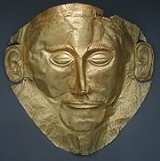
Maskeagamemnon
In Greek mythology
Greek mythology

Greek mythology is the body of myths and legends belonging to the Ancient Greece concerning their List of Greek mythological figures#Immortals and Greek hero cult, Cosmology#Metaphysical cosmology, and the origins and significance of their own cult and ritual practices....
, Agamemnon (very resolute) / (ancient Greek
Greek language

Greek is an Indo-European languages native to the southern Balkan peninsula, the language of the Greek people. It forms an independent branch within Indo-European....
: ) is the son of King Atreus
Atreus

In Greek mythology, Atreus was the son of Pelops and Hippodamia, a king of Mycenae, and the father of Agamemnon and Menelaus. Collectively, his descendants are known as Atreidai or Atreidae....
 of Mycenae
Mycenae

Mycenae , is an archaeology in Greece, located about 90 km south-west of Athens, in the north-eastern Peloponnese. Argos is 6 km to the south; Corinth, 48 km to the north....
 and Queen Aerope
Aerope

A?rope was, in Greek mythology, a daughter of Catreus, king of Crete, and granddaughter of Minos. Her father, who had received an oracle that he should lose his life by one of his children, gave her and her sister, Clymene, to Nauplius, who was to sell them in a foreign land....
, the brother of Menelaus
Menelaus

Menelaus may refer to;*Menelaus, one of the two most known Atrides, a king of Sparta and son of Atreus and Aerope*Menelaus on the Moon, named after Menelaus of Alexandria....
 and the husband of Clytemnestra
Clytemnestra

Clytemnestra was the wife of Agamemnon, king of the Ancient Greece kingdom of Mycenae or Argos. In the Oresteia by Aeschylus, she was a femme fatale who murdered her husband, Agamemnon—said by Euripides to be her second husband—and his concubine Cassandra....
; different mythological versions make him the king either of Mycenae
Mycenae

Mycenae , is an archaeology in Greece, located about 90 km south-west of Athens, in the north-eastern Peloponnese. Argos is 6 km to the south; Corinth, 48 km to the north....
 or of Argos
Argos

Argos is a city in Greece in the Peloponnese near Nafplion, which was its historic harbour, named for Nauplius ....
. When Helen
Helen

In Greek mythology, Helen , better known as Helen of Sparta later Helen of Troy, was the daughter of Zeus and Leda , wife of King Menelaus of Sparta and sister of Castor and Pollux, Castor and Pollux and Clytemnestra....
, the wife of Menelaus, was abducted by Paris
Paris (mythology)

Paris , the son of Priam, king of Troy, appears in a number of Greek mythology. Probably the best-known was his elopement with Helen, queen of Sparta, this being one of the immediate causes of the Trojan War....
 of Troy
Troy

Troy is a legendary city and center of the Trojan War, as described in the Epic Cycle, and especially in the Iliad, one of the two epic poems attributed to Homer....
, Agamemnon was the commander of the Achaeans in the ensuing Trojan War
Trojan War

In Greek mythology, the Trojan War was waged against the city of Troy by the Achaeans after Paris of Troy stole Helen from her husband Menelaus, the king of Sparta....
. Upon his return home, he was murdered by his wife Clytemnestra.

Early life

Atreus was murdered by Aegisthus
Aegisthus

In Greek mythology, Aegisthus was the son of Thyestes and of his daughter, Pelopia.Thyestes felt he had been deprived of the Mycenae throne unfairly by his brother, Atreus....
, who took possession of the throne of Mycenae and ruled jointly with his own father Thyestes
Thyestes

In Greek mythology, Thyestes was the son of Pelops, King of Olympia, Greece, and Hippodamia and father of Pelopia and Aegisthus. Thyestes and his twin brother, Atreus, were exiled by their father for having murdered their half-brother, Chrysippus in their desire for the throne of Olympia, Greece....
, Atreus´twin brother. During this period Agamemnon and his brother, Menelaus
Menelaus

Menelaus may refer to;*Menelaus, one of the two most known Atrides, a king of Sparta and son of Atreus and Aerope*Menelaus on the Moon, named after Menelaus of Alexandria....
, took refuge with Tyndareus
Tyndareus

In Greek mythology, Tyndareus ???da?e?? was a Sparta king, son of Oebalus and Gorgophone , husband of Leda and father of Helen, Castor and Polydeuces, Clytemnestra, Timandra , Phoebe and Philonoe....
, king of Sparta
Sparta

Sparta was a city-state in ancient Greece, situated on the Eurotas River in the southern part of the Peloponnese. From circa 650 BC it rose to become the dominant military power in the region and as such was recognized as the overall leader of the combined Greek forces during the Greco-Persian Wars....
. There they respectively married Tyndareus's daughters Clytemnestra
Clytemnestra

Clytemnestra was the wife of Agamemnon, king of the Ancient Greece kingdom of Mycenae or Argos. In the Oresteia by Aeschylus, she was a femme fatale who murdered her husband, Agamemnon—said by Euripides to be her second husband—and his concubine Cassandra....
 and Helen
Helen

In Greek mythology, Helen , better known as Helen of Sparta later Helen of Troy, was the daughter of Zeus and Leda , wife of King Menelaus of Sparta and sister of Castor and Pollux, Castor and Pollux and Clytemnestra....
. Agamemnon and Clytemnestra had four children: one son, Orestes, and three daughters, Iphigenia, Electra and Chrysothemis. Menelaus succeeded Tyndareus in Sparta, while Agamemnon, with his brother's assistance, drove out Aegisthus and Thyestes to recover his father's kingdom. He extended his dominion by conquest and became the most powerful prince in Greece.

Agamemnon's family history had been marred by rape
Rape

Rape, also referred to as sexual assault, is an assault by a person involving sexual intercourse with or sexual penetration of another person without that person's consent....
, murder
Murder

Murder as defined in common law countries, is the unlawful killing of another human being with intent , and generally this state of mind distinguishes murder from other forms of unlawful homicide....
, incest
Incest

Incest refers to any sexual activity between closely related persons that is illegal or socially taboo. The type of sexual activity and the nature of the relationship between persons that constitutes a breach of law or social taboo vary with culture and jurisdiction....
, and treachery
Treachery

Treachery is a statutory offence in Australia. There was also an unrelated statutory offence bearing that name in the United Kingdom, but it has been abolished....
, a result of the curse placed upon Pelops
Pelops

In Greek mythology, Pelops , king of Pisa in the Peloponnesus, was venerated at Olympia, Greece, where his cult developed into the founding myth of the Ancient Olympic Games, the most important expression of unity, not only for the Peloponnesus, "land of Pelops", but for all Hellenes....
 by Myrtilus, whom he had murdered. Thus misfortune hounded the entire House of Atreus.

The Trojan War


Agamemnon gathered the reluctant Greek forces to sail for Troy. Preparing to depart from Aulis
Aulis

Aulis is:*In Greek mythology, Aulis was both**A daughter of King Ogyges and Thebe , and**Modern day Avlida, a port in Boeotia where the Greek navy rallied before setting off against Troy...
, which was a port in Boeotia
Boeotia

Boeotia, Beotia, or B?otia , formerly Cadmeis, was a region of ancient Greece, north of the eastern part of the Gulf of Corinth. It was bounded on the south by Megaris and the Kithairon mountain range that forms a natural barrier with Attica, on the north by Opuntian Locris and the Euripus Strait at the Gulf of Euboea, and on the...
, Agamemnon's army incurred the wrath of the goddess Artemis
Artemis

In Greek mythology, Artemis was the daughter of Zeus and Leto, and the twin sister of Apollo. She was the Hellenic goddess of forests and hills, child birth/virginity/fertility, the hunt and was often depicted as a huntress carrying a bow and arrows.....
. There are several reasons throughout myth for such wrath: in Aeschylus
Aeschylus

Aeschylus was an Ancient Greece playwright. He is often recognized as the father or the founder of tragedy, and is the earliest of the three Greek tragedy whose Play survive extant, the others being Sophocles and Euripides....
' play Agamemnon, Artemis is angry for the young men who will die at Troy, whereas in Sophocles
Sophocles

Sophocles was the second of the three classical Greece tragedy whose work has survived. His first plays were written later than those of Aeschylus and earlier than those of Euripides....
' Electra
Electra (Sophocles)

Electra or Elektra is a Ancient Greece tragedy Play by Sophocles. Its date is not known, but various stylistic similarities with the Philoctetes and the Oedipus at Colonus lead scholars to suppose that it was written towards the end of Sophocles' career....
, Agamemnon has slain an animal sacred to Artemis, and subsequently boasted that he was Artemis's equal in hunting. Misfortunes, including a plague and a lack of wind, prevented the army from sailing. Finally, the prophet Calchas
Calchas

In Greek mythology, Calchas , son of Thestor, was a Argive seer, with a gift for interpreting the flight of birds that he received of Apollo: "as an augur, Calchas had no rival in the camp"....
 announced that the wrath of the goddess could only be propitiated by the sacrifice of Agamemnon's daughter Iphigenia. Classical dramatisations differ on how willing either father or daughter were to this fate, some include such trickery as claiming she was to be married to Achilles
Achilles

In Greek mythology, Achilles was a Greeks hero of the Trojan War, the central character and the greatest warrior of Homer's Iliad, which takes for its theme ; the Wrath of Achilles....
, but Agamemnon did eventually sacrifice Iphigenia. Her death appeased Artemis, and the Greek army set out for Troy. Several alternatives to the human sacrifice have been presented in Greek mythology. Other sources, such as Iphigenia at Aulis, claim that Agamemnon was prepared to kill his daughter, but that Artemis accepted a deer in her place, and whisked her to Taurus in Crimea
Crimea

Crimea or the Autonomous Republic of Crimea is an autonomous republic of Ukraine located on the northern coast of the Black Sea, occupying a peninsula of the same name....
. Hesiod
Hesiod

Hesiod was a Greek language oral poet, his date is uncertain but leading scholars agree that Hesiod lived in the latter half of the Eighth-century BCE....
 said she became the goddess Hecate
Hecate

Hecate Hekate , or Hekat was originally a goddess of the wilderness and childbirth, naturalized early in Mycenaean Greece or in Thrace, but originating among the Carians of Anatolia, the region where most theophoric names invoking Hecate, such as Hecataeus or Hecatomnus, progenitor of Mausollus, are attested, and where Hekate re...
.

Agamemnon was the commander-in-chief of the Greeks during the Trojan War. During the fighting, Agamemnon killed Antiphus
Antiphus

In Greek mythology, Antiphus is a name attributed to multiple individuals:*In the Iliad, Antiphus, or ?ntiphos ,one of the 50 sons of Priam, and son of Hecuba....
. Agamemnon's teamster
Teamster

The term "teamster" originally referred to a person who drove a team of draft animals, usually a wagon drawn by oxen, horses, or mules. This term was commonly used during the Mexican-American War and the Indian Wars throughout the 19th and early 20th centuries on the American frontier....
, Halaesus
Halaesus

In Greek mythology, Halaesus was Agamemnon's teamster during the Trojan War. After the war, he travelled to Italy and founded the city of Falerii ....
, later fought with Aeneas
Aeneas

This article is about the Roman hero. For other uses, see Aeneas .In Greco-Roman mythology, Aeneas was a Troy hero, the son of prince Anchises and the goddess Venus_....
 in Italy
Italy

Italy , officially the Italian Republic , is a country located on the Italian Peninsula in Southern Europe and on the two largest islands in the Mediterranean Sea, Sicily and Sardinia....
. The Iliad
ILiad

The iLiad is an electronic handheld device, or e-book device, which can be used for document reading and editing. Like the Sony Reader or Amazon Kindle, the iLiad makes use of an electronic paper display....
 tells the story of the quarrel between Agamemnon and Achilles in the final year of the war. Agamemnon took an attractive slave and spoil of war Briseis
Briseis

Hippodameia Brise?s is a Troy woman captured by the Greeks in the Iliad. She was first Achilles' prize of the Trojan war; he fell in love with her....
 from Achilles. Achilles, the greatest warrior of the age, withdrew from battle in revenge and nearly cost the Greek armies the war.

Although not the equal of Achilles in bravery, Agamemnon was a dignified representative of kingly authority. As commander-in-chief, he summoned the princes to the council and led the army in battle. He took the field himself, and performed many heroic deeds until he was wounded and forced to withdraw to his tent. His chief fault was his overwhelming haughtiness. An over-exalted opinion of his position led him to insult Chryses
Chryses

In Greek mythology, Chryses was a priest of Apollo at Chryse, near the city of Troy. According to a tradition mentioned by Eustathius of Thessalonica, Chryses and Briseus were brothers, sons of a man named Ardys ....
 and Achilles, thereby bringing great disaster upon the Greeks.

After the capture of Troy, Cassandra
Cassandra

In Greek mythology, Cassandra was the daughter of King Priam and Queen Hecuba of Troy. Her beauty caused Apollo to grant her the gift of prophecy....
, doomed prophetess and daughter of Priam
Priam

In Greek mythology, Priam was the king of Troy during the Trojan War and youngest son of Laomedon. Modern scholars derive his name from the Luwian compound Priimuua, which means "exceptionally courageous"....
, fell to Agamemnon's lot in the distribution of the prizes of war.

Return to Greece

After a stormy voyage, Agamemnon and Cassandra landed in Argolis
Argolis

Argolis is one of the fifty-one prefectures of Greece. It is located in the eastern part of the Peloponnesos. Most arable land lies in the central part....
 or were blown off course and landed in Aegisthus' country. Clytemnestra
Clytemnestra

Clytemnestra was the wife of Agamemnon, king of the Ancient Greece kingdom of Mycenae or Argos. In the Oresteia by Aeschylus, she was a femme fatale who murdered her husband, Agamemnon—said by Euripides to be her second husband—and his concubine Cassandra....
, Agamemnon's wife, had taken a lover, Aegisthus
Aegisthus

In Greek mythology, Aegisthus was the son of Thyestes and of his daughter, Pelopia.Thyestes felt he had been deprived of the Mycenae throne unfairly by his brother, Atreus....
, and they invited Agamemnon to a banquet at which he was treacherously slain. According to the account given by Pindar
Pindar

Pindar , was an Ancient Greek Lyric poetry poet.Of the canonical nine lyric poets of ancient Greece, Pindar is the one whose work is by far the best preserved, and critics in antiquity tended to regard him as the greatest....
 and the tragedians, Agamemnon was slain by his wife alone in a bath, a blanket of cloth or a net having first been thrown over him to prevent resistance. Clytemnestra also killed Cassandra. Her wrath at the sacrifice of Iphigenia, her jealousy of Cassandra, and the possibility of going to war for Helen's affection are said to have been the motives for her crime. Aegisthus then ruled Agamemnon's kingdom for a time, but the murder of Agamemnon was eventually avenged by his son Orestes
Orestes (mythology)

In Greek mythology, Orestes was the son of Clytemnestra and Agamemnon. He is the subject of several Ancient Greek theatre and of various legends connected with his madness and purification....
 with the help of his daughter Electra
Electra

In Greek mythology, Electra was an Argosian princess and daughter of King Agamemnon and Queen Clytemnestra, and was a sibling to sisters Iphigeneia, Chrysothemis, and brother Orestes....
 by murdering their own mother.

Other stories

Athenaeus
Athenaeus

Athenaeus , of Naucratis in Egypt, Greeks rhetorician and grammarian, flourished about the end of the 2nd and beginning of the 3rd century A.D. The Suda only tells us that he lived in the times of Marcus ; but the contempt with which he speaks of Commodus shows that he survived that emperor....
 tells a story of how Agamemnon mourned the loss of his friend Argynnus, when he drowned in the Cephisus river. He buried him, honored him with a tomb. (The Deipnosophists of Athenaeus of Naucratis, Book XIII Concerning Women, p.3) This episode is also found in Clement of Alexandria
Clement of Alexandria

Clement of Alexandria , was the first notable member of the Christianity of Alexandria, and one of its most distinguished teachers. He was born about the middle of the 2nd century, and died between 211 and 216....
 (Protrepticus II.38.2), in Stephen of Byzantium (Kopai and Argunnos), and in Propertius, III with minor variations.

The fortunes of Agamemnon have formed the subject of numerous tragedies
Tragedy

Tragedy is a form of The arts based on human suffering that offers its audience pleasure. While most cultures have developed forms that provoke this paradoxical response, tragedy refers to a specific Poetic tradition of drama that has played a unique and important role historically in the self-definition of Western culture....
, ancient and modern, the most famous being the Oresteia of Aeschylus
Aeschylus

Aeschylus was an Ancient Greece playwright. He is often recognized as the father or the founder of tragedy, and is the earliest of the three Greek tragedy whose Play survive extant, the others being Sophocles and Euripides....
. In the legends of the Peloponnesus, Agamemnon was regarded as the highest type of a powerful monarch, and in Sparta
Sparta

Sparta was a city-state in ancient Greece, situated on the Eurotas River in the southern part of the Peloponnese. From circa 650 BC it rose to become the dominant military power in the region and as such was recognized as the overall leader of the combined Greek forces during the Greco-Persian Wars....
 he was worshipped under the title of Zeus Agamemnon
Agamemnon (Zeus)

Agamemnon or Zeus Agamemnon was a cultic epithet of the Greek mythology Zeus, under which he was worshiped at Sparta. Some writers, such as Eustathius of Thessalonica, thought that the god derived this name from the resemblance between him and the Greek hero Agamemnon; others that Zeus Agamemnon was merely a synecdoche glorifying...
. His tomb was pointed out among the ruins of Mycenae
Mycenae

Mycenae , is an archaeology in Greece, located about 90 km south-west of Athens, in the north-eastern Peloponnese. Argos is 6 km to the south; Corinth, 48 km to the north....
 and at Amyclae.

Another account makes him the son of Pleisthenes
Pleisthenes

In Greek mythology, Pleisthenes was either the son of Pelops, or Pelops' son Atreus . His wife was either Aerope or Cleolla, daughter of Dias, another son of Pelops....
 (the son or father of Atreus
Atreus

In Greek mythology, Atreus was the son of Pelops and Hippodamia, a king of Mycenae, and the father of Agamemnon and Menelaus. Collectively, his descendants are known as Atreidai or Atreidae....
), who is said to have been Aerope's first husband.

In works of art there is considerable resemblance between the representations of Zeus
Zeus

Zeus in Greek mythology is the king of the gods, the ruler of Mount Olympus and the god of the sky father and List of thunder gods. His symbols are the thunderbolt, eagle, bull , and oak....
, king of the gods, and Agamemnon, king of men. He is generally characterized by the sceptre
Sceptre

A sceptre or scepter is a symbolic ornamental Staff held by a ruling monarch, a prominent item of royal regalia. While some sceptres resemble a Ceremonial mace, their use is quite different....
 and diadem
Diadem

Diadem may refer to:*Diadem , a type of crownMilitary*HMS Diadem was the lead ship of the Diadem-class of protected cruiser in the Royal Navy launched in 1896...
, the usual attributes of kings.

The most recent interpretation, Troy
Troy (film)

Troy is an epic film released on May 14, 2004, concerning the Trojan War. It is loosely based on Homer's Iliad, but includes material from Virgil's Aeneid and other sources, and frequently diverges from myth....
, depicts Agamemnon in a completely different light: in this adaptation, he is the primary villain of the movie, a cruel and power-hungry warlord who seeks to control the Aegean, for which he has to conquer Troy. He cares nothing for Menelaus' marriage and sees it as a mere excuse to go to war with Troy. In the end, he is killed during the Sack of Troy by Briseis, whom he was trying to rape at the time.

Agamemnon´s mare was named Aetha, that was also one of the pair driven by Menelaus at the funeral games of Patroclus.

Genealogy


See also

  • National Archaeological Museum of Athens
    National Archaeological Museum of Athens

    The National Archaeological Museum of Athens in Athens houses some of the most important artifacts from a variety of archaeological locations around Greece from prehistory to late antiquity....
  • Mycenae
    Mycenae

    Mycenae , is an archaeology in Greece, located about 90 km south-west of Athens, in the north-eastern Peloponnese. Argos is 6 km to the south; Corinth, 48 km to the north....
  • Troy
    Troy

    Troy is a legendary city and center of the Trojan War, as described in the Epic Cycle, and especially in the Iliad, one of the two epic poems attributed to Homer....
  • Homer
    Homer

    Homer is traditionally held to be the author of the ancient Greek language epic poems the Iliad and the Odyssey, as well as of the Homeric Hymns....


Primary sources

  • Homer
    Homer

    Homer is traditionally held to be the author of the ancient Greek language epic poems the Iliad and the Odyssey, as well as of the Homeric Hymns....
    , Iliad
    ILiad

    The iLiad is an electronic handheld device, or e-book device, which can be used for document reading and editing. Like the Sony Reader or Amazon Kindle, the iLiad makes use of an electronic paper display....
    ;
  • Euripides
    Euripides

    Euripides was the last of the three great tragedy of classical Athens . Ancient scholars thought that Euripides had written ninety-five plays, although four of those were probably written by Critias....
    , Electra
    Electra (Euripides)

    Euripides' Electra was probably written in the mid 410s BC, likely after 413 BC. It is unclear whether it was first produced before or after Sophocles' Electra of the Electra story....
    ;
  • Sophocles
    Sophocles

    Sophocles was the second of the three classical Greece tragedy whose work has survived. His first plays were written later than those of Aeschylus and earlier than those of Euripides....
    , Electra
    Electra (Sophocles)

    Electra or Elektra is a Ancient Greece tragedy Play by Sophocles. Its date is not known, but various stylistic similarities with the Philoctetes and the Oedipus at Colonus lead scholars to suppose that it was written towards the end of Sophocles' career....
    ;
  • Seneca
    Seneca the Younger

    Lucius Annaeus Seneca was a Ancient Rome Stoicism philosopher, statesman, dramatist, and in one work humorist, of the Silver Age of Latin literature....
    , Agamemnon
  • Aeschylus
    Aeschylus

    Aeschylus was an Ancient Greece playwright. He is often recognized as the father or the founder of tragedy, and is the earliest of the three Greek tragedy whose Play survive extant, the others being Sophocles and Euripides....
    , The Libation Bearers;
  • Homer
    Homer

    Homer is traditionally held to be the author of the ancient Greek language epic poems the Iliad and the Odyssey, as well as of the Homeric Hymns....
    , Odyssey
    Odyssey

    The Odyssey is one of two major ancient Hellenic civilization epic poetrys attributed to Homer. It is, in part, a sequel to the Iliad, the other work traditionally ascribed to Homer....
     I, 28-31; XI, 385-464;
  • Aeschylus
    Aeschylus

    Aeschylus was an Ancient Greece playwright. He is often recognized as the father or the founder of tragedy, and is the earliest of the three Greek tragedy whose Play survive extant, the others being Sophocles and Euripides....
    , Agamemnon
  • Apollodorus
    Apollodorus

    Apollodorus of Athens son of Asclepiades, was a Greeks scholar and grammarian. He was a pupil of Diogenes of Babylon, Panaetius, and the grammarian Aristarchus of Samothrace....
    , Epitome
    Epitome

    An epitome is a summary or miniature form; an instance that represents a larger reality, also used as a synonym for embodiment.Many documents from the Ancient Greek and Ancient Rome worlds survive now only "in epitome," referring to the practice of some later authors who wrote distilled versions of larger works now lost....
    , II, 15-III, 22; VI, 23.


Secondary sources

------