

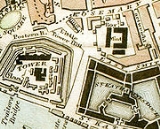
East Smithfield

Encyclopedia
East Smithfield is the name of a road in the London Borough of Tower Hamlets
in east London
, part of the A1203 road. It was historically an alternative name for the liberty and parish of St Botolph without Aldgate.
The route of both the London Marathon
and the London Triathlon
pass along East Smithfield. The Royal Mint
, Tower Bridge
and the Tower of London
are located in the vicinity.
recounts the origin of the area from the Liber Trinitae, where the Saxon
King Edgar was petitioned by 13 knights to grant them the wasteland to the East of the city
wall
, desiring to form a guild. The request was said to be granted on condition that each knight should
The strip of land to the north of Aldgate came to be Portsoken
, an extramural ward of the City of London. The open ground south of Aldgate was known as East Smithfield — derived from smoothfield. Later, Edward the Confessor
confirmed the liberties upon the heirs, and these were again confirmed in the reign of William Rufus. By 1115, during the reign of Henry I
, the entire soke, or liberty
, was given to the church of Holy Trinity within Aldgate, which had been founded in 1107 by Matilda, Henry's Queen. The prior of the Abbey was then to sit as an ex officio Alderman
of London. The gift was not without problems. The Constable of the Tower
, Geoffrey de Mandeville had cultivated a piece of ground in East Smithfield, adjacent to the Tower, as a vineyard. He refused to give it up and defended it with the garrison.
The southern part of East Smithfield was given by Holy Trinity Priory
as a site for the Hospital of St Katharine
, founded by Matilda
(wife of Stephen of England
), in 1148. Further foundations were bestowed by Eleanor
(widow of Henry III
) and Philippa
(wife of Edward III). The importance of the hospital was such that the whole of East Smithfield came to be deemed within the Precinct of St Katharine. A Pentecost
fair was granted in the district in 1229, and by 1236 Jews were settled here for protection by the Tower garrison — until their expulsion in 1290.
Between 1347–1351, the Black Death
struck the City. Two cemeteries were opened in East Smithfield to take the dead from London. During the epidemic, 200 bodies a day were buried, in mass graves, stacked five deep. In 2007, a study led by the University of Albany, NY exhumed and examined 490 skeletons – finding that the disease afflicted disproportionately the already weak and malnourished. In 1442, the neighbourhood "was constituted a Precinct free from jurisdiction civil or ecclesiastical, except that of the Lord Chancellor". With the Dissolution of the Monasteries
by King Henry VIII
in 1531, the land became the property of the Crown, and many of the religious houses were given to prominent nobles. The hospital of St Katharine was not seized, but re-established as a Protestant house — with houses and a brewery being built within the precints.
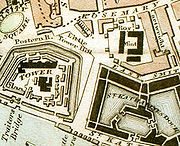 Foreign ships were not permitted to use the wharfs within the City, and St Katharine's Quay came to be used extensively for unloading these, particularly Dutch ships. Many French settled here, after the loss of Calais
. A large number were from the districts of Hammes and Guisnes, leading to a part of the Precinct becoming known as Hangman's Gains. With trade in the City regulated by the City, St Katharine became an area for foreign settlement. At the end of the 19th century, the quay was the terminus for passenger boats arriving from northern Europe, and became the arrival point for Ashkenazi Jews
fleeing persecution in eastern Europe. Many settled around Whitechapel
and Spitalfields
, only a half–mile to the north.
The Royal Mint
moved from the Tower of London
, to a site at the end of East Smithfield in 1809. Today, this building, by Robert Smirke
and its gatehouse are all that remain; the rest being swept away by continual expansion, until in November 1975, the London Mint was closed and production transferred to Wales
. The site is now occupied by Barclays Global Investors.
Over time, the area had become divided and further sub-divided. In 1294, the liberty of the Minories
was formed around the Minoresses of St. Mary of the Order of St. Clare. This site is now occupied by Tower Gateway DLR station
. Similarly, to the east, was the liberty of Well Close
, around the Abbey of St Mary Graces. By the 17th century, the rights, peculiarities and administration of these tiny areas was becoming increasing anachronistic, and in 1686, they were subsumed into the Liberties of the Tower of London
. In 1828, St Katharine Docks
were constructed on the site of the hospital, and some 11,000 persons were evicted from the slum to find their own replacement lodgings. From 1855, the whole area of the former East Smithfield was reunited under the administration of the Whitechapel District
.
In 1844, "An Association for promoting Cleanliness among the Poor" was established, and they built a bath-house
and laundry in Glasshouse Yard. This cost a single penny
for bathing or washing, and by June 1847 was receiving 4,284 people a year. This led to an Act of Parliament
to encourage other municipalities to build their own, and the model spread quickly throughout the East End. Timbs noted that "... so strong was the love of cleanliness thus encouraged that women often toiled to wash their own and their children's clothing, who had been compelled to sell their hair to purchase food to satisfy the cravings of hunger".
.
The nearest London Underground station is Tower Hill
on the District
and Circle Lines.
London Borough of Tower Hamlets
The London Borough of Tower Hamlets is a London borough to the east of the City of London and north of the River Thames. It is in the eastern part of London and covers much of the traditional East End. It also includes much of the redeveloped Docklands region of London, including West India Docks...
in east London
London
London is the capital city of :England and the :United Kingdom, the largest metropolitan area in the United Kingdom, and the largest urban zone in the European Union by most measures. Located on the River Thames, London has been a major settlement for two millennia, its history going back to its...
, part of the A1203 road. It was historically an alternative name for the liberty and parish of St Botolph without Aldgate.
The route of both the London Marathon
London Marathon
The London Marathon is one of the biggest running events in the world, and one of the five top world marathons that make up the World Marathon Majors competition, which has a $1 million prize purse. It has been held each spring in London since 1981. The race is currently sponsored by Virgin Money,...
and the London Triathlon
London Triathlon
The London Triathlon is the largest Triathlon in the world....
pass along East Smithfield. The Royal Mint
Royal Mint
The Royal Mint is the body permitted to manufacture, or mint, coins in the United Kingdom. The Mint originated over 1,100 years ago, but since 2009 it operates as Royal Mint Ltd, a company which has an exclusive contract with HM Treasury to supply all coinage for the UK...
, Tower Bridge
Tower Bridge
Tower Bridge is a combined bascule and suspension bridge in London, England, over the River Thames. It is close to the Tower of London, from which it takes its name...
and the Tower of London
Tower of London
Her Majesty's Royal Palace and Fortress, more commonly known as the Tower of London, is a historic castle on the north bank of the River Thames in central London, England. It lies within the London Borough of Tower Hamlets, separated from the eastern edge of the City of London by the open space...
are located in the vicinity.
History
John StowJohn Stow
John Stow was an English historian and antiquarian.-Early life:The son of Thomas Stow, a tallow-chandler, he was born about 1525 in London, in the parish of St Michael, Cornhill. His father's whole rent for his house and garden was only 6s. 6d. a year, and Stow in his youth fetched milk every...
recounts the origin of the area from the Liber Trinitae, where the Saxon
Anglo-Saxons
Anglo-Saxon is a term used by historians to designate the Germanic tribes who invaded and settled the south and east of Great Britain beginning in the early 5th century AD, and the period from their creation of the English nation to the Norman conquest. The Anglo-Saxon Era denotes the period of...
King Edgar was petitioned by 13 knights to grant them the wasteland to the East of the city
City of London
The City of London is a small area within Greater London, England. It is the historic core of London around which the modern conurbation grew and has held city status since time immemorial. The City’s boundaries have remained almost unchanged since the Middle Ages, and it is now only a tiny part of...
wall
London Wall
London Wall was the defensive wall first built by the Romans around Londinium, their strategically important port town on the River Thames in what is now the United Kingdom, and subsequently maintained until the 18th century. It is now the name of a road in the City of London running along part of...
, desiring to form a guild. The request was said to be granted on condition that each knight should
"accomplish three combats, one above the ground, one below the ground, and the third in the water; after this, at a certain day in East Smithfield, they should run with spears against all comers; all of which was gloriously performed; and the same day the King named it Knighten GuildeKnighten GuildeThe Knighten Guilde, also known as Portsoken Ward, was an obscure Medieval guild of the City of London, according to A Survey of London by John Stow in origin an order of chivalry founded by Saxon King Edgar for loyal knights...
, and so bounded it from Ealdgate [(AldgateAldgateAldgate was the eastern most gateway through London Wall leading from the City of London to Whitechapel and the east end of London. Aldgate gives its name to a ward of the City...
)] to the place where the bars now are toward the east, &c. and again toward the south unto to the river of Thames, and so into the water, and throw his speare; so that all East Smithfield, with the right part of the street that goeth by Dodding Pond into the Thames and also the hospital of St Katherin's, with the mills that were founded in King StephenStephen of EnglandStephen , often referred to as Stephen of Blois , was a grandson of William the Conqueror. He was King of England from 1135 to his death, and also the Count of Boulogne by right of his wife. Stephen's reign was marked by the Anarchy, a civil war with his cousin and rival, the Empress Matilda...
's daies, and the outward stone wall, and the new ditch of the Tower, are of the saide fee and liberbertie."
The strip of land to the north of Aldgate came to be Portsoken
Portsoken
Portsoken is a historical district in the City of London, located outside the former London Wall, on the eastern part of the City, near Aldgate. It is one of the 25 wards of the City....
, an extramural ward of the City of London. The open ground south of Aldgate was known as East Smithfield — derived from smoothfield. Later, Edward the Confessor
Edward the Confessor
Edward the Confessor also known as St. Edward the Confessor , son of Æthelred the Unready and Emma of Normandy, was one of the last Anglo-Saxon kings of England and is usually regarded as the last king of the House of Wessex, ruling from 1042 to 1066....
confirmed the liberties upon the heirs, and these were again confirmed in the reign of William Rufus. By 1115, during the reign of Henry I
Henry I of England
Henry I was the fourth son of William I of England. He succeeded his elder brother William II as King of England in 1100 and defeated his eldest brother, Robert Curthose, to become Duke of Normandy in 1106...
, the entire soke, or liberty
Liberty (division)
Originating in the Middle Ages, a liberty was traditionally defined as an area in which regalian rights were revoked and where land was held by a mesne lord...
, was given to the church of Holy Trinity within Aldgate, which had been founded in 1107 by Matilda, Henry's Queen. The prior of the Abbey was then to sit as an ex officio Alderman
Alderman
An alderman is a member of a municipal assembly or council in many jurisdictions founded upon English law. The term may be titular, denoting a high-ranking member of a borough or county council, a council member chosen by the elected members themselves rather than by popular vote, or a council...
of London. The gift was not without problems. The Constable of the Tower
Constable of the Tower
The Constable of the Tower is the most senior appointment at the Tower of London. In the middle ages a constable was the person in charge of a castle when the owner - the king or a nobleman - was not in residence...
, Geoffrey de Mandeville had cultivated a piece of ground in East Smithfield, adjacent to the Tower, as a vineyard. He refused to give it up and defended it with the garrison.
The southern part of East Smithfield was given by Holy Trinity Priory
Holy Trinity Priory
The Holy Trinity Priory was a priory of Austin canons founded around 1108 by Queen Matilda of England, wife of King Henry I near Aldgate in London. The queen received advice and help in the foundation from Anselm of Canterbury, the Archbishop of Canterbury. It was founded with clergy from...
as a site for the Hospital of St Katharine
St Katharine's by the Tower
St Katharine's by the Tower--full name Royal Hospital and Collegiate Church of St. Katharine by the Tower--was a medieval church and hospital next to the Tower of London. The establishment was founded in 1148 and the buildings demolished in 1825 to build St Katharine Docks, which takes its name...
, founded by Matilda
Matilda of Boulogne
Matilda I was suo jure Countess of Boulogne. She was also queen consort of England as the wife of King Stephen.-Biography:...
(wife of Stephen of England
Stephen of England
Stephen , often referred to as Stephen of Blois , was a grandson of William the Conqueror. He was King of England from 1135 to his death, and also the Count of Boulogne by right of his wife. Stephen's reign was marked by the Anarchy, a civil war with his cousin and rival, the Empress Matilda...
), in 1148. Further foundations were bestowed by Eleanor
Eleanor of Provence
Eleanor of Provence was Queen consort of England as the spouse of King Henry III of England from 1236 until his death in 1272....
(widow of Henry III
Henry III of England
Henry III was the son and successor of John as King of England, reigning for 56 years from 1216 until his death. His contemporaries knew him as Henry of Winchester. He was the first child king in England since the reign of Æthelred the Unready...
) and Philippa
Philippa of Hainault
Philippa of Hainault, or, Philippe de Hainaut was the Queen consort of King Edward III of England. Edward, Duke of Guyenne, her future husband, promised in 1326 to marry her within the following two years...
(wife of Edward III). The importance of the hospital was such that the whole of East Smithfield came to be deemed within the Precinct of St Katharine. A Pentecost
Pentecost
Pentecost is a prominent feast in the calendar of Ancient Israel celebrating the giving of the Law on Sinai, and also later in the Christian liturgical year commemorating the descent of the Holy Spirit upon the disciples of Christ after the Resurrection of Jesus...
fair was granted in the district in 1229, and by 1236 Jews were settled here for protection by the Tower garrison — until their expulsion in 1290.
Between 1347–1351, the Black Death
Black Death
The Black Death was one of the most devastating pandemics in human history, peaking in Europe between 1348 and 1350. Of several competing theories, the dominant explanation for the Black Death is the plague theory, which attributes the outbreak to the bacterium Yersinia pestis. Thought to have...
struck the City. Two cemeteries were opened in East Smithfield to take the dead from London. During the epidemic, 200 bodies a day were buried, in mass graves, stacked five deep. In 2007, a study led by the University of Albany, NY exhumed and examined 490 skeletons – finding that the disease afflicted disproportionately the already weak and malnourished. In 1442, the neighbourhood "was constituted a Precinct free from jurisdiction civil or ecclesiastical, except that of the Lord Chancellor". With the Dissolution of the Monasteries
Dissolution of the Monasteries
The Dissolution of the Monasteries, sometimes referred to as the Suppression of the Monasteries, was the set of administrative and legal processes between 1536 and 1541 by which Henry VIII disbanded monasteries, priories, convents and friaries in England, Wales and Ireland; appropriated their...
by King Henry VIII
Henry VIII of England
Henry VIII was King of England from 21 April 1509 until his death. He was Lord, and later King, of Ireland, as well as continuing the nominal claim by the English monarchs to the Kingdom of France...
in 1531, the land became the property of the Crown, and many of the religious houses were given to prominent nobles. The hospital of St Katharine was not seized, but re-established as a Protestant house — with houses and a brewery being built within the precints.
Calais
Calais is a town in Northern France in the department of Pas-de-Calais, of which it is a sub-prefecture. Although Calais is by far the largest city in Pas-de-Calais, the department's capital is its third-largest city of Arras....
. A large number were from the districts of Hammes and Guisnes, leading to a part of the Precinct becoming known as Hangman's Gains. With trade in the City regulated by the City, St Katharine became an area for foreign settlement. At the end of the 19th century, the quay was the terminus for passenger boats arriving from northern Europe, and became the arrival point for Ashkenazi Jews
Ashkenazi Jews
Ashkenazi Jews, also known as Ashkenazic Jews or Ashkenazim , are the Jews descended from the medieval Jewish communities along the Rhine in Germany from Alsace in the south to the Rhineland in the north. Ashkenaz is the medieval Hebrew name for this region and thus for Germany...
fleeing persecution in eastern Europe. Many settled around Whitechapel
Whitechapel
Whitechapel is a built-up inner city district in the London Borough of Tower Hamlets, London, England. It is located east of Charing Cross and roughly bounded by the Bishopsgate thoroughfare on the west, Fashion Street on the north, Brady Street and Cavell Street on the east and The Highway on the...
and Spitalfields
Spitalfields
Spitalfields is a former parish in the borough of Tower Hamlets, in the East End of London, near to Liverpool Street station and Brick Lane. The area straddles Commercial Street and is home to many markets, including the historic Old Spitalfields Market, founded in the 17th century, Sunday...
, only a half–mile to the north.
The Royal Mint
Royal Mint
The Royal Mint is the body permitted to manufacture, or mint, coins in the United Kingdom. The Mint originated over 1,100 years ago, but since 2009 it operates as Royal Mint Ltd, a company which has an exclusive contract with HM Treasury to supply all coinage for the UK...
moved from the Tower of London
Tower of London
Her Majesty's Royal Palace and Fortress, more commonly known as the Tower of London, is a historic castle on the north bank of the River Thames in central London, England. It lies within the London Borough of Tower Hamlets, separated from the eastern edge of the City of London by the open space...
, to a site at the end of East Smithfield in 1809. Today, this building, by Robert Smirke
Robert Smirke
Robert Smirke may refer to:* Robert Smirke , 18th/19th century English painter* Robert Smirke , son of the painter, 19th century English architect...
and its gatehouse are all that remain; the rest being swept away by continual expansion, until in November 1975, the London Mint was closed and production transferred to Wales
Wales
Wales is a country that is part of the United Kingdom and the island of Great Britain, bordered by England to its east and the Atlantic Ocean and Irish Sea to its west. It has a population of three million, and a total area of 20,779 km²...
. The site is now occupied by Barclays Global Investors.
Over time, the area had become divided and further sub-divided. In 1294, the liberty of the Minories
Minories
The Minories is the name of both an area and street in the City of London close to the Tower of London. The street called Minories runs north-south between Aldgate and Tower Hill underground stations...
was formed around the Minoresses of St. Mary of the Order of St. Clare. This site is now occupied by Tower Gateway DLR station
Tower Gateway DLR station
Tower Gateway is a Docklands Light Railway station near the Tower of London. It is in Travelcard Zone 1. It adjoins the tracks to Fenchurch Street station and is on the site of the closed Minories railway station....
. Similarly, to the east, was the liberty of Well Close
Wellclose Square
Wellclose Square lies in the London Borough of Tower Hamlets, between Cable Street to the north and The Highway to the south.The western edge, now called Ensign Street, was previously called Well Street. The southern edge was called Neptune street. On the north side is Graces Alley, home to...
, around the Abbey of St Mary Graces. By the 17th century, the rights, peculiarities and administration of these tiny areas was becoming increasing anachronistic, and in 1686, they were subsumed into the Liberties of the Tower of London
Liberties of the Tower of London
The Liberties of the Tower, or the Tower Liberty was an area adjoining the Tower of London, which was outside the jurisdiction of either the City of London or the County of Middlesex....
. In 1828, St Katharine Docks
St Katharine Docks
St Katharine Docks, in the London Borough of Tower Hamlets, were one of the commercial docks serving London, on the north side of the river Thames just east of the Tower of London and Tower Bridge...
were constructed on the site of the hospital, and some 11,000 persons were evicted from the slum to find their own replacement lodgings. From 1855, the whole area of the former East Smithfield was reunited under the administration of the Whitechapel District
Whitechapel District (Metropolis)
Whitechapel was a local government district within the metropolitan area of London, England from 1855 to 1900. It was formed by the Metropolis Management Act 1855 and was governed by the Whitechapel District Board of Works, which consisted of elected vestrymen.Until 1889 the district was in the...
.
In 1844, "An Association for promoting Cleanliness among the Poor" was established, and they built a bath-house
Public bathing
Public baths originated from a communal need for cleanliness. The term public may confuse some people, as some types of public baths are restricted depending on membership, gender, religious affiliation, or other reasons. As societies have changed, public baths have been replaced as private bathing...
and laundry in Glasshouse Yard. This cost a single penny
Penny
A penny is a coin or a type of currency used in several English-speaking countries. It is often the smallest denomination within a currency system.-Etymology:...
for bathing or washing, and by June 1847 was receiving 4,284 people a year. This led to an Act of Parliament
Act of Parliament
An Act of Parliament is a statute enacted as primary legislation by a national or sub-national parliament. In the Republic of Ireland the term Act of the Oireachtas is used, and in the United States the term Act of Congress is used.In Commonwealth countries, the term is used both in a narrow...
to encourage other municipalities to build their own, and the model spread quickly throughout the East End. Timbs noted that "... so strong was the love of cleanliness thus encouraged that women often toiled to wash their own and their children's clothing, who had been compelled to sell their hair to purchase food to satisfy the cravings of hunger".
Transport
The nearest Docklands Light Railway station is Tower GatewayTower Gateway DLR station
Tower Gateway is a Docklands Light Railway station near the Tower of London. It is in Travelcard Zone 1. It adjoins the tracks to Fenchurch Street station and is on the site of the closed Minories railway station....
.
The nearest London Underground station is Tower Hill
Tower Hill tube station
Tower Hill is a London Underground station at Tower Hill in the London Borough of Tower Hamlets.The station is in Travelcard Zone 1 and near the Tower of London...
on the District
District Line
The District line is a line of the London Underground, coloured green on the Tube map. It is a "sub-surface" line, running through the central area in shallow cut-and-cover tunnels. It is the busiest of the sub-surface lines. Out of the 60 stations served, 25 are underground...
and Circle Lines.