

Kfar Etzion massacre

Encyclopedia
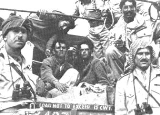
The Kfar Etzion massacre was an act committed by Arab armed forces on May 13, 1948, the day before the Declaration of Independence of the state of Israel
.
was a kibbutz
founded in 1943, about 2 km east of the road
between Jerusalem and Hebron
. By the end of 1947, there were 163 adults and 50 children living there. Together with three nearby kibbutzim established 1945-1947, it formed Gush Etzion
(the Etzion Bloc).
The United Nations partition plan for Palestine
of November 29, 1947 placed the Etzion Bloc in the interior of the intended Arab state. The Haganah decided agains the evacuation of the settlements for several reasons. The decision to hold out owed much to their strategic location as the only Jewish-held position on Jerusalem's southern approach from Hebron
. Not only a principle was at stake; strategically, they were also a 'sharp thorn stuck in the heart of a purely Arab area';' they offered a potential obstruction of Arab lines of communication, and would relieve pressure on Jerusalem by forcing Arabs to expend considerable forces elsewhere.
Throughout the winter hostilities intensified and several relief convoys from the Haganah
in Jerusalem were attacked by Arab ambushes
. In January, the children and some women were evacuated with British assistance. An emergency reinforcement convoy
attempting to march to Gush Etzion under cover of darkness were discovered and killed by Palestinian Arab forces. Despite some emergency flights by Piper Cubs
out of Tel Aviv
onto an improvised airfield, adequate supplies were not getting in.
On March 27, land communication with the Yishuv
was severed completely when the Nebi Daniel Convoy
was forced to retreat back to Jerusalem. In the following months, Arab irregular forces continued small-scale attacks against the bloc, which the Haganah was able to effectively withstand. Etzion Bloc units had repeatedly attacked Arab Legion convoys and individual vehicles on the road between Jerusalem and Hebron on several occasions in April and May.
As the end of the British Mandate drew closer, the fighting in the region intensified. Although the Arab Legion
was theoretically in Palestine under British command, they began to operate more and more independently. In March a Jewish convoy from Jerusalem intended to supply the Etzion Bloc was ambushed and 15 soldiers of the Haganah died before the remainder were extricated by the British. On April 12 and May 4, Etzion Bloc operatives ambushed Arab Legion units, and the incidents, according to a Hanagah analysis, tipped the Legion's policy towards the bloc from one of isolating it, to destroying it. On May the 4th, following the last ambush of a Legion convoy, a joint force of British, Arab Legion and irregular troops launched a major punitive attack on Kfar Etzion. The Haganah abandoned a few outposts but generally resisted, and the attack failed. A bloc counter-attack may have taken place the day after, but the failure of the Legion's assault led Hebronites and Legion units to plan a final attack and destroy the Etzion Bloc militarily.
The final assault on Kfar Etzion began on May 12. Parts of two Arab Legion companies, assisted by hundreds of local irregulars, had a dozen armored cars and artillery, to which the Jewish defenders had no effective answer. The commander of Kfar Etzion requested from the Central Command in Jerusalem permission to evacuate the kibbutz, but was ordered to stay. Later in the day, the Arabs captured the Russian Orthodox
monastery
, which the Haganah used as a perimeter fortress for the Kfar Etzion area, killing twenty-four of its thirty-two defenders.
On May 13, an attack broke through Kfar Etzion's defences and reached the settlement's centre effectively cuttingt off the perimeter outposts from each other.
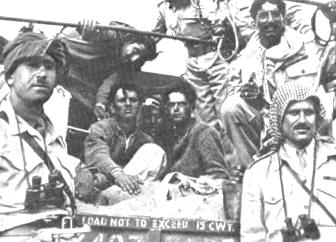 When the hopelessness of their position became undeniable on May 13, the defenders of Kfar Etzion laid down their arms and attempted to surrender. The number of people killed and the perpetrators are in dispute. According to one account, the main group of about 50 defenders were surrounded by a large number of Arab irregulars, who shouted "Deir Yassin!
" and ordered the Jews to sit down, stand up, and sit down again. Suddenly someone opened fire on the Jews with a machine gun and others joined in the killing. Those Jews not immediately cut down tried to run away but were pursued.
The Israeli histories of the Kfar Etzion massacre (such as Levi, 1986, Isseroff, 2005) note that the defenders had put out the white flag
and lined up to surrender in front of the school building of the German monastery. There were 133 people there. After they were photographed by a man in a kaffiyeh, an armored car apparently belonging to the Arab Legion
opened fire with its machine gun, and then Arab irregulars joined in. A group of defenders managed to crawl into the cellar of the monastery, where they defended themselves until a large number of grenades were thrown into the cellar. The building was then blown up and collapsed on them. According to this reckoning, about 129 persons were murdered. Yigal Allon
(1970) and Martin Gilbert
(1977) both state that fifteen Jews were killed after surrendering.
Only three of the remaining Kfar Etzion residents and one Palmach
member survived. According to their own testimony, the circumstances of their survival were as follows.
A total of 157 defenders died in the battle of Gush Etzion
(Levi, 1986), including those killed in the massacre at Kfar Etzion. About 2/3 of them were residents and the remainder were Hagana or Palmach soldiers.
On the following day, the Arab irregular forces continued their assault on the remaining three Etzion settlements. Fearing that the defenders might suffer the same fate as those of Kfar Etzion, Zionist leaders in Jerusalem negotiated a deal for the surrender of the settlements on condition that the Arab Legion protected the residents. The Red Cross took the wounded to Jerusalem, and the Arab Legion took the remainder as prisoners of war. In March 1948 320 prisoners from the Etzion settlements were released from the "Jordan POW camp at Mafrak", including 85 women.
The role of the Arab Legion in the massacre is still debated. There is no doubt that the Legion led the attack on Kfar Etzion (probably on the explicit orders of Glubb Pasha), and at least a few Legionnaires were present when the massacre began. Other than that, the most credible evidence is that of Eliza Fauktwanger, who said that the Legion officer (Captain Hikmat Mihyar) who saved her life released all other wounded and were sent to Jerusalem.
Glubb Pasha later denied that there had been a massacre at all.
was conquered by the IDF 89th Commando Battalion. The Al-Dawayima massacre
then took place, as the villagers were blamed for the Kfar Etzion massacre. Estimates of the number of murdered Arab villagers range from 80–100 to 100–200, depending on the source.
The bodies of the murdered of Kfar Etzion were left at the site for a year and a half, until in November 1949, the Chief Military Rabbi, Shlomo Goren
was allowed to collect their bones. They were buried in a full military funeral on November 17 in Mount Herzl
in Jerusalem. Their communal grave was the first grave in what is today the military cemetery of Mount Herzl.
The Etzion Bloc became a symbol of Zionist heroism and martyrdom among Israelis immediately after its fall, and this importance continues. The date of the massacre was enshrined as Israel's Day of Remembrance.
The site of the Etzion Bloc was recaptured by Israel during the 1967 war
. The children who had been evacuated from the Bloc in 1948 led a public campaign for the Bloc to be resettled, and Prime Minister Levi Eshkol
gave his approval. Kfar Etzion was re-established as a kibbutz in September 1967, as the first Israeli settlement
in the West Bank
after the war.
Israel
The State of Israel is a parliamentary republic located in the Middle East, along the eastern shore of the Mediterranean Sea...
.
Background
Kfar EtzionKfar Etzion
Kfar Etzion is a religious Israeli settlement and kibbutz located in the Judean Hills between Jerusalem and Hebron in the southern West Bank. It has a population of 400 and falls under the jurisdiction of Gush Etzion Regional Council...
was a kibbutz
Kibbutz
A kibbutz is a collective community in Israel that was traditionally based on agriculture. Today, farming has been partly supplanted by other economic branches, including industrial plants and high-tech enterprises. Kibbutzim began as utopian communities, a combination of socialism and Zionism...
founded in 1943, about 2 km east of the road
Highway 60 (Israel)
Highway 60 is a north-south intercity road in Israel and the West Bank that stretches from Beersheba to Nazareth.-Route:The route is also known as the "Route of the Patriarchs" since it follows the path of the ancient highway that runs along the length of the central watershed, and which...
between Jerusalem and Hebron
Hebron
Hebron , is located in the southern West Bank, south of Jerusalem. Nestled in the Judean Mountains, it lies 930 meters above sea level. It is the largest city in the West Bank and home to around 165,000 Palestinians, and over 500 Jewish settlers concentrated in and around the old quarter...
. By the end of 1947, there were 163 adults and 50 children living there. Together with three nearby kibbutzim established 1945-1947, it formed Gush Etzion
Gush Etzion
Gush Etzion is a cluster of Israeli settlements located in the Judaean Mountains directly south of Jerusalem and Bethlehem in the West Bank, Palestinian territories. The core group includes four agricultural villages that were founded in 1940-1947 on property purchased in the 1920s and 1930s, and ...
(the Etzion Bloc).
The United Nations partition plan for Palestine
1947 UN Partition Plan
The United Nations Partition Plan for Palestine was created by the United Nations Special Committee on Palestine in 1947 to replace the British Mandate for Palestine with "Independent Arab and Jewish States" and a "Special International Regime for the City of Jerusalem" administered by the United...
of November 29, 1947 placed the Etzion Bloc in the interior of the intended Arab state. The Haganah decided agains the evacuation of the settlements for several reasons. The decision to hold out owed much to their strategic location as the only Jewish-held position on Jerusalem's southern approach from Hebron
Highway 60 (Israel)
Highway 60 is a north-south intercity road in Israel and the West Bank that stretches from Beersheba to Nazareth.-Route:The route is also known as the "Route of the Patriarchs" since it follows the path of the ancient highway that runs along the length of the central watershed, and which...
. Not only a principle was at stake; strategically, they were also a 'sharp thorn stuck in the heart of a purely Arab area';' they offered a potential obstruction of Arab lines of communication, and would relieve pressure on Jerusalem by forcing Arabs to expend considerable forces elsewhere.
Throughout the winter hostilities intensified and several relief convoys from the Haganah
Haganah
Haganah was a Jewish paramilitary organization in what was then the British Mandate of Palestine from 1920 to 1948, which later became the core of the Israel Defense Forces.- Origins :...
in Jerusalem were attacked by Arab ambushes
Gush Etzion Convoy
From November 1947 the roads to the four kibbutzim of Gush Etzion , south of Jerusalem were blockaded by militias from neighbouring villages. The Haganah used a strategy of armed convoys to get supplies to the outposts. The initial convoys to the bloc used open pickup trucks , since the British...
. In January, the children and some women were evacuated with British assistance. An emergency reinforcement convoy
Convoy of 35
The Convoy of 35 refers to 35 soldiers of the Haganah who were killed while attempting to resupply and or reinforce the Gush Etzion kibbutzim by foot on January 16, 1948, after a number of convoys had been attacked during the early stages of the 1947–1948 Civil War in Mandatory Palestine.- Attack...
attempting to march to Gush Etzion under cover of darkness were discovered and killed by Palestinian Arab forces. Despite some emergency flights by Piper Cubs
Piper J-3
The Piper J-3 Cub is a small, simple, light aircraft that was built between 1937 and 1947 by Piper Aircraft. With tandem seating, it was intended for flight training but became one of the most popular and best-known light aircraft of all time...
out of Tel Aviv
Tel Aviv
Tel Aviv , officially Tel Aviv-Yafo , is the second most populous city in Israel, with a population of 404,400 on a land area of . The city is located on the Israeli Mediterranean coastline in west-central Israel. It is the largest and most populous city in the metropolitan area of Gush Dan, with...
onto an improvised airfield, adequate supplies were not getting in.
On March 27, land communication with the Yishuv
Yishuv
The Yishuv or Ha-Yishuv is the term referring to the body of Jewish residents in Palestine before the establishment of the State of Israel...
was severed completely when the Nebi Daniel Convoy
Gush Etzion Convoy
From November 1947 the roads to the four kibbutzim of Gush Etzion , south of Jerusalem were blockaded by militias from neighbouring villages. The Haganah used a strategy of armed convoys to get supplies to the outposts. The initial convoys to the bloc used open pickup trucks , since the British...
was forced to retreat back to Jerusalem. In the following months, Arab irregular forces continued small-scale attacks against the bloc, which the Haganah was able to effectively withstand. Etzion Bloc units had repeatedly attacked Arab Legion convoys and individual vehicles on the road between Jerusalem and Hebron on several occasions in April and May.
As the end of the British Mandate drew closer, the fighting in the region intensified. Although the Arab Legion
Arab Legion
The Arab Legion was the regular army of Transjordan and then Jordan in the early part of the 20th century.-Creation:...
was theoretically in Palestine under British command, they began to operate more and more independently. In March a Jewish convoy from Jerusalem intended to supply the Etzion Bloc was ambushed and 15 soldiers of the Haganah died before the remainder were extricated by the British. On April 12 and May 4, Etzion Bloc operatives ambushed Arab Legion units, and the incidents, according to a Hanagah analysis, tipped the Legion's policy towards the bloc from one of isolating it, to destroying it. On May the 4th, following the last ambush of a Legion convoy, a joint force of British, Arab Legion and irregular troops launched a major punitive attack on Kfar Etzion. The Haganah abandoned a few outposts but generally resisted, and the attack failed. A bloc counter-attack may have taken place the day after, but the failure of the Legion's assault led Hebronites and Legion units to plan a final attack and destroy the Etzion Bloc militarily.
The final assault on Kfar Etzion began on May 12. Parts of two Arab Legion companies, assisted by hundreds of local irregulars, had a dozen armored cars and artillery, to which the Jewish defenders had no effective answer. The commander of Kfar Etzion requested from the Central Command in Jerusalem permission to evacuate the kibbutz, but was ordered to stay. Later in the day, the Arabs captured the Russian Orthodox
Russian Orthodox Church
The Russian Orthodox Church or, alternatively, the Moscow Patriarchate The ROC is often said to be the largest of the Eastern Orthodox churches in the world; including all the autocephalous churches under its umbrella, its adherents number over 150 million worldwide—about half of the 300 million...
monastery
Monastery
Monastery denotes the building, or complex of buildings, that houses a room reserved for prayer as well as the domestic quarters and workplace of monastics, whether monks or nuns, and whether living in community or alone .Monasteries may vary greatly in size – a small dwelling accommodating only...
, which the Haganah used as a perimeter fortress for the Kfar Etzion area, killing twenty-four of its thirty-two defenders.
On May 13, an attack broke through Kfar Etzion's defences and reached the settlement's centre effectively cuttingt off the perimeter outposts from each other.
The Massacre
Deir Yassin massacre
The Deir Yassin massacre took place on April 9, 1948, when around 120 fighters from the Irgun Zevai Leumi and Lohamei Herut Israel Zionist paramilitary groups attacked Deir Yassin near Jerusalem, a Palestinian-Arab village of roughly 600 people...
" and ordered the Jews to sit down, stand up, and sit down again. Suddenly someone opened fire on the Jews with a machine gun and others joined in the killing. Those Jews not immediately cut down tried to run away but were pursued.
The Israeli histories of the Kfar Etzion massacre (such as Levi, 1986, Isseroff, 2005) note that the defenders had put out the white flag
White flag
White flags have had different meanings throughout history and depending on the locale.-Flag of temporary truce in order to parley :...
and lined up to surrender in front of the school building of the German monastery. There were 133 people there. After they were photographed by a man in a kaffiyeh, an armored car apparently belonging to the Arab Legion
Arab Legion
The Arab Legion was the regular army of Transjordan and then Jordan in the early part of the 20th century.-Creation:...
opened fire with its machine gun, and then Arab irregulars joined in. A group of defenders managed to crawl into the cellar of the monastery, where they defended themselves until a large number of grenades were thrown into the cellar. The building was then blown up and collapsed on them. According to this reckoning, about 129 persons were murdered. Yigal Allon
Yigal Allon
Yigal Allon was an Israeli politician, a commander of the Palmach, and a general in the IDF. He served as one of the leaders of Ahdut HaAvoda party and the Israeli Labor party, and acting Prime Minister of Israel, and was a member of the Knesset and government minister from the 10th through the...
(1970) and Martin Gilbert
Martin Gilbert
Sir Martin John Gilbert, CBE, PC is a British historian and Fellow of Merton College, University of Oxford. He is the author of over eighty books, including works on the Holocaust and Jewish history...
(1977) both state that fifteen Jews were killed after surrendering.
Only three of the remaining Kfar Etzion residents and one Palmach
Palmach
The Palmach was the elite fighting force of the Haganah, the underground army of the Yishuv during the period of the British Mandate of Palestine. The Palmach was established on May 15, 1941...
member survived. According to their own testimony, the circumstances of their survival were as follows.
- Yaacov Edelstein and Yitzhak Ben-Sira tried to hide amongst a jumble of boulders and branches, but they were discovered by a "wrinkled, toothless, old Arab" who told them "Don't be afraid." Then a group of Arab irregulars rushed up and threw them against a wall. The old Arab tried to shield them with his body. As they argued, two Arab Legionnaires came up and took the two Jews under their protection.
- Nahum Ben-Sira, the brother of Yitzhak, was away from the main group when the massacre started. He hid until nightfall then escaped to a nearby kibbutz.
- Eliza Fauktwanger (Palmach) tried to hide in a ditch with several others. They were discovered and all were murdered except Eliza, who was dragged away by several Arab irregulars. As the group were trying to rape her, an Arab Legion officer (Captain Hikmat Mihyar) arrived, shot two of the perpetrators and sent the rest away. Afterwards the officer gave her bread, waited until she finished eating, and said to her (quote) "You are under my protection".
A total of 157 defenders died in the battle of Gush Etzion
Gush Etzion
Gush Etzion is a cluster of Israeli settlements located in the Judaean Mountains directly south of Jerusalem and Bethlehem in the West Bank, Palestinian territories. The core group includes four agricultural villages that were founded in 1940-1947 on property purchased in the 1920s and 1930s, and ...
(Levi, 1986), including those killed in the massacre at Kfar Etzion. About 2/3 of them were residents and the remainder were Hagana or Palmach soldiers.
On the following day, the Arab irregular forces continued their assault on the remaining three Etzion settlements. Fearing that the defenders might suffer the same fate as those of Kfar Etzion, Zionist leaders in Jerusalem negotiated a deal for the surrender of the settlements on condition that the Arab Legion protected the residents. The Red Cross took the wounded to Jerusalem, and the Arab Legion took the remainder as prisoners of war. In March 1948 320 prisoners from the Etzion settlements were released from the "Jordan POW camp at Mafrak", including 85 women.
The role of the Arab Legion in the massacre is still debated. There is no doubt that the Legion led the attack on Kfar Etzion (probably on the explicit orders of Glubb Pasha), and at least a few Legionnaires were present when the massacre began. Other than that, the most credible evidence is that of Eliza Fauktwanger, who said that the Legion officer (Captain Hikmat Mihyar) who saved her life released all other wounded and were sent to Jerusalem.
Glubb Pasha later denied that there had been a massacre at all.
Aftermath
On October 28, 1948, the Arab village al-DawayimaAl-Dawayima
Al-Dawayima was a Palestinian town, located northwest of the city of Hebron. It is identified with the Old Testament town of Bosqat. According to a 1945 census, the town's population was 3,710, and the village lands comprised a total land area of 60,585 dunums of which nearly half was cultivable...
was conquered by the IDF 89th Commando Battalion. The Al-Dawayima massacre
Al-Dawayima massacre
On October 28, 1948, the Arab town al-Dawayima was conquered by the IDF's 89th Commando Battalion during the Operation Yoav. The Battalion, whose first commander was Moshe Dayan, was composed of former Irgun and Lehi forces...
then took place, as the villagers were blamed for the Kfar Etzion massacre. Estimates of the number of murdered Arab villagers range from 80–100 to 100–200, depending on the source.
The bodies of the murdered of Kfar Etzion were left at the site for a year and a half, until in November 1949, the Chief Military Rabbi, Shlomo Goren
Shlomo Goren
Shlomo Goren , was an Orthodox Religious Zionist rabbi in Israel who founded and served as the first head of the Military Rabbinate of the Israel Defense Forces and subsequently as the third Ashkenazi Chief Rabbi of Israel from 1973 to 1983.He served in the Israel Defense Forces during three wars,...
was allowed to collect their bones. They were buried in a full military funeral on November 17 in Mount Herzl
Mount Herzl
Mount Herzl , also Har HaZikaron , is the national cemetery of Israel on the west side of Jerusalem. It is named for Theodor Herzl, the founder of modern political Zionism. Herzl's tomb lies at the top of the hill. Yad Vashem, which commemorates the Holocaust, lies to the west of Mt. Herzl....
in Jerusalem. Their communal grave was the first grave in what is today the military cemetery of Mount Herzl.
The Etzion Bloc became a symbol of Zionist heroism and martyrdom among Israelis immediately after its fall, and this importance continues. The date of the massacre was enshrined as Israel's Day of Remembrance.
The site of the Etzion Bloc was recaptured by Israel during the 1967 war
Six-Day War
The Six-Day War , also known as the June War, 1967 Arab-Israeli War, or Third Arab-Israeli War, was fought between June 5 and 10, 1967, by Israel and the neighboring states of Egypt , Jordan, and Syria...
. The children who had been evacuated from the Bloc in 1948 led a public campaign for the Bloc to be resettled, and Prime Minister Levi Eshkol
Levi Eshkol
' served as the third Prime Minister of Israel from 1963 until his death from a heart attack in 1969. He was the first Israeli Prime Minister to die in office.-Biography:...
gave his approval. Kfar Etzion was re-established as a kibbutz in September 1967, as the first Israeli settlement
Israeli settlement
An Israeli settlement is a Jewish civilian community built on land that was captured by Israel from Jordan, Egypt, and Syria during the 1967 Six-Day War and is considered occupied territory by the international community. Such settlements currently exist in the West Bank...
in the West Bank
West Bank
The West Bank ) of the Jordan River is the landlocked geographical eastern part of the Palestinian territories located in Western Asia. To the west, north, and south, the West Bank shares borders with the state of Israel. To the east, across the Jordan River, lies the Hashemite Kingdom of Jordan...
after the war.
See also
- Killings and massacres during the 1948 Palestine War
- List of massacres in Israel
Sources
- L. Collins and D. Lapierre, O Jerusalem!, Grafton Books, 1982, ISBN 0-586-05452-9.
- A. Isseroff Kfar Etzion Remembered: A history of Gush Etzion and the Massacre of Kfar Etzion, 2005.
- I. Levi, Jerusalem in the War of Independence ("Tisha Kabin" - Nine Measures - in Hebrew) Maarachot - IDF, Israel Ministry of Defence, 1986. ISBN 965-05-0287-4
- D. Ohana, Kfar Etzion: the Community of Memory and the myth of return, Israel Studies, vol. 7 no. 2 (2002) 145-174.
- Y. Katz and J. Lehr, Symbolism and landscape: The Etzion Bloc in the Judean Mountains, Middle Eastern Studies, vol. 31 iss. 4 (1995) 730-743.
- J. C. Lehr and Y. Katz, Heritage Interpretation and Politics in Kfar Etzion, Israel, International Journal of Heritage Studies, Vol. 9, No. 3, 2003, 215–228.
- B. Morris, The Road to Jerusalem: Glubb Pasha, Palestine and the Jews, I.B. TaurisI.B. TaurisI. B. Tauris is an independent publishing house with offices in London and New York.-History:I.B.Tauris was founded in 1983. Its declared strategy was to fill the perceived gap between trade publishing houses and university presses—that is, to publish serious but accessible works on international...
(2003), ISBN 1-86064-989-0.