
All Topics  
Silver nitrate

 
Silver Nitrate

   Email Print
   Bookmark   Link


Silver nitrate


Silver nitrate, also known as lunar caustic, is a soluble chemical compound
Chemical compound

A chemical compound is a Chemical substance consisting of two or more different chemical element Chemical bond together in a fixed mass ratio that can be split into simpler substances....
 with chemical formula
Chemical formula

A chemical formula is a way of expressing information about the atoms that constitute a particular chemical compound, and how the relationship between those atoms changes in chemical reactions....
 Ag
Silver

Silver is a chemical element with the chemical symbol Ag and atomic number 47. A soft, white, lustrous transition metal, it has the highest electrical conductivity of any element and the highest thermal conductivity of any metal....
N
Nitrogen

Nitrogen is a chemical element that has the symbol N and atomic number 7 and atomic mass 14.00674?. Elemental nitrogen is a colorless, odorless, tasteless and mostly inert diatomic gas at standard conditions, constituting 78% by volume of Earth's atmosphere....
O
Oxygen

Oxygen no O2 produced; 2) O2 produced, but absorbed in oceans & seabed rock; 3) O2 starts to gas out of the oceans, but is absorbed by land surfaces and formation of ozone layer; 4-5) O2 sinks filled and the gas accumulates]]...
3. This compound is a versatile precursor to many other silver compounds, such as those used in photography. Comparatively, it is far less sensitive to light than the halides
Silver halide

A silver halide is one of the Chemical compound formed between silver and one of the halogens — silver bromide , silver chloride , silver iodide , and two forms of silver fluorides....
. It is called lunar caustic because silver was called luna by the ancient alchemists.

In solid silver nitrate, the silver ions are three-coordinated in a trigonal planar arrangement.

er nitrate is the least expensive salt of silver; it offers several other advantages as well.


Discussion
Ask a question about 'Silver nitrate'
Start a new discussion about 'Silver nitrate'
Answer questions from other users
Full Discussion Forum


Recent Posts


Encyclopedia


Silver nitrate, also known as lunar caustic, is a soluble chemical compound
Chemical compound

A chemical compound is a Chemical substance consisting of two or more different chemical element Chemical bond together in a fixed mass ratio that can be split into simpler substances....
 with chemical formula
Chemical formula

A chemical formula is a way of expressing information about the atoms that constitute a particular chemical compound, and how the relationship between those atoms changes in chemical reactions....
 Ag
Silver

Silver is a chemical element with the chemical symbol Ag and atomic number 47. A soft, white, lustrous transition metal, it has the highest electrical conductivity of any element and the highest thermal conductivity of any metal....
N
Nitrogen

Nitrogen is a chemical element that has the symbol N and atomic number 7 and atomic mass 14.00674?. Elemental nitrogen is a colorless, odorless, tasteless and mostly inert diatomic gas at standard conditions, constituting 78% by volume of Earth's atmosphere....
O
Oxygen

Oxygen no O2 produced; 2) O2 produced, but absorbed in oceans & seabed rock; 3) O2 starts to gas out of the oceans, but is absorbed by land surfaces and formation of ozone layer; 4-5) O2 sinks filled and the gas accumulates]]...
3. This compound is a versatile precursor to many other silver compounds, such as those used in photography. Comparatively, it is far less sensitive to light than the halides
Silver halide

A silver halide is one of the Chemical compound formed between silver and one of the halogens — silver bromide , silver chloride , silver iodide , and two forms of silver fluorides....
. It is called lunar caustic because silver was called luna by the ancient alchemists.

In solid silver nitrate, the silver ions are three-coordinated in a trigonal planar arrangement.

Uses


Precursor to other silver compounds

Silver nitrate is the least expensive salt of silver; it offers several other advantages as well. It is non-hygroscopic, in contrast to silver fluoroborate and silver perchlorate
Silver perchlorate

Silver perchlorate is the chemical compound with the formula AgClO4. This white solid forms a monohydrate and is mildly deliquescent....
. It is relatively stable to light. Finally it dissolves in numerous solvents. The nitrate can be easily replaced by other ligands, rendering AgNO3 versatile. Treatment with solutions of halide ions gives a precipitate of AgX (X = Cl, Br, I). When making photographic film
Photographic film

Photographic film is a sheet of plastic coated with an emulsion containing light-sensitive silver halide salts with variable crystal sizes that determine the sensitivity, contrast and of the film....
, silver nitrate is treated with halide
Halide

A halide is a binary compound, of which one part is a halogen atom and the other part is an chemical element or radical that is less electronegative than the halogen, to make a fluoride, chloride, bromide, iodide, or astatide compound....
 salts of sodium or potassium to form insoluble silver halide
Silver halide

A silver halide is one of the Chemical compound formed between silver and one of the halogens — silver bromide , silver chloride , silver iodide , and two forms of silver fluorides....
 in situ in photographic gelatin
Gelatin

Gelatin is a translucent, colorless, brittle, nearly tasteless solid, derived from the collagen inside animals' skin and mostly bones. It has been commonly used as a gelling agent in food, pharmaceutical, photography, and cosmetic manufacturing....
, which is then applied to strips of tri-acetate
Acetate

An acetate, or ethanoate, is either a salt or ester of acetic acid.In chemistry, the abbreviation Ac refers to the acetyl group. The anion and the functional group may be written as -OAc and AcO-, or OAc respectively....
 or polyester
Polyester

Polyester is a category of polymers which contain the ester functional group in their main chain. Although there are many polyesters, the term "polyester" as a specific material most commonly refers to polyethylene terephthalate ....
. Similarly, silver nitrate is used to prepare some silver-based explosives, such as the fulminate
Silver fulminate

Silver fulminate is an explosive ionic compound of silver and the fulminate anion.Silver fulminate is a primary explosive that has very little practical value due to its extreme sensitivity....
, azide
Silver azide

Silver azide is the chemical compound with the chemical formula AgN3. This colourless solid is a well-known explosive....
, or acetylide
Silver acetylide

Silver acetylide is an inorganic chemical compound with the formula Ag2C2, a metal acetylide. The name derived from the way it is synthesized, the alternative silver carbide is not used in literature, although the substance is similar to calcium carbide ....
, through a precipitation reaction.

Treatment of silver nitrate with base gives silver oxide:
2 AgNO3 + 2 NaOH ? Ag2O + 2 NaNO3 + H2O


Halide abstraction

The silver cation quickly and effectively irreversibly reacts with halide anions to produce the insoluble silver halide. This reaction is commonly used in inorganic chemistry
Inorganic chemistry

Inorganic chemistry is the branch of chemistry concerned with the properties and behavior of inorganic compounds. This field covers all chemical compounds except the myriad organic compounds , which are the subjects of organic chemistry....
 to abstract the halide as the insoluble silver salt:

Ag+ (aq) + X- (aq) → AgX (s)     (X = Cl, Br, I)


Other silver salts with non-coordinating anions, namely silver tetrafluoroborate
Silver tetrafluoroborate

Silver tetrafluoroborate is an inorganic compound commonly encountered in inorganic chemistry and organometallic chemistry. Similar to silver hexafluorophosphate, it is commonly used to replace halide anions or ligands with the non-coordinating anion tetrafluoroborate anions....
 and silver hexafluorophosphate
Silver hexafluorophosphate

Silver hexafluorophosphate, commonly referred to "silver PF-6," is an inorganic compound with the formula AgPF6. This salt is a commonly encountered reagent in inorganic chemistry and organometallic chemistry....
 are used for more demanding applications.

Similarly, this reaction is used in analytical chemistry
Analytical chemistry

Analytical chemistry is the study of the chemical composition of natural and artificial materials. Unlike other major sub disciplines of chemistry such as inorganic chemistry and organic chemistry, analytical chemistry is not restricted to any particular type of chemical compound or chemical reaction....
 to confirm the presence of chloride
Chloride

The chloride ion is formed when the chemical element chlorine picks up one electron to form an anion Cl−....
, bromide
Bromide

A bromide ion is a bromine atom with electric charge of -1.Compounds with bromine in formal oxidation state -1 are called bromides, and each individual chemical in this class can be called a bromide, as well....
, or iodide
Iodide

An iodide ion is an iodine with a −1 electric charge. Compounds with iodine in formal oxidation state −1 are called iodides. This can include ionic compounds such as caesium iodide or covalent compounds such as phosphorus triiodide....
 ions can be tested by adding silver nitrate solution. Samples are typically acidifed with dilute nitric acid to remove interfering ions, e.g. carbonate
Carbonate

In chemistry, a carbonate is a salt or ester of carbonic acid....
 ions and sulfide
Sulfide

The term sulfide refers to several types of chemical compounds containing sulfur in its lowest oxidation number of −2.Formally, "sulfide" is the dianion, S2−, which exists in strongly alkaline aqueous solutions formed from H2S or alkali metal salts such as Li2S, Na2S, and K2...
 ions. This step avoids confusion of silver sulfide
Silver sulfide

Silver sulfide , Ag2S, is a black sulfide of silver. It is black and constitutes the tarnish that forms on silver when exposed to the hydrogen sulfide of the atmosphere....
 or silver carbonate
Silver carbonate

Silver carbonate is the chemical compound with the chemical formula Ag2CO3. This poorly soluble solid is yellow but typical samples are grayish due to the presence of elemental silver....
 precipitates with that of silver halides. The color of precipitate varies with the halide: white (silver chloride
Silver chloride

Silver chloride is a chemical compound with the chemical formula SilverChlorine. This white crystalline solid is well known for its low solubility in water ....
), pale yellow/cream (silver bromide
Silver bromide

Silver bromide , a soft, pale-yellow, soluble salt well known for its unusual photosensitive. This property has allowed silver halides to become the basis of modern photographic materials....
), yellow (silver iodide
Silver iodide

Silver iodide is an inorganic compound. This yellow photosensitive solid is used in photography, as an antiseptic in medicine, and in rainmaking....
). AgBr and especially AgI photo-decompose
Photochemistry

Photochemistry, a sub-discipline of chemistry, is the study of the interactions between atoms, small molecules, and light . The pillars of photochemistry are UV/VIS spectroscopy, photochemical reactions in organic chemistry and photosynthesis in biochemistry....
 to the metal, as evidence by a grayish color on exposed samples.

Organic synthesis

Silver nitrate is used in many ways in organic synthesis
Organic synthesis

Organic synthesis is a special branch of chemical synthesis and is concerned with the construction of organic compounds via organic reactions. Organic_chemistry molecules can often contain a higher level of complexity compared to purely Inorganic_chemistry compounds, so the synthesis of organic compounds has developed into one of the most im...
, e.g. for deprotection and oxidations. Ag+ binds alkene
Alkene

In organic chemistry, an alkene, olefin, or olefine is an Saturation chemical compound containing at least one carbon-to-carbon double bond....
s reversibly, and silver nitrate has been used to separate mixtures of alkenes by selective absorption. The resulting adduct
Adduct

An adduct is a product of a direct addition of two or more distinct molecules, resulting in a single reaction product containing all atoms of all components, with formation of two chemical bonds and a net reduction in bond multiplicity in at least one of the reactants....
 can be decomposed with ammonia
Ammonia

Ammonia is a chemical compound with the chemical formula nitrogenhydrogen. It is normally encountered as a gas with a characteristic pungent odor....
 to release the free alkene.

Biology

In histology
Histology

Histology is the study of the anatomy of cell and tissue of plants and animals. It is performed by examining a thin slice of tissue under a light microscope or electron microscope....
, silver nitrate is used for silver stain
Silver stain

Silver staining is the use of silver to selectively alter the appearance of the target....
ing, for demonstrating protein
Protein

Proteins are organic compounds made of amino acids arranged in a linear chain and joined together by peptide bonds between the carboxyl and amino groups of adjacent amino acid Residue ....
s and nucleic acid
Nucleic acid

A nucleic acid is a macromolecule composed of chains of monomeric nucleotides. In biochemistry these molecules carry genetic information or form structures within Cell ....
s. For this reason it is also used to demonstrate proteins in PAGE
Gel electrophoresis

Gel electrophoresis is a technique used for the separation of DNA , RNA , or protein molecules using an electric current applied to a gel matrix....
 gels. It is also used as a stain in scanning electron microscopy.

Medicine


Silver salts have antiseptic
Antiseptic

Antiseptics are antimicrobials that are applied to living biological tissue/skin to reduce the possibility of infection, sepsis, or putrefaction....
 properties. Until the development and widespread adoption of antibiotics, AgNO3 used to be dropped into newborn babies' eyes at birth to prevent contraction of gonorrhoea from the mother. Eye infections and blindness of newborns was reduced by this method; incorrect dosage, however, could cause blindness in extreme cases. This protection was first used by Credé
Carl Siegmund Franz Credé

Carl Siegmund Franz Cred? was a German gynecologist and obstetrician who was a native of Berlin. In 1842 he received his doctorate from the University of Berlin....
 in 1881. Fused silver nitrate, shaped into sticks, was traditionally called "lunar caustic". It is used as a cauterizing
Cauterization

The medical practice or technique of Cauterization is a medical term describing the burn of the body to remove or close off a part of itin a process called Cautery which destroys some tissue
 agent, for example to remove granulation tissue
Granulation tissue

Granulation tissue is the perfusion, fibrous connective tissue that replaces a fibrin clot in wound healing. Granulation tissue typically grows from the base of a wound and is able to fill wounds of almost any size it heals....
 around a stoma
Stoma (medicine)

In medicine, a stoma is an opening , either natural or surgery created , which connects a portion of the body cavity to the outside environment....
. Dentists sometimes use silver nitrate infused swabs to heal oral ulcers. Silver nitrate is also used by some podiatrists to kill cells located in the nail bed.

The Canadian physician C. A. Douglas Ringrose researched the use of silver nitrate for sterilization procedures
Sterilization (surgical procedure)

Sterilization is a surgery technique leaving a male or female unable to reproduction. It is a method of birth control. For non-surgical causes of sterility, see Infertility....
 on women. A specialist in obstetrics and gynaecology, Ringrose believed that the corrosive properties of silver nitrate could be used to block and corrode the fallopian tubes, in a process that he called "office tubal sterilization". The technique was ineffective; in fact at least two women underwent abortions. Ringrose was sued for malpractice, although these suits were unsuccessful.

Disinfection


Much research has been done in evaluating the ability of the silver ion at inactivating Escherichia coli, a microorganism commonly used as an indicator for fecal contamination and as a surrogate for pathogens in drinking water treatment. Concentrations of silver nitrate evaluated in inactivation experiments range from 10-200 micrograms per liter as Ag+. The antimicrobial properties of silver was first observed thousands of years ago when silver containers were used to store water for preservation. Its disinfection ability has been scientifically studied for over a century.

Applications

The antimicrobial properties of silver have been put to a wide variety of uses, including:

  • Water disinfection in hotels and hospitals
  • Postharvest cleaning of oysters
  • Inhibition of bacterial growth on chicken farms
  • Water recycling aboard space shuttles
  • Home purification of water in Europe and North America
  • Point of use disinfectant for water and vegetables in Mexico
  • Alternative to antibiotics (not recommended by USFDA)
  • Alternative to laundry detergent
  • Application to eyes of newborn babies to prevent infection
  • Coating on catheters to prevent infection


This property of silver was used for many purposes prior to the discovery of pharmaceutical antibiotics when it fell into near disuse. Its association with argyria
Argyria

Argyria is a condition caused by the ingestion of elemental silver, silver dust or silver compounds. The most dramatic symptom of argyria is that the skin becomes blue or bluish-grey colored....
 made consumers wary and led them to turn away from it when given an alternative. Since that time, as antibiotic-resistant microorganisms have emerged, interest in using the silver ion for anti-microbial purposes has resumed.

Kinetics

Before a disinfectant can be effectively used as a water disinfectant, its inactivation kinetics must be established. Kinetics generally depend on both the dosage of disinfectant and the time of application. It is important to understand the kinetics so that the minimum dosage of disinfectant can be applied for the minimum amount of time while still effectively inactivating any pathogens in the water. Because there are many microorganisms present in water, the inactivation kinetics of each one cannot be studied extensively. Therefore, indicator organisms generally more resistant to inactivation than others are used to estimate the kinetics of microorganisms as a whole. Escherichia coli, also referred to as E. coli, is a commonly used indicator organism.

It is well-documented that the silver ion is effective in the inactivation of E. coli. , , , , , , , , , , , . However, there are many inconsistencies in the literature regarding the kinetics of the inactivation of E. coli by the silver ion. With inconsistent data, it is impossible to tell what the true inactivation kinetics are, and therefore impossible to implement any sort of large-scale water treatment.

The inconsistencies may be due to several factors. First, the kinetics may depend on the source of the silver ion being used. In recent years, research has focused largely on electrolytically generated silver ions or colloidal silver. Most studies in which the inactivation kinetics of E. coli by silver nitrate were explored extensively date back several decades. Even within this smaller group of studies, vast inconsistencies exist, likely due to inaccurate analytical methods for measuring the concentration of silver in solution. Monitoring the decay of the silver ion in solution is imperative as silver tends to both adsorb readily to organic matter in the water and to be light reactive. Furthermore, silver tends to adsorb to glassware, which can lead not only to a decrease in the silver concentration within a given experiment but also to a release of the silver in subsequent experiments unless measures further than general glassware washing are taken for the removal of silver from the glassware surface. Therefore studies must both minimize the external factors effecting the concentration and to measure the changes in concentration that take place throughout the experiment.

Effects of various parameters

Despite the inconsistencies in the literature regarding the kinetics of the inactivation of E. coli by silver nitrate, important information can still be taken from the work. A study by Wuhrmann and Zobrist investigated the effect of various parameters upon the kinetics. First, they studied the effect of several ions in the water, including calcium, phosphates and chloride, all of which were found to decrease the bactericidal effect of silver. These effects are important to consider when designing an experiment. Because of the effect of phosphates, it is undesirable to use phosphate buffer to run experiments, as this creates a phosphate concentration much higher than that found in natural waters and will falsely slow the inactivation kinetics. Furthermore, it is important to avoid touching any glassware with bare hands, as chloride from sweat may contaminate the glassware, again slowing inactivation. Chambers, Proctor and Kabler established the importance of using an effective neutralizer solution made of a combination of sodium thioglycolate and sodium thiosulfate, rather than sodium thiosulfate alone, which though it is effective in neutralizing other disinfectants does not sufficiently stop the bactericidal action of silver nitrate. Both tested the effect of pH on the kinetics, finding that a higher pH increased the bactericidal action., Wuhrmann and Zobrist further established that at a higher temperature, inactivation occurs faster.

Kinetic models

A further complication of the inactivation kinetics by silver is the question of which model to use. With most disinfectants, the inactivation is effectively modeled using a first-order Chick-Watson model, which states that a certain level of disinfection will occur at a certain CT, or concentration *time value. According to this model, the same amount of inactivation should take place when a concentration of 0.2 mg/L is applied for 10 minutes as when 0.02 mg/L is applied for 100 minutes. Wuhrmann and Zobrist found rate kinetics that followed this model for all conditions, which agrees fairly well with a study by Chambers and Proctor, while another study by Renn and Chesney found curves that did not follow this law. It is therefore unclear whether this law sufficiently models inactivation by the silver ion.

Most recent papers regarding the disinfection of E. coli by silver nitrate have simply plotted the level of disinfection against time. , , , , While this method of data analysis does not risk making false assumptions about first-order kinetics, it does nothing to account for the applied concentration, which is essential to any kinetics. Therefore, different curves need to be generated for each concentration that might be applied. Furthermore, it does not account for changes in concentration that might take place during the experiment, and which may vary based on many factors.

A third model which has been suggested for the inactivation kinetics by silver nitrate is that of Cs*T, or chemisorbed silver onto the cell body times time. This model suggests that the rate of inactivation depends not on the concentration in the water at a given time, but rather on the silver that has been chemisorbed by the bacteria. It is assumed, according to this model that C0 = C1 + C2 + C3, where C0 is the initial concentration, C1 is the silver still in solution, C2 is the silver lost to adsorption to glassware or other factors in the solution, and C3 is the silver chemisorbed to the bacteria. C0 is measured at the beginning of the experiment, C1 is measured throughout the experiment, and C2 is determine in a control experiment without bacteria. C3, or the Cs value, is then determined to be C0-C1-C2. , According to Hwang, et al., this model was successful in estimating inactivation of E. coli by silver nitrate. Although it is possible that this model does not sufficiently account for all of the possible fates of the initial silver nitrate added to the solution, it is certainly a compelling method of data analysis. Because it is a new model, it has not been extensively studied by various researchers.

Safety

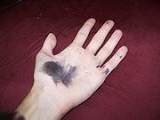
As with all silver salts, silver nitrate is toxic and corrosive. Brief exposure to the chemical will not produce immediate or even any side effects other than the purple skin stains, but with more exposure, side effects will become more noticeable. It is also very poisonous and can cause burns. Long-term exposure may cause eye damage. Short contact can lead to deposition of black silver stains on the skin. Besides being very destructive of mucous membranes, it is a skin and eye irritant.

Although silver nitrate is currently not regulated in water sources by the Environmental Protection Agency, when between 1-5 g of silver have accumulated in the body, a condition called argyria
Argyria

Argyria is a condition caused by the ingestion of elemental silver, silver dust or silver compounds. The most dramatic symptom of argyria is that the skin becomes blue or bluish-grey colored....
 can develop. Argyria is a permanent cosmetic condition in which the skin and internal organs turn a blue-gray color. The United States Environmental Protection Agency had a maximum contaminant limit for silver in water until 1990, but upon determination that argyria did not impact the function of organs affected, removed the regulation. Argyria is more often associated with the consumption of colloidal silver
Colloidal silver

Colloidal silver is a liquid suspension of microscopic particles of silver. A colloid is technically defined as particles which remain suspended without forming an Ionic liquid, or dissolved solution....
 solutions than with silver nitrate, especially at the extremely low concentrations present for the disinfection of water. However, it is still important to consider before ingesting any sort of silver-ion solution.

External links