

Photographic processing

Encyclopedia
Photographic processing is the chemical means by which photographic film
and paper
is treated after photographic exposure to produce a negative or positive image
. Photographic processing transforms the latent image
into a visible image, makes this permanent and renders it insensitive to light.
All processes based upon the gelatin-silver process are similar, regardless of the film or paper's manufacturer. Exceptional variations include instant films such as Polaroid
and thermally developed films. Kodachrome
required Kodak's proprietary K-14 process. Kodachrome film production ceased in 2009, and K-14 processing is no longer available as of December 30, 2010. Ilfochrome
materials use the dye destruction
process.
The washing time can be reduced and the fixer more completely removed if a hypo clearing agent is used after the fixer.
Once the film is processed, it is then referred to as a negative. The negative may now be printed; the negative is placed in an enlarger and projected onto a sheet of photographic paper. There are many different techniques that can be used during the enlargement process. Two examples of enlargement techniques are dodging and burning.
Alternatively (or as well), the negative may be scanned
for digital printing or web viewing after adjustment, retouching, and/or manipulation.
† In modern automatic processing machines, the stop bath is replaced by mechanical squeegee or pinching rollers. These treatments remove much of the carried-over alkaline developer, and the acid, when used, neutralizes the alkalinity to reduce the contamination of the fixing bath with the developer.
materials use dye couplers
to form colour images.
Modern colour negative film is developed with the C-41 process
and colour negative print materials with the RA-4 process
. These processes are very similar, with differences in the first chemical developer.
The C-41 and RA-4 processes consist of the following steps:
In the RA-4 process, the bleach and fix are combined. This is optional, and reduces the number of processing steps.
Transparency films, except Kodachrome
, are developed using the E-6 process
, which has the following stages:
In some old processes, the film emulsion was hardened during the process, typically before the bleach. Such a hardening bath often used aldehydes, such as formaldehyde
and glutaraldehyde
. In modern processing, these hardening steps are unnecessary because the film emulsion is sufficiently hardened to withstand the processing chemicals.
or sulphur
to increase image permanence and for aesthetic
reasons. This process is known as toning
.
In selenium toning, the image silver is changed to silver selenide; in sepia toning, the image is converted to silver sulphide. These chemicals are more resistant to atmospheric oxidising agents
than silver.
If colour negative film is processed in conventional black and white developer, and fixed and then bleached with a bath containing hydrochloric acid
and potassium dichromate solution, the resultant film, once exposed to light, can be redeveloped in colour developer to produce an unusual pastel
colour effect.
 In amateur processing, the film is removed from the camera
and wound onto a reel
in complete darkness (usually inside a darkroom
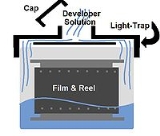
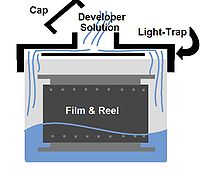
with the safelight turned off or a lightproof bag with arm holes). The reel holds the film in a spiral shape, with space between each successive loop so the chemicals may flow freely across the film's surfaces. The reel is placed in a specially designed light-proof tank (called daylight processing tank or a light-trap tank) where it is retained until final washing is complete.
Sheet films can be processed in trays, in hangers (which are used in deep tanks), or rotary processing drums. Each sheet can be developed individually for special requirements. Stand development, long development in dilute developer without agitation, is occasionally used.
and biological
oxygen demand (COD and BOD). These chemical wastes are often treated with ozone
, peroxide
or aeration
to reduce the COD in commercial laboratories.
Exhausted fixer and to some extent rinse water contain silver thiosulfate
complex ions. They are far less toxic than free silver ion, and they become silver sulfide
sludge in the sewer pipes or treatment plant. However, the maximum silver concentration in discharge is very often tightly regulated. Silver is also a somewhat precious resource. Therefore, in most large scale processing establishments, exhausted fixer is collected for silver recovery and disposal.
Many photographic chemicals use non-biodegradable compounds, such as EDTA
, DTPA, NTA
and borate
. EDTA, DTPA, and NTA are very often used as chelating agent
s in all processing solutions, particularly in developers and washing aid solutions. EDTA and other polyamine polycarboxylic acids are used as iron ligands in colour bleach solutions. These are relatively nontoxic, and in particular EDTA is approved as a food additive. However, due to poor biodegradability, these chelating agents are found in alarmingly high concentrations in some water sources from which municipal tap water is taken. Water containing these chelating agents can leach metal from water treatment equipment as well as pipes. This is becoming an issue in Europe and some parts of the world.
Another non-biodegradable compound in common use is surfactant
. A common wetting agent for even drying of processed film uses Union Carbide/Dow Triton X-100 or octylphenol ethoxylate. This surfactant is also found to have estrogenic effect and possibly other harms to organisms including mammals.
Development of more biodegradable alternatives to the EDTA and other bleaching agent constituents were sought by major manufacturers, until the industry became less profitable when the digital era began.
In most amateur darkrooms, a popular bleach is potassium ferricyanide
. This compound decomposes in the waste water stream to liberate cyanide
gas. Other popular bleach solutions use potassium dichromate (a hexavalent chromium
) or permanganate
. Both ferricyanide and dichromate are tightly regulated for sewer disposal from commercial premises in some areas.
Borate
s, such as borax
(sodium tetraborate), boric acid
and sodium metaborate, are toxic to plants, even at a concentration of 100 ppm. Many film developers and fixers contain 1 to 20 g/L of these compounds at working strength. Most non-hardening fixers from major manufacturers are now borate-free, but many film developers still use borate as the buffering agent. Also, some, but not all, alkaline fixer formulae and products contain a large amount of borate. New products should phase out borates, because for most photographic purposes, except in acid hardening fixers, borates can be substituted with a suitable biodegradable compound.
Developing agents are commonly hydroxylated
benzene
compounds or aminated benzene compounds, and they are harmful to humans and experimental animals. Some are mutagen
s. They also have a large chemical oxygen demand (COD). Ascorbic acid
and its isomers, and other similar sugar derived reductone reducing agents are a viable substitute for many developing agents. Developers using these compounds were actively patented in the US, Europe and Japan, until 1990s but the number of such patents is very low since late-1990s, when the digital era began.
Photographic film
Photographic film is a sheet of plastic coated with an emulsion containing light-sensitive silver halide salts with variable crystal sizes that determine the sensitivity, contrast and resolution of the film...
and paper
Photographic paper
Photographic paper is paper coated with light-sensitive chemicals, used for making photographic prints.Photographic paper is exposed to light in a controlled manner, either by placing a negative in contact with the paper directly to produce a contact print, by using an enlarger in order to create a...
is treated after photographic exposure to produce a negative or positive image
Image
An image is an artifact, for example a two-dimensional picture, that has a similar appearance to some subject—usually a physical object or a person.-Characteristics:...
. Photographic processing transforms the latent image
Latent image
A latent image on photographic film is an invisible image produced by the exposure of the film to light. When the film is developed, the area that was exposed darkens and forms a visible image...
into a visible image, makes this permanent and renders it insensitive to light.
All processes based upon the gelatin-silver process are similar, regardless of the film or paper's manufacturer. Exceptional variations include instant films such as Polaroid
Polaroid Corporation
Polaroid Corporation is an American-based international consumer electronics and eyewear company, originally founded in 1937 by Edwin H. Land. It is most famous for its instant film cameras, which reached the market in 1948, and continued to be the company's flagship product line until the February...
and thermally developed films. Kodachrome
Kodachrome
Kodachrome is the trademarked brand name of a type of color reversal film that was manufactured by Eastman Kodak from 1935 to 2009.-Background:...
required Kodak's proprietary K-14 process. Kodachrome film production ceased in 2009, and K-14 processing is no longer available as of December 30, 2010. Ilfochrome
Ilfochrome
Ilfochrome is a dye destruction positive-to-positive photographic process used for the reproduction of slides on photographic paper. The prints are made on a dimensionally stable polyester base, essentially a plastic base opposed to traditional paper base...
materials use the dye destruction
Dye destruction
Dye destruction or dye bleach is a photographic printing process, in which dyes embedded in the paper are bleached in processing. Because the dyes are fully formed in the paper prior to processing, they may be formulated with few constraints, compared with the complex dye couplers that must react...
process.
Common processes
All film and paper is treated in a series of chemical baths, which are closely monitored and maintained at a specific temperature and treatment time. Developer baths are most sensitive to deviations from the standard time and temperature of treatment; other baths are less sensitive.Black and white negative processing
- The film may be soaked in water to swell the gelatinGelatinGelatin is a translucent, colorless, brittle , flavorless solid substance, derived from the collagen inside animals' skin and bones. It is commonly used as a gelling agent in food, pharmaceuticals, photography, and cosmetic manufacturing. Substances containing gelatin or functioning in a similar...
layer. - The developerPhotographic developerIn the processing of photographic films, plates or papers, the photographic developer is a chemical that makes the latent image on the film or print visible. It does this by reducing the silver halides that have been exposed to light to elemental silver in the gelatine matrix...
converts the latent image to metallic silver. - A stop bathStop bathStop bath is a chemical bath usually used in processing traditional black-and-white photographic films, plates, and paper used after the material has finished developing. The purpose of the stop bath is to halt the development of the film, plate, or paper by either washing off the developing...
,† typically a dilute solution of acetic acidAcetic acidAcetic acid is an organic compound with the chemical formula CH3CO2H . It is a colourless liquid that when undiluted is also called glacial acetic acid. Acetic acid is the main component of vinegar , and has a distinctive sour taste and pungent smell...
or citric acidCitric acidCitric acid is a weak organic acid. It is a natural preservative/conservative and is also used to add an acidic, or sour, taste to foods and soft drinks...
, halts the action of the developer. A rinse with clean waterWaterWater is a chemical substance with the chemical formula H2O. A water molecule contains one oxygen and two hydrogen atoms connected by covalent bonds. Water is a liquid at ambient conditions, but it often co-exists on Earth with its solid state, ice, and gaseous state . Water also exists in a...
may be substituted. - The fixerPhotographic fixerPhotographic fixer is a chemical or a mix of chemicals used in the final step in the photographic processing of film or paper. The fixer stabilises the image, removing the unexposed silver halide remaining on the photographic film or photographic paper, leaving behind the reduced metallic silver...
makes the image permanent and light-resistant by dissolving any remaining silver halideSilver halideA silver halide is one of the compounds formed between silver and one of the halogens — silver bromide , chloride , iodide , and three forms of silver fluorides. As a group, they are often referred to as the silver halides, and are often given the pseudo-chemical notation AgX...
salts. Fixer is sometimes called hypo, a misnomer originating from casually shortened form of the alchemist's name hyposulphite. Neither hyposulphite, hyposulfite, nor hypo is used to mean thiosulfate in modern chemistry. - Washing in clean water removes any remaining fixer. Residual fixer can corrode the silver image, leading to discolouration, staining and fading.
The washing time can be reduced and the fixer more completely removed if a hypo clearing agent is used after the fixer.
- Film may be rinsed in a dilute solution of a non-ionic wetting agent to assist uniform drying, which eliminates drying marks caused by hard waterHard waterHard water is water that has high mineral content . Hard water has high concentrations of Ca2+ and Mg2+ ions. Hard water is generally not harmful to one's health but can pose serious problems in industrial settings, where water hardness is monitored to avoid costly breakdowns in boilers, cooling...
. (In very hard water areas, a pre-rinse in distilled water may be required - otherwise the final rinse wetting agent can cause residual ionic calcium on the film to drop out of solution, causing spotting on the negative.) - Film is then dried in a dust-free environment, cut and placed into protective sleeves.
Once the film is processed, it is then referred to as a negative. The negative may now be printed; the negative is placed in an enlarger and projected onto a sheet of photographic paper. There are many different techniques that can be used during the enlargement process. Two examples of enlargement techniques are dodging and burning.
Alternatively (or as well), the negative may be scanned
Film scanner
A film scanner is a device made for scanning photographic film directly into a computer without the use of any intermediate printmaking. It provides several benefits over using a flatbed scanner to scan in a print of any size: the photographer has direct control over cropping and aspect ratio from...
for digital printing or web viewing after adjustment, retouching, and/or manipulation.
† In modern automatic processing machines, the stop bath is replaced by mechanical squeegee or pinching rollers. These treatments remove much of the carried-over alkaline developer, and the acid, when used, neutralizes the alkalinity to reduce the contamination of the fixing bath with the developer.
Black and white reversal processing
This process has three additional stages:- Following the stop bath, the film is bleached to remove the developed negative image. The film then contains a latent positive image formed from unexposed and undeveloped silver halide salts.
- The film is foggedFogging (photography)Fogging in photography is the deterioration in the quality of the image caused either by extraneous light or the effects of a processing chemical.-Taxonomy of fogging:...
, either chemically or by exposure to light. - The remaining silver halide salts are developed in the second developer, converting them into a positive image.
- Finally, the film is fixed, washed, dried and cut.
Colour processing
ChromogenicChromogenic
Chromogenic refers to color photographic processes in which a traditional silver image is first formed, and then later replaced with a colored dye image.- Description :...
materials use dye couplers
Dye couplers
Dye coupler is present in chromogenic film and paper used in photography, primarily color photography. When color developer develops exposed silver-halide crystals, the developing agent molecules become oxidized, and the oxidized developer molecules react with dye coupler molecules to form dye in...
to form colour images.
Modern colour negative film is developed with the C-41 process
C-41 process
C-41 is a chromogenic color print film developing process. C-41, also known as CN-16 by Fuji, CNK-4 by Konica, and AP-70 by AGFA, is the most popular film process in use, with most photofinishing labs devoting at least one machine to this development process....
and colour negative print materials with the RA-4 process
RA-4 process
RA-4 is Kodak's proprietary name for the chemical process most commonly used to make color photographic prints. It is used for both digital printers of the types most common today in photo labs and drug stores, and for prints made with older-type optical enlargers and manual processing...
. These processes are very similar, with differences in the first chemical developer.
The C-41 and RA-4 processes consist of the following steps:
- The colour developer develops the silver negative image, and byproducts activate the dye couplers to form the colour dyes in each emulsion layer.
- A rehalogenising bleach converts the developed silver image into silver halideHalideA halide is a binary compound, of which one part is a halogen atom and the other part is an element or radical that is less electronegative than the halogen, to make a fluoride, chloride, bromide, iodide, or astatide compound. Many salts are halides...
s. - A fixer removes the silver salts.
- The film is washed, stabilised, dried and cut.
In the RA-4 process, the bleach and fix are combined. This is optional, and reduces the number of processing steps.
Transparency films, except Kodachrome
Kodachrome
Kodachrome is the trademarked brand name of a type of color reversal film that was manufactured by Eastman Kodak from 1935 to 2009.-Background:...
, are developed using the E-6 process
E-6 process
The E-6 process is a chromogenic photographic process for developing Ektachrome, Fujichrome and other color reversal photographic film....
, which has the following stages:
- A black and white developer develops the silver in each image layer.
- Development is stopped with a rinse or a stop bath.
- The film is fogged in the reversal step.
- The fogged silver halides are developed and exhausted developing agents couple with the dye couplersDye couplersDye coupler is present in chromogenic film and paper used in photography, primarily color photography. When color developer develops exposed silver-halide crystals, the developing agent molecules become oxidized, and the oxidized developer molecules react with dye coupler molecules to form dye in...
in each layer. - The film is bleached, fixed, stabilised and dried as described above.
In some old processes, the film emulsion was hardened during the process, typically before the bleach. Such a hardening bath often used aldehydes, such as formaldehyde
Formaldehyde
Formaldehyde is an organic compound with the formula CH2O. It is the simplest aldehyde, hence its systematic name methanal.Formaldehyde is a colorless gas with a characteristic pungent odor. It is an important precursor to many other chemical compounds, especially for polymers...
and glutaraldehyde
Glutaraldehyde
Glutaraldehyde is an organic compound with the formula CH22. A pungent colorless oily liquid, glutaraldehyde is used to disinfect medical and dental equipment...
. In modern processing, these hardening steps are unnecessary because the film emulsion is sufficiently hardened to withstand the processing chemicals.
Further processing
Black and white emulsions both negative and positive, may be further processed. The image silver may be reacted with elements such as seleniumSelenium
Selenium is a chemical element with atomic number 34, chemical symbol Se, and an atomic mass of 78.96. It is a nonmetal, whose properties are intermediate between those of adjacent chalcogen elements sulfur and tellurium...
or sulphur
Sulfur
Sulfur or sulphur is the chemical element with atomic number 16. In the periodic table it is represented by the symbol S. It is an abundant, multivalent non-metal. Under normal conditions, sulfur atoms form cyclic octatomic molecules with chemical formula S8. Elemental sulfur is a bright yellow...
to increase image permanence and for aesthetic
Aesthetics
Aesthetics is a branch of philosophy dealing with the nature of beauty, art, and taste, and with the creation and appreciation of beauty. It is more scientifically defined as the study of sensory or sensori-emotional values, sometimes called judgments of sentiment and taste...
reasons. This process is known as toning
Photographic print toning
In photography, toning is a method of changing the color of black-and-white photographs. In analog photography, toning is a chemical process carried out on silver-based photographic prints. This darkroom process can not be done with a color photograph and although the black-and-white photograph is...
.
In selenium toning, the image silver is changed to silver selenide; in sepia toning, the image is converted to silver sulphide. These chemicals are more resistant to atmospheric oxidising agents
Oxidizing agent
An oxidizing agent can be defined as a substance that removes electrons from another reactant in a redox chemical reaction...
than silver.
If colour negative film is processed in conventional black and white developer, and fixed and then bleached with a bath containing hydrochloric acid
Hydrochloric acid
Hydrochloric acid is a solution of hydrogen chloride in water, that is a highly corrosive, strong mineral acid with many industrial uses. It is found naturally in gastric acid....
and potassium dichromate solution, the resultant film, once exposed to light, can be redeveloped in colour developer to produce an unusual pastel
Pastel
Pastel is an art medium in the form of a stick, consisting of pure powdered pigment and a binder. The pigments used in pastels are the same as those used to produce all colored art media, including oil paints; the binder is of a neutral hue and low saturation....
colour effect.
Processing apparatus
Before processing, the film must be removed from the camera and from its cassette, spool or holder in a light-proof room or container.Small scale processing
Camera
A camera is a device that records and stores images. These images may be still photographs or moving images such as videos or movies. The term camera comes from the camera obscura , an early mechanism for projecting images...
and wound onto a reel
Developing tank
A developing tank is a light-tight container used for developing film. A developing tank allows photographic film to be developed in a daylight environment. This is useful because most film is panchromatic and therefore can not be exposed to any light during processing. A developing tank can hold...
in complete darkness (usually inside a darkroom
Darkroom
A darkroom is a room that can be made completely dark to allow the processing of light sensitive photographic materials, including photographic film and photographic paper. Darkrooms have been created and used since the inception of photography in the early 19th century...
with the safelight turned off or a lightproof bag with arm holes). The reel holds the film in a spiral shape, with space between each successive loop so the chemicals may flow freely across the film's surfaces. The reel is placed in a specially designed light-proof tank (called daylight processing tank or a light-trap tank) where it is retained until final washing is complete.
Sheet films can be processed in trays, in hangers (which are used in deep tanks), or rotary processing drums. Each sheet can be developed individually for special requirements. Stand development, long development in dilute developer without agitation, is occasionally used.
Commercial processing
In commercial processing, the film is removed automatically or by an operator handling the film in a light proof bag from which it is fed into the processing machine. The processing machinery is generally run on a continuous basis with films spliced together in a continuous line. All the processing steps are carried out within a single processing machine with automatically controlled time, temperature and solution replenishment rate. The film or prints emerge washed and dry and ready to be cut by hand. Some modern machines also cut films and prints automatically, sometimes resulting in negatives cut across the middle of the frame where the space between frames is very thin or the frame edge is indistinct, as in an image taken in low light.Environmental and safety issues
Many photographic solutions have high chemicalChemical oxygen demand
In environmental chemistry, the chemical oxygen demand test is commonly used to indirectly measure the amount of organic compounds in water. Most applications of COD determine the amount of organic pollutants found in surface water or wastewater, making COD a useful measure of water quality...
and biological
Biochemical oxygen demand
Biochemical oxygen demand or B.O.D. is the amount of dissolved oxygen needed by aerobic biological organisms in a body of water to break down organic material present in a given water sample at certain temperature over a specific time period. The term also refers to a chemical procedure for...
oxygen demand (COD and BOD). These chemical wastes are often treated with ozone
Ozone
Ozone , or trioxygen, is a triatomic molecule, consisting of three oxygen atoms. It is an allotrope of oxygen that is much less stable than the diatomic allotrope...
, peroxide
Peroxide
A peroxide is a compound containing an oxygen–oxygen single bond or the peroxide anion .The O−O group is called the peroxide group or peroxo group. In contrast to oxide ions, the oxygen atoms in the peroxide ion have an oxidation state of −1.The simplest stable peroxide is hydrogen peroxide...
or aeration
Aeration
Aeration is the process by which air is circulated through, mixed with or dissolved in a liquid or substance.-Aeration of liquids:-Methods:Aeration of liquids is achieved by:...
to reduce the COD in commercial laboratories.
Exhausted fixer and to some extent rinse water contain silver thiosulfate
Thiosulfate
Thiosulfate is an oxyanion of sulfur. The prefix thio indicates that thiosulfate ion is a sulfate ion with one oxygen replaced by a sulfur. Thiosulfate occurs naturally and is produced by certain biochemical processes...
complex ions. They are far less toxic than free silver ion, and they become silver sulfide
Silver sulfide
Silver sulfide, Ag2S, is the sulfide of silver. This dense black solid constitutes the tarnish that forms over time on silverware and other silver objects. Silver sulfide is insoluble in all solvents, but is degraded by strong acids. Silver sulfide features a covalent bond, as it is made up of...
sludge in the sewer pipes or treatment plant. However, the maximum silver concentration in discharge is very often tightly regulated. Silver is also a somewhat precious resource. Therefore, in most large scale processing establishments, exhausted fixer is collected for silver recovery and disposal.
Many photographic chemicals use non-biodegradable compounds, such as EDTA
EDTA
Ethylenediaminetetraacetic acid, widely abbreviated as EDTA , is a polyamino carboxylic acid and a colourless, water-soluble solid. Its conjugate base is named ethylenediaminetetraacetate. It is widely used to dissolve limescale. Its usefulness arises because of its role as a hexadentate ligand...
, DTPA, NTA
Nitrilotriacetic acid
Nitrilotriacetic acid , C6H9NO6, is a polyamino carboxylic acid and is used as a chelating agent which forms coordination compounds with metal ions such as Ca2+, Cu2+ or Fe3+.The uses of NTA are similar to that of EDTA...
and borate
Borate
Borates are chemical compounds which contain oxoanions of boron in oxidation state +3. The simplest borate ion, BO33−, has a trigonal planar structure. Other borates are made up of trigonal BO3 or tetrahedral BO4 structural units, sharing oxygen atoms...
. EDTA, DTPA, and NTA are very often used as chelating agent
Chelation
Chelation is the formation or presence of two or more separate coordinate bonds between apolydentate ligand and a single central atom....
s in all processing solutions, particularly in developers and washing aid solutions. EDTA and other polyamine polycarboxylic acids are used as iron ligands in colour bleach solutions. These are relatively nontoxic, and in particular EDTA is approved as a food additive. However, due to poor biodegradability, these chelating agents are found in alarmingly high concentrations in some water sources from which municipal tap water is taken. Water containing these chelating agents can leach metal from water treatment equipment as well as pipes. This is becoming an issue in Europe and some parts of the world.
Another non-biodegradable compound in common use is surfactant
Surfactant
Surfactants are compounds that lower the surface tension of a liquid, the interfacial tension between two liquids, or that between a liquid and a solid...
. A common wetting agent for even drying of processed film uses Union Carbide/Dow Triton X-100 or octylphenol ethoxylate. This surfactant is also found to have estrogenic effect and possibly other harms to organisms including mammals.
Development of more biodegradable alternatives to the EDTA and other bleaching agent constituents were sought by major manufacturers, until the industry became less profitable when the digital era began.
In most amateur darkrooms, a popular bleach is potassium ferricyanide
Potassium ferricyanide
Potassium ferricyanide is the chemical compound with the formula K3[Fe6]. This bright red salt contains the octahedrally coordinated [Fe6]3− ion. It is soluble in water and its solution shows some green-yellow fluorescence.-Preparation:...
. This compound decomposes in the waste water stream to liberate cyanide
Cyanide
A cyanide is a chemical compound that contains the cyano group, -C≡N, which consists of a carbon atom triple-bonded to a nitrogen atom. Cyanides most commonly refer to salts of the anion CN−. Most cyanides are highly toxic....
gas. Other popular bleach solutions use potassium dichromate (a hexavalent chromium
Hexavalent chromium
Hexavalent chromium refers to chemical compounds that contain the element chromium in the +6 oxidation state. Virtually all chromium ore is processed via hexavalent chromium, specifically the salt sodium dichromate. Approximately of hexavalent chromium were produced in 1985...
) or permanganate
Permanganate
A permanganate is the general name for a chemical compound containing the manganate ion, . Because manganese is in the +7 oxidation state, the permanganate ion is a strong oxidizing agent. The ion has tetrahedral geometry...
. Both ferricyanide and dichromate are tightly regulated for sewer disposal from commercial premises in some areas.
Borate
Borate
Borates are chemical compounds which contain oxoanions of boron in oxidation state +3. The simplest borate ion, BO33−, has a trigonal planar structure. Other borates are made up of trigonal BO3 or tetrahedral BO4 structural units, sharing oxygen atoms...
s, such as borax
Borax
Borax, also known as sodium borate, sodium tetraborate, or disodium tetraborate, is an important boron compound, a mineral, and a salt of boric acid. It is usually a white powder consisting of soft colorless crystals that dissolve easily in water.Borax has a wide variety of uses...
(sodium tetraborate), boric acid
Boric acid
Boric acid, also called hydrogen borate or boracic acid or orthoboric acid or acidum boricum, is a weak acid of boron often used as an antiseptic, insecticide, flame retardant, as a neutron absorber, and as a precursor of other chemical compounds. It exists in the form of colorless crystals or a...
and sodium metaborate, are toxic to plants, even at a concentration of 100 ppm. Many film developers and fixers contain 1 to 20 g/L of these compounds at working strength. Most non-hardening fixers from major manufacturers are now borate-free, but many film developers still use borate as the buffering agent. Also, some, but not all, alkaline fixer formulae and products contain a large amount of borate. New products should phase out borates, because for most photographic purposes, except in acid hardening fixers, borates can be substituted with a suitable biodegradable compound.
Developing agents are commonly hydroxylated
Hydroxylation
Hydroxylation is a chemical process that introduces a hydroxyl group into an organic compound. In biochemistry, hydroxylation reactions are often facilitated by enzymes called hydroxylases. Hydroxylation is the first step in the oxidative degradation of organic compounds in air...
benzene
Benzene
Benzene is an organic chemical compound. It is composed of 6 carbon atoms in a ring, with 1 hydrogen atom attached to each carbon atom, with the molecular formula C6H6....
compounds or aminated benzene compounds, and they are harmful to humans and experimental animals. Some are mutagen
Mutagen
In genetics, a mutagen is a physical or chemical agent that changes the genetic material, usually DNA, of an organism and thus increases the frequency of mutations above the natural background level. As many mutations cause cancer, mutagens are therefore also likely to be carcinogens...
s. They also have a large chemical oxygen demand (COD). Ascorbic acid
Ascorbic acid
Ascorbic acid is a naturally occurring organic compound with antioxidant properties. It is a white solid, but impure samples can appear yellowish. It dissolves well in water to give mildly acidic solutions. Ascorbic acid is one form of vitamin C. The name is derived from a- and scorbutus , the...
and its isomers, and other similar sugar derived reductone reducing agents are a viable substitute for many developing agents. Developers using these compounds were actively patented in the US, Europe and Japan, until 1990s but the number of such patents is very low since late-1990s, when the digital era began.
See also
- List of photographic processes
- FoggingFogging (photography)Fogging in photography is the deterioration in the quality of the image caused either by extraneous light or the effects of a processing chemical.-Taxonomy of fogging:...
- DarkroomDarkroomA darkroom is a room that can be made completely dark to allow the processing of light sensitive photographic materials, including photographic film and photographic paper. Darkrooms have been created and used since the inception of photography in the early 19th century...
- Cross processingCross processingCross processing is the procedure of deliberately processing photographic film in a chemical solution intended for a different type of film. The effect was discovered independently by many different photographers often by mistake in the days of C-22 and E-4...