


Ambrotype

Encyclopedia
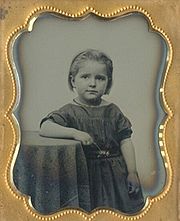
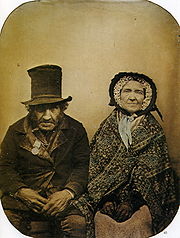
Collodion process
The collodion process is an early photographic process. It was introduced in the 1850s and by the end of that decade it had almost entirely replaced the first practical photographic process, the daguerreotype. During the 1880s the collodion process, in turn, was largely replaced by gelatin dry...
. In the United States, ambrotypes first came into use in the early 1850s. The wet plate collodion process was invented just a few years before that by Frederick Scott Archer
Frederick Scott Archer
Frederick Scott Archer invented the photographic collodion process which preceded the modern gelatin emulsion. He was born in Bishop's Stortford in the UK and is remembered mainly for this single achievement which greatly increased the accessibility of photography for the general public.tyler was...
, but ambrotypes used the plate image as a positive, instead of a negative. In 1854, James Ambrose Cutting
James Ambrose Cutting
James Ambrose Cutting was an American photographer and inventor, sometimes called the inventor of the Ambrotype photographic process.He grew up in poverty on a farm in Haverhill, NH...
of Boston took out several patents relating to the process and may be responsible for coining the term "ambrotype".
In the United Kingdom
United Kingdom
The United Kingdom of Great Britain and Northern IrelandIn the United Kingdom and Dependencies, other languages have been officially recognised as legitimate autochthonous languages under the European Charter for Regional or Minority Languages...
it was called collodion positive: one side of a very clean glass plate is covered with a thin layer of collodion
Collodion
Collodion is a flammable, syrupy solution of pyroxylin in ether and alcohol. There are two basic types; flexible and non-flexible. The flexible type is often used as a surgical dressing or to hold dressings in place. When painted on the skin, collodion dries to form a flexible cellulose film...
, then dipped in a silver nitrate
Silver nitrate
Silver nitrate is an inorganic compound with chemical formula . This compound is a versatile precursor to many other silver compounds, such as those used in photography. It is far less sensitive to light than the halides...
solution. The plate is exposed to the subject while still wet. (Exposure times vary from five to sixty seconds or more depending on the amount of available light.) The plate is then developed and fixed. The resulting negative, when viewed by reflected light against a black background, appears to be a positive image: the clear areas look black, and the exposed, opaque areas appear light. This effect is achieved by coating one side of the glass negative with black varnish
Varnish
Varnish is a transparent, hard, protective finish or film primarily used in wood finishing but also for other materials. Varnish is traditionally a combination of a drying oil, a resin, and a thinner or solvent. Varnish finishes are usually glossy but may be designed to produce satin or semi-gloss...
. Either the emulsion side or the blank side can be covered with the varnish: when the blank side is blackened, the thickness of the glass adds a sense of depth to the image. In either case, another plate of glass is put over the fragile emulsion side to protect it, and the whole is mounted in a metal frame and kept in a protective case. In some instances the protective glass was cemented directly to the emulsion, generally with a balsam resin
Burseraceae
Burseraceae is a moderate-sized family of 17-18 genera and about 540 species of flowering plants. The actual numbers differ according to the time period in which a given source is written describing this family. The Burseraceae is also known as the Torchwood family, the frankincense and myrrh...
. This protected the image well but tended to make it darker.
The ambrotype was much less expensive to produce than the daguerreotype
Daguerreotype
The daguerreotype was the first commercially successful photographic process. The image is a direct positive made in the camera on a silvered copper plate....
, and it lacked the daguerreotype's shiny metallic surface, which some found unappealing. By the late 1850s, the ambrotype was overtaking the daguerreotype in popularity; by the mid-1860s, the ambrotype itself was supplanted by the tintype
Tintype
Tintype, also melainotype and ferrotype, is a photograph made by creating a direct positive on a sheet of iron metal that is blackened by painting, lacquering or enamelling and is used as a support for a collodion photographic emulsion....
and other processes.
Ambrotypes were often hand-tinted. Untinted ambrotypes are grayish-white and have less contrast and brilliance than daguerreotypes.