


Cosmos: A Personal Voyage

Encyclopedia
Cosmos: A Personal Voyage is a thirteen-part television series written by Carl Sagan
, Ann Druyan
, and Steven Soter
, with Sagan as presenter. It was executive-produced by Adrian Malone, produced by David Kennard, Geoffrey Haines-Stiles and Gregory Andorfer, and directed by the producers, David Oyster, Richard Wells, Tom Weidlinger, and others. It covered a wide range of scientific subjects, including the origin of life and a perspective of our place in the universe.
The series was first broadcast by the Public Broadcasting Service
in 1980 and was the most widely watched series in the history of American public television until The Civil War
(1990). As of 2009, it was still the most widely watched PBS series in the world. It won an Emmy
and a Peabody Award
and has since been broadcast in more than 60 countries and seen by over 500 million people. A book
was also published to accompany the series.
affiliate KCET
on a roughly $6.3 million budget, with over $2 million additionally allocated to promotion. The show's format is based on previous BBC documentaries such as Kenneth Clark
's Civilisation, Jacob Bronowski
's The Ascent of Man
and David Attenborough
's Life on Earth. (The BBC—a co-producer of Cosmos—later screened the series, but episodes were cut to fit 50-minute slots.) However, unlike those series, which were shot entirely on film, Cosmos used videotape for interior scenes and special effects, with film being used for exteriors.
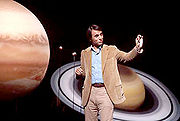 The series is notable for its groundbreaking use of special effects, which allowed Sagan to apparently walk through environments that were actually models rather than full-sized sets. The soundtrack included pieces of music provided by Greek composer Vangelis
such as Alpha, Pulstar, and Heaven and Hell Part 1
(the last movement serving as the signature theme music for the show, and is directly referenced by the title of episode 4). Throughout the 13 hours of the series, it used many tracks from several 1970s albums such as Albedo 0.39
, Spiral, Ignacio, Beaubourg
, and China
. The worldwide success of the documentary series also put Vangelis' music in the homes of many and brought it to the attention of a global audience (although the group had already been achieving a certain amount of commercial success with Jon Anderson
of Yes
).
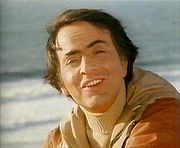 Turner Home Entertainment purchased Cosmos from series producer KCET in 1989. In making the move to commercial television, the hour-long episodes were edited to shorter lengths, and Sagan shot new epilogues for several episodes in which he discussed new discoveries (and alternate viewpoints) that had arisen since the original broadcast. Additionally, a 14th episode was added which consisted of an interview between Sagan and Ted Turner
, and this "new" version of the series was eventually released as a VHS box set. This same re-edited version was also released on 12" Laserdisc
, a popular consumer format at the time and precursor to the DVD. Two episodes were released per disc (one episode on each side). The laserdiscs were sold separately, not in a boxed set configuration like the VHS tapes.
Cosmos had long been unavailable after its initial release because of copyright issues with the included music, but was released in 2000 on worldwide
NTSC
DVD, which includes subtitles in seven languages, remastered 5.1 sound, as well as an alternate music and sound effects track. In 2005, The Science Channel
rebroadcast the series for its 25th anniversary with updated computer graphics
, film footage, digital sound and updated scientific knowledge that had occurred in the past 25 years. Despite being shown again on the Science Channel, the total amount of time for the original 13 episodes (780 minutes) was reduced 25% to 585 minutes (45 minutes per episode) in order to make room for commercials.
In 2009, Freemantle Media Enterprises released in the UK, a 5-disc DVD set of the original series plus with bonus science updates. The DVD set was digitally restored and remastered. Although a little grainy in places, it is without question, the best reproduction of the original series to date.
An Australia/New Zealand PAL DVD version (also region-free) has Encyclopedia Gallactica printed on the box and the DVD sleeve.
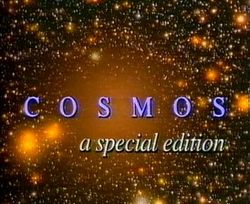 The 1986 special edition of Cosmos featured new computer animated sequences as well as new narration and filmed segments with Sagan (including content from Sagan's book Comet and discussion of his theory of nuclear winter
, none of which was used in subsequent television or home video releases). Premiering as one marathon program on the TBS network (and later broadcast in the United States, Japan, Germany, Australia, Singapore, and Argentina), the series is much shorter than the original, at four and a half hours, and was cut into six 45-minute episodes:
This version of Cosmos contains a mix of music used in the original series, with a unique composed specially by Vangelis
for this series. The score is often referred to as Comet, with "Comet 16" acting as the title and ending theme of each episode ("Comet 16" is the only one of the total 21 cues that has officially been released, though some of the new music appears in the 2000 remastered DVD release).
shortly after the series' airing, which included the signature theme "Heaven and Hell, Part 1" by Greek synthesist and composer Vangelis
(Catalog No. ABL 1–4003 and TMS-50061; both also released on cassette tape).
Side A
Side B
and, in 2002, reissued it on its Collectables label (RCA 07863 54003-2 USA; Collectables COL-CD-6293 USA). In 2002, a special two-disc "collector's edition" of music from the series was released to coincide with the DVD reissue, containing complete versions of many of the songs from series only available as snippets on previous releases.
Disc two
and will be produced by Sagan's widow Ann Druyan
and Seth MacFarlane
.
Carl Sagan
Carl Edward Sagan was an American astronomer, astrophysicist, cosmologist, author, science popularizer and science communicator in astronomy and natural sciences. He published more than 600 scientific papers and articles and was author, co-author or editor of more than 20 books...
, Ann Druyan
Ann Druyan
Ann Druyan is an American author and producer specializing in productions about cosmology and popular science. She made substantial contributions to the PBS documentary series, Cosmos, and was the wife of late scientist and educator, Carl Sagan.-Film career:Along with Carl Sagan and Steven Soter,...
, and Steven Soter
Steven Soter
Dr. Steven Soter, PhD, is an astrophysicist currently holding the positions of scientist-in-residence for New York University's Environmental Studies Program and of Research Associate for the Department of Astrophysics at the American Museum of Natural History...
, with Sagan as presenter. It was executive-produced by Adrian Malone, produced by David Kennard, Geoffrey Haines-Stiles and Gregory Andorfer, and directed by the producers, David Oyster, Richard Wells, Tom Weidlinger, and others. It covered a wide range of scientific subjects, including the origin of life and a perspective of our place in the universe.
The series was first broadcast by the Public Broadcasting Service
Public Broadcasting Service
The Public Broadcasting Service is an American non-profit public broadcasting television network with 354 member TV stations in the United States which hold collective ownership. Its headquarters is in Arlington, Virginia....
in 1980 and was the most widely watched series in the history of American public television until The Civil War
The Civil War (documentary)
The Civil War is a documentary film created by Ken Burns about the American Civil War. It was first broadcast on PBS on five consecutive nights from Sunday, September 23 to Thursday, September 27, 1990. Forty million viewers watched it during its initial broadcast, making it the most-watched...
(1990). As of 2009, it was still the most widely watched PBS series in the world. It won an Emmy
Emmy Award
An Emmy Award, often referred to simply as the Emmy, is a television production award, similar in nature to the Peabody Awards but more focused on entertainment, and is considered the television equivalent to the Academy Awards and the Grammy Awards .A majority of Emmys are presented in various...
and a Peabody Award
Peabody Award
The George Foster Peabody Awards recognize distinguished and meritorious public service by radio and television stations, networks, producing organizations and individuals. In 1939, the National Association of Broadcasters formed a committee to recognize outstanding achievement in radio broadcasting...
and has since been broadcast in more than 60 countries and seen by over 500 million people. A book
Cosmos (book)
Cosmos is a popular science book by astronomer and Pulitzer Prize-winning author Carl Sagan. Its 13 illustrated chapters, corresponding to the 13 episodes of the Cosmos TV series on which the book was based, explore the mutual development of science and civilization...
was also published to accompany the series.
Overview
Cosmos was produced in 1978 and 1979 by Los Angeles PBSPublic Broadcasting Service
The Public Broadcasting Service is an American non-profit public broadcasting television network with 354 member TV stations in the United States which hold collective ownership. Its headquarters is in Arlington, Virginia....
affiliate KCET
KCET
KCET, channel 28, is an independent, non-commercial public television station licensed to Los Angeles, California, USA. KCET's studio is located on West Sunset Boulevard in Hollywood, and its transmitter is atop Mount Wilson. Al Jerome is the current CEO and President, serving since 1996.KCET was...
on a roughly $6.3 million budget, with over $2 million additionally allocated to promotion. The show's format is based on previous BBC documentaries such as Kenneth Clark
Kenneth Clark
Kenneth McKenzie Clark, Baron Clark, OM, CH, KCB, FBA was a British author, museum director, broadcaster, and one of the best-known art historians of his generation...
's Civilisation, Jacob Bronowski
Jacob Bronowski
Jacob Bronowski was a Polish-Jewish British mathematician, biologist, historian of science, theatre author, poet and inventor...
's The Ascent of Man
The Ascent of Man
The Ascent of Man is a thirteen-part documentary television series produced by the BBC and Time-Life Films first transmitted in 1973, written and presented by Jacob Bronowski...
and David Attenborough
David Attenborough
Sir David Frederick Attenborough OM, CH, CVO, CBE, FRS, FZS, FSA is a British broadcaster and naturalist. His career as the face and voice of natural history programmes has endured for more than 50 years...
's Life on Earth. (The BBC—a co-producer of Cosmos—later screened the series, but episodes were cut to fit 50-minute slots.) However, unlike those series, which were shot entirely on film, Cosmos used videotape for interior scenes and special effects, with film being used for exteriors.
Vangelis
Evangelos Odysseas Papathanassiou is a Greek composer of electronic, progressive, ambient, jazz, pop rock and orchestral music, under the artist name Vangelis...
such as Alpha, Pulstar, and Heaven and Hell Part 1
Heaven and Hell (Vangelis album)
Heaven and Hell, released in 1975, is the fifth solo album by Greek electronic composer and artist Vangelis. It got worldwide recognition through the use of "Movement 3" as the theme for the television documentary series Cosmos....
(the last movement serving as the signature theme music for the show, and is directly referenced by the title of episode 4). Throughout the 13 hours of the series, it used many tracks from several 1970s albums such as Albedo 0.39
Albedo 0.39
Albedo 0.39 is an album by the artist Vangelis, released in 1976. It is a concept album around space and space physics.Albedo 0.39 was the second album produced by Vangelis in Nemo Studios, London, which was his creative base until the late 1980s...
, Spiral, Ignacio, Beaubourg
Beaubourg (album)
Beaubourg is a 1978 album by the Greek artist Vangelis. It is entirely synthesizer-based and highly experimental; together with Hypothesis it is often considered to be one of Vangelis' least accessible works...
, and China
China (album)
China is a 1979 album by the Greek artist Vangelis. Although he had never been to China, he employed Chinese instruments and compositional styles on this concept album.- Track listing :# "Chung Kuo" – 5:31# "The Long March" – 2:01...
. The worldwide success of the documentary series also put Vangelis' music in the homes of many and brought it to the attention of a global audience (although the group had already been achieving a certain amount of commercial success with Jon Anderson
Jon Anderson
Jon Anderson is an English singer-songwriter and musician best known as the former lead vocalist in the progressive rock band Yes...
of Yes
Yes (band)
Yes are an English rock band who achieved worldwide success with their progressive, art, and symphonic style of rock music. Regarded as one of the pioneers of the progressive genre, Yes are known for their lengthy songs, mystical lyrics, elaborate album art, and live stage sets...
).
Ted Turner
Robert Edward "Ted" Turner III is an American media mogul and philanthropist. As a businessman, he is known as founder of the cable news network CNN, the first dedicated 24-hour cable news channel. In addition, he founded WTBS, which pioneered the superstation concept in cable television...
, and this "new" version of the series was eventually released as a VHS box set. This same re-edited version was also released on 12" Laserdisc
Laserdisc
LaserDisc was a home video format and the first commercial optical disc storage medium. Initially licensed, sold, and marketed as MCA DiscoVision in North America in 1978, the technology was previously referred to interally as Optical Videodisc System, Reflective Optical Videodisc, Laser Optical...
, a popular consumer format at the time and precursor to the DVD. Two episodes were released per disc (one episode on each side). The laserdiscs were sold separately, not in a boxed set configuration like the VHS tapes.
Cosmos had long been unavailable after its initial release because of copyright issues with the included music, but was released in 2000 on worldwide
DVD region code
DVD region codes are a digital-rights management technique designed to allow film distributors to control aspects of a release, including content, release date, and price, according to the region...
NTSC
NTSC
NTSC, named for the National Television System Committee, is the analog television system that is used in most of North America, most of South America , Burma, South Korea, Taiwan, Japan, the Philippines, and some Pacific island nations and territories .Most countries using the NTSC standard, as...
DVD, which includes subtitles in seven languages, remastered 5.1 sound, as well as an alternate music and sound effects track. In 2005, The Science Channel
The Science Channel
Science is a United States cable, satellite and IPTV Television Network produced by Discovery Communications. Science features programming in the fields of space, technology, prehistory and animals.-History:...
rebroadcast the series for its 25th anniversary with updated computer graphics
Computer graphics
Computer graphics are graphics created using computers and, more generally, the representation and manipulation of image data by a computer with help from specialized software and hardware....
, film footage, digital sound and updated scientific knowledge that had occurred in the past 25 years. Despite being shown again on the Science Channel, the total amount of time for the original 13 episodes (780 minutes) was reduced 25% to 585 minutes (45 minutes per episode) in order to make room for commercials.
In 2009, Freemantle Media Enterprises released in the UK, a 5-disc DVD set of the original series plus with bonus science updates. The DVD set was digitally restored and remastered. Although a little grainy in places, it is without question, the best reproduction of the original series to date.
Episodes
| No. | Title |
|---|---|
Episode name discrepancies
There are differences in episode names and spellings for episodes 6, 8, and 12, depending on the type of media (7 NTSC DVDs, Fully International version – DVD region zero, ISBN 0-9703511-1-9).| Episode # | Opening sequence | DVD menu | Printed on DVD | Printed on box | Cosmos books |
|---|---|---|---|---|---|
| Ep. 6 | Travellers' Tales | Travelers' Tales | Travellers' Tales | Travellers' Tales | Travelers' Tales |
| Ep. 8 | Journeys in Space and Time | Travels in Space and Time | Travels in Space and Time | Travels in Space and Time | Travels in Space and Time |
| Ep. 12 | Encyclopaedia Galactica | Encyclopaedia Galactica | Encyclopedia Galactica | Encyclopedia Galactica | Encyclopaedia Galactica |
An Australia/New Zealand PAL DVD version (also region-free) has Encyclopedia Gallactica printed on the box and the DVD sleeve.
Special edition
Nuclear winter
Nuclear winter is a predicted climatic effect of nuclear war. It has been theorized that severely cold weather and reduced sunlight for a period of months or even years could be caused by detonating large numbers of nuclear weapons, especially over flammable targets such as cities, where large...
, none of which was used in subsequent television or home video releases). Premiering as one marathon program on the TBS network (and later broadcast in the United States, Japan, Germany, Australia, Singapore, and Argentina), the series is much shorter than the original, at four and a half hours, and was cut into six 45-minute episodes:
- Other Worlds, Part 1
- Other Worlds, Part 2
- Children of the Stars, Part 1
- Children of the Stars, Part 2
- Message from the Sky, Part 1
- Message from the Sky, Part 2
This version of Cosmos contains a mix of music used in the original series, with a unique composed specially by Vangelis
Vangelis
Evangelos Odysseas Papathanassiou is a Greek composer of electronic, progressive, ambient, jazz, pop rock and orchestral music, under the artist name Vangelis...
for this series. The score is often referred to as Comet, with "Comet 16" acting as the title and ending theme of each episode ("Comet 16" is the only one of the total 21 cues that has officially been released, though some of the new music appears in the 2000 remastered DVD release).
LP and Cassette
In 1981, a soundtrack LP was released by RCA RecordsRCA Records
RCA Records is one of the flagship labels of Sony Music Entertainment. The RCA initials stand for Radio Corporation of America , which was the parent corporation from 1929 to 1985 and a partner from 1985 to 1986.RCA's Canadian unit is Sony's oldest label...
shortly after the series' airing, which included the signature theme "Heaven and Hell, Part 1" by Greek synthesist and composer Vangelis
Vangelis
Evangelos Odysseas Papathanassiou is a Greek composer of electronic, progressive, ambient, jazz, pop rock and orchestral music, under the artist name Vangelis...
(Catalog No. ABL 1–4003 and TMS-50061; both also released on cassette tape).
Side A
- Space / Time Continuum
- "Heaven & Hell, Part I" - VangelisVangelisEvangelos Odysseas Papathanassiou is a Greek composer of electronic, progressive, ambient, jazz, pop rock and orchestral music, under the artist name Vangelis...
- "The Year 1905Symphony No. 11 (Shostakovich)The Symphony No. 11 in G minor by Dmitri Shostakovich was written in 1957 and premiered by the USSR Symphony Orchestra under Natan Rakhlin on 30 October 1957...
" - Dmitri ShostakovichDmitri ShostakovichDmitri Dmitriyevich Shostakovich was a Soviet Russian composer and one of the most celebrated composers of the 20th century....
(Performed by Helsinki Philharmonic) - "Alpha" - Vangelis
- "Heaven & Hell, Part I" - Vangelis
- Life
- "(Depicting) Cranes In Their Nest" - Goro YamaguchiGoro YamaguchiGorō Yamaguchi February 26, 1933- January 3, 1999, a Japanese shakuhachi player, was known for his musicality, phrasing, impeccable technique in solo and ensemble performances. He headed the Chikumeisha shakuhachi guild and became a world-famous Japanese performer and teacher...
- "Pachelbel's Canon" - Johann PachelbelJohann PachelbelJohann Pachelbel was a German Baroque composer, organist and teacher, who brought the south German organ tradition to its peak. He composed a large body of sacred and secular music, and his contributions to the development of the chorale prelude and fugue have earned him a place among the most...
(Performed by James GalwayJames Galway- External links : IMGArtists.com 15 September 2008. AllAboutJazz.com 5 August 2008.*...
) - "The Four Seasons: SpringThe Four Seasons (Vivaldi)The Four Seasons is a set of four violin concertos by Antonio Vivaldi. Composed in 1723, The Four Seasons is Vivaldi's best-known work, and is among the most popular pieces of Baroque music. The texture of each concerto is varied, each resembling its respective season...
" - Antonio VivaldiAntonio VivaldiAntonio Lucio Vivaldi , nicknamed because of his red hair, was an Italian Baroque composer, priest, and virtuoso violinist, born in Venice. Vivaldi is recognized as one of the greatest Baroque composers, and his influence during his lifetime was widespread over Europe... - "The Sea Named 'Solaris' (BWV 639)OrgelbüchleinThe Orgelbüchlein was written by Johann Sebastian Bach during the period of 1708–1714, while he was court organist at the ducal court in Weimar...
" - Johann Sebastian BachJohann Sebastian BachJohann Sebastian Bach was a German composer, organist, harpsichordist, violist, and violinist whose sacred and secular works for choir, orchestra, and solo instruments drew together the strands of the Baroque period and brought it to its ultimate maturity...
(Performed by Isao TomitaIsao Tomita, often known simply as Tomita, is a Japanese music composer, regarded as one of the pioneers of electronic music and space music, and as one of the most famous producers of analog synthesizer arrangements...
)
- "(Depicting) Cranes In Their Nest" - Goro Yamaguchi
- The Harmony of Nature
- "Partita For Violin Solo No. 3 In E, BWV 1006" - Johann Sebastian Bach (Performed by Arthur GrumiauxArthur GrumiauxArthur Grumiaux was a Belgian violinist who was also proficient in piano.-Youth:Grumiaux was born in Villers-Perwin, Belgium to a working-class family, and it was his grandfather who urged him to begin music studies at the age of only 4...
)
- "Partita For Violin Solo No. 3 In E, BWV 1006" - Johann Sebastian Bach (Performed by Arthur Grumiaux
Side B
- Exploration
- "'Vishnu Symphony No. 19, Op. 217" - Alan HovhanessAlan HovhanessAlan Hovhaness was an Armenian-American composer.His music is accessible to the lay listener and often evokes a mood of mystery or contemplation...
- "Legacy" - Larry FastLarry FastLawrence Roger 'Larry' Fast is a synthesizer expert and composer. He is best known for Synergy, his 1975–1987 series of synthesizer music albums, and for his contribution to a number of popular music acts, including Peter Gabriel, Foreigner, and Hall and Oates.- Biography :Fast grew up in...
- "Russian Easter Festival OvertureRussian Easter Festival OvertureRussian Easter Festival Overture, Op. 36 is a concert overture written by the Russian composer Nikolai Rimsky-Korsakov between August 1887 and April 1888, and dedicated to the memories of Modest Mussorgsky and Alexander Borodin, two members of the legendary "Mighty Handful." It is subtitled...
" - Nikolai Rimsky-Korsakov (Performed by Seattle SymphonySeattle SymphonyThe Seattle Symphony is an American orchestra based in Seattle, Washington. Since 1998, the orchestra is resident at Benaroya Hall. The orchestra's season runs from September through July, and serves as the pit orchestra for most productions of the Seattle Opera in addition to its own concerts...
) - "Inside The Heart Of The Universe" - Toru TakemitsuToru Takemitsuwas a Japanese composer and writer on aesthetics and music theory. Largely self-taught, Takemitsu possessed consummate skill in the subtle manipulation of instrumental and orchestral timbre...
- "'Vishnu Symphony No. 19, Op. 217" - Alan Hovhaness
- Cataclism
- "Fly...Night Bird" - Roy BuchananRoy BuchananRoy Buchanan was an American guitarist and blues musician. A pioneer of the Telecaster sound, Buchanan was a sideman and solo artist, with two gold albums early in his career, and two later solo albums that made it on to the Billboard chart. Despite never having achieved stardom, he is still...
- "Beaubourg, Part 2" - Vangelis
- "The Rite of SpringThe Rite of SpringThe Rite of Spring, original French title Le sacre du printemps , is a ballet with music by Igor Stravinsky; choreography by Vaslav Nijinsky; and concept, set design and costumes by Nicholas Roerich...
" - Igor StravinskyIgor StravinskyIgor Fyodorovich Stravinsky ; 6 April 1971) was a Russian, later naturalized French, and then naturalized American composer, pianist, and conductor....
(Performed by Swedish Radio Symphony OrchestraSwedish Radio Symphony OrchestraSwedish Radio Symphony Orchestra is a radio orchestra based in Stockholm, Sweden, and affiliated with Sveriges Radio . The orchestra broadcasts concerts on the Swedish Radio-P2 network....
)
- "Fly...Night Bird" - Roy Buchanan
- Affirmation
- "Entends-Tu Les Chiens Aboyer?" - Vangelis
- "Izel ye Delyo Haydutin" - Traditional (Performed by Valya BalkanskaValya BalkanskaValya Mladenova Balkanska is a Bulgarian folk music singer from the Rhodope Mountains known locally for her wide repertoire of Balkan folksong, but in the West mainly for singing the song "Izlel e Delyu Haydutin", part of the Voyager Golden Record selection of music included in the two Voyager...
) - "Heaven & Hell, Part I" - Vangelis
CD
In 1994, RCA Records reissued the original soundtrack compilation on compact discCompact Disc
The Compact Disc is an optical disc used to store digital data. It was originally developed to store and playback sound recordings exclusively, but later expanded to encompass data storage , write-once audio and data storage , rewritable media , Video Compact Discs , Super Video Compact Discs ,...
and, in 2002, reissued it on its Collectables label (RCA 07863 54003-2 USA; Collectables COL-CD-6293 USA). In 2002, a special two-disc "collector's edition" of music from the series was released to coincide with the DVD reissue, containing complete versions of many of the songs from series only available as snippets on previous releases.
Collector's Edition
Disc one- "Heaven & Hell, Part I" - VangelisVangelisEvangelos Odysseas Papathanassiou is a Greek composer of electronic, progressive, ambient, jazz, pop rock and orchestral music, under the artist name Vangelis...
(4:09) - "The Year 1905Symphony No. 11 (Shostakovich)The Symphony No. 11 in G minor by Dmitri Shostakovich was written in 1957 and premiered by the USSR Symphony Orchestra under Natan Rakhlin on 30 October 1957...
" - Dmitri ShostakovichDmitri ShostakovichDmitri Dmitriyevich Shostakovich was a Soviet Russian composer and one of the most celebrated composers of the 20th century....
(Performed by Helsinki Philharmonic) (5:38) - "Alpha" - Vangelis (5:42)
- "(Depicting) Cranes In Their Nest" - Goro YamaguchiGoro YamaguchiGorō Yamaguchi February 26, 1933- January 3, 1999, a Japanese shakuhachi player, was known for his musicality, phrasing, impeccable technique in solo and ensemble performances. He headed the Chikumeisha shakuhachi guild and became a world-famous Japanese performer and teacher...
(1:00) - "Clarinet Concerto in A Major, K. 622Clarinet Concerto (Mozart)Mozart's Clarinet concerto in A major, K. 622 was written in 1791 for the clarinetist Anton Stadler.It consists of the usual three movements, in a fast–slow–fast form:# Allegro# Adagio# Rondo: Allegro...
" - Wolfgang Amadeus MozartWolfgang Amadeus MozartWolfgang Amadeus Mozart , baptismal name Johannes Chrysostomus Wolfgangus Theophilus Mozart , was a prolific and influential composer of the Classical era. He composed over 600 works, many acknowledged as pinnacles of symphonic, concertante, chamber, piano, operatic, and choral music...
(Performed by Mostly Mozart Orchestra) (7:53) - "Pachelbel's Canon" - Johann PachelbelJohann PachelbelJohann Pachelbel was a German Baroque composer, organist and teacher, who brought the south German organ tradition to its peak. He composed a large body of sacred and secular music, and his contributions to the development of the chorale prelude and fugue have earned him a place among the most...
(Performed by James GalwayJames Galway- External links : IMGArtists.com 15 September 2008. AllAboutJazz.com 5 August 2008.*...
) (5:08) - "Metamorphosis" - Jeffrey Boydstun (3:34)
- "The Sea Named 'Solaris' (BWV 639)OrgelbüchleinThe Orgelbüchlein was written by Johann Sebastian Bach during the period of 1708–1714, while he was court organist at the ducal court in Weimar...
" - Johann Sebastian BachJohann Sebastian BachJohann Sebastian Bach was a German composer, organist, harpsichordist, violist, and violinist whose sacred and secular works for choir, orchestra, and solo instruments drew together the strands of the Baroque period and brought it to its ultimate maturity...
(Performed by Isao TomitaIsao Tomita, often known simply as Tomita, is a Japanese music composer, regarded as one of the pioneers of electronic music and space music, and as one of the most famous producers of analog synthesizer arrangements...
) (6:04) - "Partita For Violin Solo No. 3 In E, BWV 1006" - Johann Sebastian Bach (Performed by Arthur GrumiauxArthur GrumiauxArthur Grumiaux was a Belgian violinist who was also proficient in piano.-Youth:Grumiaux was born in Villers-Perwin, Belgium to a working-class family, and it was his grandfather who urged him to begin music studies at the age of only 4...
) (2:53) - "The Four Seasons: SpringThe Four Seasons (Vivaldi)The Four Seasons is a set of four violin concertos by Antonio Vivaldi. Composed in 1723, The Four Seasons is Vivaldi's best-known work, and is among the most popular pieces of Baroque music. The texture of each concerto is varied, each resembling its respective season...
" - Antonio VivaldiAntonio VivaldiAntonio Lucio Vivaldi , nicknamed because of his red hair, was an Italian Baroque composer, priest, and virtuoso violinist, born in Venice. Vivaldi is recognized as one of the greatest Baroque composers, and his influence during his lifetime was widespread over Europe...
(3:21) - "Sonata D-Dur Für Trompete, Oboe, Und Basso Continuo" - Gottfried FingerGottfried FingerGottfried Finger , also Godfrey Finger, was a Moravian Baroque composer. Many of his compositions were for the viol; he also wrote operas...
(Performed by Leipziger Bach-Collegium) (1:21) - "Concerto For Mandolin & Strings In C Major" - Antonio Vivaldi (2:34)
- "The Tale of Tsar SaltanThe Tale of Tsar Saltan (Rimsky-Korsakov)The Tale of Tsar Saltan is an opera in four acts with a prologue, seven scenes, by Nikolai Rimsky-Korsakov. The libretto was written by Vladimir Belsky, and is based on the poem of the same name by Aleksandr Pushkin...
" - Nikolai Rimsky-KorsakovNikolai Rimsky-KorsakovNikolai Andreyevich Rimsky-Korsakov was a Russian composer, and a member of the group of composers known as The Five.The Five, also known as The Mighty Handful or The Mighty Coterie, refers to a circle of composers who met in Saint Petersburg, Russia, in the years 1856–1870: Mily Balakirev , César...
(6:35) - "Legacy" - Larry FastLarry FastLawrence Roger 'Larry' Fast is a synthesizer expert and composer. He is best known for Synergy, his 1975–1987 series of synthesizer music albums, and for his contribution to a number of popular music acts, including Peter Gabriel, Foreigner, and Hall and Oates.- Biography :Fast grew up in...
(5:47) - "Russian Easter Festival OvertureRussian Easter Festival OvertureRussian Easter Festival Overture, Op. 36 is a concert overture written by the Russian composer Nikolai Rimsky-Korsakov between August 1887 and April 1888, and dedicated to the memories of Modest Mussorgsky and Alexander Borodin, two members of the legendary "Mighty Handful." It is subtitled...
" - Nikolai Rimsky-Korsakov (Performed by Seattle SymphonySeattle SymphonyThe Seattle Symphony is an American orchestra based in Seattle, Washington. Since 1998, the orchestra is resident at Benaroya Hall. The orchestra's season runs from September through July, and serves as the pit orchestra for most productions of the Seattle Opera in addition to its own concerts...
) (7:44)
Disc two
- "Pulstar" - Vangelis (5:13)
- "'Vishnu Symphony No. 19, Op. 217" - Alan HovhanessAlan HovhanessAlan Hovhaness was an Armenian-American composer.His music is accessible to the lay listener and often evokes a mood of mystery or contemplation...
(4:02) - "Melancholy Blues" - Louis Armstrong And His Hot SevenLouis Armstrong and his Hot SevenLouis Armstrong and his Hot Seven was a jazz studio group organized to make a series of recordings for Okeh Records in Chicago, Illinois in May 1927. Some of the personnel also recorded with Louis Armstrong and his Hot Five, including Johnny Dodds , Lil Armstrong , Johnny St. Cyr...
(2:59) - "AquariusAquarius/Let the Sunshine In"Aquarius/Let the Sunshine In" is a medley of two songs written for the 1967 musical Hair by James Rado & Gerome Ragni , and Galt MacDermot , released as a single by The 5th Dimension. The song peaked at number one for six weeks on the U.S...
- Hair (Original Off-Broadway Cast Recording)Hair (Original Off-Broadway Cast Recording)Hair is the cast recording of the original, Off-Broadway cast of the musical Hair. It was released in 1967 on the RCA label. Hair premiered Off-Broadway at the Public Theatre on October 17, 1967, and the cast album was recorded two weeks later...
(3:56) - "Beaubourg, Part 2" - Vangelis (3:14)
- "The Planets: Mars" - Gustav HolstGustav HolstGustav Theodore Holst was an English composer. He is most famous for his orchestral suite The Planets....
(Performed by Saint Louis Symphony OrchestraSaint Louis Symphony OrchestraThe Saint Louis Symphony Orchestra is an American symphony orchestra based in St. Louis, Missouri. Founded in 1880 by Joseph Otten as the St. Louis Choral Society, the SLSO is the second-oldest symphony orchestra in the United States as it is preceded by the New York Philharmonic.-History:The St...
) (7:09) - "Alien Images 1" - Jeff Boydstun (3:24)
- "Fly...Night Bird" - Roy BuchananRoy BuchananRoy Buchanan was an American guitarist and blues musician. A pioneer of the Telecaster sound, Buchanan was a sideman and solo artist, with two gold albums early in his career, and two later solo albums that made it on to the Billboard chart. Despite never having achieved stardom, he is still...
(7:43) - "Entends-Tu Les Chiens Aboyer?" - Vangelis (2:50)
- "The Rite of SpringThe Rite of SpringThe Rite of Spring, original French title Le sacre du printemps , is a ballet with music by Igor Stravinsky; choreography by Vaslav Nijinsky; and concept, set design and costumes by Nicholas Roerich...
" - Igor StravinskyIgor StravinskyIgor Fyodorovich Stravinsky ; 6 April 1971) was a Russian, later naturalized French, and then naturalized American composer, pianist, and conductor....
(Performed by Swedish Radio Symphony OrchestraSwedish Radio Symphony OrchestraSwedish Radio Symphony Orchestra is a radio orchestra based in Stockholm, Sweden, and affiliated with Sveriges Radio . The orchestra broadcasts concerts on the Swedish Radio-P2 network....
) (10:31) - "Prayer of St. Gregory" - Alan Hovhaness (Performed by Seattle SymphonySeattle SymphonyThe Seattle Symphony is an American orchestra based in Seattle, Washington. Since 1998, the orchestra is resident at Benaroya Hall. The orchestra's season runs from September through July, and serves as the pit orchestra for most productions of the Seattle Opera in addition to its own concerts...
) (4:45) - "Izel ye Delyo Haydutin" - Traditional (Performed by Valya BalkanskaValya BalkanskaValya Mladenova Balkanska is a Bulgarian folk music singer from the Rhodope Mountains known locally for her wide repertoire of Balkan folksong, but in the West mainly for singing the song "Izlel e Delyu Haydutin", part of the Voyager Golden Record selection of music included in the two Voyager...
) (5:01) - "Comet 16" - Vangelis (3:48) (Only the special edition of Cosmos)
Singles
The main theme, titled Heaven and Hell, Part 1, but edited from Heaven and Hell Part 1 3rd Movement, was released in the UK as an edited 7" single by BBC Records (Cat No: BBC1). The 7" single did not have the quiet keyboard intro to be found on the full Vangelis LP version originally released in 1975. The B-side of the 7" single was an edited version of Alpha, taken from the Vangelis LP Albedo 0.39.- 1981 Heaven and Hell / Alpha RCA 71 UK
- 1981 Heaven and Hell / Alpha BBC 1
- 1981 Theme from the TV-series COSMOS / Alpha PB 5356 Holland
- 1981 Titelmelodie aus der TV-Serie "Unser Kosmos" / Alpha PB 5356 West-Germany
Sequel
On August 5, 2011, plans were announced for a sequel to the series, bringing up-to-date special effects and scientific discoveries to the themes and messages of the original series. The new series, slated to air on Fox in 2013, is to be hosted by astrophysicist Neil deGrasse TysonNeil deGrasse Tyson
Neil deGrasse Tyson is an American astrophysicist, a science communicator, the Frederick P. Rose Director of the Hayden Planetarium at the Rose Center for Earth and Space, and a Research Associate in the Department of Astrophysics at the American Museum of Natural History...
and will be produced by Sagan's widow Ann Druyan
Ann Druyan
Ann Druyan is an American author and producer specializing in productions about cosmology and popular science. She made substantial contributions to the PBS documentary series, Cosmos, and was the wife of late scientist and educator, Carl Sagan.-Film career:Along with Carl Sagan and Steven Soter,...
and Seth MacFarlane
Seth MacFarlane
Seth Woodbury MacFarlane is an American animator, writer, comedian, producer, actor, singer, voice actor, and director best known for creating the animated sitcoms Family Guy, American Dad! and The Cleveland Show, for which he also voices many of the shows' various characters.A native of Kent,...
.
External links
- The music of Cosmos: a look at the music of Vangelis Papathanassiou
- A complete list of the Cosmos soundtrack music, based on the original cue sheets – some episodes available on Google VideoGoogle VideoGoogle Videos is a video search engine, and formerly a free video sharing website, from Google Inc. Before removing user-uploaded content, the service allowed selected videos to be remotely embedded on other websites and provided the necessary HTML code alongside the media, similar to YouTube...
- First seven episodes of Cosmos on adnstream.com
- Cosmos on HuluHuluHulu is a website and over-the-top subscription service offering ad-supported on-demand streaming video of TV shows, movies, webisodes and other new media, trailers, clips, and behind-the-scenes footage from NBC, Fox, ABC, and Obstacle on October 20th 2011 Nickelodeon and CBS and many other...
- Cosmos on AVISOM, including episode 14
- Cosmos DVD review on VideoVista