

Coke Zero 400

Encyclopedia
The Coke Zero 400 powered by Coca-Cola at Daytona is a 160 lap, 400 miles (643.7 km) NASCAR
Sprint Cup Series stock car race
held annually, beginning in 1959, at Daytona International Speedway
in Daytona Beach, Florida
; the second major stock car event held at Daytona on the Sprint Cup circuit. Since 1988, the race has been held on the first Saturday of July closest to the United State's Independence Day
and in 1998 became the first restrictor plate
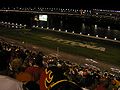
/Daytona race to be held at night.
A ten year deal, that started in 2008, between Atlanta-based Coca-Cola
and International Speedway Corporation
agreed to make Coke the official soft drink, official sparkling beverage and official water for ten of ISC's operated motorsports facilities and the Daytona 500
. The company replaced Pepsi-Cola, bringing a 19 year race sponsorship to an end, to showcase Coke Zero as the race's title brand through 2018.
The annual event is recently known for its close finishes, posting a (.154 ds) margin of victory in its last 21 races including the T-4th closest margin of victory in Sprint Cup history at (.005 ms); high speed high-density crashes under the lights, and a broad display of fireworks during post-race celebrations.
and George Amick
during the inaugural USAC Championship
(Indy Car) weekend events at Daytona International Speedway in April of 1959
, speedway officials announced that extremely high speeds would prompt them to conclude any scheduled events at the track, including a 300 mile race scheduled on July 4. William France Sr.
, the Daytona superspeedway owner at the time, announced plans to hold a 250 mile stock car race instead that would take 100 laps scheduled for the same day.
The race came to be named the Firecracker 250, owing to the fact the race would be held on Independence Day. William France Sr. announced on July 1 that the winner of the race would receive the Marshall Teague Memorial trophy, a trophy honoring and commemorating the life of Teague who died in February. The trophy was presented by Teague's daughter and widow.
The inaugural race was held on July 4, 1959, at about midday to limit the possibility of afternoon interference from thunderstorms known to Florida, and to exploit the potential for competitors hooking up with relatives and friends for an afternoon of fun on the nearby beach. Before the race preliminary activities took place including a Miss Dixie pageant, where twenty aspiring pageant winning hopefuls marched to showcase their bathing suits. With 12,900 in attendance the race ran its scheduled 250 miles with no caution flags, and with a 57sec lead over runner-up Joe Weatherly
, Daytona Beach native Fireball Roberts
won in dominate fashion leading 84 of 100 laps. For the next three years a couple of Nascar's top drivers would go on to win the Firecracker 250, including Jack Smith, David Pearson and a repeat victory in 1962 for Fireball Roberts.
Expansion was needed, in just three years from the race's inaugural event attendance had grown by more than ten thousand as tourists flocked to the beaches for the holidays; so in 1963 the race was expanded from 100 laps to 160 laps, for a distance of 400 miles, and subsequently became known as the Firecracker 400. In the same year Roberts drove his '63 Ford to victory, becoming the first driver to win back-to-back events by barely beating Fred Lorenzen
. Unfortunately Roberts was unable to go for three straight wins due to his death on July 2, 1964.
Richard Petty
was the man to beat during the sixth annual 400 mile July race, but on lap 103 engine problems cost him a chance at victory. Over the course of the final 56 laps Bobby Isaac
and rookie teammate A.J. Foyt swapped the lead fifteen times. Coming out of the fourth turn Foyt was able to barely edge out Isaac to the stripe; giving Foyt his first career NASCAR victory in only his tenth start. One year later Foyt got his second career win, becoming the second driver to win back-to-back Firecracker races.
Foyt didn't even attempt to defend the title of reigning race winner in 1966. Instead it was the dark horse 1965 Rookie of the Year driver Sam McQuagg
winning the race. McQuagg collected his first and only NASCAR victory driving a 66' Dodge Charger
while utilizing a new racing mechanism: the rear 'spoiler'. The air cutting spoiler allowed McQuagg to shatter Foyt's 151.451 mph race average set two years prior. Only two cars finished on the lead lap and the margin of victory to second place driver Darel Dieringer
was sixty-six seconds.
In late March 1969 William France Sr.
invited all surviving American Congressional Medal of Honor
recipients to attend the July 4 race dubbed the Medal of Honor Firecracker 400. Chairman of the House Armed Services Committee would arrange for the heroes and their families to be flown in via military aircraft. 100 members from 31 states would attend the race with Thomas J. Kelly the president of The Medal of Honor Society as the grand marshal
. With success France Sr. invited them on two more occasions in 1971 and 1973, won by Bobby Isaac
and David Pearson respectively.
In 1974 the maneuver used by David Pearson to win his third straight Firecracker race would be talked about well after he crossed the stripe. After collecting the white flag Pearson slowed his Wood Brothers
73' Mercury
to allow Richard Petty
to jump out to a seven car lead. Following the race Pearson was quoted saying "I thought Petty might be able to slingshot and draft past me on that last lap and that's why I didn't want to be leading..." Using the draft Pearson was able to close on Petty into the final turn and eventually passed him coming to the tri-oval for the win. Eight seconds behind the Pearson-Petty duel, Buddy Baker
and Cale Yarborough
seemed to have crossed the finish line at the same time. After two hours of deliberation officials announced a dead heat
for third place, the only tie recorded in NASCAR history. During the race nine different drivers exchanged the lead 49 times, a race record that stood until it was broken with 57 between 25 different drivers in 2011.
became the title sponsor. In 1989, the "Firecracker" name was dropped, and the race was known simply as the Pepsi 400 through 2007. From 1998-2002, the race was often subtitled
the Pepsi 400 at Daytona to avoid confusion with another race titled the Pepsi 400, held at Michigan
during that period.
From 1959 to 1987, the race was always scheduled for July 4, regardless of the day of the week. Beginning in 1988, the race was moved to the first Saturday of July (that date nearest July 4). The 2009 race was run on July 4, marking the first time since 1992 that the race was run on July 4.
On July 4, 1987, in the wake of Bobby Allison
's massive crash at Talladega
, the cars were fitted with 390 CFM carburetors. The change helped slow the cars down several mph. On the final lap, Ken Schrader
flipped upside-down in the tri-oval as the field crossed the finish line. It would be the final race at Daytona without restrictor plate
s.
For most of its history, the race normally started in the morning (10:00 a.m. or 11:00 a.m. eastern) to avoid hot summer temperatures and the frequent mid-afternoon thunderstorms in Florida
. During live ESPN
telecasts, the term "Breakfast at Daytona" was used, a gesture to NBC's
popular
"Breakfast at Wimbledon", taking place the same weekend.
In July 1997, Daytona International Speedway announced a massive lighting project to be done by MUSCO lighting, the same company who installed lights at Charlotte
. Plans called for the 1998 Pepsi 400 to be held under the lights in primetime. At the time, it was the longest track with a night race, and the first restrictor plate race held at night.
On July 4, 1998, however, the race had to be postponed. Wildfires in Florida consumed the surrounding areas, and the track was converted into a firefighters' staging area. Track officials rescheduled the race for October that year.
, U.S. Presidents have been in attendance on two notable occasions.
On Wednesday July 4, 1984, President Ronald Reagan
became the first sitting U.S. President
to attend a NASCAR race. The President gave the command to start the race ("Gentlemen, start your engines") by phone from aboard Air Force One
. Landing at Daytona, the President proceeded to the track, and viewed the race with Bill France Jr.. During his time at the race, Reagan was interviewed by NASCAR driver Ned Jarrett
, who in 1978 had begun a career as a radio race broadcaster. The 1984 Firecracker 400 is also legendary since it was the race at which Richard Petty
achieved his unparalleled 200th (and final) win. Petty and President Reagan were interviewed together following the race, and the President joined Richard Petty and his family in Victory Lane.
On July 4, 1992, President George H. W. Bush
attended the race, which served as a Daytona farewell tribute to Richard Petty
during his "Fan Appreciation Tour." Bush, on the 1992 campaign trail
, participated in pre-race festivities, gave the starting command, and rode around the track in the pace car during the pace laps. Petty qualified a strong second, and led the first 5 laps of the race and quickly fell back to the end of the field. He succumbed to heat exhaustion, however, and dropped out near the halfway point.
On July 1, 2000, then-Texas governor and future president George W. Bush
attended the race while on the campaign trail
. He gave the command to start engines.
, Sam McQuagg
, Greg Sacks
, Jimmy Spencer
, John Andretti
, Greg Biffle
, and David Ragan
. McQuagg and Sacks, in fact, never won another race in their respective careers.
The 400 has also marked the first of multiple points-paying victories at Daytona for a total of seven drivers, including Jeff Gordon
(1995) and Dale Earnhardt
(after 24 previous attempts from 1978–1990). David Pearson won the 400 four times prior to finally winning the Daytona 500
in 1976.
Jeff Burton
's 2000 race victory marks his only career restrictor plate win in 67 starts. Notably, Tony Stewart
has won the 400 three times, but has never won the Daytona 500 (his best finish was 2nd in 2004).
have also won the Coke Zero 400 at some point in their career. In addition, every single multiple-time winner of the Daytona 500
has won the Coke Zero 400 at least once. Among the most notable, David Pearson won the 400 four times prior to finally winning the Daytona 500 in 1976.
The drivers who have won the Coke Zero 400 and the Daytona 500
are as follows (Bold indicates winning both in the same season):
's Wide World of Sports on the Saturday following the race. Typically, since July 4 often fell during the week, the broadcast would not air the same day the race was held. If July 4 fell on a Saturday, the race was aired later in the day, taped and edited.
From 1989 through 1997, the race switched to a live flag-to-flag broadcast on ESPN. The 1989 event was noteworthy in that it was the event's first live coverage (actually slightly time shifted
), and the first opportunity for ESPN
to broadcast an event from Daytona
. The switch came one year after the race was planted firmly on Saturday morning. The 1990 race was live flag-to-flag.
For the 1995 Pepsi 400 and Southern 500, ESPN
ran what was a bit of prelude to DirecTV
's Hotpass
. ESPN showed the race, while ESPN2
showed onboard cameras and radio with some of the teams.
When it was scheduled to become a night race in 1998, broadcast rights changed to CBS
, which also at that time covered the Daytona 500
. However, the 1998 event was postponed until October due to Florida wildfires. CBS partner TNN broadcast the race live instead. For 1999-2000, the race reverted back to live broadcast on CBS in primetime. Between 2001-2006, the race was shared between NBC
and Fox
(NBC odd years, Fox even years, the opposite of the Daytona 500
coverage).
In 2007, TNT
took over television rights under the new contract, and introduced their "Wide Open Coverage" for this race. It is similar to ABC and ESPN's Side-by-Side
commercial format for IndyCar
broadcasts. The race was broadcast in splitscreen format, with the race footage on the top half of the screen in 16:9
format, and scoring and graphics on the bottom half. Commercials were broadcast in a box in the bottom right hand corner of the screen, and various special two-minute advertisements were filmed for the telecast by the respective advertisers. In 2010, the race was broadcast in 3-D
on NASCAR.com and DirecTV
In 2010 One HD, an australian sport channel, got the rights to show live lap by lap coverage of the daytona 500 and the coke zero 400 and it will continue showing coverage through till contract ends
NASCAR
The National Association for Stock Car Auto Racing is a family-owned and -operated business venture that sanctions and governs multiple auto racing sports events. It was founded by Bill France Sr. in 1947–48. As of 2009, the CEO for the company is Brian France, grandson of the late Bill France Sr...
Sprint Cup Series stock car race
Stock car racing
Stock car racing is a form of automobile racing found mainly in the United States, Canada, New Zealand, Great Britain, Brazil and Argentina. Traditionally, races are run on oval tracks measuring approximately in length...
held annually, beginning in 1959, at Daytona International Speedway
Daytona International Speedway
Daytona International Speedway is a race track in Daytona Beach, Florida, United States. Since opening in 1959, it has been the home of the Daytona 500, one of the most prestigious races in NASCAR. In addition to NASCAR, the track also hosts races of ARCA, AMA Superbike, Grand-Am and Motocross...
in Daytona Beach, Florida
Daytona Beach, Florida
Daytona Beach is a city in Volusia County, Florida, USA. According to 2008 U.S. Census Bureau estimates, the city has a population of 64,211. Daytona Beach is a principal city of the Deltona – Daytona Beach – Ormond Beach, Florida Metropolitan Statistical Area, which the census bureau estimated had...
; the second major stock car event held at Daytona on the Sprint Cup circuit. Since 1988, the race has been held on the first Saturday of July closest to the United State's Independence Day
Independence Day (United States)
Independence Day, commonly known as the Fourth of July, is a federal holiday in the United States commemorating the adoption of the Declaration of Independence on July 4, 1776, declaring independence from the Kingdom of Great Britain...
and in 1998 became the first restrictor plate
Restrictor plate
A restrictor plate or air restrictor is a device installed at the intake of an engine to limit its power. This kind of system is occasionally used in road vehicles for insurance purposes, but mainly in automobile racing, to limit top speed and thus increase safety, to provide equal level of...
/Daytona race to be held at night.
A ten year deal, that started in 2008, between Atlanta-based Coca-Cola
The Coca-Cola Company
The Coca-Cola Company is an American multinational beverage corporation and manufacturer, retailer and marketer of non-alcoholic beverage concentrates and syrups. The company is best known for its flagship product Coca-Cola, invented in 1886 by pharmacist John Stith Pemberton in Columbus, Georgia...
and International Speedway Corporation
International Speedway Corporation
International Speedway Corporation is a corporation whose primary business is the ownership and management of NASCAR race tracks. ISC was founded by NASCAR founder Bill France, Sr. in 1953 for the construction of Daytona International Speedway and in 1999 they merged with Penske Motorsports to...
agreed to make Coke the official soft drink, official sparkling beverage and official water for ten of ISC's operated motorsports facilities and the Daytona 500
Daytona 500
The Daytona 500 is a -long NASCAR Sprint Cup Series race held annually at the Daytona International Speedway in Daytona Beach, Florida. It is one of four restrictor plate races on the Cup schedule....
. The company replaced Pepsi-Cola, bringing a 19 year race sponsorship to an end, to showcase Coke Zero as the race's title brand through 2018.
The annual event is recently known for its close finishes, posting a (.154 ds) margin of victory in its last 21 races including the T-4th closest margin of victory in Sprint Cup history at (.005 ms); high speed high-density crashes under the lights, and a broad display of fireworks during post-race celebrations.
1959-1979
Following two separate life ending accidents to drivers Marshall TeagueMarshall Teague
Marshall Teague was an American race car driver.He was nicknamed by NASCAR fans as the "King of the Beach" for his performances at the Daytona Beach Road Course....
and George Amick
George Amick
George Amick was an American racecar driver, mainly competing in the American National Championship. He was killed in a crash in a USAC race at Daytona International Speedway...
during the inaugural USAC Championship
Champ Car
Champ Car was the name for a class and specification of open wheel cars used in American Championship Car Racing for many decades, primarily for use in the Indianapolis 500 auto race...
(Indy Car) weekend events at Daytona International Speedway in April of 1959
1959 USAC Championship Car season
The 1959 USAC Championship Car season consisted of 13 races, beginning in Daytona Beach, Florida on April 4 and concluding in Sacramento, California on October 25. There were also three non-championship events...
, speedway officials announced that extremely high speeds would prompt them to conclude any scheduled events at the track, including a 300 mile race scheduled on July 4. William France Sr.
William France Sr.
William Henry Getty France Sr. , also known by Bill France Sr. or Big Bill, was an American race car driver. He is best known for co-founding and managing NASCAR, a sanctioning body of United States-based stock car racing.-Early life:France was born in Washington, D. C...
, the Daytona superspeedway owner at the time, announced plans to hold a 250 mile stock car race instead that would take 100 laps scheduled for the same day.
The race came to be named the Firecracker 250, owing to the fact the race would be held on Independence Day. William France Sr. announced on July 1 that the winner of the race would receive the Marshall Teague Memorial trophy, a trophy honoring and commemorating the life of Teague who died in February. The trophy was presented by Teague's daughter and widow.
The inaugural race was held on July 4, 1959, at about midday to limit the possibility of afternoon interference from thunderstorms known to Florida, and to exploit the potential for competitors hooking up with relatives and friends for an afternoon of fun on the nearby beach. Before the race preliminary activities took place including a Miss Dixie pageant, where twenty aspiring pageant winning hopefuls marched to showcase their bathing suits. With 12,900 in attendance the race ran its scheduled 250 miles with no caution flags, and with a 57sec lead over runner-up Joe Weatherly
Joe Weatherly
Joseph "Joe" Weatherly was a two-time NASCAR championship driver. Weatherly was inducted into the Motorsports Hall of Fame of America in 2009 after winning NASCAR's Grand National championships in 1962 and 1963, three A.M.A...
, Daytona Beach native Fireball Roberts
Fireball Roberts
Edward Glenn Roberts, Jr. , nicknamed "Fireball", was one of the pioneering race car drivers of NASCAR.-Background:...
won in dominate fashion leading 84 of 100 laps. For the next three years a couple of Nascar's top drivers would go on to win the Firecracker 250, including Jack Smith, David Pearson and a repeat victory in 1962 for Fireball Roberts.
Expansion was needed, in just three years from the race's inaugural event attendance had grown by more than ten thousand as tourists flocked to the beaches for the holidays; so in 1963 the race was expanded from 100 laps to 160 laps, for a distance of 400 miles, and subsequently became known as the Firecracker 400. In the same year Roberts drove his '63 Ford to victory, becoming the first driver to win back-to-back events by barely beating Fred Lorenzen
Fred Lorenzen
Fred Lorenzen , nicknamed The Golden Boy, Fast Freddie, The Elmhurst Express and Flyin Freddy, is a former NASCAR driver active between 1958 and 1972. He won the 1965 Daytona 500. Lorenzen was born in Elmurst, Illinois.-Early career:Lorenzen first caught the car bug young, and had built his first...
. Unfortunately Roberts was unable to go for three straight wins due to his death on July 2, 1964.
Richard Petty
Richard Petty
Richard Lee Petty is a former NASCAR driver who raced in the Strictly Stock/Grand National Era and the NASCAR Winston Cup Series...
was the man to beat during the sixth annual 400 mile July race, but on lap 103 engine problems cost him a chance at victory. Over the course of the final 56 laps Bobby Isaac
Bobby Isaac
Bobby Isaac is a former NASCAR Grand National champion.-Early life:Isaac grew up on a farm near Catawba, North Carolina, the second youngest of nine children...
and rookie teammate A.J. Foyt swapped the lead fifteen times. Coming out of the fourth turn Foyt was able to barely edge out Isaac to the stripe; giving Foyt his first career NASCAR victory in only his tenth start. One year later Foyt got his second career win, becoming the second driver to win back-to-back Firecracker races.
Foyt didn't even attempt to defend the title of reigning race winner in 1966. Instead it was the dark horse 1965 Rookie of the Year driver Sam McQuagg
Sam McQuagg
Samuel "Sam" McQuagg was an American former NASCAR Rookie of the Year driver. He died of cancer on January 3, 2009 at the age of 73...
winning the race. McQuagg collected his first and only NASCAR victory driving a 66' Dodge Charger
Dodge Charger (B-body)
The Dodge Charger was a mid-size automobile produced by Dodge. The 1966-1974 Chargers were based on the Chrysler B platform. The 1975-1978 Chargers were based on the Chrysler Cordoba.-Origin of the Charger:...
while utilizing a new racing mechanism: the rear 'spoiler'. The air cutting spoiler allowed McQuagg to shatter Foyt's 151.451 mph race average set two years prior. Only two cars finished on the lead lap and the margin of victory to second place driver Darel Dieringer
Darel Dieringer
Darel Dieringer was a NASCAR Grand National and Winston Cup Series driver.-Summary:...
was sixty-six seconds.
In late March 1969 William France Sr.
William France Sr.
William Henry Getty France Sr. , also known by Bill France Sr. or Big Bill, was an American race car driver. He is best known for co-founding and managing NASCAR, a sanctioning body of United States-based stock car racing.-Early life:France was born in Washington, D. C...
invited all surviving American Congressional Medal of Honor
Medal of Honor
The Medal of Honor is the highest military decoration awarded by the United States government. It is bestowed by the President, in the name of Congress, upon members of the United States Armed Forces who distinguish themselves through "conspicuous gallantry and intrepidity at the risk of his or her...
recipients to attend the July 4 race dubbed the Medal of Honor Firecracker 400. Chairman of the House Armed Services Committee would arrange for the heroes and their families to be flown in via military aircraft. 100 members from 31 states would attend the race with Thomas J. Kelly the president of The Medal of Honor Society as the grand marshal
Grand Marshal
Grand Marshal is a ceremonial, military, or political office of very high rank. The term has its origins with the word "Marshal" with the first usage of the term "Grand Marshal" as a ceremonial title for certain religious orders...
. With success France Sr. invited them on two more occasions in 1971 and 1973, won by Bobby Isaac
Bobby Isaac
Bobby Isaac is a former NASCAR Grand National champion.-Early life:Isaac grew up on a farm near Catawba, North Carolina, the second youngest of nine children...
and David Pearson respectively.
In 1974 the maneuver used by David Pearson to win his third straight Firecracker race would be talked about well after he crossed the stripe. After collecting the white flag Pearson slowed his Wood Brothers
Wood Brothers
Wood Brothers may refer to the following:* Wood Brothers Racing, an American auto racing team* The Wood Brothers, musical siblings Chris and Oliver Wood* Wood Brothers TV, tv presenter siblings Danny, Ben and Sam Wood...
73' Mercury
Mercury Marquis
These were known as the "Continental Styling" years, as Mercury was trying to market itself as an affordable Lincoln, rather than a more expensive Ford...
to allow Richard Petty
Richard Petty
Richard Lee Petty is a former NASCAR driver who raced in the Strictly Stock/Grand National Era and the NASCAR Winston Cup Series...
to jump out to a seven car lead. Following the race Pearson was quoted saying "I thought Petty might be able to slingshot and draft past me on that last lap and that's why I didn't want to be leading..." Using the draft Pearson was able to close on Petty into the final turn and eventually passed him coming to the tri-oval for the win. Eight seconds behind the Pearson-Petty duel, Buddy Baker
Buddy Baker
Elzie Wylie Baker, Jr. , nicknamed "Leadfoot" or more famously Buddy, is a former American NASCAR racecar driver.-Early life:...
and Cale Yarborough
Cale Yarborough
William Caleb "Cale" Yarborough , is a farmer, businessman and former NASCAR Winston Cup Series driver and owner. He is one of only two drivers in NASCAR history to win three consecutive championships...
seemed to have crossed the finish line at the same time. After two hours of deliberation officials announced a dead heat
Tie (draw)
To tie or draw is to finish a competition with identical or inconclusive results. The word "tie" is usually used in North America for sports such as American football. "Draw" is usually used in the United Kingdom, Ireland and the Commonwealth of Nations and it is usually used for sports such as...
for third place, the only tie recorded in NASCAR history. During the race nine different drivers exchanged the lead 49 times, a race record that stood until it was broken with 57 between 25 different drivers in 2011.
1980-1999
In 1985, the race became known as the Pepsi Firecracker 400, when PepsiCoPepsiCo
PepsiCo Inc. is an American multinational corporation headquartered in Purchase, New York, United States, with interests in the manufacturing, marketing and distribution of grain-based snack foods, beverages, and other products. PepsiCo was formed in 1965 with the merger of the Pepsi-Cola Company...
became the title sponsor. In 1989, the "Firecracker" name was dropped, and the race was known simply as the Pepsi 400 through 2007. From 1998-2002, the race was often subtitled
Subtitle (titling)
In books and other works, a subtitle is an explanatory or alternate title. For example, Mary Shelley used a subtitle to give her most famous novel, Frankenstein; or, the Modern Prometheus, an alternate title to give a hint of the theme. In library cataloging the subtitle does not include an...
the Pepsi 400 at Daytona to avoid confusion with another race titled the Pepsi 400, held at Michigan
Michigan International Speedway
Michigan International Speedway is a two-mile moderate-banked D-shaped superspeedway located off U.S. Highway 12 on more than in Brooklyn, in the scenic Irish Hills area of southeastern Michigan. The track is used primarily for NASCAR events. It is sometimes known as a "sister track" to Texas...
during that period.
From 1959 to 1987, the race was always scheduled for July 4, regardless of the day of the week. Beginning in 1988, the race was moved to the first Saturday of July (that date nearest July 4). The 2009 race was run on July 4, marking the first time since 1992 that the race was run on July 4.
On July 4, 1987, in the wake of Bobby Allison
Bobby Allison
Robert Arthur Allison is a former NASCAR Winston Cup driver and was named one of NASCAR's 50 greatest drivers. His two sons, Clifford Allison and Davey Allison followed him into racing, and both died within a year of each other....
's massive crash at Talladega
Talladega Superspeedway
Talladega Superspeedway is a motorsports complex located north of Talladega, Alabama, United States. It is located on the former Anniston Air Force Base just outside the small city of Lincoln. It was constructed by International Speedway Corporation, a business controlled by the France Family, in...
, the cars were fitted with 390 CFM carburetors. The change helped slow the cars down several mph. On the final lap, Ken Schrader
Ken Schrader
Kenneth Schrader is a second-generation race car driver. He currently races on local dirt and asphalt tracks around the country while driving part-time in the NASCAR Camping World Truck Series and the ARCA Racing Series for his own Ken Schrader Racing. He also runs part time in the NASCAR Camping...
flipped upside-down in the tri-oval as the field crossed the finish line. It would be the final race at Daytona without restrictor plate
Restrictor plate
A restrictor plate or air restrictor is a device installed at the intake of an engine to limit its power. This kind of system is occasionally used in road vehicles for insurance purposes, but mainly in automobile racing, to limit top speed and thus increase safety, to provide equal level of...
s.
For most of its history, the race normally started in the morning (10:00 a.m. or 11:00 a.m. eastern) to avoid hot summer temperatures and the frequent mid-afternoon thunderstorms in Florida
Climate of Florida
The climate of North and Central Florida is humid subtropical. South Florida has a tropical climate. There is a defined rainy season from June through September, which are the months most at risk of landfalling tropical cyclones. Thunderstorms, through lightning, lead to several deaths per year...
. During live ESPN
ESPN
Entertainment and Sports Programming Network, commonly known as ESPN, is an American global cable television network focusing on sports-related programming including live and pre-taped event telecasts, sports talk shows, and other original programming....
telecasts, the term "Breakfast at Daytona" was used, a gesture to NBC's
NBC Sports
NBC Sports is the sports division of the NBC television network. Formerly "a service of NBC News," it broadcasts a diverse array of programs, including the Olympic Games, the NFL, the NHL, MLS, Notre Dame football, the PGA Tour, the Triple Crown, and the French Open, among others...
popular
"Breakfast at Wimbledon", taking place the same weekend.
In July 1997, Daytona International Speedway announced a massive lighting project to be done by MUSCO lighting, the same company who installed lights at Charlotte
Lowe's Motor Speedway
Charlotte Motor Speedway is a motorsports complex located in Concord, North Carolina, United States 13 miles from Charlotte, North Carolina. The complex features a quad oval track that hosts NASCAR racing including the prestigious Coca-Cola 600 on Memorial Day weekend and the Sprint All-Star Race...
. Plans called for the 1998 Pepsi 400 to be held under the lights in primetime. At the time, it was the longest track with a night race, and the first restrictor plate race held at night.
On July 4, 1998, however, the race had to be postponed. Wildfires in Florida consumed the surrounding areas, and the track was converted into a firefighters' staging area. Track officials rescheduled the race for October that year.
Presidential visits
With the race's fundamental link to Independence DayIndependence Day (United States)
Independence Day, commonly known as the Fourth of July, is a federal holiday in the United States commemorating the adoption of the Declaration of Independence on July 4, 1776, declaring independence from the Kingdom of Great Britain...
, U.S. Presidents have been in attendance on two notable occasions.
On Wednesday July 4, 1984, President Ronald Reagan
Ronald Reagan
Ronald Wilson Reagan was the 40th President of the United States , the 33rd Governor of California and, prior to that, a radio, film and television actor....
became the first sitting U.S. President
President of the United States
The President of the United States of America is the head of state and head of government of the United States. The president leads the executive branch of the federal government and is the commander-in-chief of the United States Armed Forces....
to attend a NASCAR race. The President gave the command to start the race ("Gentlemen, start your engines") by phone from aboard Air Force One
Air Force One
Air Force One is the official air traffic control call sign of any United States Air Force aircraft carrying the President of the United States. In common parlance the term refers to those Air Force aircraft whose primary mission is to transport the president; however, any U.S. Air Force aircraft...
. Landing at Daytona, the President proceeded to the track, and viewed the race with Bill France Jr.. During his time at the race, Reagan was interviewed by NASCAR driver Ned Jarrett
Ned Jarrett
Ned Jarrett is a retired race car driver and two-time NASCAR champion.Jarrett was best known for his calm demeanor, and he became known as "Gentleman Ned Jarrett", yet he was an intense competitor when he put his two hands on the steering wheel of a NASCAR Grand National stock car...
, who in 1978 had begun a career as a radio race broadcaster. The 1984 Firecracker 400 is also legendary since it was the race at which Richard Petty
Richard Petty
Richard Lee Petty is a former NASCAR driver who raced in the Strictly Stock/Grand National Era and the NASCAR Winston Cup Series...
achieved his unparalleled 200th (and final) win. Petty and President Reagan were interviewed together following the race, and the President joined Richard Petty and his family in Victory Lane.
On July 4, 1992, President George H. W. Bush
George H. W. Bush
George Herbert Walker Bush is an American politician who served as the 41st President of the United States . He had previously served as the 43rd Vice President of the United States , a congressman, an ambassador, and Director of Central Intelligence.Bush was born in Milton, Massachusetts, to...
attended the race, which served as a Daytona farewell tribute to Richard Petty
Richard Petty
Richard Lee Petty is a former NASCAR driver who raced in the Strictly Stock/Grand National Era and the NASCAR Winston Cup Series...
during his "Fan Appreciation Tour." Bush, on the 1992 campaign trail
United States presidential election, 1992
The United States presidential election of 1992 had three major candidates: Incumbent Republican President George Bush; Democratic Arkansas Governor Bill Clinton, and independent Texas businessman Ross Perot....
, participated in pre-race festivities, gave the starting command, and rode around the track in the pace car during the pace laps. Petty qualified a strong second, and led the first 5 laps of the race and quickly fell back to the end of the field. He succumbed to heat exhaustion, however, and dropped out near the halfway point.
On July 1, 2000, then-Texas governor and future president George W. Bush
George W. Bush
George Walker Bush is an American politician who served as the 43rd President of the United States, from 2001 to 2009. Before that, he was the 46th Governor of Texas, having served from 1995 to 2000....
attended the race while on the campaign trail
United States presidential election, 2000
The United States presidential election of 2000 was a contest between Republican candidate George W. Bush, then-governor of Texas and son of former president George H. W. Bush , and Democratic candidate Al Gore, then-Vice President....
. He gave the command to start engines.
First wins
The Coke Zero 400 has been known to produce a number of drivers' first career NASCAR Sprint Cup Series victories. Drivers include A. J. FoytA. J. Foyt
Anthony Joseph Foyt, Jr., or as he is universally known as in motorsports circles, A. J. Foyt , is a retired American automobile racing driver. He raced in numerous genres of motorsports. His open wheel racing includes USAC Champ cars and midget cars. He raced stock cars in NASCAR and USAC. He won...
, Sam McQuagg
Sam McQuagg
Samuel "Sam" McQuagg was an American former NASCAR Rookie of the Year driver. He died of cancer on January 3, 2009 at the age of 73...
, Greg Sacks
Greg Sacks
Greg Sacks is a NASCAR driver. He is married to his wife Vicky and lives in Ormond Beach, Florida. Together they had three children: Paul, Brian, and Rachel. He and his sons are partners in Grand Touring Vodka.Sacks has spent most of his career as a Research & Development driver for many NASCAR...
, Jimmy Spencer
Jimmy Spencer
Jimmy Spencer is a current television commentator, and a former NASCAR driver. He formerly hosted the NASCAR inspired talk show, “What’s the Deal?”, on SPEED. He is the former co-host, with John Roberts and Kenny Wallace, of the SPEED's pre-race and post-race NASCAR shows NASCAR RaceDay and...
, John Andretti
John Andretti
John Andretti is an American race car driver. He has won in CART, IMSA GTP, Rolex Sports Car Series and NASCAR. He was the last NASCAR driver to win a Cup race for the famous Petty Enterprises team.-Andretti family:...
, Greg Biffle
Greg Biffle
Gregory Jack "Greg" Biffle is a NASCAR driver who drives the #16 3M Ford Fusion for Roush Fenway Racing in the Sprint Cup Series. After racing in the NASCAR Winter Heat Series in the mid-90s, he was recommended to Jack Roush by former announcer Benny Parsons...
, and David Ragan
David Ragan
David Ragan, , is an American NASCAR Sprint Cup Series race car driver. He has previously driven the #6 Roush Fenway Racing ford, but is currently looking for a ride for the 2012 season...
. McQuagg and Sacks, in fact, never won another race in their respective careers.
The 400 has also marked the first of multiple points-paying victories at Daytona for a total of seven drivers, including Jeff Gordon
Jeff Gordon
Jeffery Michael "Jeff" Gordon is a professional NASCAR driver. He is the driver of the #24 Drive to End Hunger/DuPont/Pepsi Chevrolet Impala. He is a four-time Sprint Cup Series champion and a three-time Daytona 500 winner. He is third on the all-time wins list, with 85 career wins, and has the...
(1995) and Dale Earnhardt
Dale Earnhardt
Ralph Dale Earnhardt, Sr. was an American race car driver, best known for his involvement in stock car racing for NASCAR...
(after 24 previous attempts from 1978–1990). David Pearson won the 400 four times prior to finally winning the Daytona 500
Daytona 500
The Daytona 500 is a -long NASCAR Sprint Cup Series race held annually at the Daytona International Speedway in Daytona Beach, Florida. It is one of four restrictor plate races on the Cup schedule....
in 1976.
Jeff Burton
Jeff Burton
Jeffrey Brian "Jeff" Burton , also referred to as JB or The Mayor, is a NASCAR Sprint Cup Series driver who drives the #31 Caterpillar Chevrolet Impala for Richard Childress Racing. Burton is the younger brother of Ward Burton, who is a former Sprint Cup driver...
's 2000 race victory marks his only career restrictor plate win in 67 starts. Notably, Tony Stewart
Tony Stewart
Anthony Wayne "Tony" Stewart is an American auto racing driver and owner. Throughout his racing career, Stewart has won titles in Indy cars and stock cars as well as midget, sprint and USAC Silver Crown cars, giving him the recognition of "one of the finest racers of his generation."Stewart...
has won the 400 three times, but has never won the Daytona 500 (his best finish was 2nd in 2004).
Past winners
| Year | Day | Date | Driver | Team | Manufacturer | Race Distance | Race Time | Average Speed (mph) |
|
|---|---|---|---|---|---|---|---|---|---|
| Laps | Miles (km) | ||||||||
| 1959 | Saturday | July 4 | Fireball Roberts Fireball Roberts Edward Glenn Roberts, Jr. , nicknamed "Fireball", was one of the pioneering race car drivers of NASCAR.-Background:... |
Jim Stephens Jim Stephens James Walter "Jim" Stephens was a former Major League Baseball catcher who played six seasons with the St. Louis Browns of the American League from to . A weak hitter, he had a career .220 batting average, and hit three home runs in his career, all in the 1909 season... |
Pontiac Pontiac Pontiac was an automobile brand that was established in 1926 as a companion make for General Motors' Oakland. Quickly overtaking its parent in popularity, it supplanted the Oakland brand entirely by 1933 and, for most of its life, became a companion make for Chevrolet. Pontiac was sold in the... |
100 | 250 (402.336) | 1:46:42 | 140.581 |
| 1960 | Monday | July 4 | Jack Smith | Jack Smith | Pontiac Pontiac Pontiac was an automobile brand that was established in 1926 as a companion make for General Motors' Oakland. Quickly overtaking its parent in popularity, it supplanted the Oakland brand entirely by 1933 and, for most of its life, became a companion make for Chevrolet. Pontiac was sold in the... |
100 | 250 (402.336) | 1:42:09 | 146.842 |
| 1961 1961 in NASCAR The 1961 NASCAR Grand National season was considered to be the twelfth season for this motorsport.-Daytona 500:The second Daytona 500 in the history of NASCAR occurred on February 26, 1961. Marvin Panch won the race in more than three hours.-Rebel 300:... |
Tuesday | July 4 | David Pearson | John Masoni John Masoni John Masoni is a former NASCAR Grand National Series car owner whose career lasted from 1960 to 1961.-Summary:His employees included Junior Johnson, Marvin Panch, Jim Paschal, and David Pearson... |
Pontiac Pontiac Pontiac was an automobile brand that was established in 1926 as a companion make for General Motors' Oakland. Quickly overtaking its parent in popularity, it supplanted the Oakland brand entirely by 1933 and, for most of its life, became a companion make for Chevrolet. Pontiac was sold in the... |
100 | 250 (402.336) | 1:37:13 | 154.294 |
| 1962 | Wednesday | July 4 | Fireball Roberts Fireball Roberts Edward Glenn Roberts, Jr. , nicknamed "Fireball", was one of the pioneering race car drivers of NASCAR.-Background:... |
Banjo Matthews Banjo Matthews Edwin Keith "Banjo" Matthews was a NASCAR driver, car owner and builder.-Driver:... |
Pontiac Pontiac Pontiac was an automobile brand that was established in 1926 as a companion make for General Motors' Oakland. Quickly overtaking its parent in popularity, it supplanted the Oakland brand entirely by 1933 and, for most of its life, became a companion make for Chevrolet. Pontiac was sold in the... |
100 | 250 (402.336) | 1:37:36 | 153.688 |
| 1963 1963 in NASCAR 1963 in NASCAR was the fourteenth season in what is now called the NASCAR Sprint Cup Series.-1963 Daytona 500:The 1963 Daytona 500 was won by Tiny Lund driving a 1963 Ford. Lund drove his number 12 to victory in three hours and 17 minutes... |
Thursday | July 4 | Fireball Roberts Fireball Roberts Edward Glenn Roberts, Jr. , nicknamed "Fireball", was one of the pioneering race car drivers of NASCAR.-Background:... |
Holman-Moody | Ford | 160 | 400 (643.737) | 2:39:01 | 150.927 |
| 1964 | Saturday | July 4 | A. J. Foyt A. J. Foyt Anthony Joseph Foyt, Jr., or as he is universally known as in motorsports circles, A. J. Foyt , is a retired American automobile racing driver. He raced in numerous genres of motorsports. His open wheel racing includes USAC Champ cars and midget cars. He raced stock cars in NASCAR and USAC. He won... |
Ray Nichels | Dodge Dodge Dodge is a United States-based brand of automobiles, minivans, and sport utility vehicles, manufactured and marketed by Chrysler Group LLC in more than 60 different countries and territories worldwide.... |
160 | 400 (643.737) | 2:38:28 | 151.451 |
| 1965 1965 in NASCAR 1965 in NASCAR was a year that contained many changes. Due to the increasing speeds of the cars, and the concerns for safety, NASCAR outlawed the Chrysler hemi engine. Chrysler responded by withdrawing their support, and drivers like Richard Petty, David Pearson, Paul Goldsmith, Bobby Isaac were... |
Sunday | July 4 | A. J. Foyt A. J. Foyt Anthony Joseph Foyt, Jr., or as he is universally known as in motorsports circles, A. J. Foyt , is a retired American automobile racing driver. He raced in numerous genres of motorsports. His open wheel racing includes USAC Champ cars and midget cars. He raced stock cars in NASCAR and USAC. He won... |
Wood Brothers Racing Wood Brothers Racing Wood Brothers Racing is an American auto racing team that competes in the NASCAR Sprint Cup, Nationwide, and Camping World Truck Series. The team was formed in 1950 by the sons of Walter and Ada Wood, thus the Wood Brothers... |
Ford | 160 | 400 (643.737) | 2:39:57 | 150.046 |
| 1966 1966 Firecracker 400 The 1966 Firecracker 400 was a NASCAR Grand National Series racing event that took place on July 4, 1966 at Daytona International Speedway in the American community of Daytona Beach, Florida... |
Monday | July 4 | Sam McQuagg Sam McQuagg Samuel "Sam" McQuagg was an American former NASCAR Rookie of the Year driver. He died of cancer on January 3, 2009 at the age of 73... |
Ray Nichels | Dodge Dodge Dodge is a United States-based brand of automobiles, minivans, and sport utility vehicles, manufactured and marketed by Chrysler Group LLC in more than 60 different countries and territories worldwide.... |
160 | 400 (643.737) | 2:36:02 | 153.813 |
| 1967 | Tuesday | July 4 | Cale Yarborough Cale Yarborough William Caleb "Cale" Yarborough , is a farmer, businessman and former NASCAR Winston Cup Series driver and owner. He is one of only two drivers in NASCAR history to win three consecutive championships... |
Wood Brothers Racing Wood Brothers Racing Wood Brothers Racing is an American auto racing team that competes in the NASCAR Sprint Cup, Nationwide, and Camping World Truck Series. The team was formed in 1950 by the sons of Walter and Ada Wood, thus the Wood Brothers... |
Ford | 160 | 400 (643.737) | 2:47:09 | 143.583 |
| 1968 | Thursday | July 4 | Cale Yarborough Cale Yarborough William Caleb "Cale" Yarborough , is a farmer, businessman and former NASCAR Winston Cup Series driver and owner. He is one of only two drivers in NASCAR history to win three consecutive championships... |
Wood Brothers Racing Wood Brothers Racing Wood Brothers Racing is an American auto racing team that competes in the NASCAR Sprint Cup, Nationwide, and Camping World Truck Series. The team was formed in 1950 by the sons of Walter and Ada Wood, thus the Wood Brothers... |
Mercury Mercury (automobile) Mercury was an automobile marque of the Ford Motor Company launched in 1938 by Edsel Ford, son of Henry Ford, to market entry-level luxury cars slotted between Ford-branded regular models and Lincoln-branded luxury vehicles, similar to General Motors' Buick brand, and Chrysler's namesake brand... |
160 | 400 (643.737) | 2:23:30 | 167.247 |
| 1969 | Friday | July 4 | LeeRoy Yarbrough LeeRoy Yarbrough Lonnie "LeeRoy" Yarbrough was a NASCAR racer. His best season was 1969 when he won seven races, tallied 21 finishes in the top-ten and earned $193,211... |
Junior Johnson Junior Johnson Robert Glenn Johnson, Jr. , better known as Junior Johnson, is a retired moonshiner in the rural South who became one of the early superstars of NASCAR in the 1950s and 1960s. He won 50 NASCAR races in his career before retiring in 1966... |
Ford | 160 | 400 (643.737) | 2:29:11 | 160.875 |
| 1970 1970 in NASCAR The 1970 NASCAR Grand National Series season began on Sunday January 18 and ended on Sunday November 22. Bobby Isaac was the champions of the series as NASCAR transitioned itself from the Grand National era to the Winston Cup era... |
Saturday | July 4 | Donnie Allison Donnie Allison Dunkiny "Donnie" Allison is a former driver on the NASCAR Grand National/Winston Cup circuit, who won ten times during his racing career, which spanned the 1960s, 1970s and early 1980s. He was part of the "Alabama Gang," and is the brother of 1983 champion Bobby Allison and uncle of Davey Allison... |
Banjo Matthews Banjo Matthews Edwin Keith "Banjo" Matthews was a NASCAR driver, car owner and builder.-Driver:... |
Ford | 160 | 400 (643.737) | 2:27:56 | 162.235 |
| 1971 | Sunday | July 4 | Bobby Isaac Bobby Isaac Bobby Isaac is a former NASCAR Grand National champion.-Early life:Isaac grew up on a farm near Catawba, North Carolina, the second youngest of nine children... |
Nord Krauskopf Nord Krauskopf Nord Krauskopf was a former NASCAR Winston Cup Series race car owner whose career spanned from 1966 to 1977. He was the owner of K&K Insurance and a part of the business since its foundation in 1952. This was a position that he kept in the corporate world while having a second career in the... |
Dodge Dodge Dodge is a United States-based brand of automobiles, minivans, and sport utility vehicles, manufactured and marketed by Chrysler Group LLC in more than 60 different countries and territories worldwide.... |
160 | 400 (643.737) | 2:28:12 | 161.947 |
| 1972 1972 NASCAR Winston Cup Series The 1972 NASCAR Winston Cup Series season began on Sunday January 23 and ended on Sunday November 12. Richard Petty won his second consecutive Winston Cup Championship and third overall. Larry Smith was named NASCAR Rookie of the Year.... |
Tuesday | July 4 | David Pearson | Wood Brothers Racing Wood Brothers Racing Wood Brothers Racing is an American auto racing team that competes in the NASCAR Sprint Cup, Nationwide, and Camping World Truck Series. The team was formed in 1950 by the sons of Walter and Ada Wood, thus the Wood Brothers... |
Mercury Mercury (automobile) Mercury was an automobile marque of the Ford Motor Company launched in 1938 by Edsel Ford, son of Henry Ford, to market entry-level luxury cars slotted between Ford-branded regular models and Lincoln-branded luxury vehicles, similar to General Motors' Buick brand, and Chrysler's namesake brand... |
160 | 400 (643.737) | 2:29:14 | 160.821 |
| 1973 1973 NASCAR Winston Cup Series The 1973 NASCAR Winston Cup Season began on Sunday January 21 and ended on Sunday October 21. Benny Parsons was crowned Winston Cup champion at the end of the season finishing 67 points ahead of Cale Yarborough. Lennie Pond was named NASCAR Rookie of the Year. David Pearson dominated the season... |
Wednesday | July 4 | David Pearson | Wood Brothers Racing Wood Brothers Racing Wood Brothers Racing is an American auto racing team that competes in the NASCAR Sprint Cup, Nationwide, and Camping World Truck Series. The team was formed in 1950 by the sons of Walter and Ada Wood, thus the Wood Brothers... |
Mercury Mercury (automobile) Mercury was an automobile marque of the Ford Motor Company launched in 1938 by Edsel Ford, son of Henry Ford, to market entry-level luxury cars slotted between Ford-branded regular models and Lincoln-branded luxury vehicles, similar to General Motors' Buick brand, and Chrysler's namesake brand... |
160 | 400 (643.737) | 2:31:27 | 158.468 |
| 1974 1974 NASCAR Winston Cup Series The 1974 NASCAR Winston Cup Season began on Sunday January 20 and ended on Sunday November 24. The first 15 races were shortened 10 percent due to the 1973 oil crisis. Richard Petty was Winston Cup champion at the end of the season finishing 567.45 points ahead of Cale Yarborough... |
Thursday | July 4 | David Pearson | Wood Brothers Racing Wood Brothers Racing Wood Brothers Racing is an American auto racing team that competes in the NASCAR Sprint Cup, Nationwide, and Camping World Truck Series. The team was formed in 1950 by the sons of Walter and Ada Wood, thus the Wood Brothers... |
Mercury Mercury (automobile) Mercury was an automobile marque of the Ford Motor Company launched in 1938 by Edsel Ford, son of Henry Ford, to market entry-level luxury cars slotted between Ford-branded regular models and Lincoln-branded luxury vehicles, similar to General Motors' Buick brand, and Chrysler's namesake brand... |
160 | 400 (643.737) | 2:53:32 | 138.310 |
| 1975 1975 NASCAR Winston Cup Series The 1975 NASCAR Grand National Winston Cup Series season began on Sunday, January 19 and ended on Sunday, November 12. Richard Petty, driving the #43 Petty Enterprises STP Dodge scored his sixth NASCAR Grand National Series Winston Cup Championship. Bruce Hill was named NASCAR Rookie of the Year.... |
Friday | July 4 | Richard Petty Richard Petty Richard Lee Petty is a former NASCAR driver who raced in the Strictly Stock/Grand National Era and the NASCAR Winston Cup Series... |
Petty Enterprises Petty Enterprises Petty Enterprises was a NASCAR racing team based in Randleman, North Carolina, USA. The team was owned by Richard Petty, his son Kyle Petty, and Boston Ventures. At the time of its folding the team operated the #43 and #45 Dodge Chargers in the NASCAR Sprint Cup Series. Petty Enterprises ran from... |
Dodge Dodge Dodge is a United States-based brand of automobiles, minivans, and sport utility vehicles, manufactured and marketed by Chrysler Group LLC in more than 60 different countries and territories worldwide.... |
160 | 400 (643.737) | 2:31:32 | 158.381 |
| 1976 1976 Firecracker 400 The 1976 Firecracker 400 was a NASCAR Winston Cup Series racing event that took place on July 4, 1976 at Daytona International Speedway in Daytona Beach, Florida, U.S.A.. Ticket prices for this race ranged from $8 to $30 .-Summary:There were 40 drivers on the racing grid; all of them were... |
Sunday | July 4 | Cale Yarborough Cale Yarborough William Caleb "Cale" Yarborough , is a farmer, businessman and former NASCAR Winston Cup Series driver and owner. He is one of only two drivers in NASCAR history to win three consecutive championships... |
Junior Johnson Junior Johnson Robert Glenn Johnson, Jr. , better known as Junior Johnson, is a retired moonshiner in the rural South who became one of the early superstars of NASCAR in the 1950s and 1960s. He won 50 NASCAR races in his career before retiring in 1966... |
Buick Buick Buick is a premium brand of General Motors . Buick models are sold in the United States, Canada, Mexico, China, Taiwan, and Israel, with China being its largest market. Buick holds the distinction as the oldest active American make... |
160 | 400 (643.737) | 2:29:06 | 160.966 |
| 1977 1977 NASCAR Winston Cup Series The 1977 NASCAR Grand National Winston Cup Series season began on Sunday, January 16 and ended on Sunday, November 20. Cale Yarborough driving the Junior Johnson #11 Holly Farms Chevrolet won his second consecutive NASCAR Grand National Series Winston Cup Championship... * |
Monday | July 4 | Richard Petty Richard Petty Richard Lee Petty is a former NASCAR driver who raced in the Strictly Stock/Grand National Era and the NASCAR Winston Cup Series... |
Petty Enterprises Petty Enterprises Petty Enterprises was a NASCAR racing team based in Randleman, North Carolina, USA. The team was owned by Richard Petty, his son Kyle Petty, and Boston Ventures. At the time of its folding the team operated the #43 and #45 Dodge Chargers in the NASCAR Sprint Cup Series. Petty Enterprises ran from... |
Dodge Dodge Dodge is a United States-based brand of automobiles, minivans, and sport utility vehicles, manufactured and marketed by Chrysler Group LLC in more than 60 different countries and territories worldwide.... |
160 | 400 (643.737) | 2:48:10 | 142.716 |
| 1978 | Tuesday | July 4 | David Pearson | Wood Brothers Racing Wood Brothers Racing Wood Brothers Racing is an American auto racing team that competes in the NASCAR Sprint Cup, Nationwide, and Camping World Truck Series. The team was formed in 1950 by the sons of Walter and Ada Wood, thus the Wood Brothers... |
Mercury Mercury (automobile) Mercury was an automobile marque of the Ford Motor Company launched in 1938 by Edsel Ford, son of Henry Ford, to market entry-level luxury cars slotted between Ford-branded regular models and Lincoln-branded luxury vehicles, similar to General Motors' Buick brand, and Chrysler's namesake brand... |
160 | 400 (643.737) | 2:35:30 | 154.340 |
| 1979 1979 NASCAR Winston Cup Series The 1979 NASCAR Winston Cup Series began on Sunday, January 14 and ended on Sunday, November 18. Richard Petty won his seventh and final Winston Cup championship, winning by 11 points over Darrell Waltrip... |
Wednesday | July 4 | Neil Bonnett Neil Bonnett Lawrence Neil Bonnett was a NASCAR driver who compiled 18 victories and 20 poles over his 18-year career. The Alabama native currently ranks 35th in all-time NASCAR Cup victories. He appeared in the 1983 film Stroker Ace and the 1990 film Days of Thunder... |
Wood Brothers Racing Wood Brothers Racing Wood Brothers Racing is an American auto racing team that competes in the NASCAR Sprint Cup, Nationwide, and Camping World Truck Series. The team was formed in 1950 by the sons of Walter and Ada Wood, thus the Wood Brothers... |
Mercury Mercury (automobile) Mercury was an automobile marque of the Ford Motor Company launched in 1938 by Edsel Ford, son of Henry Ford, to market entry-level luxury cars slotted between Ford-branded regular models and Lincoln-branded luxury vehicles, similar to General Motors' Buick brand, and Chrysler's namesake brand... |
160 | 400 (643.737) | 2:18:49 | 172.890 |
| 1980 1980 Firecracker 400 The 1980 Firecracker 400 was a NASCAR-sanctioned race where one hundred and sixty laps of stock car racing would result in a final win for Mercury in the Winston Cup Series before the manufacturer was "legislated out of NASCAR" due to rule changes reducing the wheelbase of the tires from to... |
Friday | July 4 | Bobby Allison Bobby Allison Robert Arthur Allison is a former NASCAR Winston Cup driver and was named one of NASCAR's 50 greatest drivers. His two sons, Clifford Allison and Davey Allison followed him into racing, and both died within a year of each other.... |
Bud Moore Engineering Bud Moore Engineering Bud Moore Engineering was a championship-winning NASCAR team. It was owned and operated by mechanic Bud Moore and ran out of Spartanburg, South Carolina. While the team was a dominant force in the 60s and 80s, the final years were tumultuous due to lack of sponorship and uncompetitive race cars.-... |
Mercury Mercury (automobile) Mercury was an automobile marque of the Ford Motor Company launched in 1938 by Edsel Ford, son of Henry Ford, to market entry-level luxury cars slotted between Ford-branded regular models and Lincoln-branded luxury vehicles, similar to General Motors' Buick brand, and Chrysler's namesake brand... |
160 | 400 (643.737) | 2:18:21 | 173.473 |
| 1981 1981 NASCAR Winston Cup Series The 1981 NASCAR Winston Cup Series began on Sunday, January 11 and ended on Sunday, November 22. Darrell Waltrip won his first Winston Cup championship by 53 points over Bobby Allison... |
Saturday | July 4 | Cale Yarborough Cale Yarborough William Caleb "Cale" Yarborough , is a farmer, businessman and former NASCAR Winston Cup Series driver and owner. He is one of only two drivers in NASCAR history to win three consecutive championships... |
M.C. Anderson | Buick Buick Buick is a premium brand of General Motors . Buick models are sold in the United States, Canada, Mexico, China, Taiwan, and Israel, with China being its largest market. Buick holds the distinction as the oldest active American make... |
160 | 400 (643.737) | 2:48:32 | 142.588 |
| 1982 1982 NASCAR Winston Cup Series The 1982 NASCAR Winston Cup season began on February 14 At the Daytona International Speedway and concluded on November 21 at Riverside International Raceway... |
Sunday | July 4 | Bobby Allison Bobby Allison Robert Arthur Allison is a former NASCAR Winston Cup driver and was named one of NASCAR's 50 greatest drivers. His two sons, Clifford Allison and Davey Allison followed him into racing, and both died within a year of each other.... |
DiGard Motorsports DiGard Motorsports DiGard Motorsports was a championship-winning race team in NASCAR Winston Cup that had its most success in the late 1970s and early 1980s... |
Buick Buick Buick is a premium brand of General Motors . Buick models are sold in the United States, Canada, Mexico, China, Taiwan, and Israel, with China being its largest market. Buick holds the distinction as the oldest active American make... |
160 | 400 (643.737) | 2:27:09 | 163.099 |
| 1983 1983 NASCAR Winston Cup Series The 1983 NASCAR Winston Cup Season began on Sunday February 20 and ended on Sunday November 20. Bobby Allison was Winston Cup champion at the end of the season finishing 47 points ahead of Darrell Waltrip... |
Monday | July 4 | Buddy Baker Buddy Baker Elzie Wylie Baker, Jr. , nicknamed "Leadfoot" or more famously Buddy, is a former American NASCAR racecar driver.-Early life:... |
Wood Brothers Racing Wood Brothers Racing Wood Brothers Racing is an American auto racing team that competes in the NASCAR Sprint Cup, Nationwide, and Camping World Truck Series. The team was formed in 1950 by the sons of Walter and Ada Wood, thus the Wood Brothers... |
Ford | 160 | 400 (643.737) | 2:23:20 | 167.442 |
| 1984 1984 Firecracker 400 The 1984 Firecracker 400 was a NASCAR Winston Cup Series racing event that took place on July 4, 1984 at Daytona International Speedway .-General information:... |
Wednesday | July 4 | Richard Petty Richard Petty Richard Lee Petty is a former NASCAR driver who raced in the Strictly Stock/Grand National Era and the NASCAR Winston Cup Series... |
Mike Curb Mike Curb Michael Curb is an American musician, record company executive, NASCAR and IRL race car owner. A Republican, he served as the 42nd Lieutenant Governor of California from 1979-1983 under Democratic Governor Edmund G. "Jerry" Brown, Jr... |
Pontiac Pontiac Pontiac was an automobile brand that was established in 1926 as a companion make for General Motors' Oakland. Quickly overtaking its parent in popularity, it supplanted the Oakland brand entirely by 1933 and, for most of its life, became a companion make for Chevrolet. Pontiac was sold in the... |
160 | 400 (643.737) | 2:19:59 | 171.204 |
| 1985 1985 NASCAR Winston Cup Series The 1985 NASCAR Winston Cup Season began on Sunday February 10 and ended on Sunday November 17. Darrell Waltrip, driving for Junior Johnson, was crowned champion at the end of the season... |
Thursday | July 4 | Greg Sacks Greg Sacks Greg Sacks is a NASCAR driver. He is married to his wife Vicky and lives in Ormond Beach, Florida. Together they had three children: Paul, Brian, and Rachel. He and his sons are partners in Grand Touring Vodka.Sacks has spent most of his career as a Research & Development driver for many NASCAR... |
DiGard Motorsports DiGard Motorsports DiGard Motorsports was a championship-winning race team in NASCAR Winston Cup that had its most success in the late 1970s and early 1980s... |
Chevrolet Chevrolet Chevrolet , also known as Chevy , is a brand of vehicle produced by General Motors Company . Founded by Louis Chevrolet and ousted GM founder William C. Durant on November 3, 1911, General Motors acquired Chevrolet in 1918... |
160 | 400 (643.737) | 2:31:12 | 158.730 |
| 1986 1986 Firecracker 400 The 1986 Firecracker 400 was a NASCAR Winston Cup Series racing event that took place on July 4, 1986 at Daytona International Speedway in the American community of Daytona Beach, Florida.-Summary:... |
Friday | July 4 | Tim Richmond Tim Richmond Tim Richmond was an American race car driver from Ashland, Ohio. He competed in IndyCar racing before transferring to NASCAR's Winston Cup Series . Richmond was one of the first drivers to change from open wheel racing to NASCAR stock cars full-time, which has since become an industry trend... |
Hendrick Motorsports Hendrick Motorsports Hendrick Motorsports , originally named All Star Racing, is a current American auto racing team created in 1984 by Rick Hendrick. The team currently competes in the NASCAR Sprint Cup Series with Chevrolet Impalas... |
Chevrolet Chevrolet Chevrolet , also known as Chevy , is a brand of vehicle produced by General Motors Company . Founded by Louis Chevrolet and ousted GM founder William C. Durant on November 3, 1911, General Motors acquired Chevrolet in 1918... |
160 | 400 (643.737) | 3:01:56 | 131.916 |
| 1987 | Saturday | July 4 | Bobby Allison Bobby Allison Robert Arthur Allison is a former NASCAR Winston Cup driver and was named one of NASCAR's 50 greatest drivers. His two sons, Clifford Allison and Davey Allison followed him into racing, and both died within a year of each other.... |
Stavola Brothers Racing Stavola Brothers Racing 8--98.194.31.156 16:33, 27 November 2011 Stavola Brothers Racing was a NASCAR racing team, owned by Bill and Mickey Stavola, and operating NASCAR Winston Cup and Busch Series teams from 1984 through 1998. The team won the 1988 Daytona 500 with Bobby Allison behind the wheel of the #12 Miller High... |
Buick Buick Buick is a premium brand of General Motors . Buick models are sold in the United States, Canada, Mexico, China, Taiwan, and Israel, with China being its largest market. Buick holds the distinction as the oldest active American make... |
160 | 400 (643.737) | 2:29:00 | 161.074 |
| 1988 | Saturday | July 2 | Bill Elliott Bill Elliott William Clyde "Bill" Elliott , also known as Awesome Bill from Dawsonville or Million Dollar Bill, is a part-time driver and former champion of the NASCAR Sprint Cup Series. Elliott was inducted into the Motorsports Hall of Fame of America on August 15, 2007. He won the 1988 NASCAR Winston Cup... |
Melling Racing Melling Racing Melling Racing was a NASCAR team that ran from 1982 to 2002. The team won the 1988 championship with driver Bill Elliott.-History:Owner Harry Melling first became involved in NASCAR when his company Melling Tool sponsored Benny Parsons in 1979. The team began in 1982 with driver Bill Elliott by... |
Ford | 160 | 400 (643.737) | 2:26:58 | 163.302 |
| 1989 | Saturday | July 1 | Davey Allison Davey Allison David Carl "Davey" Allison was a NASCAR driver. He was best known for driving the #28 Texaco-Havoline Ford for Robert Yates Racing in the Winston Cup Series. Born in Hollywood, Florida, he was the eldest of four children born to Bobby Allison and wife Judy... |
Robert Yates Racing | Ford | 160 | 400 (643.737) | 3:01:32 | 132.207 |
| 1990 | Saturday | July 7 | Dale Earnhardt Dale Earnhardt Ralph Dale Earnhardt, Sr. was an American race car driver, best known for his involvement in stock car racing for NASCAR... |
Richard Childress Racing Richard Childress Racing RCR Enterprises, LLC, doing business as Richard Childress Racing, is a NASCAR team based in Welcome, North Carolina, and is owned and operated by former driver Richard Childress... |
Chevrolet Chevrolet Chevrolet , also known as Chevy , is a brand of vehicle produced by General Motors Company . Founded by Louis Chevrolet and ousted GM founder William C. Durant on November 3, 1911, General Motors acquired Chevrolet in 1918... |
160 | 400 (643.737) | 2:29:10 | 160.894 |
| 1991 | Saturday | July 6 | Bill Elliott Bill Elliott William Clyde "Bill" Elliott , also known as Awesome Bill from Dawsonville or Million Dollar Bill, is a part-time driver and former champion of the NASCAR Sprint Cup Series. Elliott was inducted into the Motorsports Hall of Fame of America on August 15, 2007. He won the 1988 NASCAR Winston Cup... |
Melling Racing Melling Racing Melling Racing was a NASCAR team that ran from 1982 to 2002. The team won the 1988 championship with driver Bill Elliott.-History:Owner Harry Melling first became involved in NASCAR when his company Melling Tool sponsored Benny Parsons in 1979. The team began in 1982 with driver Bill Elliott by... |
Ford | 160 | 400 (643.737) | 2:30:50 | 159.116 |
| 1992 | Saturday | July 4 | Ernie Irvan Ernie Irvan Virgil Earnest Irvan, more commonly known as Ernie Irvan is a former race driver in NASCAR. He is best remembered for his comeback after a serious head injury at Michigan International Speedway which earned him numerous awards and respect from his fellow drivers... |
Morgan-McClure Motorsports Morgan-McClure Motorsports Morgan-McClure Motorsports is an American auto racing team that competed in the NASCAR Sprint Cup Series full time until 2007 and now occasionally attempts races. It has been in operation for 27 years, starting in 1982. The team is most notable for running the #4 from 1983 to 2009.-Starting... |
Chevrolet Chevrolet Chevrolet , also known as Chevy , is a brand of vehicle produced by General Motors Company . Founded by Louis Chevrolet and ousted GM founder William C. Durant on November 3, 1911, General Motors acquired Chevrolet in 1918... |
160 | 400 (643.737) | 2:20:47 | 170.457 |
| 1993 | Saturday | July 3 | Dale Earnhardt Dale Earnhardt Ralph Dale Earnhardt, Sr. was an American race car driver, best known for his involvement in stock car racing for NASCAR... |
Richard Childress Racing Richard Childress Racing RCR Enterprises, LLC, doing business as Richard Childress Racing, is a NASCAR team based in Welcome, North Carolina, and is owned and operated by former driver Richard Childress... |
Chevrolet Chevrolet Chevrolet , also known as Chevy , is a brand of vehicle produced by General Motors Company . Founded by Louis Chevrolet and ousted GM founder William C. Durant on November 3, 1911, General Motors acquired Chevrolet in 1918... |
160 | 400 (643.737) | 2:38:09 | 151.755 |
| 1994 | Saturday | July 2 | Jimmy Spencer Jimmy Spencer Jimmy Spencer is a current television commentator, and a former NASCAR driver. He formerly hosted the NASCAR inspired talk show, “What’s the Deal?”, on SPEED. He is the former co-host, with John Roberts and Kenny Wallace, of the SPEED's pre-race and post-race NASCAR shows NASCAR RaceDay and... |
Junior Johnson Junior Johnson Robert Glenn Johnson, Jr. , better known as Junior Johnson, is a retired moonshiner in the rural South who became one of the early superstars of NASCAR in the 1950s and 1960s. He won 50 NASCAR races in his career before retiring in 1966... |
Ford | 160 | 400 (643.737) | 2:34:17 | 155.558 |
| 1995 | Saturday | July 1 | Jeff Gordon Jeff Gordon Jeffery Michael "Jeff" Gordon is a professional NASCAR driver. He is the driver of the #24 Drive to End Hunger/DuPont/Pepsi Chevrolet Impala. He is a four-time Sprint Cup Series champion and a three-time Daytona 500 winner. He is third on the all-time wins list, with 85 career wins, and has the... |
Hendrick Motorsports Hendrick Motorsports Hendrick Motorsports , originally named All Star Racing, is a current American auto racing team created in 1984 by Rick Hendrick. The team currently competes in the NASCAR Sprint Cup Series with Chevrolet Impalas... |
Chevrolet Chevrolet Chevrolet , also known as Chevy , is a brand of vehicle produced by General Motors Company . Founded by Louis Chevrolet and ousted GM founder William C. Durant on November 3, 1911, General Motors acquired Chevrolet in 1918... |
160 | 400 (643.737) | 2:23:44 | 166.976 |
| 1996 | Saturday | July 6 | Sterling Marlin Sterling Marlin Sterling Marlin is a retired NASCAR Sprint Cup Series driver. He is the son of late NASCAR driver Coo Coo Marlin. He is married to Paula and has a daughter, Sutherlin, and a son, Steadman, who sometimes races in the Nationwide Series.... |
Morgan-McClure Motorsports Morgan-McClure Motorsports Morgan-McClure Motorsports is an American auto racing team that competed in the NASCAR Sprint Cup Series full time until 2007 and now occasionally attempts races. It has been in operation for 27 years, starting in 1982. The team is most notable for running the #4 from 1983 to 2009.-Starting... |
Chevrolet Chevrolet Chevrolet , also known as Chevy , is a brand of vehicle produced by General Motors Company . Founded by Louis Chevrolet and ousted GM founder William C. Durant on November 3, 1911, General Motors acquired Chevrolet in 1918... |
117* | 292.5 (470.733) | 1:48:36 | 161.602 |
| 1997 | Saturday | July 5 | John Andretti John Andretti John Andretti is an American race car driver. He has won in CART, IMSA GTP, Rolex Sports Car Series and NASCAR. He was the last NASCAR driver to win a Cup race for the famous Petty Enterprises team.-Andretti family:... |
Cale Yarborough Cale Yarborough William Caleb "Cale" Yarborough , is a farmer, businessman and former NASCAR Winston Cup Series driver and owner. He is one of only two drivers in NASCAR history to win three consecutive championships... |
Ford | 160 | 400 (643.737) | 2:32:06 | 157.791 |
| 1998 | Saturday | Oct 17* | Jeff Gordon Jeff Gordon Jeffery Michael "Jeff" Gordon is a professional NASCAR driver. He is the driver of the #24 Drive to End Hunger/DuPont/Pepsi Chevrolet Impala. He is a four-time Sprint Cup Series champion and a three-time Daytona 500 winner. He is third on the all-time wins list, with 85 career wins, and has the... |
Hendrick Motorsports Hendrick Motorsports Hendrick Motorsports , originally named All Star Racing, is a current American auto racing team created in 1984 by Rick Hendrick. The team currently competes in the NASCAR Sprint Cup Series with Chevrolet Impalas... |
Chevrolet Chevrolet Chevrolet , also known as Chevy , is a brand of vehicle produced by General Motors Company . Founded by Louis Chevrolet and ousted GM founder William C. Durant on November 3, 1911, General Motors acquired Chevrolet in 1918... |
160 | 400 (643.737) | 2:46:02 | 144.549 |
| 1999 | Saturday | July 3 | Dale Jarrett Dale Jarrett Dale Arnold Jarrett is a former American race car driver and current sports commentator known for winning the 1999 NASCAR Winston Cup Series championship... |
Robert Yates Racing | Ford | 160 | 400 (643.737) | 2:21:50 | 169.213 |
| 2000 | Saturday | July 1 | Jeff Burton Jeff Burton Jeffrey Brian "Jeff" Burton , also referred to as JB or The Mayor, is a NASCAR Sprint Cup Series driver who drives the #31 Caterpillar Chevrolet Impala for Richard Childress Racing. Burton is the younger brother of Ward Burton, who is a former Sprint Cup driver... |
Roush Racing Roush Racing Roush Fenway Racing is a racing team competing in NASCAR racing. As one of NASCAR's largest premier racing teams, Roush runs teams in the Sprint and Nationwide Series, and formerly in the Camping World Truck Series and ARCA RE/MAX Series.Roush first entered NASCAR competition in 1988, but had... |
Ford | 160 | 400 (643.737) | 2:41:32 | 148.576 |
| 2001 | Saturday | July 7 | Dale Earnhardt, Jr. Dale Earnhardt, Jr. * NOTE: References to "Earnhardt", "he", and "him" refer to the subject of this article, unless otherwise specified. References to his father will include "Sr."... |
Dale Earnhardt, Inc. Dale Earnhardt, Inc. Dale Earnhardt, Inc. was a NASCAR-related organization located in Mooresville, North Carolina, United States working to continue the legacy of Dale Earnhardt. It was originally formed in 1980 by seven-time Winston Cup champion Dale Earnhardt who died in a crash on the closing lap of the 2001... |
Chevrolet Chevrolet Chevrolet , also known as Chevy , is a brand of vehicle produced by General Motors Company . Founded by Louis Chevrolet and ousted GM founder William C. Durant on November 3, 1911, General Motors acquired Chevrolet in 1918... |
160 | 400 (643.737) | 2:32:17 | 157.601 |
| 2002 | Saturday | July 6 | Michael Waltrip Michael Waltrip Michael Curtis Waltrip is a semi-former professional race car driver, co-owner of Michael Waltrip Racing, and a published author. He is the younger brother of three-time NASCAR champion and racing commentator Darrell Waltrip. Waltrip is a two-time winner of the Daytona 500; having won the race in... |
Dale Earnhardt, Inc. Dale Earnhardt, Inc. Dale Earnhardt, Inc. was a NASCAR-related organization located in Mooresville, North Carolina, United States working to continue the legacy of Dale Earnhardt. It was originally formed in 1980 by seven-time Winston Cup champion Dale Earnhardt who died in a crash on the closing lap of the 2001... |
Chevrolet Chevrolet Chevrolet , also known as Chevy , is a brand of vehicle produced by General Motors Company . Founded by Louis Chevrolet and ousted GM founder William C. Durant on November 3, 1911, General Motors acquired Chevrolet in 1918... |
160 | 400 (643.737) | 2:56:32 | 135.952 |
| 2003 | Saturday | July 5 | Greg Biffle Greg Biffle Gregory Jack "Greg" Biffle is a NASCAR driver who drives the #16 3M Ford Fusion for Roush Fenway Racing in the Sprint Cup Series. After racing in the NASCAR Winter Heat Series in the mid-90s, he was recommended to Jack Roush by former announcer Benny Parsons... |
Roush Racing Roush Racing Roush Fenway Racing is a racing team competing in NASCAR racing. As one of NASCAR's largest premier racing teams, Roush runs teams in the Sprint and Nationwide Series, and formerly in the Camping World Truck Series and ARCA RE/MAX Series.Roush first entered NASCAR competition in 1988, but had... |
Ford | 160 | 400 (643.737) | 2:24:29 | 166.109 |
| 2004 | Saturday | July 3 | Jeff Gordon Jeff Gordon Jeffery Michael "Jeff" Gordon is a professional NASCAR driver. He is the driver of the #24 Drive to End Hunger/DuPont/Pepsi Chevrolet Impala. He is a four-time Sprint Cup Series champion and a three-time Daytona 500 winner. He is third on the all-time wins list, with 85 career wins, and has the... |
Hendrick Motorsports Hendrick Motorsports Hendrick Motorsports , originally named All Star Racing, is a current American auto racing team created in 1984 by Rick Hendrick. The team currently competes in the NASCAR Sprint Cup Series with Chevrolet Impalas... |
Chevrolet Chevrolet Chevrolet , also known as Chevy , is a brand of vehicle produced by General Motors Company . Founded by Louis Chevrolet and ousted GM founder William C. Durant on November 3, 1911, General Motors acquired Chevrolet in 1918... |
160 | 400 (643.737) | 2:45:23 | 145.117 |
| 2005 | Sat/Sun | July 2/3* | Tony Stewart Tony Stewart Anthony Wayne "Tony" Stewart is an American auto racing driver and owner. Throughout his racing career, Stewart has won titles in Indy cars and stock cars as well as midget, sprint and USAC Silver Crown cars, giving him the recognition of "one of the finest racers of his generation."Stewart... |
Joe Gibbs Racing Joe Gibbs Racing Joe Gibbs Racing is a group of NASCAR racing teams owned and operated by former Washington Redskins coach Joe Gibbs, who first started racing on the NASCAR circuit in 1991, and J. D. Gibbs, his son... |
Chevrolet Chevrolet Chevrolet , also known as Chevy , is a brand of vehicle produced by General Motors Company . Founded by Louis Chevrolet and ousted GM founder William C. Durant on November 3, 1911, General Motors acquired Chevrolet in 1918... |
160 | 400 (643.737) | 3:03:11 | 131.016 |
| 2006 | Saturday | July 1 | Tony Stewart Tony Stewart Anthony Wayne "Tony" Stewart is an American auto racing driver and owner. Throughout his racing career, Stewart has won titles in Indy cars and stock cars as well as midget, sprint and USAC Silver Crown cars, giving him the recognition of "one of the finest racers of his generation."Stewart... |
Joe Gibbs Racing Joe Gibbs Racing Joe Gibbs Racing is a group of NASCAR racing teams owned and operated by former Washington Redskins coach Joe Gibbs, who first started racing on the NASCAR circuit in 1991, and J. D. Gibbs, his son... |
Chevrolet Chevrolet Chevrolet , also known as Chevy , is a brand of vehicle produced by General Motors Company . Founded by Louis Chevrolet and ousted GM founder William C. Durant on November 3, 1911, General Motors acquired Chevrolet in 1918... |
160 | 400 (643.737) | 2:36:43 | 153.143 |
| 2007 2007 Pepsi 400 The 2007 Pepsi 400 was the 18th race of the 2007 NASCAR NEXTEL Cup Series season and held on July 7, 2007, at Daytona International Speedway in Daytona Beach, Florida.... |
Saturday | July 7 | Jamie McMurray Jamie McMurray James Christopher "Jamie" McMurray is a professional American race car driver. McMurray is best known for winning the 2002 UAW-GM Quality 500 as a substitute driver in his second Winston Cup start, and is one of three drivers to win both the Daytona 500 and Brickyard 400 in the same year... |
Roush Fenway Racing | Ford | 160 | 400 (643.737) | 2:52:41 | 138.983 |
| 2008 2008 Coke Zero 400 Powered by Coca-Cola The 2008 Coke Zero 400 Powered by Coca-Cola was the eighteenth race of the 2008 NASCAR Sprint Cup season, marking the official halfway point of the season. This race was held on July 5 of that year at Daytona International Speedway in Daytona Beach, Florida, and was the third race utilizing... |
Saturday | July 5 | Kyle Busch Kyle Busch Kyle Thomas Busch, is an American NASCAR driver and team owner. He currently drives the No. 18 Mars/Interstate Batteries Toyota Camry for Joe Gibbs Racing in the Sprint Cup Series, the No. 18 Z-Line Designs/NOS Energy Drink Toyota Camry for Joe Gibbs in the Nationwide Series, and the No... |
Joe Gibbs Racing Joe Gibbs Racing Joe Gibbs Racing is a group of NASCAR racing teams owned and operated by former Washington Redskins coach Joe Gibbs, who first started racing on the NASCAR circuit in 1991, and J. D. Gibbs, his son... |
Toyota | 162* | 405 (651.784) | 2:55:23 | 138.554 |
| 2009 2009 Coke Zero 400 Powered by Coca-Cola The 2009 Coke Zero 400 powered by Coca-Cola was the eighteenth race of the 2009 NASCAR Sprint Cup schedule, marking the halfway point of the season, and the third of four restrictor plate races on the season slate. The 160 lap, event was held on Saturday night, July 4 at the Daytona... |
Saturday | July 4 | Tony Stewart Tony Stewart Anthony Wayne "Tony" Stewart is an American auto racing driver and owner. Throughout his racing career, Stewart has won titles in Indy cars and stock cars as well as midget, sprint and USAC Silver Crown cars, giving him the recognition of "one of the finest racers of his generation."Stewart... |
Stewart-Haas Racing | Chevrolet Chevrolet Chevrolet , also known as Chevy , is a brand of vehicle produced by General Motors Company . Founded by Louis Chevrolet and ousted GM founder William C. Durant on November 3, 1911, General Motors acquired Chevrolet in 1918... |
160 | 400 (643.737) | 2:48:28 | 142.461 |
| 2010 2010 Coke Zero 400 The 2010 Coke Zero 400 was a NASCAR Sprint Cup Series automobile race that was held on July 3, 2010 at Daytona International Speedway in Daytona Beach, Florida. It was the eighteenth race – and the official halfway point – of the 2010 NASCAR Sprint Cup Series season, and was scheduled to... |
Sat/Sun | July 3/4* | Kevin Harvick Kevin Harvick Kevin Michael Harvick is an American stock car auto racing race car driver and car owner currently competing in the NASCAR Sprint Cup Series for Richard Childress Racing, driving the No. 29 Budweiser/Jimmy John's/Rheem/Okuma/Realtree Outdoors/Bad Boy Buggies Chevrolet Impala... |
Richard Childress Racing Richard Childress Racing RCR Enterprises, LLC, doing business as Richard Childress Racing, is a NASCAR team based in Welcome, North Carolina, and is owned and operated by former driver Richard Childress... |
Chevrolet Chevrolet Chevrolet , also known as Chevy , is a brand of vehicle produced by General Motors Company . Founded by Louis Chevrolet and ousted GM founder William C. Durant on November 3, 1911, General Motors acquired Chevrolet in 1918... |
166* | 415 (667.877) | 3:03:28 | 130.814 |
| 2011 2011 Coke Zero 400 The 2011 Coke Zero 400 was a NASCAR Sprint Cup Series stock car race that was held on July 2, 2011 at Daytona International Speedway in Daytona Beach, Florida. Contested over 160 laps on the asphalt tri-oval, it was the 17th race of the 2011 Sprint Cup Series season. The race was won by... |
Saturday | July 2 | David Ragan David Ragan David Ragan, , is an American NASCAR Sprint Cup Series race car driver. He has previously driven the #6 Roush Fenway Racing ford, but is currently looking for a ride for the 2012 season... |
Roush Fenway Racing | Ford | 170* | 425 (683.971) | 2:39:53 | 159.491 |
- 1977: Race had a 2-hour rain delay red flag near the halfway point
- 1996: Race shortened due to rain.
- 1998: Scheduled for July 4; postponed to October 17 due to Florida wildfires.
- 2005: Race moved from 8pm to 11pm due to rain. Ended at 2am on Sunday July 3.
- 2008 & 2011: Race extended due to a Green-white-checker finishGreen-white-checker finishThe green-white-checker finish is a rule implemented into many levels of automobile racing in the United States. When the race would otherwise end during a yellow-flag caution condition , this rule gives the field an attempt to finish the race under a green-flag, racing condition...
. 2011 race took 2 attempts. - 2010: Race started 90 minutes late due to rain and ended at 12:45am on Sunday July 4. Race extended due to a Green-white-checker finish. Last race on the old asphalt.
Race summaries
- 1963: The Firecracker race was lengthened from 250 miles to 400 in 1963, and one of Fireball RobertsFireball RobertsEdward Glenn Roberts, Jr. , nicknamed "Fireball", was one of the pioneering race car drivers of NASCAR.-Background:...
' final wins came in this race. In a highly competitive race (39 official lead changes) Junior JohnsonJunior JohnsonRobert Glenn Johnson, Jr. , better known as Junior Johnson, is a retired moonshiner in the rural South who became one of the early superstars of NASCAR in the 1950s and 1960s. He won 50 NASCAR races in his career before retiring in 1966...
won the pole and battled Roberts until falling out with a burned piston while leading with 50 laps to go. Fred LorenzenFred LorenzenFred Lorenzen , nicknamed The Golden Boy, Fast Freddie, The Elmhurst Express and Flyin Freddy, is a former NASCAR driver active between 1958 and 1972. He won the 1965 Daytona 500. Lorenzen was born in Elmurst, Illinois.-Early career:Lorenzen first caught the car bug young, and had built his first...
took over and the two Fords battled until Roberts passed Lorenzen on the final lap.
- 1964: The hemi-head Dodges dominated the big tracks in 1964, and in the Firecracker that July Richard PettyRichard PettyRichard Lee Petty is a former NASCAR driver who raced in the Strictly Stock/Grand National Era and the NASCAR Winston Cup Series...
led all but one of the first 103 laps, but then blew up. That season's Indianapolis champion, A.J. Foyt, was entered in a Ray Nichels Dodge and after Petty fell out Foyt fought it out with teammate Bobby IsaacBobby IsaacBobby Isaac is a former NASCAR Grand National champion.-Early life:Isaac grew up on a farm near Catawba, North Carolina, the second youngest of nine children...
; the lead bounced around 17 times between the two before Foyt won on the final lap. The weekend was marred, however, as Fred LorenzenFred LorenzenFred Lorenzen , nicknamed The Golden Boy, Fast Freddie, The Elmhurst Express and Flyin Freddy, is a former NASCAR driver active between 1958 and 1972. He won the 1965 Daytona 500. Lorenzen was born in Elmurst, Illinois.-Early career:Lorenzen first caught the car bug young, and had built his first...
was injured in a bad crash during practice, and word came down that Fireball RobertsFireball RobertsEdward Glenn Roberts, Jr. , nicknamed "Fireball", was one of the pioneering race car drivers of NASCAR.-Background:...
had died of injuries sustained in a savage fire in the World 600 six weeks earlier.
- 1971: Restrictor plates debuted in NASCAR in August 1970 and had become a constant source of controversy in 1971 over differing plate sizes for different engines. Team owner Nord KrauskopfNord KrauskopfNord Krauskopf was a former NASCAR Winston Cup Series race car owner whose career spanned from 1966 to 1977. He was the owner of K&K Insurance and a part of the business since its foundation in 1952. This was a position that he kept in the corporate world while having a second career in the...
withdrew the #71 Dodges of Bobby IsaacBobby IsaacBobby Isaac is a former NASCAR Grand National champion.-Early life:Isaac grew up on a farm near Catawba, North Carolina, the second youngest of nine children...
after the Motor State 400 in June, but for July was persuaded by crew chief Harry HydeHarry HydeHarry Hyde was a leading crew chief in NASCAR stock car racing in the 1960s through the 1980s, winning 56 races and 88 pole positions. He was the 1970 championship crew chief for Bobby Isaac...
to enter with a wedge-head engine, which was allowed a larger plate than hemi-head engines. Isaac started the Firecracker 21st but raced to the front quickly. His Dodge and that of Buddy BakerBuddy BakerElzie Wylie Baker, Jr. , nicknamed "Leadfoot" or more famously Buddy, is a former American NASCAR racecar driver.-Early life:...
raced the Plymouths of Richard PettyRichard PettyRichard Lee Petty is a former NASCAR driver who raced in the Strictly Stock/Grand National Era and the NASCAR Winston Cup Series...
and Pete HamiltonPete HamiltonPete Hamilton is a retired American NASCAR racer. He won four times in his career , three times driving for Petty Enterprises. His father was a Ph.D. from Harvard University....
all day; these four cars led 145 of 160 laps and Isaac led a four-car sweep of the top spots, this despite nearly being black flagged for a broken hood pin that began bending his hood toward his windshield. The lead changed 35 times among eight drivers.
- 1974: The most audacious finish in NASCAR history. David Pearson had become a superspeedway power in the Wood BrothersWood Brothers RacingWood Brothers Racing is an American auto racing team that competes in the NASCAR Sprint Cup, Nationwide, and Camping World Truck Series. The team was formed in 1950 by the sons of Walter and Ada Wood, thus the Wood Brothers...
Mercury starting in April 1972 and by the 1974 Firecracker had won 20 times in the #21. The '74 Firecracker began as a multicar battle between Pearson, the Allison brothers (BobbyBobby AllisonRobert Arthur Allison is a former NASCAR Winston Cup driver and was named one of NASCAR's 50 greatest drivers. His two sons, Clifford Allison and Davey Allison followed him into racing, and both died within a year of each other....
and DonnieDonnie AllisonDunkiny "Donnie" Allison is a former driver on the NASCAR Grand National/Winston Cup circuit, who won ten times during his racing career, which spanned the 1960s, 1970s and early 1980s. He was part of the "Alabama Gang," and is the brother of 1983 champion Bobby Allison and uncle of Davey Allison...
), A.J. Foyt, Buddy BakerBuddy BakerElzie Wylie Baker, Jr. , nicknamed "Leadfoot" or more famously Buddy, is a former American NASCAR racecar driver.-Early life:...
, Cale YarboroughCale YarboroughWilliam Caleb "Cale" Yarborough , is a farmer, businessman and former NASCAR Winston Cup Series driver and owner. He is one of only two drivers in NASCAR history to win three consecutive championships...
, and Richard PettyRichard PettyRichard Lee Petty is a former NASCAR driver who raced in the Strictly Stock/Grand National Era and the NASCAR Winston Cup Series...
. The lead changed 45 times (a race record broken in 2010) among nine drivers. Bobby AllisonBobby AllisonRobert Arthur Allison is a former NASCAR Winston Cup driver and was named one of NASCAR's 50 greatest drivers. His two sons, Clifford Allison and Davey Allison followed him into racing, and both died within a year of each other....
debuted in Roger PenskeRoger PenskeRoger S. Penske is the owner of the automobile racing team Penske Racing, the Penske Corporation, and other automotive related businesses. A winning racer in the late 1950s, Penske was named 1961's Sports Car Club of America Driver of the Year by Sports Illustrated...
's AMC MatadorAMC MatadorThe AMC Matador is a mid-size car that was built and sold by American Motors Corporation from 1971 to 1978. The Matador came in two generations: 1971 to 1973 and a major redesign from 1974 to 1978...
and led 50 laps; a broken intake valve dropped him out of contention in the final 20 laps. Pearson, Petty, Baker, and Cale were now alone for the win and the finish shook into a Pearson-Petty showdown with Baker and Cale left half a straightaway back racing for third. Petty was in the draft of Pearson, waiting for the last moment to storm past with no chance of a counterattack by Pearson. Knowing this, Pearson took the white flag and immediately hit his brakes, forcing a surprised Petty to swerve right and take the lead; Petty took a seven car-length lead, but Pearson got back on the gas and caught Petty's draft; he shot forward and in Four swung underneath Petty, who swerved to cut him off but left room for Pearson to clear. Pearson took the win and it left Petty angry enough that he confronted Pearson in the press box after the race. Amid all this, Baker and Cale hit the stripe for third at an exact instant, the first tie in modern NASCAR history.
- 1977: Petty won the Firecracker in 1975, and in 1977 he rebounded from a disappointing 1976 season to win four races in the season's first half. This race saw the entry of female racers Janet GuthrieJanet GuthrieJanet Guthrie is a retired professional race car driver and the first woman to qualify and compete in both the Indianapolis 500 and the Daytona 500....
, Christine Beckers, and Lella LombardiLella LombardiMaria Grazia "Lella" Lombardi was a racing driver from Italy.Born in Frugarolo, she participated in 17 Formula One World Championship Grands Prix, debuting on July 20, 1974...
; none, however, were around at the end as an early Bobby AllisonBobby AllisonRobert Arthur Allison is a former NASCAR Winston Cup driver and was named one of NASCAR's 50 greatest drivers. His two sons, Clifford Allison and Davey Allison followed him into racing, and both died within a year of each other....
/Cale YarboroughCale YarboroughWilliam Caleb "Cale" Yarborough , is a farmer, businessman and former NASCAR Winston Cup Series driver and owner. He is one of only two drivers in NASCAR history to win three consecutive championships...
fight gave way to a runaway by Petty. "I wish people would stop complaining about the Chevrolets," runner-up Darrell WaltripDarrell WaltripDarrell Lee Waltrip is a 3-time NASCAR Cup Series champion , 3-time runner-up , winner of the 1989 Daytona 500 and 5-time winner of the prestigeous Coca-Cola 600 ,...
said afterward. "A Dodge (Neil BonnettNeil BonnettLawrence Neil Bonnett was a NASCAR driver who compiled 18 victories and 20 poles over his 18-year career. The Alabama native currently ranks 35th in all-time NASCAR Cup victories. He appeared in the 1983 film Stroker Ace and the 1990 film Days of Thunder...
) won the pole and Petty blew my doors off."
- 1980: The lead changed 41 times among nine drivers as sophomore sensation Dale EarnhardtDale EarnhardtRalph Dale Earnhardt, Sr. was an American race car driver, best known for his involvement in stock car racing for NASCAR...
tried to run down the Bud MooreBud MooreBud Moore may refer to:* Bud Moore , American football player and coach* Bud Moore , former NASCAR owner**Bud Moore Engineering, his team* Bud Moore , former NASCAR driver...
Mercury of Bobby AllisonBobby AllisonRobert Arthur Allison is a former NASCAR Winston Cup driver and was named one of NASCAR's 50 greatest drivers. His two sons, Clifford Allison and Davey Allison followed him into racing, and both died within a year of each other....
; Earnhardt, though, got into a race with David Pearson and this allowed Allison to breeze to the win. The final lap, however, saw a huge crash well after Allison took the win, as Phil Finney spun off Four, plowed into an earth embankment, and flew 20 feet off the ground before landing at the pit entrance.
- 1981: Cale YarboroughCale YarboroughWilliam Caleb "Cale" Yarborough , is a farmer, businessman and former NASCAR Winston Cup Series driver and owner. He is one of only two drivers in NASCAR history to win three consecutive championships...
passed Harry GantHarry GantHarry Phil Gant is a retired American racecar driver best known for driving the #33 Skoal Bandit car on the NASCAR Winston Cup circuit during the 1980s and 1990s.-Nicknames:...
on the final lap for the win.
- 1982: "Geoff BodineGeoff BodineGeoffrey Eli Bodine is an American motorsport driver and bobsled builder. He is the oldest of the three Bodine brothers . Bodine currently lives in Cornelius, North Carolina....
tried to kick my Pontiac for a field goal," said Richard PettyRichard PettyRichard Lee Petty is a former NASCAR driver who raced in the Strictly Stock/Grand National Era and the NASCAR Winston Cup Series...
of a late-race melee that eliminated him, Harry GantHarry GantHarry Phil Gant is a retired American racecar driver best known for driving the #33 Skoal Bandit car on the NASCAR Winston Cup circuit during the 1980s and 1990s.-Nicknames:...
, and several others chasing Bobby AllisonBobby AllisonRobert Arthur Allison is a former NASCAR Winston Cup driver and was named one of NASCAR's 50 greatest drivers. His two sons, Clifford Allison and Davey Allison followed him into racing, and both died within a year of each other....
. Allison edged Bill ElliottBill ElliottWilliam Clyde "Bill" Elliott , also known as Awesome Bill from Dawsonville or Million Dollar Bill, is a part-time driver and former champion of the NASCAR Sprint Cup Series. Elliott was inducted into the Motorsports Hall of Fame of America on August 15, 2007. He won the 1988 NASCAR Winston Cup...
for the win and a Daytona season sweep.
- 1984: Petty ground past Cale YarboroughCale YarboroughWilliam Caleb "Cale" Yarborough , is a farmer, businessman and former NASCAR Winston Cup Series driver and owner. He is one of only two drivers in NASCAR history to win three consecutive championships...
racing to the race-ending yellow in front of President Reagan for his 200th NASCAR win.
- 1985: Greg SacksGreg SacksGreg Sacks is a NASCAR driver. He is married to his wife Vicky and lives in Ormond Beach, Florida. Together they had three children: Paul, Brian, and Rachel. He and his sons are partners in Grand Touring Vodka.Sacks has spent most of his career as a Research & Development driver for many NASCAR...
authored the race's biggest upset when he overpowered Bill ElliottBill ElliottWilliam Clyde "Bill" Elliott , also known as Awesome Bill from Dawsonville or Million Dollar Bill, is a part-time driver and former champion of the NASCAR Sprint Cup Series. Elliott was inducted into the Motorsports Hall of Fame of America on August 15, 2007. He won the 1988 NASCAR Winston Cup...
for the win.
- 1986: Tim RichmondTim RichmondTim Richmond was an American race car driver from Ashland, Ohio. He competed in IndyCar racing before transferring to NASCAR's Winston Cup Series . Richmond was one of the first drivers to change from open wheel racing to NASCAR stock cars full-time, which has since become an industry trend...
won his only Daytona race as a late-race wreck knocked out Buddy BakerBuddy BakerElzie Wylie Baker, Jr. , nicknamed "Leadfoot" or more famously Buddy, is a former American NASCAR racecar driver.-Early life:...
and Dale EarnhardtDale EarnhardtRalph Dale Earnhardt, Sr. was an American race car driver, best known for his involvement in stock car racing for NASCAR...
.
- 1987: The race was run with smaller carburators following Bobby AllisonBobby AllisonRobert Arthur Allison is a former NASCAR Winston Cup driver and was named one of NASCAR's 50 greatest drivers. His two sons, Clifford Allison and Davey Allison followed him into racing, and both died within a year of each other....
's Talladega crash; Allison got back on the lead lap in the final laps, then in a five-lap finish bolted past Dave MarcisDave MarcisDave Marcis is a retired driver on the NASCAR Winston Cup circuit whose career spanned five decades. Marcis won five times over this tenure, twice at Richmond, including his final win in 1982...
, Harry GantHarry GantHarry Phil Gant is a retired American racecar driver best known for driving the #33 Skoal Bandit car on the NASCAR Winston Cup circuit during the 1980s and 1990s.-Nicknames:...
, and Ken SchraderKen SchraderKenneth Schrader is a second-generation race car driver. He currently races on local dirt and asphalt tracks around the country while driving part-time in the NASCAR Camping World Truck Series and the ARCA Racing Series for his own Ken Schrader Racing. He also runs part time in the NASCAR Camping...
to the win, to the surprise of many (including the race's broadcaster ABC Sports) who thought he was still a lap down. On the final lap Schrader blew a tire and flipped into Gant, nearly climbing the fencing; NASCAR went from smaller carburators to restrictor plates after 1987.
- 1988: In the first restrictor plate Firecracker 400 since 1973, Bill ElliottBill ElliottWilliam Clyde "Bill" Elliott , also known as Awesome Bill from Dawsonville or Million Dollar Bill, is a part-time driver and former champion of the NASCAR Sprint Cup Series. Elliott was inducted into the Motorsports Hall of Fame of America on August 15, 2007. He won the 1988 NASCAR Winston Cup...
edged upstart Rick Wilson in a five-car scramble.
- 1989: Mark MartinMark MartinMark Martin may refer to:* Mark Martin , American racecar driver* Mark Martin , American cartoonist* Mark Martin , American judge* Mark Martin , British murderer...
came back from a mid-race spin, but ran out of gas in the final laps. Davey AllisonDavey AllisonDavid Carl "Davey" Allison was a NASCAR driver. He was best known for driving the #28 Texaco-Havoline Ford for Robert Yates Racing in the Winston Cup Series. Born in Hollywood, Florida, he was the eldest of four children born to Bobby Allison and wife Judy...
edged Morgan ShepherdMorgan ShepherdClay Morgan Shepherd has been a NASCAR Sprint Cup driver since 1977. He has also raced in the Nationwide, and Camping World Truck Series. He is a born again Christian who serves as a lay minister to the racing community...
, who misread the flags and thought the final lap was two to go. Lake SpeedLake Speed-Background:Lake was named after the best friend of his father, Bob Lake. Lake's father Leland L. Speed took office as the Mayor of Jackson, Mississippi in 1948, the same year that he was born. He started his racing career at the age of thirteen racing karts, much to the displeasure of his family...
survived a violent melee on the backstretch when he sideslammed Sterling MarlinSterling MarlinSterling Marlin is a retired NASCAR Sprint Cup Series driver. He is the son of late NASCAR driver Coo Coo Marlin. He is married to Paula and has a daughter, Sutherlin, and a son, Steadman, who sometimes races in the Nationwide Series....
and Marlin bounced back into him.
- 1990: Dale EarnhardtDale EarnhardtRalph Dale Earnhardt, Sr. was an American race car driver, best known for his involvement in stock car racing for NASCAR...
won his first Winston Cup race at Daytona after a plethora of wins in Busch Clash's, IROC, and Gatorade 125s over the years. A 20-plus car melee erupted at the end of the opening lap as Greg SacksGreg SacksGreg Sacks is a NASCAR driver. He is married to his wife Vicky and lives in Ormond Beach, Florida. Together they had three children: Paul, Brian, and Rachel. He and his sons are partners in Grand Touring Vodka.Sacks has spent most of his career as a Research & Development driver for many NASCAR...
made contact with Derrike CopeDerrike CopeDerrike Cope is a NASCAR driver. He is best known for his win in the 1990 Daytona 500. He currently drives the #28 Chevrolet for Jay Robinson Racing in the Nationwide Series and the #75 Chevrolet/Dodge for his own team in the Sprint Cup Series.-Early years:Cope was born in San Diego, California...
as they were racing for seventh with Richard PettyRichard PettyRichard Lee Petty is a former NASCAR driver who raced in the Strictly Stock/Grand National Era and the NASCAR Winston Cup Series...
; the two cars spun into Petty and most of the field behind them plowed into the mess. Earnhardt dominated the race against a depleted field the rest of the way.
- 1994: Jimmy SpencerJimmy SpencerJimmy Spencer is a current television commentator, and a former NASCAR driver. He formerly hosted the NASCAR inspired talk show, “What’s the Deal?”, on SPEED. He is the former co-host, with John Roberts and Kenny Wallace, of the SPEED's pre-race and post-race NASCAR shows NASCAR RaceDay and...
authored one of the biggest upsets in the event's history as he ran down Ernie IrvanErnie IrvanVirgil Earnest Irvan, more commonly known as Ernie Irvan is a former race driver in NASCAR. He is best remembered for his comeback after a serious head injury at Michigan International Speedway which earned him numerous awards and respect from his fellow drivers...
and beat him by a wheel for his first Winston Cup win and the first for car owner Junior JohnsonJunior JohnsonRobert Glenn Johnson, Jr. , better known as Junior Johnson, is a retired moonshiner in the rural South who became one of the early superstars of NASCAR in the 1950s and 1960s. He won 50 NASCAR races in his career before retiring in 1966...
since 1992. Spencer went low down the backstrech on the final lap to take the lead into turn 3, and led only 1 lap (the final lap) in the entire race.
- 1997: John AndrettiJohn AndrettiJohn Andretti is an American race car driver. He has won in CART, IMSA GTP, Rolex Sports Car Series and NASCAR. He was the last NASCAR driver to win a Cup race for the famous Petty Enterprises team.-Andretti family:...
dominated en route to his first Winston Cup win and the only win for Cale YarboroughCale YarboroughWilliam Caleb "Cale" Yarborough , is a farmer, businessman and former NASCAR Winston Cup Series driver and owner. He is one of only two drivers in NASCAR history to win three consecutive championships...
as a car owner. Following a crash with five laps to go between Michael WaltripMichael WaltripMichael Curtis Waltrip is a semi-former professional race car driver, co-owner of Michael Waltrip Racing, and a published author. He is the younger brother of three-time NASCAR champion and racing commentator Darrell Waltrip. Waltrip is a two-time winner of the Daytona 500; having won the race in...
, Hut StricklinHut StricklinWaymond Lane "Hut" Stricklin is a former NASCAR race car driver. He was born on June 24, 1961, in Calera, Alabama. He married Pam Allison, the daughter of NASCAR legend Donnie Allison after they were introduced by her cousin Davey. Hut was the last member of the Alabama Gang.In 1986, Stricklin won...
, and Ricky RuddRicky RuddRicky Rudd is a former American NASCAR driver. He is the uncle of actor Skeet Ulrich and Nationwide Series driver Jason Rudd. Rudd is known as the "Iron Man" of NASCAR; holding the record for most consecutive starts in NASCAR racing. At the conclusion of the 2005 season, Rudd had made 788...
he sweated out a one-lap restart; in Turn Three Mark MartinMark MartinMark Martin may refer to:* Mark Martin , American racecar driver* Mark Martin , American cartoonist* Mark Martin , American judge* Mark Martin , British murderer...
tried to pass between two other cars and it detonated a huge melee.
- 2001: Dale Earnhardt, Jr.Dale Earnhardt, Jr.* NOTE: References to "Earnhardt", "he", and "him" refer to the subject of this article, unless otherwise specified. References to his father will include "Sr."...
won his first race since Dale Earnhardt Sr. was killed. It was also the first race at Daytona since then. Him and Michael Waltrip finished in reverse order of the Daytona 500
- 2007: Perhaps the greatest finish in the race's history came in a ferocious scramble over the event's final seven laps, the final laps run at Daytona before the debut of the Car of TomorrowCar of TomorrowThe Car of Tomorrow, sometimes called CoT or "Car of Today", is the car style for the NASCAR Sprint Cup Series. Larger and boxier than the design it replaced, the Car of Tomorrow is safer, costs less to maintain, and was intended to make for closer competition.The car was introduced in the 2007 Cup...
. Jeff GordonJeff GordonJeffery Michael "Jeff" Gordon is a professional NASCAR driver. He is the driver of the #24 Drive to End Hunger/DuPont/Pepsi Chevrolet Impala. He is a four-time Sprint Cup Series champion and a three-time Daytona 500 winner. He is third on the all-time wins list, with 85 career wins, and has the...
had the lead on the restart; teammate Kyle BuschKyle BuschKyle Thomas Busch, is an American NASCAR driver and team owner. He currently drives the No. 18 Mars/Interstate Batteries Toyota Camry for Joe Gibbs Racing in the Sprint Cup Series, the No. 18 Z-Line Designs/NOS Energy Drink Toyota Camry for Joe Gibbs in the Nationwide Series, and the No...
jumped from seventh spot with six to go but Jamie McMurrayJamie McMurrayJames Christopher "Jamie" McMurray is a professional American race car driver. McMurray is best known for winning the 2002 UAW-GM Quality 500 as a substitute driver in his second Winston Cup start, and is one of three drivers to win both the Daytona 500 and Brickyard 400 in the same year...
, rallying from a penalty for passing below the line earlier, jumped in front of him and stormed past Gordon at the stripe; Busch then jumped to the low side and tho two were locked in a ferocious side draft with the rest of the field stacked behind them; McMurray stormed into a clear lead with three to go but Busch caught back up and stormed ahead with two to go, but the two sidedrafted all the way to the stripe and McMurray squeezed ahead by inches, his first Winston Cup win since 2002.
- 2009: On the final lap, going into the tri-oval, Kyle BuschKyle BuschKyle Thomas Busch, is an American NASCAR driver and team owner. He currently drives the No. 18 Mars/Interstate Batteries Toyota Camry for Joe Gibbs Racing in the Sprint Cup Series, the No. 18 Z-Line Designs/NOS Energy Drink Toyota Camry for Joe Gibbs in the Nationwide Series, and the No...
was hooked head on into the wall by Tony StewartTony StewartAnthony Wayne "Tony" Stewart is an American auto racing driver and owner. Throughout his racing career, Stewart has won titles in Indy cars and stock cars as well as midget, sprint and USAC Silver Crown cars, giving him the recognition of "one of the finest racers of his generation."Stewart...
. Busch's car was then hit by the car Kasey KahneKasey KahneKasey Kenneth Kahne is a NASCAR driver. He drives the #5 Farmers Insurance Group Chevrolet Impala for Hendrick Motorsports in the Sprint Cup Series....
at an estimated 180 mph, sending the rear of the car airborne. After crossing the start finish line, Busch suffered a third hit from teammate Joey LoganoJoey LoganoJoseph Thomas "Joey" Logano , nicknamed "sliced bread" by Randy LaJoie, is an American stock car auto racing race car driver who currently drives the #20 Home Depot Toyota Camry in the Sprint Cup Series and the #20 GameStop/Sport Clips Toyota Camry in the Nationwide Series for Joe Gibbs...
. Busch walked away from the car uninjured but contends to this day that Stewart, a former teammate of Busch, intentionally wrecked him.
- 2010: The 400 was delayed nearly two hours by rain and saw numerous crashes, including a 20-car melee in which Mark MartinMark MartinMark Martin may refer to:* Mark Martin , American racecar driver* Mark Martin , American cartoonist* Mark Martin , American judge* Mark Martin , British murderer...
had to be helped out of his burning car on pit road. Kyle BuschKyle BuschKyle Thomas Busch, is an American NASCAR driver and team owner. He currently drives the No. 18 Mars/Interstate Batteries Toyota Camry for Joe Gibbs Racing in the Sprint Cup Series, the No. 18 Z-Line Designs/NOS Energy Drink Toyota Camry for Joe Gibbs in the Nationwide Series, and the No...
was leading when he lapped Juan Montoya on the backstretch and Montoya hooked Busch head-on into the wall, a virtual carbon copy of the last-lap wreck from the year before. Kevin HarvickKevin HarvickKevin Michael Harvick is an American stock car auto racing race car driver and car owner currently competing in the NASCAR Sprint Cup Series for Richard Childress Racing, driving the No. 29 Budweiser/Jimmy John's/Rheem/Okuma/Realtree Outdoors/Bad Boy Buggies Chevrolet Impala...
took the win as RCRRCRRCR may stand for:* Radio Caracas Radio* Association of Radio Industries and Businesses* Ramsbottom Carbon Residue* RCR Refrigeracion S.A. de C.V., a mexican HVAC Company* Richard Childress Racing, a championship-winning NASCAR team...
Chevrolets raced together in the top three for much of the race's final quarter. The lead changed 47 times, a new race record. It was the final race at Daytona on the pavement laid down in 1978; the day before a pothole opened in the section of Turn Two that had seen a much larger pothole during the 500; the section was fixed in time for racing activity to proceed without delay.
- 2011: With the two-car tandem draft in effect, drivers sought out drafting partners for the race. Daytona 500Daytona 500The Daytona 500 is a -long NASCAR Sprint Cup Series race held annually at the Daytona International Speedway in Daytona Beach, Florida. It is one of four restrictor plate races on the Cup schedule....
winner Trevor BayneTrevor BayneTrevor Bayne is an American NASCAR Sprint Cup Series and Nationwide Series race car driver. He drives the No. 21 Motorcraft/QuickLane Ford Fusion for Wood Brothers Racing in the Sprint Cup Series, and the No. 16 Ford Mustang for Roush Fenway Racing in the Nationwide Series.Bayne began his racing...
was knocked out early, and David RaganDavid RaganDavid Ragan, , is an American NASCAR Sprint Cup Series race car driver. He has previously driven the #6 Roush Fenway Racing ford, but is currently looking for a ride for the 2012 season...
with assisstance from Roush Fenway Racing teammate Matt KensethMatt KensethMatthew Roy "Matt" Kenseth is an American stock car driver. Kenseth currently drives the No. 17 Crown Royal Ford Fusion in the NASCAR Sprint Cup Series for Roush Fenway Racing...
grabbed his first career Sprint Cup victory, redeeming himself for the restart lane violation that cost him the 500 in February. The race set a new race record for lead changes (58) and also saw three large crashes in two green-white-checker restarts.
Most victories
- 5 victories
- David Pearson (1961, 1972, 1973, 1974, 1978)
- 4 victories
- Cale YarboroughCale YarboroughWilliam Caleb "Cale" Yarborough , is a farmer, businessman and former NASCAR Winston Cup Series driver and owner. He is one of only two drivers in NASCAR history to win three consecutive championships...
(1967, 1968, 1976, 1981)
- Cale Yarborough
- 3 victories
- Fireball RobertsFireball RobertsEdward Glenn Roberts, Jr. , nicknamed "Fireball", was one of the pioneering race car drivers of NASCAR.-Background:...
(1959, 1962, 1963) - Richard PettyRichard PettyRichard Lee Petty is a former NASCAR driver who raced in the Strictly Stock/Grand National Era and the NASCAR Winston Cup Series...
(1975, 1977, 1984) - Bobby AllisonBobby AllisonRobert Arthur Allison is a former NASCAR Winston Cup driver and was named one of NASCAR's 50 greatest drivers. His two sons, Clifford Allison and Davey Allison followed him into racing, and both died within a year of each other....
(1980, 1982, 1987) - Jeff GordonJeff GordonJeffery Michael "Jeff" Gordon is a professional NASCAR driver. He is the driver of the #24 Drive to End Hunger/DuPont/Pepsi Chevrolet Impala. He is a four-time Sprint Cup Series champion and a three-time Daytona 500 winner. He is third on the all-time wins list, with 85 career wins, and has the...
(1995, 1998, 2004) - Tony StewartTony StewartAnthony Wayne "Tony" Stewart is an American auto racing driver and owner. Throughout his racing career, Stewart has won titles in Indy cars and stock cars as well as midget, sprint and USAC Silver Crown cars, giving him the recognition of "one of the finest racers of his generation."Stewart...
(2005, 2006, 2009)
- Fireball Roberts
- 2 victories
- A. J. FoytA. J. FoytAnthony Joseph Foyt, Jr., or as he is universally known as in motorsports circles, A. J. Foyt , is a retired American automobile racing driver. He raced in numerous genres of motorsports. His open wheel racing includes USAC Champ cars and midget cars. He raced stock cars in NASCAR and USAC. He won...
(1964, 1965) - Bill ElliottBill ElliottWilliam Clyde "Bill" Elliott , also known as Awesome Bill from Dawsonville or Million Dollar Bill, is a part-time driver and former champion of the NASCAR Sprint Cup Series. Elliott was inducted into the Motorsports Hall of Fame of America on August 15, 2007. He won the 1988 NASCAR Winston Cup...
(1988, 1991) - Dale EarnhardtDale EarnhardtRalph Dale Earnhardt, Sr. was an American race car driver, best known for his involvement in stock car racing for NASCAR...
(1990, 1993)
- A. J. Foyt
Consecutive victories
- 3 consecutive victories
- David Pearson (1972—1973—1974)
- 2 consecutive victories
- Fireball RobertsFireball RobertsEdward Glenn Roberts, Jr. , nicknamed "Fireball", was one of the pioneering race car drivers of NASCAR.-Background:...
(1962—1963) - A. J. FoytA. J. FoytAnthony Joseph Foyt, Jr., or as he is universally known as in motorsports circles, A. J. Foyt , is a retired American automobile racing driver. He raced in numerous genres of motorsports. His open wheel racing includes USAC Champ cars and midget cars. He raced stock cars in NASCAR and USAC. He won...
(1964—1965) - Cale YarboroughCale YarboroughWilliam Caleb "Cale" Yarborough , is a farmer, businessman and former NASCAR Winston Cup Series driver and owner. He is one of only two drivers in NASCAR history to win three consecutive championships...
(1967—1968) - Tony StewartTony StewartAnthony Wayne "Tony" Stewart is an American auto racing driver and owner. Throughout his racing career, Stewart has won titles in Indy cars and stock cars as well as midget, sprint and USAC Silver Crown cars, giving him the recognition of "one of the finest racers of his generation."Stewart...
(2005—2006)
- Fireball Roberts
Manufacturer wins
| Rank | Manufacturer | Wins |
|---|---|---|
| 1 | Ford | 15 |
| 1 | Chevrolet Chevrolet Chevrolet , also known as Chevy , is a brand of vehicle produced by General Motors Company . Founded by Louis Chevrolet and ousted GM founder William C. Durant on November 3, 1911, General Motors acquired Chevrolet in 1918... |
15 |
| 3 | Mercury Mercury (automobile) Mercury was an automobile marque of the Ford Motor Company launched in 1938 by Edsel Ford, son of Henry Ford, to market entry-level luxury cars slotted between Ford-branded regular models and Lincoln-branded luxury vehicles, similar to General Motors' Buick brand, and Chrysler's namesake brand... |
7 |
| 4 | Pontiac Pontiac Pontiac was an automobile brand that was established in 1926 as a companion make for General Motors' Oakland. Quickly overtaking its parent in popularity, it supplanted the Oakland brand entirely by 1933 and, for most of its life, became a companion make for Chevrolet. Pontiac was sold in the... |
5 |
| 4 | Dodge Dodge Dodge is a United States-based brand of automobiles, minivans, and sport utility vehicles, manufactured and marketed by Chrysler Group LLC in more than 60 different countries and territories worldwide.... |
5 |
| 6 | Buick Buick Buick is a premium brand of General Motors . Buick models are sold in the United States, Canada, Mexico, China, Taiwan, and Israel, with China being its largest market. Buick holds the distinction as the oldest active American make... |
4 |
| 7 | Toyota | 1 |
Coke Zero 400 & Daytona 500
Many drivers who have won the Daytona 500Daytona 500
The Daytona 500 is a -long NASCAR Sprint Cup Series race held annually at the Daytona International Speedway in Daytona Beach, Florida. It is one of four restrictor plate races on the Cup schedule....
have also won the Coke Zero 400 at some point in their career. In addition, every single multiple-time winner of the Daytona 500
Daytona 500
The Daytona 500 is a -long NASCAR Sprint Cup Series race held annually at the Daytona International Speedway in Daytona Beach, Florida. It is one of four restrictor plate races on the Cup schedule....
has won the Coke Zero 400 at least once. Among the most notable, David Pearson won the 400 four times prior to finally winning the Daytona 500 in 1976.
The drivers who have won the Coke Zero 400 and the Daytona 500
Daytona 500
The Daytona 500 is a -long NASCAR Sprint Cup Series race held annually at the Daytona International Speedway in Daytona Beach, Florida. It is one of four restrictor plate races on the Cup schedule....
are as follows (Bold indicates winning both in the same season):
| Driver | Daytona 500 win(s) | Coke Zero 400 win(s) |
|---|---|---|
| Richard Petty Richard Petty Richard Lee Petty is a former NASCAR driver who raced in the Strictly Stock/Grand National Era and the NASCAR Winston Cup Series... |
1964, 1966, 1971, 1973, 1974, 1979, 1981 | 1975, 1977, 1984 |
| Cale Yarborough Cale Yarborough William Caleb "Cale" Yarborough , is a farmer, businessman and former NASCAR Winston Cup Series driver and owner. He is one of only two drivers in NASCAR history to win three consecutive championships... |
1968, 1977, 1983, 1984 | 1967, 1968, 1976, 1981 |
| Bobby Allison Bobby Allison Robert Arthur Allison is a former NASCAR Winston Cup driver and was named one of NASCAR's 50 greatest drivers. His two sons, Clifford Allison and Davey Allison followed him into racing, and both died within a year of each other.... |
1978, 1982, 1988 | 1980, 1982, 1987 |
| Jeff Gordon Jeff Gordon Jeffery Michael "Jeff" Gordon is a professional NASCAR driver. He is the driver of the #24 Drive to End Hunger/DuPont/Pepsi Chevrolet Impala. He is a four-time Sprint Cup Series champion and a three-time Daytona 500 winner. He is third on the all-time wins list, with 85 career wins, and has the... |
1997, 1999, 2005 | 1995, 1998, 2004 |
| Dale Jarrett Dale Jarrett Dale Arnold Jarrett is a former American race car driver and current sports commentator known for winning the 1999 NASCAR Winston Cup Series championship... |
1993, 1996, 2000 | 1999 |
| Bill Elliott Bill Elliott William Clyde "Bill" Elliott , also known as Awesome Bill from Dawsonville or Million Dollar Bill, is a part-time driver and former champion of the NASCAR Sprint Cup Series. Elliott was inducted into the Motorsports Hall of Fame of America on August 15, 2007. He won the 1988 NASCAR Winston Cup... |
1985, 1987 | 1988, 1991 |
| Sterling Marlin Sterling Marlin Sterling Marlin is a retired NASCAR Sprint Cup Series driver. He is the son of late NASCAR driver Coo Coo Marlin. He is married to Paula and has a daughter, Sutherlin, and a son, Steadman, who sometimes races in the Nationwide Series.... |
1994, 1995 | 1996 |
| Michael Waltrip Michael Waltrip Michael Curtis Waltrip is a semi-former professional race car driver, co-owner of Michael Waltrip Racing, and a published author. He is the younger brother of three-time NASCAR champion and racing commentator Darrell Waltrip. Waltrip is a two-time winner of the Daytona 500; having won the race in... |
2001, 2003 | 2002 |
| David Pearson | 1976 | 1961, 1972, 1973, 1974, 1978 |
| Fireball Roberts Fireball Roberts Edward Glenn Roberts, Jr. , nicknamed "Fireball", was one of the pioneering race car drivers of NASCAR.-Background:... |
1962 | 1962, 1963 |
| A.J. Foyt | 1972 | 1964, 1965, |
| LeeRoy Yarbrough LeeRoy Yarbrough Lonnie "LeeRoy" Yarbrough was a NASCAR racer. His best season was 1969 when he won seven races, tallied 21 finishes in the top-ten and earned $193,211... |
1969 | 1969 |
| Dale Earnhardt Dale Earnhardt Ralph Dale Earnhardt, Sr. was an American race car driver, best known for his involvement in stock car racing for NASCAR... |
1998 | 1990, 1993 |
| Buddy Baker Buddy Baker Elzie Wylie Baker, Jr. , nicknamed "Leadfoot" or more famously Buddy, is a former American NASCAR racecar driver.-Early life:... |
1980 | 1983 |
| Ernie Irvan Ernie Irvan Virgil Earnest Irvan, more commonly known as Ernie Irvan is a former race driver in NASCAR. He is best remembered for his comeback after a serious head injury at Michigan International Speedway which earned him numerous awards and respect from his fellow drivers... |
1991 | 1992 |
| Dale Earnhardt, Jr. Dale Earnhardt, Jr. * NOTE: References to "Earnhardt", "he", and "him" refer to the subject of this article, unless otherwise specified. References to his father will include "Sr."... |
2004 | 2001 |
| Davey Allison Davey Allison David Carl "Davey" Allison was a NASCAR driver. He was best known for driving the #28 Texaco-Havoline Ford for Robert Yates Racing in the Winston Cup Series. Born in Hollywood, Florida, he was the eldest of four children born to Bobby Allison and wife Judy... |
1992 | 1989 |
| Jamie McMurray Jamie McMurray James Christopher "Jamie" McMurray is a professional American race car driver. McMurray is best known for winning the 2002 UAW-GM Quality 500 as a substitute driver in his second Winston Cup start, and is one of three drivers to win both the Daytona 500 and Brickyard 400 in the same year... |
2010 | 2007 |
| Kevin Harvick Kevin Harvick Kevin Michael Harvick is an American stock car auto racing race car driver and car owner currently competing in the NASCAR Sprint Cup Series for Richard Childress Racing, driving the No. 29 Budweiser/Jimmy John's/Rheem/Okuma/Realtree Outdoors/Bad Boy Buggies Chevrolet Impala... |
2007 | 2010 |
- In 1982, Bobby AllisonBobby AllisonRobert Arthur Allison is a former NASCAR Winston Cup driver and was named one of NASCAR's 50 greatest drivers. His two sons, Clifford Allison and Davey Allison followed him into racing, and both died within a year of each other....
won the Busch Clash, Daytona 500Daytona 500The Daytona 500 is a -long NASCAR Sprint Cup Series race held annually at the Daytona International Speedway in Daytona Beach, Florida. It is one of four restrictor plate races on the Cup schedule....
and Firecracker 400 in the same season.
Broadcasting
In the 1970s and 1980s, the race was shown tape delayed on ABCAmerican Broadcasting Company
The American Broadcasting Company is an American commercial broadcasting television network. Created in 1943 from the former NBC Blue radio network, ABC is owned by The Walt Disney Company and is part of Disney-ABC Television Group. Its first broadcast on television was in 1948...
's Wide World of Sports on the Saturday following the race. Typically, since July 4 often fell during the week, the broadcast would not air the same day the race was held. If July 4 fell on a Saturday, the race was aired later in the day, taped and edited.
From 1989 through 1997, the race switched to a live flag-to-flag broadcast on ESPN. The 1989 event was noteworthy in that it was the event's first live coverage (actually slightly time shifted
Time shifting
Time shifting is the recording of programming to a storage medium to be viewed or listened to at a time more convenient to the consumer. Typically, this refers to TV programming but can also refer to radio shows via podcasts....
), and the first opportunity for ESPN
ESPN
Entertainment and Sports Programming Network, commonly known as ESPN, is an American global cable television network focusing on sports-related programming including live and pre-taped event telecasts, sports talk shows, and other original programming....
to broadcast an event from Daytona
Daytona International Speedway
Daytona International Speedway is a race track in Daytona Beach, Florida, United States. Since opening in 1959, it has been the home of the Daytona 500, one of the most prestigious races in NASCAR. In addition to NASCAR, the track also hosts races of ARCA, AMA Superbike, Grand-Am and Motocross...
. The switch came one year after the race was planted firmly on Saturday morning. The 1990 race was live flag-to-flag.
For the 1995 Pepsi 400 and Southern 500, ESPN
ESPN
Entertainment and Sports Programming Network, commonly known as ESPN, is an American global cable television network focusing on sports-related programming including live and pre-taped event telecasts, sports talk shows, and other original programming....
ran what was a bit of prelude to DirecTV
DirecTV
DirecTV is an American direct broadcast satellite service provider and broadcaster based in El Segundo, California. Its satellite service, launched on June 17, 1994, transmits digital satellite television and audio to households in the United States, Latin America, and the Anglophone Caribbean. ...
's Hotpass
NASCAR Hot Pass
NASCAR Hot Pass is a complementary television package available exclusively on DirecTV in the United States and on various cable & satellite providers in Canada. It debuted at the 2007 Daytona 500, which aired on February 18 of that year. In 2007 and 2008, it was a pay-per-view subscription package...
. ESPN showed the race, while ESPN2
ESPN2
ESPN2 is an American sports cable television network owned by ESPN. The channel debuted on October 1, 1993.Originally nicknamed "the deuce," ESPN2 was initially branded as a network for a younger generation of sports fans featuring edgier graphics as well as extreme sports like motocross,...
showed onboard cameras and radio with some of the teams.
When it was scheduled to become a night race in 1998, broadcast rights changed to CBS
NASCAR on CBS
NASCAR on CBS was a series of NASCAR races airing on CBS Sports from 1960-2000.-Races covered by CBS:*Jiffy Lube Miami 300*Michigan 400...
, which also at that time covered the Daytona 500
Daytona 500
The Daytona 500 is a -long NASCAR Sprint Cup Series race held annually at the Daytona International Speedway in Daytona Beach, Florida. It is one of four restrictor plate races on the Cup schedule....
. However, the 1998 event was postponed until October due to Florida wildfires. CBS partner TNN broadcast the race live instead. For 1999-2000, the race reverted back to live broadcast on CBS in primetime. Between 2001-2006, the race was shared between NBC
NASCAR on NBC
NASCAR on NBC, identified by its on-air logo as NBC NASCAR, was a series of NASCAR races that aired on the network from 2001-2006. Prior to the contract that gave NBC broadcast rights the network aired races as early as the 1964 World 600...
and Fox
NASCAR on Fox
NASCAR on Fox is the Emmy-winning branding used for Fox Sports's broadcasts of NASCAR races airing on the Fox network since 2001. The production has been in high-definition since 2005.-Background:...
(NBC odd years, Fox even years, the opposite of the Daytona 500
Daytona 500
The Daytona 500 is a -long NASCAR Sprint Cup Series race held annually at the Daytona International Speedway in Daytona Beach, Florida. It is one of four restrictor plate races on the Cup schedule....
coverage).
In 2007, TNT
NASCAR on TNT
NASCAR on TNT is the tagname for any NASCAR series race that has been broadcast on Turner Network Television by Turner Sports.-Prior to 2001:...
took over television rights under the new contract, and introduced their "Wide Open Coverage" for this race. It is similar to ABC and ESPN's Side-by-Side
Side-By-Side (graphic)
Side-By-Side is a television graphic originally introduced by ESPN which allows the broadcast to show commercials and live sports simultaneously. It is primarily associated with ABC's telecasts of the IndyCar Series and ESPN's coverage of NASCAR...
commercial format for IndyCar
IndyCar Series
The IZOD IndyCar Series is the premier level of American open wheel racing. The current championship, founded by Indianapolis Motor Speedway owner Tony George, began in 1996 as a competitor to CART known as the Indy Racing League . Citing CART's increasing reliance on expensive machinery and...
broadcasts. The race was broadcast in splitscreen format, with the race footage on the top half of the screen in 16:9
16:9
16:9 is an aspect ratio with a width of 16 units and height of 9. Since 2009, it has become the most common aspect ratio for sold televisions and computer monitors and is also the international standard format of HDTV, Full HD, non-HD digital television and analog widescreen television ...
format, and scoring and graphics on the bottom half. Commercials were broadcast in a box in the bottom right hand corner of the screen, and various special two-minute advertisements were filmed for the telecast by the respective advertisers. In 2010, the race was broadcast in 3-D
3D television
A 3D television is a television set that employs techniques of 3D presentation, such as stereoscopic capture, multi-view capture, or 2D-plus-depth, and a 3D display – a special viewing device to project a television program into a realistic three-dimensional field.- History :In the late-1890's,...
on NASCAR.com and DirecTV
DirecTV
DirecTV is an American direct broadcast satellite service provider and broadcaster based in El Segundo, California. Its satellite service, launched on June 17, 1994, transmits digital satellite television and audio to households in the United States, Latin America, and the Anglophone Caribbean. ...
In 2010 One HD, an australian sport channel, got the rights to show live lap by lap coverage of the daytona 500 and the coke zero 400 and it will continue showing coverage through till contract ends
Live flag-to-flag coverage
| Year | Network | Lap-by-lap | Color commentator(s) Color commentator A color commentator is a sports commentator who assists the play-by-play announcer, often by filling in any time when play is not in progress. The color analyst and main commentator will often exchange comments freely throughout the broadcast, when the play-by-play announcer is not describing the... |
Ratings Nielsen Ratings Nielsen ratings are the audience measurement systems developed by Nielsen Media Research, in an effort to determine the audience size and composition of television programming in the United States... |
Viewers |
|---|---|---|---|---|---|
| 2011 2011 in NASCAR The following NASCAR national series are scheduled to be held in 2011:*2011 NASCAR Sprint Cup Series – The top racing series in NASCAR*2011 NASCAR Nationwide Series – The second-highest racing series in NASCAR... |
TNT And ONE HD NASCAR on TNT NASCAR on TNT is the tagname for any NASCAR series race that has been broadcast on Turner Network Television by Turner Sports.-Prior to 2001:... |
Adam Alexander Adam Alexander Adam Alexander is a fictional character in the American soap opera The Bold and the Beautiful. He was played by actor Michael Swan from 1998 to 2000, and then made guest appearances in 2001 and was recurring from 2002 to 2003.... |
Wally Dallenbach Wally Dallenbach, Jr. Wally Dallenbach, Jr. is an American former NASCAR Winston Cup driver. He competed in 226 Winston Cup races from 1991 to 2001 and had 23 top 10 finishes. The son of open wheel racer and former CART chief steward, Wally Dallenbach, Sr., Wally Jr. is also a road racer... and Kyle Petty Kyle Petty Kyle Eugene Petty is a former American NASCAR driver and is currently a co-host for NASCAR RaceDay and panel member for NASCAR Smarts which are both on SPEED. He also commentates for TNT in the summer. He is the son of racer Richard Petty, grandson of racer Lee Petty, and father of the late Adam... |
3.4 | 6.029 million |
| 2010 2010 in NASCAR There were three NASCAR national series in 2010:*2010 NASCAR Sprint Cup Series – The top racing series in NASCAR*2010 NASCAR Nationwide Series – The second-highest racing series in NASCAR... |
TNT and ONE HD NASCAR on TNT NASCAR on TNT is the tagname for any NASCAR series race that has been broadcast on Turner Network Television by Turner Sports.-Prior to 2001:... |
Adam Alexander Adam Alexander Adam Alexander is a fictional character in the American soap opera The Bold and the Beautiful. He was played by actor Michael Swan from 1998 to 2000, and then made guest appearances in 2001 and was recurring from 2002 to 2003.... |
Wally Dallenbach Wally Dallenbach, Jr. Wally Dallenbach, Jr. is an American former NASCAR Winston Cup driver. He competed in 226 Winston Cup races from 1991 to 2001 and had 23 top 10 finishes. The son of open wheel racer and former CART chief steward, Wally Dallenbach, Sr., Wally Jr. is also a road racer... and Kyle Petty Kyle Petty Kyle Eugene Petty is a former American NASCAR driver and is currently a co-host for NASCAR RaceDay and panel member for NASCAR Smarts which are both on SPEED. He also commentates for TNT in the summer. He is the son of racer Richard Petty, grandson of racer Lee Petty, and father of the late Adam... |
3.6 | 6.13 million |
| 2009 2009 in NASCAR There were three NASCAR national series in 2009:*2009 NASCAR Sprint Cup Series - The top racing series in NASCAR*2009 NASCAR Nationwide Series - The second-highest racing series in NASCAR... |
TNT NASCAR on TNT NASCAR on TNT is the tagname for any NASCAR series race that has been broadcast on Turner Network Television by Turner Sports.-Prior to 2001:... |
Ralph Sheheen Ralph Sheheen Ralph Sheheen is currently a pit reporter for NASCAR on TNT, an announcer for AMA supercross and superbike racing on the Speed Channel, and is the lead commentator of CBS Sports' coverage of the AMA.... |
Wally Dallenbach Wally Dallenbach, Jr. Wally Dallenbach, Jr. is an American former NASCAR Winston Cup driver. He competed in 226 Winston Cup races from 1991 to 2001 and had 23 top 10 finishes. The son of open wheel racer and former CART chief steward, Wally Dallenbach, Sr., Wally Jr. is also a road racer... and Kyle Petty Kyle Petty Kyle Eugene Petty is a former American NASCAR driver and is currently a co-host for NASCAR RaceDay and panel member for NASCAR Smarts which are both on SPEED. He also commentates for TNT in the summer. He is the son of racer Richard Petty, grandson of racer Lee Petty, and father of the late Adam... |
3.1 | 5.3 million |
| 2008 2008 in NASCAR There were three NASCAR national series in 2008:*2008 NASCAR Sprint Cup Series - The top racing series in NASCAR*2008 NASCAR Nationwide Series - The second-tier NASCAR racing series*2008 NASCAR Craftsman Truck Series - The third-tier NASCAR racing series... |
TNT NASCAR on TNT NASCAR on TNT is the tagname for any NASCAR series race that has been broadcast on Turner Network Television by Turner Sports.-Prior to 2001:... |
Bill Weber Bill Weber Bill Weber is a former television sports commentator, perhaps best known for his work on TNT and NBC NASCAR broadcasts. Weber was also the lead announcer for Champ Car World Series events and other auto racing series on NBC. He currently is working as an illusionist.-Early life and career:Weber... |
Wally Dallenbach Wally Dallenbach, Jr. Wally Dallenbach, Jr. is an American former NASCAR Winston Cup driver. He competed in 226 Winston Cup races from 1991 to 2001 and had 23 top 10 finishes. The son of open wheel racer and former CART chief steward, Wally Dallenbach, Sr., Wally Jr. is also a road racer... and Kyle Petty Kyle Petty Kyle Eugene Petty is a former American NASCAR driver and is currently a co-host for NASCAR RaceDay and panel member for NASCAR Smarts which are both on SPEED. He also commentates for TNT in the summer. He is the son of racer Richard Petty, grandson of racer Lee Petty, and father of the late Adam... |
3.8 | 6.4 million |
| 2007 2007 in NASCAR The 2007 NASCAR NEXTEL Cup season began on February 10, 2007 at Daytona International Speedway with the Budweiser Shootout and ended on November 18 of that same year at Homestead-Miami Speedway with the Ford 400. The Chase for the NEXTEL Cup began with the Sylvania 300 at New Hampshire... |
TNT NASCAR on TNT NASCAR on TNT is the tagname for any NASCAR series race that has been broadcast on Turner Network Television by Turner Sports.-Prior to 2001:... |
Bill Weber Bill Weber Bill Weber is a former television sports commentator, perhaps best known for his work on TNT and NBC NASCAR broadcasts. Weber was also the lead announcer for Champ Car World Series events and other auto racing series on NBC. He currently is working as an illusionist.-Early life and career:Weber... |
Wally Dallenbach Wally Dallenbach, Jr. Wally Dallenbach, Jr. is an American former NASCAR Winston Cup driver. He competed in 226 Winston Cup races from 1991 to 2001 and had 23 top 10 finishes. The son of open wheel racer and former CART chief steward, Wally Dallenbach, Sr., Wally Jr. is also a road racer... and Kyle Petty Kyle Petty Kyle Eugene Petty is a former American NASCAR driver and is currently a co-host for NASCAR RaceDay and panel member for NASCAR Smarts which are both on SPEED. He also commentates for TNT in the summer. He is the son of racer Richard Petty, grandson of racer Lee Petty, and father of the late Adam... |
3.8 | 6.2 million |
| 2006 2006 in NASCAR The 2006 NASCAR NEXTEL Cup season started at Daytona International Speedway on Sunday, February 12 with the Bud Shootout and ended on Sunday, November 19 with the Ford 400 at Homestead-Miami Speedway. The Chase for the NEXTEL Cup began with the Sylvania 300 on Sunday, September 17 at New Hampshire... |
Fox NASCAR on Fox NASCAR on Fox is the Emmy-winning branding used for Fox Sports's broadcasts of NASCAR races airing on the Fox network since 2001. The production has been in high-definition since 2005.-Background:... |
Mike Joy Mike Joy Mike Joy is an American TV sports announcer, who currently serves as the lap-by-lap voice of FOX Sports' NASCAR Sprint Cup coverage. His color analysts are Darrell Waltrip and Larry McReynolds. Joy has broadcast more than 30 Daytona 500s, NASCAR's biggest event... |
Darrell Waltrip Darrell Waltrip Darrell Lee Waltrip is a 3-time NASCAR Cup Series champion , 3-time runner-up , winner of the 1989 Daytona 500 and 5-time winner of the prestigeous Coca-Cola 600 ,... and Larry McReynolds Larry McReynolds Lawrence Joseph McReynolds III is a former NASCAR crew chief and currently serves as a racing analyst on Fox Sports, TNT and a columnist on Foxsports.com. He currently lives in Mooresville, North Carolina... |
5.1/11 | 8.2 million |
| 2005 2005 in NASCAR The 2005 NASCAR Nextel Cup Series began on Saturday, February 12. The ten race Chase for the Nextel Cup started with the Sylvania 300 on Sunday, September 18, and ended on Sunday, November 20, with the Ford 400.... |
NBC NASCAR on NBC NASCAR on NBC, identified by its on-air logo as NBC NASCAR, was a series of NASCAR races that aired on the network from 2001-2006. Prior to the contract that gave NBC broadcast rights the network aired races as early as the 1964 World 600... |
Bill Weber Bill Weber Bill Weber is a former television sports commentator, perhaps best known for his work on TNT and NBC NASCAR broadcasts. Weber was also the lead announcer for Champ Car World Series events and other auto racing series on NBC. He currently is working as an illusionist.-Early life and career:Weber... |
Benny Parsons Benny Parsons Benjamin Stewart Parsons was an American NASCAR driver, and later an announcer/analyst on TBS, ESPN, NBC and TNT... and Wally Dallenbach Wally Dallenbach, Jr. Wally Dallenbach, Jr. is an American former NASCAR Winston Cup driver. He competed in 226 Winston Cup races from 1991 to 2001 and had 23 top 10 finishes. The son of open wheel racer and former CART chief steward, Wally Dallenbach, Sr., Wally Jr. is also a road racer... |
5.5/13 | 8.3 million |
| 2004 2004 in NASCAR The 2004 NASCAR Nextel Cup season began on Saturday, February 7 and ended on Sunday, November 21. Kurt Busch with Roush Racing driving a Ford was the Nextel Cup champion.... |
Fox NASCAR on Fox NASCAR on Fox is the Emmy-winning branding used for Fox Sports's broadcasts of NASCAR races airing on the Fox network since 2001. The production has been in high-definition since 2005.-Background:... |
Mike Joy Mike Joy Mike Joy is an American TV sports announcer, who currently serves as the lap-by-lap voice of FOX Sports' NASCAR Sprint Cup coverage. His color analysts are Darrell Waltrip and Larry McReynolds. Joy has broadcast more than 30 Daytona 500s, NASCAR's biggest event... |
Darrell Waltrip Darrell Waltrip Darrell Lee Waltrip is a 3-time NASCAR Cup Series champion , 3-time runner-up , winner of the 1989 Daytona 500 and 5-time winner of the prestigeous Coca-Cola 600 ,... and Larry McReynolds Larry McReynolds Lawrence Joseph McReynolds III is a former NASCAR crew chief and currently serves as a racing analyst on Fox Sports, TNT and a columnist on Foxsports.com. He currently lives in Mooresville, North Carolina... |
5.2/12 | 8.7 million |
| 2003 2003 in NASCAR The 2003 NASCAR Winston Cup began on Saturday February 8 and ended on Sunday November 16. Matt Kenseth with Roush Racing driving a Ford was crowned the Winston Cup champion, despite winning only one race all year. Chevrolet took home the NASCAR Manufacturers' Championship after capturing 19 wins... |
NBC NASCAR on NBC NASCAR on NBC, identified by its on-air logo as NBC NASCAR, was a series of NASCAR races that aired on the network from 2001-2006. Prior to the contract that gave NBC broadcast rights the network aired races as early as the 1964 World 600... |
Allen Bestwick Allen Bestwick Allen Bestwick is the host of ESPN's NASCAR pre-race show NASCAR Countdown and play-by-play announcer for the Sprint Cup Series races for the same company. He took over that position in 2011 after serving as the countdown to green host from 2008-2010 and a pit reporter for the network in 2007... |
Benny Parsons Benny Parsons Benjamin Stewart Parsons was an American NASCAR driver, and later an announcer/analyst on TBS, ESPN, NBC and TNT... and Wally Dallenbach Wally Dallenbach, Jr. Wally Dallenbach, Jr. is an American former NASCAR Winston Cup driver. He competed in 226 Winston Cup races from 1991 to 2001 and had 23 top 10 finishes. The son of open wheel racer and former CART chief steward, Wally Dallenbach, Sr., Wally Jr. is also a road racer... |
6.0/13 | 9.7 million |
| 2002 2002 in NASCAR The 2002 NASCAR Winston Cup began on Saturday, February 10, and ended on Sunday, November 17. Tony Stewart with Joe Gibbs Racing was crowned the Winston Cup champion. The NASCAR Manufacturers' Championship was captured by Ford after winning 14 events, and gaining 245 points over second place... |
Fox NASCAR on Fox NASCAR on Fox is the Emmy-winning branding used for Fox Sports's broadcasts of NASCAR races airing on the Fox network since 2001. The production has been in high-definition since 2005.-Background:... |
Mike Joy Mike Joy Mike Joy is an American TV sports announcer, who currently serves as the lap-by-lap voice of FOX Sports' NASCAR Sprint Cup coverage. His color analysts are Darrell Waltrip and Larry McReynolds. Joy has broadcast more than 30 Daytona 500s, NASCAR's biggest event... |
Darrell Waltrip Darrell Waltrip Darrell Lee Waltrip is a 3-time NASCAR Cup Series champion , 3-time runner-up , winner of the 1989 Daytona 500 and 5-time winner of the prestigeous Coca-Cola 600 ,... and Larry McReynolds Larry McReynolds Lawrence Joseph McReynolds III is a former NASCAR crew chief and currently serves as a racing analyst on Fox Sports, TNT and a columnist on Foxsports.com. He currently lives in Mooresville, North Carolina... |
5.2/12 | 8.6 million |
| 2001 2001 in NASCAR The 2001 NASCAR Winston Cup season began on February 11 at the Daytona International Speedway and ended on November 23 at the New Hampshire International Speedway. Jeff Gordon of Hendrick Motorsports was crowned series champion for the fourth time in seven years. The season was marked by tragedy,... |
NBC NASCAR on NBC NASCAR on NBC, identified by its on-air logo as NBC NASCAR, was a series of NASCAR races that aired on the network from 2001-2006. Prior to the contract that gave NBC broadcast rights the network aired races as early as the 1964 World 600... |
Allen Bestwick Allen Bestwick Allen Bestwick is the host of ESPN's NASCAR pre-race show NASCAR Countdown and play-by-play announcer for the Sprint Cup Series races for the same company. He took over that position in 2011 after serving as the countdown to green host from 2008-2010 and a pit reporter for the network in 2007... |
Benny Parsons Benny Parsons Benjamin Stewart Parsons was an American NASCAR driver, and later an announcer/analyst on TBS, ESPN, NBC and TNT... and Wally Dallenbach Wally Dallenbach, Jr. Wally Dallenbach, Jr. is an American former NASCAR Winston Cup driver. He competed in 226 Winston Cup races from 1991 to 2001 and had 23 top 10 finishes. The son of open wheel racer and former CART chief steward, Wally Dallenbach, Sr., Wally Jr. is also a road racer... |
6.1/13 | 10.2 million |
| 2000 2000 in NASCAR The 2000 NASCAR Winston Cup Season began on Sunday February 13 and ended on Sunday November 20. Joe Gibbs Racing driver Bobby Labonte was crowned champion at season's end. The NASCAR Manufacturers' Championship was won by Ford when they captured 14 wins and 234 points to better Pontiac's 11 wins... |
CBS NASCAR on CBS NASCAR on CBS was a series of NASCAR races airing on CBS Sports from 1960-2000.-Races covered by CBS:*Jiffy Lube Miami 300*Michigan 400... |
Mike Joy Mike Joy Mike Joy is an American TV sports announcer, who currently serves as the lap-by-lap voice of FOX Sports' NASCAR Sprint Cup coverage. His color analysts are Darrell Waltrip and Larry McReynolds. Joy has broadcast more than 30 Daytona 500s, NASCAR's biggest event... |
Ned Jarrett Ned Jarrett Ned Jarrett is a retired race car driver and two-time NASCAR champion.Jarrett was best known for his calm demeanor, and he became known as "Gentleman Ned Jarrett", yet he was an intense competitor when he put his two hands on the steering wheel of a NASCAR Grand National stock car... and Buddy Baker Buddy Baker Elzie Wylie Baker, Jr. , nicknamed "Leadfoot" or more famously Buddy, is a former American NASCAR racecar driver.-Early life:... |
5.2/12 | |
| 1999 1999 in NASCAR The 1999 NASCAR Winston Cup Season began on Sunday February 7 and ended on Sunday November 21. Robert Yates Racing driver Dale Jarrett was crowned the champion... |
CBS NASCAR on CBS NASCAR on CBS was a series of NASCAR races airing on CBS Sports from 1960-2000.-Races covered by CBS:*Jiffy Lube Miami 300*Michigan 400... |
Mike Joy Mike Joy Mike Joy is an American TV sports announcer, who currently serves as the lap-by-lap voice of FOX Sports' NASCAR Sprint Cup coverage. His color analysts are Darrell Waltrip and Larry McReynolds. Joy has broadcast more than 30 Daytona 500s, NASCAR's biggest event... |
Ned Jarrett Ned Jarrett Ned Jarrett is a retired race car driver and two-time NASCAR champion.Jarrett was best known for his calm demeanor, and he became known as "Gentleman Ned Jarrett", yet he was an intense competitor when he put his two hands on the steering wheel of a NASCAR Grand National stock car... and Buddy Baker Buddy Baker Elzie Wylie Baker, Jr. , nicknamed "Leadfoot" or more famously Buddy, is a former American NASCAR racecar driver.-Early life:... |
5.4/12 | |
| 1998 1998 in NASCAR See Also: 1998 in NASCAR Busch Series-1998 Team Chart:-Bud Shootout Qualifier:The Bud Shootout Qualifier, a race for the fastest second round qualifier, from each race from the previous season, was run on February 8 in Daytona Beach, Florida. Sterling Marlin drew the pole... |
TNN NASCAR on TNN NASCAR on TNN was the name of a television program that broadcast NASCAR races on The Nashville Network .-History:TNN started showing races live in 1991, but it had aired taped coverage of a few Winston Cup races in the 1980s on its American Sports Cavalcade program.TNN had a self-operating and... |
Eli Gold Eli Gold Eli Gold is an American sportscaster. Gold is best known as the radio voice for the Alabama Crimson Tide football team, along with Tom Roberts, as part of the Crimson Tide Sports Network since 1988. He has also been the host of NASCAR Live on the Motor Racing Network since 1982... |
Buddy Baker Buddy Baker Elzie Wylie Baker, Jr. , nicknamed "Leadfoot" or more famously Buddy, is a former American NASCAR racecar driver.-Early life:... and Dick Berggren Dick Berggren Dr. Dick Berggren is a motorsports announcer and magazine editor from Manchester, Connecticut in the United States. Born in Westerly, Rhode Island, he now lives in Ipswich, Massachusetts with his wife Kathy. He is commonly seen wearing a trademark flat cap.- Academia :Berggren described himself... |
4.7/8 | 3.4 million HH |
| 1997 1997 in NASCAR - 1997 Team Chart :- Busch Clash :The Busch Clash, a race for polewinners from the previous season, and drivers who have won the event before, was run on February 9 in Daytona Beach, Florida. Terry Labonte drew the pole... |
ESPN | Bob Jenkins Bob Jenkins Bob Jenkins is an American television and radio sports announcer with NBC Sports Network, also known for his work at ABC and ESPN calling IndyCar and NASCAR telecasts. He is currently the lead commentator for the IndyCar Series on NBC Sports Network.-ESPN and ABC:Bob Jenkins was born in Richmond,... |
Benny Parsons Benny Parsons Benjamin Stewart Parsons was an American NASCAR driver, and later an announcer/analyst on TBS, ESPN, NBC and TNT... and Ned Jarrett Ned Jarrett Ned Jarrett is a retired race car driver and two-time NASCAR champion.Jarrett was best known for his calm demeanor, and he became known as "Gentleman Ned Jarrett", yet he was an intense competitor when he put his two hands on the steering wheel of a NASCAR Grand National stock car... |
4.0 | 2.9 million HH |
| 1996 1996 in NASCAR The 1996 NASCAR Winston Cup Series started on February 18, 1996 and ended on November 10, 1996 with Terry Labonte pulling off a massive upset and winning his second championship.-1996 Team Chart:-Busch Clash:... |
ESPN | Bob Jenkins Bob Jenkins Bob Jenkins is an American television and radio sports announcer with NBC Sports Network, also known for his work at ABC and ESPN calling IndyCar and NASCAR telecasts. He is currently the lead commentator for the IndyCar Series on NBC Sports Network.-ESPN and ABC:Bob Jenkins was born in Richmond,... |
Benny Parsons Benny Parsons Benjamin Stewart Parsons was an American NASCAR driver, and later an announcer/analyst on TBS, ESPN, NBC and TNT... and Ned Jarrett Ned Jarrett Ned Jarrett is a retired race car driver and two-time NASCAR champion.Jarrett was best known for his calm demeanor, and he became known as "Gentleman Ned Jarrett", yet he was an intense competitor when he put his two hands on the steering wheel of a NASCAR Grand National stock car... |
2.6 | 1.8 million HH |
| 1995 1995 in NASCAR The 1995 NASCAR Winston Cup Season began on February 12 and concluded November 12. Jeff Gordon of Hendrick Motorsports won his first career championship.- Overview :... |
ESPN/ESPN2 | Bob Jenkins Bob Jenkins Bob Jenkins is an American television and radio sports announcer with NBC Sports Network, also known for his work at ABC and ESPN calling IndyCar and NASCAR telecasts. He is currently the lead commentator for the IndyCar Series on NBC Sports Network.-ESPN and ABC:Bob Jenkins was born in Richmond,... |
Benny Parsons Benny Parsons Benjamin Stewart Parsons was an American NASCAR driver, and later an announcer/analyst on TBS, ESPN, NBC and TNT... and Ned Jarrett Ned Jarrett Ned Jarrett is a retired race car driver and two-time NASCAR champion.Jarrett was best known for his calm demeanor, and he became known as "Gentleman Ned Jarrett", yet he was an intense competitor when he put his two hands on the steering wheel of a NASCAR Grand National stock car... |
||
| 1994 1994 in NASCAR The 1994 NASCAR Winston Cup Season began on Sunday February 20 and ended on Sunday November 13. Dale Earnhardt of Richard Childress Racing was crowned champion at season's end, winning consecutive Winston Cups for the third time in his career and tying Richard Petty for the record of most top-level... |
ESPN | Bob Jenkins Bob Jenkins Bob Jenkins is an American television and radio sports announcer with NBC Sports Network, also known for his work at ABC and ESPN calling IndyCar and NASCAR telecasts. He is currently the lead commentator for the IndyCar Series on NBC Sports Network.-ESPN and ABC:Bob Jenkins was born in Richmond,... |
Benny Parsons Benny Parsons Benjamin Stewart Parsons was an American NASCAR driver, and later an announcer/analyst on TBS, ESPN, NBC and TNT... and Ned Jarrett Ned Jarrett Ned Jarrett is a retired race car driver and two-time NASCAR champion.Jarrett was best known for his calm demeanor, and he became known as "Gentleman Ned Jarrett", yet he was an intense competitor when he put his two hands on the steering wheel of a NASCAR Grand National stock car... |
||
| 1993 1993 in NASCAR The 1993 NASCAR Winston Cup Series Season began on February 7 and ended on November 14. Dale Earnhardt of Richard Childress Racing won the title, the sixth of his career.... |
ESPN | Bob Jenkins Bob Jenkins Bob Jenkins is an American television and radio sports announcer with NBC Sports Network, also known for his work at ABC and ESPN calling IndyCar and NASCAR telecasts. He is currently the lead commentator for the IndyCar Series on NBC Sports Network.-ESPN and ABC:Bob Jenkins was born in Richmond,... |
Benny Parsons Benny Parsons Benjamin Stewart Parsons was an American NASCAR driver, and later an announcer/analyst on TBS, ESPN, NBC and TNT... and Ned Jarrett Ned Jarrett Ned Jarrett is a retired race car driver and two-time NASCAR champion.Jarrett was best known for his calm demeanor, and he became known as "Gentleman Ned Jarrett", yet he was an intense competitor when he put his two hands on the steering wheel of a NASCAR Grand National stock car... |
||
| 1992 1992 in NASCAR The 1992 NASCAR Winston Cup Series Season began on February 9, 1992 and ended on November 15, 1992. Independent owner/driver Alan Kulwicki of AK Racing won the Winston Cup championship in the closest championship battle in NASCAR history to-date.... |
ESPN | Bob Jenkins Bob Jenkins Bob Jenkins is an American television and radio sports announcer with NBC Sports Network, also known for his work at ABC and ESPN calling IndyCar and NASCAR telecasts. He is currently the lead commentator for the IndyCar Series on NBC Sports Network.-ESPN and ABC:Bob Jenkins was born in Richmond,... |
Benny Parsons Benny Parsons Benjamin Stewart Parsons was an American NASCAR driver, and later an announcer/analyst on TBS, ESPN, NBC and TNT... and Ned Jarrett Ned Jarrett Ned Jarrett is a retired race car driver and two-time NASCAR champion.Jarrett was best known for his calm demeanor, and he became known as "Gentleman Ned Jarrett", yet he was an intense competitor when he put his two hands on the steering wheel of a NASCAR Grand National stock car... |
||
| 1991 1991 in NASCAR The 1991 NASCAR Winston Cup Season began February 10 and ended November 17. Dale Earnhardt of Richard Childress Racing was crowned champion at the end of the season. It was his fifth championship.-1991 Team Chart:-Busch Clash:... |
ESPN | Bob Jenkins Bob Jenkins Bob Jenkins is an American television and radio sports announcer with NBC Sports Network, also known for his work at ABC and ESPN calling IndyCar and NASCAR telecasts. He is currently the lead commentator for the IndyCar Series on NBC Sports Network.-ESPN and ABC:Bob Jenkins was born in Richmond,... |
Benny Parsons Benny Parsons Benjamin Stewart Parsons was an American NASCAR driver, and later an announcer/analyst on TBS, ESPN, NBC and TNT... and Ned Jarrett Ned Jarrett Ned Jarrett is a retired race car driver and two-time NASCAR champion.Jarrett was best known for his calm demeanor, and he became known as "Gentleman Ned Jarrett", yet he was an intense competitor when he put his two hands on the steering wheel of a NASCAR Grand National stock car... |
||
| 1990 1990 in NASCAR The 1990 NASCAR Winston Cup began on Sunday February 11 and ended on Sunday November 18. Because of a highly controversial penalty to Mark Martin early in the season, Dale Earnhardt with Richard Childress Racing was crowned the Winston Cup champion for the fourth time, edging out Martin by 21... |
ESPN | Bob Jenkins Bob Jenkins Bob Jenkins is an American television and radio sports announcer with NBC Sports Network, also known for his work at ABC and ESPN calling IndyCar and NASCAR telecasts. He is currently the lead commentator for the IndyCar Series on NBC Sports Network.-ESPN and ABC:Bob Jenkins was born in Richmond,... |
Benny Parsons Benny Parsons Benjamin Stewart Parsons was an American NASCAR driver, and later an announcer/analyst on TBS, ESPN, NBC and TNT... and Ned Jarrett Ned Jarrett Ned Jarrett is a retired race car driver and two-time NASCAR champion.Jarrett was best known for his calm demeanor, and he became known as "Gentleman Ned Jarrett", yet he was an intense competitor when he put his two hands on the steering wheel of a NASCAR Grand National stock car... |
||
| 1989 1989 in NASCAR The 1989 NASCAR Winston Cup Season began February 12 and ended November 19. Rusty Wallace of the #27 Kodiak Pontiac for Blue Max Racing won the championship... |
ESPN | Bob Jenkins Bob Jenkins Bob Jenkins is an American television and radio sports announcer with NBC Sports Network, also known for his work at ABC and ESPN calling IndyCar and NASCAR telecasts. He is currently the lead commentator for the IndyCar Series on NBC Sports Network.-ESPN and ABC:Bob Jenkins was born in Richmond,... |
Benny Parsons Benny Parsons Benjamin Stewart Parsons was an American NASCAR driver, and later an announcer/analyst on TBS, ESPN, NBC and TNT... and Ned Jarrett Ned Jarrett Ned Jarrett is a retired race car driver and two-time NASCAR champion.Jarrett was best known for his calm demeanor, and he became known as "Gentleman Ned Jarrett", yet he was an intense competitor when he put his two hands on the steering wheel of a NASCAR Grand National stock car... |
Tape-delay coverage
| Year | Network | Lap-by-lap | Color commentator(s) Color commentator A color commentator is a sports commentator who assists the play-by-play announcer, often by filling in any time when play is not in progress. The color analyst and main commentator will often exchange comments freely throughout the broadcast, when the play-by-play announcer is not describing the... |
|---|---|---|---|
| 1988 1988 in NASCAR The 1988 NASCAR Winston Cup Season began February 7 and ended November 20. Bill Elliott of Melling Racing won the championship.See also: 1988 in NASCAR Busch Series- 1988 Team Chart :- Busch Clash :... |
ABC NASCAR on ABC NASCAR on ESPN is the coverage of NASCAR on ESPN, ESPN2, and ABC. ABC, and later ESPN, carried NASCAR races from the sanctioning body's top three divisions at various points from the early 1960s until 2002. ESPN resumed coverage of NASCAR with the Nationwide Series race at Daytona in February 2007... |
Paul Page Paul Page Paul Page is an American motorsports broadcaster who was the lead announcer for ABC Sports' coverage of CART and the IRL from 1988 to 2004. He currently is the lead announcer for NHRA.-Early life and career:... |
Johnny Rutherford Johnny Rutherford For the Major League Baseball pitcher, see Johnny Rutherford . For other people with a similar name, see John RutherfordJohn Sherman Rutherford III , better known as Johnny Rutherford, and also known as "Lone Star JR" is a former U.S... |
| 1987 1987 in NASCAR The 1987 NASCAR Winston Cup Series Season began February 8 and ended November 22. Dale Earnhardt of RCR Enterprises won the championship for the third time... |
ABC NASCAR on ABC NASCAR on ESPN is the coverage of NASCAR on ESPN, ESPN2, and ABC. ABC, and later ESPN, carried NASCAR races from the sanctioning body's top three divisions at various points from the early 1960s until 2002. ESPN resumed coverage of NASCAR with the Nationwide Series race at Daytona in February 2007... |
Keith Jackson Keith Jackson Keith Jackson is an American sportscaster, known for his long career with ABC Sports , his coverage of college football , his style of folksy, down-to-earth commentary, and his distinctive voice, with its deep cadence, and operatic tone considered "like Edward R... |
Donnie Allison Donnie Allison Dunkiny "Donnie" Allison is a former driver on the NASCAR Grand National/Winston Cup circuit, who won ten times during his racing career, which spanned the 1960s, 1970s and early 1980s. He was part of the "Alabama Gang," and is the brother of 1983 champion Bobby Allison and uncle of Davey Allison... |
| 1986 1986 in NASCAR The 1986 NASCAR Winston Cup Series Season began February 16 and ended November 16. Dale Earnhardt of RCR Enterprises won his second championship this year.See also: 1986 NASCAR Busch Series- Busch Clash :... |
ABC NASCAR on ABC NASCAR on ESPN is the coverage of NASCAR on ESPN, ESPN2, and ABC. ABC, and later ESPN, carried NASCAR races from the sanctioning body's top three divisions at various points from the early 1960s until 2002. ESPN resumed coverage of NASCAR with the Nationwide Series race at Daytona in February 2007... |
Keith Jackson Keith Jackson Keith Jackson is an American sportscaster, known for his long career with ABC Sports , his coverage of college football , his style of folksy, down-to-earth commentary, and his distinctive voice, with its deep cadence, and operatic tone considered "like Edward R... |
Donnie Allison Donnie Allison Dunkiny "Donnie" Allison is a former driver on the NASCAR Grand National/Winston Cup circuit, who won ten times during his racing career, which spanned the 1960s, 1970s and early 1980s. He was part of the "Alabama Gang," and is the brother of 1983 champion Bobby Allison and uncle of Davey Allison... |
| 1985 | ABC NASCAR on ABC NASCAR on ESPN is the coverage of NASCAR on ESPN, ESPN2, and ABC. ABC, and later ESPN, carried NASCAR races from the sanctioning body's top three divisions at various points from the early 1960s until 2002. ESPN resumed coverage of NASCAR with the Nationwide Series race at Daytona in February 2007... |
Al Trautwig Al Trautwig Al Trautwig is a commentator with the MSG Network, NBC, Versus, and USA Network. He does the pre-game and post-game shows for the New York Knicks and New York Rangers, as well as fill-in play-by-play for both teams.-Early life:... |
Sam Posey Sam Posey Sam Posey is a retired American racecar driver and sports broadcast journalist.-Driving career:... |
| 1984 | ABC NASCAR on ABC NASCAR on ESPN is the coverage of NASCAR on ESPN, ESPN2, and ABC. ABC, and later ESPN, carried NASCAR races from the sanctioning body's top three divisions at various points from the early 1960s until 2002. ESPN resumed coverage of NASCAR with the Nationwide Series race at Daytona in February 2007... |
Jim Lampley Jim Lampley James "Jim" Lampley is an American sportscaster, news anchor, movie producer, and restaurant owner. Lampley has anchored a record 14 Olympic Games U.S. television broadcasts, most recently the 2008 Summer Olympics in Beijing, China.... |
Sam Posey Sam Posey Sam Posey is a retired American racecar driver and sports broadcast journalist.-Driving career:... |
| 1983 | ABC NASCAR on ABC NASCAR on ESPN is the coverage of NASCAR on ESPN, ESPN2, and ABC. ABC, and later ESPN, carried NASCAR races from the sanctioning body's top three divisions at various points from the early 1960s until 2002. ESPN resumed coverage of NASCAR with the Nationwide Series race at Daytona in February 2007... |
Keith Jackson Keith Jackson Keith Jackson is an American sportscaster, known for his long career with ABC Sports , his coverage of college football , his style of folksy, down-to-earth commentary, and his distinctive voice, with its deep cadence, and operatic tone considered "like Edward R... |
|
| 1982 | ABC NASCAR on ABC NASCAR on ESPN is the coverage of NASCAR on ESPN, ESPN2, and ABC. ABC, and later ESPN, carried NASCAR races from the sanctioning body's top three divisions at various points from the early 1960s until 2002. ESPN resumed coverage of NASCAR with the Nationwide Series race at Daytona in February 2007... |
Keith Jackson Keith Jackson Keith Jackson is an American sportscaster, known for his long career with ABC Sports , his coverage of college football , his style of folksy, down-to-earth commentary, and his distinctive voice, with its deep cadence, and operatic tone considered "like Edward R... |
Chris Economaki Chris Economaki Christopher "Chris" Constantine Economaki is an American motorsports commentator, pit road reporter, and journalist. Chris Economaki has been given the title "The Dean of American Motorsports." Microsoft chose Economaki to author the auto racing history portion of its Encarta... |
| 1981 | ABC NASCAR on ABC NASCAR on ESPN is the coverage of NASCAR on ESPN, ESPN2, and ABC. ABC, and later ESPN, carried NASCAR races from the sanctioning body's top three divisions at various points from the early 1960s until 2002. ESPN resumed coverage of NASCAR with the Nationwide Series race at Daytona in February 2007... |
Keith Jackson Keith Jackson Keith Jackson is an American sportscaster, known for his long career with ABC Sports , his coverage of college football , his style of folksy, down-to-earth commentary, and his distinctive voice, with its deep cadence, and operatic tone considered "like Edward R... |
Jackie Stewart Jackie Stewart Sir John Young Stewart, OBE , better known as Jackie Stewart, and nicknamed The Flying Scotsman, is a Scottish former racing driver and team owner. He competed in Formula One between 1965 and 1973, winning three World Drivers' Championships. He also competed in Can-Am... |
| 1980 | ABC NASCAR on ABC NASCAR on ESPN is the coverage of NASCAR on ESPN, ESPN2, and ABC. ABC, and later ESPN, carried NASCAR races from the sanctioning body's top three divisions at various points from the early 1960s until 2002. ESPN resumed coverage of NASCAR with the Nationwide Series race at Daytona in February 2007... |
Keith Jackson Keith Jackson Keith Jackson is an American sportscaster, known for his long career with ABC Sports , his coverage of college football , his style of folksy, down-to-earth commentary, and his distinctive voice, with its deep cadence, and operatic tone considered "like Edward R... |
|
| 1979 | ABC NASCAR on ABC NASCAR on ESPN is the coverage of NASCAR on ESPN, ESPN2, and ABC. ABC, and later ESPN, carried NASCAR races from the sanctioning body's top three divisions at various points from the early 1960s until 2002. ESPN resumed coverage of NASCAR with the Nationwide Series race at Daytona in February 2007... |
Keith Jackson Keith Jackson Keith Jackson is an American sportscaster, known for his long career with ABC Sports , his coverage of college football , his style of folksy, down-to-earth commentary, and his distinctive voice, with its deep cadence, and operatic tone considered "like Edward R... |
|
| 1978 1978 in NASCAR The 1978 NASCAR Grand National Winston Cup Series season began on Sunday, January 22 and ended on Sunday, November 19. Cale Yarborough driving the Junior Johnson #11 First National City Travelers Checks Oldsmobile won his then record third consecutive NASCAR Grand National Series Winston Cup... |
ABC NASCAR on ABC NASCAR on ESPN is the coverage of NASCAR on ESPN, ESPN2, and ABC. ABC, and later ESPN, carried NASCAR races from the sanctioning body's top three divisions at various points from the early 1960s until 2002. ESPN resumed coverage of NASCAR with the Nationwide Series race at Daytona in February 2007... |
Keith Jackson Keith Jackson Keith Jackson is an American sportscaster, known for his long career with ABC Sports , his coverage of college football , his style of folksy, down-to-earth commentary, and his distinctive voice, with its deep cadence, and operatic tone considered "like Edward R... |
|
| 1977 | ABC NASCAR on ABC NASCAR on ESPN is the coverage of NASCAR on ESPN, ESPN2, and ABC. ABC, and later ESPN, carried NASCAR races from the sanctioning body's top three divisions at various points from the early 1960s until 2002. ESPN resumed coverage of NASCAR with the Nationwide Series race at Daytona in February 2007... |
Keith Jackson Keith Jackson Keith Jackson is an American sportscaster, known for his long career with ABC Sports , his coverage of college football , his style of folksy, down-to-earth commentary, and his distinctive voice, with its deep cadence, and operatic tone considered "like Edward R... |
|
| 1976 1976 in NASCAR The 1976 NASCAR Grand National Winston Cup Series season began on Sunday, January 18 and ended on Sunday, November 21. Cale Yarborough, driving the #11 Junior Johnson Holly Farms Chevrolet scored his first of three consecutive NASCAR Grand National Series Winston Cup Championships... |
ABC NASCAR on ABC NASCAR on ESPN is the coverage of NASCAR on ESPN, ESPN2, and ABC. ABC, and later ESPN, carried NASCAR races from the sanctioning body's top three divisions at various points from the early 1960s until 2002. ESPN resumed coverage of NASCAR with the Nationwide Series race at Daytona in February 2007... |
Keith Jackson Keith Jackson Keith Jackson is an American sportscaster, known for his long career with ABC Sports , his coverage of college football , his style of folksy, down-to-earth commentary, and his distinctive voice, with its deep cadence, and operatic tone considered "like Edward R... |
|
| 1975 | ABC NASCAR on ABC NASCAR on ESPN is the coverage of NASCAR on ESPN, ESPN2, and ABC. ABC, and later ESPN, carried NASCAR races from the sanctioning body's top three divisions at various points from the early 1960s until 2002. ESPN resumed coverage of NASCAR with the Nationwide Series race at Daytona in February 2007... |
Keith Jackson Keith Jackson Keith Jackson is an American sportscaster, known for his long career with ABC Sports , his coverage of college football , his style of folksy, down-to-earth commentary, and his distinctive voice, with its deep cadence, and operatic tone considered "like Edward R... |
|
| 1974 | ABC NASCAR on ABC NASCAR on ESPN is the coverage of NASCAR on ESPN, ESPN2, and ABC. ABC, and later ESPN, carried NASCAR races from the sanctioning body's top three divisions at various points from the early 1960s until 2002. ESPN resumed coverage of NASCAR with the Nationwide Series race at Daytona in February 2007... |
Keith Jackson Keith Jackson Keith Jackson is an American sportscaster, known for his long career with ABC Sports , his coverage of college football , his style of folksy, down-to-earth commentary, and his distinctive voice, with its deep cadence, and operatic tone considered "like Edward R... |
Jackie Stewart Jackie Stewart Sir John Young Stewart, OBE , better known as Jackie Stewart, and nicknamed The Flying Scotsman, is a Scottish former racing driver and team owner. He competed in Formula One between 1965 and 1973, winning three World Drivers' Championships. He also competed in Can-Am... and Chris Economaki Chris Economaki Christopher "Chris" Constantine Economaki is an American motorsports commentator, pit road reporter, and journalist. Chris Economaki has been given the title "The Dean of American Motorsports." Microsoft chose Economaki to author the auto racing history portion of its Encarta... |
| 1973 | ABC NASCAR on ABC NASCAR on ESPN is the coverage of NASCAR on ESPN, ESPN2, and ABC. ABC, and later ESPN, carried NASCAR races from the sanctioning body's top three divisions at various points from the early 1960s until 2002. ESPN resumed coverage of NASCAR with the Nationwide Series race at Daytona in February 2007... |
Keith Jackson Keith Jackson Keith Jackson is an American sportscaster, known for his long career with ABC Sports , his coverage of college football , his style of folksy, down-to-earth commentary, and his distinctive voice, with its deep cadence, and operatic tone considered "like Edward R... |
Jackie Stewart Jackie Stewart Sir John Young Stewart, OBE , better known as Jackie Stewart, and nicknamed The Flying Scotsman, is a Scottish former racing driver and team owner. He competed in Formula One between 1965 and 1973, winning three World Drivers' Championships. He also competed in Can-Am... and Chris Economaki Chris Economaki Christopher "Chris" Constantine Economaki is an American motorsports commentator, pit road reporter, and journalist. Chris Economaki has been given the title "The Dean of American Motorsports." Microsoft chose Economaki to author the auto racing history portion of its Encarta... |
| 1972 | ABC NASCAR on ABC NASCAR on ESPN is the coverage of NASCAR on ESPN, ESPN2, and ABC. ABC, and later ESPN, carried NASCAR races from the sanctioning body's top three divisions at various points from the early 1960s until 2002. ESPN resumed coverage of NASCAR with the Nationwide Series race at Daytona in February 2007... |
Keith Jackson Keith Jackson Keith Jackson is an American sportscaster, known for his long career with ABC Sports , his coverage of college football , his style of folksy, down-to-earth commentary, and his distinctive voice, with its deep cadence, and operatic tone considered "like Edward R... |
Chris Economaki Chris Economaki Christopher "Chris" Constantine Economaki is an American motorsports commentator, pit road reporter, and journalist. Chris Economaki has been given the title "The Dean of American Motorsports." Microsoft chose Economaki to author the auto racing history portion of its Encarta... |
| 1971 | ABC NASCAR on ABC NASCAR on ESPN is the coverage of NASCAR on ESPN, ESPN2, and ABC. ABC, and later ESPN, carried NASCAR races from the sanctioning body's top three divisions at various points from the early 1960s until 2002. ESPN resumed coverage of NASCAR with the Nationwide Series race at Daytona in February 2007... |
Jim McKay Jim McKay James Kenneth McManus , better known by his professional name of Jim McKay, was an American television sports journalist.... |
Chris Economaki Chris Economaki Christopher "Chris" Constantine Economaki is an American motorsports commentator, pit road reporter, and journalist. Chris Economaki has been given the title "The Dean of American Motorsports." Microsoft chose Economaki to author the auto racing history portion of its Encarta... |
| 1970 1970 in NASCAR The 1970 NASCAR Grand National Series season began on Sunday January 18 and ended on Sunday November 22. Bobby Isaac was the champions of the series as NASCAR transitioned itself from the Grand National era to the Winston Cup era... |
ABC NASCAR on ABC NASCAR on ESPN is the coverage of NASCAR on ESPN, ESPN2, and ABC. ABC, and later ESPN, carried NASCAR races from the sanctioning body's top three divisions at various points from the early 1960s until 2002. ESPN resumed coverage of NASCAR with the Nationwide Series race at Daytona in February 2007... |
Jim McKay Jim McKay James Kenneth McManus , better known by his professional name of Jim McKay, was an American television sports journalist.... |
Chris Economaki Chris Economaki Christopher "Chris" Constantine Economaki is an American motorsports commentator, pit road reporter, and journalist. Chris Economaki has been given the title "The Dean of American Motorsports." Microsoft chose Economaki to author the auto racing history portion of its Encarta... |
| 1969 | ABC NASCAR on ABC NASCAR on ESPN is the coverage of NASCAR on ESPN, ESPN2, and ABC. ABC, and later ESPN, carried NASCAR races from the sanctioning body's top three divisions at various points from the early 1960s until 2002. ESPN resumed coverage of NASCAR with the Nationwide Series race at Daytona in February 2007... |
Jim McKay Jim McKay James Kenneth McManus , better known by his professional name of Jim McKay, was an American television sports journalist.... |
Chris Economaki Chris Economaki Christopher "Chris" Constantine Economaki is an American motorsports commentator, pit road reporter, and journalist. Chris Economaki has been given the title "The Dean of American Motorsports." Microsoft chose Economaki to author the auto racing history portion of its Encarta... |
| 1968 | |||
| 1967 | ABC NASCAR on ABC NASCAR on ESPN is the coverage of NASCAR on ESPN, ESPN2, and ABC. ABC, and later ESPN, carried NASCAR races from the sanctioning body's top three divisions at various points from the early 1960s until 2002. ESPN resumed coverage of NASCAR with the Nationwide Series race at Daytona in February 2007... |
Jim McKay Jim McKay James Kenneth McManus , better known by his professional name of Jim McKay, was an American television sports journalist.... |
Fred Lorenzen Fred Lorenzen Fred Lorenzen , nicknamed The Golden Boy, Fast Freddie, The Elmhurst Express and Flyin Freddy, is a former NASCAR driver active between 1958 and 1972. He won the 1965 Daytona 500. Lorenzen was born in Elmurst, Illinois.-Early career:Lorenzen first caught the car bug young, and had built his first... and Chris Economaki Chris Economaki Christopher "Chris" Constantine Economaki is an American motorsports commentator, pit road reporter, and journalist. Chris Economaki has been given the title "The Dean of American Motorsports." Microsoft chose Economaki to author the auto racing history portion of its Encarta... |
| 1966 1966 in NASCAR 1966 in NASCAR evolved into the first of three NASCAR Grand National championships for David Pearson, whose 15 wins through the season was second only to Tim Flock's 18 victories in 1955 at that time. NASCAR allowed the return of the Chrysler Hemi engine in 1966, and at the same time Ford decided... |
|||
| 1965 1965 in NASCAR 1965 in NASCAR was a year that contained many changes. Due to the increasing speeds of the cars, and the concerns for safety, NASCAR outlawed the Chrysler hemi engine. Chrysler responded by withdrawing their support, and drivers like Richard Petty, David Pearson, Paul Goldsmith, Bobby Isaac were... |
ABC NASCAR on ABC NASCAR on ESPN is the coverage of NASCAR on ESPN, ESPN2, and ABC. ABC, and later ESPN, carried NASCAR races from the sanctioning body's top three divisions at various points from the early 1960s until 2002. ESPN resumed coverage of NASCAR with the Nationwide Series race at Daytona in February 2007... |
Bill Flemming Bill Flemming William Norman "Bill" Flemming was an American television sports journalist who was one of the original announcers for the ABC Sports show Wide World of Sports.-Early life:... |
Chris Economaki Chris Economaki Christopher "Chris" Constantine Economaki is an American motorsports commentator, pit road reporter, and journalist. Chris Economaki has been given the title "The Dean of American Motorsports." Microsoft chose Economaki to author the auto racing history portion of its Encarta... |
| 1964 | |||
| 1963 1963 in NASCAR 1963 in NASCAR was the fourteenth season in what is now called the NASCAR Sprint Cup Series.-1963 Daytona 500:The 1963 Daytona 500 was won by Tiny Lund driving a 1963 Ford. Lund drove his number 12 to victory in three hours and 17 minutes... |
ABC NASCAR on ABC NASCAR on ESPN is the coverage of NASCAR on ESPN, ESPN2, and ABC. ABC, and later ESPN, carried NASCAR races from the sanctioning body's top three divisions at various points from the early 1960s until 2002. ESPN resumed coverage of NASCAR with the Nationwide Series race at Daytona in February 2007... |
Bill Flemming Bill Flemming William Norman "Bill" Flemming was an American television sports journalist who was one of the original announcers for the ABC Sports show Wide World of Sports.-Early life:... |
Chris Economaki Chris Economaki Christopher "Chris" Constantine Economaki is an American motorsports commentator, pit road reporter, and journalist. Chris Economaki has been given the title "The Dean of American Motorsports." Microsoft chose Economaki to author the auto racing history portion of its Encarta... |
| 1962 | ABC NASCAR on ABC NASCAR on ESPN is the coverage of NASCAR on ESPN, ESPN2, and ABC. ABC, and later ESPN, carried NASCAR races from the sanctioning body's top three divisions at various points from the early 1960s until 2002. ESPN resumed coverage of NASCAR with the Nationwide Series race at Daytona in February 2007... |
Bill Flemming Bill Flemming William Norman "Bill" Flemming was an American television sports journalist who was one of the original announcers for the ABC Sports show Wide World of Sports.-Early life:... |
Chris Economaki Chris Economaki Christopher "Chris" Constantine Economaki is an American motorsports commentator, pit road reporter, and journalist. Chris Economaki has been given the title "The Dean of American Motorsports." Microsoft chose Economaki to author the auto racing history portion of its Encarta... |
| 1961 1961 in NASCAR The 1961 NASCAR Grand National season was considered to be the twelfth season for this motorsport.-Daytona 500:The second Daytona 500 in the history of NASCAR occurred on February 26, 1961. Marvin Panch won the race in more than three hours.-Rebel 300:... |
ABC NASCAR on ABC NASCAR on ESPN is the coverage of NASCAR on ESPN, ESPN2, and ABC. ABC, and later ESPN, carried NASCAR races from the sanctioning body's top three divisions at various points from the early 1960s until 2002. ESPN resumed coverage of NASCAR with the Nationwide Series race at Daytona in February 2007... |
Bill Flemming Bill Flemming William Norman "Bill" Flemming was an American television sports journalist who was one of the original announcers for the ABC Sports show Wide World of Sports.-Early life:... |
Chris Economaki Chris Economaki Christopher "Chris" Constantine Economaki is an American motorsports commentator, pit road reporter, and journalist. Chris Economaki has been given the title "The Dean of American Motorsports." Microsoft chose Economaki to author the auto racing history portion of its Encarta... |
See also
- List of current NASCAR races
- Subway Jalapeño 250 - A NASCAR Nationwide Series race that takes place during the same weekend of the Coke Zero 400
- Brumos Porsche 250Brumos Porsche 250The Brumos Porsche 250, also known as the Paul Revere 250, is a 250-mile sports car race support race held on the road course at Daytona International Speedway on the Independence Day the weekend of the NASCAR Cup Series' Coke Zero 400. It has been held off-and-on over the history of that event,...
- A Grand-AmGrand American Road Racing AssociationGRAND-AM Road Racing or GRAND-AM is an auto racing sanctioning body that was established in 1999 to organize road racing competitions in North America...
Rolex Sports Car SeriesRolex Sports Car SeriesThe Rolex Sports Car Series is the premier series run by the Grand American Road Racing Association. It is a North American-based sports car series that was founded in 2000 under the name Grand American Road Racing Championship to replace the failed United States Road Racing Championship...
race that takes place on the same day as the Coke Zero 400